Written in 1878 and composed in the key of D major, Tchaikovsky's and Brahms's violin concertos are among the most demanding works of the genre. The two concertos share one important aspect: in each case a great violinist assisted during the compositional process, and promoted virtuosic writing that featured the abilities of the violinist involved. Both concertos also elicited criticism in their day for being ‘unviolinistic’.
Whereas Brahms's concerto, like those of Beethoven and Mendelssohn, was composed for a particular interpreter (in this case Joseph Joachim), the early history of Tchaikovsky's concerto was more complex. The composer collaborated closely with the violinist Yosif Kotek, and he gratefully acknowledged Kotek's advice about technical matters, saying ‘there is no denying that without him [Kotek] I could not have done anything.’Footnote 1 Kotek was also the first to perform the work, albeit privately, only days after it was finished; the official orchestral premiere occurred only in 1881.
Despite Kotek's active role, Tchaikovsky felt uneasy about dedicating the piece to him, for the composer had developed a socially risqué attachment to the violinist.Footnote 2 And yet, the letters written during the unusually short gestation period of one month express glowing enthusiasm, surely owing to Kotek's involvement: ‘From the day that propitious mood struck it has not left me. In such a phase of spiritual life composition completely loses the character of labor: it is a veritable pleasure.’Footnote 3 Completed on 30 March/11 April, the concerto was the first work finished after Tchaikovsky's marriage debacle.Footnote 4
The official dedicatee of the piano score, published in 1879, was Tchaikovsky's student, Leopold Auer. However, Auer had some initial concerns about the work's pronounced difficulties and ‘unviolinistic’ nature: ‘When I went over the score in detail, however, I felt that, in spite of its great intrinsic value, it called for a thorough revision, since in various portions it was quite “unviolinistic” … I regretted deeply that the composer had not shown me his score before having it sent to the engraver, and determined to subject it to a revision which would make it more suited to the nature of the violin.’Footnote 5 Although a very accomplished violinist, Auer was said to lack a ‘certain virtuoso flair’.Footnote 6 In this regard, the cadenza he composed for the Brahms concerto is revealing, as it features few complex passages for the bow and instead relies heavily on slurs. Considering today's standards of virtuosity, it is perhaps fortunate that Auer did not have a chance to influence the genesis of Tchaikovsky's violin concerto, because his technical preferences would likely have rendered it less compelling. Since Auer was unwilling or unable to perform the concerto's premiere, Tchaikovsky instead asked Adolph Brodsky, who introduced it in Vienna in 1881. The concert must have been unforgettable, for it prompted shock and disbelief about the seemingly unplayable degree of virtuosity. Hanslick's shattering criticism did not help the early reception (Hanslick's comment, that the violin was ‘being no longer played but beaten’, perhaps hinted at the variety of bouncing bows). As a consequence, Kotek himself refused to play the concerto, fearing the negative impact it could have on his career. Nevertheless, he remains an important if underestimated figure in the earliest history of this work. Although his influence on the concerto cannot be precisely determined, his immersion during the gestation period suggests he was an important collaborative partner.Footnote 7 When the score finally appeared in 1888, Tchaikovsky conferred the dedication on Brodsky, understandable since he had given the premiere (hence the different dedicatees for the piano reduction and the full score).
The publication of the full score by Breitkopf & Härtel represents the first Urtext edition to take into account all surviving sources. Tchaikovsky supervised the printing of his epoch-making violin concerto with great care, and he even examined the proofs for the publication of the version for violin and piano in 1878, followed by the orchestral parts the following year and the score in 1888. After many editions and arrangements – by Leopold Auer in 1899, Fritz Kreisler in 1939 and, most recently, Konstantin G. Mostras and David Oistrakh, based on Auer – this new Urtext edition is a wonderful contribution.
The Bärenreiter publication of the study score for Brahms's violin concerto complements the score, piano reduction, orchestral parts and a critical commentary, all published in autumn 2005 (BA 9049). This scholarly-critical edition was edited by Clive Brown, who has taken into account the autograph score, solo part and piano reduction, as well as the composer's personal copies of the first edition score and orchestral parts. The foreword, drawn from the full score, gives an outstanding account of the compositional process as well as the collaborative relationship between Brahms and Joachim, and useful insights into performance practice issues.
Brahms's concerto betrays his intense collaboration with Joachim. During the twelve months between Brahms's letter to his friend announcing the composition of the concerto and its publication, the two exchanged many ideas, in person and through written correspondence,Footnote 8 about various matters, mostly involving technical idioms and possible solutions in the concerto. Joachim marked many suggestions into the solo violin part used for the premiere on 1 January and his subsequent concert tour to England in February 1879. These markings highlight the difference between certain slightly awkward passages by Brahms and, in turn, highly idiomatic and comfortable violinistic solutions in the revisions proposed by Joachim.
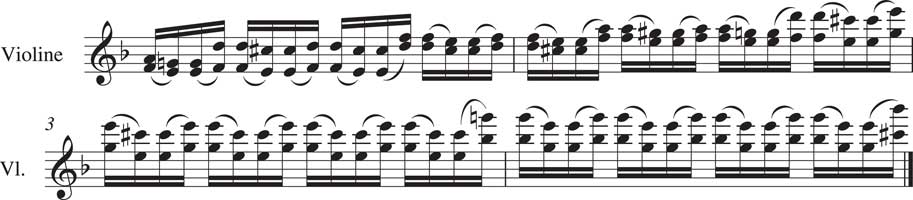
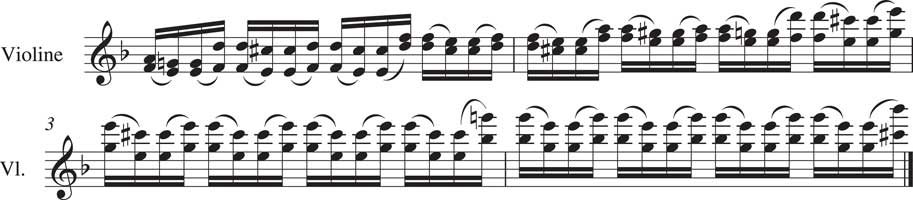
One striking revision in which Boris Schwarz believes Joachim had a hand occurs at the end of the first movement (bars 559–664).Footnote 9 The original shows a passage of thirds, in which each third appears three times in fast quaver triplets. The revision penciled into the score reveals a much more idiomatic bowing pattern. Instead of triple-repetitions, each third is repeated only twice and furnished with slurs that bind together notes 2–3, 4–1, and so forth. It is unclear, however, whether the penciled-in version was Joachim's or Brahms's idea (Brahms composed multiple versions for several passages). But a passage from Joachim's ‘Hungarian’ Concerto, composed in 1857 and dedicated to Brahms, may provide the answer (see ex. 1). The pattern used here and in the penciled-in version described above is markedly violinistic and occurs in the works of other virtuoso composers such as Henryk Wieniawski. Most likely this ingenious revision was Joachim's. This passage, in fact, represents just one of the links between Brahms's concerto and Joachim's ‘Hungarian’ Concerto. Joachim's finale is titled Finale alla Zingara, paying tribute to his Hungarian heritage. As has been noted, the gypsy-inspired rhythms of Brahms's finale also invoke the Hungarian trope, which can be interpreted as a gesture of friendship with Joachim.
Joachim, ‘Hungarian’ Concerto, bar 487 (10 before letter K)
Not surprisingly, Joachim performed the concerto's premiere under Brahms's baton in the Leipzig Gewandhaus, where Joachim had made his own debut in 1843. But the premiere was less successful than expected.Footnote 10 Although Joachim's performances of the concerto shaped its early performance history, other violinists, after some initial hesitation, promoted the work. In particular, Adolph Brodsky (Leipzig, Mannheim, Hamburg), Hugo Heermann (Paris, New York, and Australia) and the 20-year old Marie Soldat (Vienna) were pioneers in securing the composition's place in the canon of great nineteenth-century violin concertos.Footnote 11
Apart from the shared aspect of collaboration between a violinist and composer, Tchaikovsky's and Brahms's concertos could hardly be more dissimilar. Comments on the unusual nature of Brahms's violin concerto included ‘violinistically quite original’ (Joachim), ‘too symphonic’ (Sarasate)Footnote 12 and ‘[written] not for, but against the violin’ (Hellmesberger).Footnote 13 These reactions all point to Brahms's thickly orchestrated symphonic writing, and to his refusal to accommodate his concerto to popular norms of the day, as represented in many examples of the Franco-Belgian school (such as Vieuxtemps and Wieniawski, both contemporaries of Joachim). Clara Schumann summarized the symphonic nature of the concerto as follows: ‘You can well imagine that this is a concerto where the orchestra and soloist blend completely. The mood of the work is very similar to that of the second symphony [Op 73], also in D major.’Footnote 14
One way in which Brahms's concerto was decidedly unconventional for its time was its use of form. The trend in concerto writing in the later nineteenth century moved away from the classical model and its use of a ‘double exposition’. This trend was noticed as early as mid century by A.B. Marx, and it was vigorously defended in 1878 by Ernst Pauer, who observed that it had become standard to divert from this model, as had been done by Mendelssohn and Schumann.Footnote 15 Brahms's full-blown, non-reduced orchestral exposition brings up both themes (later restated by the soloist) and concludes on the tonic, which coincides with the first entrance of the solo. Adhering to traditional classical form, the cadenza is heard at the end of the recapitulation.
Tchaikovsky's formal approach is much less old-fashioned. By radically reducing the orchestral prelude (which does not close on the tonic), Tchaikovsky followed in Schumann's and Mendelssohn's footsteps, and was thus more in step with current fashion. Tchaikovsky's short, unassertive orchestral exposition thwarts every attempt to achieve thematic grandeur and, significantly, never revisits the themes presented, thus raising some doubt about the ‘authority’ of the orchestra and its relevance for the remainder of the concerto. Another progressive feature, inspired by Mendelssohn, is Tchaikovsky's cadenza, which appears at the end of the development section, thereby forming a link to the recapitulation.
These differences in formal application seem to parallel the two composers’ approaches to virtuosity and soloistic display. The technical difficulties in Brahms are hardly ostentatious. Instead of brilliant virtuoso passagework the soloist engages in chordal passages requiring playing three strings simultaneously (for example the secondary theme) and wide leaps across the fingerboard (the development). And instead of indulging in flying virtuoso bow-strokes Brahms relies heavily on detaché stokes executed on the string. Furthermore, like Beethoven in his violin concerto, Brahms shows great reliance on the most basic (but nevertheless highly effective) musical building blocks – scales and arpeggios, featured in his transitions. These technical difficulties point to the ‘composer's small acquaintance with violin technique, tacitly admitted both by Brahms and Joachim’.Footnote 16 Still, notwithstanding the occasional ‘unviolinistic’ writing, the technical difficulties are not to be underestimated.
In Tchaikovsky's concerto, on the other hand, brilliant runs pervade the score. The transitions are used for virtuoso display of the highest order. Here the soloist confronts the most perplexing use of fast springing bow strokes, sautillé, employed in chordal patterns over all four strings almost up to the snow line of the fingerboard (high on the E string, where the fingerboard ends). But these technical difficulties, although of a very different kind than Brahms's, were also viewed as ‘unviolinistic’, a consequence of Kotek's involvement in the creation of the work. The orchestra's role during these soloistic extravaganzas is explicitly secondary, consisting mainly of short imitation and comments. In view of the orchestral prelude, we should not be surprised by this passive role of the orchestra. Only occasionally does Tchaikovsky's orchestra come to the fore, for example in the tutti outburst at the end of the exposition, an uninhibited reaction to the otherwise restrained mode. But even here, the tutti trails off to ‘an uncertain 21 bars’ at the beginning of the development, and to a ‘theme-less wandering’ that entirely lacks musical momentum.Footnote 17
Let us return to the brave violinists of the two premieres, Brodsky and Joachim, whose approaches to sound production apparently differed considerably. Whereas Joachim, as Clive Brown convincingly argues, was a violinist with an explicitly pure style and remarkably selective use of vibrato, always ‘striving to hide the charms of virtuosity rather than accentuate them’,Footnote 18 Brodsky presumably used rather ‘exaggerated […] vibrato’, as judged by Elisabet von Herzogenberg, who was well acquainted with both Joachim's and Brodsky's playing.Footnote 19 Whether these contrasting manners of performance can guide us to a better understanding of Brahms's and Tchaikovsky's works remains open to debate. The fact is, however, that the last decade has seen important new literature on historical performance practice of Brahms but not of Tchaikovsky, whose concerto has been viewed as emblematic of the ‘Slavic Soul,’Footnote 20 interpreted by violinists throughout the twentieth century with a tendency toward voluptuous, passionately vibrated sound. However, recently Sir Roger Norrington has undertaken a quest for the historically informed Tchaikovsky by performing his Pathétique Symphony with an approach highlighting articulation and resisting the use of ‘glamorous vibrato’, resulting in an interpretation more ‘noble than bombastic’.Footnote 21 Given Joachim's and Brodsky's differing applications of vibrato, we might question whether Tchaikovsky's violin concerto should be added to the canon of historically informed repertoire. To do so would doubtless require a courageous violinist to perform it with an unconventional approach, something unlikely to be dared by any of today's top violinists.