Introduction
Do all patients with schizophrenia (SZ) need to be treated with antipsychotic medications continuously throughout their lives? Prolonged use of antipsychotic medications is the current standard of care in the field and is viewed as the cornerstone of treatment for SZ (Gilbert et al. Reference Gilbert, Harris, McAdams and Jeste1995; Bosveld-van Haandel et al. Reference Bosveld-van Haandel, Slooff and van den Bosch2001; Buchanan et al. Reference Buchanan, Kreyenbuhl, Kelly, Noel, Boggs, Fischer, Himelhoch, Fang, Peterson, Aquino and Keller2010). This involves billions of dollars in treatment expenditures. However, some research and formulations about patients with SZ have raised empirical and theoretical issues that question the importance of continuous multi-year antipsychotic medication for all SZ (Bleuler, Reference Bleuler1978; Fenton & McGlashan, Reference Fenton and McGlashan1987; Harrison et al. Reference Harrison, Hopper, Craig, Laska, Siegel, Wanderling, Dube, Ganev, Giel, an der Heiden, Holmberg, Janca, Lee, Leon, Malhotra, Marsella, Nakane, Sartorius, Shen, Skoda, Thara, Tsirkin, Varma, Walsh and Wiersma2001; American Diabetes Association, 2004; Harrow et al. Reference Harrow, Grossman, Jobe and Herbener2005, Reference Harrow and Jobe2007; Jobe & Harrow, Reference Jobe and Harrow2005; Lieberman et al. Reference Lieberman, Stroup, McEvoy, Swartz, Rosenheck, Perkins, Keefe, Davis, Davis, Lebowitz, Severe and Hsiao2005; Menezes et al. Reference Menezes, Arenovich and Zipursky2006; Samaha et al. Reference Samaha, Seeman, Stewart, Rajabi and Kapur2007; Webber & Marder, Reference Webber and Marder2008; Moncrieff, Reference Moncrieff2009; Moncrieff & Leo, Reference Moncrieff and Leo2010; Remington & Kapur, Reference Remington and Kapur2010; Ho et al. Reference Ho, Andreasen, Ziebell, Pierson and Magnotta2011).
In addition, our research, using 15-year longitudinal data from our Chicago Follow-up Study and multiple assessments at systematic intervals, has indicated that, after early antipsychotic medication treatment during the first few years of disorder, a number of SZ patients can function adequately over a prolonged period without antipsychotics (Harrow et al. Reference Harrow, Grossman, Jobe and Herbener2005, Reference Harrow and Jobe2007; Jobe & Harrow, Reference Jobe and Harrow2010). Research studies of other prominent investigators are in agreement (Bleuler, Reference Bleuler1978; Fenton & McGlashan, Reference Fenton and McGlashan1987).
Overall, based on numerous double-blind studies, there is strong evidence on the efficacy of first- and second-generation antipsychotic medications over the short term in the treatment of SZ (Gilbert et al. Reference Gilbert, Harris, McAdams and Jeste1995; Buchanan et al. Reference Buchanan, Kreyenbuhl, Kelly, Noel, Boggs, Fischer, Himelhoch, Fang, Peterson, Aquino and Keller2010) and there is debate about whether very early treatment improves long-term outcome (Owens et al. Reference Owens, Johnstone, Miller, Macmillan and Crow2010). Many comprehensive treatment summaries impacting on the long-term course of SZ consider multiple treatment alternatives but do not consider the possibility of no antipsychotic medications (Tandon et al. Reference Tandon, Belmaker and Gattaz2008; Kreyenbuhl et al. Reference Kreyenbuhl, Buchanan, Dickerson and Dixon2010).
The importance of research into the long-term efficacy of antipsychotics and the lack of longitudinal data on its effect on outcome and potential relapse were emphasized by the President's New Freedom Commission on Mental Health (2003), noting the dearth of information on the long-term use of medications for severe mental illness.
The current research report uses longitudinal data involving a prospective assessment at index hospitalization and six subsequent follow-ups over 20 years to study whether long-term antipsychotic medication use is necessary for all SZ. It provides data on whether subgroups of SZ can experience prolonged periods of recovery without antipsychotics, and whether select risk and protective factors alter the chances of SZ going off antipsychotic medications for prolonged periods (Harrow & Jobe, Reference Harrow and Jobe2007). Overall, the current 20-year prospectively designed longitudinal research provides data to help answer the following questions:
-
(1) Is there a subgroup of SZ who, years after the acute phase of hospitalization, function adequately for a prolonged period when not receiving antipsychotic medications?
-
(2) Do SZ patients not in treatment with antipsychotics for a prolonged period have a high rate of relapse?
-
(3) What patient characteristics, including select risk and protective factors associated with more favorable outcome in SZ, identify patients who may go off antipsychotic medications for a prolonged period.
Method
Patient sample
The current investigation was based on data from the Chicago Follow-up Study, a prospectively designed, longitudinal, multi-follow-up research program studying major symptoms and functioning, outcome and recovery in SZ and other psychotic disorders (Grinker & Harrow, Reference Grinker and Harrow1987; Harrow et al. Reference Harrow, Goldberg, Grossman and Meltzer1990, Reference Harrow, Grossman, Herbener and Davis2000, Reference Harrow, Grossman, Jobe and Herbener2005, Reference Harrow, Hansford and Astrachan-Fletcher2009; Carone et al. Reference Carone, Harrow and Westermeyer1991; Jobe & Harrow, Reference Jobe and Harrow2005, Reference Jobe and Harrow2010; Harrow & Jobe, Reference Harrow and Jobe2007, Reference Jobe and Harrow2010; Bonner-Jackson et al. Reference Bonner-Jackson, Harrow and Rosen2010). Beginning relatively early in their illness, 139 young patients were studied prospectively at the acute phase of hospitalization and then reassessed at six subsequent follow-ups over a 20-year period. The follow-ups occurred at 2, 4.5, 7.5, 10, 15 and 20 years post-index hospitalization.
The sample of 139 DSM-III diagnosed patients included 70 patients with SZ syndromes (61 SZ patients and nine schizo-affective patients) and a control sample of 69 patients with mood disorders who were psychotic at index hospitalization. All SZ met the 6 months' duration of illness criterion (none were schizophreniform patients). From among the 70 SZ, 59 were assessed at the 20-year follow-ups. The other 11 SZ were assessed at each of the first five follow-ups, including the 15-year follow-ups. The 69 non-SZ patients who were psychotic at index included 38 psychotic bipolar patients and 31 psychotic unipolar depressives.
After Institutional Review Board approval, signed informed consent was obtained from all subjects. The research diagnoses were based on structured research interviews conducted during index hospitalization (Grinker & Harrow, Reference Grinker and Harrow1987), supplemented by intake interviews at hospital admission. Satisfactory inter-rater reliability was established for diagnosis (e.g. a κ value of 0.88 for SZ).
At index hospitalization, the patients were consecutive admissions at two Chicago hospitals (a private hospital and a state hospital) within the limitation of giving preference to younger patients (aged between 17 and 32 years at index) with no or fewer previous hospitalizations. Forty-one percent of the sample were first-admission patients at index, and another 25% had only one previous hospitalization. The mean age of the patients was 22.9 years at index hospitalization. The diagnostic groups did not differ in age. The mean level of education at index was 13.0 years. Fifty-two percent of the sample was male, with more male SZ patients and more female mood-disordered psychotic patients.
Follow-up assessments
Trained interviewers who were not informed of diagnoses or the results of previous assessments conducted the follow-ups. We used structured interviews [the Schedule for Affective Disorders and Schizophrenia (SADS) and a functioning interview (Endicott & Spitzer, Reference Endicott and Spitzer1978; Grinker & Harrow, Reference Grinker and Harrow1987; Harrow et al. Reference Harrow, Grossman, Jobe and Herbener2005)] to evaluate psychosis (the presence of delusions and/or hallucinations during the follow-up year) and other major symptoms (negative symptoms, anxiety and affective symptoms). We also used these instruments to assess global outcome and self-support, social functioning, work functioning, rehospitalization and treatment (Grinker & Harrow, Reference Grinker and Harrow1987; Strauss & Carpenter, Reference Strauss and Carpenter1972). The measure of global outcome that includes symptoms and life functioning is the eight-point Levenstein–Klein–Pollack (LKP) scale, used in many previous reports (Levenstein et al. Reference Levenstein, Klein and Pollack1966; Grinker & Harrow, Reference Grinker and Harrow1987; Harrow et al. Reference Harrow, Goldberg, Grossman and Meltzer1990, Reference Harrow, Grossman, Herbener and Davis2000, Reference Harrow, Grossman, Jobe and Herbener2005; Harrow & Jobe, Reference Harrow and Jobe2007) We also administered measures to assess potential risk and protective factors. These included cognitive tests to evaluate accessing of stored information (Wechsler, Reference Wechsler1955) and abstract ability (Marengo et al. Reference Marengo, Harrow and Rogers1980), although cognitive assessments, including executive functioning, involve multiple skills, often with complex relationships to major symptoms (Reed et al. Reference Reed, Harrow, Herbener and Martin2002; Dibben et al. Reference Dibben, Rice, Laws and McKenna2009). We used questionnaires to assess attitudinal and personality variables, including anxiety at each of the six assessments (Katz & Lyerly, Reference Katz and Lyerly1963). We also used two major scales involving risk and protective factors that have theoretical relevance and that our team and other investigators have found relate to outcome in SZ. These are scales of prognostic variables reported by Vaillant (Reference Vaillant1978) and Stephens et al. (Reference Stephens, Pascal and McHugh1997) and a scale by Zigler and co-workers assessing pre-morbid developmental achievement (Zigler & Levine, Reference Zigler and Levine1983; Zigler & Glick, Reference Zigler and Glick2001).
Information on treatment and outcome at the 15- and/or 20-year follow-ups was available for 73% of the original sample assessed. The 70 patients with SZ did not differ significantly on major demographic variables from a subsample of SZ who were assessed at index hospitalization and at the first follow-ups, but not assessed at the 15- or 20-year follow-ups.
Operational definition of recovery
The criteria for global ‘recovery’ during a follow-up year, defined operationally, required no positive or negative symptoms, and no rehospitalizations during the follow-up year. Also required were partially adequate (or better) work and social functioning (scores of ⩾2 on the Strauss–Carpenter scales; Strauss & Carpenter, Reference Strauss and Carpenter1972). Recovery at any follow-up does not automatically prejudge whether recovery will continue during future years, which may be a function of (a) the natural course of SZ, (b) individual characteristics of the patient assessed, and (c) treatment.
Medications
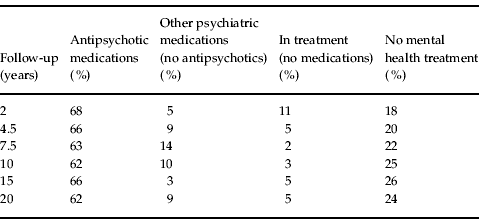
Table 1 reports data on the percentage of SZ on medications at each follow-up over 20 years. As frequently found in the natural course of a large series of SZ, there was no single, uniform treatment plan that applied to all patients. Rather, at the 20-year follow-ups, 62% of the SZ were on antipsychotic medications with or without other medications; 79% of the SZ on antipsychotics at the 20-year follow-ups had been on an antipsychotic at the 2-year follow-ups. At the 20-year follow-ups, 28% of the patients with other types of psychotic disorders were on antipsychotics with or without other medications, and an additional 37% were on other psychiatric medications but not on antipsychotics.
Patients with schizophrenia (SZ) on antipsychotic medications at each assessment over 20 years

SZ not on antipsychotic medications for prolonged periods
Although the medication course for many SZ varied over the 20 years, 24 of the 70 SZ were prescribed antipsychotics at every one of the follow-up assessments over 20 years, and 15 SZ were not on antipsychotic medications at any one of the six assessments. These two groups of SZ, (a) one group prescribed antipsychotic medications throughout the 20-year periods and (b) another group not on antipsychotics throughout the past 18 years of the 20-year period, represent important subgroups. They allow study of whether a group of SZ who are medication free for many successive years can show prolonged periods of recovery. They also provide an opportunity to determine outcome for SZ prescribed antipsychotics for many successive years. Longitudinal data from both groups have previously been unavailable to the field.
Results
Frequency of antipsychotic treatment and group differences in psychosis and recovery
By the 2-year follow-ups almost 35% of the SZ were no longer taking antipsychotic medications. Although the specific SZ not an antipsychotics shifted somewhat from follow-up to follow-up, this figure of about 35% remained relatively constant for the 20 years of follow-ups.
At the 2-year assessment there were no significant differences in severity of psychosis between SZ on antipsychotic medications and SZ not on any medications. However, starting at the 4.5-year follow-ups and continuing over the next 15 years, the SZ who were not on antipsychotic medications were significantly less psychotic than those on antipsychotics (p<0.05). The χ2 values with 1 df varied from 4.78 to 13.59, with three of the five χ2 >10.0 (p<0.002).
In addition (see Fig. 1), starting at the 4.5-year follow-up and continuing at each assessment over the next 15 years, a significantly larger percentage of SZ not on medications experienced a period of recovery (p<0.01), which also requires adequate work and social functioning. The χ2 values with 1 df varied from 9.06 to 19.75, with all p<0.01.
Relationship between recovery and use of antipsychotics in schizophrenia (SZ). * p<0.01, ** p<0.001.

Periods of recovery: a cumulative analysis of recovery in SZ not on antipsychotic medications over 20 years
Of those SZ on antipsychotic medications continuously over all follow-ups (24 SZ) over the 15–20-year period, only four (17%) ever entered into a period meeting the operational definition of recovery during any of the six follow-ups. The two factors most prominent in these SZ on antipsychotics who did not meet the operational definition of recovery were (a) the presence of psychosis, and (b) not working. By contrast, of the 15 SZ who had gone off antipsychotic medications prior to the 2-year follow-up assessments and subsequently were not on antipsychotics at any of the six follow-ups over the 20-year period, the great majority (13/15 or 87%) experienced two or more periods of recovery.
Relationship between antipsychotic use and recovery for patients who had mood disorders with psychosis at index hospitalization
When both (a) global functioning and (b) psychosis scores for the psychotic mood-disordered patients were compared to the SZ during the 20 years of follow-ups, there were strong significant outcome differences in favor of the mood-disordered patients. For comparison of SZ with originally psychotic mood-disordered patients on global outcome, a 2×6 mixed design, repeated-measures ANOVA (two diagnostic groups and six follow-up assessments) showed large significant differences (F=11.12, df=1,65, p=0.001). Similarly, a 2×6 repeated-measures ANOVA for psychosis, comparing SZ and mood-disordered patients, showed large significant differences (F=11.22, df=1,50, p=0.002). The assessment of psychotic patients who had experienced mood disorders focused on a comparison of patients on antipsychotic medications versus those not on any psychiatric medications. At every follow-up assessment over the 20 years, including the 2-year follow-ups, significantly more of the unmedicated patients than those on antipsychotics experienced a period of recovery. The χ2 values, with 1 df, varied from 3.71 to 20.22 (p<0.05).
Risk and protective factors: pre-morbid and early prognostic characteristics that separate SZ who stay on antipsychotics versus those not on medications for prolonged periods
Analysis was conducted of potential risk and protective factors that separate the SZ taking antipsychotic medications from those who had removed themselves or been removed from antipsychotic treatment. The data on SZ who have good and poor prognostic features, and who have good and poor pre-morbid developmental achievements, point to different characteristics of the SZ who are more likely to remain on antipsychotic medications versus those who do not remain on antipsychotic medications. The SZ who go off antipsychotic medications for a prolonged period are a self-selected group. These two prognostic type indices are based on pre-morbid features and on prognostic characteristics present at index hospitalization or before, and both were collected long before any of the 20 years of follow-ups. Starting at the 2-year follow-ups, more of the SZ with poor prognostic features and poor developmental achievements were on antipsychotics, with these differences between SZ with good and poor features being significant (p<0.02) in seven of the 12 comparisons over the 20-year period (χ2 varied from 5.77 to 10.15), and additionally showing a trend (p<0.09 and p<0.08) in another two of the 12 comparisons.
Previously reported research by our group and other research on early impaired social functioning and psychosis provide evidence that a series of early prognostic characteristics are important predictors of potential periods of recovery and of less vulnerability to chronic psychosis (Jones et al. Reference Jones, Murray, Rodgers and Marmot1994; Harrow & Jobe, Reference Harrow and Jobe2007, Reference Harrow and Jobe2010; White et al. Reference White, Stirling, Hopkins, Morris, Montague, Tantam and Lewis2009; Cornblatt et al. Reference Cornblatt, Carrión, Addington, Seidman, Walker, Cannon, Cadenhead, McGlashan, Perkins and Tsuang2011).
Differences in vulnerability to anxiety between SZ on antipsychotic medications and unmedicated SZ
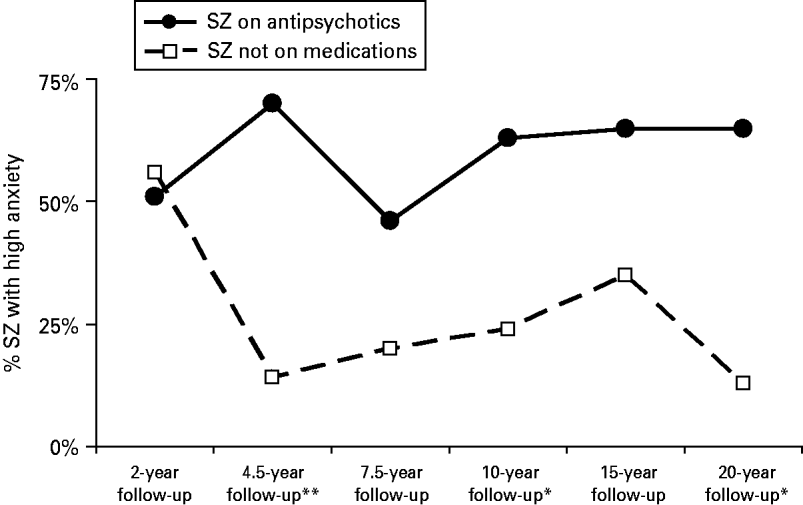
Data on anxiety are reported in Fig. 2. After the 2-year follow-ups, starting at the 4.5-year follow-ups, SZ who are high on anxiety or get anxious more easily were more likely to remain on antipsychotic medications. Thus, at the 4.5-year follow-ups (χ2=13.04, 1 df, p<0.001), the 10-year follow-ups (χ2=7.08, 1 df, p<0.001) and the 20-year follow-ups (χ2=11.88, 1 df, p<0.001), SZ on antipsychotic medications were significantly more anxious than those on no medications. Akathisia may also be involved. Previous research has provided evidence that less anxious SZ have better longitudinal courses (Harrow et al. Reference Harrow, Jobe, Astrachan-Fletcher, Freeman, Garety and Bentall2008; Jobe & Harrow, Reference Jobe and Harrow2010).
Relationship between vulnerability to anxiety and use of antipsychotic medications in schizophrenia (SZ). * p<0.01, ** p<0.001.

Neurocognitive differences: SZ on antipsychotics versus SZ on no medications
Potential differences in neurocognitive skills between SZ who stay on antipsychotics and those who remove themselves or are removed from antipsychotic medications were explored, using two cognitive tests. The first was a test of skills in accessing general information: the Wechsler Adult Intelligence Scale (WAIS), Information Test (Wechsler, Reference Wechsler1955). The SZ not on antipsychotic medications showed significantly better cognitive skill in accessing stored knowledge than the SZ on antipsychotics at three of the six follow-ups. The t values ranged from 2.04 to 2.62 (p<0.05) with non-significant trends (p=0.09 to p=0.13) towards better cognitive functioning for SZ not on antipsychotics on the other three follow-ups.
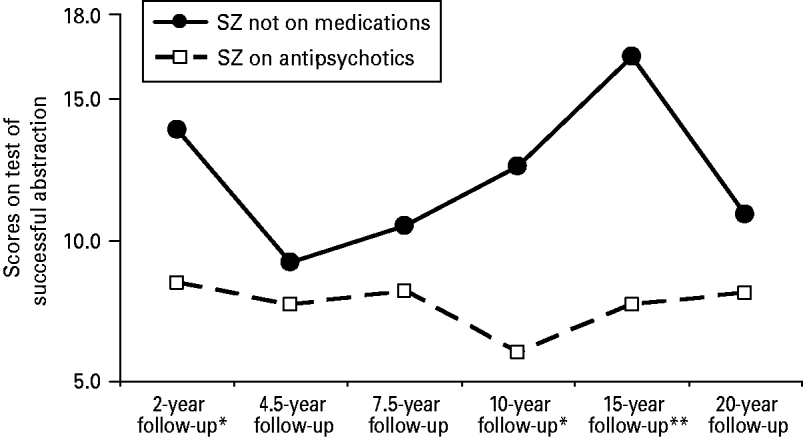
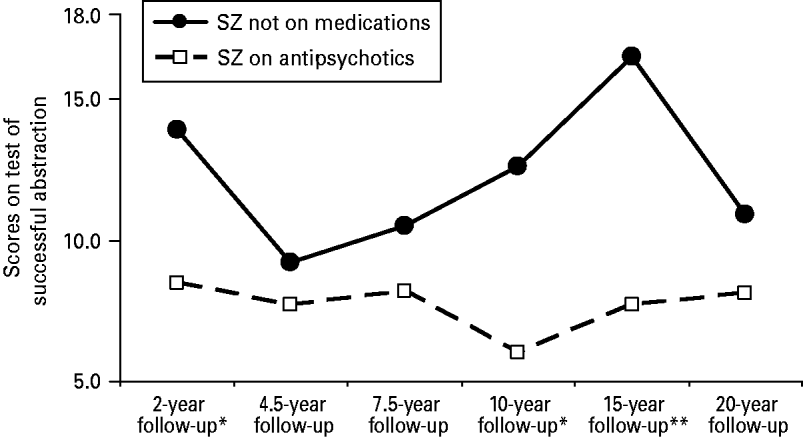
Data on successful abstraction are reported in Fig. 3. Using the Proverbs Test (Gorham, Reference Gorham1956) to assess successful abstraction ability at each follow-up assessment, the SZ not on antipsychotic medications also showed significantly better abstract skills at three of the six follow-ups. The t values ranged from 2.35 to 3.47 (p<0.03). Previous research of ours and others has provided evidence that SZ with poorer neurocognitive performance have poorer long-term outcomes (Bonner-Jackson et al. Reference Bonner-Jackson, Harrow and Rosen2010). These data suggest that assessment of other types of cognitive skills would be profitable.
Cognition scores on test of successful abstraction for schizophrenia (SZ). * p<0.05, ** p<0.01.
Potential relapse of SZ patients not on antipsychotic medications
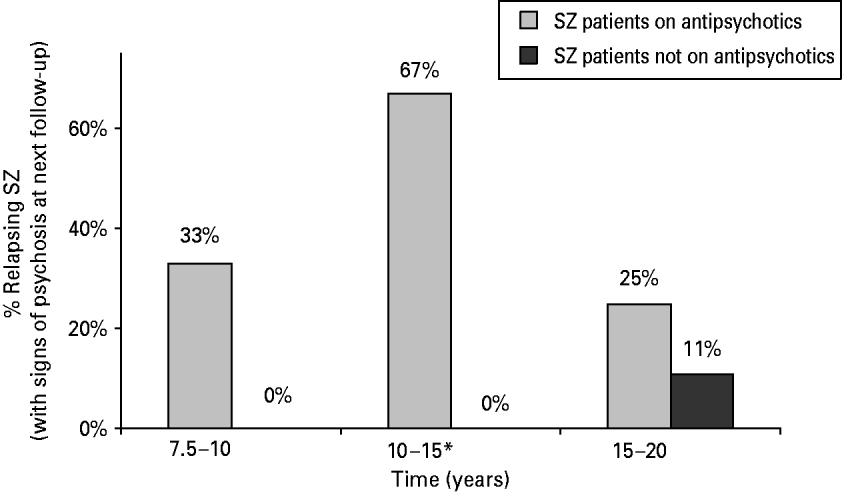
Potential relapse of SZ on or off antipsychotic medications has always been a major issue. A discriminating assessment of potential relapse involves analyses at a succeeding follow-up of the group of SZ who were on antipsychotic medications and were not psychotic at the previous follow-up, and comparing them with the group of SZ who were not on antipsychotics who were not psychotic at the previous follow-up. This important analysis involves a comparison of the relapse rate of those two groups of SZ, with both groups composed of SZ who were not psychotic at the previous follow-up.
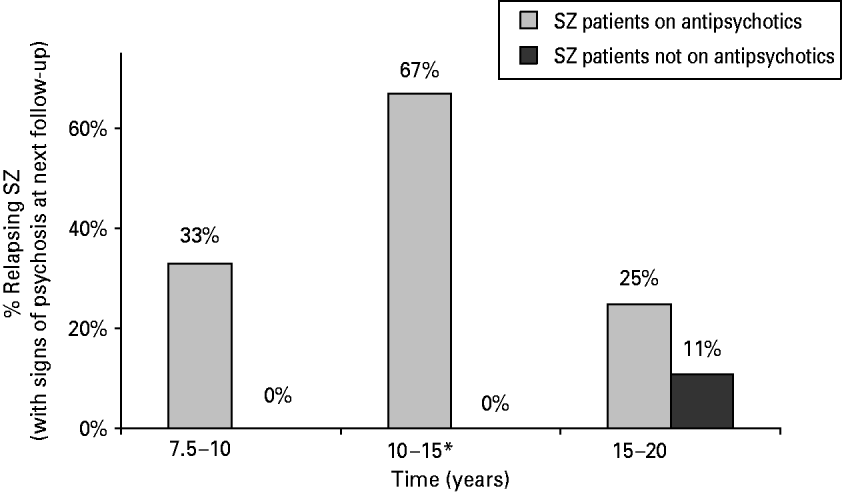
Figure 4 reports data on relapse for the two groups. After the 2-year follow-ups, the unmedicated SZ who were not psychotic at the previous follow-up had low rates of relapse at the next follow-ups. At each of the five comparison points, the rate of psychotic relapse for SZ who were not psychotic at a previous follow-up was lower for SZ not on medications than for SZ who were on antipsychotic medications, with differences significant at the 15-year follow-ups (χ2=8.18, 1 df, p<0.01).
How protective are antipsychotics against relapse? * p<0.01.
Discussion
The central issue posed is whether all SZ need to be treated with antipsychotic medications continuously throughout their lives, an issue that also involves costs of billions of dollars of expenditures, and multiple potential side-effects. The efficacy and effectiveness of antipsychotic medications in reducing psychosis during the acute phase, especially flagrant psychosis, has clearly been established. Some of this reduction of flagrant psychosis to mild levels of psychosis for most, and no psychosis for some, may be related to its sedating effect as a ‘major tranquilizer’. Its long-term use as a maintenance medication in SZ is the current standard of care. However, despite many short-term (0–2 years) double-blind studies, long-term evaluations based on multi-year assessments at systematic intervals that include SZ who have left treatment are rare, with systematic longitudinal data on this issue unavailable to the field.
The current data, based on 20 years of assessments, indicate that not all SZ need antipsychotic medications continuously. Of the 15 SZ who had gone off antipsychotic medications prior to the 2-year follow-up assessments and subsequently were not on antipsychotics for the next 18 years, the great majority (87%) experienced at least two periods of recovery. Most of these SZ were not permanently ‘cured’ but the post-hospital course and outcome of this subgroup of 15 SZ was significantly better (p<0.001) than the SZ on antipsychotics throughout the 20 years. Other aspects of our data suggest that internal factors associated with their greater resiliency was one of the prominent factors linked to their better course and outcome.
By contrast, the great majority of SZ on antipsychotics continuously did not show any sustained periods of recovery. Several major investigators have noted that antipsychotic medications are, at best, only partially effective treatments (Carpenter et al. Reference Carpenter, Appelbaum and Levine2003) with only a low rate of complete recovery in treated SZ (Ventura et al. Reference Ventura, Subotnik, Guzik, Hellemann, Gitlin, Wood and Nuechterlein2011).
These results on the better functioning of unmedicated SZ were influenced by some patients who had started to recover from their symptoms leaving treatment because of their improved status, and other SZ improving after leaving treatment.
Are there many SZ who are not in antipsychotic treatment?
The better functioning of SZ not on antipsychotics, on a longitudinal basis after the first 4 years, raises the issue of whether the group of SZ not in antipsychotic treatment represent (a) a moderate-sized (or larger) sample of SZ or (b) only a few SZ. Our 20-year data indicate that the subsample of SZ not on antipsychotics represent a moderate-sized group (30–40%) of SZ.
The issue of relapse
Another issue concerns the potential relapse of SZ who, at an earlier follow-up, were psychosis free. When SZ are not on antipsychotic medications for a prolonged period, and at the time are not psychotic, are they likely to be psychotic 5 years later? The data indicate that many of these unmedicated SZ patients have good internal resources and are those who are less vulnerable to psychosis. The data in Fig. 4 indicate that these SZ are more likely to manifest a very low rate of relapse when off antipsychotics for a prolonged period.
For most SZ not on medications or not in treatment this was their choice, at times against professional advice. For professionals engaged in treatment, removing an SZ from medication that he/she had been treated with over a prolonged period often involves a difficult decision because of concerns (with possible legal implications) that an SZ doing well may experience a psychotic relapse. However, continuous exposure to antipsychotics poses risks, and the current data indicate that many SZ continuing on antipsychotics also relapse (see Fig. 4), posing a delicate risk–benefit assessment for the clinician.
The poorer functioning of the patients with mood disorders who were treated with antipsychotic medications
Not surprisingly, psychotic mood-disordered patients had better global outcomes and less psychosis than the SZ (p<0.01). However, the 20-year data on poorer functioning for the patients with mood disorders who were on antipsychotics are consistent with the data on the poorer long-term functioning of the SZ who were on antipsychotic medications. These data on mood-disordered patients are also in accord with earlier reports of ours and of other major investigators, years ago, that began to question extremely optimistic views on lithium as a miracle cure for 70–80% of bipolar patients (Harrow et al. Reference Harrow, Goldberg, Grossman and Meltzer1990; Goldberg & Harrow, Reference Goldberg and Harrow1999).
Periods of recovery
Recovery is often viewed as a static variable, indicating multiple years of good outcome. However, we should adopt a more realistic outlook toward recovery in severe mental disorders. Rather than viewing recovery as a permanent state, we should view it in terms of periods of recovery with its length partly related to the extent of the underlying biological vulnerability to psychosis of the SZ. For some of these patients, recovery may last for a relatively short period, such as 1–3 years, and for some patients, periods of recovery may last over 10 years, or even for a lifetime.
The prediction of periods of recovery in SZ
Fitting with the multi-dimensional nature of SZ, recovery in SZ is a multi-dimensional process, with many factors involved; there are also many different variables that show some potential to predict aspects of outcome in this disorder. This includes a series of prognostic variables in addition to risk factors (e.g. vulnerability to anxiety) and protective factors such as favorable pre-morbid developmental achievements, better neurocognitive function and even some attitudinal variables (Harrow et al. Reference Harrow, Grossman, Jobe and Herbener2005, Reference Harrow, Jobe, Astrachan-Fletcher, Freeman, Garety and Bentall2008, Reference Harrow, Hansford and Astrachan-Fletcher2009; Harrow & Jobe, Reference Harrow and Jobe2007; Jobe & Harrow, Reference Jobe and Harrow2010).
Towards a more representative view of outcome in modern-day SZ
Treatment is very important, especially for those patients with SZ who are vulnerable to frequent acute disorder and chronic positive symptoms. However, many other factors are involved in outcome and recovery. The SZ underlying diathesis, which includes a vulnerability to psychosis and other psychopathology, is a major factor in their disorder and in potential chronicity for many SZ. This underlying vulnerability accounts for much of the chronic or partially chronic picture found in 50–65% of SZ (Harrow et al. Reference Harrow, Grossman, Jobe and Herbener2005; Harrow & Jobe, Reference Harrow and Jobe2010). We might view SZ as involving a biological vulnerability to sustained psychosis, to other major symptoms and to functional disability, with various biological and non-biological risk and protective factors (e.g. vulnerability to anxiety, neurocognitive impairment, hardiness-resiliency, personality-attitudinal factors, and numerous other factors) influencing whether the underlying vulnerability will manifest itself and result in sustained episodes of SZ for some (but not all) of these biologically vulnerable people. Some of these risk and protective factors may be endophenotypes (Gottesman & Shields, Reference Gottesman and Shields1982; Gur et al. Reference Gur, Calkins, Gur, Horan, Nuechterlein, Seidman and Stone2007; Kendler & Neale, Reference Kendler and Neale2010). As one example, many types of neurocognitive impairment in SZ are familial and show a genetic influence, and our own data indicate that neurocognitive domains are longitudinally stable (trait-like) across broad domains in SZ (Burdick et al. Reference Burdick, Harrow and Goldberg2006), thus meeting two of the characteristics for endophenotypes (heritability and stability). Our longitudinal data suggest that SZ internal resources are as important as their treatment.
It is important to note that lack of adherence with medication schedules can interfere with favorable outcome for some medicated patients. However, lack of adherence does not account at all for the relatively favorable outcome of a number of untreated SZ.
As in many other areas of medicine, we in the field have considerable contact with chronic or partially chronic patients in aftercare treatment. We do not see most of the SZ not in treatment. Much of our impressions about outcome in SZ are based on chronic patients who do come for treatment and who we see frequently. The clinic SZ patients do not give us a complete picture of outcome for all SZ. These relapsing patients are the ones from whom opinions are formed about the necessity for continuous antipsychotic medications throughout all SZ lifetimes. Cohen & Cohen (Reference Cohen and Cohen1984) have written about the bias we can easily develop from our frequent contact with these clinic patients.
Major issues concerning long-term treatment with antipsychotic medications
Two major issues concerning long-term treatment with antipsychotic medications are: (1) do all SZ patients need to be on antipsychotics throughout their lives, and (2) is very long-term treatment with antipsychotic medications undesirable? Regarding the first question, the current results provide strong evidence that not all SZ need to be on antipsychotic medications for all of their lives. The data point to risk and protective factors. If protective factors are present and the SZ has already shown some periods of recovery, and wants to try a period without antipsychotics, then he/she is a good candidate to try going off antipsychotics, although, as with many other medical procedures, there is no certainty of the results.
The data suggest that the main factor leading to the more favorable outcome of SZ not on antipsychotics for a prolonged period is the leaving of treatment by SZ with good prognosis and favorable outcome who are less vulnerable to psychosis.
The other major issue is whether very long-term use of antipsychotic medications produces undesirable effects for some SZ. The current 20-year longitudinal data do not provide direct evidence on this second question. Some have proposed that, over a prolonged period of antipsychotic treatment, supersensitivity of dopamine receptors may occur as a compensation of the brain for many years of reduced dopamine resulting from dopamine blockade (Chouinard & Jones, Reference Chouinard and Jones1980; Samaha et al. Reference Samaha, Seeman, Stewart, Rajabi and Kapur2007; Remington & Kapur, Reference Remington and Kapur2010). The current data do not pertain directly to the dopamine supersensitivity hypothesis of continuous antipsychotic use, or to potential decreases in brain volume associated with many years of antipsychotic medication treatment (Moncrieff & Le, Reference Moncrieff and Leo2010; Ho et al. Reference Ho, Andreasen, Ziebell, Pierson and Magnotta2011).
Have other longitudinal studies found similar results?
Is the current subsample of untreated SZ who showed favorable outcomes unusual or unique? Several other major longitudinal studies, both in the USA and elsewhere, have found similar results on subsamples of unmedicated and untreated SZ, many of whom are functioning better then expected. Most of these studies did not involve evaluations of multiple risk and protective factors and multiple periods of assessments, as in the present research. However, they studied longitudinal data indicating that some SZ not in treatment show more favorable outcomes. Thus, longitudinal studies that clearly note and both discuss and comment on the subsamples of unmedicated and untreated SZ functioning relatively well include the Chestnut Lodge Study (Fenton & McGlashan, Reference Fenton and McGlashan1987), a longitudinal study by Bleuler (Reference Bleuler1978), the Vermont studies of Harding et al. (Reference Harding, Brooks, Ashikiga, Strauss and Breier1987) and the shorter-term studies of Bola & Mosher (Reference Bola and Mosher2002) and the Finnish Need-Adapted Program (Lehtinen et al. Reference Lehtinen, Aaltonen, Koffert, Räkköläinen and Syvälahti2000). Other important longitudinal studies that found that their untreated SZ were functioning significantly better than SZ in treatment, years later, include the Alberta hospitals studies (Bland et al. Reference Bland, Parker and Orn1978) and the important World Health Organization studies (Harrison et al. Reference Harrison, Hopper, Craig, Laska, Siegel, Wanderling, Dube, Ganev, Giel, an der Heiden, Holmberg, Janca, Lee, Leon, Malhotra, Marsella, Nakane, Sartorius, Shen, Skoda, Thara, Tsirkin, Varma, Walsh and Wiersma2001).
Acknowledgements
This work was supported, in part, by United States Public Health Service (USPHS) grants MH-26341 and MH-068688 from the National Institute of Mental Health, USA (M. Harrow).
Declaration of Interest
None.