1 Visual reasoning with literal depictions
This article has two aims. The first is to broaden the scope of discussions of visual reasoning by arguing that visual reasoning operates on a larger class of images than hitherto acknowledged. Whereas discussions of visual reasoning have so far focused mostly on images taken to be literal depictions of the objects of the reasoning, I will seek to extend the domain to cover images that constitute—for want of a better word at this stage—metaphorical depictions of objects, or visual metaphors. I will proceed partly by bringing into contact bodies of literature that are usually kept apart. The second aim, to which I shall turn in Section 4, is to argue that this account applies also to mathematical law statements in present-day sciences such as physics. I will argue both that law statements partly constitute metaphorical depictions of their objects and that physicists achieve understanding of them mainly by visual inspection and visual reasoning.
Research into visual reasoning by cognitive scientists, philosophers, and others has proceeded along various lines. The ground has been prepared by work seeking to revalue visual thinking by comparison with propositional thinking (Arnheim, Reference Arnheim1969), analyses of the roles of illustrations in science (Mazzolini, Reference Mazzolini1993), and discussions of the similarities and intersections of science and visual art (Baigrie, Reference Baigrie1996; Gooding, Reference Gooding2004). Further research has focused on the use of images in concrete media, such as diagrams on paper. Topics of this research have included the epistemology of diagrams in mathematical arguments (Giaquinto, Reference Giaquinto2007; Brown, Reference Brown2008) and graphical modelling techniques in physics, such as Feynman diagrams (Kaiser, Reference Kaiser2005; Meynell, Reference Meynell2008). A parallel line of research has studied the apprehension and manipulation of images conceived in the mind. Research in this vein has studied, among other phenomena, the mental rotation of representations to ascertain whether a given object is congruent to another (Shepard & Metzler, Reference Shepard and Metzler1971; Shepard & Cooper, Reference Shepard and Cooper1982), the mental scanning of representations to compare spatially separated properties of objects (Kosslyn, Reference Kosslyn1980), visualizations of the dynamics of physical systems, such as projectile motion (Gentner & Stevens, Reference Gentner and Stevens1983), the manipulation of mental images in thought experiments (Gendler, Reference Gendler2004), and visual thinking in the design of technical artefacts (Ferguson, Reference Ferguson1992).
These otherwise diverse lines of research share a notable feature: almost without exception, they discuss images taken to be literal depictions of their objects. This assumption holds on two levels: researchers portray the cognitive agents whose visual reasoning they model as conceiving images to be literal depictions of objects, but they also tacitly endorse the conception of those images as literal depictions, building the property of literalness into their accounts of visual reasoning.
‘Literalness’ is notoriously hard to define. If one accepts a resemblance theory of representation, one is inclined to think that a literal representation shows the highest possible degree of resemblance to its object: this degree is obtained when the representation is isomorphic to its object, that is, when there is a one-to-one correspondence between elements of the object and elements of the representation. However, this proposal fails to take sufficiently into account the fact that even what we call a literal depiction of an object exhibits a degree of simplification, abstraction, and idealization: indeed, insofar as a depiction differs from its object in any respect, it may be regarded as simplifying, abstracting from, and idealizing it. An improved proposal, therefore, is to say that a depiction is literal if it can be smoothly and cumulatively transformed into another depiction that has any desired degree of isomorphism to its object. A map is a literal depiction of a landscape in this sense: whereas any usable map incorporates substantial simplification, abstraction, and idealization, we can smoothly and cumulatively augment a map by increasing the scale and inserting detail to achieve as high a degree of isomorphism to the landscape as we wish.
The images studied up to now in research into visual reasoning share this property of literalness. Take as an example the mental images used in classic thought experiments in physics, such as Galileo's tower, Newton's bucket, Maxwell's demon, Einstein's lift, Heisenberg's gamma-ray microscope, and Schrödinger's cat (Brown, Reference Brown2011): each of these images is presented as a literal depiction of a physical effect. The effect may be encountered in the actual world (free fall) or be deemed impossible (a demon sorting molecules by velocity), and the image may depict familiar articles (a bucket) or imaginary machinery (a lift accelerating upwards in zero gravity). Nonetheless, the image in each case is intended to model a physical effect literally, thereby supporting the inference that some relation holds or does not hold in the actual world. Thought experiments of this kind owe their evidential value to the literalness of the images that they employ.
Some other classes of depiction discussed in research into visual reasoning count as literal on the grounds that, rather than reproducing pre-existing objects, they call objects into being. A diagram used in a visual proof of Pythagoras's theorem, for example, creates a particular geometrical construction—or, for some Platonists, picks out one element from the plenitude of all existing mathematical entities—and thus is necessarily isomorphic to the object that it is intended to depict. Similarly, when an engineer conceives a mental image of an artefact that he or she is designing, that image is isomorphic to the intended object by virtue not of faithfully reproducing it, but of being a mental blueprint of it.
Even writers who differ on other fundamental issues pertaining to visual images seem to agree not to widen the scope of the discussion beyond images that constitute literal depictions. For example, both sides in the so-called analog–propositional debate about mental imagery accept this restriction. This debate turns on the question whether mental representations that we experience as imagery have intrinsically spatial properties, like pictures, or lack such properties, and thus resemble more closely linguistic descriptions of visual scenes (Kosslyn et al., Reference Kosslyn, Pinker, Smith and Shwartz1979; Block, Reference Block1981). Broadening the scope to encompass metaphorical depictions would seem likely to alter materially the terms of this debate.
While research into visual reasoning has placed the category of the literal at the centre of discussion, other academic disciplines concerned with representation attribute less importance to it. Researchers in linguistics, literary studies, rhetoric, and allied disciplines call into question the assumption that there is a sharp dividing line between literal and non-literal depictions. Many researchers in these disciplines take the concept of metaphor as the crucial organizing principle: they devote attention to the seeming ubiquity of metaphor, the hypothesis that all meaning is metaphorical, and the roles of metaphor in cognition (Black, Reference Black1962; Shibles, Reference Shibles1971; Lakoff & Johnson, Reference Lakoff and Johnson1980; Ortony, Reference Ortony1993). Philosophers and historians of science too have increasingly acknowledged the use of metaphor in scientific discourse and practice, especially in the formation of new concepts and the construction of models and explanations (Hesse, Reference Hesse1966; Bailer-Jones, Reference Bailer-Jones2002), and particularly in sciences such as psychology (Leary, Reference Leary1990). Feminist scholars in science studies have shown the role of scientific metaphors in maintaining gender hierarchies (Keller, Reference Keller1995). These lines of research into metaphor are partial in another way, however: the metaphors that they study are conceptual rather than visual. The metaphorical depiction of the brain as a computer, for example, which became popular in the 1970s, was intended to suggest conceptualizations of the brain as an information-processing device, but did not consist primarily of visual depictions or involve visual reasoning.
Yet another group of academic disciplines addresses visual metaphors in art (Carroll, Reference Carroll1994). The branch of art history and criticism known as iconology has flourished since the 1930s (Panofsky, Reference Panofsky1939; Gombrich, Reference Gombrich1965, Reference Gombrich1972). Iconology studies the meanings of allegorical symbols in works of visual art, such as the personifications of moral virtues and human attributes found in ancient, Renaissance, and Baroque painting and sculpture. It also studies emblems as encapsulations of wisdom (Manning, Reference Manning2004). Symbols of these kinds constitute visual metaphors of their referents.
This brief and selective survey reveals the existence of at least three distinct research programmes: an intensive investigation of visual reasoning restricted to images taken to be literal depictions of objects, an exploration of the role of conceptual metaphors both in literary discourses and in scientific reasoning, and a rich study of the meanings of visual metaphors in art. So far these research programmes have not overlapped to consider reasoning that operates on visual metaphors. It seems natural now to attempt to develop this topic. By reasoning that operates on visual metaphors, I mean reasoning that consists in the inspection, exploration, analysis, interpretation, and manipulation of images that stand to their subject matter in a metaphorical, rather than a literal, relation. These images may be recorded in concrete media, or they may be mental constructs.
2 Visual reasoning with expressive symbols
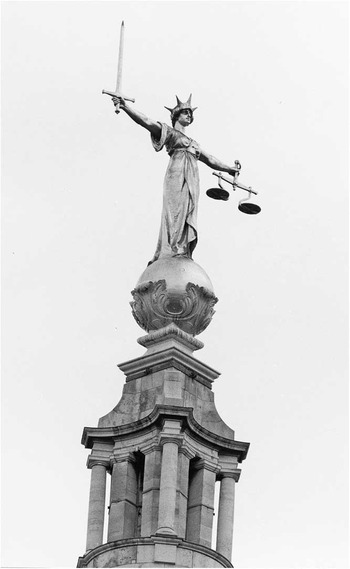
Imagine trying to convey information of a complex object, such as a particular system of criminal justice. One way of doing this is by means of a discursive text. This might take the form of a treatise or textbook, such as Criminal Justice, by Malcolm Davies et al. (Reference Davies, Croall and Tyrer2010), which describes the criminal justice system in England and Wales. Another way is by presenting an expressive symbol, such as the personification Justitia, a woman standing in a dignified pose while brandishing scales in one hand and a sword in the other. Justitia is portrayed for example by F. W. Pomeroy's gilt bronze statue on the cupola of the Central Criminal Court, known as the Old Bailey, in London (Figure 1; for further details, see Ward-Jackson, Reference Ward-Jackson2003: 63). Both the treatise and the expressive symbol allude to multiple facets of a criminal justice system, including gravity, impartiality, evenhandedness, and retributiveness. However, the two depictions differ in at least two respects.
Statue of Justice by F. W. Pomeroy, Central Criminal Court, London, 1906. Reproduced by permission. © Courtauld Institute of Art

The treatise is a description of a criminal justice system that is both literal and non-visual. The property of literalness is assured by the facts that the authors provide a high degree of detail of the different modes and stages of operation of the criminal justice system, and moreover that their account can be smoothly and cumulatively augmented in order to attain any required degree of isomorphism with its object. The treatise includes chapters on trial procedure, requirements for establishing guilt, and principles of sentencing and punishment, any of which could be extended and rendered more detailed. The property of being non-visual is demonstrated by the treatise's lack of reliance on visual imagery. The account consists of the introduction and discussion of abstract concepts and categories. Learning about the criminal justice system from the account involves no visual reasoning, but only conceptual reasoning.
By contrast, the image of Justitia is a depiction of a criminal justice system that is both metaphorical and visual. The metaphorical nature of the depiction consists in the fact that no attempt is made to match the complexity of the structure of the criminal justice system in the image of Justitia. Facets of the system are evoked by the dignified pose and by the attributes of the scales and the sword in a global and indirect way. Furthermore, the image does not lend itself to augmentation in order to account for further details of the criminal justice system: the image is substantially a finished artefact, which may be accepted or rejected but in which additional levels of detail cannot easily be inserted.
Like the textbook, nonetheless, the image of Justitia is a medium for conveying information about the criminal justice system. The viewer accesses knowledge of the object by inspecting, analyzing, and interpreting the image—in other words, by visual reasoning. By conducting a visual exploration of the image, the viewer is able to reconstruct information about the identity and the property of the object depicted.
I call images that are both visual and metaphorical depictions of an object, such as the figure of Justitia, ‘expressive symbols’. What is required for an image to count as an expressive symbol, and thereby to act as a source of information about another object? For this to be possible, there must be some correspondence between the properties of the object and those of the image. Expressive symbols contain parts that are literal depictions of certain objects, whose properties are shared by the object for which the expressive symbol as a whole stands.
Consider the image of Justitia: this contains parts that consist of images of scales and a sword. The images of the scales and the sword are literal depictions of real scales and swords. Real scales can be used to compare weights, and real swords can be used to inflict punishment. These properties of scales and swords are shared by the criminal justice system, where they are known as the properties of evenhandedness and retributiveness. The inclusion of images of scales and of a sword in the image of Justitia ties the latter image objectively to the properties of having the capacities of comparing weights and inflicting punishment. There is, thus, an objective relation between the portrayal of Justitia and the properties of a criminal justice system. This objective relation ensures that the former can be used as a source of knowledge about the properties of the latter.
Thus, it is possible to perform visual reasoning on the figure of Justitia to recognize features of a criminal justice system. For example, Grazia Mannozzi gives a philosophical analysis of the various attributes of Justitia in order to reconstruct the conception of a criminal justice system to which the image refers. This is Mannozzi's analysis of the scales:
The scales […] are a figurative element recalling the Aristotelian doctrine of justice—based on the dichotomy between distributive justice and commutative justice—and, more generally, on the concept of equity. The scales—both weighing and moderating—are also a metaphor for the idea of proportion which, since the tradition embodied in the Old Testament, has been the inspiring principle behind the ius dicere (administration of justice) as well as the criterion by which to decide how punishment is to be applied. (Mannozzi, Reference Mannozzi2002: 227)
In this passage, Mannozzi invites us to scrutinize the image of Justitia, to interpret parts of the image, and to infer what they tell us about a certain criminal justice system (see also Sandford-Couch, Reference Sandford-Couch2013).
It is possible to go far in inferring information about an object from an expressive symbol. Take for example the historical evolution in the representation of Justitia. The eyes of Justitia are uncovered in ancient and medieval portrayals, whereas the figure is more usually blindfolded in depictions dating from the end of the 15th century onwards (Jay, Reference Jay1999; Resnik & Curtis, Reference Resnik and Curtis2011)—Pomeroy's statue on the Old Bailey, erected in 1906, goes against this trend. Like Justitia's other attributes, a real blindfold has an objective property; it prevents the wearer from seeing. The iconology thus suggests that the prevailing conception of justice underwent change around 1500. The interpretation is subject to a degree of underdetermination, admittedly: the blindfold might signify incapacity to detect when the scales are in balance or inaccuracy in wielding the sword. One must turn to additional evidence to determine that the blindfold actually stands for a lack of regard for the identity of persons appearing before the law. Nonetheless, it is not purely by virtue of convention that the blindfold stands for this feature.
The acknowledgement that we use visual reasoning to explore expressive symbols helps to undermine the persistent idea that, because images are delivered to the eye in an all-at-once manner, whereas discursive texts must be scanned sequentially, we perceive the meaning of images in a single act, in an instantaneous and unstructured event, as if in a flash (Shlain, Reference Shlain1998: 4–5). One would not expect instant recognition if visual reasoning were involved. The experimental evidence seems to support this scepticism. Data show that human observers are capable of identifying the gist of even a complex visual scene within 30–50 ms, a fraction of a single fixation, without attention shifts. However, searching for and identifying individual components of a visual scene requires time-consuming additional processing (Henderson & Ferreira, Reference Henderson and Ferreira2004). Cogitation to establish the significance and meaning of a component, such as Justitia's scales, will require more time still.
3 The problem of conventionality
Requiring that an image be a literal depiction of an object has one valuable advantage: it rules out the possibility that the image is purely conventional. If we define literalness in terms of isomorphism between image and object, as I suggested in Section 1, then the question whether a given image is a literal depiction of a given object depends partly on the structure of the image and of the object: it cannot be a purely conventional matter. This means, among other things, that an image that is a literal depiction of its object is objectively either an adequate or an inadequate depiction. This, of course, enhances the usefulness of such images in visual reasoning.
At the other extreme, many classes of symbols stand to objects in a purely conventional relation. We may choose any sign we please as the conventional symbol of a given object, although our choice may be guided by pragmatic considerations. Examples of conventional symbols are many of the letters that stand for numbers and other terms in mathematical formulae, such as π for the ratio of a circle's circumference to its diameter and e for the limit of (1 + 1/n)n as n approaches infinity.
What can be said about the incidence of conventionality in expressive symbols, which are metaphorical depictions of their objects? If they were entirely conventional, expressive symbols would be adequate or inadequate depictions of their objects only by stipulation, and not by virtue of the properties of them and of their objects. Expressive symbols would be of no greater use in visual reasoning than conventional symbols. But is this conclusion warranted?
It is certainly the case that an expressive symbol conveys information about its object in virtue partly of a representational code. Let us turn to classical iconology for an example. The depiction of Justitia in a Renaissance work of art, such as Raphael's fresco in the Stanza della Segnatura in the Vatican, denotes justice partly in virtue of some principles of mythology and aesthetics. Among the mythological principles is that each of several virtues is embodied in human form; among the aesthetic principles is that each personification is portrayed in artworks in some customary idiom. A certain figure becomes a depiction of justice partly by virtue of these principles. Furthermore, ignorance of the representational code may make it difficult for an observer to identify the object for which an expressive symbol stands. An observer unaware of the conventions of classical iconology might be unable to identify what a depiction of Justitia in a Renaissance artwork stands for.
However, these observations refute neither the claim that a given expressive symbol truly stands for a particular object, nor the claim that information about an object can be extracted from its symbol, so that it can be correctly established which object a symbol stands for. After all, even a discursive text carries information only in virtue of a linguistic code, without knowledge of which it cannot be understood: this fact does not usually lead us to doubt that pieces of discursive text may refer to specified objects. The same holds for expressive symbols. A depiction of Justitia stands for justice only on the strength of certain tenets of classical culture; but once those tenets are given, then in virtue of its intrinsic properties a depiction of Justitia truly represents justice, and not war, love, or some other object. The fact that the interpretation of expressive symbols is based on representational conventions does not transform such symbols into an arbitrary code.
Similarly, describing a person metaphorically as a fox is not a purely conventional act. Foxes objectively have certain properties, such as slinkiness and an ability to squeeze through small gaps, that partly coincide with the human trait of cunning. Someone who hears the description and who possesses the necessary knowledge about foxes will be able to infer that the person is being portrayed as cunning, rather than as lazy or stubborn.
There has been long discussion of the distinction between ‘conventional’ and ‘natural’ signs. Conventional signs are supposed to be arbitrary, instituted, and local, while natural signs are motivated, objective, and universal. Charles S. Peirce classified signs into three categories: icons, which are signs by resemblance or analogy; indices, which are signs by causal connection, such as the trace of a physical process; and symbols, which are signs by convention (Short, Reference Short2007). I call conventional and expressive symbols what Peirce called symbols and icons, respectively. In his study of visual thinking, similarly, Rudolf Arnheim (Reference Arnheim1969: 135–152) distinguished between pictures, symbols, and signs.
The distinction is often treated by reference to words and images. Nelson Goodman (Reference Goodman1976) argued that all pictorial representation is completely conventional; there are no relations between the features of a picture and its referent that can determine the content of a picture. Other writers take the view that representations consisting of natural signs are superior to those consisting of conventional signs; their grounds are generally that natural signs bear a likeness to their objects while a conventional sign represents its object only by chance. Yet others insist that the conventional signs of which language consists are a representational tool superior to natural signs such as images, because they are capable of articulating complex entities and relations while images can only display entities (Rollin, Reference Rollin1976).
In Plato's dialogue, Cratylus, Socrates attempts to convince Cratylus that words, like images, have a connection of resemblance with the objects for which they stand, and are therefore not conventional signs. Later in the dialogue, though, Socrates seems to question the resemblance theory not only for words but also for images, leading towards the conclusion that neither words nor images are fully natural signs (Reeve, Reference Reeve1998).
E. H. Gombrich once spoke of ‘the commonsense distinction between images which are naturally recognisable because they are imitations and words which are based on conventions’ (Gombrich, Reference Gombrich1981: 11). The contrast between images and words that he drew on that occasion should be qualified: after all, as Gombrich (Reference Gombrich1956; Mitchell, Reference Mitchell1986: 75–94) himself emphasized, the production and understanding of images too depend on representational conventions.
4 Laws of nature as expressive symbols
In this section, I advance two claims. The first is that mathematical laws of nature in modern sciences, such as physics, relate to their subject matter in the way in which expressive symbols do. This means that laws of nature constitute representations of the world that are regarded more properly as metaphorical than as literal (McAllister, Reference McAllister1997). The second claim is that physicists apprehend laws of nature primarily by conducting visual inspection of and visual reasoning on law statements displayed in concrete media, especially on the printed page. If both these claims are substantiated, it follows that, to grasp and explore laws of nature, physicists engage primarily in reasoning with visual metaphors.
Many Renaissance natural philosophers, especially those holding to Neoplatonism, attributed to expressive symbols the power to capture deep truths about the universe. Many thinkers saw Egyptian hieroglyphs as a striking case. Neoplatonists had been fascinated by hieroglyphs since Plotinus (third century CE), who believed them to be Platonic ideas in visual form. He thought that they expressed concepts and offered understanding not by discursive reasoning and deliberation, but instantaneously, in a flash of intuition. Interest in hieroglyphs grew following the rediscovery in 1419 of Hieroglyphica, a compendium attributed to Horapollon, an Egyptian writer of the fourth century CE (Boas, Reference Boas1993; Dempsey, Reference Dempsey2003). Citing Horapollon, Marsilio Ficino reflected on the difference between discursive text and expressive symbols in 1576:
Your thought of time, for instance, is manifold and mobile, maintaining that time is speedy and by a sort of revolution joins the beginning to the end. It teaches prudence, produces much, and destroys it again. The Egyptians comprehend this whole discourse in one stable image, painting a winged serpent, holding its tail in its mouth. Other things are represented in similar images, as Horus describes. (Boas, Reference Boas1993: 14)
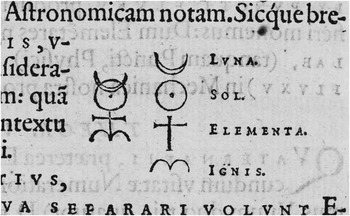
In the same vein, John Dee in 1564 proposed a symbol that he called monas hieroglyphica, which he took to encapsulate the essence of the universe (Figure 2; for further details, see Josten, Reference Josten1964; Clulee, Reference Clulee2005, Reference Clulee2006). This compact symbol incorporates a circle that represents the sun, a semicircle that represents the moon, a cross, and the zodiacal sign of Aries.
John Dee's monas hieroglyphica and its component elements. From John Dee, Monas hieroglyphica, Antwerp, 1564, Theorema X. Reproduced by permission. © Wellcome Library, London

In present-day terms, the image of the winged serpent described by Ficino and Dee's monas hieroglyphica constitute visual metaphors. They are metaphors because they relate to their objects in a metaphorical rather than in a literal manner, and they are visual because the viewer must conduct a visual inspection of the images and perform visual reasoning on their features in order to extract from them information about the world.
Ficino and Dee are usually regarded as pre-modern thinkers. One might expect that belief in a correspondence between the structure of the world and expressive symbols was abandoned with the rise of modern science, and more particularly when mathematical laws of nature came into use. Johannes Kepler, Galileo Galilei, and other natural philosophers originated the concept of mathematical law of nature at the beginning of the 17th century. Laws of nature seem to offer a plain, non-metaphorical way of describing fundamental phenomena, and therefore to be more recognizably modern than expressive symbols.
Brian Vickers is one of the writers who advance this interpretation of the scientific revolution. Contradicting historians of science such as Alexandre Koyré, who ascribed the rise of modern science largely to the influence of Platonism, and Frances Yates, who asserted the importance of Hermeticism in early-modern scientific thinking, Vickers sees a discontinuity between what he calls the ‘occult’ and ‘scientific’ traditions in the early modern period. The occult tradition failed to distinguish between the literal and the metaphorical; in that tradition, analogies were taken to be relations between things in the world, rather than purely inferential and explanatory devices. In the scientific tradition, by contrast, ‘a clear distinction is made between words and things and between literal and metaphorical language’ (Vickers, Reference Vickers1984: 95). According to Vickers, metaphor was expelled from the investigation of nature with the rise of modern science in the 17th century. Metaphorical depictions of the world exemplified by Dee's monas hieroglyphica vanished, to be replaced by literal depictions, primarily in the form of laws of nature.
Similarly, Dedre Gentner and Michael Jeziorski portray the rise of modern science partly as an evolution ‘from the alchemists’ pluralistic use of all sorts of metaphorical similarities to the more austere modern focus on structural analogy’ (Gentner & Jeziorski, Reference Gentner and Jeziorski1993: 448). The accounts of Vickers and of Gentner and Jeziorski match the self-image of many of the protagonists of the scientific revolution. In The History of the Royal Society, a work that promoted the views of leading fellows, Thomas Sprat portrayed them as repudiating the ‘trick of metaphors’ and adopting a ‘natural way of speaking’ to present their findings (Sprat, Reference Sprat1667/1958: 112–113).
Doubts about the interpretation of the scientific revolution as involving the replacement of metaphors by literalism arise once we realize that the cognitive concerns and epistemic values of the natural philosophers who formulated laws of nature largely coincided with those of the 16th-century practitioners of occult symbolism. Kepler exemplifies this continuity best. He made two sustained attempts to explain the structure of the solar system. In the first, which yielded the Mysterium cosmographicum of 1596, Kepler employed a visually attractive nesting of the five Platonic solids: he thought that visual reasoning performed on this construction and its geometrical properties fixed and therefore explained the number of planets and the relative sizes of their orbits. In the second attempt, reported in the Astronomia nova of 1609, Kepler formulated the first two of his three mathematical laws of nature relating physical parameters of the planetary orbits (Martens, Reference Martens2000). Whereas Vickers might depict this evolution as a transition from metaphorical to literal descriptions, it is more plausible to assume that Kepler's Neoplatonist views about the relation of mathematics to the world remained unchanged, and that he simply drew on two different branches of mathematics in successive decades to explore this relation.
Here I suggest that there is substantial continuity between the metaphorical approach of Renaissance thinkers and the mathematical laws formulated by modern scientists: I contend that mathematical laws of nature should be regarded in important respects as visual metaphors. This claim has two parts: the claim that laws stand to phenomena in a relation that can be described as metaphorical rather than literal, and the claim that laws are primarily visual images, which scientists apprehend by visual inspection and on which they perform visual reasoning.
Let us take first the claim that mathematical laws of nature stand in a metaphorical rather than in a literal relation to their objects. Clearly, the language of mathematical equations is more sophisticated and precise than that of geometrical symbolism: the formal rules for manipulating equations are more rigorous, for example, and as a consequence equations lend themselves better to being embedded into arguments. No one doubts that laws of nature in the form of equations therefore constitute an advance over expressive symbols in the form of geometrical constructions. On the other hand, mathematical laws of nature resemble expressive symbols in a striking respect: they are concise and simple formulae that capture their object in a global or holistic manner. This becomes apparent in two characteristics of laws.
First, the fundamental laws of present-day physics are comparatively hermetic: they do not directly contain any precise and verifiable claims about observable outcomes. Instead, claims about observable outcomes can be extracted only by means of lengthy chains of interpretation. The reason was pointed out by P. A. M. Dirac (Reference Dirac1929: 714): ‘The underlying physical laws necessary for the mathematical theory of a large parts of physics and the whole of chemistry are thus completely known, and the difficulty is that the exact application of these laws leads to equations much too complicated to be soluble’. The development of physics since Dirac's time has not altered the situation.
Second, laws of nature are not, and are not intended to be, literally true of individual occurrences. Whereas laws may describe an idealization of observable phenomena, they are not capable of accounting for individual data points, which are the outcomes of individual observations or measurements. Each data point is the consequence of a large number of causal factors, many of which are idiosyncratic to particular situations, including experimental apparatus (Scriven, Reference Scriven1961; Cartwright, Reference Cartwright1983: 54–73). Instead, laws aim to describe global aspects of the world: they approach the world in the intention not of assembling it from component elements, but of capturing what holds true of its entirety. Similarly, an expressive symbol is not required to shed light on individual instances: for example, Justitia contains no indication about what outcome the criminal justice system would or should reach in a particular case.
The empirical results and successes pertaining to individual occurrences that are often credited to laws of nature are in fact due usually to scientific models (Morgan & Morrison, Reference Morgan and Morrison1999). Models approximate literal descriptions of particular physical systems more closely than laws of nature. In many cases models are inspired by laws or are conjoined to laws to generate predictions. Nonetheless, they are partly autonomous from laws, as shown by the fact that a useful model will often survive the replacement of one set of high-level laws by another.
Let us now turn to the second commonality between laws of nature and older expressive symbols such as Dee's monas hieroglyphica: their visual nature. Studies of the place of visual thinking in physical science have concentrated hitherto on the visualization of phenomena and on such questions as whether the rise of quantum theory established that consistent visualizations of submicroscopic processes in everyday terms are unattainable (Miller, Reference Miller1984). I suggest, however, that visual reasoning plays an important role in another context in physics too: learning and grasping the content and implications of mathematical laws of nature.
Physicists mostly apprehend the content and implications of laws of nature by visually examining law statements on paper. The visual form of an equation offers access to the content of the law: a physicist comes to grasp the law and what it entails by exploring it visually. This is especially evident in the manner in which laws of nature are taught to physics students. For example, in his textbook, A Student's Guide to Maxwell's Equations, Daniel Fleisch displays an expanded and annotated view of each of the four fundamental laws of electrodynamics and leads the student in a visual inspection and exploration of it. Take as an example the third equation, known as Faraday's law:
 $$\mathop{\oint}{_________{\!\!\!\!\!\!\!\!\!C} { {{E}}} \cdot d{ {{l}}}\, = \,{\rm{ - }}d{\rm{/}}dt\,{\int} _{\!\!\!\!\!S} {{{{B}}} \cdot \widehat{{{{n}}}}\,da} } $$
Fleisch guides the student's gaze around this equation in an explicitly visual reconnaissance:
The right side of the common form of Faraday's law may look intimidating at first glance, but a careful inspection of the terms reveals that the largest portion of this expression is simply the magnetic flux […]. If you're tempted to think that this quantity must be zero according to Gauss's law for magnetic fields, look more carefully. […] If you're wondering how the magnetic flux through a surface might change, just look at the equation and ask yourself what might vary with time in this expression. (Fleisch, Reference Fleisch2008: 69)
I contend that the visual reasoning that Fleisch invites us to perform shares many features of the visual reasoning on the image of Justitia through which Mannozzi guided us in Section 2.
Visual reasoning on law statements lies at the heart of two facets of the experience of physicists. The first is gaining an understanding of a law of nature. I believe the source of this understanding is primarily visual inspection of law statements. Richard P. Feynman wrote in 1947: ‘What do I mean by understanding? Nothing deep or accurate—just to be able to see some of the qualitative consequences of the equations by some method other than solving them in detail’ (quoted from Schweber, Reference Schweber1994: 408; see also De Regt & Dieks, Reference de Regt and Dieks2005). I suggest that Feynman's use of the verb ‘to see’ in this statement is not merely metaphorical but literal: whereas solving equations in detail involves abstract mathematical manipulation, grasping the qualitative consequences of an equation involves visual perception turned onto the law statement.
The second relevant facet of the experience of physicists is the aesthetic attractiveness of mathematical laws of nature. It is well known that physicists at different times value various aesthetic properties of mathematical equations, such as conciseness, simplicity, and symmetry properties, and their perception of these properties influences their judgement whether a law is correct and fundamental (McAllister, Reference McAllister1996). Dirac was particularly insistent on this matter: in Moscow in 1955, ‘When asked to write briefly his philosophy of physics, he wrote on the blackboard “Physical Laws Should Have Mathematical Beauty” ’, recalls Richard H. Dalitz (Reference Dalitz1987: 20). Whereas it is possible to apprehend conceptual beauty by non-visual means, I suggest that mathematical beauty is apprehended visually in the first instance. For example, the symmetries among Maxwell's equations, on which many physicists have remarked, are a primarily visual property.
If both these conclusions are accepted, then laws of nature in modern physics constitute to a large extent visual metaphors. They are then objects of visual reasoning, and they stand in largely metaphorical relation to their objects. This suggests that there is substantial continuity between modern laws of nature and the expressive symbols of Renaissance natural philosophy. The resemblance is most pronounced for laws of nature with the widest scope. What James B. Hartle and Stephen W. Hawking (Reference Hartle and Hawking1983) call ‘the wave function of the universe’, derived from the Schrödinger equation, is not very different in intent from Dee's monas hieroglyphica. Admiring Lagrangian functions, Alfred North Whitehead suggested in an evocative way their continuity with an earlier natural philosophy: ‘The beauty and almost divine simplicity of these equations is such that these formulae are worthy to rank with those mysterious symbols which in ancient times were held directly to indicate the Supreme Reason at the base of all things’ (Whitehead, Reference Whitehead1926: 91).
Let us summarize the position that we have reached. It appears that laws of nature share some striking properties of images that constitute expressive symbols of the world, pertaining both to the relation in which they stand to the world and their visual dimension. It is therefore a plausible conjecture that visual reasoning is the prime technique for thinking about and with laws of nature. That is, physicists and other scientists formulate laws of nature, learn about them, develop an understanding of their content, investigate their implications, manipulate them, and appraise them primarily by means of visual reasoning.
5 A broader view of visual reasoning
Some laws of nature in present-day science appear to depict a domain of phenomena that is visualizable in everyday terms; other laws, as we know from the development of quantum mechanics, offer no coherent visualization of phenomena. There is also, however, another sense in which laws of nature may or may not be amenable to visual reasoning. This sense comes to light when we ask whether the formulation, understanding, and manipulation of laws of nature involve visual reasoning.
In the previous section, I have provided grounds for thinking that the answer to this question is positive. Laws of nature resemble images that constitute expressive symbols of the world: constructs of both these kinds represent the world in a holistic manner, not entailing any literal claim about occurrences, and in a visual manner. The fact that the class of expressive symbols also includes Dee's monas hieroglyphica and portrayals of Justitia should not induce anyone to think that my account devalues laws of nature. To the contrary, it is a credit to the concept of law of nature that laws play such an iconic role in modern culture.
With this conclusion, the strands of research surveyed in Section 1 are brought into contact. There appears to be a well-demarcated domain and a solid foundation for the study of visual reasoning that involves metaphors. It is to be hoped that current research into visual reasoning is broadened beyond the literal.
Acknowledgements
I thank James Robert Brown, Mélanie Frappier, and Letitia Meynell, the editors of this special issue on ‘Visual Representation and Reasoning’, for inviting me to submit an article. I am additionally grateful to Professor Frappier for perceptive criticism of a previous draft, which resulted in substantial improvements.