Introduction
With the rise of digital infrastructure, the camera has increasingly become a ubiquitous technology over the last decade. There is a proliferation of digital cameras, mobile phones, iPads, tablets, laptops and other mobile devices that have the capacity to take photographs, and to support the transformation and circulation of images and interaction with them. This article examines how the ubiquity of the camera, its overt and surreptitious use, and the dissemination of the resulting photographs constitute political acts in a postcolonial African context. I expound the elements and contexts of this ubiquity in Nigeria and situate them within a global framework. Further, I show how the context of production and circulation of the image gives it the status of an eyewitness account, amid contestations that heighten its force as a political statement. Lastly, I analyse the ubiquitous camera as a means through which the public observes, polices and exposes the duplicity of state functionaries. This investigation helps us to understand how digital infrastructure allows public access to the political undertaking of photography, but also how the camera is deployed to imagine political transformation.
The ubiquity of the camera as explored here reflects the unprecedented use of camera devices as agentive tools for cyber-based civil struggle by postcolonial African subjects. But the fact that this use is unprecedented does not mean that Africans were only represented in photographs and never handled cameras before the digital era. Since the mid-nineteenth century, professional photography had been undertaken by Africans. Indigenous Nigerian photographer J. A. Green (1873–1905), based in the Niger Delta region, worked in various thematic genres including architecture, commercial and ritual activities, and portraiture (Anderson and Aronson Reference Anderson and Aronson2017). In the aftermath of the abolition of the slave trade, returnees – including Sierra Leoneans, Afro-Brazilians and the Yoruba (of south-western Nigeria) – ran photography studios in Lagos in the 1880s, establishing what came to be known as Yoruba photography. Érika Nimis (Reference Nimis, Peffer and Cameron2013) questions photography's association with the linguistic, ethnic and national category ‘Yoruba’, as it affirms colonial assumptions. However, this became the signifier of a trope of professional practices which expanded into the rest of West Africa – Republic of Benin, Burkina Faso, Côte d'Ivoire, Ghana, Mali and Niger – through the migration of photographers in the first half of the twentieth century.
There is a broad scholarly discussion of the various dimensions of the studio portrait tradition in West Africa. One such perspective is that Africans gained control over how they were represented in photographs. Through the work of Seydou Keïta and Malick Sidibé, who worked in Mali in the twentieth century, we can understand how photography was adopted as an honorific means of identity formation and of gaining agency, and as a result of the desire to insert oneself into the visual frame of modernity (Keller Reference Keller, Peffer and Cameron2013). Within a similar framework, Stephen Sprague (Reference Sprague1978) studied the Yoruba of south-western Nigeria in the 1970s, focusing on how photographic self-presentation indexed local status and political hierarchy.
A further line of enquiry is the illusory construction of the self through the photographic framing of human subjects alongside non-human imageries, using backdrop paintings and accessories. These allow photographic subjects to inhabit desired and imagined spaces (Buckley Reference Buckley2000; Mustafa Reference Mustafa, Landau and Kaspin2002; Behrend Reference Behrend, Pinney and Peterson2003). Similarly, there is a fusion of fashion and photography that constitutes a means of constructing solidarity and friendship (Nwafor Reference Nwafor2011).
Another perspective from which we can read the genealogy of African photography is the way in which the medium extended or replaced existing forms of visual representation. The double exposure in Yoruba photography as examined by Nimis (Reference Nimis, Peffer and Cameron2013) is an extension of the statues of twins (ibeji) that stood in for them in the event of their death. Related to ibeji is the ako tradition, which is also found among the Yoruba. Flourishing before the twentieth century, it involved the use of life-size statues of the deceased for burial and funeral purposes. Ako’s encounter with photography produced what Roland Abíódún (Reference Abíódún, Peffer and Cameron2013) has called ‘akography’, where ako figures are dressed up and posed for the camera.
Some other parts of Africa are associated with precolonial-era aesthetics that served to visualize the grandeur of established kingdoms. As Geary (Reference Geary, Peffer and Cameron2013) demonstrates with reference to the Bamum Kingdom of Cameroon, between the late nineteenth century and early twentieth century, photography was deployed by Africans as well as Europeans to depict kings and other elites as a way to articulate their hold on power, and to inscribe history.
In Southern Africa, the history of the use of the camera by Africans is connected to the anti-colonial struggle. Black South African photographers, for instance, formed collectives through which they sought to challenge apartheid by exposing its violence in photographs. Hayes (Reference Hayes2009) goes further, demonstrating how documentary photography and photojournalism, the dominant genres in the struggle, can be conceptualized outside the stable, realist notion of exposing brutality. She writes about Santu Mofokeng, whose documentary photographic work in the 1980s did not conform to the dominant tradition of showing apartheid violence. Insisting that ‘the violence is in the knowing, not in the seeing’, he pursued the mundane, the spiritual and, to use his words, ‘shadows’ – ‘something that refuses to be photographed’ (Mofokeng Reference Mofokeng2011).
The photographs taken by Africans as discussed above were produced within the domain of analogue technology. One remarkable outcome of the rise of digital media is that the proliferation of mobile camera devices, especially since the 2000s, has resulted in many more people being involved in photographic practices, some aspects of which are political. The imaging devices are intricately connected to online image-sharing platforms that support social interactions through which Nigerians pass on their critiques of socio-political conditions.
I use ‘Nigerians’ as a category that I have described elsewhere as ‘ordinary Nigerians’, referring to citizens of Nigeria who perceive themselves to be outside the country's political elite group. They are a geographically unbounded population connected via the heterogeneous networks of the cyber world, especially social media (Agbo Reference Agbo2018). They include students, academia, civil servants, petty traders and others in the informal sectors of the economy. This demographically diverse and geographically dispersed population is brought together through agitation about socio-political issues in Nigeria – and its members use the ubiquitous camera to call attention to these issues. The images produced (including those analysed in this article) are widely distributed across online platforms, especially Facebook, YouTube, Twitter, NairalandFootnote 1 and news websites.
I draw on Martin Hand's (Reference Hand2012) work on ‘ubiquitous photography’. But while Hand engages with the ‘constellation of practices’ that broadly address ‘making, storing, distributing and displaying images’, I am interested in ubiquity as the impetus to activism. Nigeria makes a fascinating case study due to the considerable freedom of expression that gives its people a reputation for blunt use of language, especially when expressing discontent, across various media. And digital practices thrive despite poor infrastructure in Nigeria.
The constituent elements of ubiquity
In this article, the idea of the ubiquitous camera comprises elements that can be examined in technological and spatial terms, and in relation to interpersonal exchange. The context of this ubiquity situates the contemporary Nigerian experience within the global political sphere. Technologically, the ubiquitous camera speaks to the pervasive presence of mobile and portable devices that have the capacity to take photographs and support interpersonal sharing of images across a range of digital platforms. The conventional digital camera appeared in the 1990s and later advanced from taking still pictures to recording motion and sound, and to transmitting audiovisual impulses in real time. This was followed by the emergence of other devices, such as laptops, iPads and mobile phones designed with in-built cameras. These gadgets constitute what Hand (Reference Hand2012: 84) calls ‘interconnected technical artifacts’. They operate with superlative compatibility; share modes of taking, reading, storing, retrieving and disseminating photographs; and are powered by related software technologies. The picture file format JPEG (Joint Photographic Experts Group) illustrates their compatibility. Palmer (Reference Palmer and Lister2013) refers to JPEG as the structure of the image that allows it to enter a circuit of networked people and devices, and offers a democratized viewing experience. It is built into camera devices, computers and operating systems, image-viewing and editing applications, online image-sharing platforms, printers and scanners. It also allows for image compression, which in turn makes it easy to upload and download images online. Compression may reduce the resolution and clarity of an image, but it does not undermine the political force that it achieves, especially through its circulation.
The mobile phone has become one of the most widely distributed devices on which the ubiquitous JPEG photographs circulate. The rate of penetration of mobile phones even in rural parts of the so-called developing states is impressive: 21 million smartphones are currently in use in Nigeria alone (Adepetun Reference Adepetun2018). By the end of 2011, the estimated figure was between 1 billion and 5 billion globally (Hand Reference Hand2012; Shanks and Svabo Reference Shanks, Svabo, Larsen and Sandbye2014). The mobile phone camera may seem to be an extra technological advantage in addition to the telephony services for which the machine was originally designed. Yet, for many, the camera is an important consideration when deciding which kind of mobile phone to acquire. The desire to be ‘camera-ready’, to frame the world, is as strong as the desire to stay connected to the world through voice calls and text messaging.
The wide distribution of digital camera devices allows more people than ever to traverse, experience and participate in places where they find themselves, and to freeze fleeting moments through photography (Daisuke and Ito Reference Daisuke and Ito2003; Hand Reference Hand2012; Pink Reference Pink2011; Shanks and Svabo Reference Shanks, Svabo, Larsen and Sandbye2014). In some instances, the photographs that result from spatial-visual practices have a strong political impact through their composition, the context of their production and their circulation. In other cases, they are trivial and can generate political force only through their circulation. The former are important in understanding the beginning of digital photography's relationship with politics. In 2010, local authorities closed Mohamed Bouazizi's business in Tunisia. When higher-level authorities failed to intervene in Bouazizi's case, he set himself ablaze. The ubiquitous camera caught the moment of self-immolation in still and moving images. Just as the subject and production of the images had a direct link to protests that were political, their circulation on social media platforms stirred the pent-up anger over the perceived duplicity of the president of Tunisia, Zine El Abidine Ben Ali (Joseph Reference Joseph2012). The result was the Tunisian revolution, a revolution that snowballed into other states in North Africa and the Middle East. In September the following year (2011), in another region of the world, crowds of people gathered in the Wall Street district of New York to protest against financial inequality and political corruption. Sympathy for the movement – Occupy Wall Street – and for other protest actions it inspired in the US and elsewhere was generated by viral online photographs and videos of police confronting the protesters (Juris Reference Juris2012).
These examples show that the fleeting moments caught by the ubiquitous camera in its spatial engagement can be politically self-evident. In Nigeria, there are similar cases of such engagements, as exemplified by the visual production of the Occupy Nigeria movement (2012), enacted in both actual and online spaces. Occupy Nigeria was a nationwide movement ignited by the Nigerian government's removal of the fuel subsidy. Offline moments in the protest were photographed and circulated on social media in continuation of the struggle. Pictures of the mundane – the taken-for-granted aspects of human experiences – may not be overtly political, but they can produce political critique through digital editing and circulation. There are many editing applications in the cyber world, ranging from the popular to the professional. Image editing involves digitally restructuring the image in order to comment on socio-political realities. Further, the edited photograph becomes subject to networked sociality on the internet (Lister Reference Lister, Larsen and Sandbye2014). Through the processes of posting, sharing, liking, tagging and commenting, human subjects are brought together to interact around the photograph. The photographs of former Nigerian president Yar'Adua's teenage son analysed later in this article (and that could not be reproduced here due to copyright issues) are depictions of mundane performances enacted before the camera in enclosed residential spaces. But they later took on a different life and became politically charged through digital working and circulation on online platforms.
The networked structure of photographic experience is what distinguishes the digital photograph from the analogue. From the 1840s to the 1880s, photography was a middle-class practice associated with travel and privilege. The launch of the Kodak camera in 1888 brought many more people into the domain of photographic representation (Hand Reference Hand2012). But the emergence of digital photography soon revealed that there was more to the democratization of visual production than Kodak could achieve with the snapshot and the popular photography it facilitated. In fact, digital cameras led to the decline of Kodak film photography, with the company filing for bankruptcy in 2012 (Shanks and Svabo Reference Shanks, Svabo, Larsen and Sandbye2014).
Camera phones are not only devices for taking pictures; they are also a means of circulating the photographs they produce. The 2000s saw the international proliferation of the camera phone and the launch of image-hosting and -sharing websites (such as Flickr and Facebook) and also witnessed the advent of mobile phone technology in Nigeria. Three ‘Global System for Mobile Communications’ (GSM) companies were licensed in the early 2000s: Mobile Telephone Network (MTN) and Econet Wireless (now Airtel) in 2001, and Globacom in 2002. Etisalat, now known as 9Mobile, came to Nigeria in 2008. The ownership of camera phones grew rapidly. Besides providing telephony services, mobile phone technology in Nigeria (as elsewhere) became the gateway to internet access. Hence, to possess a mobile phone is to ‘carry a phone-cum-camera-cum-computer’ that is linked to cyberspace (Shanks and Svabo Reference Shanks, Svabo, Larsen and Sandbye2014).
While online image circulation is a major component of the ubiquitous camera, the fact that GSM is a key means of accessing the internet in most parts of Africa, including Nigeria, suggests the possibility of reading GSM as a political tool. The Zimbabwean government under Robert Mugabe in the 1990s envisioned the political potential of GSM when it refused to issue Strive Masiyiwa a licence to operate Econet Wireless. Masiyiwa won the case against the government, and Econet was established. But Zimbabwe became politically tense following the loss of the referendum for constitutional reform by Mugabe's government and the authoritarian atmosphere drove Masiyiwa out of Zimbabwe (Goodstein and Velamuri Reference Goodstein and Velamuri2009; Takavarasha and Makumbe Reference Takavarasha and Makumbe2012). Econet, too, expanded to other parts of Africa, arriving in Nigeria in 2001.
Amid intense competition, the GSM companies have covered vast areas of Nigeria's cities and suburbs, offering internet connections alongside telephony services. But this is not to say that internet access is not problematical in Nigeria. There are deficiencies in both internet connections and electricity – the two technologies that drive the ubiquitous camera. But these problems are managed creatively through technological appropriation and improvisation. For instance, phones are powered using alternative sources of electricity such as generators, and, by subscribing to multiple GSM networks, users may have different ways of accessing the internet, although there are cases of connectivity failure across all networks.
The internet supports one element of photographic practice: circulation of the image, through which people interact with one another. They bring their frustrations about societal upheavals to bear on how they relate to the photograph. Even before the image is circulated, the ubiquity of the camera is seen in the availability of mobile image-producing devices and people's engagement with them to freeze their experience while moving through geographical spaces. The resulting images appear in a standard format, subject to structural reordering with universal applications, and distributed across cyber platforms that are also ubiquitous.
The ubiquity of the camera, as seen here through the lens of politics, encompasses the increasing availability of mobile camera devices and the growing inclination to put them to use, framing the world their users traverse. The digital format of the photograph is also a ubiquitous technology: it is readable across a wide range of devices, applications and websites. Circulation of the photographs – which is itself a component of the ubiquity of visual production – helps affirm the forms of expression created using the images. The next section discusses the context of circulation.
The image as witness
One way to understand how the ubiquitous camera operates is from the perspective of journalism, the domain of which has been broadened by the cyber world. The idea of bearing witness – ‘citizen witnessing’, as Allan (Reference Allan2013) puts it – underlines the production of ‘first-hand’ accounts by people who experience or are present at a time of crisis, and photography is at the heart of this practice. Those who were present when the tsunami of 2004 struck in South Asia provided visual ‘eyewitness’ accounts of the tragedy, and the mainstream media turned to these accounts to report the event. This form of practice came to be described as ‘citizen journalism’. Related formulations such as ‘citizen photojournalism’ and ‘citizen photography’ have also emerged (Allan Reference Allan2015). Anyone armed with a camera is thus a potential news reporter, photojournalist or photographer.
But the eyewitness photograph is not an uncontroversial framing of the fleeting world experienced by someone who has the device to record the moment and transmit the image to the public domain of the internet. There may be contestations about the ‘authenticity’ of the image, which are stirred up by – but also addressed through – the mechanism of circulation, the dialogue created by the image, and the nature of the platforms on which this happens.
Consider, for instance, the photograph of schoolchildren in a poorly illuminated classroom equipped with makeshift desks composed of building blocks.Footnote 2 On 1 August 2014, Garba Aliyu Gayari – then director of Zamfara State Cotton Development Agency – posted the photograph on Facebook. In a brief comment accompanying the photograph, Garba claimed that the post was a photograph of a classroom setting in a school in Abuja, Nigeria's capital. He lamented that the conditions depicted in the image were to be found in a country where monthly state allocations run into billions of naira, where individuals can donate generously to victims of insurgency, and where a minister can ride in a car worth hundreds of millions of naira. With these accompanying lines, the tone of the conversation around the image was established, allowing users to bring their knowledge and ways of seeing to bear on their view of it. Most of the comments reflected a sense of frustration about negligence in educational institutions as portrayed in the photograph. But a few contended that the photograph was not taken in Abuja, given the competition for ‘excellence’ among schools in a city that prides itself on being a world-class metropolis. This view tended to be supported by the fact that the school's name was withheld. For some, the authenticity of the photograph would depend on identifying the specific school by name.
This conversation reflects the long-standing debate around photography's claim to truth that began with the earliest work on the medium, such as that by Henry Talbot (Reference Talbot1844) and Louis Daguerre (Reference Daguerre and Trachtenberg1980). Talbot, for instance, evoked the power of photographic indexicality when, in the 1840s, he photographed ceramic wares and claimed that the images could be used in law courts as evidence against anyone caught stealing the pictured objects. Later, scholars such as Sekula (Reference Sekula1978) and Meyer (Reference Meyer1995) would argue against such realist understandings. Meyer, a documentary photographer, claims that it is through the altering of photographic indexicality that social realities come into view. The photograph of schoolchildren analysed here has not undergone any visual editing. But with such comments as ‘my bro just enter any remote village or slums around FCT [Federal Capital Territory, Abuja]’ by Henry Ojobo, the pictured school becomes an archetypical representation of the state of some of the schools in Abuja. So, as the eyewitness photograph circulates, it tends to lose its indexical connection with a specific subject and becomes a signifier of something else, something outside the frame. Through the photograph and its accompanying description, Garba Gayari alludes to official corruption and other ludicrous acts of high-profile politicians in Nigeria. His post appeared at the height of the Boko Haram insurgency, which, in many ways, became a site of politics. For instance, Garba's remark that there are people who can invest billions of naira in the rehabilitation of Boko Haram victims is not necessarily an evocation of philanthropy. In March 2014, the government of Yobe State earmarked 100 million naira for the rehabilitation of those attacked by Boko Haram in a college in Buni-Yadi.Footnote 3 Earlier in 2012, the Central Bank, then under the leadership of Lamido Sanusi of Kano State, donated 100 million naira towards the rehabilitation of the victims of the February 2012 Boko Haram attack in Kano State (Edike Reference Edike2012).
This financial commitment stirred up a critique of the response to insurgency in Nigeria as skewed and motivated by political leanings. For example, the pan-Igbo organization Ohanaeze Ndigbo argued that Sanusi could use his position to come to the aid of ‘his’ Kano people, but not the Igbo, who were also victims of Boko Haram attacks across northern Nigeria. Similarly, the comments on Garba's photograph that ‘a minister can purchase a car of 250 million’ naira in Nigeria allude to corruption, one of the socio-political conditions the ubiquitous camera seeks to expose. In 2013, the then Minister of Aviation, Stella Oduah, was questioned about allegedly purchasing a bullet-proof car at a cost of 250 million naira, a sum that would cover the salary of a professor in a Nigerian university for fifty years (Ovuakporie and Nwabuhiogu Reference Ovuakporie and Nwabuhiogu2013).
The photograph of the schoolchildren appeared at a time when President Goodluck Jonathan's administration was vigorously projecting the idea of having overhauled the Nigerian education sector. The claim was made with reference to the establishment of twelve universities across the country and 150 schools in the north. During the 2015 general election campaign, Jonathan's party, the People's Democratic Party (PDP), focused on this as an impressive accomplishment that should be rewarded by the PDP being voted in for a second term. The photograph was caught up in even deeper political tensions. Garba, who posted it on Facebook, was then the director of an agency in Zamfara State. While Zamfara was and still is led by the All Progressives Congress (APC), APC was then the opposition party, striving to take over power from the ruling PDP, a feat it achieved in the 2015 election. Most of the criticism of the government prior to the election was directed at the PDP. Sanusi, who facilitated the donation of 100 million naira to Boko Haram victims, and the embattled Oduah were also members of the PDP. Garba used the ubiquitous camera to articulate a critique of a rival party. It therefore could be argued that the political elites who were criticized using the photograph were to some extent drawn into the visual production and exchange. They used the image to attack their political rivals, to assert their claim to transformative politics, or to respond to the criticism against them.
These political articulations are afforded by the circulation of the ubiquitous photograph. At the time of writing, the image analysed here had been shared (re-circulated) on Facebook 23,964 times. As it moves across cyberspace, it enters forums whose strong political focus heightens its effect. For instance, it was shared on the Nigerian Global Awakening Day Protest (NGADP) Facebook group page set up in October 2011 by the UK-based Nigerian Marian Awolowo. The initial goal of the NGADP was to mobilize Nigerians from across the world against corruption and state failure in Nigeria. As the 2015 Nigerian general election approached, the NGADP aligned itself with the APC to engage in an intensive media campaign aimed at overthrowing the ruling PDP. Given the increasing public perception that the PDP had failed to deliver on its promise of social transformation since it took power from the military in 1999, the support for the APC grew rapidly, as did NGADP membership. On the NGADP Facebook page, photographs would not generate as much debate about authenticity as they would on individual pages. For members of the group, any photograph, regardless of where it was taken, would constitute a visual critique of the government of the period.
Conventional news platforms such as TV channels and newspapers are other examples of online platforms where photographs are quickly accepted and not questioned as bearers of witness to actual acts of injustice perpetrated by political elites. To some extent, this is a validation of the ubiquitous image, a process that does not involve any formal scrutinization of the image, as would happen in a court of law. Rather, it is validated not just by the way in which the photograph affirms living conditions to which people can relate, but also due to the reputation (in terms of news production and political undertakings) of the news media platform on which it circulates.
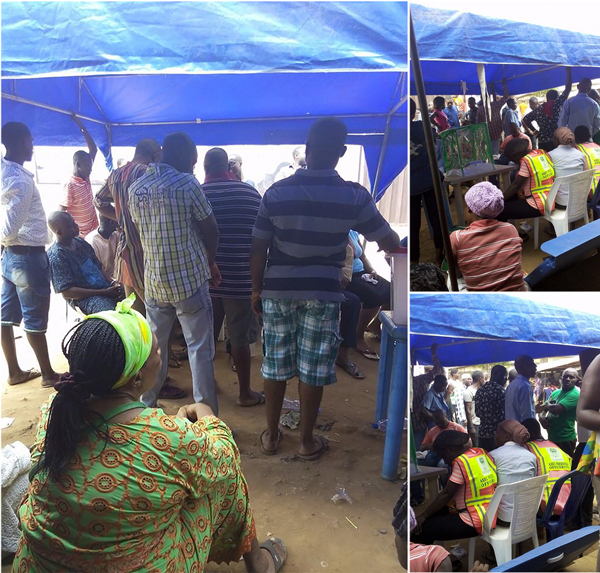
Eyewitness photographs of the 2015 general election produced and inserted into the circuit of online circulation corroborate the familiar practice of electoral fraud in Nigeria. The series of photographs depicting waiting individuals substantiates this (see Figure 1). They were taken and circulated on Facebook on 28 March 2015, the first day of the 2015 Nigerian general election. We see a few figures in yellow-coloured jackets, sitting in front of empty green, transparent ballot boxes. The individuals are apparently electoral officials, but we do not see them actively engaging with the voters. The descriptive note on the images indicates that, at 2.30 p.m., the crowd is still waiting at the polling centre for a complete supply of electoral materials to arrive. As a follow-up, another set of images appeared an hour later to inform us that, as the rest of the electoral materials never arrived, the officials left. The crowd dispersed without casting their votes. Those familiar with electoral practices in Nigeria could relate to these successive reports. There are usually stories of disenfranchisement (as demonstrated in the above instance), election rigging, shooting, and much more. So, the ubiquitous photograph gives credence to the existence of familiar anomalies in Nigerian post-independence politics. This connection is in itself a way to validate the eyewitness image, which gains even more acceptance through its appearance on reputable news platforms: mainstream television channels, newspapers, and other news outlets.
Okeafa/Ejigbo electoral centre, Anambra State, Nigerian general election, 28 March 2015. Source: Posted on Facebook by Ubah Rita Doris Edumchieke with the caption ‘Its 2:30pm.We are just here; no accreditation; no voting yet.’Footnote 4

Many of the eyewitness photographic reports of the 2015 election were circulated on Twitter. Affirming Shanks and Svabo's (Reference Shanks, Svabo, Larsen and Sandbye2014) assertion that the social media site is a place ‘to find first-hand news directly from the event as it happens’, Vanguard newspaper retrieved a number of the photographs and published them on 11 April 2015. The subjects covered included thuggery, the carting away of ballot boxes, and low voter turnout in some parts of the country (Alade Reference Alade2015).
While Vanguard newspaper turned to social media for eyewitness photographic reporting of the election, Channels Television, Lagos, received eyewitness photographs directly from their creators. Through the channel's ‘Eyewitness’ programme, members of the public are asked to report events as they happen. They can do this by installing the Channels TV app on their smartphones. With the device, they can send in pictures and videos with a title, description and location. Once they are received, the images become eyewitness stories reported as news items. This model of reportage began to gain currency in the 2000s. In the aftermath of the South Asian tsunami, mentioned above, media dependence on eyewitness reports of the event prompted the BBC to reconsider its participatory modes of operation. It ‘launched a user-generated content hub as a three-month pilot project, recognizing … the pressing need to expand reportorial boundaries to find new ways to facilitate citizen involvement in newsmaking’ (Allan Reference Allan2015).
While some media outlets incorporate ‘citizen witnessing’ in their news production, as demonstrated by the Vanguard newspaper and Channels TV examples, others are basically activist platforms whose goals are defined by their political engagement with ubiquitous photography. Sahara Reporters is a case in point. It is a conglomerate of online platforms (newspaper, TV and social media sites) founded at the beginning of the twenty-first century by US-based Nigerian Omoyele Sowore. Kperogi (Reference Kperogi2011) shows that Omoyele was a witness to and victim of oppression by the military government in Nigeria in the 1990s. His critique of the regime resulted in multiple illegal imprisonments before he relocated to the US in 1999, coincidentally the year that saw the beginning of the Fourth Republic in Nigeria. Disappointed by the failure of the new democracy, Sahara Reporters began operating with a sense of aggression, as expressed on its website:
SaharaReporters.com is an outstanding, groundbreaking news website that encourages citizen journalists to report ongoing corruption and government malfeasance in Africa. Using photos, texts, and videos dynamically, the site informs and prompts concerned African citizens and activists globally to act, denouncing officially-sanctioned corruption, the material impoverishment of its citizenry, defilement of the environment, and the callous disregard of the democratic principles enshrined in the constitution.Footnote 5
Sahara Reporters has gained a reputation for its politically compelling investigative and citizen photojournalistic reports. Photographs gain political currency by virtue of their appearance on one of the Sahara Reporters’ online platforms. Circulation is important to the way in which the ubiquitous photograph produced as an eyewitness account generates political critique. As the image circulates, the dialogue it produces shows that it transcends the particular moments frozen within it and it becomes a signifier of broader socio-political tensions. From another perspective, the visual economy can be read as a form of surveillance. These images, circulating across social media and news platforms, help constitute new circuits within the visual economy of politics in Nigeria. They bring new perspectives and participants into view, at the same time reorienting and expanding the kinds of surveillance involved in governance and citizenship.
The reconstitution of surveillance
Photography's relationship to surveillance is most often understood in the context of state power that filters through a range of institutional frameworks, including legal practice, police work and immigration (Tagg Reference Tagg1988). However, photographic surveillance is not exercised exclusively by the state. Private organizations and individuals are involved in securitization by means of photography. While digital image production has afforded the state new forms of surveillance – the e-passport, for example – the same technology has led to the reordering of the gaze. The observer can now be observed. In Nigeria, the ubiquitous camera surreptitiously directs its lens onto the political elites, to expose and challenge their abuse of power. The consequence is a feeling of insecurity among the corrupt state officials as they are thrown into disarray. This can be illustrated by the experience of Ali Modu Sheriff, the former governor of Borno State and the son of the country's late president, Umaru Musa Yar'Adua.
In 2008, Sheriff was caught on video dancing with a female musician in Dubai, holding her and scattering cash.Footnote 6 Although it is not a still photograph, it is possible to view the video through the prism of paparazzi photography. According to Jerslev and Mortensen (Reference Jerslev, Mortensen, Larsen and Sandbye2014: 156), this kind of photographic practice ‘is characterized by an aesthetics and discourse of ordinariness: celebrities apparently caught unawares while engaged in everyday routines such as walking along the street, carrying a cup of coffee, shopping … and so on’. The problem with that point of view is that it tends to excuse the image from being subjected to a political reading. It also leads us to ignore the effect it would have on the photographed when they see themselves depicted in certain ways and the images published for public view.
Carol Squiers (Reference Squiers and Squiers1999) is mindful of these crucial elements of paparazzi photography by thinking of it as an intersection of photojournalism, documentary, celebrity photography and surveillance photography. Jerslev and Mortensen (Reference Jerslev, Mortensen, Larsen and Sandbye2014) disagree with that position and argue that surveillance photography should be removed from the list and street photography added. In my understanding, Sheriff's video can be read in the context of paparazzi photography, but in a context from which the notion of surveillance is not detached. It is paparazzi photography as a mode of protest against the excesses of the powerful. Ordinariness – the organizing principle of paparazzi photography as a form of photographic representation – underlines the depiction of Sheriff having fun like the man that he is. On the other hand, the understanding of the video in terms of surveillance is informed by the context in which it is produced and disseminated. Through its description on YouTube, where it was circulated, the video calls public attention to the frivolous life for which the Nigerian political class is largely known. Consider the two key components of Sheriff's conduct in the video: dancing and the spray of cash.
At the time of the event, Sheriff was the governor of Borno State, one of the northern Nigerian states that had begun to institute sharia law following the return to democracy in 1999. Sharia law was rationalized as a panacea for the corruption in Nigerian democracy (Harnischfeger Reference Harnischfeger2008). The law has a specific moral and religious aspect, and that is what Sheriff flouts by dancing with a woman. Sheriff's use of cash in the video goes against the Nigerian regulation for handling currency that was passed into law in June 2007.Footnote 7 Granted, the short description accompanying the video identifies the currency in question as the US dollar, not the naira, and the incident occurred in Dubai, not in Nigeria. But Nigerian officials should behave in appropriate ways outside the country, even if their conduct is not illegal.
Like Sheriff, those implicated in this form of visual production perceive their ‘unknown’ colleagues as traitors for clandestinely producing their images and launching them in the public domain. But the citizens involved in the struggle against misrule in Nigeria are pleased to have people who are close to the political elites but oppose them surreptitiously. The exposure of major scandals among Nigerian politicians can be traced to this mode of revelation.
Sheriff's example has been used to illustrate the covert way in which the camera is deployed to observe the behaviour of Nigerian political elites. But surveillance also operates in yet another manner. In some settings, within close-knit groups, for instance, the observed voluntarily offer themselves to be photographed. At the outset, there may be no conceivable risk of public access to the image or of its appropriation in any activist context. But through subsequent circulation it could produce scandalous narratives that show the photographed that they are being observed. Consider the pictures of Musa, the son of former president Musa Yar'Adua.Footnote 8 In the image, we see, as vividly described by Kperogi (Reference Kperogi2011: 38), ‘exclusive pictures of the president's son bathing in a pile of cash and brandishing brand new guns’. The message of the photographs transcends the exuberance of a wannabe. On YouTube and Nairaland, the images produce politically charged meanings, with each platform generating specific effects. On YouTube, the images, along with others in the series, appear in video format, displayed like a PowerPoint presentation with typographical and musical accompaniments.Footnote 9 This is a good illustration of Manovich's notion of ‘variability’, one of the concepts with which he theorizes the logic of new media. By ‘variability’, he means that ‘a new media object typically gives rise to many different versions’ (Manovich Reference Manovich2001: 56).
The flexibility of new media content favours the mobilization of civil resistance. It allows users to construct their messages in the way they want them to be presented. The rendering of the still photographs of young Musa in audiovisual form allows for a critique of the ex-president's conduct as a public figure. The text describes the youngster as an irresponsible child whose character suggests poor parental upbringing. That implied failure at the micro level challenges Yar'Adua's capability as the leader of a populous nation such as Nigeria. The background music taken from the work of the activist musician Fela Kuti rehashes ‘thief’, ‘rogue’, ‘robber’ and related expressions with which he described the military government of the 1980s. The music prompts us to query the stockpiling of cash by Yar'Adua and the rationale behind making it (and a rifle) accessible to his apparently teenage child.
The use of the ubiquitous camera as examined above causes anxiety among politicians. To illustrate this, Yar'Adua was amazed at the evolution of the scandal surrounding his son's photographs, from their production and appropriation in various contexts to their viral online circulation. He viewed it as an intrusion into his private and family life by those close to him at the official and social level. The ‘anxiety about visual intrusion’ (Hand Reference Hand2012: 11) presumably had some connection to the oath of secrecy he administered the same year (2008) to the staff in his office. However, his move was severely criticized as a restriction on the free circulation of information in a democracy (Oji et al. Reference Oji, Nwachukwu and Eme2014). That criticism produces its own anxiety. All these anxieties began with the application of the ubiquitous camera as a means of surveillance.
Surveillance as examined here interrupts our prior understanding of the concept. It is not always the state that surveys the citizens. With the ubiquitous camera, public observation of state officials has become possible. Imaging devices can be used clandestinely, or the photographed individuals might be aware of the camera and consent to its use. But the circulation of the resulting image and the interpretive process it undergoes online bring out the underlying contexts of surveillance and activism. The result is that the implicated politicians become apprehensive about being policed visually.
Conclusion
The camera, which has become more ubiquitous than ever, is associated with visual productions that are important in the civil struggle produced digitally. The notion of ubiquity encompasses the proliferation of mobile communication devices that have the capacity to take photographs, and in formats that make them readable on various gadgets and across a range of digital platforms. The camera is also ubiquitous as it is possessed by individuals who move through actual spaces and use it to frame the moments they encounter. What is caught within the frame may appear mundane on the one hand or politically charged on the other. In both cases, editing, circulation and interaction around the photograph in internet spaces that are themselves ubiquitous have the tendency to transform the image into a strong political statement. It is therefore the case that photographic meaning is not always inscribed in what is composed within the frame. Even the eyewitness photograph – one of the kinds of image produced with the ubiquitous camera – is not a neutral framing of the world. It is a contested representation that tends to lose its indexical connection to its referents and becomes a generic visual code deployed to critique society. The fact that the circulation of the photograph is important in how it produces its political effect does not mean that its subject does not matter. In fact, it matters so much that in certain instances state officials become the target of the camera. Their appearances in photographs – and, of course, the circulation and conversations around those images – give a sense that they are under surveillance by the networked public. The political critique that grows out of this visual culture is so strong that it creates tension among the elites who are denounced as they strive either to exonerate themselves or to forestall further attacks. Whether these visual practices result in state functionaries becoming more accountable or not, they give us an idea of how digital photography tries to transform the African political sphere. Other important questions are likely to emerge around the political use of photography. For instance, the way in which photo editing fits into this complex visual-political production is worth exploring in more detail.
Acknowledgements
I would like to thank the Centre for Humanities Research (CHR) at the University of the Western Cape for the Andrew Mellon Fellowship (2014–16) that funded the doctoral research from which this article was drawn. The Ivan Karp Doctoral Research Award, which I received in 2015, also facilitated my fieldwork in Nigeria. The CHR, the Interdisciplinary Center for the Study of Global Change and the African History Graduate Student Collaborative at the University of Minnesota supported my participation in the 2016 International African Studies Conference where this essay was first presented and received the best graduate student paper prize.