INTRODUCTION
When Europeans first settled the east coast of North America, salt marshes were the cornerstone of their agricultural economy (Hatvany Reference Hatvany2003). From the St Lawrence Estuary south, these naturally fertile grasslands provided pastures and hay fields that could be exploited without investment in clearing or sowing. In the USA and Canada, extensive agricultural use of these grasslands continued until the first half of the 20th century when initial changes in agricultural methods and later pressures from the environmental sector resulted in abandonment. In North America, livestock grazing is widely prohibited, while some grazing of salt marshes continues in Europe (for example the sheep of the Mont-St-Michel Bay, France).
Despite their historically recognized agricultural value, extensive areas of tidal salt marshes have been dyked and drained to enable terrestrial agriculture in North America and Europe. Rising sea levels associated with global warming now threaten these systems, presenting a dilemma for coastal managers and the agricultural sector. Should these sites be restored to tidal flooding or maintained for agriculture at an increasing cost? Or is a third alternative possible: restoration of salt marsh ecosystems along with their use of these marshes for agriculture? This third alternative would still permit agricultural harvests, thereby engaging this sector, which owns much of the salt marsh area, while enabling the recovery of at least some of the ecological services recognized for salt marshes, such as storm protection (Barbier et al. Reference Barbier, Koch, Silliman, Hacker, Wolanski, Primavera, Granek, Polasky, Aswani, Cramer, Stoms, Kennedy, Bael, Kappel, Perillo and Reed2008), fish and waterfowl habitat and aesthetics (Keddy Reference Keddy2000; Mitsch & Gosselink Reference Mitsch and Gosselink2000), as well as soil carbon sequestration (Connor et al. Reference Connor, Chmura and Beecher2001; Chmura et al. Reference Chmura, Anisfeld, Cahoon and Lynch2003).
Our study begins to address the question of whether marsh sustainability is possible under agricultural use. To be sustainable, tidal marsh soils must accrete vertically, in pace with rising sea levels. Studies along the north-west Atlantic coastline have shown that organic matter accumulation plays a key role in vertical accretion of tidal marshes (for example Nyman et al. Reference Nyman, Chabreck and Kinler1993; Turner et al. Reference Turner, Swenson, Milan, Weinstein and Kreeger2001; Chmura & Hung Reference Chmura and Hung2004). Moreover, a recent study in Louisiana showed that the most important organic component of the ecosystem is the belowground portion, namely the roots and rhizomes of the vegetation (Nyman et al. Reference Nyman, Walters, Delaune and Patrick2006).
Interest in use of salt marshes for grazing livestock has been renewed in Québec. From 2000 to 2006, small-scale lamb production ‘subsidized’ through grazing of a salt marsh on a St Lawrence Estuary island provided a unique opportunity to study effects of controlled livestock grazing on a North American salt marsh where this practice is largely prohibited. We took advantage of the permitted grazing to assess the impact of low density grazing on root production and soil carbon storage. The latter is an important ecosystem service that could provide an economic incentive to restore drained salt marshes used for agriculture (Connor et al. Reference Connor, Chmura and Beecher2001).
Although root production and soil carbon are keys to tidal salt marsh sustainability, few studies of grazing impacts have addressed these aspects. Instead, many have focused on aboveground vegetation and often on sites where grazing intensity was not controlled, such as by wild or feral populations (Reimold et al. Reference Reimold, Linthurst and Wolf1975; Turner Reference Turner1987; Gough & Grace Reference Gough and Grace1998; Seliskar Reference Seliskar2003). Intensive or continuous grazing by livestock (for example Turner Reference Turner1987), waterfowl (for example Handa et al. Reference Handa, Harmsen and Jefferies2002) or even snails (Silliman & Bertness Reference Silliman and Bertness2002) is detrimental to the aboveground vegetation, causing declines in plant production, displacement of species and denudation of soil surfaces.
Changes in aboveground production, however, do not necessarily reflect the belowground responses, and both may vary with species and grazing regime. For instance, moderate grazing and trampling by feral horses did not decrease the rhizome concentration of Spartina alterniflora, but did lower aboveground biomass (Turner Reference Turner1987). In Louisiana, Gough and Grace (Reference Gough and Grace1998) found higher aboveground biomass of Spartina patens in grazed plots, while Ford and Grace (Reference Ford and Grace1998) detected c. 75% decrease in aboveground biomass in grazed plots from a separate study at the same marsh. Reader and Craft (Reference Reader and Craft1999) detected a significant decrease in both aboveground and belowground biomass of S. alterniflora where feral horses grazed in North Carolina. Yet, grazing by feral horses of S. patens on back dunes marshes on Assateague Island (Maryland, USA) reduced aboveground, but not belowground biomass (Seliskar Reference Seliskar2003), although detection may have been impaired by the limited replication.
Considerable research on the impacts of livestock grazing has been based in Europe because of the long history of using salt marshes as pastures there (Bakker et al. Reference Bakker, DeLeeuw, Dijkema, Leendertse, Prins and Rozema1993). In Europe, light to moderate sheep and cattle grazing was suggested as a conservation strategy to maintain a desired landscape for migratory geese habitat and for maintenance of species diversity (Bakker Reference Bakker1985; Pehrsson Reference Pehrsson1988; Bakker et al. Reference Bakker, DeLeeuw, Dijkema, Leendertse, Prins and Rozema1993; Bernhardt & Koch Reference Bernhardt and Koch2003; Bouchard et al. Reference Bouchard, Tessier, Digaire, Vivier, Valery, Gloaguen and Lefeuvre2003; Bos et al. Reference Bos, Loonen, Stock, Hofeditz, Van der Graaf and Bakker2005). Grazing increases plant canopy heterogeneity and reduces the competition of dominant species, thus increasing species diversity (for example Ranwell Reference Ranwell1961; Jensen Reference Jensen1985; Bakker & de Vries Reference Bakker and DeVries1992; Kiehl et al. Reference Kiehl, Eischeid, Gettner and Walter1996; Tessier et al. Reference Tessier, Vivier, Ouin, Gloaguen and Lefeuvre2003). Disturbance by sheep seems to be less than that by cattle owing to differences in grazing behaviour (Jensen Reference Jensen1985). Sheep graze selectively, leading to plant canopy micropatterns (differences in plant heights), while cattle are generalists often uprooting plants from the soft substrate. Without grazing, the tall canopy of dominant species prevents colonization of annual species that require light provided in bare patches (Bakker Reference Bakker1985; Bakker & de Vries Reference Bakker and DeVries1992). Areas with moderate grazing (≤4.5 sheep ha−1), which results in a low plant canopy and alters the plant community, are preferred by migratory geese because of the increase in forage species (Bos et al. Reference Bos, Loonen, Stock, Hofeditz, Van der Graaf and Bakker2005).
Large expanses of salt marsh have been dyked along the St Lawrence River estuary. Approximately 1600 ha of regularly flooded salt marshes border the St Lawrence River (Létourneau & Jean Reference Létourneau and Jean2005) located mainly on the south shore of the upper estuary with the highest concentration near the town of Île Verte, Québec (Environment Canada 1985).
Changes in plant community structure affect rates of carbon and nutrient cycling. As a result, much research had been devoted to understanding the role of herbivores in salt marsh primary production (for example Cargill & Jefferies Reference Cargill and Jefferies1984; Morris & Jensen Reference Morris and Jensen1998; Kuijper & Bakker Reference Kuijper and Bakker2005; Jefferies et al. Reference Jefferies, Jano and Abraham2006). However, simultaneous above- and belowground production measurements are few, partly because of methodology limitations. Many studies have focused on the observable aboveground component, even though herbivory affects above- and belowground processes. The objectives of our study were (1) to compare the above- and below ground biomass between grazed and ungrazed area of the salt marsh and (2) to measure the soil and environmental variables associated with a grazing or non-grazing condition.
METHODS
Study area
In the region of the St Lawrence River near the town of Île Verte, tides are semi-diurnal with an amplitude of 3.4 m (Canadian Hydrographic Service 2007). Gauthier (Reference Gauthier1982) reported that salinity of the estuary ranged from 17–20 (Practical Salinity Scale) in this region, yet salinity of tidal water we measured on 30 July 2008 at the La Richardière port, Île Verte was 25. The area has a mean annual temperature of 3.6°C and a growing season of 1469 growing degree days (Environment Canada 2004). Cumulative rainfall during each week before sampling was 29.2 mm in June, 62.0 mm in July, 12.2 mm in August and 49.4 mm in September (Environment Canada 2007).
Vegetation of the region's salt marshes has been described in reports by Reed and Moisan (Reference Reed and Moisan1971) and Environment Canada (1985). Spartina alterniflora dominates the lower elevations of the tidal marshes, while at higher elevations, other grasses such as Spartina patens, Spartina pectinata, Hierochloe odorata and Hordeum jubatum dominate, together with the sedge Eleocharis sp. and lower abundances of a variety of forbs such as Atriplex spp., Glaux maritima, Limonium nashii, Plantago maritima, Ranunculus cymbalaria, Salicornia europaea, Suaeda maritima, Spergularia canadensis and Triglochin maritime. Also common in the high marsh are pools with the submerged aquatic Ruppia maritima and salt pannes, where poor drainage and hypersaline soils severely limit plant growth (Reed & Moisan Reference Reed and Moisan1971).
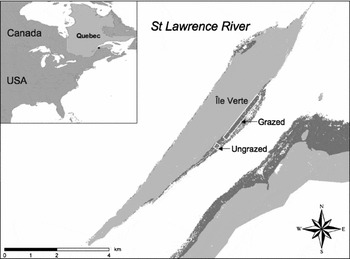
The only inhabited island in the upper estuary of the St Lawrence, Île Verte (48° 02′ N, 69° 26′ W), is c. 4 km from the south bank of the St Lawrence River (Fig. 1). On the central portion of the island's eastern shore lies a 110 ha salt marsh where islanders introduced sheep grazing.
Inset map depicts the location of Île Verte, denoted by a star (Natural Resources Canada, unpublished data 2003). The larger map shows distribution of salt marsh, in dark grey, around the island and neighbouring mainland with location of grazed and ungrazed areas noted (adapted from 1990–1991 vegetation map series of Létourneau & Jean Reference Létourneau and Jean2005).

Between 2000 and 2006, about 100 lambs grazed for at least six hours per day for 90 days. An experienced shepherd rotated them among thirty c. 80 × 80 m paddocks, which were restricted to the high marsh. The herd was shifted to minimize impacts on soil and vegetation.
Islanders were inspired by sheep grazing on the salt marshes of Mont-St-Michel Bay (France), where these sheep are part of the attraction of Mont-St-Michel and are prized as a local gourmet product. Indeed, lambs grazing by the sea shore of Île Verte provide picturesque scenes used in television news and magazine articles about the region. This exposure and menus featuring special salt marsh lamb at major hotels has given the island considerable free publicity.
Fieldwork
We conducted our fieldwork between May and October 2007, as ferry access was restricted to the period between thaw and freezing of sea ice. We selected stations from a 19.2 ha grazed and 0.9 ha ungrazed area of the salt marsh. Approximately 0.5 km separated the two treatments. Both the grazed and ungrazed areas contained 10 stations; those within the grazed area were haphazardly located in paddocks that were continuously grazed throughout the previous six summers and in the middle marsh where grazing was most regular (evidenced by fecal remains and short lawn-like sections), and those in the ungrazed area were chosen to conform to elevations (the mean elevation difference between two stations was 2.9 cm) and vegetation of the grazed stations. Pools and patches dominated by Salicornia sp. or Bolboschoenus (= Scirpus) maritimus were excluded in an attempt to sample similar vegetation zones.
Each station was 1 m2 and subdivided into nine 30 cm × 30 cm plots. The four corner plots were reserved for litter and aboveground biomass sampling, and the remaining four edge plots were used for soil and belowground biomass sampling.
In the remaining centre plot, we inserted a PVC pipe with perforations in the lower 15 cm for measuring depth to water table. Each month during neap tides (21 June, 19 July, 19 August and 14 September), and generally during the ebbing tide, we measured depth to water table and collected samples for porewater chemistry analysis. On these dates, the predicted tidal amplitudes ranged from 1.2 to 4.1 m (Canadian Hydrographic Service 2007). At each plot (n = 80), soil temperature at 10 cm depth was recorded with a dial thermometer on 21 June.
We measured depth to water table by inserting a thin metal tube with a piece of plastic tubing attached into the PVC pipe while blowing into the plastic tubing. The sound of bubbling indicated the presence of water. Some pipes were dry when measurements were taken, thus the depth to water table was probably underestimated in some cases.
We collected soil porewater samples after measuring water table depth. The porewater sampler was constructed from 1-cm diameter, 50.8-cm long PVC tube with evenly spaced 2-mm holes along the lower 10 cm. This end of the tube was sealed with silicon gel. The other end was attached to a 30-cm length of plastic Tygon tubing fitted with a three-way valve. We used a 30 ml syringe, attached to the second port of the valve, to suction water from the soil through the sampler. Extracted porewater was passed through a 0.45 μm nylon filter and into acid-washed glass vials for nutrient analyses. Another porewater sample was withdrawn and transferred to vials for pH and salinity measurements. All samples were chilled immediately and nutrient samples were frozen within hours after collection.
We collected soil cores with a 5-cm diameter sharpened pipe. The pipe was gently twisted to 10 cm depth, and then a plumber's valve was inserted to create a vacuum, allowing the soil to be withdrawn. This portion was used for laboratory analyses. The pipe was twisted to an additional 20 cm depth and the retrieved soil discarded. We collected soil on 5–6 May from all grazed stations and three stations in the ungrazed section of the salt marsh. At the remaining ungrazed stations, soil was frozen to the surface preventing coring. We completed soil collection on 23 May 2007, when the soil was still frozen at 20 cm depth at six stations and at 10–15 cm depth at one station.
Immediately after soil was removed, we inserted ingrowth cores, for determination of belowground production. These were 2.5 mm nylon mesh bags (Kane Supply Corp.) packed with finely ground Sphagnum peat (Berger Blonde Golden). Cores were 5-cm diameter and c. 30-cm long. We removed all 79 ingrowth cores (the ungrazed area only had 39 cores installed) on 20–21 October 2007 and stored them under refrigeration upon return to the laboratory.
We sampled litter (standing dead vegetation from previous growing seasons) on 5–6 May 2007 from all stations, acquiring a total of 80 samples. Green biomass was observed but was avoided as much as possible during litter harvest. End-of-season standing crop, dead and alive, was harvested on 20–21 October 2007 from the same plots clipped in the spring for litter, providing 79 samples from 20 stations (one ungrazed sample was lost).
Laboratory analyses
Soil was freeze-dried and then oven-dried (salt marsh soils harden with warm drying). Dried soil was weighed and then ground with a small food processor. Per cent organic matter was determined by loss-on-ignition of replicate ground samples. A third replicate was run when acceptable variance (<10%) was not met. Per cent organic matter was converted to per cent organic carbon using a formula published by Craft et al. (Reference Craft, Seneca and Broome1991).
After retrieval, the length of each ingrowth core was measured, biomass and debris outside the mesh bags removed and cores divided into 10-cm sections measured from the top of the core. Owing to difficulty in installation and irregularities in bag construction, some cores were less than 30 cm deep. The biomass of the bottom section was normalized to 10 cm. Statistical analyses were performed on both the 20 cm and normalized 30 cm of belowground biomass.
Peat from the ingrowth cores was washed over a 1-mm sieve. Live belowground biomass, roots and rhizomes, identified by their pale colour, turgidity and ability to float, were separated from the peat. Cleaned roots were blotted on paper towels before their volume was measured by displacement using a graduated cylinder. Roots were oven-dried and weighed. Aboveground biomass (litter and end-of-season) was washed, placed in a 70°C oven until dry, then ground. We analysed total carbon and nitrogen of ground biomass using a Carlo Erba Na-1500 CNS Elemental Analyzer (Department of Earth and Ocean Sciences, University of British Columbia, Canada).
Porewater NH4+-N, PO4−3-P, salinity and pH were measured after different periods post field sampling. Salinity and pH were measured within 48 h and frozen nutrient samples analysed within months. Salinity was determined with a hand-held refractometer (Fisherbrand), and pH with an Oyster 10 pH meter. We used colorimetric procedures (Parsons et al. Reference Parsons, Maita and Lalli1984) to analyse NH4+-N and PO4−3-P, albeit with some modifications of the former. We determined nutrient concentrations with a Thermo Electron Corp. Genesys 10 UV spectrophotometer.
Statistical analyses
Our study occurred during the first summer without grazing. The two sections of salt marsh had one pre-determined treatment each (control and grazed); hence, this is a mensurative study. While we used analysis of variance (ANOVA) to test for the influence of grazing, the conclusions drawn from our use of inferential statistics are limited as this was not a manipulative study.
Statistical analyses were performed with SPSS 15.0. A two-level mixed-model nested one-way ANOVA was used to test for differences in biomass and soil properties of grazed and ungrazed stations. The first level representing treatment was fixed and the second level, stations, was random. To determine the effect of porewater on treatment differences, we used a three-level mixed-model nested one-way ANOVA. In porewater analyses, the stations became the third level nested within months, which was the second level. We used Student's t-test to test for treatment difference within a given month.
Parameters with missing samples were analysed as suggested by Sokal and Rohlf (Reference Sokal and Rohlf1995), by applying the Satterthwaite approximation to a nested level's mean square. We report adjusted F values and degrees of freedom. We assessed homogeneity of variance with Levene's test of equal means at α = 0.05, and graphically with cell plots. Normality was determined graphically by normal Q-Q plots, skewness and kurtosis values, and the Shapiro-Wilk statistic at α = 0.05. Both tests of homogeneity and normality were assessed with station averages of four replicates (grazed n = 10 and ungrazed n = 10) to avoid violation of assumptions of independence and randomness (Underwood Reference Underwood1997). Where necessary, we applied transformations to normalize data following recommendations of Tabachnick and Fidell (Reference Tabachnick and Fidell2001). A log10 transformation was applied to depth to water table and PO4-P concentration and an inverse transformation to NH4-N concentration. However, data in figures are non-transformed.
RESULTS
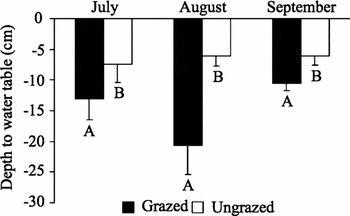
Soil temperature on 21 June 2007 averaged 13.5 °C in the grazed and 10.9 °C in the ungrazed areas. The minimum and maximum air temperatures were 9.4 °C and 18.4 °C, respectively, on this date (Environment Canada 2007). The average depth to water table in each month was lower (F1,4 = 15.5, p = 0.017; Fig. 2) in the grazed than the ungrazed area.
Depth to water table (±SE) in grazed and ungrazed areas of the high marsh. Different letter represents overall treatment effects. Means within months are significantly different.

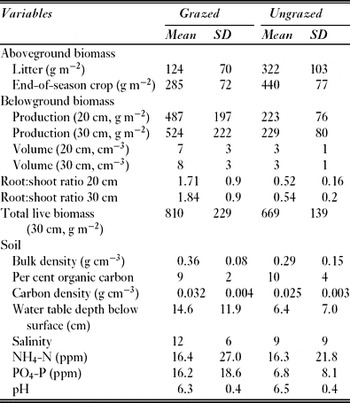
With the exception of salinity, there was no significant difference in pore water chemistry between grazed and ungrazed areas (Table 1). Averaged over the growing season, salinity was 12 and 9 in grazed and ungrazed areas, respectively (F1,4 = 6.2, p = 0.048).
Mean and standard deviation of biomass, soil, water table and porewater chemistry variables. Belowground variables are given for the surface 20 cm and estimated for 30 cm, as the lowermost section was normalized to 10 cm.

There was no significant difference in bulk density (F1,17 = 1.3, p = 0.271) or per cent organic carbon between grazed and ungrazed soils (F1,17 = 0.4, p = 0.536). In contrast, average soil carbon density of the grazed soil (0.032 gC cm−3) was significantly higher than in ungrazed soil (0.025 gC cm−3) (F1,17 = 25.1, p < 0.001).
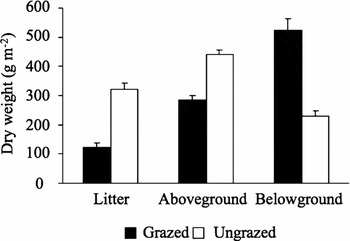
The litter mass in May was significantly lower (F1,18 = 25.3, p < 0.001) in the grazed than ungrazed marsh (124 and 322 g m−2, respectively). End-of-season standing crop was nearly one-third greater in the ungrazed area than in the grazed area (F1,17 = 21.3, p < 0.001; Fig. 3). The per cent carbon of the vegetation harvested from the grazed area was significantly higher (F1,8 = 6.2, p = 0.022), but on an areal basis, average (± SD) nitrogen and carbon content of aboveground biomass (3.5 ± 1.4 gN m−2 and 127.2 ± 32.6 gC m−2) was significantly lower than ungrazed samples (4.8 ± 0.9 gN m−2 and 186.5 ± 23.1 gC m−2). There was no difference in C:N ratio (F1,8 = 0.007, p = 0.933).
Average litter, aboveground (end-of-season standing crop) and belowground (30 cm depth) dry weight biomass (±SE). Means within each variable are significantly different.

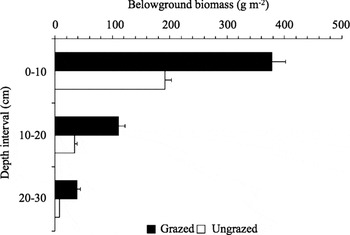
Average belowground biomass was significantly greater in the grazed samples, whether we consider biomass normalized to 30 cm depth or that held in the top 20 or 10 cm (Table 1, Fig. 3). Cumulative belowground production to either 20 or 30 cm depth in the grazed area (487 and 524 g m−2, respectively) was more than twice that in the ungrazed area (223 and 229 g m−2, respectively; Fig. 4). Average cumulative root volume followed the same pattern; it was also significantly higher in the grazed (8 cm−3) than ungrazed area (3 cm−3) to 30 cm depth (F1,16 = 18.6, p = 0.001). The volume of roots measured would comprise 1.3% of grazed soil volume (within a depth of 30 cm) compared to 0.5% in the ungrazed soil.
Cumulative belowground biomass (±SE) in each 10 cm interval. The 20–30 cm interval was normalized.

There was no significant difference in combined above and belowground production between grazed and ungrazed areas (F1,18 = 2.8, p = 0.113). However, there was a significant difference in root to shoot ratio; this was 1.8 in the grazed marsh and only 0.5 in the ungrazed marsh (F1,18 = 23.2, p < 0.001).
DISCUSSION
In the ungrazed marsh at Île Verte, aboveground production was lower than for more southern marshes, fitting the trend of declining aboveground production with increasing latitude and colder climates (Turner Reference Turner1976). The density of soil carbon is also consistent with increasing density with decreasing average annual temperature as noted in S. patens marshes (Chmura et al. Reference Chmura, Anisfeld, Cahoon and Lynch2003). Chmura et al. (Reference Chmura, Anisfeld, Cahoon and Lynch2003) surmised that increased rates of decomposition driven by higher temperatures at lower latitudes overcome the high rates of biomass production; thus soil carbon density increases with latitude. Our results from Île Verte expand this knowledge because it has a colder climate than any Spartina-dominated marsh where carbon density has been reported.
Potential impacts of grazing on root production and soil carbon
Greater root production in the grazed area is likely owing to a combination of better drained soils (lower water tables), higher salinities of soil porewater and a longer grower season. All could be a response to grazing, but differences in soil drainage and salinity could also be owing to differences in geomorphic factors between the grazed and ungrazed areas. The width of the salt marsh in the grazed area is greater than in the ungrazed area, and the distance from a station to the upland was greater. Thus freshwater drainage from adjacent terrestrial slopes may have had a greater influence on water tables and porewater salinity.
However, if these soil water conditions were due to geomorphic factors, the grazing history did not reduce production of belowground biomass or soil carbon below values of the adjacent marsh. Our lack of detection of clearly deleterious effects is likely owing to the cold climate, controlled low-density grazing and the type of grazer (sheep) at Île Verte. Differences in one or more of these factors have caused degradation of marsh conditions in regions to the north and south of the St Lawrence River estuary.
The response of root production to controlled grazing at Île Verte may be unique to tidal salt marshes in cold climates. The decreased aboveground growth and litter allowed more light to reach the soil surface, which increased soil temperature, depth and period the soil was unfrozen, allowing increased belowground production. Increased light and warmer soils increase evapotranspiration, which increases soil salinity (Bertness et al. Reference Bertness, Gough and Shumway1992). Even in tidal salt marshes, increased soil salinity increases plant stress and the demand for nitrogen to produce enzymes critical for maintaining osmotic equilibrium (Crain Reference Crain2007). Greater root production was not only possible due to greater overall soil volume available from May to October, but was needed to meet higher nitrogen demands associated with greater salinity stress in the grazed soil. From our study it is not possible to determine if greater belowground production would occur under active grazing at Île Verte. If grazing practices are renewed, further study will be worthwhile.
The response of soil temperature to grazing is not unique to Île Verte. On the Wadden Sea, where grazing intensity is similar to Île Verte (3–5 sheep ha−1), marsh soil temperatures at 5 cm below soil surface were 0.5–4 °C higher in grazed marsh (Meyer et al. Reference Meyer, Fock, Haase, Reinke and Tulowitzki1995). At Île Verte, on 21 June 2007, the average difference in soil temperatures between the grazed and ungrazed stations was 2.5 °C and differences were as great as 9 °C. Lower soil temperatures were measured at ungrazed stations, despite the fact that they were taken in the afternoon and grazed stations were monitored in the morning of the same day.
Our results vary from other studies in Canadian salt marshes where negative impacts of waterfowl grazing occur owing to increased soil salinity. Jefferies and colleagues worked in Arctic salt marshes where higher evapotranspiration rates under grazing by the lesser snow goose (Chen caerulescens caerulescens) resulted in soil salinities that limited plant growth (Iacobelli & Jefferies Reference Iacobelli and Jefferies1991; Srivastava & Jefferies Reference Srivastava and Jefferies1995, Reference Srivastava and Jefferies1996). Increased soil salinity in these Hudson Bay marshes was due to upward movement of salt from subsurface fossil deposits (Price & Woo Reference Price and Woo1988). Two of the dominant species in the Hudson Bay marshes, Puccinellia phryganodes and Carex subspathacea are not commonly found where soil salinities are >15.4. They likely are less salt tolerant than S. patens, which is regularly found at salinities > 25 (for example Pezeshki & DeLaune Reference Pezeshki and DeLaune1991).
Beside the differences in plant tolerance to salinity levels and substrate, the lesser snow goose is causing marsh degradation because of high densities (Jefferies et al. Reference Jefferies, Rockwell and Abraham2004), intense feeding for ≥20 h day−1 (Cargill & Jefferies Reference Cargill and Jefferies1984) and duration of feeding from June to mid-August (Bazely & Jefferies Reference Bazely and Jefferies1986). In the spring before shoot growth, the breeding adults will grub for roots and rhizomes, further damaging the salt marsh plant community (Iacobelli & Jefferies Reference Iacobelli and Jefferies1991). This intensive uncontrolled grazing provides no opportunity for these Arctic salt marshes to recover.
At lower latitudes, hypersalinity occurs in salt marshes because higher temperatures drive greater levels of evapotranspiration. In these salt marshes the removal of aboveground biomass, which moderates soil temperatures, can lead to excessive evapotranspiration rates and adverse effects on plant production (Pennings & Bertness Reference Pennings, Bertness, Bertness, Gaines and Hay2001). In Louisiana, Ford and Grace (Reference Ford and Grace1998) reported that grazing resulted in a 75% decrease in aboveground biomass and increase in ambient light levels reaching the soil surface from 17% in ungrazed plots to about 75% in grazed plots (Ford & Grace Reference Ford and Grace1998).
At Île Verte, the higher belowground production in grazed soils (117% more than ungrazed) contributed to higher soil carbon content. This outcome would not be predicted, if based upon observations from warmer climates in the north-western Atlantic. Grazing by feral ponies in a Georgia low marsh resulted in 51–72% decrease of S. alterniflora belowground biomass and a decrease in carbon input and accumulation (Reader & Craft Reference Reader and Craft1999). In Louisiana, grazing by nutria and wild boar resulted in nearly 50% reduction in S. patens belowground biomass (Ford & Grace Reference Ford and Grace1998). Seliskar (Reference Seliskar2003) found a decrease in above- and belowground biomass of S. patens from feral horses grazing on Assateague Island. The grazing was neither controlled nor seasonal at the southern salt marshes.
Implications for marsh sustainability and restoration
Soil organic matter is critical to vertical accretion of tidal salt marshes (DeLaune et al. Reference DeLaune, Patrick and van Breemen1990; Nyman et al. Reference Nyman, Chabreck and Kinler1993; Turner et al. Reference Turner, Swenson, Milan, Weinstein and Kreeger2001; Chmura & Hung Reference Chmura and Hung2004), and thus to the ability of a marsh to maintain its elevation under rising sea levels. Our results suggest that, in cold climate marshes, controlled grazing may increase the organic matter content of the soil, and may thus enhance the vertical accretion required for marsh sustainability under rising sea levels. Such considerations are important in light of the threat of the more rapid rise of sea level associated with global warming (Bindoff et al. Reference Bindoff, Willebrand, Artale, Cazenave, Gregory, Gulev, Hanawa, Le Quéré, Levitus, Nojiri, Shum, Talley, Unnikrishnan, Solomon, Qin, Manning, Chen, Marquis, Averyt, Tignor and Miller2007).
Greater carbon sequestration in salt marshes used for grazing could provide an economic incentive to restore salt marshes drained for agriculture. The Chicago Climate Exchange is already buying carbon credits for changes in agricultural practices in North America. For instance, a rancher in Montana is receiving a yearly income of US$ 30 000 for cessation of grazing on his rangeland (Ahearn Reference Ahearn2008). Drained marshes do not sequester carbon and the carbon previously stored is subject to loss as decomposition proceeds under drained conditions. Restoration of tidal flooding would return the carbon sink to these marshes, and our study suggests that the value of this sink would not be compromised if the restored marsh were used for controlled grazing. The value of the carbon stored in salt marsh soils is high relative to that stored in terrestrial ecosystems and freshwater wetlands. The last two ecosystems release methane, a greenhouse gas with higher warming potential than carbon dioxide, while salt marshes release negligible amounts of methane (Bridgham et al. Reference Bridgham, Megonigal, Keller, Bliss and Trettin2006, Keppler et al. Reference Keppler, Hamilton, Brab and Rockmann2006). In addition, the carbon sequestered in salt marsh soils represents a long-term sink, that remains as long as the salt marsh does not erode.
Rather than posing a loss of livelihood for the agricultural sector, transformation of a drained salt marsh could present a win-win situation as owners could benefit from carbon payments and, contrary to the rangeland situation, continued agricultural production. The agricultural value of the marsh could be substantial. The meat of livestock once grazed on the salt marshes of the St Lawrence estuary was highly prized (Hatvany Reference Hatvany2003), but now many of those marshes have been dyked and drained. The meat of lambs grazed on the salt marshes of Mont-St-Michel Bay in France is highly sought after, and flocks of sheep provide added value as a tourist attraction. When it was being produced, the meat from the Île Verte lambs fetched as much as four times the price of conventionally grazed lamb.
Before livestock grazing can be recommended, more research is needed. Previous grazing studies on salt marshes indicate that the effect of grazing is dependent on the type of grazers and their density, as well as duration of grazing. Controls of these factors must be considered in any proposal for grazing.
Livestock grazing merits consideration as an economic incentive to restore a dykeland. Most ecosystem services of salt marsh are lost under drainage. Restoration of reclaimed marshes returns most of the ecosystem services, many of which could be retained alongside grazing. For instance, ponds on the soil surface provide fish habitat and forage sites for water birds. Seasonal restrictions and rotational systems of livestock grazing could allow wild fauna to graze in the absence of livestock, as observed on Île Verte. Higher levels of grazing by waterfowl would also strengthen predation on herbivores, such as snails, which can be a negative top-down control on marsh vegetation (Bertness & Silliman 2008). On a landscape scale, reversion of dykelands to salt marshes would have a wider ecological impact by lowering the human contribution to degradation of sub-Arctic marshes by removal of a food source for migratory birds (Jefferies et al. Reference Jefferies, Rockwell and Abraham2004).
Although livestock grazing in salt marshes is prohibited in many regions today, relaxation of regulations with regards to restoration sites would expand the interest and means for marsh restoration. The possibility of grazing as a sustainable use in cool temperate and boreal salt marshes is worthy of consideration and further research to quantify the potential for carbon storage and sustainability of other ecosystem services under active grazing regimes.
ACKNOWLEDGEMENTS
This research was supported by an NSERC Discovery Grant to G. Chmura and partial funding from the Global Environmental and Climate Change Centre to O. Yu. We are grateful to the residents of Île Verte for allowing us access and providing assistance during our visits, particularly Collette Caron and Charles Méthé; the last was instrumental in the origin and execution of the project. We thank M. Beaumier, A. Mloszewska, M. Kim and M. Graf for assistance in the field, and L. King and K. Yu for help with lab processing. We appreciate comments from anonymous reviewers that helped improve the manuscript.