Introduction
How does depression affect higher-order cognition? Given its association with maladaptive rumination (Nolen-Hoeksema, Reference Nolen-Hoeksema1991) and abnormal frontal lobe function (Wagner et al. Reference Wagner, Sinsel, Sobanski, Köhler, Marinou, Mentzel, Sauer and Schlösser2006), one might expect depression to weaken executive function, which encompasses the exertion of cognitive control to achieve goals despite obstacles. Indeed, a meta-analysis of 113 studies found broadly negative effects of major depressive disorder (MDD) on executive function (Snyder, Reference Snyder2013), linking MDD to impaired performance on tasks tapping inhibition, set-shifting, and working memory updating. Thus, the negative relationship between depression and executive function is well-established.
However, a close reading of the literature reveals a puzzle: several studies report positive effects of depression and sad mood on tasks that would seem to depend on executive function. For instance, Snyder et al. (Reference Snyder, Kaiser, Whisman, Turner, Guild and Munakata2014) reported that, although anxiety impaired selection from amongst competing response options in three language tasks, increased depression facilitated selection (after accounting for variance associated with anxiety). Along similar lines, Au et al. (Reference Au, Chan, Wang and Vertinsky2013) assessed the effects of sad, positive, and neutral moods on decision-making during financial trading. Across two experiments, sad mood was associated with accurate decisions and conservative allocation strategies, leading to financial gains. By contrast, positive mood was linked to inaccurate decisions coupled with aggressive allocations, leading to poor outcomes: while participants in sad moods profited, those in positive moods incurred net losses. Although sad mood and depression are not equivalent, the fact that excessive sadness is a cardinal symptom of depression (APA, 2013) makes these results surprising: one might have expected a negative effect of sad mood on complex financial decisions, which surely involve executive function.
Research with the Eriksen flanker task (Eriksen & Eriksen, Reference Eriksen and Eriksen1974) has also yielded counterintuitive findings. Several versions of the flanker task exist, but they share a common structure: participants must report the identity of a centrally presented stimulus that is surrounded by flankers, which call for either the same response as the central stimulus (congruent condition) or the opposite response (incongruent condition). In the arrow flanker task, participants report the direction (left or right) of a central arrow that is flanked by arrows pointing in the same direction (congruent: <<<<< or >>>>) or the opposite direction (incongruent: <<><< or >><>>). Typically, response time (RT) is slower and accuracy is lower in the incongruent condition due to interference introduced by the misleading flankers. Resisting this interference suggests intact executive function.
Against this backdrop, results from two flanker studies are striking (Dubal et al. Reference Dubal, Pierson and Jouvent2000; Dubal & Jouvent, Reference Dubal and Jouvent2004). In these studies, undergraduates with severe anhedonia responded more slowly but also more accurately on incongruent trials than did healthy participants, suggesting that executive function was delayed but intact. Because anhedonia is the second cardinal symptom of MDD (APA, 2013), these data accentuate the paradox: MDD is associated with executive dysfunction, but its defining symptoms – anhedonia and sadness – are sometimes associated with high accuracy on cognitive control tasks. Finally, there is evidence that this result extends to clinical samples, as several studies that have administered the flanker and Stroop tasks to adults with MDD and healthy controls have found slower but more accurate responses in depressed participants, although the accuracy effect is typically non-significant in small samples (e.g. Siegle et al. Reference Siegle, Steinhauer and Thase2004; Chiu & Deldin, Reference Chiu and Deldin2007; Holmes & Pizzagalli, Reference Holmes and Pizzagalli2010).
If depression involves diminished executive function, what explains this pattern? To date, answers to this question have appealed to cognitive styles. Depressed individuals adopt a deliberative, analytical stance towards information processing (Andrews et al. Reference Andrews, Aggen, Miller, Radi, Dencoff and Neale2007; Andrews & Thomson, Reference Andrews and Thomson2009). When a task calls for rapid, intuitive decisions, this is counterproductive and accuracy suffers (e.g. Ambady & Gray, Reference Ambady and Gray2002). But when fast responses are likely to produce errors, the careful approach associated with depression can support high accuracy.
This naturally raises a second question: why is depression associated with a systematic information processing style? One possibility is that depressed individuals are especially motivated to avoid the negative emotions triggered by errors (e.g. Robinson et al. Reference Robinson, Meier, Wilkowski and Ode2007). Alternatively, depression rumination may be an evolved response that serves to limit distraction and focus cognitive resources in order to identify the causes of low mood (Andrews & Thomson, Reference Andrews and Thomson2009). These explanations are intriguing, but it may prove useful to study depression in the context of computational models of response inhibition, which provide quantitative estimates of specific cognitive processes that may be sensitive to MDD. We take this approach by applying a modified drift diffusion model (DDM; Ratcliff & McKoon, Reference Ratcliff and McKoon2008; Noorani & Carpenter, Reference Noorani and Carpenter2013) to flanker data from healthy controls and a large depressed sample.
Briefly, the model decomposes performance in the flanker task into separate parameters that reflect prepotent response bias, response inhibition, and executive function, providing an opportunity to determine which (if any) of these parameters is affected by depression (Hübner et al. Reference Hübner, Steinhauser and Lehle2010; White et al. Reference White, Ratcliff and Starns2011; Pe et al. Reference Pe, Vandekerckhove and Kuppens2013). Furthermore, because the DDM has been fit to data from neural network simulations of cortico-striatal-thalamic circuits (Ratcliff & Frank, Reference Ratcliff and Frank2012; see also Wiecki & Frank, Reference Wiecki and Frank2013), results from the DDM may suggest hypotheses about brain function in depression. Response inhibition depends on fronto-striatal circuits that receive dopaminergic projections from the midbrain (Wiecki & Frank, Reference Wiecki and Frank2013), and that are dysfunctional in anhedonic depression (Epstein et al. Reference Epstein, Pan, Kocsis, Yang, Butler, Chusid, Hochberg, Murrough, Strohmayer, Stern and Silbersweig2006; Pizzagalli et al. Reference Pizzagalli, Holmes, Dillon, Goetz, Birk, Bogdan, Dougherty, Iosifescu, Rauch and Fava2009; Treadway & Zald, Reference Treadway and Zald2011; Dillon et al. Reference Dillon, Rosso, Pechtel, Killgore, Rauch and Pizzagalli2014). Consequently, slow but accurate performance in tasks that probe response inhibition – such as the flanker task – may reflect dysfunction in fronto-striatal circuitry, and results from the DDM could suggest which aspects of this circuitry are most strongly affected by depression (Montague et al. Reference Montague, Dolan, Friston and Dayan2012; Wiecki et al. in press).
Method
The data described here were collected in a multi-site study entitled ‘Establishing Moderators and Biosignatures of Antidepressant Response for Clinical Care for Depression’ (EMBARC) (http://clinicaltrials.gov/show/NCT01407094). Recruiting sites are Columbia University Medical Center in New York City, Massachusetts General Hospital in Boston, the University of Texas Southwestern Medical Center in Dallas, and the University of Michigan in Ann Arbor. Participants with unipolar depression completed several behavioral, self-report, and physiological assessments prior to enrolling in a double-blind, placebo-controlled clinical trial designed to identify biomarkers of response to sertraline and bupropion. Data collection is ongoing and the blind is unbroken, thus we are unable to consider treatment outcomes. We present an analysis of flanker task data from the first 100 depressed participants enrolled in the study and 40 healthy controls. McLean Hospital was responsible for analysis of flanker data.
Participant recruitment, eligibility criteria, and reimbursement
Participants were recruited using flyers and posters, and by research coordinators who visited local clinics. Participants provided informed consent following procedures approved by site IRBs. Adults aged 18–65 years of all races and ethnicities were invited to participate. Eligible depressed participants met DSM-IV criteria for non-psychotic MDD, as assessed via the SCID-I/P (First et al. Reference First, Spitzer, Gibbon and Williams2002), and scored ⩾14 on the self-report version of the 16-item Quick Inventory of Depression Symptomatology (QIDS-SR16; Rush et al. Reference Rush, Trivedi, Ibrahim, Carmody, Arnow, Klein, Markowitz, Ninan, Kornstein, Manber, Thase, Kocsis and Keller2003); this cut-off corresponds to moderate depression. Exclusion criteria included: lifetime psychotic depressive, schizophrenic, bipolar, schizoaffective, or other Axis I psychotic disorder; current primary diagnosis of obsessive compulsive disorder; substance dependence in the past 6 months (excluding nicotine) or substance abuse in the past 2 months; active suicidality; or unstable medical conditions that would likely require hospitalization during the study. Critically, no depressed participant was being treated with antidepressant or other psychotropic medication for at least 3 weeks when the data described here were collected.
Data from two depressed individuals were excluded due to difficulty following instructions and technical problems, leaving a sample of 98 depressed participants and 40 healthy controls. Controls did not meet criteria for any current or lifetime history of mood, anxiety, eating, dementing, or psychotic disorder, did not meet any of the other exclusion criteria in place for the depressed group, and had a QIDS-SR score of <8. Participants were paid $50 for the session, which included additional testing not described here.
Questionnaires
Participants in the EMBARC study complete an extensive clinical evaluation battery, including clinician- and participant-rated instruments probing various domains, including lifetime diagnosis, personality traits, and social functioning. Because flanker performance is sensitive to anhedonia (Dubal et al. Reference Dubal, Pierson and Jouvent2000; Dubal & Jouvent, Reference Dubal and Jouvent2004) and may be influenced by depressive severity (Chiu & Deldin, Reference Chiu and Deldin2007), we concentrate on data from the QIDS-SR16 and the Snaith Hamilton Pleasure Scale (SHAPS; Snaith et al. Reference Snaith, Hamilton, Morley, Humayan, Hargreaves and Trigwell1995). The QIDS-SR16 is a self-report instrument that assesses core DSM-IV diagnostic criteria for MDD. It has acceptable psychometric properties and demonstrates convergent validity with other measures of depression (Rush et al. Reference Rush, Trivedi, Ibrahim, Carmody, Arnow, Klein, Markowitz, Ninan, Kornstein, Manber, Thase, Kocsis and Keller2003). The SHAPS was used to assess hedonic capacity and was scored dimensionally, with higher scores indicating greater anhedonia (Franken et al. Reference Franken, Rassin and Muris2007). Finally, we also tested the hypothesis that flanker performance would be negatively associated with the number of depressive episodes reported (we thank an anonymous reviewer for this suggestion). The distribution of number of depressive episodes was positively skewed, thus we binned these data into six categories (number of episodes: 1, n = 10; 2–3, n = 17; 4–5, n = 13; 6–10, n = 27; 11–30, n = 16; >30, n = 7; unrecorded, n = 2).
Flanker task
Participants completed a 30-trial practice session that included 15 congruent and 15 incongruent trials. The flanking arrows were presented alone (duration: 100 ms) and were then joined by the central arrow (50 ms); the total stimulus duration was thus 150 ms. Participants were asked to indicate whether the center arrow pointed left or right by pressing a button, and accuracy and RT were recorded.
Participants then completed five blocks of 70 trials (46 congruent, 24 incongruent), for a total of 350 trials (230 congruent, 120 incongruent). To ensure adequate difficulty, a response deadline corresponding to the 85th percentile of the RT distribution on incongruent trials in the preceding block was established; for the first block, the practice RT distribution was used (Holmes et al. Reference Holmes, Bogden and Pizzagalli2010). Stimulus presentation was followed by a fixation cross (1400 ms). If the participant did not respond by the response deadline, a screen reading ‘too slow!’ was presented (300 ms). Participants were told that if they saw this screen, they should speed up. If a response was made before the deadline, the ‘too slow!’ screen was omitted and the fixation cross remained on screen for the 300 ms interval. Finally, each trial ended with presentation of the fixation cross for an additional 200–400 ms. Thus, trial duration varied between 2050–2250 ms. The sequence of congruent and incongruent trials was created using optseq2 (http://surfer.nmr.mgh.harvard.edu/optseq/) and was identical across participants.
While data collection was ongoing, block-by-block feedback was added to the paradigm to maintain performance at desired levels. If participants made fewer than three incongruent errors in a block, the following instructions were presented after the block: ‘Remember to respond as quickly as possible while still being accurate’. If ⩾6 incongruent errors were made, the screen read, ‘Remember to respond as accurately as possible while still being fast’. Otherwise, the screen read, ‘Please respond as quickly and accurately as possible’. Block-by-block feedback was presented to 7/40 controls and 42/98 depressed participants.
Quality control
Quality control checks were used to exclude datasets characterized by unusually poor performance. First, for each participant outlier trials were defined as those in which the raw RT was <150 ms or the log-transformed RT exceeded the participant's mean ± 3s.d., computed separately for congruent and incongruent stimuli. Second, we excluded datasets with: ⩾35 RT outliers (>10% of trials), <200 outlier-free congruent trials, <90 outlier-free incongruent trials, or <50% correct for congruent or incongruent trials. Data from 92 depressed and 37 healthy participants passed these checks and constitute the final sample. Trials characterized by RT outliers were excluded from all analyses.
Analysis of flanker interference effects on accuracy and RT
We computed linear mixed models on trial-level RT and accuracy data using the lme4 package (version 1.1.7) in the R software environment (R Core Team, 2013). In the first model, RT was the dependent variable. We expected depressed adults to respond more slowly than controls, particularly in response to incongruent stimuli (Snyder, Reference Snyder2013), thus we included Group and Stimulus as independent variables. Furthermore, errors are typically faster than correct responses on incongruent but not congruent trials in the flanker task (Wiecki & Frank, Reference Wiecki and Frank2013), and there is evidence of hypersensitivity to errors in MDD (Chiu & Deldin, Reference Chiu and Deldin2007; Holmes & Pizzagalli, Reference Holmes and Pizzagalli2008), thus Accuracy was added as another independent variable. Site was included as covariate. In the second model, accuracy was the dependent variable and the independent variables were Group and Stimulus, with Site as a covariate. Because accuracy was scored as 0 or 1, logistic regression was used for this model. Participant was entered as a random effect in both models. Follow-up tests for significant interactions were conducted using the lsmeans (version 2.11) package in R. Additional analyses focused on congruency sequence effects (Gratton et al. Reference Gratton, Coles and Donchin1992) and post-error behavioral adjustments (Rabbitt, Reference Rabbitt1966; Laming, Reference Laming1979) did not reveal any group differences; they are presented in the Supplementary online Appendix.
Computational modeling
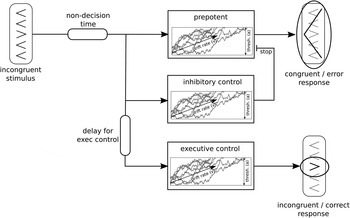
Our computational model uses a modified version of the Linear Approach to Threshold with Ergodic Rate (LATER; Noorani & Carpenter, Reference Noorani and Carpenter2013); the key modification is that noise in the accumulation process is explicitly modeled. This should not yield qualitatively different interpretations as these models are closely related (Bogacz et al. Reference Bogacz, Brown, Moehlis, Holmes and Cohen2006; Donkin et al. Reference Donkin, Brown, Heathcote and Wagenmakers2011). Behavior reflects the output of three mechanisms: (i) a prepotent, reflexive mechanism biased to respond according to the distracting flankers; (ii) inhibitory control, which can suppress the prepotent response tendency; and (iii) executive control, needed to initiate the correct response on incongruent trials. As shown in Fig. 1, each mechanism is modeled as a drift process that progresses towards a shared threshold (i.e. one model parameter – denoted ‘a’ – controls the threshold setting for all three mechanisms). The drift processes reflect the accumulation of evidence from the stimulus presented on each trial, and they are noisy to simulate noise in the environment and sensory systems. The response executed by the model depends on which drift process crosses its threshold first. See online Appendix for details regarding the algorithm used to simulate trial-level data.
Computational model, adapted from the LATER model (Noorani & Carpenter, Reference Noorani and Carpenter2013) for application to the flanker task.

On congruent trials, responses are committed when the prepotent accumulator reaches threshold; because all arrows point in one direction on congruent trials, the inhibitory and executive control mechanisms are inactive. By contrast, the less frequent incongruent trials involve a race between the prepotent accumulator, which responds in agreement with the flanking arrows (Fig. 1, top), and the executive control unit, which responds according to the central arrow (Fig. 1, bottom). Onset of the executive control accumulator is delayed by a constant (Fig. 1, bottom left) that simulates time needed to retrieve and apply rules on incongruent trials (i.e. respond to the central arrow, not the flankers; Wiecki & Frank, Reference Wiecki and Frank2013). If the prepotent accumulator crosses its threshold first, the model commits an error (Fig. 1, top right). By contrast, if the executive control accumulator wins the race, the model makes the correct response (Fig. 1, bottom right). Finally, the inhibitory control accumulator acts as a brake, stopping the prepotent accumulator when its threshold is reached (Fig. 1, middle). Thus, the model has the following parameters: a shared threshold setting for all accumulators; drift rates for the prepotent, inhibitory, and executive control accumulators; a delay to onset for the executive control accumulator; and a constant, non-decision time capturing motor execution (Fig. 1, top left). RT corresponds to the passage time of the winning accumulator.
We fit the DDM to each participant's full distribution of RT data from congruent and incongruent trials simultaneously, and used Powell optimization (Powell, Reference Powell1964) with basin hopping (Wales & Doye, Reference Wales and Doye1997) to find the best-fitting model parameters while avoiding local maxima. Threshold settings and prepotent drift rate were shared across congruent and incongruent trials, while the inhibitory and executive control parameters were only fit to data from incongruent trials. Model fit was evaluated by probability density approximation (PDA; Turner & Sederberg, Reference Turner and Sederberg2014), which uses kernel density estimation of samples generated by the model (see online Appendix for details) and does not require a closed-form solution of the likelihood function. Optimal model fits were found by maximizing the summed log-likelihood (evaluated using PDA) of the RT and choice data from each subject. Weakly informative priors were placed on model parameters to constrain extreme model fits. Finally, we compared best-fitting DDM parameters across the groups.
Results
Demographics and clinical measures
There were no group differences (ts < 1.1, ps > 0.27) in age (controls: 36.22 ± 14.32; depressed: 39.16 ± 12.99) or years of education (controls: 15.77 ± 4.52; depressed: 15.06 ± 2.43). QIDS-SR16 scores were higher in depressed participants (18.48 ± 2.87) versus controls (1.46 ± 1.30), reflecting eligibility criteria. The mean QIDS-SR16 score in the depressed group indicates moderate depression (Rush et al. Reference Rush, Trivedi, Ibrahim, Carmody, Arnow, Klein, Markowitz, Ninan, Kornstein, Manber, Thase, Kocsis and Keller2003). SHAPS scores were higher in depressed participants (33.83 ± 5.99) versus controls (21.05 ± 5.37) (t 127 = 11.27, p < 0.001).
Flanker interference effects
RT
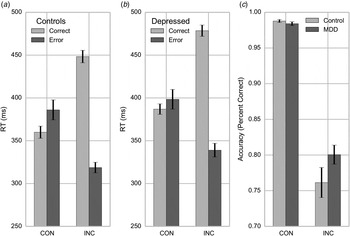
Controls (Fig. 2 a) and depressed participants (Fig. 2 b) responded more quickly on correct congruent trials versus correct incongruent trials, consistent with flanker interference. Both groups showed the opposite pattern when making errors, generating faster RTs on incorrect incongruent trials versus incorrect congruent trials. This pattern led to a Stimulus × Accuracy interaction (Z = 22.82, p < 0.001).
Flanker interference effects on (a) response time (RT) in controls, (b) RT in depressed participants, and (c) accuracy in both groups. Error bars indicate standard error of the mean. CON, Congruent; INC, incongruent.

The model also returned a Group × Accuracy interaction (Z = 3.28, p = 0.001), and a Group × Stimulus interaction (Z = 2.05, p = 0.040). Follow-up contrasts linked the Group × Accuracy interaction to a difference on correct trials: depressed participants were slower than controls (Z = −2.49, p = 0.013). There was no difference on error trials (p = 0.424). The Group × Stimulus interaction reflected a difference on incongruent trials, with depressed participants responding more slowly than controls (Z = −2.09, p = 0.037). Depressed participants were also slower on congruent trials, but this difference was not significant (p = 0.242). Thus, depressed participants responded more slowly than controls, with significant differences for correct responses and responses to incongruent stimuli. Slow responses on incongruent trials are common in depressed samples, consistent with executive function deficits (Snyder, Reference Snyder2013).
Accuracy
As shown in Fig. 2 c, both groups were more accurate when responding to congruent versus incongruent stimuli, consistent with flanker interference. However, depressed participants were more accurate than controls on incongruent trials, leading to a Group × Stimulus interaction (Z = 3.90, p < 0.001). Follow-up linear contrasts confirmed a (marginal) Group effect on incongruent trials (Z = −1.94, p = 0.053) that was absent on congruent trials (Z = 0.68, p = 0.495). This result echoes reports of better accuracy on incongruent trials in sad and anhedonic samples (Dubal et al. Reference Dubal, Pierson and Jouvent2000; Au et al. Reference Au, Chan, Wang and Vertinsky2013).
Block-by-block feedback
Two analyses investigated whether including block-by-block feedback for some participants influenced the RT and accuracy results. First, the linear models were re-computed with Version (feedback, no feedback) as an additional covariate. Version was not significant in either model, and all interactions reported above remained significant. Second, we re-computed the original models including only participants who did not receive feedback (33 controls, 42 MDD). Again, all reported interactions remained significant. Thus, including block-by-block feedback for some participants did not strongly influence the findings.
Computational modeling
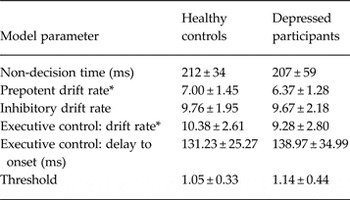
Table 1 shows best-fitting parameter values from the model. The executive control drift rate on incongruent trials was lower in depressed versus healthy participants (t 127 = −2.05, p = 0.043), consistent with slower executive function. However, the prepotent drift rate was also lower in depressed participants (t 127 = −2.40, p = 0.018). This is intriguing because weak prepotent bias might offset the executive control deficit (see online Appendix for distributions of both parameters).
Mean (±s.d.) best fitting parameter values from the drift diffusion model

* Depressed < Controls, p < 0.05.
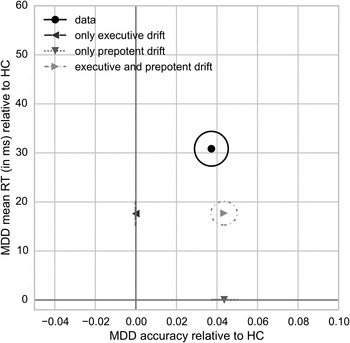
To test this hypothesis, we conducted simulations in which the model was used to generate artificial RT and accuracy data. In the first simulation, all model parameters were set to the best-fitting values for controls with the exception of the executive control drift rate, which was matched to the best-fitting value for the depressed participants. As shown in Fig. 3, this resulted in prolonged incongruent RT but no group difference in accuracy. In the second simulation, we returned the executive control drift rate to the controls’ value but set the prepotent drift rate to the best-fitting value for depressed participants. As can be seen in Fig. 3, this modulation accounted for the increase in accuracy but failed to capture the slow RTs seen on correct incongruent trials in depressed participants. The fact that there is no variability in accuracy when allowing executive control drift rate to change nor variability in RT when allowing prepotent drift rate to change is expected because these two parameters affect incongruent RT and accuracy independently in this parameter setting. In the third simulation, we set both the executive control and prepotent drift rates to best-fitting values for the depressed group, leaving all other parameters set to optimal values for controls. This yielded the pattern most similar to data from depressed participants (Fig. 3): responding on correct incongruent trials was slower, and the incongruent error rate was reduced. We corroborated this finding by performing model comparison using the Bayesian Information Criterion (BIC): lower scores indicate better model fit. The best-fitting model was the one that allowed for group differences in executive control and prepotent drift rate (BIC = 115.13); manipulating only executive drift rate (BIC = 124.33) or prepotent drift rate (BIC = 179.03) produced worse fits. Thus, accurate performance can emerge if executive control is sluggish, provided prepotent response bias is also decreased. The combination is critical: neither factor alone could account for the data.
Response time (RT) simulations isolate the effects of particular cognitive processes on behavior. Points indicate accuracy on incongruent trials (x axis) and mean RT on correct incongruent trials (y axis) for major depressive disorder (MDD) subjects relative to healthy controls (HC). Ellipses indicate standard error of the mean. The collected data revealed that depressed participants were slower and more accurate than controls on incongruent trials (‘data’, circle). Simulated data show that manipulation of only the executive control drift rate (‘only executive drift’, left-facing arrowhead) captured slowing in the MDD group but not the group difference in accuracy (difference relative to model with all parameters set to HC values). Conversely, manipulation of only the prepotent drift rate (‘only prepotent drift’; down-facing arrowhead) captured increased accuracy in the MDD group but not the increased RT (difference relative to model with all parameters set to HC values). Simultaneous adjustment of the executive control and prepotent drift rates (‘executive and prepotent drift’; right-facing arrowhead) yielded results that most closely match the combination of increased accuracy and prolonged incongruent RT in depressed participants. Note that the overall model fit displayed here is sub-optimal because, in order to isolate the effect of manipulating the prepotent and executive drift rates, all other parameters were set to best-fitting values from controls; overall model fit is improved when all parameters are set to optimal values for the MDD group.

Correlations
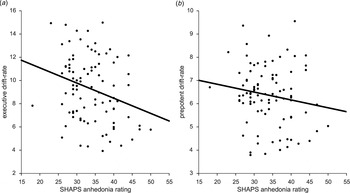
As shown in Fig. 4, we found a significant Pearson correlation between anhedonia, as assessed by the SHAPS total score, and executive control in the MDD group (r = −0.28, p = 0.007). The correlation with prepotent drift rate was not significant (r = −0.09, p = 0.40), and neither drift rate was correlated with QIDS-SR16 scores in the MDD group. Number of depressive episodes was positively correlated with congruent accuracy (r = 0.23, p = 0.03) and median correct RT on incongruent trials (r = 0.22, p = 0.04).
Self-reported anhedonia was negatively correlated with executive control drift rate (a) but not prepotent drift rate (b) in the depressed group. SHAPS, Snaith Hamilton Pleasure Scale.

Discussion
This study yielded three main results. First, responding on incongruent trials was slower but (marginally) more accurate in depressed versus healthy participants. Second, the DDM uncovered slow executive control and reduced prepotent response bias in the MDD group, with simulations indicating that the combination of these two factors best accounted for the observed group differences in accuracy and RT. Third, executive control was negatively correlated with anhedonia in depressed participants. These findings extend recent DDM research in depression and point to a candidate neural mechanism: tonically reduced striatal dopamine.
Using the DDM to probe depression
This study extends recent work by Vallesi et al. (Reference Vallesi, Canalaz, Balestrieri and Brambilla2015) that used the standard DDM to analyze data from a color perception task. Relative to controls, depressed participants in that study showed a lower drift rate that was negatively correlated with Hamilton Depression Rating Scale (HAMD) scores (Hamilton, Reference Hamilton1960). The current findings extend this study in two ways. First, the modified DDM afforded increased precision: we also found a negative effect of depression on drift rate, but it was specific to executive control and prepotency. Second, because the HAMD is sensitive to several facets of depression (Bagby et al. Reference Bagby, Ryder, Schuller and Marshall2004), it is difficult to know which ones are related to reduced drift rate. We found a negative relationship between executive control drift rate and anhedonia, linking this particular aspect of depression to deficits in executive function. Assessing the reliability and specificity of this relationship is a key goal for future work.
Additional points of convergence with the report by Vallesi et al. (Reference Vallesi, Canalaz, Balestrieri and Brambilla2015) merit consideration. First, neither study found a group difference in non-decision time, which captures processes such as response execution. This suggests that the observed group differences do not reflect psychomotor slowing. Second, neither study found an effect of depression on decision threshold. Consequently, the results do not simply reflect a speed-accuracy trade-off in depressed participants, because such a trade-off should yield a threshold difference (Dutilh et al. Reference Dutilh, Vandekerckhove, Forstmann, Keuleers, Brysbaert and Wagenmakers2012).
Reduced striatal dopamine in depression
We speculate that reduced executive and prepotent drift rates in depression reflects dysfunction in circuits that connect the basal ganglia to the frontal cortex, and that receive dopaminergic innervation from the midbrain. Selective activation of basal ganglia neurons in the Go and NoGo pathways acts to facilitate or suppress action plans stored in frontal cortex, making their execution more or less likely (Chevalier & Deniau, Reference Chevalier and Deniau1990; Mink, Reference Mink1996). The balance between facilitation and suppression is modulated by dopamine, which excites Go neurons and inhibits NoGo neurons (Frank, Reference Frank2005). Low concentrations of striatal dopamine disinhibit NoGo neurons and weakly activate Go neurons, leading to response slowing (Wiecki et al. Reference Wiecki, Riedinger, Meyerhofer, Schmidt and Frank2009; Wiecki & Frank, Reference Wiecki and Frank2010). This is true for habitual actions (parameterized by the prepotent drift rate) and volitional actions (parameterized by the executive control drift rate) (Wiecki & Frank, Reference Wiecki and Frank2013). Thus, low striatal dopamine could account for reduced prepotent and executive control drift rates in depressed participants, consistent with independent evidence of abnormal striatal dopamine concentration and function (Treadway & Zald, Reference Treadway and Zald2011; Dillon et al. Reference Dillon, Rosso, Pechtel, Killgore, Rauch and Pizzagalli2014). To resolve the paradox introduced earlier, tonically reduced striatal dopamine may help explain the coexistence of executive function deficits and accurate performance in depressed samples. Moreover, the positive correlation between number of depressive episodes and correct RT on incongruent trials indicates that mechanisms supporting action selection may be sensitive to cumulative effects of depression. Neuroimaging techniques sensitive to dopamine are needed to test these conjunctures.
Our data are intriguing in light of work on predictors of antidepressant treatment response. Specifically, psychomotor slowing predicts a poor response to selective serotonin reuptake inhibitors (SSRIs; Taylor et al. Reference Taylor, Bruder, Stewart, McGrath, Halperin, Ehrlichman and Quitkin2006; Bruder et al. Reference Bruder, Alvarenga, Alshculer, Abraham, Keilp, Hellerstein, Stewart and McGrath2014) but a good response to bupropion (Herrera-Guzmán et al. Reference Herrera-Guzmán, Gudayol-Ferré, Lira-Mandujano, Herrera-Abarca, Herrera-Guzmán, Montoya-Pérez and Guardia-Olmos2008; Bruder et al. Reference Bruder, Alvarenga, Alshculer, Abraham, Keilp, Hellerstein, Stewart and McGrath2014), which is a dopamine/noradrenaline reuptake inhibitor. The current results raise the possibility that slow but accurate performance on the flanker task, although not directly attributable to psychomotor slowing, may predict a better response to bupropion versus SSRIs. When treatment outcome data from the EMBARC study are available, we will be able to test this hypothesis.
Limitations
Two important limitations deserve mention. First, negative effects of depression are typically strongest in unconstrained tasks (Hertel, Reference Hertel1997). The flanker task features clear instructions and few response options, thus it may be less sensitive to depression and depressive rumination than more open-ended tasks. Second, while the computational model used here has been validated on the related antisaccade task (Noorani & Carpenter, Reference Noorani and Carpenter2013), other models have been successfully applied to the flanker task (Hübner et al. Reference Hübner, Steinhauser and Lehle2010; White et al. Reference White, Ratcliff and Starns2011). The relationship between these models is not well-established, and they might suggest negative effects of depression on different parameters.
Conclusions
Depressed participants responded more slowly and accurately than controls in the flanker task, consistent with prior findings. Because depression impairs executive function, highly accurate performance has been difficult to explain. We used computational modeling to show that reduced prepotent response bias offset slow executive control in MDD, and we speculate that these abnormalities may reflect reduced striatal dopamine.
Supplementary material
For supplementary material accompanying this paper visit http://dx.doi.org/10.1017/S0033291715000276.
Acknowledgements
The EMBARC study was supported by the National Institute of Mental Health of the National Institutes of Health under award numbers U01MH092221 (M. H. Trivedi,) and U01MH092250 (P. J. McGrath, R. V. Parsey, M. M. Weissman). The content is solely the responsibility of the authors and does not necessarily represent the official views of the National Institutes of Health. Valeant Pharmaceuticals donated the Wellbutrin XL used in the study. This work was supported by the EMBARC National Coordinating Center at UT Southwestern Medical Center (M. H. Trivedi, M.D., Coordinating PI), and the Data Center at Columbia and Stony Brook Universities. Dr Dillon was supported by NIMH grant R00MH094438.
Declaration of of Interest
D.G.D., T.W., P.P, C.W., F.G., L.M., P.J.M., M.W., R.P., B.K., P.A., T.C., S.W., K.S.-W., M.T., M.A.O., C.C., P.D., and G.B. declare no financial, professional, or personal relationships with the potential to bias this work. M. H. Trivedi is or has been an advisor/consultant to: Abbott Laboratories, Inc., Abdi Ibrahim, Akzo (Organon Pharmaceuticals Inc.), Alkermes, AstraZeneca, Axon Advisors, Bristol-Myers Squibb Company, Cephalon, Inc., Cerecor, Concert Pharmaceuticals, Inc., Eli Lilly & Company, Evotec, Fabre Kramer Pharmaceuticals, Inc., Forest Pharmaceuticals, GlaxoSmithKline, Janssen Global Services, LLC, Janssen Pharmaceutica Products, LP, Johnson & Johnson PRD, Libby, Lundbeck, Meade Johnson, MedAvante, Medtronic, Merck, Mitsubishi Tanabe Pharma Development America, Inc., Naurex, Neuronetics, Otsuka Pharmaceuticals, Pamlab, Parke-Davis Pharmaceuticals, Inc., Pfizer Inc., PgxHealth, Phoenix Marketing Solutions, Rexahn Pharmaceuticals, Ridge Diagnostics, Roche Products Ltd., Sepracor, SHIRE Development, Sierra, SK Life and Science, Sunovion, Takeda, Tal Medical/Puretech Venture, Targacept, Transcept, VantagePoint, Vivus, and Wyeth-Ayerst Laboratories. In addition, he has received research support from: Agency for Healthcare Research and Quality (AHRQ), Corcept Therapeutics, Inc., Cyberonics, Inc., National Alliance for Research in Schizophrenia and Depression, National Institute of Mental Health, National Institute on Drug Abuse, Novartis, Pharmacia & Upjohn, Predix Pharmaceuticals (Epix), and Solvay Pharmaceuticals, Inc. B. Kurian has received grant support from the following additional sources: Targacept, Inc.; Pfizer, Inc.; Johnson & Johnson; Evotec; Rexahn; Naurex; Forest Pharmaceuticals. M. McInnis has consulted for and been on speakers’ bureaux with Janssen, Merck, and Lily Pharmaceuticals in the past 5 years. For a comprehensive list of lifetime disclosures of Dr Fava, see http://mghcme.org/faculty/faculty-detail/maurizio_fava. Over the past 3 years, Dr Pizzagalli has received honoraria/consulting fees from Advanced Neuro Technology North America, AstraZeneca, Otsuka America Pharmaceutical, Pfizer, and Servier.