Introduction
A problem-solving orientation and trust among political actors have positive impacts on policy-making processes and outputs (Scharpf Reference Scharpf1997; Leach and Sabatier Reference Kriesi, Grande, Lachat, Dolezal, Bornschier and Frey2005; Lubell Reference Lowi2007; Berardo Reference Berardo2009). On the contrary, a non-collaborative attitude and mistrust between actors jeopardise the elaboration of effective policy solutions, be it among individual actors such as MPs, among collective political actors such as interest groups, parties or public administrations or among states on the international level. Mistrust and conflict among political actors, in turn, may be based on sociopsychological mechanisms rather than on real disagreements over substantive policy issues. The “devil shift” phenomenon (Sabatier et al. Reference Sabatier, Hunter and McLaughlin1987) describes situations where political actors systematically misperceive their opponents. The argument implies two distinct, complementary dimensions. First, policy actors remember losses more vividly than policy gains. They, therefore, fear their opponents and tend to see them as more powerful than they really are. Second, because having a positive image of opponents is difficult to actors, they also overestimate the divergence over values and policy beliefs with their opponents. Consequently, they evaluate them as more evil than they actually are (Sabatier et al. Reference Sabatier, Hunter and McLaughlin1987).
The devil shift phenomenon has detrimental consequences for both political actors and policy processes. On one hand, mistrust among actors strengthens boundaries between coalitions, favours long-term disagreement about problem definitions and hampers compromise finding. On the other hand, one of the critical informational requirements for political actors to be able to choose among alternative strategies in policy processes is their ability to accurately assess the goals and resources of their adversaries (Sabatier et al. Reference Sabatier, Hunter and McLaughlin1987). If actors lack this ability, they are unable to choose the appropriate negotiation strategy. Thus, policy processes and related outputs are affected by the devil shift.
Given its strong theoretical claim and potentially far-reaching implications, it is surprising to see that the devil shift phenomenon has been analysed in very few empirical studies (Sabatier et al. Reference Sabatier, Hunter and McLaughlin1987; Leach and Sabatier Reference Kriesi, Grande, Lachat, Dolezal, Bornschier and Frey2005; Weible et al. Reference Weible, Sabatier and McQueen2009; Weible et al. Reference Weible, Sabatier, Jenkins-Smith, Nohrstedt, Henry and DeLeon2011a). Despite having originated in the Advocacy Coalition Framework (ACF, Sabatier and Jenkins-Smith Reference Sabatier and Jenkins-Smith1993; Jenkins-Smith and Sabatier Reference Ingold and Fischer1994), the argument has been overlooked in many ACF applications (Weible et al. Reference Weible, Sabatier and McQueen2009, Reference Weible, Sabatier, Jenkins-Smith, Nohrstedt, Henry and DeLeon2011a). In addition, to our knowledge, it has not been incorporated in other public policy approaches so far.
Against this background, the first purpose of this article is to measure whether and to what extent the devil shift occurs in policy processes. Second, we wish to identify the actor- and process-related factors behind the devil shift. To that end, we apply regression models to data from 212 face-to-face interviews with actors participating in the nine most important policy processes in Switzerland between 2001 and 2006. Our contribution is threefold. First, by considering the devil shift as a dependent variable influenced by both actor and process characteristics, we take an important step towards understanding the mechanisms leading to this phenomenon and related detrimental consequences for the policy process. Second, by systematically comparing nine different policy-making processes, we can check for the robustness of our findings in a variety of policy contexts (Weible and Sabatier Reference Weible and Sabatier2005, 195; Henry Reference Heaney2011, 367). Third, we look at the devil shift in a country that can be seen as a least likely case – namely, Switzerland. Switzerland has been portrayed as the paradigmatic case of consensus democracy (Lijphart Reference Leifeld and Schneider1999) and of corporatist policymaking (Katzenstein Reference Kahnemann and Tversky1985). In such a context, policy processes are especially collaborative, which should involve low levels of devil shift (Weible et al. Reference Weible, Siddiki and Pierce2011b). Therefore, if the devil shift phenomenon shows up in our Swiss case, then the empirical findings of this study should also be relevant in other democracies.
The remainder of the article is structured as follows: in the next section, we review the scarce literature on the devil shift phenomenon. We then develop our theoretical argument and formulate hypotheses about factors that are conducive to the devil shift – i.e. which lead actors to overestimate the power and the evilness of their opponents. We differentiate between variables located at the actor level and variables regarding the types of policy-making processes. In the third section, we describe the research design and the data. We then present the empirical tests. In conclusion, we summarise the factors that seem to influence the devil shift phenomenon and draw some lessons for political decision making in general and for future research in particular.
Analytical framework
The devil shift argument was put forward in the context of the ACF (Sabatier and Jenkins-Smith Reference Sabatier and Jenkins-Smith1993). The ACF postulates that different types of actors such as political parties, interest groups, experts or public administrations form coalitions in order to influence policy processes. Coalitions are defined by two elements. First, actors in a coalition share similar beliefs – i.e. basic positions with respect to a given policy problem. Second, in order to overcome collective action problems within a coalition, actors need to engage in some sort of coordination so as to influence a policy project (Schlager Reference Schlager1995; Weible and Sabatier Reference Weible and Sabatier2005; Sabatier and Weible Reference Sabatier and Weible2007; Henry Reference Heaney2011). According to the ACF, policy actors tend to see the real world through a set of filters composed of preexisting values and policy beliefs that are difficult to alter. Actors belonging to different coalitions are likely to perceive the same (objective) information in very different, if not contradictory, ways. Perceptual filters screen out dissonant information and reaffirm conforming information, thus making change in policy beliefs quite difficult, if not impossible (see also Berardo Reference Berardo2013).
The basic idea of the devil shift argument is that political actors in opposing coalitions tend to develop biased perceptions of the power and beliefs of their opponents. First, if the devil shift is at work, actors overestimate the influence of their opponents on the output of the policy process. That is, they will see opponents as more powerful than they really are. We rely on Max Weber’s famous definition: “Power means every opportunity, within a social relationship, to enforce one’s own preference despite resistance” (Weber 1980, cited in Weiss Reference Weiss1996, 306). This definition fits well to the policy-making perspective in which the devil shift is embedded: on one hand, power means exerting influence on other actors; on the other, it means influencing policy decisions. Second, as a result of the devil shift, actors think that the policy beliefs of their opponents regarding the output of a given policy process are less similar to their own beliefs than they actually are. Policy beliefs express basic positions of actors towards given policy issues and are supposed to be the glue of coalitions (Sabatier Reference Sabatier1987; Sabatier and Weible Reference Sabatier and Weible2007). Consequently, they evaluate them as more evil than they actually are.
In order to explain how actors perceive their opponents, the devil shift argument relies on theories in the domain of cognitive psychology, such as cognitive balance/dissonance theory or information processing theories (for references, see Sabatier et al. Reference Sabatier, Hunter and McLaughlin1987, 452–453). First, political actors remember their policy defeats and losses more vividly than their policy victories and gains. This argument is based on the psychological theory of loss aversion, which implies that actors prefer avoiding losses over obtaining gains (Kahnemann and Tversky Reference Jenkins-Smith and Sabatier1984). In addition, defeats are more frequent than victories for most political actors. They are, thus, aware of the limitations of their own influence and frequently experience their opponents’ success. Further, the social movements and interest group literatures emphasise that exaggerating the power of opponents helps collective actors to promote internal cohesion and action frames (e.g. Moe Reference Mintrom and Vergari1980). All this is likely to nurture actors’ perceptions that their opponents are more powerful than they actually are.
Second, with respect to the perception of beliefs, Sabatier et al. (Reference Sabatier, Hunter and McLaughlin1987) argue that people find it difficult to balance a positive self-image with a positive image of opponents. The fact that winners of political conflicts are often able to impose costs on losers can only further worsen the latter’s perception of the winners’ beliefs and motivations. This, in turn, may close the ranks among members of the same coalition, or at least may make them feel closer to each other. By the same token, this may exacerbate the perception of conflict between competing coalitions (Sabatier Reference Sabatier1998; Sabatier and Weible Reference Sabatier and Weible2007) and therefore lead political actors to overestimate conflict with opponents.
Empirical accounts of the devil shift are rare. Sabatier et al. (Reference Sabatier, Hunter and McLaughlin1987) have operationalised and measured the devil shift in their seminal study on land use policy at the Lake Tahoe basin in the states of California and Nevada. On one hand, and in line with their theoretical expectations, they found that policy actors tended to – erroneously – question the legitimacy of their opponents’ motives and the reasonableness of their behaviours, thus misperceiving them as evil. On the other hand, their results were mixed with respect to the (misperception of) opponents’ power and influence on the substantive land use policy (Sabatier et al. Reference Sabatier, Hunter and McLaughlin1987, 470).
Updating this pioneering work, Weible et al. (Reference Weible, Siddiki and Pierce2011b) have collected new survey data on the devil shift among the stakeholders of Lake Tahoe basin management. Their longitudinal analysis compared devil shift dynamics at three points in time – namely, 1984, 1990 and 2004. Empirical results show that the number of policy actors that actually experience devil shift decreases over time. This is partially due to a major transformation in the policy-making process itself. Although policy making was highly adversarial before 1986/1987, a new management plan for Lake Tahoe was negotiated in 1987. Its implementation paved the way for a cooperative policy-making style, which is an important determinant of the level of devil shift in a policy subsystem.
Finally, Leach and Sabatier (Reference Kriesi, Grande, Lachat, Dolezal, Bornschier and Frey2005) have looked at the devil shift phenomenon as an independent variable, focusing on its potentially negative impact on interpersonal trust. They examined stakeholders’ partnerships dealing with local watershed management in the states of California and Washington between 1999 and 2003, and showed that the absence of the devil shift has a positive impact on interpersonal trust. In addition, the authors observed that trust is inversely related to conflicts about policy-related beliefs and to the presence of alternative institutional arenas allowing for strategic venue shopping.
Despite these first empirical results, we still know little about the extent of the devil shift phenomenon and even less so about its determinants. However, given the potential negative consequences for political decision making, it is crucial to uncover the factors that drive the devil shift. In line with the sociopsychological foundation of the devil shift phenomenon, we start with actor-related factors. Next, we follow the argument of Weible et al. (Reference Weible, Siddiki and Pierce2011b) and examine whether the context of the policy process plays a role.
Actor-level drivers of the devil shift
Regarding individual determinants, it is essential to understand how political actors directly interact and have the possibility (or not) to build trust relationships among each other. Well beyond the ACF, theories of the policy process claim that different types of political actors behave in different ways in policy processes (i.e. state actors, political parties, interest groups, etc., Nohrstedt and Ingold Reference Moe2011). Political parties compete with each other in political decision making not only for policy reasons – i.e. because they wish to influence the policy outputs – but also for electoral reasons – i.e. because they wish to show to their constituency that they defend their interests (Besley and Case Reference Besley and Case1995; Stokman and Zeggelink Reference Stokman and Zeggelink1996; Strolovitch Reference Strolovitch2006). Similarly, interest groups follow a “logic of membership” (Schmitter and Streeck Reference Schmitter and Streeck1999) – i.e. they defend the policy beliefs of their members and compete with other interest groups for new resources or even for organisational survival. Therefore, both political parties and interest groups defend well-defined values and policy positions, and both are exposed to blameshifting by the general public and/or by their own supporters. In addition, both might want to exaggerate the power of and conflict with opponents in order to promote internal cohesion and rally their members to political action (Sabatier et al. Reference Sabatier, Hunter and McLaughlin1987).
By contrast, state actors and administrative organisations (i.e. public administrations and independent regulatory agencies) will usually advocate more moderate positions and play a more “neutral” role in policy making (Jenkins-Smith and Sabatier Reference Ingold and Fischer1994, 187). Even if they can be part of advocacy coalitions (Sabatier Reference Sabatier1987), state actors are frequently able to connect different opposing coalitions, engage in compromise finding and act as “policy brokers” within a policy subsystem (Ingold and Varone Reference Ingold2012). Because they generally advocate for more moderate positions, state actors are also less likely to experience important defeats (Sabatier et al. Reference Sabatier, Hunter and McLaughlin1987). In sum, the different roles political parties and interest groups play, as compared with state actors, are likely to affect how they are perceived in policy processes. From that we derive our first hypothesis as follows:
H1 Political parties and interest groups are more affected by the devil shift than state actors.
Independently from the formal type of policy actor, we assume that actors’ power also has an influence on the devil shift. Many policy-making processes are characterised by a broad inclusion of state and non-state actors trying to influence policy outputs by forming advocacy coalitions (Sabatier Reference Sabatier1987; Stokman and Zeggelink Reference Stokman and Zeggelink1996; Ansell and Gash Reference Ansell and Gash2008). Not all actors within a coalition play the same role, but some actors occupy a more central role within a coalition, whereas others are more peripheral and less crucial representatives of the coalition (Hojnacki Reference Henry1998; Beyers and Braun Reference Beyers and Braun2014). Indeed, leaders and policy entrepreneurs are an important resource to a coalition (Mintrom and Vergari Reference Maas and Hox1996; Sabatier and Weible Reference Sabatier and Weible2007). More powerful actors are, thus, more visible in the policy process in general and within their coalition in particular. Given this, they should be especially affected by the devil shift, meaning that they are especially likely to appear as more powerful and more evil than they actually are. Powerless actors, by contrast, should hardly suffer from the devil shift. They are by definition less important within a coalition, and their influence on the policy process, therefore, remains largely unnoticed. This strongly reduces the risk of misperception in terms of the devil shift. We, therefore, formulate our second hypothesis as follows:
H2 Powerful actors are more affected by the devil shift than powerless actors.
Process-level drivers of the devil shift
As former studies have shown (Weible et al. Reference Weible, Siddiki and Pierce2011a), the devil shift is not only an individual phenomenon. Characteristics of the policy process also affect the overall perception of power and conflict. First, the behaviour of actors and coalitions in policy processes depends on institutional opportunity structures (Baumgartner and Jones Reference Baumgartner and Jones1991; Ostrom Reference Ostrom2005; Sabatier and Weible Reference Sabatier and Weible2007; Leifeld and Schneider Reference Leach and Sabatier2012; Fischer Reference Doreian and Mrvar2014). Actors may exploit different institutional venues in order to defend their policy beliefs and reshape the policy conflict. Venue shopping in such a context refers to “the activities of political actors that seek out a decision setting where they can air their grievances with current policy and present alternative policy proposals” (Pralle Reference Pralle2006, 26). If a policy actor is prevented from participating in a specific venue (e.g. has no access to government’s consultation or to parliamentary hearings), or if the decision rules regulating this venue are biased in favour of their opponents, then this actor may opt for an alternative policy venue (e.g. launching a popular initiative, engaging in litigation). Shopping across alternative venues is, thus, a tactical option for policy losers, disadvantaged groups or outsiders following a “conflict expansion” strategy (Schattschneider Reference Schattschneider1960). This conflict expansion strategy does not only imply to shift venues but also to expand the problem boundaries, to adopt a new frame of the policy solution and, last but not least, to “label opponents as enemies” and “encourage conflict and [the] appearance of it” (Pralle Reference Pralle2006, 16). By contrast, if policy actors engage in a conflict containment strategy or even in “quiet politics” (Culpepper Reference Culpepper2011), they meet in the same institutional venue, play repeated games and develop stable patterns of interaction. In such a collaborative policy process, trust relationships are supported by the absence of venue shopping. For instance, Leach and Sabatier (Reference Kriesi, Grande, Lachat, Dolezal, Bornschier and Frey2005) demonstrate that interpersonal trust increases significantly if alternative decision-making venues are not activated by policy actors. Our third hypothesis, thus, reads as follows:
H3 The devil shift is stronger in processes with high venue shopping than in processes with low venue shopping.
Second, the type of conflict, influenced by the type of policy at stake, may also play a role. In Switzerland, as in most western countries, the traditional Right–Left opposition is still the most important conflict line among the political elite (Kriesi et al. Reference Kriesi, Adam and Jochum2006b; Sciarini Reference Sciarini2014). Whereas right-wing parties as well as employers’ associations and economic interest groups defend free markets and deregulation, left-wing parties and trade unions defend more state intervention. We expect the devil shift to be stronger when actors deal with socioeconomic issues than if a process is about other issues. First, on traditional issues dealing with social or economic policy, conflict lines and coalition boundaries are well established and entrenched. Coalitions have been defending opposite basic “world views” or ideologies for decades, and are, therefore, trapped in the vicious cycle of the devil shift – i.e. the mutual reinforcement of conflict and misperception (Sabatier et al. Reference Sabatier, Hunter and McLaughlin1987). In policy processes raising newer issues and conflicts, goals and resources of the adversaries are not clearly identified yet, and thus coalition boundaries are not well established. Second, socioeconomic conflicts directly tackle actors’ material interests as they deal with the redistribution of resources between groups of actors. Other more recent conflicts deal with regulatory issues or issues related to the internationalisation of domestic politics or the openness towards foreigners. Such issues are more based on values and have less imminent material consequences for actors (Lowi Reference Lijphart1964). They are, therefore, less clearly linked to a well-defined ideological camp, which lowers the risk of the devil shift.
H4 The devil shift is stronger in processes dealing with socioeconomic conflicts than in processes dealing with other types of conflicts.
Data and methods
Nine policy-making processes
The empirical analysis is based on data on the nine most important policy processes in Switzerland between 2001 and 2006. The choice of the most important policy processes is based on an extensive expert survey among experts of Swiss politics.Footnote 1 These nine processes include the following: the law on nuclear energy dealing with nuclear energy plants and the treatment of nuclear waste; the law on telecommunication dealing with the transition from a monopoly to a market situation within the Swiss telecommunication industry; the new law on foreigners restricting immigration from countries outside the European Union (EU) to specialists and providing integration measures; the 11th pension reform aiming at adapting the public pension scheme to new economic circumstances; the reform of fiscal equalisation and tasks distribution, representing a major reform of the competencies and financial flows in Swiss federalism; the law on the infrastructure fund establishing a fund for the financing of urgent road and railway projects; the programme of budget relief 2003 reducing public spending in times of crisis; the extension of the bilateral agreement with the EU on the free movement of persons to the 10 new EU member states; and the bilateral agreement with the EU regarding Switzerland’s participation in the Schengen/Dublin agreements.
Based on the classic combination of positional, decisional and reputational approaches (e.g. Knoke Reference Knill and Tosun1993, 30), we identified the main collective actors participating in each process (political parties, interest groups, government and administrative agencies, subnational actors and scientific institutions). Following the decisional approach, we identified the actors that took part in the different venues (e.g. expert committees, consultation procedure, parliamentary committees, etc.) of the policy processes. To this list, we added the actors holding an overall strategic position in the Swiss political system (positional approach). Finally, we checked during the first interviews conducted with the administrative actors responsible for the policy process to ensure that no powerful actor was missing (reputational approach). Data regarding reputational power, collaboration, convergence/divergence relations and issue satisfaction were gathered through 212 face-to-face interviews with individual representatives of these collective actors.Footnote 2 We made sure to select the individual within an organisation best able to respond in the name of the organisation with respect to a given issue. Contrary to mail or online surveys, face-to-face interviews are supposed to result in more valid and reliable data, as the interviewer is able to immediately respond to questions from the interview partner. The interview questionnaire consisted mainly of closed questions.
Research design and operationalisation
The devil shift argument states that actors from different coalitions are likely to misperceive the power and beliefs of their opponents. Thus, to begin with, we need to define which actors belong to the same or to opposing coalitions, respectively.
As mentioned in the theroretical part of this paper, actors in a coalition do have similar beliefs and coordinate their activities (Schlager Reference Schlager1995; Knoke et al. Reference Knoke1996; Weible and Sabatier Reference Weible and Sabatier2005; Henry Reference Heaney2011). To take into account both elements, coalitions are identified in two steps. In a first step, actors are grouped together according to their profile of belief convergence and divergence. Based on a list comprising all actors participating in the process, interview partners were asked to select the actors with whom their organisation had convergent (coded as 1) or divergent (coded as −1) views regarding the policy issue at stake.Footnote 3 These subjective perceptions of actors’ convergence with other actors have been shown to be a good proxy for similar beliefs (Ingold Reference Howlett, Ramesh and Perl2011). Groups are then identified with the “balance” procedure in the computer programme Pajek (Batagelj and Mrvar Reference Batagelj and Mrvar1996). This algorithm continuously rearranges the matrix of actors until reaching an arrangement that is closest to a predefined structure with only positive within-group ties and negative between-group ties (de Nooy et al. Reference Nohrstedt and Ingold2005). Deviations from this ideal arrangement are indicated with an error term, which can be higher or lower depending on the number of groups defined by the researcher (Doreian and Mrvar Reference de Nooy, Mrvar and Batagelj2009). We selected the number of groups with the lowest error term – i.e. the number of groups that created the group structure closest to an ideal arrangement. Actors within one group are allies, whereas actors from different groups are opponents.
Because simply perceiving another actor as an ally is not enough for actors to form a coalition, the second step identifies actors within each group who cooperate at least indirectly. To that end, we again rely on our interviews with political actors. More specifically, we asked our interview partners to select actors with whom their organisation cooperated closely during the policy process at stake from the same list of actors mentioned above.Footnote 4 Based on the symmetrised cooperation networkFootnote 5 among actors within each group, we identified all cliques of actors that are cooperating with each other at least indirectly (i.e. two-cliques, Wasserman and Faust Reference Wasserman and Faust1994) with the computer program UCINET (Borgatti et al. Reference Borgatti, Everett and Freeman2002). This allowed eliminating actors that have similar beliefs as other actors in the group but that are not well integrated in the cooperation structure within the group.Footnote 6
Thus, actors sharing similar beliefs (step 1) and cooperating with each other at least indirectly (step 2) form a coalition.Footnote 7 This procedure leaves us with two to four coalitions per process. From the original 212 actors in the nine networks, 142 were considered members of a coalition, and are, therefore, included in the subsequent analysis.Footnote 8
The opponents appear more powerful than they actually are
The first argument of the devil shift states that actors see their opponents as more powerful than they really are. This implies that the devil shift exists if the power of actor b from coalition B is overestimated by actor a from coalition A. Formally, this can be expressed as follows:
 $${\rm Devil\,Shift\,if}\, {Pp_{{_{{(a \to b)}} }} \gt \mathop{{Pr_{b}}} } $$
In expression (1), Pp stands for perceived power and Pr represents real power. A test of this argument, thus, needs to compare two variables – one measuring the perception of the power of actor b by actor a
 $$\big( {P_{{p_{{_{{(a \to b)}} }} }} } \big)$$
and one measuring actor b’s real power
 $$(Pr_b)$$
. If the first is bigger than the second, there is an overestimation of the power of the opponent, which indicates a devil shift. We measure variable
 $$\left {P_{{p_{{_{{(a \to b)}} }} }} } \right$$
as the attribution of reputational power from actor a to actor b. In line with the theories of the policy process (Sabatier Reference Sabatier2007), the power of an actor is operationalised by its influence on the policy process at hand. Data stem from interviews. Based on the list of actors participating in a given policy process, interview partners were asked to indicate which actors had, in their view, been very influential in that policy process.Footnote
9
This results in a binary matrix of reputation attribution, where 0 expresses that actor a does not consider actor b as powerful, and 1 means that actor a does consider actor b as powerful.Footnote
10
Actor b’s real power (Pr) is approximated by calculating its average reputational power. This variable varies between 0 and 1 and represents the percentage of interview partners who considered actor b as powerful. The reputational measure for assessing the power of political actors has proved to be a valid and encompassing measure of actors’ power in studies on public policy, policy networks and political decision making (e.g. Knoke et al. Reference Knoke1996; Kriesi et al. Reference Kriesi2006a; Fischer et al. Reference Fischer2009; Henry Reference Heaney2011).Footnote
11
As an example for the construction of this variable, we take the case of the Radical Democratic Party in the process leading to the pension reform. The average reputational power of this party, as estimated by all actors, is 0.87 (Pr). However, actors from the opposing coalition (the Left) estimated the power of the Radical Democratic Party to be 1.00 on average (Pp).Footnote 12 There is, thus, an overestimation of power – i.e. a devil shift effect of 0.13 for this actor. Because the perceived power is larger than the real power, opponents evaluate this actor as more powerful than it really is.
The opponents appear more evil than they actually are
The second part of the devil shift argument states that actors perceive their opponents as more evil than they actually are – i.e. they see the dissimilarity between their own policy beliefs and the ones of their opponents as bigger than it really is. More concretely, the devil shift exists if actor b from coalition B perceives its policy beliefs to be more distant to the beliefs of actor a from coalition A than they really are. Formally, this can be expressed as follows:
 $${\rm Devil\ Shift\ if}\, {BDp_{{(a \to b)}} \gt BDr_{{(a \to b)}} } $$
In expression (2), BDp stands for perceived belief dissimilarity and BDr represents real belief dissimilarity. In order to test this argument, we again need to compare two variables – i.e. one representing perceived belief dissimilarity
 $BDp_{{(a \to b)}} $
and one representing real belief dissimilarity
 $BDr_{{(a \to b)}} $
. If the first is bigger than the second, there is an overestimation of the belief dissimilarity with the opponent, which indicates a devil shift. The measure of perceived belief dissimilarity is based on the same question that we used to identify coalitions (see above) – i.e. the question asking our interview partners to select those collective actors with whom their organisation had converging or diverging beliefs about the policy issue at stake. This information is represented as a matrix, with the value of 1 expressing perceived belief dissimilarity and the value of 0 representing perceived belief similarity.
The measure for real belief dissimilarity also stems from our interview data, but is based on another, arguably more objective, measure: we asked our interview partners to indicate how satisfied they were with the solution to a number of issues raised during the policy process at stake (four to seven issues, depending on the policy process). Actors could indicate whether they were fully satisfied (1), rather satisfied (2), rather unsatisfied (3) or not satisfied at all (4). If two actors were satisfied to the same degree with an output, we assumed that their policy beliefs were similar. If, on the contrary, two actors differed with respect to their degree of satisfaction with the output, they arguably did not have the same policy beliefs. Based on actors’ satisfaction scores, we calculated Manhattan distancesFootnote 13 between them and standardised this value by the theoretical maximum distance. This results in a matrix of actors’ real belief dissimilarities based on their satisfaction with the solution to a given issue. Values of 1 express maximum belief dissimilarity, whereas 0 stands for maximum belief similarity.
As an example, we again take the case of the Radical Democratic Party in the process of pension reform. Based on issue satisfaction, the dissimilarity score between the opponents (the Left) and the Radical Democratic Party is 0.45 (BDr). However, the Left, on average,Footnote 14 perceives belief dissimilarity to be 0.89 (BDp). Thus, there is a difference of 0.44 corresponding to the evil dimension of the devil shift for this actor. Because the perceived belief dissimilarity is bigger than the real belief dissimilarity, opponents evaluate this actor as more evil than it really is.
Independent variables
Our theoretical arguments imply that important drivers of the devil shift can be located at the level of the actor as well as the process. Actor-level variables are measured as follows: first, actor types are measured by simple dummy variables indicating whether an actor is a political party, an interest group or a state actor (i.e. government and its public administration units). In the regression models, state actors serve as the reference category, together with a residual group of cantons (i.e. subnational entities) and scientific experts. Second, the models include a reputation variable measuring the extent of actors’ power. This variable also stems from interviews and has been explained above. It indicates the percentage of interview partners who considered an actor powerful.
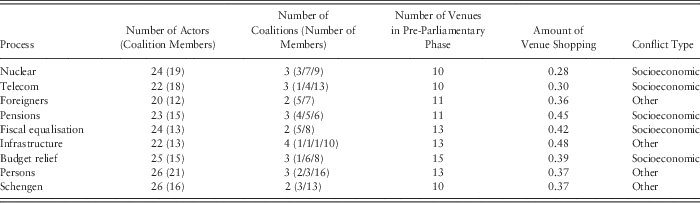
Process-level variables are listed in Table 1. First, as an indicator of the degree of venue shopping, we calculate the extent to which non-state actors participated in the preparatory phase of the legislative process. The preparatory phase is the most decisive one in Switzerland, and it comprises several subphases (Kriesi Reference Knoke, Pappi, Broadbent and Tsujinaka1980; Sciarini Reference Sciarini2014). Some of these subphases are formally closed to non-state actors, but in practice they are open to non-state actors on a selective basis. To identify the various venues of the pre-parliamentary phase, we rely on official documents regarding a given policy process, and on a preliminary interview with the civil servant responsible for the respective policy process. During our interviews, we submitted the list of venues of the preparatory phase to our interview partners and asked them to indicate in which venues their organisation did actively participate.Footnote 15 To evaluate the degree of venue shopping, we calculated the proportion of non-state actors that participated in the venues of the pre-parliamentary phase for each policy process. Although this measure admittedly does not inform about the specific pattern of venue shopping for each policy actor, it is an acceptable proxy of the varying extent of venue shopping across processes, and one that is in line with the idea of conflict expansion mentioned in the theoretical section. In the policy process regarding the law on nuclear energy, the case with the lowest degree of venue shopping, only 28% of the non-state actors participating in the whole process participated, on average, in the venues of the pre-parliamentary phase of the policy process. By contrast, 48% of the non-state actors participated, on average, in the pre-parliamentary venues of the policy process regarding the infrastructure funds. Second, a dummy variable indicates whether a policy process deals with a classical socioeconomic Left–Right conflict (1) or with any other type of conflict (0). Typical examples of a socioeconomic Left–Right conflict are those regarding the pension scheme reform or the programme of budget relief 2003.
Process descriptives

Empirical analysis
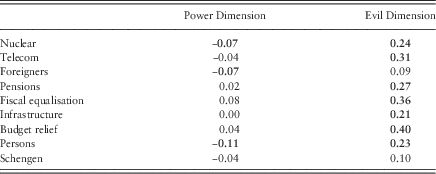
As a first step, we check whether and to what extent the devil shift shows up at the process level. Table 2 shows the existence or absence of the devil shift in both its power and evil dimensions in each of the nine policy processes.
Average devil shift per process
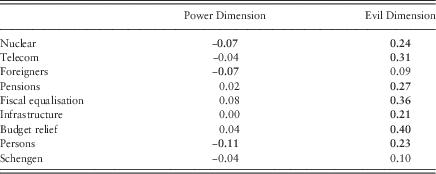
Average values in bold are significantly different from 0 (p<0.05).
The values in the second column indicate whether, on average, actors are considered as more powerful than they really are by the opposing coalition(s). The values in the third column indicate whether actors are considered as more evil than they really are by the opposing coalition(s). Regarding the first dimension of the devil shift, Table 2 suggests that actors do not, on average, overestimate opponents’ power. In all processes, the average devil shift value is either not significantly different from 0Footnote 16 or even negative (in three processes). Negative values indicate the opposite of the devil shift – i.e. actors are considered by their opponents to be less powerful than they actually are. By contrast, in the third column, there is evidence for the second dimension of the devil shift – i.e. the fact that actors tend to consider opponents as more evil than they actually are. In all but two processes, the average devil shift value for all actors is significantly greater than 0. What is more, the magnitude of the differences between perceived and real conflict is considerable and varies between 21 and 40%. Average values fail to be significantly different from 0 in two processes – the one on the bilateral agreement with the EU on Schengen/Dublin and the one on the law on foreigners. Overall, then, our data on the nine policy processes suggest that, at the aggregated level of policy processes, there is a great deal of devil shift on the second dimension, but much less on the first dimension – i.e. the overestimation of the opponents’ power.
Actor and process-level determinants of the devil shift
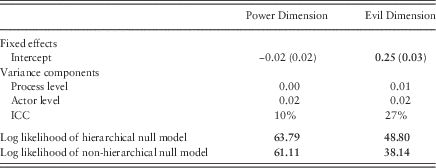
In order to test our hypotheses, we ran multilevel models with random intercepts (Steenbergen and Jones Reference Steenbergen and Jones2002; Gelman and Hill Reference Fischer, Fischer and Sciarini2006; Bliese Reference Bliese2012).Footnote 17 The dependent variable measures the amount of devil shift at the actor level. We estimated two separate models for both dependent variables – i.e. the power and the evil dimensions of the devil shift.Footnote 18 The intraclass correlation coefficient (Bliese Reference Bliese2012) suggests that there are differences at the process level in both models: 10% with respect to the power dimension and 27% with respect to the evil dimension (see Table A.1). Further, a comparison of the fit (log likelihood ratios) (Steenbergen and Jones Reference Steenbergen and Jones2002) shows that the hierarchical null model allowing for varying intercepts across processes performs better than the nonhierarchical null model; the related difference between the log likelihood ratios was significantly different from 0. This suggests that there are indeed important differences to be explained at the process level. Note that this also holds for the power dimension, despite the fact that there was no devil shift at the aggregated level according to Table 2.
Determinants of the power dimension of the devil shift
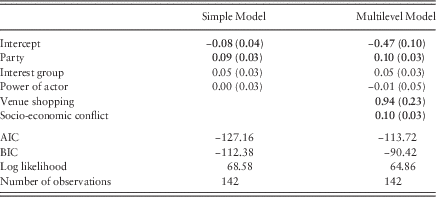
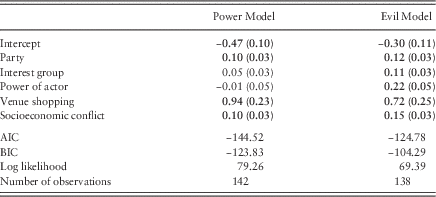
Table 3 presents the regression results for the power dimension of the devil shift. The model in the second column includes only actor-level predictors; process-level variables are added to the model in column three.Footnote 19 Results provide mixed support for our H1 that political parties and interest groups are more affected by the devil shift than state actors. On one hand, the extent of devil shift regarding political parties is significantly higher than the reference category. On the other hand, although the coefficient for interest groups is positive, it fails to reach statistical significance. Results are even less conclusive with respect to H2, as powerful actors are not seen as more powerful than they are. Whether an actor is powerful or not has no influence on whether opponents overestimate the power of that actor.Footnote 20 Unlike what is suggested by the aggregate results presented in Table 2, Table 3 shows that there are some significant process-level effects on the power dimension of the devil shift. Both variables on the process level have a significantly positive effect. On one hand, the higher the level of venue shopping in a policy process, the more actors tend to overestimate the power of their opponents. On the other hand, the devil shift is stronger in policy processes that give rise to a classical socioeconomic conflict than in processes that give rise to another type of conflict. In sum, controlling for the individual-level factors helps to uncover the process-related differences in devil shift on the power dimension. We can, therefore, corroborate H3 and H4.
Determinants of the devil shift on the power dimension

Unstandardised regression coefficients.
Estimates in bold are statistically significant at p<0.05.
Determinants of the evil dimension of the devil shift
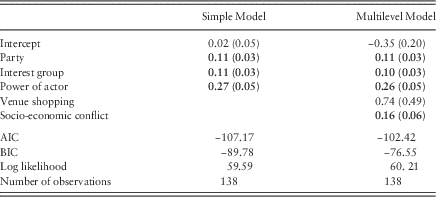
Table 4 presents regression results concerning the influence of actor- and process-level variables on the second dimension of the devil shift – i.e. the tendency of actors to overestimate the evilness of their opponents.
Determinants of the devil shift on the evil dimension

Unstandardised regression coefficients.
Estimates in bold are statistically significant at p<0.05.
Results support H1. As expected, both political parties and interest groups are more affected by the devil shift than state actors. This is in agreement with the fact that state actors are less inclined to defend their own preferences and would rather play a neutral role and work towards a compromise solution for the policy issue at stake. The devil shift can also be observed for powerful actors; in line with H2, the more powerful an actor is, the more belief dissimilarity is overestimated by its opponents. This is probably due to the fact that powerful actors have a higher standing within their coalition, and are thus the main targets of opponents’ criticism. Besides differences across types of actors, we expected differences across types of policy processes. Results of the multilevel analyses that appear in the second column of Table 4 lend support to only one of the two process-level hypotheses. According to our results, actors overestimate conflict with their opponents, especially in policy processes dealing with socioeconomic issues. In contrast, the devil shift does not apply to policy processes that give rise to other types of conflicts, such as the one regarding the desired level of international openness of the country (e.g. free movement of persons with the EU or Schengen–Dublin agreement). This yields support to H4. Presumably, the devil shift is especially strong in socioeconomic issues, because the same coalitions have been opposing each other for decades. This result highlights the dangerous consequences of the devil shift phenomenon: actors consider each other as more evil than they really are, which may lead to a lack of both collaboration and trust between coalitions. This again is highly likely to reinforce the misinterpretation of information on the opposing coalition and thereby to further strengthen the devil shift, thus leading to a vicious cycle. In contrast to what we observed for the power dimension, venue shopping does not affect the evil dimension of the devil shift. This suggests that the second dimension of the devil shift does not depend on the institutional context. For the evil dimension of the devil shift, we, thus, have to reject H4. In sum, our results tend to demonstrate that the power dimension and the evil dimension of the devil shift relate to different causal factors. Whereas the evil dimension is more sensitive to actor-level factors, the power dimension is more sensitive to process-level factors. The only factor that has a consistent effect across both dimensions is the type of conflict, with socioeconomic conflicts leading to more devil shift on both the power and the evil dimensions.
Conclusions
This study analysed the tendency of political actors to ignore, misinterpret and mistrust opposing actors in policy-making processes. It addressed two dimensions of the devil shift (Sabatier et al. Reference Sabatier, Hunter and McLaughlin1987): the tendency of actors to see opponents as more powerful and evil than they actually are. The devil shift bias has so far only been analysed in single-case studies, or it has simply been overlooked (Weible et al. Reference Weible, Sabatier and McQueen2009, Reference Weible, Sabatier, Jenkins-Smith, Nohrstedt, Henry and DeLeon2011a). This is all the more problematic, as the devil shift is likely to have detrimental consequences for political decision making. To our knowledge, this study presents the first cross-sector statistical test of this important theoretical argument. In addition, it tests the effects of two sets of factors on the devil shift, one relating to the actor level and the other to the process level. In that sense, this study makes an important step towards a more thorough understanding of the devil shift.
Based on interview data regarding the nine most important policy processes in Switzerland between 2001 and 2006 and multilevel regression methods, we find that the devil shift mainly exists with respect to its evil dimension – i.e. with respect to values and policy beliefs. The devil shift on the evil dimension affects political parties and interest groups more strongly than state actors, and affects powerful actors more strongly than powerless actors. Furthermore, the propensity to perceive opponents as more evil than they actually are is stronger in policy processes dealing with socioeconomic conflicts than in processes dealing with other types of conflict.
There is less empirical evidence for the existence of the devil shift concerning the power dimension, at least on the aggregate level of policy processes. This result confirms that ideologies seem to matter more than power in conflictive policy subsystems (Ingold and Fischer Reference Ingold and Varone2014). It is further in line with former empirical analyses of the devil shift phenomenon, where expectations with respect to the power dimension could not be confirmed as clearly as those with respect to the “evilness” dimension (Sabatier et al. Reference Sabatier, Hunter and McLaughlin1987, 470). On closer inspection, however, we also witness important cross-actor and cross-process differences concerning the devil shift on the power dimension. More specifically, we find that political parties “suffer” more strongly from the devil shift, and that the extent of devil shift increases with the amount of venue shopping in the process and is higher in socioeconomic conflicts than in other types of conflict.
Although based on the ACF where the devil shift was first conceptualised, our results also speak to a larger set of literature in political science. On one hand, the phenomenon might well apply to voting coalitions in parliaments or to perceptions of political ideologies among citizens (Ahler Reference Ahler2014), as overestimating the power of opponents fosters collective action and group identity (Moe Reference Mintrom and Vergari1980). On the other hand, our results regarding the importance of process-related effects contribute to comparative studies of policy making (Howlett et al. Reference Hojnacki2009; Knill and Tosun Reference Kingdon2012; Beyers and Braun Reference Beyers and Braun2014). More specifically, it emphasises the crucial importance of taking into account different types of policy subsystems and their characteristics, such as policy-related conflict lines or institutions. In addition, focusing on the devil shift phenomenon fosters an innovative coupling of policy process models with seminal approaches in cognitive psychology and behavioural economics (e.g. prospect theory, Kahnemann and Tversky Reference Jenkins-Smith and Sabatier1984).
Our study also has practical implications and contributes to the larger understanding of policy processes and change. On the actor level, we find that political parties, interest groups and powerful actors are especially affected by the devil shift. In the long run, a persisting devil shift might affect their reputation and ability to influence formal decision making (Heaney Reference Gelman and Hill2014). On the level of the political system, it is argued that the devil shift leads to more polarisation, more disagreement and distrust in general. It thereby impedes efficient and effective policy making and ultimately the production of feasible outcomes and compromises (Ostrom Reference Ostrom1990; Putnam Reference Putnam2000; Tsebelis Reference Tsebelis2002). To overcome these potentially important (negative) consequences of the devil shift for political decision making, our results suggest that it is crucial to cross well-established coalition borders in processes characterised by traditional socioeconomic conflict lines. It seems additionally important to foster cooperation among a variety of actors (including interest groups and political parties). State actors, which are less affected by the devil shift, may play the crucial role of mediators among competing coalitions and manage to impact policy change by recognising windows of opportunity and engaging in strategic venue participation (Baumgartner and Jones Reference Baumgartner and Jones1993; Kingdon Reference Katzenstein2003).
Having analysed the phenomenon of the devil shift for nine different policy processes dealing with different issues obviously increases the confidence in the external validity of our findings. What is more, our findings are in line with empirical applications of the devil shift argument in another country (Sabatier et al. Reference Sabatier, Hunter and McLaughlin1987, 470). Still, the policy processes analysed in this study all took place in the Swiss democracy, which is known as an ideal example of an inclusive political system with strong collaboration, power-sharing and consensus-seeking across ideological borders (Lijphart Reference Leifeld and Schneider1999). The fact that we could find the devil shift in such a political system, however, shows that the phenomenon is important. Given that we find evidence for the devil shift in such an unlikely case, we could expect that the phenomenon applies to an even stronger degree in more competitive political systems. Therefore, although we are confident that our results are valid beyond the Swiss context, we strongly encourage other researchers to study the devil shift phenomenon in other countries. Further research should try to corroborate these findings, and, more concretely, take into account the fact that the devil shift does not apply to all policy processes and actors.
Acknowledgements
The authors thank Sandrine Bossy, David Keller, Guenda Malinverni and Denise Traber who contributed to the data gathering. Data used in this article stem from a research project sponsored by the Swiss Science Foundation (Grant No. 100012-113964). The authors also thank Mark Lubell as well as the editor and two anonymous reviewers of this journal for their helpful comments.
Appendix
Analysis of variance/null models

Determinants of the devil shift (regression with cluster-robust standard errors)