Introduction
Lithium cobaltate (LiCoO2) is a common cathode material used for making rechargeable lithium-ion batteries (LIBs). It is thermally stable and ensures large specific capacity and high operating voltage of the LIBs.[Reference Mizushima, Jones, Wiseman and Goodenough1, Reference Whittingham2] A number of studies[Reference Choi, Son, Yoon and Kim3–Reference Sinha and Munichandraiah5] have shown that the use of the submicron LiCoO2 particles in the manufacture of cathodes raises the energy density and the quantity of the recharging cycles of the batteries. At present, much attention is being given to a search for suitable ways of reproducibly synthesizing LiCoO2 nanoparticles. Molten salt synthesis (MSS) is considered to be among the most promising techniques to prepare ultrafine powders.[Reference Liang, Qiu, Zhang, He, Zhu and Chen6–Reference Kamali and Fray10] The MSS of LiCoO2 is generally conducted by using nitrates, oxalates, and carbonates as precursors that undergo thermal decomposition to form Li2O and Co3O4. The subsequent step of annealing at temperatures of about 900 °C and above is required to complete the synthesis, but this process results in a hard-to-control aggregation of the particles (up to micron sizes) that reduces the LIBs discharge capacity and cycle life considerably.[Reference Sinha and Munichandraiah5]
The direct oxidation of halide ions with molecular oxygen in halide melts can be used for the synthesis of oxide compounds as well. Alkali, alkaline earth, rare earth, and transition metal halides are thermally stable over a wide temperature range. After being melted, they enter into reactions with oxygen giving metal oxides that dissolve in halide melts to a variable degree.[Reference Smirnov and Tkacheva11–Reference Tremillon and Picard15] For molten salt mixtures like LiCl–MCl2 (M = Mn, Co, and Ni), lithium and transition metal oxides formed in situ interact with one another yielding insoluble mixed oxide compounds at much lower temperatures than in the event of the conventional solid state or molten salt methods. Considerable aggregation of the particles synthesized does not happen owing to their ion solvation. Besides, the product is not subjected to any additional process of annealing. The chemical composition of the resultant complex oxide corresponds to that with the smallest Gibbs energy,[Reference Wang and Navrotsky16] such as LiMn2O4, LiCoO2, and LiNiO2. The modification of the body or surface chemical composition of the compounds synthesized can be performed through an ion exchange on the addition of a suitable precursor to the molten reaction medium.[Reference Bréger, Kang, Cabana, Ceder and Grey17] The conception proposed allows one to control the size and the morphology of the reaction products under changes in concentrations of the components of the halide melt, oxygen partial pressure in the working gas mixture, temperature, and the other operating conditions.
This article reports the preparation of LiCoO2 that was chosen as a model compound by an original molten salt technique. As judged from the scientific literature, this synthesis method has not been employed yet by other researchers.
Experimental
Materials and synthesis
A novel route of the LiCoO2 MSS is based on the following reactions:
 $${\rm 4LiCl}+{\rm O}_ 2={\rm 2Li}_ 2 {\rm O}+{\rm 2Cl}_ 2 \; \quad \Delta G_{ 700\, ^\circ {\rm C}} \approx+ 383\, {\rm kJ}/{\rm mole}\comma \;$$
 $$\eqalign{&{\rm 3CoCl}_ 2+{\rm 2O}_ 2={\rm Co}_ 3 {\rm O}_ 4+{\rm 3Cl}_ 2 \quad \cr &\quad \Delta G_{ 700\, ^\circ {\rm C}} \approx+ 9 \, {\rm kJ}/{\rm mole}\comma \; \, {\rm and}\;}$$
 $$\eqalign{&{\rm 6Li}_ 2 {\rm O}+{\rm 4Co}_ 3 {\rm O}_ 4+{\rm O}_ 2={\rm 12LiCoO}_ 2 \quad \cr &\quad \Delta G_{ 700\, ^\circ {\rm C}} \approx - 1695 \, {\rm kJ}/{\rm mole}.}$$
High Li2O solubility (up to 10 mass % at 700 °C) in the salt melts containing LiCl[Reference Usami, Kurata, Inoue, Jenkins, Sims, Beetham and Brown18] and the incompleteness of the reaction of Co3O4 with Cl2 up to 850 °C[Reference Anufrieva and Derlyukova19] were taken into account to successfully realize the interaction between the reactive Li2O and Co3O4 oxides in the melt resulting in the formation of insoluble LiCoO2 particles that are not subjected to essential aggregation owing to the ion solvation effect of the salt medium. Although the changes in the Gibbs energy of reactions (1) and (2) are positive, the preparation of LiCoO2 is possible due to the continuous shift of the equilibria resulting from the combination of Li2O and Co3O4 according to reaction (3) and the elimination of Cl2 from the reaction zone. The calculations of the ΔG 700 °C values were performed with the data of Barin[Reference Barin20] and Bushkova et al.[Reference Bushkova, Andreev, Batalov, Shkerin, Kuznetsov, Tyutyunnik, Koryakova, Song and Chung21]
Analytical grade LiCl and CoCl2 were used without additional purification. Both of the salts were placed into crucibles of sintered alumina or beryllium oxide and dried for 3 h on slow heating from room temperature to 250 °C under an air atmosphere.
Initially, LiCoO2 was synthesized through the interaction of the molten LiCl–CoCl2 mixtures containing 42 or 20 mole % of CoCl2 with atmospheric oxygen at 600 and 700 °C, respectively, with the process duration not exceeding 8 h. However, in these experiments, the yield of LiCoO2 was minor because of less Gibbs energy for the Co3O4 formation as compared with that for Li2O resulting in the precipitation of a great amount of the cobalt oxide particles. Therefore, we performed all of the subsequent experiments under an air atmosphere by the gradual addition of CoCl2 in small portions (about 50 mg every 20 min) to the Li2O solution in molten LiCl prepared in advance at 700 °C. In specific cases, a little LiNO3 as Li2O donor was added to molten LiCl to increase the rate of the MSS process.
After completing the synthesis, the salt melt containing the reaction products was cooled to room temperature and then dissolved in distilled water. The suspension obtained was filtered through a paper filter with a pore diameter of less than 3 nm. The filtration residue was washed with distilled water and dried at a temperature below 100 °C. The powders prepared in this manner were studied closely.
Characterization
The chemical and phase compositions of the samples as well as the size and the morphology of the particles obtained were determined by the methods of Fourier transform infrared (FTIR) and Raman spectroscopies, x-ray diffraction (XRD), and transmission electron microscopy (TEM).
FTIR spectra of the powders were recorded on a Bruker Tensor 27 instrument in the wavenumber range of 375 to 700 cm−1 at a resolution of 1 cm−1. Preliminarily, the powders were mixed with chemically pure KBr and then pressed to form thin pellets (about 1 mm in thickness).
Raman spectra were obtained with a Renishaw 1000 system by using the 514.5 nm line of the argon-ion laser. The measuring range was 375–700 cm−1.
The XRD patterns were collected by employing a Rigaku DMAX2200/PC diffractometer with a graphite monochromator (CuKα1 radiation, λ = 1.540562 Å). Continuous scanning method was conducted in the 2θ range of 10 to 75° at a scan speed of 4°/min. The phase composition was identified by using a PDF-2 database.
TEM images of the particles were obtained with a JEOL JEM-2100 microscope operating at 200 kV. The samples for the TEM were prepared from the powder suspensions in isopropyl alcohol (10 g/L) by using ultrasonic treatment (22 kHz, 3 min) to prevent aggregation of the particles. A suspension drop was applied on a Cu gauze support (3 mm in diameter) coated with a carbon film of 10–20 nm thick.
Results and discussion
Vibrational spectroscopy
It is well known[Reference Antaya, Cearns, Preston, Reimers and Dahn22] that crystalline LiCoO2 adopts a hexagonal layered structure ( $R\bar 3m$ trigonal space group) when it is synthesized at elevated temperatures. This polymorph is denoted as a high-temperature (HT) form in spite of the fact that it is also obtained at low temperatures.[Reference Amatucci, Tarascon, Larcher and Klein23]
The vibrational modes of crystals with known structures can be predicted by the factor group analysis.[Reference DeAngelis, Newnham and White24] For HT-LiCoO2, the calculations yield two Raman and four IR bands to be observed.[Reference Huang and Frech25] In addition, it should be noted that the IR bands of LiCoO2 appear in two different parts of the spectrum, with one band being located in the low-wavenumber region (at about 270 cm−1) and the others being placed in the high-wavenumber range (400–700 cm−1).[Reference Julien and Massot26]
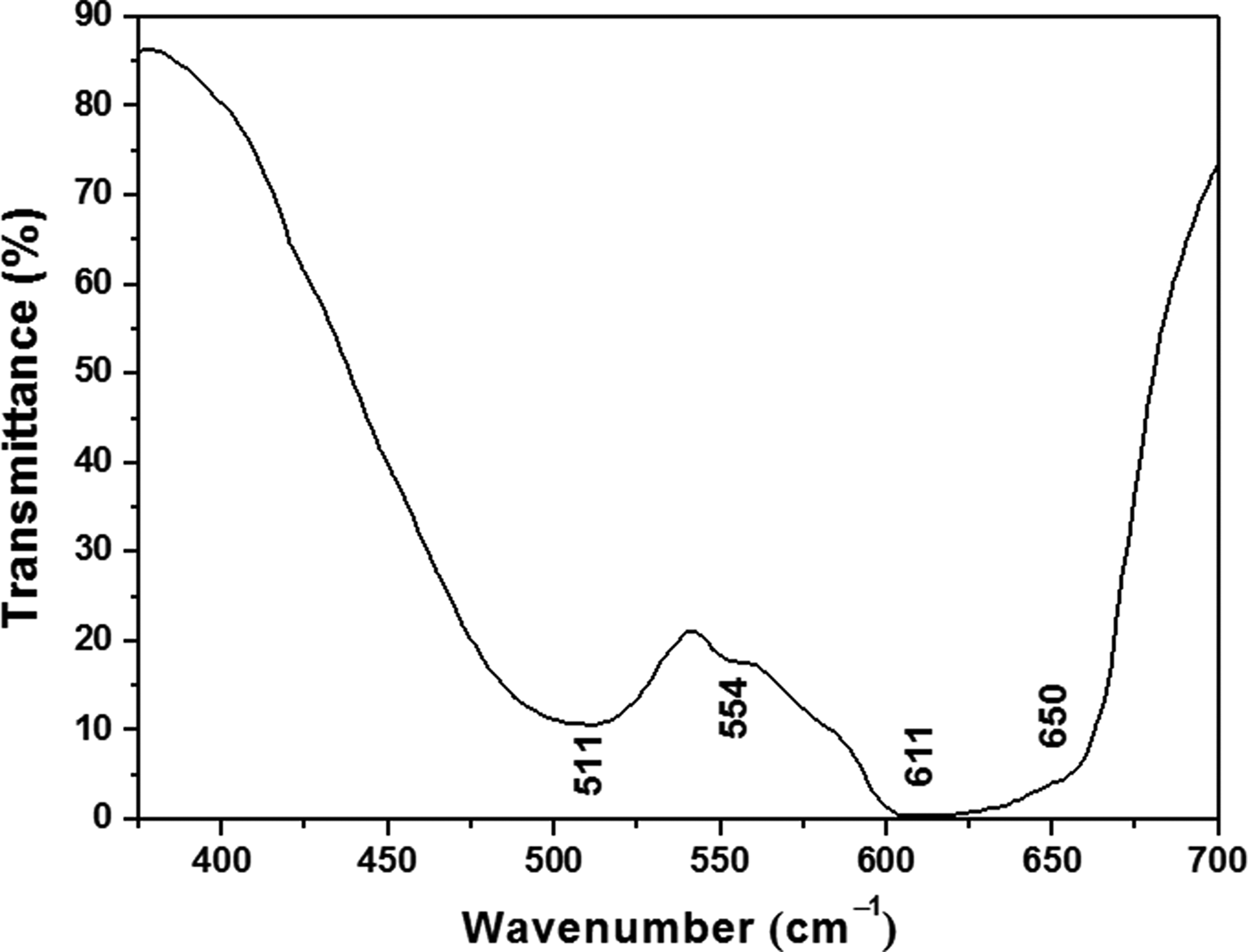
In all of the samples that were synthesized under an air atmosphere by the addition of CoCl2 in small portions to the Li2O solution in molten LiCl at 700 °C, bands at 510–530, 555, and 600–610 cm−1 as well as a shoulder of the latter at 650 cm−1, respectively, were detected (Fig. 1). These wavenumbers are characteristic of HT-LiCoO2 and close to the data from the literature[Reference Huang and Frech25–Reference Komova, Simagina, Kosova, Netskina, Odegova, Samoilenko, Devyatkina and Ishchenko28] (taking into consideration that the positions of the IR bands can vary somewhat depending on the conditions of producing HT-LiCoO2).
FTIR spectrum of a sample synthesized in the chloride melt.

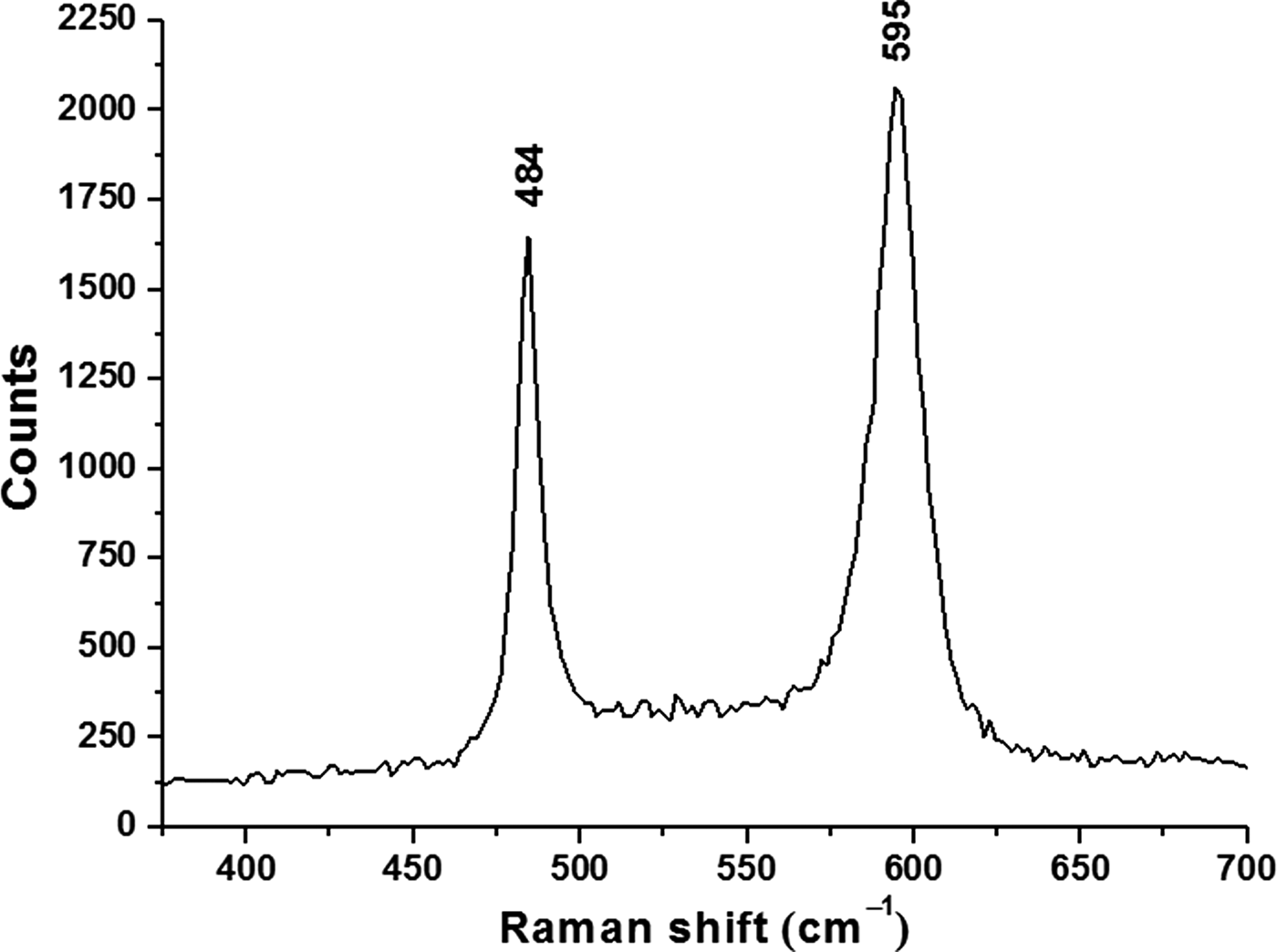
A typical Raman spectrum of a powder that is obtained under an air atmosphere by the addition of CoCl2 in small portions to the Li2O solution in molten LiCl at 700 °C is shown in Fig. 2. Our experimental Raman shifts are in excellent agreement with those characteristic of HT-LiCoO2.[Reference Huang and Frech25–Reference Yang, Hsieh, Chuang and Chen27]
Raman spectrum of a sample synthesized in the chloride melt.
X-ray diffraction
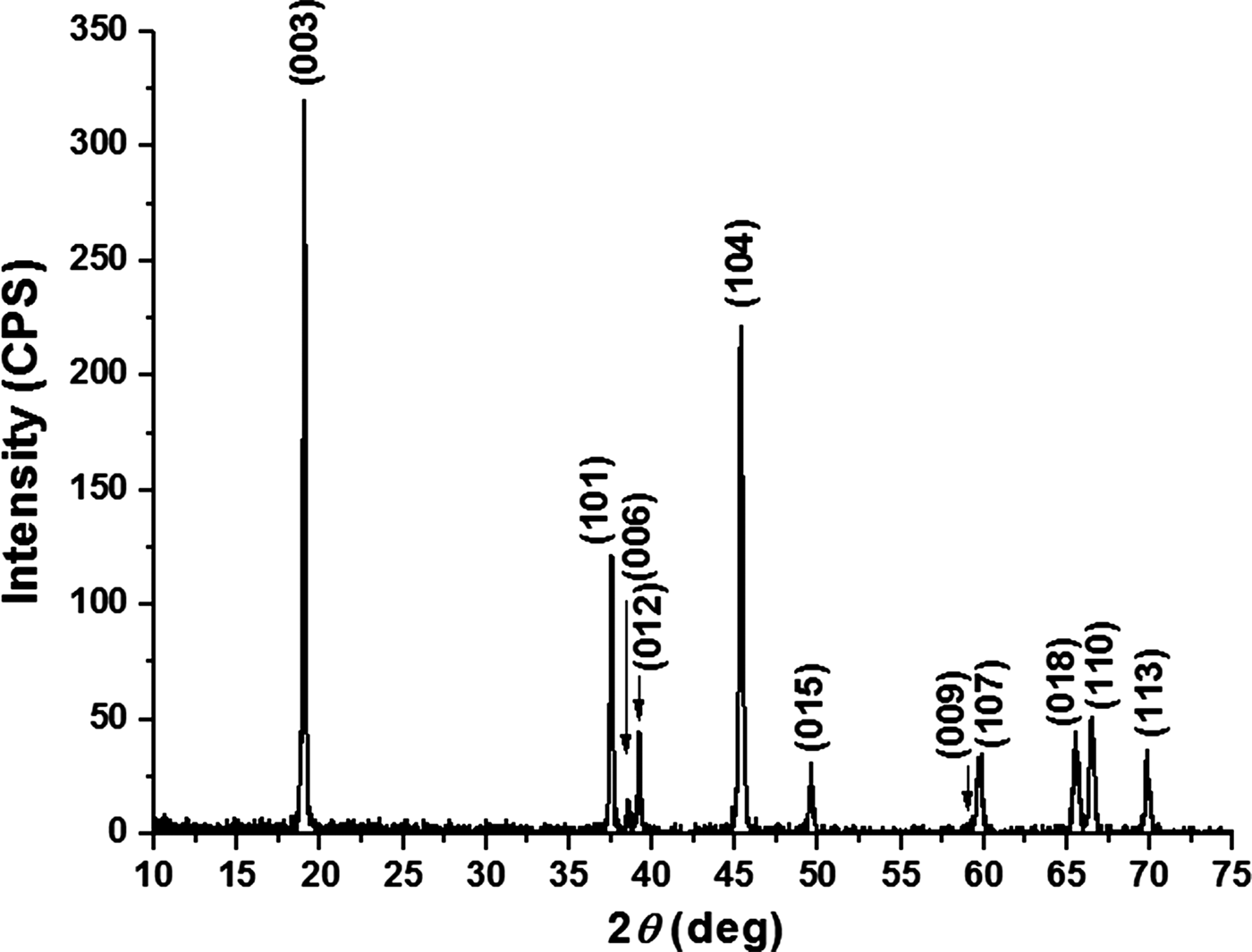
XRD analysis has shown that the synthesis under an air atmosphere by the addition of CoCl2 in small portions to the Li2O solution in molten LiCl at 700 °C results in the formation of HT-LiCoO2 with little or no cobalt oxide impurity (Fig. 3). This conclusion correlates well with the results of the FTIR and Raman investigations. The parameters of the LiCoO2 lattice were calculated (e.g., a = 2.8156 Å, c = 14.0571 Å, c/a = 4.99 for one of the samples). Our XRD data are in complete agreement with the lattice parameters reported for the LiCoO2 single crystals,[Reference Akimoto, Gotoh and Oosawa29] the results of the neutron diffraction study of the LiCoO2 powders,[Reference Orman and Wiseman30] and the direct observation of the LiCoO2 structure with a high-resolution transmission electron microscope.[Reference Shao-Horn, Croguennec, Delmas, Nelson and O'Keefe31] In addition, for powders under consideration, the crystallite size was estimated from broadening peaks. The average size was about 45 nm.
XRD pattern of a powder prepared in the chloride melt (all of the reflections indexed belong to the HT-LiCoO2 phase).
Transmission electron microscopy
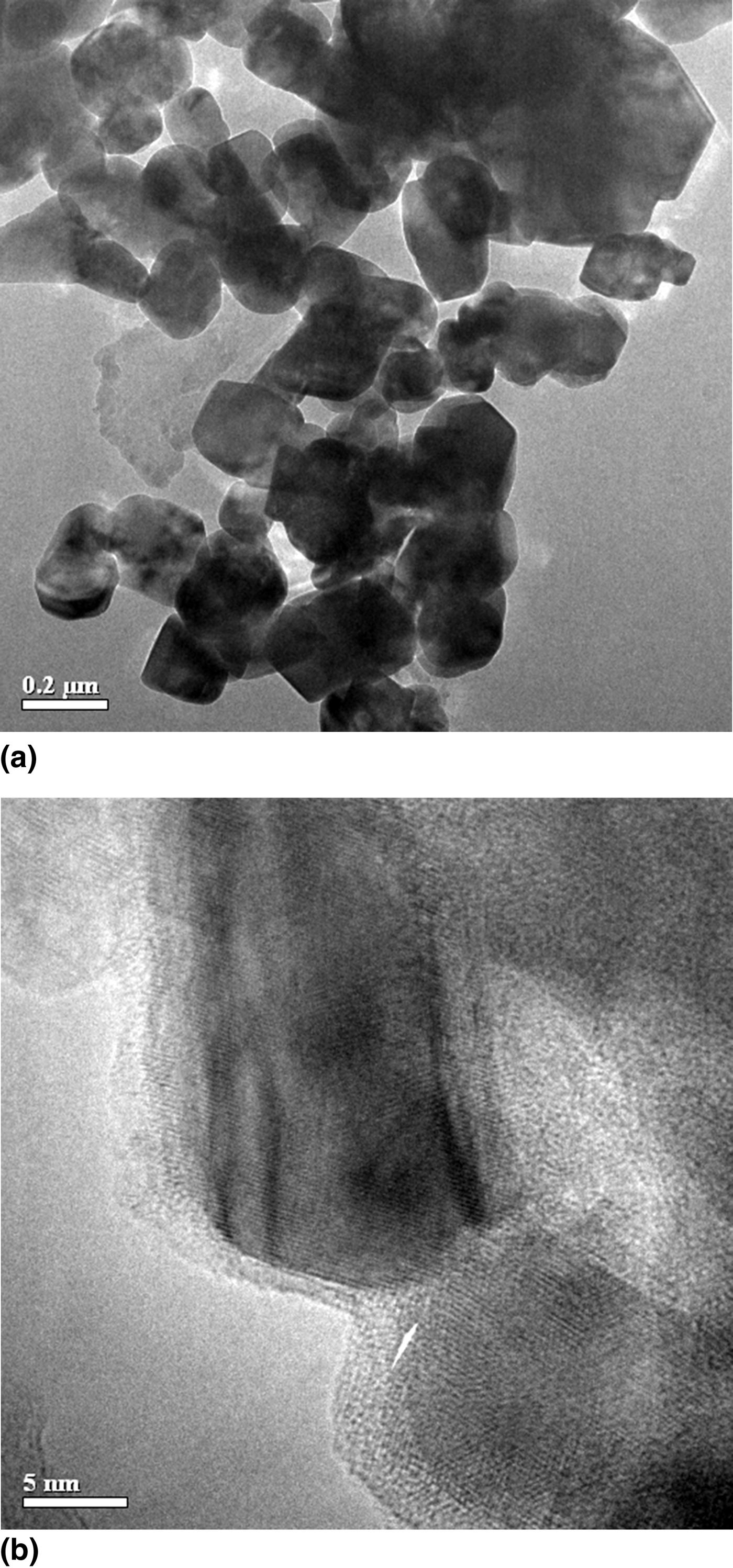
The size and the microstructure of the LiCoO2 particles that were synthesized under an air atmosphere by the addition of CoCl2 in small portions to the Li2O solution in molten LiCl at 700 °C were studied by the TEM method (Fig. 4). The powders consist of weakly aggregated particles with a mean size of 150–200 nm [Fig. 4(a)]. These particles are nanocrystalline [Fig. 4(b)] and the present observation is in accordance with the XRD analysis.
TEM images of the HT-LiCoO2 nanoparticles at different enlargements: (a) ×260,000 and (b) ×12.5 × 10⁶.
Conclusions
A new technique of the MSS of LiCoO2 that is based on the direct oxidation of chloride ions with molecular oxygen in thermally stable LiCl–CoCl2 melts was proposed. This method does not involve annealing at high temperatures (above 900 °C) and it allows one to obtain uniform HT-LiCoO2 nanoparticles under changes of the chloride melt composition and temperature.
Acknowledgments
The authors are very thankful to Dr B. Antonov from the Institute of High-Temperature Electrochemistry for performing the XRD experiments and the useful discussion on the results obtained. This study was supported by the Russian Foundation for Basic Research (grant no. 11-03-00042-a) and the Ural Branch of the Russian Academy of Sciences (grant no. 11-3-NP-660).