One of the central debates within the literature on parenting behavior concerns the implications of harsh physical discipline. Although generally accepted that more serious forms of physical abuse are associated with negative outcomes, there is less consensus about the larger continuum of discipline behaviors. Some researchers believe that mild to moderate behaviors, such as spanking and slapping, are not harmful for children (Baumrind, Larzelere, & Cowan, 2002), whereas others argue these behaviors predict a more negative trajectory (Gershoff, 2002). Furthermore, there is little evidence about whether harsh parental discipline is associated with developmental progress during the adolescent years. To date, most studies have examined the behavioral and emotional sequelae of harsh punishment and physical abuse during childhood (Strassberg, Dodge, Pettit, & Bates, 1994; Toth, Manly, & Cicchetti, 1992), rather than the developmental course as it unfolds in adolescence. The goal of this paper is twofold: to examine the links between harsh is parental discipline and developing autonomy and relatedness in the parent–adolescent relationship, and to examine the relationship between harsh parental discipline and selected behavioral outcomes outside of the family context.
This paper first focuses on difficulties in achieving a primary task of social development during adolescence, establishing autonomy while maintaining a sense of relatedness with parents, as a possible correlate of harsh physical discipline. Many contemporary theorists recognize this task as a defining aspect of the parent–adolescent relationship and a marker of healthy relationships into adulthood (Allen, Hauser, Bell, & O'Connor, 1994; Silverberg & Gondoli, 1996). The ability to handle this challenge has been linked to higher levels of future self-esteem and ego development (Allen, Hauser, Bell, et al., 1994). Less than optimal outcomes, such as depression and externalizing behavior, are seen among adolescents who lack autonomy and relatedness in interactions with parents (Allen, Hauser, Eickholt, Bell, & O'Connor, 1994).
Both theory and research suggest that harsh physical discipline is likely to undermine adolescent efforts to express autonomy and relatedness. Experiences of harsh discipline may lessen an adolescent's sense of felt security in the family, and thus signal to the adolescent that relationships with parents are too fragile to survive an increase in autonomy. In addition, an adolescent who perceives his parents as highly punitive is perhaps more reluctant to articulate warmth and empathy (i.e., relatedness) with these same parents. The reliance on harsh physical discipline may also provide adolescents with a salient model of maladaptive relationships. This model may not teach adolescents the interpersonal skills to form close, autonomous relationships in their families (Allen, Hauser, O'Connor, Bell, & Eickholt, 1996). Consistent with this theory, empirical work demonstrates that many early markers of autonomy and relatedness are absent in infants and children who are physically abused (Carlson, Cicchetti, Barnett, & Braunwald, 1989; Cicchetti & Beeghley, 1987). During later childhood, maltreatment is linked to difficulty establishing relatedness with mothers, teachers, and peers (Lynch & Cicchetti, 1991). This study extends this research into adolescence and examines the relationship between harsh discipline and autonomous-relatedness at this stage.
A second question addressed in this study is whether high levels of harsh parental discipline predict both emotional and behavioral outcomes during adolescence. In childhood, researchers have shown that harsh forms of discipline are associated with internalizing and externalizing behaviors. Physically abused adolescents endorse more depression and anxiety than their nonabused peers in both self-reports and structured interviews (Egeland, 1997; Kaplan et al., 1998). Physical abuse has also been tied to greater externalizing behavior across the life span (Briere & Runtz, 1990; Strassberg et al., 1994). The present study assesses the extent to which internalizing (depression and anxiety) and externalizing behaviors are associated with a history of harsh discipline in adolescence.
One concern about all research on the sequelae of harsh physical discipline is that it has not generally addressed the confound between discipline and other aspects of parenting with which it tends to co-occur. It is possible that adolescents who are exposed to harsh discipline have outcomes such as depression that may primarily reflect other problematic aspects of their relationships with parents. These confounding family environment factors may account for many of the links with psychopathology that are seen in studies of harsh discipline, and raise the possibility that it is not necessarily harsh discipline per se that is harmful. This study examined three other measures of parenting, warmth, quality of attachment, and firm control, that are known to relate to adolescent outcomes (Jones, Forehand, & Beach, 2000; Matza, Kupersmidt, & Glenn, 2001; Simons, Paternite, & Shore, 2001), and thus may act as alternative explanations of the effects of harsh discipline.
Another limitation of the research on parental discipline has been its consideration of physical abuse as a dichotomous variable (e.g., Williamson, Borduin, & Howe, 1991). Although this approach may be useful to studying more serious cases of physical abuse, it does not allow us to consider problematic parenting behaviors as existing on a continuum (Dolz, Cerezo, & Milner, 1997). Physical abuse may occupy an extreme point on the continuum, whereas harsh physical discipline may occupy a less extreme but more prevalent point. This study utilizes a sample of adolescents who were not selected for their abuse status, which enables us to examine a broad range of discipline behaviors other than those that meet legal child abuse criteria. Thus, we include the entire continuum of physical discipline as it is reported in this at-risk community sample, ranging from mild physical punishment to possible physical abuse. As such, our harsh discipline variable consists of both behaviors that do not cause physical injury (i.e., corporal punishment) and behaviors that could cause visible harm (i.e., physical abuse; Gershoff, 2002); however, the small number of parents and adolescents who reported possibly injurious behaviors (e.g., choke, beat) in this sample suggests that it includes mainly corporal punishment. The use of a continuous variable distinguishes this study from other studies that focus solely on corporal punishment or physical abuse, and demonstrates our interest in examining the entire continuum of parental discipline.
There has been considerable debate among researchers about the effects of noninjurious physical discipline, such as spanking and slapping. In her recent meta-analysis, Gershoff (2002) concluded that corporal punishment is associated with a variety of negative outcomes, including (but not limited to) aggression, antisocial behavior, poor mental health, and child abuse potential. Similarly, Egeland (1997) asserted that mild spanking was related to similar behavioral problems as severe physical abuse in his sample of adolescents. Other researchers have stated that the data “does not justify a blanket injunction against mild to moderate disciplinary” practices (Baumrind et al., 2002, pp. 587–588). The current study seeks to further clarify the correlates of physical discipline during adolescence, with a specific focus on outcomes that have not been established in other research (e.g., anxiety, autonomous relatedness).
This study expands on the previous literature on harsh discipline in two additional areas. First, it was not clear if the outcomes for adolescents would differ depending upon the gender of the punitive parent, or if there would be a generalized effect of harsh discipline across parents. Although fathers are responsible for about half of physical abuse cases, the majority of studies have included only mothers as perpetrators (Haskett, Marziano, & Dover, 1996). The few studies that have conducted analyses of parent gender suggest certain differences (Hart, DeWolf, Wozniak, & Burts, 1992; Loos & Alexander, 1997). For instance, Downs and Miller (1998) found that a history of paternal, but not maternal, violence was associated with poor self-esteem and alcohol problems in adult women. To expand on this research, we made an effort to parse out the joint and unique effects of maternal and paternal discipline in this study.
Second, most studies on harsh physical discipline have relied on self-report measures of psychosocial functioning. This approach has been helpful, but is limited by the biases of using self-report measures to assess behavior (Nisbett & Wilson, 1977). Coded observations can also be applied to assess interactions that occur in a family. Such observations have been used with success to demonstrate that abused children are less positive and neutral, more aggressive and noncompliant, and less interactive with their mothers than are controls (Bousha & Twentyman, 1984; Burgess & Conger, 1978; Cerezo & D'Ocon, 1995). Although these data pertain to children who are exposed to abuse, this study was able to examine and code the behavior of adolescents with a history of harsh discipline.
The current study gathered self- and parent reports to investigate the relationship between harsh physical discipline and adolescent symptomatology in a socioeconomically and ethnically diverse sample of moderately at-risk 9th and 10th graders. The sample was selected to allow assessments within a maximally meaningful range of psychosocial and family functioning, including adolescents and families functioning both adequately and poorly. It used observational data to assess adolescent efforts to establish autonomy and relatedness in interactions with their mothers and for a subset of fathers. We first examined the hypothesis that harsh discipline would be linked to increased levels of adolescent depression, anxiety, and externalizing behaviors. We then examined whether harsh discipline would predict difficulties in expressing autonomy and relatedness in interactions with mothers. In both cases, we also considered whether the observed correlates of harsh discipline would remain after first accounting for other parenting factors known to predict adolescent behaviors. Last, a set of analyses was performed to examine the role of parent gender in the prediction of each outcome.
On the basis of studies linking demographic factors to adolescent functioning, we have also included gender, age, race/ethnicity, and socioeconomic risk as important covariates in the analyses. Adolescent gender has served as a moderating variable in various studies of physical abuse and corporal punishment (Silverman, Reinherz, & Giaconia, 1996), and has shown main effects with psychosocial outcomes such as depression (Ge, Conger, & Elder, 2001). Both race and age have been reported as risk factors for physical abuse and corporal punishment in other research (Cappelleri, Eckenrode, & Powers, 1993; Straus & Stewart, 1999). In a prior study of this at-risk community sample, McElhaney and Allen (2001) revealed differences in autonomy behaviors and social adjustment among adolescents at high and low socioeconomic risk. Thus, we examined the potential main effects of these four demographic factors and their interactions with harsh discipline in predicting outcomes.
Method
Participants
Data were obtained from 141 adolescents (74 male, 67 female), 141 mothers, and 48 fathers. There was a smaller number of fathers in the sample for a variety of reasons, including divorce (38%), separation (14%), death (5%), and refusal to participate (9%). Adolescents were recruited in two public school systems serving rural, suburban, and moderately urban populations. Adolescents were selected to participate based on the presence of at least one of four risk factors: failing a single course for a single marking period, any lifetime history of grade retention, 10 or more absences in one marking period, and any history of school suspension. These broad criteria were established to sample adolescents who could be identified from academic records as having the potential for future social, academic, and/or emotional difficulties. As intended, these criteria identified approximately one-half of 9th- and 10th-grade students as eligible for the study.
The mean age of adolescents was 15.9 years, with a range of 14 to 18.7 years. The self-identified racial/ethnic background of the sample was 58% Caucasian, 40% African American, and 2% other. The median family income was $25,000, but included a range of less than $5,000 to greater than $70,000. Adolescents were raised in families with two biological parents (29%), single parents (52%), and stepfamilies (19%). There were significant differences between father-absent and father-present families on only two variables: adolescent relatedness with mothers and socioeconomic risk. Adolescents exhibited greater positive relatedness with mothers in father-present homes (M = 0.29, SD = 0.90) than father-absent homes (M = −0.18, SD = 1.09; t = 2.53, p < .05). Father-absent homes were also at greater socioeconomic risk (M = 0.48, SD = 0.50) than father-present homes (M = 0.13, SD = 0.34; t = 5.63, p < .001).
Procedure
High school personnel identified adolescents who met the selection criteria for being at risk. Parents of these adolescents were initially contacted in a letter that described the study as an investigation into the lives of teenagers and their families. Families who returned a postcard to express their interest in the study were then contacted by telephone. Approximately 50% of the original at-risk sample and 67% of the families contacted by telephone agreed to participate.
Families came in to university-based offices for two 3-hr sessions and were paid $105 for their participation. At each session, adolescents and parents were explained that the purpose of the study was to learn about various aspects of adolescent functioning, including the role that families have in facilitating development. Active, informed consent was obtained from parents and adolescents prior to the session. Interviewers assured participants that the information they would provide was confidential, except in situations where the adolescent was a danger to him/herself or others or was being abused. All data in the study were covered under a confidentiality certificate from the US Department of Health and Human Services, which protects information from subpoena by federal, state, and local courts. After this introduction, family members were taken to separate rooms to complete paper and pencil measures. Adolescents and their mothers were also videotaped in a 10-min interaction task, as described below.
Measures
Harsh physical discipline
Parental use of harsh physical discipline was assessed with a modified version of the Conflict Tactics Scale (CTS; Straus, 1979). Both adolescent and parent forms of the CTS were utilized to evaluate the frequency with which a parent engaged in certain behaviors with the adolescent during conflict. Adolescents completed separate CTS reports of maternal and paternal physical discipline.
This study used the 11-item physical aggression scale of the CTS, with three small modifications. First, participants were asked to report how often each behavior had occurred over their lifetime, rather than in the previous year. This approach was used to capture the outcomes of harsh physical discipline that occurs at any time during the child and adolescent period. Widom and Shepard (1996) have reported strong reliability and validity properties with retrospective reports on the CTS. Second, a 4-point scale (1 = never, 2 = once or twice, 3 = several times, 4 = many times) was used instead of raw frequencies. Third, the score for each participant was calculated with a method created by Straus (1988) that weighs the frequency score for each harsh behavior by its seriousness and then sums across behaviors. These weights were assigned based on external judges' evaluations of the seriousness of specific behaviors, so as to avoid the problem in which a few instances of minor behaviors (e.g., spanking) would carry more weight than an instance of an extremely harsh behavior (e.g., choking).
A composite of the adolescent and parent forms of the CTS was used to address the concern that adolescents and parents might be reluctant to endorse certain behaviors (e.g., purposely burning or scalding). It was created by taking the sum of the higher of the two scores (adolescent and parent) on each discipline item. For instance, if an adolescent endorsed being slapped many times by his father, but the father reported never doing so, the adolescent's score on the item was used. If an adolescent and parent endorsed the same score (e.g., once or twice) for a specific behavior, that score was used. This approach was believed to yield a more accurate measure of physical discipline, on the basis that if either party endorsed a behavior, it was more likely than not to have occurred. In addition, the physical discipline composite was omitted from the data analyses when either the adolescent or parent report was not completed, enabling us to examine only discipline scores that reflected the higher score of two reporters.
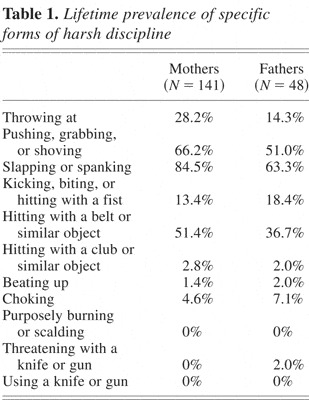
The physical aggression scale of the CTS has demonstrated both good internal consistency and construct validity (Straus, 1988). In the current study, it was internally consistent for teen reports (α = .68 for mothers, α = .78 for fathers) and parent reports (α = .54 for mothers, α = .65 for fathers) of parental aggression. These alpha values are considered adequate, given that the CTS is an inventory of different kinds of behaviors that may not be highly intercorrelated. The frequencies for each discipline item can be seen in Table 1. Two of the items were endorsed at a high rate. These were: (a) pushing, grabbing, or shoving; and (b) slapping or spanking. Three of the items were endorsed at a low to moderate rate. These were (a) throwing at; (b) kicking, biting, or hitting with a fist; and (c) hitting with a belt or similar object. The other six items were endorsed rarely or not at all, suggesting that this sample did indeed provide an opportunity to examine mild to moderate punishment more than physical abuse.
Lifetime prevalence of specific forms of harsh discipline

Autonomy and relatedness coding system
The Autonomy and Relatedness Coding System (Allen, Hauser, Bell, Boykin, & Tate, 1995) was used to assess adolescents' behavior during separate 10-min interactions with their mothers and fathers.1
The number of fathers who participated in the interaction (N = 43) with adolescents was low, which limits the generalizability of these findings. However, given the lack of data on father–adolescent interactions, we included this subsample of father-present data in the current study.
The Autonomy and Relatedness Coding System includes a set of 10 discrete codes that are applied to adolescents' behavior during the interaction. The codes are summed to yield four scales: (a) Behaviors That Promote Autonomy, (b) Behaviors That Inhibit Autonomy, (c) Behaviors That Promote Relatedness, and (d) Behaviors That Inhibit Relatedness. Autonomy can be seen in behaviors that differentiate a person from others and reflect independence of thought (Allen & Hauser, 1996). Behaviors that promote autonomy include offering reasons to support one's position and showing confidence during the discussion. Behaviors that inhibit autonomy include recanting without having been persuaded, overpersonalizing the argument, and using pressuring statements. Relatedness can be seen in behaviors that show an interest in the other person's thoughts and feelings (Allen & Hauser, 1996). Behaviors that promote relatedness include expressing agreement, asking questions, and being warm and empathic. Last, behaviors that inhibit relatedness include ignoring or interrupting, and making critical or hostile statements.
Four graduate students who were blind to the other data in this study assigned codes by reviewing transcripts and videotapes of the interactions. A 0–4 rating was obtained for each subscale, using half-point intervals and concrete behavioral anchors to determine the score for each behavior. The four overall scales were created by summing the individual subscales for a given overall scale (e.g., summing reasons and confidence for promoting autonomy). Each adolescent thus received two autonomy and two relatedness scores for their own behavior for each interaction. Reliabilities, assessed with intraclass correlation coefficients, were .88 and .75 for adolescent promoting autonomy and inhibiting autonomy, respectively. The reliability coefficients for both adolescent promoting relatedness and inhibiting relatedness were .84 and .81. Past research has demonstrated the reliability and construct validity of these codes in relation to outcomes such as adolescent depression, delinquency, self-esteem, and ego development (Allen, Hauser, Bell, et al., 1994; Allen, Hauser, Eickholt, et al., 1994).
Self-reported externalizing and internalizing symptoms
Adolescents were asked to complete the Youth Self-Report (YSR), a reliable and well-validated measure of behavior problems (Achenbach, 1991). On this measure, adolescents rated the extent to which a series of behaviors were characteristic of them, on a scale of 0 = not true to 2 = very or often true. Only the externalizing behavior factor was assessed in the current study. This scale includes negative behaviors that are directed toward others, such as lying, arguing, stealing, swearing, and destroying property. Excellent psychometric qualities of the YSR, including discriminant and construct validity and reliability, have been reported (Achenbach & Edelbrock, 1987).
A composite score of depression was created using the Beck Depression Inventory (BDI; Beck, Rush, Shaw, & Emery, 1979) and two subscales of the Weinberger Adjustment Inventory (WAI; Weinberger, 1989). The BDI provides a sum of scores on 21 items that are rated on a 4-point scale and assess for various signs of depression. It has shown internal consistency (.81) and concurrent validity (.60–.74) with other measures of depression within nonclinical samples (Beck, Steer, & Garbin, 1988). The WAI is a self-report measure of social and emotional adjustment. Only the depression and low self-esteem scales were used in this study. Each of these scales comprises three items, such as “I often feel sad or unhappy” (depression) and “I really don't like myself very much” (low self-esteem). The WAI scales have produced test–retest reliabilities of .73 and strong predictive and discriminant validity (Weinberger, 1996; Weinberger & Gomes, 1995). For each adolescent, the BDI score and two WAI scores were standardized and summed to yield a composite score for depression. The alpha of this composite was quite high (.82), suggesting that the items were responded to similarly across the two measures.
Adolescent reports of anxiety were obtained on the State-Trait Anxiety Inventory (STAI; Spielberger, 1985), a measure of two dimensions of anxiety: state and trait. The STAI contains 40 items rated on a 4-point scale from “not at all” to “very much.” The sum of the adolescent's score on each item was used as an index of anxiety. Internal consistency scores higher than .90 on both the state and trait scales and good convergent validity have been found in other studies (Novy, Nelson, Goodwin, & Rowzee, 1993).
Parenting measures
Adolescents were asked to indicate how much each of their parents voiced affection for them on the Expression of Affection Inventory (Patterson, 1982). The 11-item expression of affection scale was used. These items are associated with expression of parental warmth and contain items (e.g., “hug or kiss,” “spend time with”) that have been shown to relate to areas of adolescent adjustment, such as peer sociometric status (Matza et al., 2001). Maternal and paternal use of firm control was assessed with the Children's Report of Parenting Behavior Inventory (Schaefer, 1965). This scale is made up of 10 items (e.g., “believes in having a lot of rules and sticking to them”) that are rated by teens on a 3-point scale. It has been linked in prior research to a range of outcomes at this age, including more secure early romantic attachments (Jones et al., 2000). Adolescents were asked to indicate their quality of attachment to each parent on the Inventory of Parent and Peer Attachment (Armsden & Greenberg, 1987). The sum of responses on all 25 items (e.g., “he/she understands me”) was used as an index of their attachment quality. This scale has also been associated in other studies with positive outcomes, such as self-esteem and less aggressive behavior (Simons et al., 2001).
Demographic information
Both mothers and adolescents were asked to provide basic demographic information, including gender, age, race/ethnicity, family income, and residence. We assessed the riskiness of the adolescent's socioeconomic environment with a measure that combines both family income and urban residence and has previously been found relevant to understanding family interactions in adolescence (McElhaney & Allen, 2001). A status of higher socioeconomic risk was given to adolescents who resided in an urban environment and had a family income at or below 200% of the poverty line.
Results
Preliminary analyses
Descriptive statistics
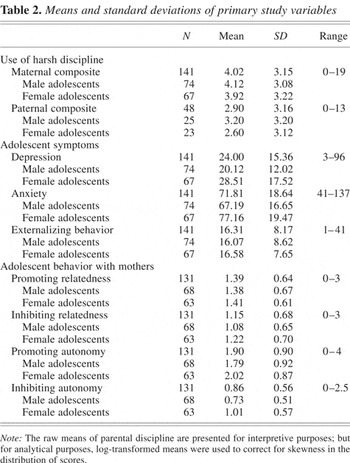
Means and standard deviations for the major study variables are presented in Table 2. All variables were examined for assumptions of normality and linearity. Only the maternal and paternal harsh discipline composites violated these assumptions, and these variables were log transformed for all regression analyses.
Means and standard deviations of primary study variables

Research has revealed associations between adolescent gender, age, race/ethnicity, and socioeconomic status and various measures of adolescent functioning. Thus, a set of t tests was used to assess differences on each of the outcome variables for males and females, minorities, and Caucasians. We examined the relationship of age and socioeconomic risk to the outcome variables. The results suggested some differences in outcomes based on demographic characteristics. Female adolescents endorsed more depression and anxiety symptoms than did male adolescents. Females also exhibited more behaviors to inhibit their autonomy with mothers in the interaction. Compared to younger adolescents, older adolescents reported somewhat more depression and externalizing behaviors. Minorities demonstrated less autonomy and relatedness promotion with mothers than did Caucasian adolescents. Last, adolescents at high socioeconomic risk endorsed more anxiety and externalizing behavior and exhibited less autonomy and relatedness promotion than adolescents at low socioeconomic risk.
We also examined how demographic variables may be related to histories of harsh physical discipline. Male adolescents were more likely than females to receive harsh discipline from their fathers, but equally likely to receive discipline from their mothers. There were no differences between minorities and nonminorities, and neither age nor socioeconomic status was associated with histories of harsh physical discipline.
In a final analysis, we assessed moderating effects of the four demographic variables on the relationship between harsh discipline and each of the adolescent outcomes. In particular, we were interested in whether the effects of harsh discipline would differ based on the demographic characteristics. No moderating effects for gender, age, race/ethnicity, or socioeconomic status were identified.
Primary analyses
Analytic strategy
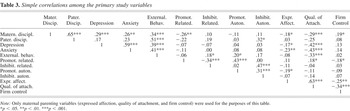
A four-step analytic strategy was applied to the data. First, simple correlations among predictors and outcomes were calculated (Table 3). Second, partial correlations of harsh discipline with each outcome were examined, after accounting for the demographic variables (adolescent gender, age, race/ethnicity, and socioeconomic risk). Third, we assessed the extent to which harsh parental discipline would add to the variance in adolescent outcomes, over and above the variance explained by other parenting qualities (expressed affection, quality of attachment, firm control). Conversely, we also tested the unique predictive power of each of these parenting qualities, after accounting for harsh discipline. In the last analyses, we explored whether outcomes associated with maternal harsh discipline would differ from those associated with paternal harsh discipline.
Simple correlations among the primary study variables

Internalizing and externalizing symptoms
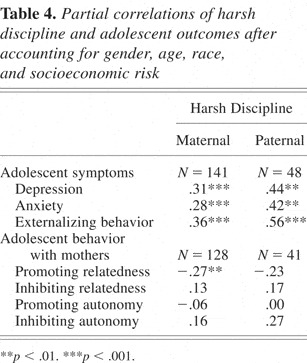
The first research question in this study was whether harsh discipline would predict adolescents' internalizing and externalizing symptoms. Table 4 presents the partial correlations of harsh discipline (Ns = 141 maternal, 48 paternal) with adolescent self-reported anxiety, depression, and externalizing behavior, holding the four demographic factors constant. The results revealed that both maternal and paternal harsh discipline were positively associated with adolescent symptoms. Adolescents who experienced harsh discipline by either parent were more likely to endorse depression, anxiety, and externalizing behavior.
Partial correlations of harsh discipline and adolescent outcomes after accounting for gender, age, race, and socioeconomic risk

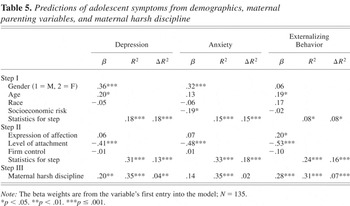
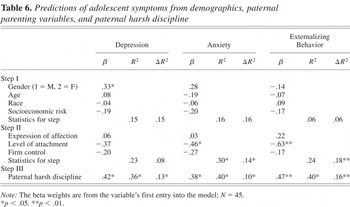
To determine whether the links between harsh discipline and symptoms would remain after accounting for other parenting variables, we examined a series of hierarchical regression models. In these models, we first entered the demographic variables, then the three parenting factors, with harsh discipline in the final block. The results of these analyses are presented in Tables 5 and 6. Maternal harsh discipline (N = 135) was a significant predictor of adolescent depression and externalizing behavior, over and above maternal affection, quality of attachment, and firm control. Paternal harsh discipline (N = 45) was related to adolescent depression, anxiety, and externalizing behavior, over and above these aspects of fathers' parenting. In sum, findings suggest that harsh physical discipline is associated with symptoms during adolescence in a way that is unique from other aspects of parenting, rather than simply being a marker for other well-known indices of poor parenting.
Predictions of adolescent symptoms from demographics, maternal parenting variables, and maternal harsh discipline

Predictions of adolescent symptoms from demographics, paternal parenting variables, and paternal harsh discipline

Autonomy and relatedness
We next examined whether harsh parental discipline would be linked to adolescent displays of autonomy and relatedness in interactions with each parent. Table 4 presents the partial correlations of harsh discipline (Ns = 128 maternal, 41 paternal) with adolescent expression of autonomy and relatedness with mothers, over and above the four demographic factors. The results indicated that adolescents enduring high levels of maternal discipline were less likely to promote the relationship with their mothers. However, there were no associations between paternal harsh discipline and adolescent efforts to express autonomy or relatedness. Neither maternal nor paternal harsh discipline was related to adolescent expression of autonomy or relatedness in interactions with fathers.
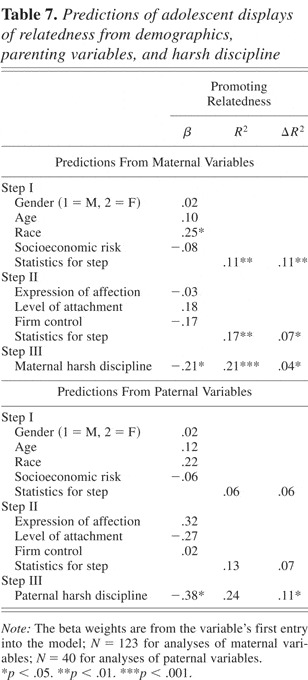
We also addressed whether the links between harsh discipline and adolescent displays of autonomy and relatedness would remain after accounting for other parenting variables known to relate to adolescent outcomes. For the subset of adolescents who participated in interactions with fathers, there was no relationship between harsh discipline and displays of autonomy and relatedness with fathers. However, harsh discipline was related to adolescents' interactions with their mothers. The results of these analyses are presented in Table 7. Maternal harsh discipline (N = 123) remained a unique predictor of adolescent difficulties with promoting relatedness, over and above maternal expressed affection, attachment quality, and firm control. When other parenting variables were considered, paternal harsh discipline (N = 40) became a predictor of adolescents displaying fewer efforts to promote a close relationship with mothers, although it was not significant in models with the demographic variables alone. Neither maternal nor paternal harsh discipline were associated with adolescent promoting autonomy, inhibiting autonomy, and inhibiting relatedness, after accounting for the three parenting variables.
Predictions of adolescent displays of relatedness from demographics, parenting variables, and harsh discipline

Unique parenting effects
In addition, we considered the effects of the three parenting variables over and above the effects of harsh maternal (N = 135) and paternal discipline (N = 45). Maternal attachment quality was negatively associated with adolescent depression (β = −.34, p < .001), anxiety (β = −.43, p < .001), and externalizing behavior (β = −.43, p < .001), after covarying out maternal harsh discipline. Therefore, the quality of the adolescent–mother attachment was a unique predictor of symptoms in this moderately at-risk sample. Maternal expressed affection and firm control were not associated with outcomes, nor were any of the paternal parenting variables.
Parental gender
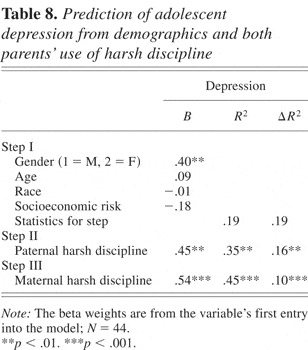
Last, analyses were conducted to explore whether one parent's level could predict adolescent outcomes, over and above the other parent's level of harsh discipline. In these analyses (N = 44), maternal harsh discipline was related to adolescent depression, over and above paternal harsh discipline; but paternal discipline was not significant when entered in the equation after maternal discipline. This result suggests that maternal use of harsh discipline provides unique information in predicting depression in this sample (Table 8).
Prediction of adolescent depression from demographics and both parents' use of harsh discipline

No unique parental effects were found for adolescent anxiety and externalizing behavior. This result may have arisen because of the high correlation between maternal and paternal harsh discipline (r = .65, p ≤ .0001). Although each was a predictor of these outcomes, it appears that most of the variance they accounted for was shared. It is also likely that certain differences were not detected because of low power in the small sample of families for which both mother and father data were available.
Discussion
The results of this study indicate that a history of harsh physical discipline is associated with internalizing and externalizing symptoms in a moderately at-risk adolescent sample. Both maternal and paternal harsh discipline were related to adolescent reports of depression, anxiety, and externalizing behavior. Maternal harsh discipline was also related to adolescent difficulties expressing warmth and engagement (i.e., relatedness) in interactions with their mothers. Nearly all of these predictions remained significant after accounting for other parenting qualities, which suggests harsh discipline adds unique value to understanding adolescent behavior in this sample. When other parental variables were examined over and above harsh discipline, the quality of the attachment between adolescents and mothers was associated with self-reported symptoms. The limitations and implications of each of these results are discussed below.
The present study was designed to examine the outcomes of a moderately at-risk sample of adolescents who experienced harsh discipline that almost never rose to the level of reportable abuse. The sample included adolescents exposed to mild and moderate forms of discipline, such as spanking and hitting with a belt, as well as possible abuse in a very small percentage of cases. The results suggest that adolescents with a lifetime history of harsh discipline are more likely to report depression, anxiety, and externalizing behaviors. Thus, these data support the notion that the entire continuum of physical discipline is associated with poor outcomes among adolescents already at risk for school failure. In the literature on child abuse, some researchers have argued that even mild forms of discipline such as spanking have implications for childhood adjustment (Strassberg et al., 1994). This study extends this argument to the adolescent years and indicates that harsh discipline by either parent is related to adolescent emotional problems at age 16.
The second result of this study suggests that adolescents with a history of harsh maternal discipline are less likely to work to maintain a strong relationship with their mothers during a conflict. These adolescents are thus displaying deficits in one of the primary developmental tasks of this era of development—establishing autonomy while maintaining relatedness with their parents—a task that has previously been found to predict a broad array of long-term psychosocial outcomes (Allen & Hauser, 1996; Allen, Hauser, Bell, et al., 1994; Allen, Hauser, Eickholt, et al., 1994). Although harsh discipline was not related to adolescent expressions of autonomy, it was clearly linked to evidence of lack of relatedness on adolescents' part during discussions of disagreements. Adolescents who had experienced harsh physical discipline were less engaged in discussions, less likely to agree or show empathy, and less interested in asking about the mother's position. One explanation for this poor relatedness with mothers is derived from social learning theory. Mothers who use higher levels of harsh physical discipline may not model for their adolescents how to remain warm and engaged during a conflict discussion. As a result, adolescents from these homes may not develop some of the interpersonal skills relevant to promoting relatedness (Baron & Richardson, 1994). Another possibility is that these adolescents learn it is safer to withdraw in the face of conflict with a mother who is harshly punitive.
The third purpose of this study was to consider whether other aspects of parenting could explain the link between harsh discipline and adolescent outcomes. Many authors have asserted that key features of a child's environment may mediate the impact of physical discipline. These features may include other markers of poor parenting that are present in abusive homes (Aber, Allen, Carlson, & Cicchetti, 1989). We decided to examine three distinct aspects of parenting that have been related in past research to adolescent social–emotional functioning (Jones et al., 2000; Matza et al., 2001; Simons et al., 2001): expressed affection, quality of attachment, and firm control. The results suggest that harsh physical discipline continues to predict adolescent outcomes, over and above the effects of these parenting variables. Both maternal and paternal discipline held unique power in predicting adolescent depression, externalizing behaviors, and promoting relatedness; and paternal discipline was also uniquely associated with anxiety. In a related set of analyses, we found that maternal attachment quality was negatively correlated to symptoms, over and above the effects of maternal discipline. Adolescents who reported being close with mothers were less likely to endorse depression, anxiety, and externalizing behavior. Taken together, the results suggest that harsh discipline and maternal attachment quality each provide unique information in understanding outcomes in this sample.
In interpreting these analyses, it is important to emphasize that parental expression of affection and firm control were not associated with either adolescent symptoms or autonomy relatedness. Although other researchers have found these qualities relevant to specific outcomes such as romantic relationships and sociometric status (Jones et al., 2000; Matza et al., 2001), there are no studies that demonstrate their association to the outcomes examined in this study. Although our results are not inconsistent with the literature, we believe that further research with adolescent samples is needed to better understand these parenting variables. The small sample size, particularly for fathers who participated in the interactions, also limits the generalizability of the current study. In addition, it is possible that expressed affection and firm control have different effects in community samples not at risk for social and academic difficulties. In addition, behavioral measures of the same qualities (e.g., affection in interactions with parents) could predict the outcomes in this study.
The final question addressed was whether adolescent symptoms and behaviors would differ based on the gender of the punitive parent. A history of maternal harsh discipline was associated with adolescent depressive symptoms, over and above a history of paternal harsh discipline. Although this finding must be qualified by noting that collinearity between these two constructs makes it difficult to disentangle their unique effects, it is, however, consistent with a review by Phares and Compas (1992), that suggests child depression is more closely related to maternal qualities than to paternal qualities. It also concurs with an earlier study by Kashani, Burbach, and Rosenberg (1988) that indicates a relation between adolescents' depression and maternal conflict resolution. In this sample, there were no other outcomes uniquely related to one parent's harsh physical discipline; but rather, it appears that adolescents with a history of harsh discipline by mothers and fathers demonstrated similar outcomes. However, with the smaller sample size of fathers in this analysis, there remains the possibility that this finding does not generalize to other samples of adolescents. Further research that examines the distinct correlates of physical discipline by mothers versus fathers is needed (Haskett et al., 1996).
This study includes a number of methodological limitations that merit discussion. First, because of the cross-sectional design, we cannot determine the precise direction of the relations among variables. Although many authors suggest that the direction of causality runs from parental factors to negative outcomes (e.g., Cummings & Cicchetti, 1990; Dodge, Bates, & Pettit, 1990), it is possible that these relationships are reciprocal in nature. On the one hand, harshly punitive parents may cause children to develop emotional problems; on the other hand, symptomatic children (e.g., externalizing) may elicit more harsh discipline from their parents. The design of this study does not allow us to determine the extent to which each of these explanations applies to our sample. Second, the central measure in this study inquired about physical discipline that occurred years before the relationship processes examined. That is, we inquired about histories of discipline, but examined the current qualities of the adolescent–parent relationship (e.g., firm control, autonomy relatedness). This strategy does not enable us to understand the relationship factors that precede and accompany acts of physical discipline, which are likely to predict both the current parental relationship and adolescent symptoms. However, we were able to examine relational qualities and symptoms associated with a history of harsh discipline; and we believe these data are an important step in understanding the interplay of harsh discipline and parental relationships.
Third, another limitation of this study is the small sample size of fathers (N = 48), compared to mothers (N = 141). This lack of fathers resulted in less power to detect associations between paternal harsh discipline and adolescent outcomes. For instance, the correlation between harsh discipline by fathers and adolescent inhibiting autonomy was at the trend level (p < .10), but did not reach significance because of the sample size. In addition, the small number of fathers who participated in the conflict discussion with adolescents further limits the generalizability of these data, particularly given that the adolescents in the sample who did not have participating fathers were at greater socioeconomic risk. Fourth, a limitation of the sample was the inclusion of only at-risk adolescents. Although the selection criteria were useful in identifying adolescents with harsh discipline histories and problem behaviors, our results do not generalize to all adolescents in the community. Exposure to harsh discipline could have greater effects on adolescents who are already struggling in other areas of their lives (i.e., school). Alternatively, adolescents at risk for academic problems could elicit more harsh discipline than adolescents in the general population. Further studies are needed to replicate these results in a more normative sample of adolescents.
Fifth, we relied on a lifetime measure of harsh discipline that did not inquire about when the behaviors occurred. Thus, we could not consider the notion that early and late discipline are associated with different outcomes. For instance, Keiley, Howe, Dodge, Bates, and Pettit (2001) have suggested that early physical abuse is related to more negative correlates than the same abuse occurring at later periods. Although we recognize this limitation, we also believe there is value to our approach of examining harsh discipline across development. Last, there was some shared method variance in the analyses of parenting behaviors and symptoms, because adolescent scores were included in both of these variables. It is possible that adolescents in greater emotional distress may inflate levels of parental harsh discipline. Depressed adolescents, for instance, may remember physical discipline as a more hurtful experience and thus inflate this behavior on the CTS.
Conclusion
This study is the first to examine progress in a developmental task, establishing autonomy while maintaining a relationship with parents, among adolescents with a history of harsh discipline. It is among the few studies to include fathers as well as mothers, utilize a nonclinical sample of adolescents, and examine other key aspects of parenting that tend to coincide with harsh discipline. The results demonstrate that these adolescents are at risk for depression, anxiety, and externalizing behavior and are less likely to promote a close relationship with their mothers, all outcomes that might be profitable targets of remedial interventions. It is suggested that researchers continue to examine the intersection of harsh discipline and developmental tasks and develop prevention and intervention programs that address other types of punishment along with physical abuse.