1 INTRODUCTION
The Adriatic countries (Albania, Bosnia and Herzegovina, Croatia, Italy, Montenegro and Slovenia) share many common problems and interests. Among the most common threatening situations that these countries face are maritime incidents, especially marine pollution, which present problems when they occur close to the coast, threatening the lives of the population, their daily activities, the quality of life, their economies and the environment including wildlife and protected species. However, despite the common nature of hazards and potential disasters, these countries do not have a coordinated, standardised or shared system and database involving all the information relevant to these issues (Bajic, Reference Bajic2012). There is a need to integrate emergency data and procedures into one functional system (Stosic, Reference Stosic2016), that could be easily used for both joint cross-border response and within national borders.
A significant way of realising data and procedure sharing is the development of a Decision Support System (DSS) for coastal emergency management as a web-based decision-making application. Croatia took the initiative and started development of a Geographic-Information-System (GIS)-based Web application called Web-based Decision Support for Incident Situations in the Adriatic Sea (WDS-ISAS). It is a first step toward development of collaborative DSS for the Adriatic countries. Such a DSS could result in:
-
• increased preparedness, awareness and skills of professionals and volunteers at local, national and regional level which allows for a better direct response;
-
• enhanced institutional capacity through the use of a functional standardised database that allows for exchange and broader availability of information;
-
• improved regional preparedness for disasters and thorough training of staff for its use;
-
• reinforced coordination and efficiency in the event of receiving international assistance as well as facilitated provision of international assistance using a user-friendly web-based decision tool.
Regarding Croatia, it is important to note that its coastline is very indented, with more than 1,000 islands, more than two million tourists during the summer and with many ecological and cultural sites. However, at the same time, the Adriatic Sea hosts lot of tankers. Each year more than 5,000 tankers carrying more than 70 million tonnes of oil enter the Adriatic. 80% of them are on the way toward ports in the northern Adriatic (Trieste, Venice, Kopar, Omisalj). So, each year the whole Croatian coast is potentially endangered with more than 55 million tonnes of oil. In case of a serious incident, with slow and poor emergency response, the damage to the Croatian economy and ecology would be remarkable (Bradaric et al., Reference Bradaric, Mladineo and Mladineo2011).
Croatia has already signed the European Parliament Directive 2002/59/EC. This is binding on all member states of the European Union (EU) to establish (and communicate to the European Community) Places of Refuge (PoR) for ships in need of assistance off their coasts, or to develop techniques for providing assistance to such ships (EUR-Lex, 2002). The focus of the developed DSS is on maritime incident situations which could cause marine pollution.
Different types of DSS are used for different security and safety aspects of maritime traffic (Urbanski et al., Reference Urbanski, Morgas and Kopacz2008), usually to avoid collisions of vessels (Pietrzykowski et al., Reference Pietrzykowski, Wolejsza and Borkowski2017). There are commercial products such as NAVDEC from Poland (Pietrzykowski et al., Reference Pietrzykowski, Wolejsza and Borkowski2017) and Totem Plus - DST from Israel (Marine Electronics & Communications, 2016). These systems are DSS for collision avoidance based on a marine GIS: Electronic Chart Display and Information System (ECDIS). This type of DSS is for incident prevention, but incident response is a completely different research topic and involves decision-making after the incident has occurred and is the focus of this research. Management of any kind of incident (collision, search and rescue, oil spill, mass rescue operation, or similar) is usually very complex. An important part of this research is to consider that the human factor is not just a major cause of most incidents, but in many cases human factors also lead to poor performance of emergency responses. In this research a special focus is on human behaviour in emergency response, i.e. focus on emergency operators and commanders. They are usually non-experts, or experts in just one field, and it is important to help them visualise all essential information and possible threats and improve their decision-making process. That is why in this research a GIS-based Web approach is used as the interface within the developed DSS.
1.1 Influence of human factor in marine traffic incident situations
Numerous papers have researched the influence of human factors in marine traffic incident situations. Some use a mathematical model, such as the Bayesian Network (Li et al., Reference Li, Yin, Bang, Yang and Wang2012; Akhtar and Utne, Reference Akhtar and Utne2014), to model the risk of maritime ship accidents. Others use a Human Factors Analysis and Classification System (HFACS) combined with a cognitive map to model human error in marine accident analysis and prevention (Akyuz and Celik, Reference Akyuz and Celik2014), or use HFACS for analysis of human and organisational factors in maritime accident investigation (Chen et al., Reference Chen, Wall, Davies, Yang, Wang and Chou2013). However, in this paper the focus is on decision-making by emergency operators and commanders during emergency response, and requires a different approach.
1.2 Web GISs for non-expert users
Web GISs provide online maps and spatial information supporting visual thinking and understanding of spatial data, but interaction with these systems, especially for non-expert users, is an important issue (Skarlatidou et al., Reference Skarlatidou, Haklay and Cheng2011). Many studies have shown that non-expert users in interaction with Web GISs have many problems. Usually, the main problem is the complexity of Web GIS interface (Unwin, Reference Unwin2005; Haklay and Jafiri, Reference Haklay and Zafiri2008). Because of the complexity of interface, some non-expert users fail to perform fundamental tasks. Skarlatidou and Hacklay (Reference Skarlatidou and Haklay2006) demonstrated this in a usability evaluation study on some of the most popular public web-mapping sites. A similar study (Nivala et al., Reference Nivala, Brewster and Sarjakoski2008) reported many usability problems and concluded with some important guidelines for the development of public web-mapping sites. Some other studies show that non-expert users were not able to interpret the map in the way that the map designer had intended (Ishikawa et al., Reference Ishikawa and Kastens2005). This brings the conclusion that experts are not always capable of producing effective and easily understood maps and other visualisations, i.e. GIS (Skarlatidou et al., Reference Skarlatidou, Haklay and Cheng2011). The solution to this human-computer interaction problem is presented in a user-centred design approach (Van Elzakker, Reference Van Elzakker2005; Kramers, Reference Kramers2008). This type of design considers users’ needs and expectations as top priority.
1.3 GIS-based MCDM
Multi-Criteria Decision-Making (MCDM) or Multi-Criteria Analysis (MCA) provides a well-established decision support tool in decision-making processes with conflicting objectives. Multi-Criteria Analysis can also be used if alternatives are spatial. This requires data on the geographical locations of alternatives, geo-referenced data on criterion values and, in many cases, a combination of Multi-Criteria methods with GIS (Arciniegas et al., Reference Arciniegas, Janssen and Omtzigt2011). This combination is usually referred to as a Spatial Decision Support System (SDSS) (Jankowski, Reference Jankowski1995). Jankowski et al. (Reference Jankowski, Andrienko and Andrienko2001) introduces a new prototype SDSS emphasising the need for improvement of the typically limited role of maps as a support tool, to move toward the use of maps as a source of structuring in multiple criteria spatial decision-making. The most typical use of spatial-based MCA is comparison and ranking of alternatives. Some examples of GIS and MCA combinations can be found in land-use planning (Janssen et al., Reference Janssen, van Herwijnen, Stewart and Aerts2008; Recatalá and Zinck, Reference Recatalá and Zinck2008; Arciniegas et al., Reference Arciniegas, Janssen and Omtzigt2011), natural resource management decision-making (Lesslie et al., Reference Lesslie, Hill, Hill, Cresswell and Dawson2008), green space planning (Pelizaro et al., Reference Pelizaro, Arentze and Timmermans2009), mine action management (Knezic and Mladineo, Reference Knezic and Mladineo2006), etc.
2 THEORY
2.1 Decision Support System
The decision process is a generic process that can be applied to any kind of organised set of activities to meet objectives. Generally, there is no unique model of decision processes, because they include numerous variables, different levels of decisions (strategic, tactical, and operational), as well as different decision makers (Mladineo et al., Reference Mladineo, Lozic, Stosic, Mlinaric and Radica1992).
A DSS helps to structure and organise a large quantity of information related to, for example, the emergency management system in the case of maritime accidents, especially spatial data, to make it available to decision makers in a comprehensible and user-friendly way. A conceptualised DSS for the tactical and operational level is divided in several segments (modules). For emergency management, the basic module is the Geographical Information System (GIS), for all levels of DSS. The GIS module comprises information sub-systems covering spatial and other data and serves the other modules with data and information. Additionally, the GIS module is divided into several thematic layers with basic information such as climatological and maritime characteristics, hydrographic characteristics, ecological and biological characteristics, boundaries of counties and cities, limits of territorial sea, continental shelf, military zones, topographic data, location emergency services, etc. (Mladineo et al., Reference Mladineo, Knezic and Jajac2011).
It is very important not to forget DSS users. In many cases, users are emergency operators or commanders and they are non-experts in many fields. It is a very important consideration for the selection of DSS concept. In this paper, there is focus on modelling human decision-making processes and the proposed DSS concept is based on the developed model.
2.1.1 Modelling human decision-making processes
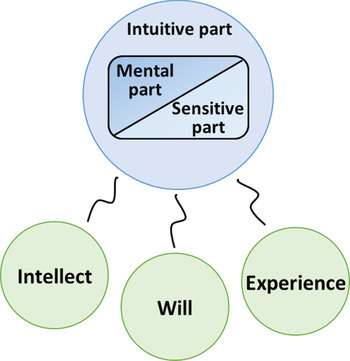
One of the main aims in this research was to model human decision-making processes in incident situations, particularly in situations of ships in distress. To find out the behaviour of emergency operators this research looked for answers in medieval anthropology derived from Christian philosophy (Gilson, Reference Gilson2002; Walsh, Reference Walsh2005). This anthropology recognises three main parts of the human mind (Walsh, Reference Walsh2005): mental, sensitive and intuitive. These parts generate different human functions. The most important are intellect, will and experience, which categorise and analyse all information humans receive through body sensors (eyes, ears, touch, etc). According to this perception, a model of human behaviour could be represented by the schema in Figure 1. The other human functions are found to be irrelevant for the modelling of decision-making processes.
Model of human according to medieval anthropology.

The Decision Support System paradigm is based on Information Technology (IT) support as well as on artificial intelligence where needed. The crucial question is if it is possible to fully replace emergency operators with artificial intelligence and, consequently, is it possible to build a DSS where the decision-making process is completely replaced with artificial intelligence? The answer is apparent because such systems are decision-making systems not decision support ones. Still, it is doubtful that these systems could entirely replace human behaviour and thinking, especially for ill-defined problems (Mladineo et al., Reference Mladineo, Knezic and Jajac2011).
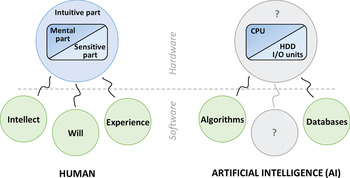
The three human functions presented in Figure 1 (intellect, will and experience) are not subdivisions of the brain parts (intuitive, mental and sensitive). They are the creation of human behaviour represented through these parts. A similarity can be found in the IT world by thinking of software and its output as a creation “passed” through hardware. Therefore, the human parts could be mapped to hardware and human functions to software, respectively. In that sense, Figure 2 shows a model of artificial intelligence that could replace humans.
Model of artificial intelligence that could replace humans (Mladineo et al., Reference Mladineo, Knezic and Jajac2011).

The model shows that some parts of a human model cannot be mapped to an artificial intelligence model. The human will and intuition could not be modelled and mapped into software. Regarding hardware, the Central Processing Unit (CPU) could be recognised as the mental part and Hard Disk Drive (HDD) and other I/O units could be the sensitive part. Concerning software, various algorithms correspond to intellect and the databases to experience.
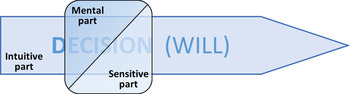
A decision is a product of the human mind's three parts: mental, sensitive and intuitive. The intuitive part carries out the decision process and primarily represents human will, while the sensitive and mental parts influence a final decision. Since it is not possible to map the human intuitive part to an artificial intelligence model, the decision-making process in uncertain and poorly defined environments are the exclusive province of the human and his or her intuitive part. The question here is not about whether a decision is right or wrong, but about who carries out the decision process. Figure 3 shows the human decision-making process.
Human decision-making process (Mladineo et al., Reference Mladineo, Knezic and Jajac2011).

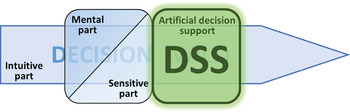
As already mentioned the role of DSSs is to support not to replace the human decision-making process. Therefore, artificial intelligence could be a supporting part of a DSS (Figure 4).
Human decision-making process supported with DSS (Mladineo et al., Reference Mladineo, Knezic and Jajac2011).

It is important to consider consequences that follow wrong decisions. For example, a wrong decision during a tanker rescue procedure could lead to an oil spill and enormous ecological catastrophe and fatalities. The responsibility is on the emergency operator and emergency team to propose a proper solution and adequate place of refuge for a ship in distress (Mladineo et al., Reference Mladineo, Knezic and Jajac2011). Therefore, a DSS should assist the operator in making a good decision rather than a poor one.
2.1.2 Proposed decision support concept
From modelling the human decision-making process (Figures 2 and 4) two main conclusions can be made: a human is an irreplaceable part of the decision-making process, but a human can also be a “weak link” in the process. So, the goal of this DSS is twofold, to support making the right decisions (e.g. place of refuge selection) as well as to prevent wrong decisions that have catastrophic consequences.
Our proposed decision support concept, for DSS that will be used by non-expert users, considers the following:
-
• Data visualisation – since more than 80% of data have a spatial component (Vriens, Reference Vriens2004), the best way to visualise it is using a GIS.
-
• Models’ results must be clear – since many models used in DSS, such as the MCDM model, sometimes have unclear results for non-expert users, models should be modified and adjusted for non-expert users.
-
• Visual management – all important information and/or warnings must be highlighted for the user, so design of interface is very important and it should use a visual management approach.
These requirements will be primarily achieved by combining GIS and MCDM methods. This idea is not new, because a significant number of decision-making problems can be characterised as multi-criterial and spatial at the same time (Jankowski et al., 1995; Janssen et al., Reference Janssen, van Herwijnen, Stewart and Aerts2008; Recatalá and Zinck, Reference Recatalá and Zinck2008; Arciniegas et al., Reference Arciniegas, Janssen and Omtzigt2011). However, in this paper special care has been taken to modify the MCDM method to be used by non-expert users.
2.2 Multi-Criteria Decision-Making method
Multi-Criteria (Multi-Attribute or Multi-Objective) Decision-Making (MCDM) is characterised by a set of alternatives (actions) A, a set of criteria (objectives) G, and evaluations of each alternative on each criterion which represent evaluation set F. Decision-making consists of the selection of the “best” alternative, comparison and ranking of alternatives, or comparison of alternatives with some reference points (sorting of alternatives). Usually, there is also set of weights W, which consists of a weight value for each criterion, i.e. criteria are not equally important.
Generally, Multi-Criteria Decision-Making methods can be divided into the following groups based on their characteristics: based on utility functions, outranking methods or interactive methods. Popular MCDM methods are (Guitouni and Martel, Reference Guitouni and Martel1998): based on utility functions – Multi-Attribute Utility Theory (MAUT), Measuring Attractiveness by a Categorical-Based Evaluation Technique (MACBETH), outranking methods – Analytic Hierarchy Processes (AHP), Elimination and Choice Expressing Reality (ELECTRE), Preference Ranking Organisation Method for Enrichment Evaluations (PROMETHEE), Technique for Order of Preference by Similarity to Ideal Solution (TOPSIS), and interactive methods – Visual Interactive Method for Decision Analysis (VIMDA).
Among various multi-criteria methods, due to its good performance (Guitouni and Martel, Reference Guitouni and Martel1998), the PROMETHEE II method was chosen (Brans and Mareschal, Reference Brans and Mareschal1991) and implemented into a GIS. PROMETHEE II is accepted by decision-makers because it is comprehensive and can present visualised results as proven in the application of this method in other engineering problems (Mladineo et al., Reference Mladineo, Margeta, Brans and Mareschal1987; Reference Mladineo, Lozic, Stosic, Mlinaric and Radica1992).
However, the results from the PROMETHEE II method can be confusing for non-expert users like emergency operators. So, considering the presented idea of human decision-making processes supported with DSS, results need to be interpreted in a different way and are explained below.
3 METHODS
3.1 PROMETHEE method
In the last 30 years, several decision aid methods or decision support systems have been proposed to help in the selection of the best compromise alternatives. In this paper, the PROMETHEE (Preference Ranking Organisation Method for Enrichment Evaluations) method was chosen for treating the multi-criteria problem (Brans and Mareschal, Reference Brans and Mareschal1991). This method is known as one of the most efficient but also one of the easiest in the field. The PROMETHEE method is accepted by decision-makers because it is comprehensive and can present results using simple ranking (Brans and Mareschal, Reference Brans and Mareschal1991).
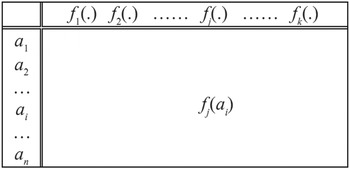
An input for the PROMETHEE method is a matrix consisting of set of potential alternatives (actions) A, where each a element of A has its f(a) which represents evaluation of one criteria (Figure 5). Each evaluation f j (a i ) must be a real number.
Input matrix for the PROMETHEE method.

PROMETHEE I ranks actions by a partial pre-order, with the following dominance flows (Brans and Mareschal, Reference Brans and Mareschal1991), for leaving flow:
 $${\Phi}^{+}(a) = {1\over n-1}\sum\limits_{b\in A} {\Pi (a, b)}$$
and for entering flow:
 $${\Phi}^{-}(a) = {1\over n-1}\sum\limits_{b\in A} {\Pi (b, a)}$$
where a denotes a set of actions, n is the number of actions and Π is the aggregated preference index defined for each pair of actions.
PROMETHEE I gives a partial relation, and then a net outranking flow is obtained from the PROMETHEE II method which ranks the actions by total pre-order calculating net flow (Brans and Mareschal, Reference Brans and Mareschal1991):
 $${\Phi}\lpar a \rpar = {\Phi}^{+}\lpar a \rpar -{\Phi }^{-}(a)$$
In the sense of priority assessment, net outranking flow represents the synthetic parameter based on defined criteria and priorities among criteria. Usually, criteria are weighted using criteria weights w j and the usual pondering technique:
 $$\Pi (a, b) = {\sum\limits_{j=1}^n {w_{j}P_{j}(a, b)} \over \sum\limits_{j=1}^n w_{j}}$$
Furthermore, different sets of criteria weights can be used and then each set represents one scenario.
3.2 Simplified interpretation of PROMETHEE II results
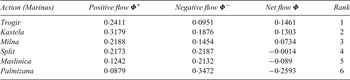
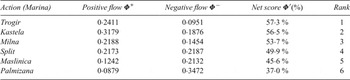
The problem with PROMETHEE II results for non-expert users is that they are presented on a [−1, 1] scale where a higher number represents “better” action. Additional information is a rank of each action, as presented in Table 1. A case of comparison of six actions (alternatives) that represent yacht marinas is presented in Table 1. In this case, marinas are compared to select the most competitive one according to criteria grouped into the following groups: price, infrastructure, maintenance services, catering and sports facilities, safety, quality and standards, and extra services. The case is taken from a PhD thesis (Jadrijevic, Reference Jadrijevic2016).
Results of PROMETHEE II comparison of six actions (case of competitiveness of marinas).

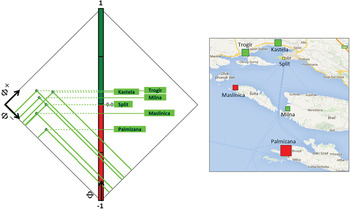
However, rank itself is usually insufficient information to make the right decision, because it is too coarse. It does not indicate how close actions are to each other, it uniformly distributes actions. This represents a problem in the application and implementation of PROMETHEE II in practice. Nevertheless, visual representation of results could be used, such as the PROMETHEE Diamond chart (Figure 6), but it can still be confusing for non-expert users.
Results of PROMETHEE II comparison of six actions (nautical marinas) on PROMETHEE Diamond chart with map preview (“Visual PROMETHEE” software)

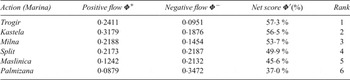
The solution to this problem is to change the PROMETHEE II scale from [−1, 1] interval to [0, 1] interval i.e. [0%, 100%] interval. This can be easily done, as presented in Table 2. However, is it mathematically and logically correct to change scale in such a way?
Simplified interpretation of results of PROMETHEE II comparison of six actions (case of competitiveness of marinas).
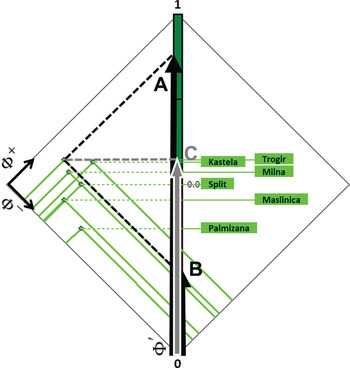
If the [−1, 1] scale of the PROMETHEE Diamond chart main axis Φ is changed to a [0, 1] interval, i.e. to Φ′, then a projection of one action a (Trogir) along onto Φ′ results in vector A. Projection of the same action a (Trogir) along onto Φ′ will result in vector B, as presented in Figure 7. Vectors A and B are pointing in the same direction, because they are both positive. The scalar value of vector A can be calculated as:
Vectors A and B as the projections of the best ranked action and vector C representing Φ′ value of that action.

 $$A={\surd \left ( \left ( {1-\Phi }^{-}(a) \right )^{2}+\left ( {1-\Phi }^-(a) \right )^{2} \right ) \over \surd 2} = {1-\Phi }^{-}\lpar a \rpar = {\Phi }^{+ \prime}\lpar a \rpar $$
and scalar value of vector B can be calculated as:
 $$B={\surd \left ( \left ( {\Phi }^{+}(a) \right )^{2}+\left ( {\Phi}^{+}(a) \right ) ^{2} \right ) \over \surd 2} = {{\Phi}}^{+}\lpar a \rpar $$
where
 $\Phi^{+ \prime}$
represents how “good” the action was in comparison with actions “better” than itself. It differs from Φ− which represents how “bad” an action was in comparison with actions “better” than itself. Since, Φ+ represents how “good” an action was in comparison with actions “worse” than itself, i.e. Φ− and Φ+ are vectors pointing in opposite direction, Φ is calculated by subtracting them. However,
 $\Phi^{+ \prime}$
and Φ+ are vectors pointing in the same direction, so ɸ′ can be calculated by summing them, as presented in Figure 7. By summing vectors the A and B scale is duplicated and rises from [0, 1] to [0, 2], so the result must be divided by two.
Finally, the expression for the simplified interpretation of PROMETHEE II results i.e. for a net score, instead of net flow, can be defined as:
 $${\Phi}^{\prime}\lpar a \rpar = {1\over 2}\left ( {\Phi}^{+}\lpar a \rpar +{\Phi}^{+^{\prime}}\lpar a \rpar \right ) $$
where
 $\Phi^{+ \prime}(a)$
can be calculated using expression:
 $${\Phi}^{+\prime}\lpar a \rpar = 1-{\Phi}^{-}(a)$$
and Φ′ will result in a [0, 1] interval which represents a [0%, 100%] interval. It is a type of scale very familiar to any group of non-expert users. Another advantage of net score is that its calculation uses a standard output of the PROMETHEE I method (positive net flow and negative net flow); there is no need for additional calculations.
3.3 Grade interpretation of PROMETHEE II results
Additionally, when having action scores represented as a score in a [0%, 100%] interval, on one hand it is really easy to understand them, and on the other hand additional interpretation of scores can be made. For instance, it is possible to make grade interpretation of scores.
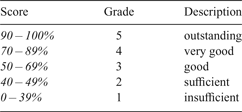
A set of ranges of scores can be defined and to each range a grade is assigned, as presented in Table 3. The presented grade interpretation is similar to grade interpretation at universities or in schools.
Grade interpretation of scores.

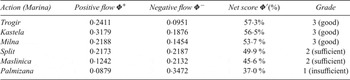
Using this grade interpretation of scores, it is even easier to understand how much one action is “better” compared to another action. It is shown in the example presented in Table 4.
Example of grade interpretation of PROMETHEE II net scores (case of competitiveness of marinas).

From the example (Table 4) it is clear that the best alternative (Trogir) is actually just “good”. It is not “outstanding”, although it is the best one. This is very important, because it is possible to compare two alternatives and have a case “one alternative is excellent, another one is poor” (Table 5), or to have a case “one alternative is just better than the other one” (Table 6).
Comparison of dominating and weak alternative.

Comparison of two non-dominating alternatives.

Using grade interpretation of PROMETHEE II net scores it is really easy for the non-expert user to know which alternative is the best one and how much it is “better” than other alternatives.
4 RESULTS
4.1 Solving the Places of Refuge selection problem
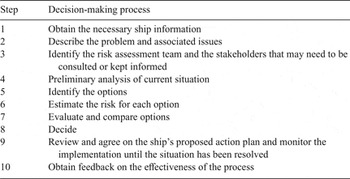
Selection of a Place of Refuge (PoR) plays an important role in maritime navigation to either mitigate or avoid potential negative consequences, like marine pollution. The underlying decision-making process should be accurate, quick and consider several criteria. The decision should offer the most feasible reliable solution to a ship in distress. Lee (Reference Lee2014) describes different approaches of decision-making processes for selection of an optimal PoR. The paper analyses the decision-making sequences with emphasis on situational assessment and roles of the authorities in several countries. This research shows that evaluation and ranking of PoRs represents an important step in this decision-making process (Table 7).
PoR decision-making process in Canada (Lee, Reference Lee2014).

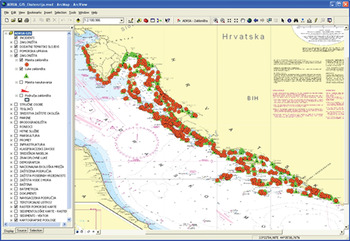
Being a tourist area with many small bays and islands on the coastline (Figure 8), where yachts are anchored, in a situation of a ship in distress Croatia faces a challenge to find an adequate PoR, which will be the least harmful to both environment and economic activities. To this end, the Croatian Ministry of the Sea, Transport and Infrastructure suggested berth and anchorage locations from the official nautical charts be used as potential PoR locations. Each location has detailed pilotage information (sea bed information, depth, sea marks, etc.), as well as a narrative description of the location's characteristics and wind conditions. Subsequently, 380 potential PoRs have been identified in Croatia (Figure 8), described by the experts from the Hydrographic Institute of the Republic of Croatia, and entered into the database (GIS) of the DSS.
PoRs identified in Croatian part of the Adriatic Sea (Mladineo et al., Reference Mladineo, Knezic and Grzetic2009).

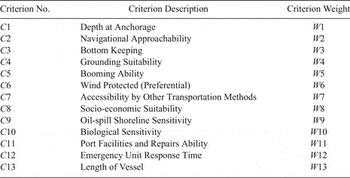
The decision-making process must be supported with an adequate procedure for the selection of the most suitable PoR for a particular situation. Therefore, the PoR selection procedure has been based on a MCDM model, i.e. Multi-Criteria Analysis (MCA), using PROMETHEE methods. As already mentioned, the model includes 380 potential locations for PoR, which are evaluated and ranked according to the set of predefined criteria. Relevant criteria are carefully defined considering the most important characteristics of the refuge. Each criterion has a weight defining its importance for the overall goal: the most suitable place with regard to the environment and economic activities. Table 8 shows the set of 13 criteria selected for the assessment of PoR.
Criteria for Multi-Criteria Analysis of PoRs.

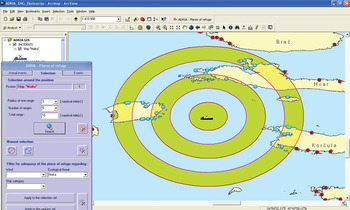
The selection procedure starts with GIS analysis, which includes assessment of criteria presented as thematic layers. For criteria that cannot be spatially presented using GIS analysis, a team of experts evaluates the situation and provides specific numeric values as the input for MCA. MCA is implemented by the mathematical model adapted to the criteria values and coupled with a GIS database. The model performs selection and/or ranking of n places of refuge within a pre-defined viable radius r around the position of a ship sending a request (Figure 9). In Figure 9, circles, defined by radius r, look like ellipses, because the map is presented using a simple Bessel ellipsoid to use the same coordinate system as is used in Croatian nautical charts. The operation of setting up of a radius is optional and it enables exclusion of places which an emergency operator considers as unfeasible because of their distance from the ship. It speeds up the criteria evaluation and decision-making process.
Searching potential places of refuge according to defined radius.

To facilitate and automate the process of decision-making in an emergency and to reduce the possibility of subjective error, a “Scenario generator” is developed in cooperation with the expert team. Predefined sets of criteria weights correspond to scenarios in MCDM methods. The “Scenario generator” enables adjustment of the criteria weights (Wi) to adapt to the decision-making process, characteristics of a ship type or length, and an incident, e.g. ship damage. For instance, if there is a possibility of oil spill, the criteria representing “booming ability”, “oil spill shoreline sensitivity” and “biological-sensitivity” will have the highest weights. However, a customised scenario (set of criteria weights) can be used as well.
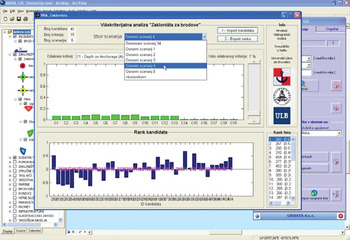
The selected PoRs (Figure 9) are sent to MCA software (based on the PROMETHEE method) and according to the selected scenario (criteria weights set) comparison and ranking of PoRs are made (Figure 10). However, since the results, i.e. PROMETHEE II net flow of PoRs, are not easy to understand for an emergency team, only the ranking of PoRs is exported to the map.
MCA software support for comparison and ranking of PoRs (Mladineo et al., Reference Mladineo, Knezic and Grzetic2009).

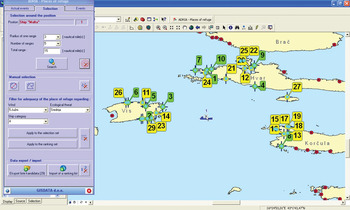
The final rank of PoRs is shown on the map in the GIS (Figure 11), suggesting to an emergency operator the most suitable PoR for the actual case (ship). The numbers in boxes correspond to the ranks of the PoRs’ suitability. The green ones are ranked from 1 to 10, and yellow places have lower ranks. An emergency team (emergency operator, harbourmaster, emergency commanders, etc) considers the best ranked PoRs and makes a decision.
Display of calculated rank of potential places of refuge using MCA.

The presented procedure and a system for PoR selection have been developed as an extension of “ESRI ArcMap” software. Since 2006, this system has been in use in the Maritime Rescue Coordination Centre (MRCC) Rijeka, Croatia. However, from the very beginning, the need for some improvements of the system were identified.
4.2 Improving MCA part of Places of Refuge (PoR) selection procedure
As already mentioned, since PROMETHEE II net flow is not easy to understand for non-expert users, only ranking of PoRs has been used. However, ranking does not give sufficient information about differences between alternatives (PoRs). Two PoRs can be quite similar, yet they will probably have different ranks. To understand the real difference between two PoRs, some more precise scores must be used. Therefore, a different interpretation of PROMETHEE II results, presented in this paper, can be used to improve the decision-making process in PoR selection procedure. It will be demonstrated with a simple example.
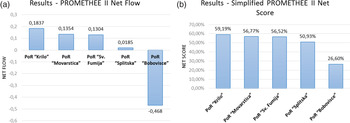
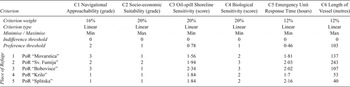
An example of MCA input matrix for the PROMETHEE method for five places of refuge and six criteria is presented in Table 9. A simplified set of six, instead of 13 criteria, is used for easier presentation. Criteria values for each PoR are given, together with the decision-maker's preferences: scenario (criteria weights) and preference function type and parameters. For each criterion, the linear preference function type has been used (with preference thresholds only). Some criteria have real-world units (like hours or metres) and some criteria use scores or grades defined by experts, because these criteria cannot be presented with a unit. Results of the analysis are presented in Figure 12.
Comparison of results of MCA presented as PROMETHEE II net flow and simplified net score.

Input matrix for selection of optimal PoR based on six criteria.

Evidently, for a non-expert user, it is much easier to understand a simplified PROMETHEE II net score (Figure 12(b)) than PROMETHEE II net flow (Figure 12(a)). These values are then used for the ranking of PoRs.
4.3 Case Study: Web-based Decision Support for Incident Situation in the Adriatic Sea (WDS-ISAS)
A complete system for management of incident situations in maritime traffic, not just for solving the PoR selection problem, was developed as a Web MCA-based DSS (Mladineo et al., Reference Mladineo, Mladineo and Stosic2014). The developed DSS, based on a model of human decision-making processes during emergency management, integrates all designed modules with an emphasis on intuitive and user-friendly interface and visual management of data, information and warnings.
The only way to integrate many different data types and functions into a single Web application was to design a Web “mashup” application. A “mashup” application is synonym for a Web application that uses content from more than one source to create a single new service displayed in a single graphical interface. “Microsoft Silverlight” was chosen as a platform to build such an application, and it was built using “ESRI ArcGIS API for Silverlight”. Regarding maritime traffic, the main challenge is to integrate Automatic Identification System (AIS) data and radar data into a single chart (Kazimierski and Stateczny, Reference Kazimierski and Stateczny2015). Furthermore, that chart can be extended with satellite AIS and imagery (Zhao et al., Reference Zhao, Ji, Xing, Zou and Zhou2014).
The following data and modules were integrated, or are about to be integrated, into a new Web application called “Web-based Decision Support for Incident Situation in the Adriatic Sea” (WDS-ISAS) developed by the University of Split – GIS Lab (Mladineo et al., Reference Mladineo, Mladineo and Stosic2014; UnistGIS, 2015):
-
• existing spatial database of Adriatic Sea called “ADRIA-GIS”;
-
• existing criteria and scenario dataset for selection of PoRs in Adriatic Sea;
-
• live feed of weather and maritime forecasting for Adriatic Sea call “Adriatic Forecasting System” (INGV, 2016);
-
• live feed of vessels position using AIS data from web services like “AIS Marine Traffic” (MarineTraffic, 2016) and/or “ExactAIS” (ExactEarth, 2016);
-
• live feed of radar data exported from civil radar systems;
-
• spatial databases from different organisations and institutions responsible for maritime traffic in Adriatic Sea (Police, Coast Guard, etc);
-
• results from oil spill prediction models such as “GNOME” (NOAA, 2016) and/or “RPS ASA OilMapWeb” (ASA, 2016), etc.
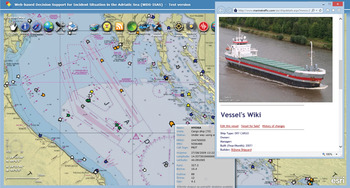
The developed Web application has a very simple interface: the menus and tools are presented using icons, the overall presentation of GIS has been simplified with emphasis on layers related to emergency management and there are no unnecessary tools and functions. The following figures show the new Web MCA-based DSS and its main features (Figures 13–17).
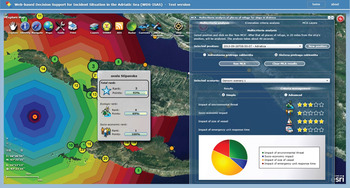
Web MCA-based DSS: live feed of vessels position using AIS data from web services and charts.

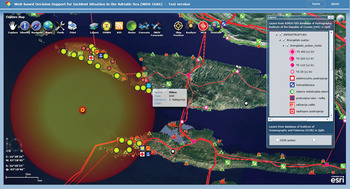
Web MCA-based DSS: selection of PoR using MCA module.

Web MCA-based DSS: all important spatial and emergency data around vessel's position.

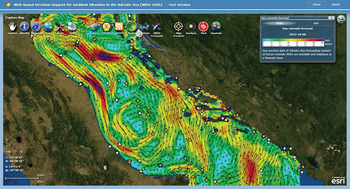
Web MCA-based DSS: live feed of weather and maritime forecasting.

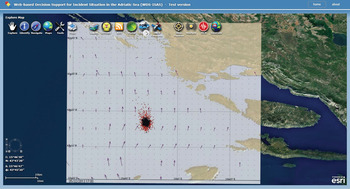
Web MCA-based DSS: import of results from oil spill prediction model “GNOME”.

The developed PoR procedure and system have been implemented in this DSS as well (Figure 14). However, it is important to note that results of MCA are displayed in multiple ways (based on visual management principles): on a map by placing a rank number on each PoR, and on a PoR's “map tip” with details about each PoR's rank and its net score using the developed simplified interpretation of PROMETHEE II results.
To minimise the possibility that a wrong decision is made, three MCAs are made at each time: the main MCA which results with total rank of PoR and two additional MCAs which result only with ecological and socio-economic ranks and scores.
Different scenarios represent different situations on the sea. Scenarios are represented in MCA using different weighting factors for criteria. Thus, every time, regardless of which scenario is chosen, the ecology and socio-economic ranks and scores of PoR are shown. This ensures the two most important impacts, ecology and socio-economic, are always considered.
In Figures 15, 16 and 17 it can be seen that this DSS goes beyond PoR selection and it supports any kind of incident, emphasising marine pollution. Thus, it needs weather (wind) and maritime (sea currents) forecasting (Figure 16) based on web services such as the “Adriatic Forecasting System”, in order to produce oil spill drifting and dispersion prediction (using “GNOME” software) in case of marine pollution (Figure 17). All other spatial data (Figure 15) supports decision-making and is significant information for many types of incidents.
The developed DSS is more focused on the management of incident response, so the main application is to be used in a Maritime Rescue Coordination Centre, Coast Guard Command Centre, or similar. It is based on “ESRI ArcGIS” software technology and “ESRI ArcGIS Server”, but it can be combined with other solutions, including open-source GIS servers. This DSS is still being developed, and some presentations may change.
5 CONCLUSIONS
This paper proposes a special Web Multi-Criteria-Analysis-based Decision Support System (DSS) concept which helps to establish efficient emergency management using GIS and its spatial analysis tools. Using visual management combined with powerful Multi-Criteria Decision-Making (MCDM), the possibilities of making poor decision in emergencies are significantly reduced. A model of human behaviour with its main functions based on medieval anthropology has been presented. It helps to better understand human behaviour during emergency management in maritime situations. Furthermore, a need to simplify MCDM method results, to make them more understandable to non-expert users, was identified. Therefore, a different interpretation of PROMETHEE II results has been presented in this paper. Results are presented on a [0%, 100%] interval scale instead of the original [−1, 1] interval scale, to make them more understandable. Additionally, grade interpretation of PROMETHEE II results has been presented. The presented Web MCA-based DSS concept has been implemented in the Adriatic Sea, but it can be realised everywhere. Further research should consider the usage of some artificial intelligence methods to automate and improve some parts of the decision-making process. For instance, to develop a DSS that can recognise by itself a need for a PoR procedure.
ACKNOWLEDGEMENTS
The presented Web application “Web-based Decision Support for Incident Situations in the Adriatic Sea (WDS-ISAS)” is still under development by the University of Split in collaboration with the Coast Guard of the Republic of Croatia and other institutions. The collaboration started in 2012, with Commodore Marin Stosic as the Coast Guard Commander.