

Introduction
As one of the pillars constituting its efforts toward regional integration, the Association of Southeast Asian Nations (ASEAN) is working to realize a ‘socio-cultural community’ based on ‘the region's aspiration to lift the quality of life of its peoples through cooperative activities that are people-oriented and environmentally friendly, geared toward the promotion of sustainable development’ (ASEAN, 2009a: II-5). In March 2009, the organization adopted the ASEAN Socio-Cultural Community Blueprint in an effort to improve ‘the quality of life’ in the region. Following the initiative of ASEAN, South-East Asian countries increasingly see the region from a ‘quality of life’ perspective.
However, even in the narrow terms of policy standards, the concept of quality of life has various meanings. This polysemousness can be seen in the case of ASEAN. Besides, ASEAN has not had an original theoretical framework concerning quality of life so far.
This study examines ASEAN's policy documents, tracing the process by which, although its meaning is still indeterminate, the concept of quality of life has increased in importance as the key to socio-cultural integration. On the basis of this examination, the paper focuses on the current trend that emphasizes subjective levels of quality of life and clarifies that ASEAN has been moving toward including this level in its policymaking. It also examines the method used to assess subjective levels of quality of life. The paper then analyzes the reality of subjective quality of life among people in ASEAN by using data from the ASEAN Barometer, considering the implications of the results.
Quality of life and ASEAN
Quality of life
In English-speaking countries, the concept of quality of life has been in use since around the mid-eighteenth century, and philosophical thinking relating to the concept dates back even further. It was only in the 1970s, however, that quality of life came to be widely used as an index to evaluate the state of society and the individual. At a time when the post-war economy was entering a new phase, people started to question the existing socio-economic structures, encouraged in part by new social movements. Under such circumstances, quality of life grew in importance, first as a standard for reconsidering existing domestic, scientific, and technological policies that had prioritized the expansion of productivity and economic efficiency, and second as a goal that post-rapid-economic-growth societies should achieve (Stöber and Schumacher, Reference Stöber and Schumacher1973). The quality of life referred to back then was initially a rather vague ‘something’ that could not be measured by GDP and other economic scales but which needed to be prioritized, and the movement to define that ‘something’ flourished. Eventually, research and development took place to create an index that quantitatively described quality of life, and efforts were made to incorporate these studies into policymaking and evaluations of societies (Bognar, Reference Bognar2005: 561–2).
These developments had an international influence – or rather, from its earliest stage, an international initiative was present in the movements – as typically represented by the use of quality of life by the Committee on Science Policies of the Organization for Economic Co-operation and Development (OECD) as a term symbolizing its policy changes (OECD, 1971). In particular, from the 1990s onward, most of the indices or similar standards that have been widely used to describe the level of quality of life were developed by international organizations. To list a few, there are the Human Development Index and Millennium Development Goals Index of the United Nations (UN), the Social Index of the OECD, the European Quality of Life index of the European Union (EU), and the Happy Planet Index of the New Economics Foundation. Indicators and indices established by the UN, EU, and OECD are well known for their close correlation with efforts concerning ‘human development’ and ‘social protection’.
Quality of life in ASEAN
ASEAN cites quality of life as one of the core concepts in its moves toward regional integration. Although ASEAN has so far not established its own quality of life index, it has made the concept central to its social policy goals since the mid-2000s. In addition, it concurrently drafted and is presently promoting action plans designed to improve quality of life in ASEAN, incorporating the UN Millennium Development Goals.
In the Declaration of ASEAN Concord II, the organization clarified its intention to build an ‘ASEAN Community’, consisting of a ‘Security Community’, ‘Economic Community’, and ‘Socio-Cultural Community’ by 2020. At the 12th ASEAN Summit in January 2007, the plan was announced to achieve the establishment of the ASEAN Community by 2015. The chairperson's statement declared the intention of creating ‘a caring environment that prioritizes the quality of life of its peoples’ (ASEAN, 2007).
One of the moments where quality of life first emerged as a key term in ASEAN was probably during the revision process of the First Initiative for ASEAN Integration. The main focus of this Initiative is to narrow the ‘development gap’ between initial member states and Cambodia, Laos, Myanmar, and Vietnam (collectively referred as CLMV), who joined ASEAN in the late 1990s and lag behind other member countries in terms of development level. Among CLMV members, the average GDP per capita is one-fourth or less of that of other member states, and their positions on the Human Development Index and Millennium Development Index are similarly low in comparison. In 2010, the Human Development Index (consisting of an average longevity index, education index, and GDP index) ranked them at 124 (Cambodia), 122 (Laos), 113 (Myanmar), and 132 (Vietnam) of 196 countries (UNDP, 2010). The mid-term review of the Initiative for ASEAN Integration, aiming to facilitate the development of CLMV, took place in 2005. In the review, new priorities were incorporated into the plan and were grouped together as quality of life issues. These were the maintenance, securement, and improvement of the urban life environment (including housing, transport, and waste disposal); natural environment; air pollution; marine pollution; and clean water (ASEAN, 2006).
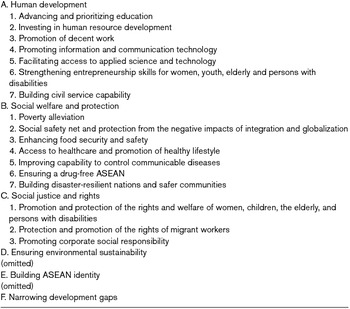
In March 2009, ASEAN further adopted the ASEAN Socio-Cultural Community Plan of Action, a comprehensive plan envisaged to realize the ‘Socio-Cultural Community’ (ASEAN 2009a). According to the plan, the aim was to create a ‘Socio-Cultural Community’ to respond to ‘the region's aspiration to lift the quality of life of its peoples’. The concept of quality of life used here has a broader perspective than that used by the Initiative for ASEAN Integration in terms of geography and definition. In accordance with this, the Socio-Cultural Community Blueprint, which highlights the improvement of quality of life as its ideal, sets forth a wide range of actions, as shown in Table 1. All ASEAN member states are subject to the plan.

ASEAN and the quality of life related index
In the policy goals included in the ASEAN Socio-Cultural Community Blueprint – ‘poverty alleviation’, ‘access to healthcare and promotion of healthy lifestyle’, and ‘improving capability to control communicable diseases’ – links to the UN Millennium Development Goals are expressly mentioned.
In 2000, ASEAN countries jointly acknowledged their intention of achieving the Millennium Development Goals and adopted a joint declaration in March 2009 to confirm this. There are also some movements within the organization to draw up a roadmap toward the achievement of these Goals in the region (McClean et al., Reference McClean, Warr and Lorenzen2008).
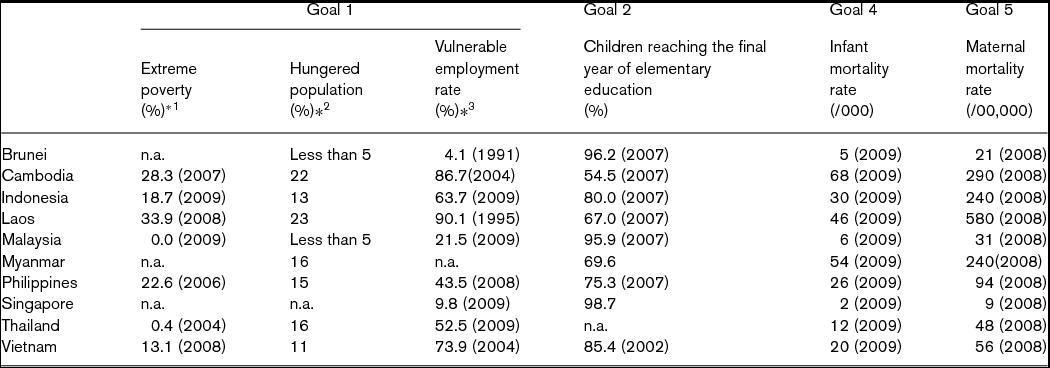
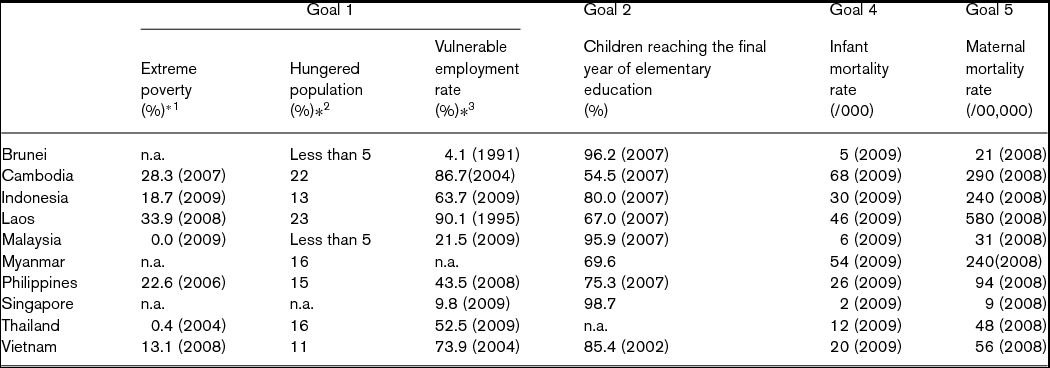
The UN Millennium Development Goals consist of eight areas, in which a total of 60 indices are included. The target year of the Goals is 2015, which is the same year as ASEAN's target for integration. Table 2 shows ASEAN member states’ progress in terms of some of the Millennium Development Goals that relate more directly to the three policy areas of the ASEAN Socio-Cultural Community Blueprint: Goal 1 (eradication of extreme poverty and hunger), Goal 2 (universal primary education), Goal 4 (reduction in child mortality), and Goal 5 (improvements in maternal health).
Millennium Development Goals Index in ASEAN countries
Notes: *1: The proportion of population below USD1 (PPP) per day.
*2: The proportion of population below minimum level of dietary energy consumption.
*3: The proportion of unpaid family workers and own-account workers in total employment.
Source: ADB (2011).
All indices suggest that, in comparison with the optimistic levels enjoyed by Brunei, Singapore, and Malaysia, the CLMV countries face many challenges. To this extent, the effort to narrow the ‘development gaps’ under the Initiative for ASEAN Integration may also be inevitable in the efforts under the Socio-Cultural Community Blueprint. On the other hand, the indices shown in Table 2 suggest that there are some non-CLMV countries that clearly require improvement in some areas or as a whole. In this sense, the ASEAN Socio-Cultural Community Blueprint, which incorporates the UN Millennium Development Goals, has more relevancies to almost all ASEAN countries than the social policy agendas laid out in the Initiative for ASEAN Integration.
As seen above, in recent years ASEAN has set quality of life as one of the major goals in the social realm. At the same time, although the package of guidelines originated in the UN, ASEAN has adopted indices concerning quality of life and has been moving forward with policies based on them. Behind the increasing attention to quality of life probably lies not only rapid urbanization and other social changes combined with causes such as the procurement of development funds from international organizations and other countries, but also an awareness that ASEAN's commitment to create a ‘Socio-Cultural Community’ needs to be linked closely to the everyday lives of people in the region in order to be successful.
State of subjective quality of life in ASEAN
Two approaches to quality of life
There are two approaches to the indexing of quality of life: objective and subjective (Phillips, Reference Phillips2006:3). An objective approach focuses on observable and numerically verifiable statuses, heights, frequencies, and incidences – such as income level or mortality rate. The Human Development Index and the Millennium Development Goals Index can be categorized as quality of life indices based on an objective approach. The subjective approach tries to measure the assessment or awareness of people themselves of their quality of life. The Happy Planet Index and the European Quality of Life Index take people's satisfaction rates, awareness, and values into account, and, therefore, can be said to adopt a subjective approach.
The ASEAN Socio-Cultural Community Blueprint, which highlights quality of life as a policy agenda, has so far used the Millennium Development Index as the only index in assessing quality of life. In this sense, the organization depends solely on an objective approach. However, discussions about health in ASEAN potentially possess elements of the subjective approach toward quality of life. Discussions concerning mental health in ASEAN should be highlighted here.
Prioritization of mental health in ASEAN
ASEAN countries organize an ASEAN Health Ministers Meeting biennially. At the meeting in 2000, the meeting announced the ‘Healthy ASEAN 2020’ initiative, based on their shared awareness that ‘despite significant progress made in uplifting the quality of life of individuals in our region, health problems continue to be associated with poverty and are increasingly associated with urbanization, industrialization, environmental pollution, lifestyle diseases, and stress-related conditions’. The announcement introduced the initiative to place health ‘at the center of development’ by 2010 and to ‘ensure that our peoples are healthy in mind and body and living in harmony in safe environments’ (ASEAN, 2000). In 2002, the meeting agreed to promote a Regional Action Plan on Healthy ASEAN Lifestyles, which had been drawn up to materialize the aforementioned initiative. The plan has been incorporated into the ASEAN Socio-Cultural Community Blueprint, prioritizing improvements to quality of life (ASEAN, 2009a: B4).
Mental health has been given priority in the Regional Action Plan on Healthy ASEAN Lifestyles, in which ‘to collaborate on providing environments that promote social participation, minimize discrimination, and enhance economic opportunities’ are acknowledged as the fundamental policies for pursuit of goals in this area (ASEAN, 2002). Because of the integration of the Regional Action Plan on Healthy ASEAN Lifestyles into the ASEAN Socio-Cultural Community Blueprint, measures directly concerning the improvement of mental health have been limited to PR activities designed to form part of educational, information, and public health efforts (ASEAN, 2009a: B4ii). On the other hand, the key policies of the Regional Action Plan on Healthy ASEAN Lifestyles, namely, the ‘promotion of social participation’, ‘minimizing of discrimination’, and ‘enhancement of economic opportunities’, have been incorporated into the ASEAN Socio-Cultural Community Blueprint as follows: (1) the Strengthening of Entrepreneurship Skills for Women, Youth, the Elderly, and Persons with Disabilities (Table 1: A6); (2) the Promotion and Protection of the Rights and Welfare of Women, Children, the Elderly, and Persons with Disabilities (Table 1: C1); and (3) the Protection and Promotion of the Rights of Migrant Workers (Table 1: C2). These may be seen as the materialization and expansion of the mental health concept through its integration into ASEAN's quality of life policy.
Mental health is a topic that concerns people's minds, as defined in the Healthy ASEAN 2020 initiative; therefore, efforts to maintain and improve mental health naturally suit subjective approaches. It is true that the concept of mental health depicted in the Healthy ASEAN 2020 and ASEAN Socio-Cultural Community Blueprint put heavier focus on preventive medicine, the importance of which has been increasingly recognized in today's rapidly changing economy and society, rather than subjective quality of life based on the concept of prioritizing each individual's happiness or well-being. Even so, as seen in the aforementioned ASEAN Socio-Cultural Community Blueprint, ‘mental health’ has been included as an element in discussions concerning quality of life in ASEAN, not necessarily as a narrow, preventive medicinal concept. Under such circumstances, the subjective level of quality of life in efforts to improve it has been increasing in weight, together with the subjective approach concerning quality of life. There are several studies on the subjective quality of life in the region (Inoguchi and Fujii, Reference Inoguchi and Fujii2012; Kuan and Jiuan, Reference Kuan and Jiuan2011; Inoguchi and Shin, Reference Inoguchi and Shin2010). They provide us with important points of comparison, even though a study that tries to examine subjective quality of life with a view to mental health needs to adopt its own approach.
Subjective quality of life index–WHOQOL
In the area of mental health, the development of quality of life indices based on a subjective approach has been made in studies of ‘health-related quality of life’. Against the backdrop of heightened awareness in the realms of health and medical care that patients should be seen not only as treatment objects but also as individuals who are pursuing their own well-being, the quality of life concept has been used as an ideal or standard in efforts to realize medical care that allows each patient to lead the life they desire. Reflecting such a trend, movements to establish a health-related quality of life index has gained momentum since the 1970s (Nordenfelt, Reference Nordenfelt1994: 1–2). In the 1990s, the World Health Organization (WHO) research group developed the WHO Quality of Life (WHOQOL) metric, among which the WHOQOL-100 and WHOQOL-BREF indices have been used internationally in surveys. WHOQOL-100 divides subjective quality of life into six domains with a total of 100 questions. WHOQOL-BREF is a simplified version of WHOQOL-100 (WHO, 1998). In WHOQOL-BREF, the domains constituting subjective quality of life are divided into four categories with a total of 26 questions.
One feature that characterizes WHOQOL is its ‘cross-cultural perspective’. The WHO defines quality of life as an ‘individual’s perception of their position in life in the context of the culture and value systems in which they live and in relation to their goals, expectations, standards, and concerns’ (WHOQOL Group, 1995: 1405). WHOQOL also uses this definition of quality of life and acknowledges that the quality of life concept itself contains cultural diversity. The WHOQOL developers realized that the majority of existing quality of life indexes were established on the basis of the cultures and values of specific countries or regions, significantly restricting the geographical range for their practical application (ibid., 1403–4). According to the researchers, WHOQOL has been developed to establish a ‘cross-cultural’ quality of life index that even recognizes the possibility of translation bias, which can occur when translating the questions into different languages.
Another characteristic of WHOQOL is its promotion of a ‘holistic approach to health and health care’. The WHO's definition of ‘healthy’ is ‘not only a status suggesting the absence of diseases or disabilities but also referring to the physically, mentally, and socially sound state of being’. The WHOQOL developers call this view of health and the efforts to establish and promote healthcare based on such view a ‘holistic approach to health and health care’ (ibid., 1404). Based on this philosophy, the group tried to build a cross-cultural index around the core concept of holistic health as a tool to analyze health, subjective quality of life, and the reality of healthcare of the people living in a particular area. In accordance with the adoption of a holistic approach, WHOQOL included both healthy and disabled or sick people as its subjects and structured the questions to include both individuals and their environment as elements affecting subjective quality of life.
The ASEAN Barometer incorporates in its questionnaire most of these WHOQOL elements. To be precise, in its Health Module it includes 25 out of the 26 questions constituting WHOQOL-BREF.Footnote 1 Consequently, it is possible to compare and assess subjective quality of life in a way that largely complies with WHOQOL-BREF. As WHOQOL has been developed with a focus on cross-cultural validity, the index can be used not only to make country-to-country comparisons and analyses in ASEAN but also for detailed analyses within the countries and regions that are diverse in religions and ethnicities.
Analysis of ASEAN’ subjective quality of life
ASEAN Barometer 2009
This paper omits the description of the ASEAN Barometer because an overview will be provided in another article. Here only the following fact concerning the representativeness of samples needs to be mentioned: when comparing the demographic characteristics of the target population for the ASEAN Barometer with the ones used in statistics by international organizations and countries’ statistical bureaus, the female compositions in Indonesia, Myanmar, and Singapore are approximately three points higher. As for the age composition, the proportion of people in their twenties in the region is generally smaller. In some countries, there are discrepancies of around ten points for certain age groups. Although their residential distributions make a simple comparison difficult, because different sets of statistics adopt different standards, Indonesia and the Philippines showed a particularly low proportion of people living in urban areas (the survey took place only in the urban areas of Myanmar). The occupation and income distributions do not necessarily reflect the actual situations of the surveyed countries as a whole, because the results may be biased by the areas where the surveys took place (ASEAN, 2008; ASEAN, 2009b; ADB, 2010). In any discussions based on survey results of the ASEAN Barometer, the above facts need to be taken into account.
Self-assessed quality of life
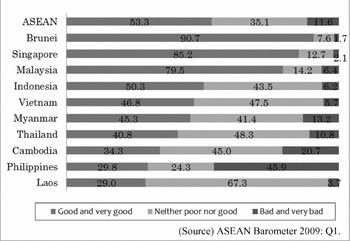
Like WHOQOL-BREF, the Health Module of the ASEAN Barometer asks respondents to subjectively rate their own quality of life on a scale of one to five. Figure 1 shows the response rates for each country after combining ‘very poor’ and ‘poor’ and ‘good’ and ‘very good’, respectively (the overall valid response rate was 99.9%). In Brunei, Singapore, and Malaysia, the ratio of those who have chosen ‘good’ exceeds the average of total respondents. This result is similar to that of Inoguchi and Fujii (Reference Inoguchi and Fujii2012: 28) in self-assessed happiness, although the research areas of these two studies do not overlap entirely. Although the sample of Singapore slightly over-represents women, sex differences in relation to self-assessed quality of life is not statistically significant. The ‘good’ response ratio in other countries was below the average. Among them, the ratio of ‘poor’ was significantly high in the Philippines, while in Laos the majority of respondents chose ‘neither poor nor good’.
Self-assessed quality of life (%)

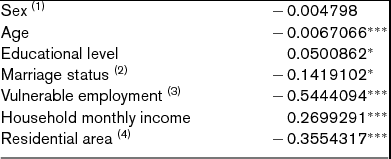
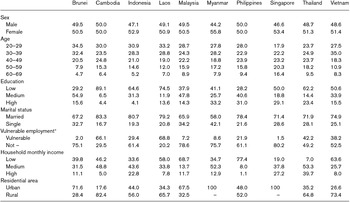
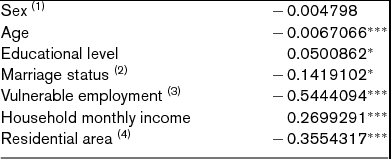
Table 3 is the result of a regression analysis of valid respondents, setting self-assessed quality of life as the dependent variable and the demographic characteristics of the respondents as the independent variable (Appendix Table A1 shows the profiles of the respondents). Apart from sex differences, the result is statistically significant. As the overall analysis shows a negative correlation between residential area and self-assessed quality of life, it is probable that the actual ratio of positive assessment of quality of life in Myanmar is much lower. By contrast, the ratio of Indonesia and the Philippines, where urban residents are less represented, is likely to be higher.
Result of regression analysis of self-assessed quality of life and respondents’ demographic characteristics (overall)
Notes: ***p < 0.001; **p < 0.01; *p < 0.05.
(1) Male = 0, Female = 1.
(2) Single = 0, Married = 1.
(Married includes de facto marriage. Those who are widowed, divorced, or separated are not included because their samples are too small.)
(3) Others (except unemployed or workless) = 0, Vulnerable employment = 1.
‘Vulnerable employment’, as defined by the UN's Millennium Development Goals Report, consists of unpaid family work and own-account work. Although the ASEAN Barometer does not have this category, this study regards occupations classified as self-employed farmer/forester/fisherman, hawker, and street vendor as having some overlap with the vulnerable employment.
(4) Urban area = 0, Rural area = 1.
The same analyses for each country identify some unique features from Table 3. In Indonesia, the self-assessed quality of life is positively correlated with vulnerable employment and rural-area residents (p = 0.000, 0.015, respectively). Because the sample of Indonesians over-represented rural residents, their real positive self-assessment of their quality of life is probably lower than the result shown in Figure 1. In Singapore, the self-assessment and the status of being married had a positive correlation (p = 0.04). This result is consistent with the study of Inoguchi and Shin (Reference Inoguchi and Shin2010: Ch. 5 Sec. 8–1), which revealed that married Singaporeans were happier than the unmarried. Sex difference is statistically not significant in relation to self-assessed quality of life in Singapore.
Table 3 shows that the overall self-assessed quality of life in the region is negatively correlated with marital status. The country-by-country analysis reveals that self-assessed quality of life in relation to marital status is statistically significant in Brunei (coef. = –.43849, p = 0.038), Myanmar (coef. = –.31033, p = 0.048), and Singapore (coef. = .43671, p = 0.04). The pattern of overall self-assessed quality of life in relation to marital status does not change when the same regression analysis is made after excluding the sample of Myanmar (coef. = –178247, p = 0.006). The pattern of Singaporeans is consistent with the finding of Inoguchi and Shin (Reference Inoguchi and Shin2010: Ch. 8 Sec. 8–1), while that of Bruneians and the whole region requires explanation because they stand in contrast to previous studies. Inoguchi and Shin (Reference Inoguchi and Shin2010) and Inoguchi and Fujii (Reference Inoguchi and Fujii2012) cover some or most of the countries surveyed in the ASEAN Barometer, finding that, in general, married persons experienced a higher quality of life (Inoguchi and Shin, Reference Inoguchi and Shin2010: Ch. 7 Sec. 9, Inoguchi and Fujii, Reference Inoguchi and Fujii2012: 2, 198). To some extent, the difference may be attributed to the biased sample of the ASEAN Barometer. The sample under-represents younger people (especially those in their 20s), while those who are older tend to be married and assess their quality of life lower (see Table 3). However, the difference in terms of marital status in relation to self-assessed quality of life is due mainly to the different approach to ‘quality of life’. This study uses one of the ASEAN Barometer's questions – ‘How would you rate your quality of life in the last four weeks? (Q1)’ – to measure respondents’ self-assessment of quality of life. Both Inoguchi and Shin (Reference Inoguchi and Shin2010) and Inoguchi and Fujii (Reference Inoguchi and Fujii2012) adopt a multidimensional method, which measures respondents’ overall subjective quality of life by three variables, namely, self-assessed happiness, enjoyment, and achievement (for the method, see Inoguchi and Fujii, Reference Inoguchi and Fujii2012: 4–5). Subjective ‘happiness’, ‘enjoyment’, and ‘achievement’ are supposedly more associated with family life, including marriage, than is the phrase ‘quality of life’. On the other hand, the regression analysis of demographic variables of the ASEAN Barometer shows the negative correlation between marital status and household income (coef. = –.167264, p = 0.000). This fact presumably affects respondents’ self-assessment of their quality of life, especially in those areas where Inoguchi and Fujii (Reference Inoguchi and Fujii2012: 121–50) show that the materialist sphere is the most important determinant and positively related to overall life quality.Footnote 2
The application of WHOQOL to ASEAN countries
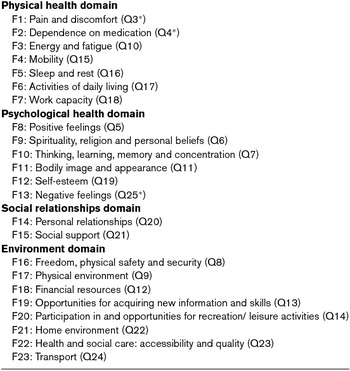
WHOQOL-BREF, which indexes the subjective quality of life in a cross-cultural way, has been established by confirming correlation with self-assessed quality of life. In it, the subjective quality of life is divided into four domains of physical health, psychological health, social relationships, and environment, and indexed respectively. Table 4 shows the facets of each domain with reference to the ASEAN Barometer questions (shown in the brackets). The total score of each domain is calculated on the basis of a five-grade evaluation carried out by respondents. The computation follows the WHOQOL method, which is
 \begin{equation*}
[({\rm the}\,\,{\rm average}\,\,{\rm of}\,\,{\rm component}\,\,{\rm summation}\,\, \times 4) - 4] \times (100/16).
\end{equation*}
Facets incorporated within domains

Note: *Scores are adjusted to make higher scores represent better condition.
The five-grade evaluation for each question is scored in ascending order (from 1 to 5).
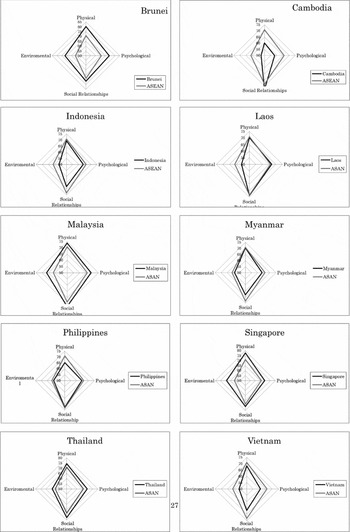
Figure 2 shows the results by country. Brunei, Singapore, and Malaysia, which showed higher-than-average percentages of ‘good’ responses, also exceeded the average in all other domains. The other countries, apart from Thailand, scored below the average in at least two of four domains. On the basis of these findings, the following part discusses the focal points of efforts to improve subjective quality of life across the ASEAN region.
The country-by-country patterns of subjective quality of life

Discussions by domain
With regard to raising standards of subjective quality of life at ASEAN level in terms of the physical health domain, it may be necessary to focus on the patterns of Cambodia and the Philippines, where the scores for this domain are comparatively low. The regression analysis with each respondent's demographic characteristics as the independent variable found that the scores for both countries’ physical health domain were negatively correlated with age (p = 0.000 and p = 0.003, respectively) and positively correlated with household income (p = 0.001 and 0.03 respectively). The same correlation was found as an overall trend in the entire survey. The sample for the Philippines under-represents urban residents, but the analysis shows that residential area is not statistically significant in relation to physical health. From these facts, it can be suggested that higher policy priorities should be given to the elderly and lower-income groups to address the issues in the physical health domain, with the patterns appearing in Cambodia and Philippines in mind.
For the psychological health domain, priority should be given to Cambodia and Vietnam, the two countries with comparatively low scores, as shown in Figure 2. In these two countries, the results of the regression analysis revealed positive correlations with sex and negative correlations with household income, using the respondents’ demographic characteristics as independent variables (for sex, p = 0.000 and 0.001, respectively, and for household income, p = 0.000 in both countries). In addition, the scores for the psychological health domain were found to be negatively correlated with age in Cambodia (p = 0.000) and positively correlated with education level in Vietnam (p = 0.022). These correlations were also observed in respondents as a whole. In addition, educational level was positively correlated with household income in all countries (p = 0.000). These results suggest that an effective measure to boost quality of life in the psychological health domain should primarily focus on elderly women with low incomes with priority given to expanding educational opportunities, which may in turn address the low-income issues.
In terms of the social relationships domain, the scores for Vietnam and Myanmar (urban areas) were found to be relatively low among the countries surveyed. Regression analyses made with the demographic characteristics of respondents in these two countries as the independent variables revealed positive correlations with household income and residential area in Vietnam (p = 0.000 in both) and, in Myanmar, negative correlations with sex (p = 0.016) and positive correlations with household income (p = 0.01). The same tendencies manifested in the overall results. To boost quality of life in terms of the social relationships domain at the overall ASEAN level, with the patterns of Vietnam and Myanmar (urban areas) in mind, it may be effective to build measures prioritizing low-income groups, combined with an emphasis on their attributes as rural residents and women.
With regard to the environment domain, Cambodia, Indonesia, and Vietnam scored five to ten points below the average of total respondents. Through the regression analyses with the demographic characteristics of respondents in these countries as the independent variables, positive correlations were found between the environment domain scores and household income in all these countries (p = 0.000). Positive correlations with vulnerable employment in Indonesia (p = 0.025) and with residential area in Vietnam (p = 0.011) were also observed. By contrast, the same analysis of all respondents revealed negative correlations with vulnerable employment and residential area (p = 0.000 in both).Footnote 3 These findings suggest that in order to boost quality of life in the environment domain, it may be effective to concentrate on low-income groups and then search for focal attributes, such as residential area and employment status, according to region.
Relationship with the Millennium Development Goals
The above discussions were based on respondents’ own demographic characteristics as the central topic. We still need to identify what factors in their surroundings affect people's subjective quality of life. As pointed out earlier in this article, the ASEAN Socio-Cultural Community Blueprint incorporated the Millennium Development Goals in its agendas: ‘poverty alleviation’, ‘access to healthcare and promotion of a healthy lifestyle’, and ‘improving the capability to control communicable diseases’. In connection with this, we discuss here extreme poverty and access to healthcare, which are the targets for reduction and improvement, respectively, under the Millennium Development Goals.
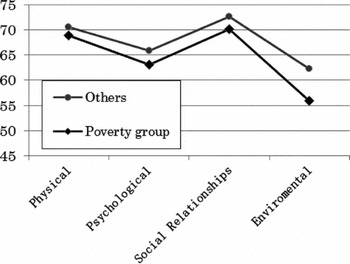
The extreme poverty defined in the Millennium Development Goals as a target of reduction refers to an existence sustained on income of one US dollar a day or its equivalent. Although the ASEAN Barometer is not designed to specify those who fall under the strict UN definition of extreme poverty, it is possible to identify roughly those who are highly likely to live under such conditions by using the household monthly income data. Figure 3 shows the subjective quality of life scores for this group extracted in such a manner (poverty group) and in comparison with the rest of the respondents. The poverty group's scores are below those of the other respondents in every respect.
Poverty and subjective quality of life (all respondents)

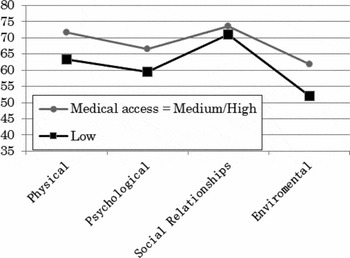
Figure 4 defines those who rated their access to medical treatment as ‘very bad’ or ‘bad’ as the group with low levels of medical access and compares their scores with the rest of the respondents (Q47d). Although the two scores are close in the social relationships domain, other scores by the group with low levels of healthcare access are below those of the other respondents. These findings suggest that the alleviation of poverty and improvement in healthcare access may also contribute to boosting subjective quality of life.
Medical access and subjective quality of life (all respondents)

Sharing of experience and best practices
The ASEAN Socio-Cultural Community Blueprint mentions the ‘sharing of experience and best practices’ within the region as one of the principles of the effort as a whole. In this regard, it should be noted that the countries whose average self-assessment scores concerning the aforementioned medical access were higher than the average of total respondents (3.78) were Brunei (4.28), Singapore (4.21), Malaysia (3.92), and Thailand (3.99). The examples of these countries, including their systems, may serve as reference cases. These countries are also the ones whose subjective quality of life levels, based on WHOQOL, are relatively high. Among these countries, Brunei and Singapore are unusual in terms of area and population sizes, so in the search for a more general approach toward overall improvement across the region, Malaysia and Thailand may best serve as practical models in improving subjective quality of life in the entire ASEAN region.
Of these two countries, Thailand scored above the average for all respondents in every domain, as shown in Figures 1 and 2. The explanation for this result may be found in the implementation of the Healthy Thailand project, which included the establishment and expansion of a public health insurance system, improvements in healthcare, and health promotion. In terms of the people's own assessment of quality of life in Thailand, however, the percentage of ‘good’ responses was relatively low, ranking seventh out of ten countries. In contrast, Malaysia's scores were above the average for all domains, and the country ranked third, after Brunei and Singapore, in self-assessed quality of life. As shown in Figure 2, Malaysia scored higher than Thailand only in the environment domain. A look at the environment domain as depicted in Table 4 reveals that the country's scores are higher than those of Thailand for sense of safety and security, physical environment, financial resources, opportunities for acquiring information, and participation in and opportunities for recreation/leisure activities. One of these aspects, or a combination of two or more, may have led to Malaysia's relatively high subjective quality of life assessment. Although further scrutiny into the matter is required, this observation may serve as one of the focuses in designing measures to improve subjective quality of life at the ASEAN level.
Overview
This paper clarified the following points:
(1) The idea of using quality of life as a political ideal and engaging in efforts to improve quality of life by creating an index to evaluate it is an international phenomenon, and ASEAN has had a clear vision of such a concept since the mid-2000s. ASEAN adopted the Declaration of ASEAN Concord II in 2003, in which it expressed its intention to establish a community not only in the area of economy and security but also in the socio-cultural realm by 2020 at the latest. As part of the effort toward the realization of the initiative, ASEAN drew up the ASEAN Socio-Cultural Community Blueprint and adopted it in 2009, in order to ‘lift the quality of life of its peoples’. The ASEAN Socio-Cultural Community Blueprint incorporates the UN Millennium Development Goals and integrates former ASEAN policies and plans, such as the Initiative for ASEAN Integration, which was mainly designed to correct and solve ‘development gaps’ within the region, and the Regional Action Plan on Healthy ASEAN Lifestyles. Because the latter regional action plan establishes mental health in a wider sense as one of its priorities, the plan's partial incorporation into the Blueprint means that the potential importance of subjective quality of life has been increased.
(2) For subjective quality of life, the WHOQOL has been developed to evaluate it in a cross-cultural way. As the index is based on a holistic health and healthcare perspective uniquely developed by the WHO, it may serve as a tool for evaluating and analyzing not only the healthcare and medical realm in a narrow sense but also mental health in a wider sense, encompassing subjective quality of life, improvement of which is specified by ASEAN as one of its goals for the social realm.
(3) On the basis of the survey results of the ASEAN Barometer, which incorporates most of the questions of WHOQOL-BREF, the paper analyzed subjective quality of life in ASEAN for the period from the end of 2009 to the beginning of 2010. The analysis found the following results:
(a) Brunei, Singapore, and Malaysia scored higher than the average of all countries for ‘very good’ and ‘good’ in self-assessed quality of life (Figure 1).
(b) The results, after dividing subjective quality of life into four domains in line with WHOQOL and scoring each domain by country, revealed a range of patterns (Figure 2). The paper then discussed where efforts to improve subjective quality of life effectively at an ASEAN level should place their priorities by focusing on the demographic characteristics of respondents.
(c) With respect to ASEAN's efforts to achieve the UN Millennium Development Goals, the paper pointed out that the alleviation of extreme poverty and improvement in healthcare access are likely to improve subjective quality of life, and that the case of Malaysia is worth further detailed examination because the country may serve as an example for other ASEAN countries, especially in terms of the environment domain.
About the author
Taku Yamamoto is Professor at the Department of Political Science of the Hosei University, Tokyo. His major is comparative welfare (income security, health, and welfare care). One of his recent research topics is dementia care.
Demographic profile of respondents