Introduction
Disasters are increasingly common in the modern age. Technology creates devastating weapons, travel speeds the spread of disease, and climate change intensifies global weather. When disaster strikes, medical clinics serve as the first point-of-care for local communities. Local clinics are a key part of disaster management – one often overlooked.
Haiti, one of the poorest countries in the Western Hemisphere, often lacks the necessary infrastructure to provide life-saving patient care. A brief review of Haiti’s health statistics reveals health disparities in injuries from trauma. Like other low- and middle-income countries (LMICs), road traffic accidents remain a leading cause of mortality. Unintentional injuries contribute significantly to lost years of life.1 Trauma accounts for a significant disease burden and trauma patients are six-times more likely to die in LMICs than in high-income countries.Reference Daurisca2 At present, Haiti lacks a national Emergency Medical Services (EMS) system. Research suggests that globally, medically preventable deaths could be cut in half by improving emergency response mechanisms.
In addition to a lack of infrastructure, Haiti is prone to natural disasters. Proximity to the North American and Caribbean Tectonic plates, existing deforestation, and increasingly strong storms from climate change predispose Haiti to floods and earthquakes. Haiti’s high population density, poor physical infrastructure, and lack of emergency response systems increase the effects of disasters. Floods and landslides cause serious consequences for Haitians.Reference Granvorka3 As defined by the Intergovernmental Panel on Climate Change (IPCC; Geneva, Switzerland), Haiti and many LMICs are vulnerable to climate change and poorly suited to cope with natural disasters.
During disasters, local communities struggle to receive expedient aid from the health care system. In the days following a disaster, as national agencies and international groups organize to provide care, local clinics and the communities themselves are called upon to provide care to the injured. These clinics and communities are under-resourced and under-prepared to respond effectively to patient needs. There remains a lack of education and an imperative for disaster training in clinics throughout LMICs.
The North-East Region of Haiti lacks a formal EMS system,Reference De Wulf, Aluisio, Muhlfelder and Bloem4,Reference Aluisio, De Wulf, Louis and Bloem5 and health care is primarily provided by community clinics. According to a recent study,Reference Stanley6 fewer than two-percent of accidents in Haiti are attended by free ambulances. Northeast Haiti’s current EMS system consists of the free National Ambulance Center (CAN) and private providers. In the North-East Region, free ambulance use is limited due to a lack of personnel, few ambulances, and CAN’s distant location in Port-au-Prince. A national ambulance system or other method to increase coverage is imperative. Recent economic analysis7 has shown this to be a worthy investment with the estimated reduction in morbidity, mortality, and economic productivity worth nearly eight-times the cost. In disasters, EMS links patients in local communities to national health care resources.
To improve disaster education, this group created a disaster manual to help clinics set up effective and practical disaster plans. The manual teaches the Incident Command System (ICS), a well-known system for disaster management. It is written in basic language for the clinic level. It guides clinic staff through disaster management.
Staff address the four stages of disaster response: Prevention, Preparation, Response, and Recovery, then complete a Risk Assessment, Hazard Vulnerability Analysis, and create an ICS. They then create a disaster team of Incident Commander, Safety Officer, Liaison Officer, Operations Officer, and Information Officer with a disaster plan to link clinics to resources when local ones are overwhelmed.
This study examines disaster response training at the clinic level. It posits that clinic workers in LMICs can better respond to disasters through a manual designed to teach at the clinic level.
Study Design and Methods
The study assessed clinic workers’ disaster skills through a tabletop drill after training with a disaster tool kit. Exemption of informed consent was provided by the SUNY Downstate Medical Center Institutional Review Board (Brooklyn, New York USA; FWA: # 3624, IORG: # 64, IRB: # 11521).
The disaster tool kit was piloted in two clinics in Haiti’s North-East Region: Clinique Esperance Et Vie and Clinique Medicale des Vertieres. Clinic Medicale des Vertieres is located in the city of Cap-Haitien near an airport, hospital, electricity, water, and medical professionals. It is staffed by general practitioners, resident physicians, and an obstetrician. Clinic Esperance Et Vie is located an hour outside the city with only a general practitioner. This clinic has access to electricity and water, but is remote to airports and hospitals. Both clinics are near a local Ministry of Public Health and Population (MSPP) hospital, Hopital Universitaire Justinien, that trains residents and has surgical capabilities.
In a prior study, staff in these clinics had received training using the disaster tool kit. That study showed training to be effective with positive comments from clinic staff and improved objective performance in a tabletop disaster drill. In both clinics, staff felt empowered to join a larger disaster response and to use the plan they created with the disaster manual to respond to an event. At that time, a plan was set in place to repeat the drill within the year to ensure long-term effectiveness and to test retention of the manual.
This study is a follow-up to evaluate retention of training in use of the disaster manual. The evaluation took place in one afternoon; clinic directors made attendance mandatory for all staff, including doctors, nurses, accountants, housekeepers, pharmacists, and janitors. Both clinics had maintained copies of prior manuals with roles and the prior disaster plan. Each staff member received their own copy of the manual, and since it is interactive, by going through it, staff reinforced their previously agreed upon disaster plan and roles.
After completing a disaster plan, staff was then asked to respond to a simulated disaster. Basic triage using the Simple Triage and Rapid Treatment (START) method was reinforced with staff, and then a tabletop drill simulating a flood in the North-East Region of Haiti was conducted. In this drill, the staff learned when the flood would occur and was then responsible for organizing the clinic and preparing the community. During the flood, the clinic received multiple boluses of simulated patients until, eventually, local resources were overwhelmed and outside organizations were needed.
In the drill, staff was assessed through an objective assessment tool (Appendix A; available online only). This tool measured staff’s ability to set up the incident command center, to assign roles and carry them out, to contact nearby organizations, to inform the community, and to respond effectively to the needs of patients in the disaster. The tool evaluates staff on 12 metrics using a three-point scale for a total possible score of 36. In the objective assessment of the tabletop drill, >20 was assigned as adequate performance in disaster management, 16-20 as moderate performance in disaster management, and <16 as poor performance in disaster management. These tools were created by disaster medicine trained emergency medicine doctors to reflect key priorities in disaster response.
Clinic staff were also given a subjective pre-test and post-test assessment tool (Appendix B; available online only) to evaluate their perceived understanding of disaster management. This tool graded numerically their own perception of disaster preparation in the clinic prior to and after the drill. In six categories, staff used a five-point Likert scale to grade their confidence and preparation in disaster management. In addition to this numerical score, staff was given space for written feedback. For the subjective assessment of disaster management, >24 was assigned as adequate understanding, 12-24 as some understanding, and <12 as a gap in understanding.
Mean values between groups were compared to test the hypothesis that disaster training improved response in clinics. This was conducted with an alpha of 0.05 with the null hypothesis that training had no effect. Confidence intervals were calculated at a level of 95% post data collection.
Finally, qualitative data were collected through a feedback session with clinic staff to assess the drill and need for future training. Study coordinators solicited input from participants on further directions with this training and future efforts to mitigate disasters in their region of Haiti and other areas around the world.
Results
Data were collected from clinic staff. There were 18 staff members that participated in the training at Clinique Esperance Et Vie and 15 staff members that participated in the training at Clinique Des Vertieres for a total of 33 staff members that participated in the training.
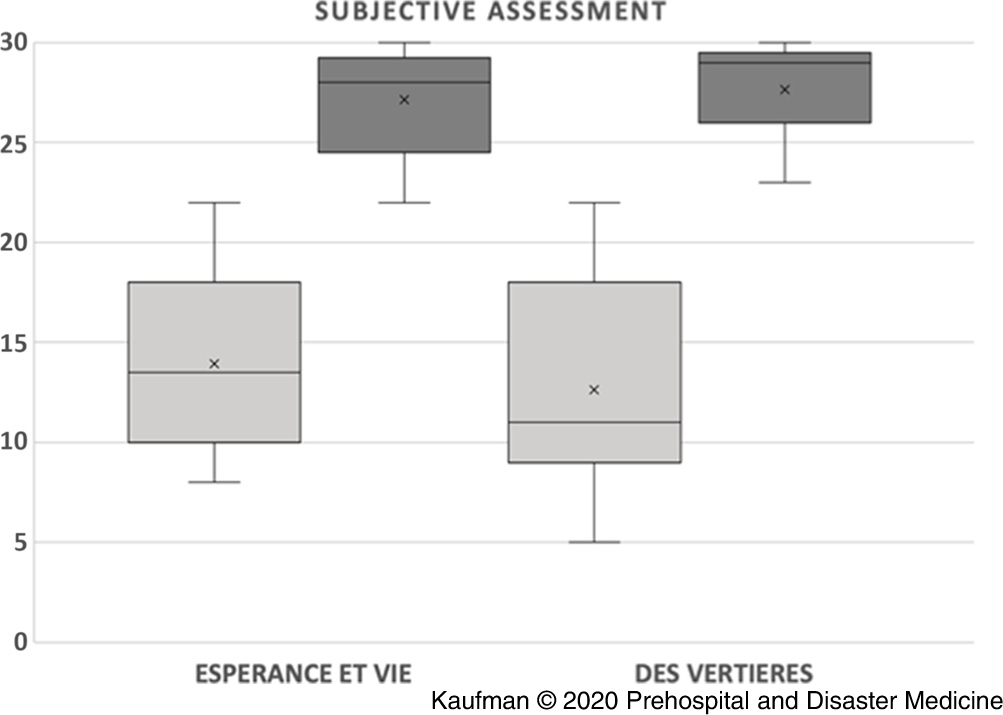
For the subjective assessment, the staff members of Clinique Esperance Et Vie (n = 15) rated their understanding at a mean value of 14 (95% CI, 11.5 to 16.2; median = 13.5; IQR 10-18) prior to training. After training, this increased to a mean value of 27 (95% CI, 25.7 to 28.6; median = 28; IQR 25.5-29). Using these data, the null hypothesis that training had no effect can be rejected at an alpha of 0.05. For staff members at Clinique Des Vertieres (n = 18), prior to training, they rated understanding at a mean value of 13 (95% CI, 10.4 to 14.9; median = 11; IQR 10-18). After the training, this increased to a mean value of 27 (95% CI, 26.5 to 28.8; median = 29; IQR 27-29). Again, this increase proved to be statistically significant and the null hypothesis was rejected at an alpha of 0.05. Using the study’s scale, understanding of clinic staff improved from “some” to “adequate” (Figure 1).
Subjective Assessment: Participants Grading of Disaster Knowledge Pre- and Post-Training.

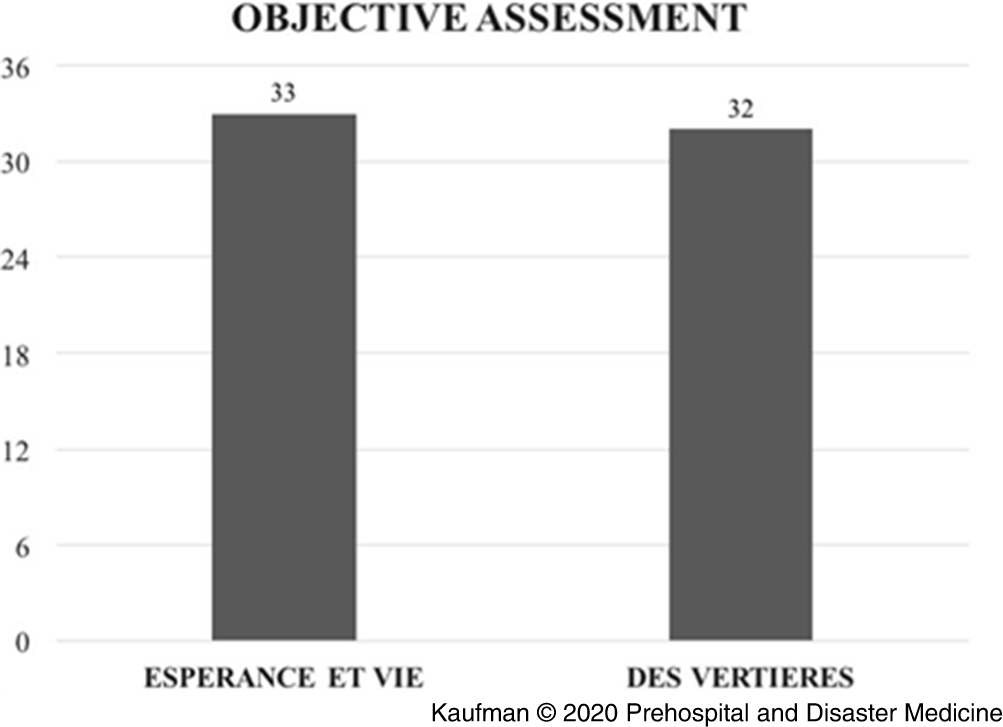
For the objective assessment, Clinique Esperance Et Vie received 33 out of a possible 36 points and Clinique Des Vertieres received 32 out of a possible 36 points (Figure 2). Both of these performances rated as more than adequate and marked effective retention of disaster management principles of performance in a drill.
Objective Assessment: Objective Measure of Key Objectives Completed by Staff in Disaster Drill.

Qualitative data were gathered through a feedback session. The comments were largely positive. The group voiced a desire to repeat this training with other clinics and health care professionals in Haiti. Prior to training, clinic staff felt unable to manage basic aspects of disaster response. Comments included, “we need a hospital” or “we cannot handle that.” After training, clinic staff felt empowered to treat and handle basic aspects of a disaster and were able to triage more serious injuries to the hospital system efficiently. They felt a desire to share this with the community and that the training would make them more effective in disaster response.
Discussion
The goal of this project and disaster manual is to raise awareness of the importance of educating and involving local clinics and communities in disaster response to improve outcomes in LMICs.
Study results were significant and demonstrate the usability of disaster manual and long-term retention of principles. Overall, this indicates the potential for disaster training to improve response through local clinics. Introduction of disaster training at the clinic level has the potential to decrease costs and improve communication and response to disasters in LMICs.
Recent studies have shown that training first responders in Haiti has one of the highest cost-benefit ratios of any public investment in the country.7 This study points to the importance of these projects and the need to involve the communities they serve each step of the way.
This manual serves as a tool for national and international organizations to include clinics in larger disaster response. Patients present first to local clinics and too often wait to receive care. This study shows the importance of including clinics in national disaster preparedness plans. Clinics should be the first link in a functional acute care system designed to provide effective care.
Limitations
This study has specific limitations. First, a tabletop drill is drastically different from a disaster. To the authors’ knowledge, there are no known studies proving that performance in drills correlates to performance in disasters. As disasters should not be created for studies and are hard to predict, disaster performance is inherently a difficult outcome to study. Additionally, this study assessed short-term knowledge retention and long-term performance is a future initiative.
Lastly, the scales and evaluation tools used in the study are not externally validated as evaluation tools. The subjective assessments of participants and objective criteria represent a best effort to measure effectiveness in an area where no validated tools exist.
Conclusion
This study examined disaster response training at the clinic level. Though there were significant limitations, the study points to the usefulness of a manual to teach disaster principles at the clinic level. As patients often present first to local clinics, it is important that these clinics be included in future national disaster planning.
Conflicts of interest
none
Supplementary Material
To view supplementary material for this article, please visit https://doi.org/10.1017/S1049023X20000199