Darwin (Reference Darwin1872/1998) conceived the emotions as inherently adaptive and as powerful influences on both mental processes and overt behavior. In his famous treatise on emotion expressions, he advocated eloquently for the nurturance of emotions and emotion communication in early development. Darwin's counsel seems quite congruent with findings on parental socialization, positive emotion interactions, emotion education (tutoring and coaching), and the development of emotion competence in middle-class families in the United States (Eisenberg, Cumberland, & Spinrad, Reference Eisenberg, Cumberland and Spinrad1998; Gottman, Katz, & Hooven, Reference Gottman, Katz and Hooven1997). The benefits of following Darwin's counsel also accrue to ethnic minorities where poverty occurs at a disproportionately higher rate. Most ethnic minority children who receive adequate parental care and social support develop effective emotion regulatory skills as reflected in individual and social functioning (Garner & Spears, Reference Garner and Spears2000; Raver, Reference Raver1996). Scores on measures of emotion knowledge and emotion regulation in children of low-income families tend to be distributed over a relatively wide range. Yet, a disproportionately high percentage of them have low emotion competence and are at risk for the development of maladaptive behavior patterns (Ackerman, Brown, & Izard, Reference Ackerman, Brown and Izard2004; Denham et al., Reference Denham, Blair, DeMulder, Levitas, Sawyer and Auerbach-Major2003; Izard, Trentacosta, King, & Mostow, Reference Izard, Trentacosta, King and Mostow2004).
The relatively sparse data on emotion socialization in low-income families present a troublesome picture of emotion expression between adult and child (Cutting & Dunn, Reference Cutting and Dunn1999; García Coll & Garrido, Reference García Coll, Garrido, Sameroff and Lewis2000; Garner & Estep, Reference Garner and Estep2001; Garner, Jones, Gaddy, & Rennie, Reference Garner, Jones, Gaddy and Rennie1997). For a substantial percentage of low-income families, the harsh environment created by poverty provides fewer occasions for positive emotion interactions in the family, and may result in relatively more occasions for anger expression and negative interactions (Ackerman, Izard, Schoff, Youngstrom, & Kogos, Reference Ackerman, Izard, Schoff, Youngstrom and Kogos1999; Miller & Olson, Reference Miller and Olson2000; Shaw, Vondra, Hommerding, Keenan, & Dunn, Reference Shaw, Vondra, Hommerding, Keenan and Dunn1994).
The stress induced by an impoverished and threatening environment may be experienced as negative emotions that are poorly regulated and thus not utilized constructively (McLloyd, Reference McLloyd1998; Shaw et al., Reference Shaw, Winslow, Owens, Vondra, Cohn and Bell1998). These negative emotions, which include anger and frustration as well as anxious and depressed mood, may increase the likelihood of harsh parenting, including aggression or physical punishment (Ackerman et al., Reference Ackerman, Izard, Schoff, Youngstrom and Kogos1999; Deater-Deckard & Dodge, Reference Deater-Deckard and Dodge1997; Fine, Trentacosta, Izard, Mostow, & Campbell, Reference Fine, Trentacosta, Izard, Mostow and Campbell2004). As a result, these children may have less opportunity than children of middle-class families to engage in emotion discourse, a process that promotes emotion knowledge and emotion regulation (Cutting & Dunn, Reference Cutting and Dunn1999; Harris, Reference Harris1999). Thus, the stress associated with poverty and its cofactors (e.g., parents' education level and frequent changes in residence and relationships) probably contributes to children's relatively poor emotion knowledge and emotion regulation and increases the risk of developing maladaptive behavior patterns (Ackerman et al., Reference Ackerman, Brown and Izard2004; Raver, Reference Raver2004; Shaw et al., Reference Shaw, Winslow, Owens, Vondra, Cohn and Bell1998). The evidence suggests that an emotion focused intervention with an emphasis on emotion knowledge and emotion regulation may meet a critical need in low income communities.
Emotion Knowledge
Findings from more than 3 decades of research make a strong case for a significant relation between emotion knowledge and other aspects of emotion development. Four early studies showed that measures of different aspects of children's understanding of emotion interrelated, suggesting a coherent construct (Izard, Reference Izard1971). These studies also showed that indices of emotion knowledge related positively to both social and academic competence and that emotion knowledge was influenced adversely by socioeconomic level but not by ethnicity.
Since these early studies, extensive research has shown that emotion knowledge related positively to adaptive behavioral outcomes and negatively to maladaptive outcomes (for reviews, see Denham, Reference Denham1998; Denham & Burton, Reference Denham and Burton2003; Halberstadt, Denham, & Dunsmore, Reference Halberstadt, Denham and Dunsmore2001; Izard, Reference Izard2002). For example, emotion knowledge in former Head Start first graders predicted internalizing behavior in late childhood (Fine, Izard, Mostow, Trentacosta, & Ackerman, Reference Fine, Izard, Mostow, Trentacosta and Ackerman2003). Emotion knowledge in a primarily White middle-class sample at age 3 predicted anger and aggression at ages 4 and 5 (Denham et al., Reference Denham, Caverly, Schmidt, Blair, DeMulder and Caal2002). Emotion knowledge also played a role in mediating the effects of trait emotionality on aggressive behavior (Schultz, Izard, & Bear, Reference Schultz, Izard and Bear2004). In addition, emotion knowledge in Head Start mediated the effect of verbal ability on teacher ratings of academic competence (Izard et al., Reference Izard, Fine, Schultz, Mostow, Ackerman and Youngstrom2001; cf. Trentacosta, Izard, Mostow, & Fine, Reference Trentacosta, Izard, Mostow and Fine2006).
Several studies revealed a relation between emotion knowledge and peer acceptance, widely acknowledged as critical to children's sense of well being, interpersonal transactions, and the developmental task of making and keeping friends (Denham, McKinley, Couchoud, & Holt, Reference Denham, McKinley, Couchoud and Holt1990; Edwards, Manstead, & MacDonald, Reference Edwards, Manstead and MacDonald1984; Garner, Jones, & Miner, Reference Garner, Jones and Miner1994; Hartup, Reference Hartup, Hasselt and Hersen1992; Hubbard & Coie, Reference Hubbard and Coie1994; Smith, Reference Smith2001; Walden & Field, Reference Walden and Field1990). A later study showed that emotion knowledge predicted social skills, which in turn, mediated the effects of emotion knowledge on peer acceptance (Mostow, Izard, Fine, & Trentacosta, Reference Mostow, Izard, Fine and Trentacosta2002). A number of other researchers showed that emotion knowledge relates to social judgment, social skills, and the development of social competence (Cicchetti, Ackerman, & Izard, Reference Cicchetti, Ackerman and Izard1995; Denham et al., Reference Denham, Blair, DeMulder, Levitas, Sawyer and Auerbach-Major2003; Garner, Reference Garner1996; Izard, Schultz, Fine, Youngstrom, & Ackerman, Reference Izard, Schultz, Fine, Youngstrom and Ackerman2000; Miller & Olson, Reference Miller and Olson2000; Nowicki & Duke, Reference Nowicki and Duke1994; Rogosch, Cicchetti, & Aber, Reference Rogosch, Cicchetti and Aber1995).
Emotion Regulation
Some researchers see emotion knowledge as a correlate or determinant of emotion regulation and argue that both of these related constructs contribute to the growth of emotion and social competence (Arsenio, Cooperman, & Lover, Reference Arsenio, Cooperman and Lover2000; Halberstadt et al., Reference Halberstadt, Denham and Dunsmore2001; Hubbard & Coie, Reference Hubbard and Coie1994; Izard, Reference Izard1971, Reference Izard2002; Miller, Gouley, Seifer, Dickson, & Shields, Reference Miller, Gouley, Seifer, Dickstein and Shields2004). In any case, extensive research depicts a central role for emotion regulation in various aspects of social functioning, ranging from anger expression and aggression to empathy, sympathy, and prosocial behavior (Cole, Martin, & Dennis, Reference Cole, Martin and Dennis2004; Eisenberg, Reference Eisenberg2001; Eisenberg & Fabes, Reference Eisenberg, Fabes, Damon and Eisenberg1998; Fantuzzo, Bulotsky-Shearer, Fusco, & McWayne, Reference Fantuzzo, Bulotsky-Shearer, Fusco and McWayne2005; Raver, Reference Raver2004).
Defining emotion regulation
Experts agree that we do not have consensus on a definition of emotion regulation (see Cole et al., Reference Cole, Martin and Dennis2004, and the commentaries on their article). For purposes of the present study, we conceptualize emotion regulation in the context of other causal processes—emotionality/temperament or emotion traits, emotion information processing, cognitive ability, and emotion knowledge. We see all of these processes as codeterminants of perception, thought, and overt behavior. Within this context of multiple causal processes, emotion regulation operates as a key factor in preventing emotion arousal from disrupting or overwhelming cognitive and action systems. These emotion regulatory processes facilitate the use of cognitive and action systems in responding effectively to challenges and opportunities. Because emotion is frequently a key factor in motivating cognition and action (Ekman & Davidson, Reference Ekman and Davidson1994; Izard, Reference Izard1977; Tomkins, Reference Tomkins1962, Reference Tomkins1963), emotion regulation is critical in increasing the utilization, or effective use of emotion motivation, in social and person–environment transactions (Izard, Reference Izard2002). Emotion utilization may be viewed as the optimal mode of emotion regulation, which in turn, enhances emotion utilization. These two sets of related processes influence each other reciprocally to enhance the development of adaptive behavior patterns. In this framework, emotion regulation is realized and indexed largely in terms of emotion utilization, or emotion-motivated and self-regulated cognition and action, in response to opportunities and challenging events and situations (cf. Cole et al., Reference Cole, Martin and Dennis2004; Schultz et al., Reference Schultz, Izard and Bear2004).
Emotion regulation and emotion competence
Emotion regulation affects individual and social functioning across socioeconomic and cultural populations. In low-income primarily African American children, aggressive or socially negative behavior early in the first semester of Head Start classrooms reflected emotion dysregulation. This maladaptive behavior was thought to predict greater emotional lability at the end of the school year (Fantuzzo et al., Reference Fantuzzo, Bulotsky-Shearer, Fusco and McWayne2005). Even brief bouts of high level emotion dysregulation predicted teacher-rated classroom adjustment and peer conflict (Miller et al., Reference Miller, Gouley, Seifer, Dickstein and Shields2004). Emotion regulation, as well as language ability and temperament factors, contributed differentially to peer-play competence in the classroom (Mendez, Fantuzzo, & Cicchetti, Reference Mendez, Fantuzzo and Cicchetti2002).
Evidence suggests that emotion regulation plays a key role in managing anger and reducing aggression during periods of early development (Gilliom, Shaw, Beck, Schonberg, & Lukon, Reference Gilliom, Shaw, Beck, Schonberg and Lukon2002). Aggressive behavior may emerge as a transient part of normative behavior in toddlers' strivings for autonomy. However, if the aggressive behavior does not subside and becomes characteristic of the toddler, it will likely remain a stable characteristic of caregiver–child interactions (Keenan & Shaw, Reference Keenan and Shaw1994). Moreover, it will arise in peer interactions during ages 2–5 years (Cummings, Iannotti, & Zahn-Waxler, Reference Cummings, Iannotti and Zahn-Waxler1989) and characterize children with externalizing problems or conduct disorder in middle childhood (Keenan, Reference Keenan2000; O'Leary, Slep, & Reid, Reference O'Leary, Slep and Reid1999). Unchecked development of aggression may lead to psychological disorders, more commonly in boys than in girls (Crick, Casas, & Mosher, Reference Crick, Casas and Mosher1997; Ostrov & Keating, Reference Ostrov and Keating2004; Owens & Shaw, Reference Owens and Shaw2003; Shaw et al., Reference Shaw, Winslow, Owens, Vondra, Cohn and Bell1998).
For children of middle-income families, emotion regulation in terms of ability to face the problem and cope actively with emotion-eliciting situations had a beneficial effect on preschoolers' social behavior (Blair, Denham, Kochanoff, & Whipple, Reference Blair, Denham, Kochanoff and Whipple2004). Emotion dysregulation in conjunction with lack of maternal guidance and control during a teaching task predicted children's shy and reticent behavior (Rubin, Cheah, & Fox, Reference Rubin, Cheah and Fox2001). Low regulation of positive emotion and exuberance, together with high anger emotionality in preschool, predicted externalizing behavior at age 8 years. Fear regulation, together with high fear emotionality, predicted internalizing behavior (Rydell, Berlin, & Bohlin, Reference Rydell, Berlin and Bohlin2003). Emotion regulation in preschool contributed to both concurrent and kindergarten social competence, as indexed by peer ratings of likeability and teacher ratings of social skills (Denham et al., Reference Denham, Blair, DeMulder, Levitas, Sawyer and Auerbach-Major2003). Similarly, in a study with a largely European American sample, findings suggested that emotion regulation and emotion knowledge made unique contributions to children's emotion competence with peers (Keane & Calkins, Reference Keane and Calkins2004; Lindsey & Colwell, Reference Lindsey and Colwell2003).
The foregoing summary as well as more extensive reviews of relations among emotion knowledge, emotion regulation, and behavioral outcomes suggest that emotion knowledge contributes to the development of emotion regulation. The evidence also suggests that emotion competence defined in terms of both emotion knowledge and emotion regulation should promote an increase in self-regulated expressive and overt behavior and a decrease in maladaptive behavior (Denham & Burton, Reference Denham and Burton2003; Izard, Reference Izard2002; Raver, Reference Raver2004; Southam-Gerow & Kendall, Reference Southam-Gerow and Kendall2002).
Accelerating the Development of Emotion Knowledge and Emotion Regulation
Contemporary research, like the classic observations of Darwin, supports the idea of translating findings and implications from basic research on emotion knowledge and emotion regulation into preventive interventions. This process requires the translation of findings from empirical research on these major components of emotion competence into substantive material and techniques that can be understood, learned, and practiced by young children. It also requires formulating and testing hypotheses relating to intervention-induced changes across multiple heterogeneous measures representing emotion knowledge and emotion regulation and their behavioral correlates (Izard, Reference Izard2002; Raver, Reference Raver2004). Such translational and related intervention research has special relevance for young children whose emotion development is more likely to have been slowed by the effects of poverty and its cofactors (Ackerman et al., Reference Ackerman, Brown and Izard2004; Cutting & Dunn, Reference Cutting and Dunn1999; Izard et al., Reference Izard, Fine, Schultz, Mostow, Ackerman and Youngstrom2001; McLloyd, Reference McLloyd1998; Raver & Spagnola, Reference Raver and Spagnola2002). Both translational and intervention evaluation research seem critical to our understanding of the development and integration of emotion knowledge and emotion regulation into adaptive behavior.
The challenge of accelerating or enhancing the development of emotion knowledge and emotion regulation has been a concern of researchers for more than two decades. In an extensive review of this topic, Denham and Burton (Reference Denham and Burton2003) identified four programs that have proven successful in enhancing the development of one or more aspects of preschool children's emotion or social functioning and reducing maladaptive behavior. The four programs are Social–Emotional Intervention for At-Risk 4-Year Olds (Denham & Burton, Reference Denham and Burton1996), Preschool PATHS—Promoting Alternative Thinking Strategies (Domitrovich, Cortes, & Greenberg, Reference Domitrovich, Cortes and Greenberg2002), Second Step Preschool/Kindergarten (McMahon, Washburn, Felix, Yakin, & Childrey, Reference McMahon, Washburn, Felix, Yakin and Childrey2000), and The Incredible Years (Webster-Stratton, Reid, & Hammond, Reference Webster-Stratton, Reid and Hammond2001). Some types of successful interventions not covered in the Denham and Burton (Reference Denham and Burton2003) review targeted specific negative behavior, diagnostic categories, or disabilities (e.g., anxiety disorders in inhibited preschool children; Rapee, Kennedy, Ingram, Edwards, & Sweeney, Reference Rapee, Kennedy, Ingram, Edwards and Sweeney2005; challenging behavior; Conroy, Durlap, Clarke, & Alter, Reference Conroy, Dunlap, Clarke and Alter2005).
Since Denham and Burton's (Reference Denham and Burton2003) review identifying four successful teacher-implemented interventions, other researchers have validated what they describe as a resilience-based prevention program that aims to achieve both risk reduction and enhancement of protective factors (Lynch, Geller, & Schmidt, Reference Lynch, Geller and Schmidt2004). This program (“Al's Pals”) has content that overlaps with the other four validated programs as well as some distinctive content relating to drug abuse and health practices. In addition, a parenting program that focused on emotion coaching showed parallel changes in young children's decreased emotion negativity and difficult behaviors (Havighurst, Harley, & Prior, Reference Havighurst, Harley and Prior2004). All of these programs have a substantial component focusing on aspects of emotion development, particularly emotion knowledge and emotion regulation, along with components focusing on social skills, problem solving, and conflict resolution.
In developing the foregoing programs, the authors took advantage of program content and techniques from a variety of theoretical frameworks—social–cognitive, cognitive–behavioral, psychoanalytic, attachment, and emotion theories (for a review, see Denham & Burton, Reference Denham and Burton2003). The researchers who developed these programs have realized considerable success in addressing the pressing social problem of developmental delay in emotion and social competence, and some have succeeded in reducing aggression in young children at risk (Denham & Burton, Reference Denham and Burton1996; McMahon et al., Reference McMahon, Washburn, Felix, Yakin and Childrey2000).
Because several successful preventive interventions for preschool children at risk already exist, the purpose of the present study was not simply to validate another one. A central goal was to develop an effective intervention within a single theoretical framework to facilitate the search for causal processes in behavior change. A prevention program that makes all its substantive content and techniques consistent with a single theory should offer some advantages in explaining treatment effects and the factors involved in the development of adaptive behavior. Current preventive interventions that address anger expression, aggression, disruptive and withdrawal behavior in young children have not greatly increased our understanding of factors that contribute to behavior changes in these domains (Denham & Burton, Reference Denham and Burton2003; Havighurst, Reference Havighurst, Denham and Burton2003; Izard, Reference Izard2002). Although effective as prevention programs, their eclectic approaches make them less effective in relating causal processes in treatment-induced behavior changes to particular theoretical principles and theory-based techniques (Gennetian, Bos, & Morris, Reference Gennetian, Bos and Morris2002; Robins, Reference Robins, McCord and Tremblay1992).
Conceptual Framework for Emotion-Based Prevention Program (EBP) and the Explication of Treatment Effects
EBP shares common ground with the successful programs that we identified above. For example, all the programs have components designed to increase emotion knowledge and emotion regulation. EBP is distinct in that all its substance and techniques derive from emotion theory.
EBP is an emotion-based treatment for accelerating emotion competence and decreasing maladaptive behavior that stems from differential emotions theory (Izard, Reference Izard2001a, Reference Izard2002) and follows the tradition of Darwin (Reference Darwin1872/1998) and Tomkins (Reference Tomkins1962, Reference Tomkins1963). It emphasizes the inherently adaptive functions of emotions and recognizes that poor understanding and regulation of emotions may put children on a trajectory toward psychopathology. In keeping with key tenets of the underlying theory, the central goal of EBP is to increase young children's ability to understand and regulate emotions, utilize modulated emotions, and reduce maladaptive behavior. It makes no use of the extrinsic reward characteristic of some behavioral and cognitive–behavioral programs (see Bear, Webster-Stratton, Furlong, & Rhee, Reference Bear, Webster-Stratton, Furlong, Rhee, Bear and Minke2000, for a review of some of these interventions). Rather, EBP depends on the intrinsic rewards that derive from increased emotion competence and decreased maladaptive behavior (Izard, Reference Izard2002).
On the basis of differential emotions theory and the relevant empirical research, we posit a dynamic relation between emotion knowledge, emotion regulation, and behavioral outcomes. They influence each other in a nonlinear fashion. Inadequate emotion knowledge that causes misperception of another child's neutral expressions as signs of anger may lead to emotion dysregulation, conflict, and aggressive behavior (Schultz et al., Reference Schultz, Izard and Bear2004). Frequent aggressive behavior may lead to traitlike changes in emotion thresholds that lead to increased emotion dysregulation (Izard, Reference Izard1977) and peer rejection (Hubbard & Coie, Reference Hubbard and Coie1994; Hubbard et al., Reference Hubbard, Smithmyer, Ramsden, Parker, Flanagan and Dearing2002). Moreover, an aggressor's dysregulated anger will tend to create a traitlike bias in perceptual and cognitive processes that degrade emotion information processing and impede the acquisition of accurate or ecologically valid emotion knowledge (Denham et al., Reference Denham, Caverly, Schmidt, Blair, DeMulder and Caal2002; Izard et al., Reference Izard, Fine, Schultz, Mostow, Ackerman and Youngstrom2001; Lemerise & Arsenio, Reference Lemerise and Arsenio2000; Schultz et al., Reference Schultz, Izard and Bear2004). An anger perception bias could contribute to the perpetuation of the maladaptive emotion–cognition–behavior cycle.
A similar maladaptive interaction among emotion knowledge, emotion regulation, and behavioral outcomes can also occur in relation to emotions associated with internalizing problems. Failure of peers and adults to detect and respond appropriately to a child's signs of sadness and shyness may exacerbate the child's withdrawal behavior and increase the likelihood that the child will develop depression (Fine et al., Reference Fine, Izard, Mostow, Trentacosta and Ackerman2003). Therefore, we expected that intervention-induced increases in emotion knowledge and emotion regulation would represent a gain in emotion competence that leads to a decrease in maladaptive behavior.
Testing the Effects of EBP
We examined the effects of EBP on Head Start children in both a rural/small town (Study 1) and an inner-city setting (Study 2). Although the two studies have central features in common, the second was not designed as an exact replication of the first. For the second study, we used feedback from discussions with teachers to adapt EBP for use in an inner-city setting. The feedback from inner-city Head Start teachers and our experience from study 1 led to some changes in EBP, particularly in the Emotions Course (EC) component. In addition, the findings from Study 1 and differences in resources available for each study led to a change in some measures for Study 2.
Study 1
In implementing EBP in the rural/small town Head Start system, practical matters necessitated devoting 1 year to program development and teacher training and a second year to a preliminary trial of EBP prior to initiating Study 1. Teacher training to administer the EC consisted of only one 2-hr session because of the very tight schedule for all aspects of staff training at the beginning of the school year in the collaborating Head Start system. Thus, we conceived the first implementation (2001–2002 academic year) as a learn by doing training experience for the teachers. We got quite positive and helpful qualitative feedback from teachers and supervisory staff in response to this first implementation of EBP. A preliminary trial (2002–2003) showed that the experimental treatment significantly increased children's emotion knowledge and decreased teachers' ratings of negative emotion expressions (Izard et al., Reference Izard, Trentacosta, King and Mostow2004).
For Study 1, the first comprehensive trial of EBP (2003–2004), we made three hypotheses. We hypothesized that EBP would increase emotion knowledge (Hypothesis 1), increase emotion regulation (Hypothesis 2), and increase adaptive social behavior and decrease maladaptive behavior that might include precursors of psychopathology (Hypothesis 3). Last, we examined teachers' experience, their fidelity in implementing EBP, parent participation, child age, and child gender as possible moderators of treatment effects.
Method
Design
The research plan was a cluster randomized design. Because random assignment of classrooms would very likely result in a mix of treatment and control group teachers in the same center, and hence a high risk of contamination across conditions, randomization was by center. Six Head Start centers were randomly assigned to treatment (EBP) and control (Head Start as usual) groups. The number of classes in these centers ranged from one to four. Altogether there were 16 (9 EBP, 7 control) classrooms in the six participating Head Start centers.
Participants
The participants came from a collaborating Head Start system that serves small towns and the surrounding rural areas of two counties in a mid-Atlantic state. Six of the seven centers in these counties participated in the project. The seventh center was not included in the randomized design because it had just opened and was staffed with one teacher that had former training and experience in administering the EC component of EBP and one that did not. The Head Start administration agreed to make EBP part of the overall curriculum in treatment classrooms. Within the nine EBP/treatment and seven control classrooms, participation in the pre- and post-EBP assessments ranged from about 50 to 100% of the children, depending on the number of parents who gave informed consent for this phase of the project. The resulting sample included 191 children ages 2.93–5.03 years (M = 3.89 years, SD = 0.55); 100 were boys. Parent-reported ethnicity indicated that there were 66 African American children, 82 Caucasian, 26 Biracial, 2 Asian, and 1 Hawaiian/Pacific Islander (14 parents did not report their child's ethnic identity); 21 of the 191 children were Hispanic.
Families moving and children leaving Head Start resulted in a final sample of 179 children at pretest and 146 children at posttest. Results of t tests revealed no mean differences between children in the final sample and those who had incomplete data at posttest. Because some children attend Head Start for 2 years, 18 children received the treatment as 3-year-olds in 2002–2003 and again as 4-year-olds in 2003–2004. The 18 children who had the course twice were significantly older than the other children in Study 1 at pretest, t (178) = 4.68, p < .01. There were no mean differences on the pretest or posttest measures between the 18 children who had the course twice and those of the same age who had it only once (ts = .01–1.60, ps = .12–.99), so all children were retained in the analyses.
Experimental treatment: EBP
The experimental treatment, EBP, consisted of three components: (a) the EC conducted by Head Start teachers, (b) biweekly observations of EC lessons and consultations with teachers by the authors, and (c) parent involvement consisting of weekly messages about the emotion lessons and four monthly meetings for discussions of the EC content and techniques.
Description of EBP
In developing EBP, we followed what some have described as the first principle of primary prevention (Bond & Hauf, Reference Bond and Hauf2004). We made all the substance and techniques of the experimental intervention congruent with the underlying theory and relevant empirical research. EC materials include two manuals for teachers: one that presents the conceptual framework and another that details 20 lessons, each with three to five parts (Izard, Reference Izard2001b; Izard, Fine, Mostow, Trentacosta, & Campbell, Reference Izard, Fine, Mostow, Trentacosta and Campbell2002). The lessons focus mainly on joy/happiness, sadness, anger, and fear. They also introduce the emotion of interest as the one that drives learning and exploration and contempt as the emotional behavior that makes someone feel left out.
Part 1 of each lesson begins with the teacher and assistant teacher doing a puppet show that illustrates the gist of the lesson. The rest of the lesson consists of interactive games relating to aspects of the emotions.
During the EBP lesson, children are frequently given the opportunity to label or name emotion expressions depicted on posters. They compare the expressions of different emotions and they compare different intensities of each of the individual emotions. The teacher also gives the children the opportunity and some coaching in drawing expressions of the emotions, and encoding the expressions for classmates to see. A central aim of these exercises is to increase skills in decoding emotion signals or recognizing emotion expressions.
During another part of the lessons in each emotion category, the teacher asks the children if they would like to tell the class what causes them to feel the emotion featured in the lesson (e.g., “What makes you feel sad?”). This game aims to help children learn about event–emotion relations, individual differences in emotionality and emotion responding, and to lay a foundation for the development of empathy.
Each lesson ends with the interactive reading of an emotion storybook that, like the puppet show, provides children the opportunity to experience mild emotions vicariously. Teachers are trained to try to capitalize on the ongoing emotion feeling/motivation experienced by the children in these and other EC game-like activities, thereby helping the children to lock in learned labels for emotion feeling states and expressions and enhance discourse about emotions and their functions in a safe and supportive environment. The underlying assumption is that increasing children's ability to understand and articulate their feeling states or emotion experiences will increase their conscious control of them.
The lessons contain several specific techniques for regulating emotions in self and others. We attempted to make each one of them a constructive activity that could be motivated by the child's own modulated emotion. For example, a lesson devoted to helping a friend who is sad includes coaching on recognizing another child's sadness, empathy, and using the vicarious emotion experience as part of the motivation for helping behavior such as comforting and offering to play.
In developing EBP, we made the assumption that emotion regulation enables emotion utilization, or effective use of modulated emotion feelings. Thus, a central feature of EBP is its emphasis on increasing children's ability to regulate emotion by harnessing its inherently adaptive motivational component for constructive behavior. An example is the hold tight technique. It teaches a child that on sensing conflict and anger arousal he or she should (a) hug himself or herself or hold tight to something soft (pillow), (b) take three deep breaths and count them, (c) use words to negotiate, and (d) play fair. Step 1 is designed to decrease the energy of emotion arousal by using some of it in a benign activity. Step 2 further decreases physiological arousal and engages the mind by focusing interest in the benign mental operations of attending to one's breaths and counting them. Steps 3 and 4 are intended to utilize the modulated emotion motivation in constructive interpersonal negotiation and interaction. Thus, the hold tight technique teaches the child to reduce anger arousal (by using energy to hold onto something soft or hugging oneself and taking deep breaths), engage cognitive processes in counting the deep breaths, and to capitalize on the modulated emotion motivation by using words to negotiate.
Comparison of the hold tight technique with the widely used turtle technique for anger management (Denham & Burton, Reference Denham and Burton1996; Greenberg & Kusche, Reference Greenberg and Kusche1993, Reference Greenberg and Kusche1998; Robin, Schneider, & Dolnick, Reference Robin, Schneider and Dolnick1976; Schneider, Reference Schneider1974) highlights some similarities and key differences between EBP and other successful preventive intervention programs for young children. Both techniques are designed to reduce arousal, but only hold tight facilitates the reduction by immediately using some of the energy and muscle tension generated by anger arousal. Both techniques use deep breathing as a means of tension reduction (probably via decreasing sympathetic nervous system activity), but only hold tight emphasizes the value of quickly harnessing some of the energy of anger arousal to negotiate and resolve the anger-eliciting situation. The turtle technique encourages children to withdraw from the situation until they are completely calm. In contrast, the hold tight technique encourages expression of the emotion feeling as part of Step 3 (using words and emotion communication to negotiate or resolve the problem). Thus, hold tight exemplifies not only a technique for emotion regulation but also one that facilitates emotion utilization or effective use of emotion, a key feature of EBP.
EBP includes dialogues to assist teachers in emotion tutoring and coaching with a child experiencing dysregulation. It provides weekly messages to parents requesting that they interact with their children in a way that rehearses something the children had learned about emotions that week. (For more detail on EBP and the underlying differential emotions theory, see Izard, Reference Izard2002, and Izard et al., Reference Izard, Fine, Mostow, Trentacosta and Campbell2002.)
Conducting EBP
Before initial data collection, we waited about 3 weeks for the children to accommodate to Head Start. Then, the teachers completed pretreatment ratings of the children, research assistants administered assessments to children individually, and additional research assistants conducted structured observations. After the pretesting, the teachers administered the 20-week EC, sent home the weekly messages to parents, and participated in biweekly fidelity checks or fidelity checks plus consultations with the authors. Postintervention teacher ratings, assessments, and observations followed completion of the treatment.
Biweekly observations and consultations with emotion course teachers
Every 2 weeks one of the authors observed each of the treatment group teachers conduct an EC lesson and completed a form assessing treatment fidelity. This form covered fidelity to the techniques and lesson content of the Emotion Lesson Manual and fidelity to the conceptual framework of EBP. Four of the nine treatment classrooms were randomly selected for additional teacher consultation sessions subsequent to lesson observations. In treatment classrooms where this additional teacher consultation was conducted, the biweekly observation and consultation served as a means of reinforcing the central theoretical premises. These premises relate to the adaptiveness of emotions and the benefits that accrue to children from understanding and regulating emotions and utilizing modulated emotion motivation effectively. It sometimes afforded the opportunity to observe and provide feedback on a teacher's effort to do emotion coaching with a child who was experiencing emotion arousal that was beginning to run out of control. We also discussed with the teachers their work in emotion tutoring and coaching during the past 2 weeks. Finally, we reviewed the several emotion tutoring and coaching techniques that are described in the Emotion Lesson Manual for use when a child exhibits intense and unregulated emotion. Because no significant differences between the treatment groups were found at posttest, the nine treatment classrooms were combined for all analyses.
Parent involvement in EBP
We attempted to involve parents in two ways. First, over the 20-week period of implementation of the program we sent all parents in the treatment group a weekly message, one for each of the 20 EC lessons. Each message summarized the lesson of the week or highlighted a key aspect of it. It also requested that the parent complete and return to the Head Start center (via her child) a brief parent–child lesson-related activity that requires a response from her child. For example, the message for Lesson 5 tells the parent to ask the child: “What can you do to help a child who is sad?” After the response to the first question, the parent asks: “If you were sad, what would you like a friend to do for you?” For Lesson 6, the parent asks the child to draw a mad face and then asks the child “What does the mad face say?”
Second, we had four meetings at Head Start centers for parents in the treatment group. Because our meetings had to follow meetings regularly scheduled for parents by the Head Start administration, our time was limited to about 30 min. Our meetings, like the regular Head Start parent meetings, were typically poorly attended. Although Head Start provided refreshments, and we added a small incentive of $10 for parents on the nights we met with them, less than one-third of them attended. With the exception of two meetings at one of the centers, we had only 4–10 parents (out of a possible 30–60) at each meeting.
In the time we had with the few parents who attended, we discussed the content of EBP to increase understanding of what their children were learning about emotions at Head Start. We also illustrated techniques that we had taught teachers to use to help children understand, regulate, and utilize emotions. We talked about the weekly parent messages and noted that they provided a brief summary of each of the Emotion Course lessons. Finally, we discussed how doing the brief emotion-related parent–child activity described in the parent message would help their children learn about emotions and how to talk to them about their feelings. We sometimes got permission to use a parent-completed description of an emotion-related activity to stimulate discussion.
Child measures
Preintervention data on the children were collected from late September to early November 2003 and postintervention data were collected from April to May 2004 by specially trained undergraduate research assistants who were blind to treatment condition. On different days and in separate sessions, these assistants gave each child two tests: a measure of verbal ability (administered only at pretest) and a measure of emotion knowledge. Immediately following the emotion knowledge measure, the research assistant rated the child's attention during testing.
Peabody Picture Vocabulary Test—Third Edition (PPVT-III)
The PPVT-III (Dunn & Dunn, Reference Dunn and Dunn1997) provided a measure of receptive vocabulary and an estimate of cognitive ability. Each page of the PPVT-III test booklet has four pictures on it. The research assistant says a word and asks the child to point to the picture that represents that word. The PPVT-III (α = .94) correlated .91 with a measure of general intelligence in children (Dunn & Dunn, Reference Dunn and Dunn1997).
Emotion matching task (EMT)
The EMT (Izard, Haskins, Schultz, Trentacosta, & King Reference Izard, Haskins, Schultz, Trentacosta and King2003) measured four relatively distinct facets of emotion knowledge relating to the (a) recognition of emotion expressions, (b) production of expression labels, (c) matching of expressions and examiner-verbalized expression labels, and (d) articulation of the causes of joy, sadness, anger, and fear expressions. Each of the 48 items on the EMT requires a response to a question relating to a standardized facial expression photograph of one of these four basic emotions. For the EMT total score, α = .82 and .86, respectively, at the two time points of the study. Correlations of EMT (total score) with widely used measures of children's emotion knowledge attest to its construct validity. In a sample of 59 middle-class preschoolers, the correlations of EMT with the Kusche Emotional Interview (Kusche, Reference Kusche1984) was .70 and with Denham's (1986) Puppet Interview .75 (Morgan, Izard, King, Diaz, & Trentacosta, Reference Morgan, Izard, King, Diaz and Trentacosta2005). EMT was specially developed for multiethnic low-income populations. Unlike similar measures, it is based primarily on ethnically diverse and well-standardized emotion expression photographs. Moreover, it makes less demand on cognitive ability than measures used more frequently with children from middle-income families.
Guide to the Assessment of Test Session Behavior (GATSB)
Immediately following the EMT, the research assistant rated the child's attention during testing by completing the Inattentiveness scale of the GATSB (Glutting & Oakland, Reference Glutting and Oakland1991). Only the seven items that were applicable to the testing of preschoolers were used (α = .87 at pretest, α = .82 at posttest).
Teacher measures
The Emotion Regulation Checklist (ERC)
The ERC (Shields & Cicchetti, Reference Shields and Cicchetti1997) was used to measure children's emotion regulation abilities. To maintain emotion regulation as a construct independent of emotion knowledge, we removed two items from the scale that concern emotion knowledge. The remaining 22 4-point Likert scale items relate to either emotion regulation skills (7 items, α = .82 at pretest, α = .72 at posttest) or lability/negative emotionality (15 items, α = .88 at pretest, α = .90 at posttest).
The Emotion Expression Ratings Scale (EERS)
Frequency of emotion expressions was rated using the seven-item EERS (Izard, Reference Izard2000). On the EERS, teachers used a 7-point Likert scale to rate the frequency with which each child expressed the positive emotions of interest and joy (α = .80 at pretest, α = .81 at posttest) and the negative emotions of sadness, anger, fear, shame, and guilt (α = .69 at pretest, α = .51 at posttest).
The Caregiver–Teacher Report Form (C-TRF)
The C-TRF Aggressive Behavior Scale (α = .96 at pre- and posttest) and Anxious/Depressed Scale (α = .71 at pretest, α = .70 at posttest) were used to assess symptoms of externalizing and internalizing behavior (Achenbach & Rescorla, Reference Achenbach and Rescorla2000). The C-TRF is a standardized measure with well-established reliability and validity. Teachers read a brief description of a behavior or characteristic and rated how true this was of the child on a 3-point Likert scale.
The Preschool Competence Questionnaire (PCQ)
The PCQ (α = .96 at pretest, α = .95 at posttest; Olson, Reference Olson1984) was included as a brief measure of preschoolers' social competence. The 20 items of the PCQ assess positive peer interactions, social cooperativeness, and learning ability.
Independent observer measure
Six undergraduate research assistants who were kept blind to treatment condition were trained on the use of a structured observation system. Research assistants were provided with oral and written instructions for making observations of behaviors and emotion expressions and a detailed explanation of all observation categories. Training was complete when the research assistant reached an average of at least 85% agreement with one of the authors over three consecutive 8-min observation sessions with no session having less than 80% agreement. Each observation data-collection period lasted 8 min. Observers listened with earphones to cassettes that beeped at 15-s intervals for 8 min. The observation categories consisted of children's interactions with others, parallel play, solitary behavior, and emotion expressions (happiness, sadness, and anger). Coders recorded each behavioral event at the moment of the beep and the predominant emotion expression across the preceding 15-s interval.
Because of time limitations, we randomly selected half of the children in each classroom for observation. Each of these children was observed during three free-play periods on separate days across at least 2 weeks of a 5-week period both pre- and postintervention. Because of the low base rate of many of the separate expressions and actions observed, like-valenced emotion expressions and actions toward peers and teachers were totaled to form one index for positive behavior and positive emotion expressions and one for negative behavior and negative emotion expressions. Across the 6 weeks of pretest observations, approximately 15% of observations were double coded to verify that reliability across coders remained at or above 85% agreement.
Results
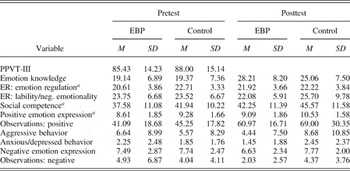
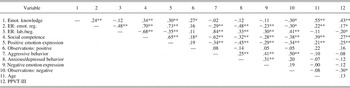
Table 1 presents the means and standard deviations and Table 2 presents the intercorrelations for all variables in the study. The magnitude of the correlations among cognitive ability, emotion regulation, and emotion knowledge are consistent with previous findings from low-income populations. The analyses for 3 of the 10 outcome variables (one index of emotion regulation, social competence, and positive emotion expression) were rendered invalid because their means differed significantly across treatment and control groups at pretest.
Study 1: Means and standard deviations of all variables

Note: EBP, Emotion Based Prevention Program; PPVT-III, Peabody Picture Vocabulary Test—III score; Emotion knowledge, emotion matching task score; ER: emotion regulation, Emotion Regulation Checklist (ERC) Emotion Regulation Scale score; ER: lability/neg. emotionality, ERC Lability/Negative Emotionality Scale score; social competence, Preschool Competence Questionnaire score; positive emotion expression, Emotion Expression Ratings Scale (EERS) Positive Scale score; Observations: positive, aggregate of independent observers' ratings of children's positive interactions with peers, positive interactions with adults, and happy expressions; aggressive behavior, Caregiver–Teacher Report Form (C-TRF) Aggressive Behavior Scale score; anxious/depressed behavior, C-TRF Anxious/Depressed Behavior Scale score; negative emotion expression, EERS Negative Scale score; observations: negative, aggregate of independent observers' ratings of children's negative interactions with peers, negative interactions with adults, anger expressions, and sad expressions.
aSignificant difference between groups in pretest means.
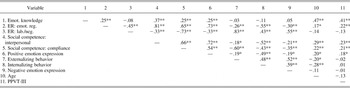
Study 1: Intercorrelations among outcome measures at pretest, verbal ability, and age

Note: Emot. knowledge, emotion matching task score; ER: emot. reg., Emotion Regulation Checklist (ERC) Emotion Regulation Scale score: ER: lab./neg. Emotionality, ERC Lability/Negative Emotionality Scale score; social competence, Preschool Competence Questionnaire score; positive emotion expression, Emotion Expression Ratings Scale (EERS) Positive Scale score; observations: positive, aggregate of independent observers' ratings of children's positive interactions with peers, positive interactions with adults, and happy expressions; aggressive behavior, caregiver–Teacher Report Form (C-TRF) Aggressive Behavior Scale score; anxious/depressed behavior, C-TRF Anxious/Depressed Behavior Scale score; negative emotion expression, EERS Negative Scale score; observations: negative, aggregate of independent observers' ratings of children's negative interactions with peers, negative interactions with adults, anger expressions, and sad expressions; age, child age at pretest; PPVT-III, Peabody Picture Vocabulary Test—Third Edition score at pretest.
* p < .05.
** p < .01.
Primary analyses of treatment effectiveness
When examining intervention effects in educational settings, the nesting of children in classrooms and classrooms in schools can lead to biased standard errors. The bias is usually in the direction of reduced standard errors (Murray, Reference Murray1998) and can lead to inflated estimates of treatment effects and increased Type I errors. We therefore performed the primary data analysis using hierarchical linear modeling (HLM; Raudenbush & Bryk, Reference Raudenbush and Bryk2002). HLM provides correct standard errors for tests of inference that take into account interdependence in the data because of clustering. Because some Head Start centers had only one classroom and there were too few centers altogether (N = 6) to expect stable estimates of variance at the center level, we performed two-level analyses with children represented at Level 1 and classrooms at Level 2.
We estimated seven models in HLM, one focused on each of the main outcome variables except for the three that had significant mean differences across treatment conditions at pretest (Cohen & Cohen, Reference Cohen and Cohen1983, p. 380). In each two-level model predicting an outcome variable, Level 1 represented individual children (within-class variance) and Level 2 represented classrooms (between-class variance). Before estimating each model, we correlated each outcome variable with its pretest score and the potential confounding variables (potential covariates) of age, gender, PPVT-III score, and their interactions with treatment. Potential covariates that had significant correlations (p < .05) were included in the final models. The model predicting EMT scores also included research assistants' ratings of children on the GATSB inattention scale. All predictor variables except treatment and gender of child were grand-mean centered. We entered treatment at Level 2 as a dummy-coded variable (1 = treatment, 0 = control).
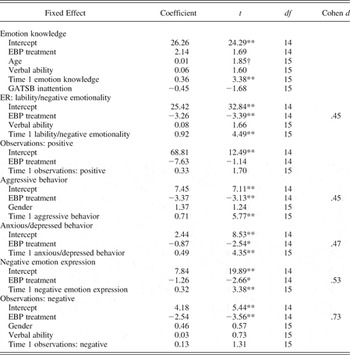
Table 3 provides estimates for the final HLM models across the seven outcome variables that had comparable means at pretest. The primary analyses failed to support Hypothesis 1 in that the increase in emotion knowledge for the EBP group as a whole did not differ significantly from that of the control group. However, because age approached significance and accounted for 30% of the variance in EMT scores, we conducted an additional HLM analysis to determine whether EBP affected emotion knowledge in the subset of children who were at least 4 years old at pretest. This analysis of the effect of EBP on emotion knowledge was significant, t (14) = 2.28, p < .05, Cohen d = .75, providing partial support for Hypothesis 1.
Study 1: Primary hierarchical linear modeling analyses

Note: Cohen's d (computed as the ratio of the posttest mean difference to the pooled SD) is reported only for significant Emotion Based Prevention Program (EBP) effects. Emotion knowledge, emotion matching task score; GATSB, Guide to the Assessment of Test Session Behavior; ER: emotion regulation, Emotion Regulation Checklist (ERC) Emotion Regulation Scale score: ER: lability/negative emotionality, ERC Lability/Negative Emotionality Scale score; social competence, Preschool Competence Questionnaire score; positive emotion expression, Emotion Expression Ratings Scale (EERS) Positive Scale score; observations: positive, aggregate of independent observers' ratings of children's positive interactions with peers, positive interactions with adults, and happy expressions; aggressive behavior, Caregiver–Teacher Report Form (C-TRF) Aggressive Behavior Scale score; anxious/depressed behavior, C-TRF Anxious/Depressed Behavior Scale score; negative emotion expression, EERS Negative Scale score; observations: negative, aggregate of independent observers' ratings of children's negative interactions with peers, negative interactions with adults, anger expressions, and sad expressions.
† p < .10. *p < .05. **p < .01.
A statistically significant EBP effect (p < .05) for the teacher-rated emotion regulation scale of lability/negative emotionality provided partial support for Hypothesis 2. The analyses supported Hypothesis 3 by showing that EBP significantly decreased aggressive behavior, anxious/depressed behavior, and negative emotion expression and independent observers' records of negative behaviors and emotions. The results did not show significant effects of EBP on positive or adaptive behavior.
To further examine the prediction of Hypothesis 3 that EBP would decrease possible precursors of psychopathology, we used chi-square analyses to test changes in C-TRF classifications from pre- to posttest in treatment and control classrooms. Only children who remained in Head Start through posttest were included in these analyses. EBP decreased the number of children with C-TRF scores at borderline or above clinical cutoff on the aggressive behavior or anxious/depressed behavior scales from 15% (14 children) to 9% (8 children). In contrast, the number of children in these categories tripled in the control group, increasing from 7% (4 children) to 22% (12 children). The differences in frequencies of children with abnormal C-TRF scores between groups was not significant at pretest, χ2 (1, N = 149) = 1.90, p < .10, but was significant at posttest, χ2 (1, N = 149) = 5.29, p < .05.
Analyses for potential moderators of treatment/EBP effects
Teacher experience (number of years) in teaching EBP and teacher fidelity to the EBP manual were explored as possible moderators of treatment effects. The primary models were rerun for children in the EBP group with the addition of each of these prospective moderators. Fidelity to the EBP manual predicted larger gains in emotion knowledge, t (7) = 2.75, p < .05. Parent participation, indexed by return of completed parent messages to teachers, was not a significant moderator of outcomes. Child gender and child age did not moderate treatment outcomes other than emotion knowledge, as described above.
Discussion
The data only partially supported the general hypothesis. The results showed that EBP accelerated the development of emotion knowledge and emotion regulation for only some of the children in the treatment group. However, teacher ratings and independent classroom observations converged on the conclusion that EBP reduced both negative emotionality and maladaptive behavior.
The effect of EBP on emotion knowledge differed for 3- and 4-year-olds. In the initial analysis testing Hypothesis 1, the effect of treatment on emotion knowledge was not significant. A follow-up age–cohort analysis showed that EBP significantly increased emotion knowledge in 4-year-olds. The gain for 3-year-olds was not significant. The treatment effect on emotion knowledge was estimated after controlling for age and cognitive ability. As expected, the latter two predictor variables had moderate to high correlations with emotion knowledge.
We had expected that age and cognitive ability might limit the growth of emotion knowledge in the younger children in our low-income sample. Those attending Head Start for the first time were mostly 3-year-olds, and some were under 3 at the start of the treatment. Their pretest mean receptive vocabulary score was a full standard deviation below the norm, and their individual chronological age equivalents ranged from 1.9 to 2.6 (Dunn & Dunn, Reference Dunn and Dunn1997). These data suggest that they were well behind the pace of normative growth in the 0–3 period, a period of rapid development in brain systems serving cognitive ability, language, emotion, and social processes (Cicchetti & Tucker, Reference Cicchetti and Tucker1994; Dawson, Hessl, & Frey, Reference Dawson, Hessl and Frey1994; Fonagy, Reference Fonagy1998; Greenough, Reference Greenough, Krasnegor and Blass1987, Reference Greenough1991; Laucht, Esser, & Schmidt, Reference Laucht, Esser and Schmidt1994; Panksepp, Reference Panksepp2001; Posner & Rothbart, Reference Posner and Rothbart2000; Zeanah, Boris, & Scheeringa, Reference Zeanah, Boris and Scheeringa1997).
In the overall analysis testing Hypothesis 2, we found that, as expected, EBP predicted a significant decrease in the lability/negative emotionality scale of the ERC. We did not have a valid test of the effects of EBP on the emotion regulation scale of the ERC because there were pretest mean differences across groups on this measure.
The analyses provided support for only one part of Hypothesis 3. The results did not show that EBP increased adaptive behavior. They did show that EBP decreased maladaptive behavior patterns. Results revealed significant decreases in both internalizing and externalizing types of maladaptive behavior. In the overall analysis testing the effect of EBP on child behavior, the results showed that compared to children in the control condition, children in the treatment (EBP) condition had greater decreases in negative emotion expressions, negative classroom encounters, externalizing behavior, and anxious/depressed behaviors. These behavioral outcomes have positive implications for the development of school readiness. Externalizing behavior may be the number one target of Head Start and early elementary grade school teachers' efforts to regulate emotion, particularly anger in possession contests and other agonistic encounters (Cummings et al., Reference Cummings, Iannotti and Zahn-Waxler1989; Keenan & Shaw, Reference Keenan and Shaw1994; Shaw et al., Reference Shaw, Vondra, Hommerding, Keenan and Dunn1994).
EBP apparently reduced maladaptive behavior that might include precursors of psychopathology. This was particularly so for a subset of children whose C-TRF scores were at the borderline or above the clinical cutoff on aggressive or anxious/depressed behavior. The number of children above the clinical cutoff on the indices of these precursors of psychopathology decreased by nearly half in the treatment group and tripled in the control condition.
We failed to find a treatment effect on the three measures of positive behavior: teachers' ratings of social competence (PCQ), teachers' ratings of positive emotion expression (EERS), and the aggregate of independent observers' ratings of positive classroom interactions and emotion expression. However, analyses for two of the three measures of positive behavior, teacher ratings of social competence and teacher ratings of positive emotion expression, were invalid because the pretest means differed across groups. That independent observers also failed to find a difference in positive behaviors and expressions across treatment and control classrooms is consistent with the idea that EBP did not increase positive behavior. Overall, the results of Study 1 were inconclusive as to whether the findings regarding a lack of positive outcomes reflected a weakness in the treatment/EBP, a measurement problem, or a design feature (randomization at the center level) that led to pretest mean differences on two of the positive behavior variables.
Study 2
A goal for Study 2 was to increase the generalizability of the effectiveness of EBP by verifying the principal findings from the rural/small town Head Start system in an inner-city system and to extend the search for mediators and moderators of treatment (EBP) effects. Study 1 compared EBP only to Head Start as usual, but in Study 2 we compared the treatment effects of EBP with those of an established intervention program called I Can Problem Solve (ICPS; Shure, Reference Shure1993). The Head Start teachers in the collaborating urban Head Start system had been trained to do ICPS, and it had been in place as a social–cognitive component of the Head Start's curriculum for more than 10 years. Study 2 thus offered an opportunity for a head to head treatment comparison.
An exact replication of Study 1 was not possible because of administrative and curriculum changes in the rural system. Moreover, it was necessary to make some changes in EBP for use in the inner-city system. These changes were made, in part, through discussions with staff and teachers. One purpose of the changes was to make a more teacher-friendly EC Manual and involve the teachers in this task. A second purpose of the changes, inspired by null findings for emotion knowledge gains in 3-year-olds in Study 1, was to make the program more engaging for the younger children. The changes concerned formatting (use of desktop publishing to make the manual easier to use and more visually engaging), accessories (e.g., more ethnically diverse emotion expression photographs and illustrations), and additional emotion story books and emotion-related crafts. These adaptations did not affect the theoretical substance or the primary techniques of EBP.
As in Study 1, we tested three hypotheses: compared to ICPS, EBP would show relatively greater increases in emotion knowledge (Hypothesis 1) and emotion regulation (Hypothesis 2), and greater increases in adaptive behavior along with greater decreases in maladaptive behavior (Hypothesis 3). We expected emotion knowledge to mediate the effect of EBP on emotion regulation, and emotion competence, defined in terms of emotion knowledge and emotion regulation, to mediate the effect of EBP on social competence. As in Study 1, we also explored possible moderating effects of teacher fidelity, parent participation, child age, and child gender.
Method
Design
As in Study 1, the research plan was a cluster randomized design. Six of the 7 centers in the urban Head Start system were randomly assigned to treatment and comparison groups with the restrictions that the groups be balanced in terms of ethnicity and the number of classrooms. The number of classrooms in these centers ranged from 1 to 9, and the total was 26. A seventh center was not included in the study because of a change in teacher assignment after substantial training had taken place that prevented it from being a pure EBP or ICPS room. No participants were recruited from that center.
Participants
The participants came from a collaborating Head Start system that serves an inner-city area in a mid-Atlantic state (adjacent to the state in which Study 1 was conducted). All children in the treatment group received EBP because the Head Start administration agreed to make it part of the overall curriculum in these classrooms. All children in the comparison group received the ICPS program. There were 15 treatment and 11 comparison classrooms. The number of participants at pretest was 191, but because of families moving and children leaving Head Start or switching across EBP and comparison treatment classrooms it was 177 at posttest. Children ranged in age from 2.99 to 5.17 years (M = 4.22 years, SD = 0.60); 91 were boys. Parent-reported race and ethnicity indicated that 50% were African American, 48% were Hispanic or Latino.
Procedure
The substance and techniques of EBP, the manner in which it was conducted, and fidelity checks remained the same as in Study 1. Teachers were trained by the authors at four, 2-hr sessions prior to program implementation. Training included discussion of EBP principles and practice of lessons on each emotion covered in the EC. During the intervention, biweekly consultations were held with all EBP teachers. Differences occurred in parent involvement. We held four meetings at Head Start centers for parents in the EBP group. These meetings lasted for 2 hr. We provided refreshments and provided a small incentive of $10 for parents to cover cost of transportation. Meetings typically had higher attendance by Hispanic parents, with 18–20 parents on average, and lower attendance by non-Hispanic parents, with 4–5 parents on average.
During these meetings, we discussed the content of the EC to increase understanding of what their children were learning about emotions at Head Start. We also illustrated techniques teachers use to help children understand, regulate, and utilize emotions. Finally, we talked about the weekly parent messages and discussed the importance of acknowledging and dealing with emotions in parent–child interactions.
Measures
Child measures
The child measures used in Study 2 were identical to those used in Study 1: PPVT-III, EMT, and the GATSB Inattentiveness Scale. As in Study 1, research assistants blind to experimental condition performed these assessments. However, because of a logistical problem (unavoidable conflict between schedules of graduate student supervisors and undergraduate research assistants) and lack of resources to circumvent that problem, we were unable to obtain reliable observations of children's behavior from trained independent observers in Study 2.
Teacher measures
As in Study 1, teachers in Study 2 completed the ERC and EERS for each child in the study. In Study 2, teachers completed the entire C-TRF for each child, enabling us to use the broadband Externalizing and Internalizing scores rather than the Aggressive Behavior and Anxious/Depressed Scale scores. In lieu of the PCQ, Study 2 used the Adaptive Social Behavior Inventory (ASBI; Hogan, Scott, & Bauer, Reference Hogan, Scott and Bauer1992) as a measure of children's social competence. Because the ASBI was developed for a high-risk population and has shown good psychometric properties in several high-risk preschool populations, including ethnically diverse Head Start samples (Greenfield, Iruka, & Munis, Reference Greenfield, Iruka and Munis2004; Greenfield, Wasserstein, Gold, & Jorden, Reference Greenfield, Wasserstein, Gold and Jorden1997), it was deemed the more suitable measure. The ASBI has 30 Likert scale items used by teachers to rate social competence and disruptive behavior. For the interpersonal aspect of social competence, α = .89 at pretest and posttest. One item was removed from this scale because it assessed emotion knowledge. For the compliance aspect, α = .91 at pretest, α = .92 at posttest. Because of construct overlap with the C-TRF Externalizing scale, the disruptive behavior scale of ASBI was not used.
Results
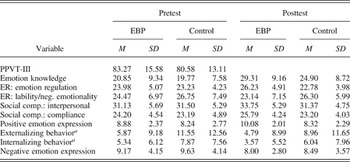
Table 4 presents the means and standard deviations, and Table 5 presents the intercorrelations for all variables in the study. The magnitude of the correlations among cognitive ability, emotion regulation, and emotion knowledge are consistent with previous findings from low-income populations. At pretest, there were significant mean differences for two of the nine outcome variables. The mean for teacher-rated externalizing behavior was higher in ICPS classrooms, t (166) = 3.29, p < .01. (Note that had we opted to create an aggregate of externalizing behavior from the ASBI and C-TRF, this problem of pretest differences would remain.) The mean for teacher-rated internalizing behavior was also higher in ICPS classrooms, t (166) = 2.30, p < .05. The mean for teacher-rated lability/negative emotionality was higher in ICPS classrooms, but the difference only approached significance, t (165) = 1.91, p < .06.
Study 2: Means and standard deviations of all variables

Note: EBP, Emotion Based Prevention Program; PPVT-III, Peabody Picture Vocabulary Test—Third Edition score; emotion knowledge, emotion matching task score; ER: emotion regulation, Emotion Regulation Checklist (ERC) Emotion Regulation Scale score; ER: lability/neg. emotionality, ERC Lability/Negative Emotionality Scale score; social comp.: interpersonal, Adaptive Social Behavior Inventory (ASBI) Expressive Scale score; social comp.: compliance, ASBI Comply Scale score; positive emotion expression, Emotion Expression Ratings Scale (EERS) Positive Scale score; externalizing behavior, Caregiver–Teacher Report Form (C-TRF) Externalizing Behavior Scale score; internalizing behavior, C-TRF Internalizing Behavior Scale score; negative emotion expression, EERS Negative Scale score.
aSignificant difference between groups in pretest means.
Study 2: Intercorrelations among outcome measures at pretest, verbal ability, and age

Note: Emot. knowledge, emotion matching task score; ER: emot. reg., Emotion Regulation Checklist (ERC) Emotion Regulation Scale score: ER: lab./neg. Emotionality, ERC Lability/Negative Emotionality Scale score; social competence: interpersonal, Adaptive Social Behavior Inventory (ASBI) Expressive Scale score; social competence: Compliance, ASBI Comply Scale score; Positive emotion expression, Emotion Expression Ratings Scale (EERS) Positive Scale score; externalizing behavior, Caregiver–Teacher Report Form (C-TRF) Externalizing Behavior Scale score; internalizing behavior, C-TRF Internalizing Behavior Scale score; negative emotion expression, EERS Negative Scale score; age, child age at pretest; PPVT-III, Peabody Picture Vocabulary Test—Third Edition score at pretest.
* p < .05. **p < .01.
Primary analyses of treatment effectiveness
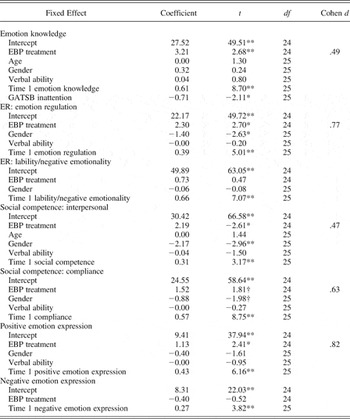
As in Study 1, we performed two-level analyses in HLM with children represented at Level 1 and classrooms at Level 2. We estimated seven models; one focused on each of the main outcome variables, except the two (externalizing and internalizing behaviors) where pretest means were significantly different across the EBP and ICPS treatment groups. The strategy for the HLM analyses was the same as in Study 1. Estimates for the final HLM models across the seven outcome variables that had comparable means at pretest are given in Table 6.
Study 2: Primary hierarchical linear modeling analyses

Note: Cohen's d (computed as the ratio of the posttest mean difference to the pooled SD) is reported only for Emotion Based Prevention Program (EBP) effects that are significant or approach significance. Emotion knowledge, emotion matching task score; GATSB, Guide to the Assessment of Test Session Behavior; ER: emotion regulation, Emotion Regulation Checklist (ERC) Emotion Regulation Scale score: ER: lability/negative emotionality, ERC Lability/Negative Emotionality Scale score; social competence: interpersonal, Adaptive Social Behavior Inventory (ASBI) Expressive Scale score; social competence: compliance, ASBI Comply Scale score; positive emotion expression, Emotion Expression Ratings Scale (EERS) Positive Scale score; negative emotion expression, EERS Negative Scale score.
† p < .10.
* p < .05.
** p < .01.
In testing Hypothesis 1, the HLM analyses showed that compared to children in ICPS classrooms, children in EBP classrooms gained significantly more emotion knowledge over the course of the fall to spring 5-month intervention, t (24) = 2.68, p < .01. In testing Hypothesis 2, the analyses showed that children in EBP classrooms had larger increases from fall to spring in teacher-rated emotion regulation, t (24) = 2.70, p < .05. Analyses did not show a significant effect of EBP on decreases in the lability/negative emotionality scale of the ERC measure.
In testing Hypothesis 3, the analyses provided support only for predicted changes in positive behavioral outcomes. These analyses revealed that compared to children in ICPS classrooms those in EBP classrooms showed significantly greater increases in positive emotion expression, t (24) = 2.41, p < .05, and in the interpersonal component of social competence, t (24) = 2.61, p < .05. Children in EBP classrooms also tended to show relatively greater gains in the compliance component of social competence (p < .10).
Contrary to predictions, analyses for testing Hypothesis 3 did not show that children in EBP classrooms differed significantly from children in ICPS classrooms on changes in negative emotion expression, externalizing behavior, or internalizing behavior. As previously noted, significant baseline differences were observed in teacher ratings of children's externalizing and internalizing behaviors across ICPS and EC classrooms. Follow-up analyses of children at borderline or clinical levels on externalizing or internalizing behavior were not conducted because of these pretest mean differences.
Analyses for potential moderators of treatment/EBP effects
The fidelity with which teachers administered EBP moderated gains in emotion knowledge, t (13) = 2.62, p < .05, with higher fidelity predicting greater gains. In addition, within EBP classrooms, children whose parents completed more of the take-home exercises had higher teacher-rated emotion regulation at postintervention, t (14) = 2.31, p < .05, after controlling for Time 1 emotion regulation and covariates. This index of parent participation tended to predict higher emotion competence and fewer internalizing behavior problems (ps < .10).
We also investigated child age and gender as possible moderators of the effect of treatment. Child age moderated the treatment effect for the interpersonal aspect of social competence, t (24) = 2.13, p < .05. Both 3- and 4-year-olds in EBP classrooms improved in social competence from pre- to posttest, whereas only the 3-year-olds improved in ICPS classrooms. Age did not moderate other outcomes, and child gender was not a significant moderator of any outcome.
Mediation analyses for potential mechanisms of change
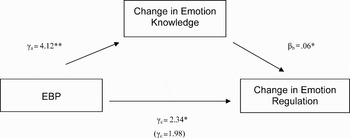
Multilevel mediation analyses were performed based on procedures recommended by Krull and MacKinnon (Reference Krull and MacKinnon2001) and the significance of mediated effects was evaluated using Sobel tests (Figure 1). The effect of EBP on emotion regulation (Time 2 emotion regulation controlling for Time 1 emotion regulation) was fully mediated by EBP's effect on emotion knowledge (Time 2 emotion knowledge controlling for Time 1 emotion knowledge).
The effect of EBP on children's emotion regulation was mediated by the change in children's emotion knowledge. Sobel's test: z = 2.00 (p < .05). EBP, emotion-based prevention program; change in emotion knowledge, Time 2 emotion knowledge, controlling for Time 1 emotion knowledge; change in emotion regulation, Time 2 emotion regulation, controlling for Time 1 emotion regulation. *p < .05. **p < .01.

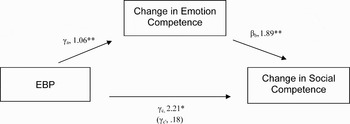
For the mediation analysis of changes in child social competence (Figure 2), emotion competence aggregates for each child at Time 1 and Time 2 were computed by standardizing and summing children's emotion knowledge scores and teachers' ratings of emotion regulation. The effect of EBP on the interpersonal component of social competence (Time 2 social competence controlling for Time 1 social competence) was fully mediated by the effect of EBP on emotion competence (Time 2 emotion competence controlling for Time 1 emotion competence).
The effect of EBP on children's social competence was mediated by the change in children's emotion competence. Sobel's test: z = 3.39 (p < .01). EBP, emotion-based prevention program; change in emotion competence, Time 2 emotion competence, controlling for Time 1 emotion competence; change in social competence, Time 2 social competence, controlling for Time 1 social competence. *p < .05. **p < .01.

Discussion
The data generally supported Hypotheses 1 and 2 that EBP increases emotion knowledge and emotion regulation and partially supported Hypothesis 3 that EBP increases adaptive behavior and decreases maladaptive behavior.
Results of the mediation analyses should be interpreted with caution. The evidence that emotion knowledge mediates the effect of EBP/treatment on emotion regulation and the evidence that emotion competence mediates the effects of EBP on adaptive behavior changes must be considered tentative. We would have more definitive evidence of mediation had we been able to measure emotion knowledge at a middle time point to establish a timeline for mediation effects (Kazdin & Nock, Reference Kazdin and Nock2003). In addition, the potential mediator identified as emotion competence was an aggregate that included a teacher measure and thus shared method variance may have influenced the prediction of teacher-rated social competence.
General Discussion
There were some differences in the findings from Study 1 and Study 2. The similarities and differences are presented with the caveat that their interpretation is rendered difficult, if not moot, by the differences in settings (rural vs. urban), experimental conditions (EBP vs. Head Start as usual in one and EBP vs. an established preventive intervention in the other), and in the number of children in Study 2 who entered Head Start and the treatment program with little or no knowledge of English. In addition, pretest differences occurred on different measures across the two studies, further complicating the comparison.
Similarities in findings across studies
Both studies found that, compared to a control condition (Head Start as usual) or to another intervention (ICPS), EBP increased emotion knowledge and emotion regulation. EBP also had favorable effects on behavioral outcomes in both studies. In both studies, teacher fidelity to the EBP program manual influenced the children's acquisition of emotion knowledge.
Differences in findings of Study 1 and Study 2
In Study 1, EBP increased emotion knowledge only in 4-year-olds. Based on this finding, we intentionally made EBP more engaging for 3-year-olds for Study 2 by making EBP materials more visually interesting and adding additional emotion-related crafts. In Study 2, emotion knowledge increases were not moderated by child age. In Study 1, EBP was more effective in reducing maladaptive behavior than in increasing positive or adaptive behavior. The reverse was true in Study 2. Because of nonsignificant paths between relevant variables, mediation analyses of the type performed in Study 2 were not possible in Study 1.
Identifying causal processes in the EBP intervention
We can tentatively suggest some causal processes that help account for the effects of EBP as a whole. There are conceptual relations between the theoretical principles underlying EBP and the behavior changes it facilitated. Thus, the principle that accurate emotion knowledge represents effective connections among feelings, thought, and action could help explain increases in adaptive behavior and decreases in maladaptive behavior. In addition, the effects of EBP are congruent with the findings from extensive research from many different laboratories on relations among emotion knowledge, emotion regulation, and behavioral outcomes (Denham & Burton, Reference Denham and Burton2003; Havighurst, Reference Havighurst, Denham and Burton2003; Izard, Reference Izard2002; Izard et al., Reference Izard, Fine, Mostow, Trentacosta and Campbell2002).
Perhaps more important, our results are consistent with the assumption that EBP, particularly the teacher-administered EC, increased children's awareness of emotions in self and others and teachers' awareness of the potential benefits of giving preschool children the freedom to experience and express modulated emotions verbally and nonverbally in a safe and supportive environment. The results are also consistent with the related assumption that the EC increased language-related emotion awareness, conscious control of emotions, and adaptive emotion utilization (cf. Prencipe & Zelazo, Reference Prencipe and Zelazo2005). Several of the activities and techniques in the treatment condition involved children connecting words and feelings and using language to express and respond to emotion feelings. The processes involved in talk about emotion feelings, tempered expression of emotions, and emotion awareness may have enhanced each other dynamically in facilitating desirable behavior change.
EBP included no extrinsic rewards for children even when they showed successful negative behavior regulation. This characteristic of the treatment may rule out explanation of positive effects on negative outcomes in terms of the reward factor in behavioral and cognitive–behavioral theories (cf. Samoilov & Goldfried, Reference Samoilov and Goldfried2000). We assumed that the EBP-induced increase in emotion competence, reflected in part by the accompanying decrease in maladaptive behavior or increase in adaptive behavior, provided continual intrinsic rewards.
Causal processes involved in increasing children's emotion knowledge
A number of elements of the treatment were designed to increase emotion knowledge. The EBP Manual has numerous illustrations of facial expressions that meet the criteria for prototypic emotion signals (Izard, Reference Izard1995). Several lessons have materials that focus directly on learning to label and describe expressive behavior and relate it to emotion feelings and possible overt actions. These lessons include emotion-related games, such as placing expressions in categories, make a feeling face, interactive reading of emotion stories, and practice at telling about events and situations that cause a particular emotion. Children play the latter game in group (circle) time and, with assistance from the teacher, get the opportunity to learn about individual differences in event–emotion relations.
Certain benefits of the children's understanding of emotions may have motivated them to participate in activities designed to further increase their emotion knowledge. Increasing children's understanding of the expressions, causes, and functions of emotions increases their ability to detect the signals of others' feelings and intentions. Thus, they can better anticipate others' behavior and thereby reduce the likelihood of agonistic encounters and respond more appropriately to anxious/depressive behavior as well (Dunn, Brown, & Beardsall, Reference Dunn, Brown and Beardsall1991; Gottman et al., Reference Gottman, Katz and Hooven1997; Harris, Reference Harris1999; Izard, Reference Izard2002). Improving children's ability to label emotions enables discourse about them, and the latter increases children's ability to obtain social support. Emotion expression labeling may also increase awareness and cognitive control of emotions (Northoff et al., Reference Northoff, Heinzel, Bermpohl, Niese, Pfennig and Pascual-Leone2004; cf., Prencipe & Zelazo, Reference Prencipe and Zelazo2005).
Causal processes involved in increasing children's emotion regulation
We attribute the gain in emotion regulation primarily to two processes. First, the data of Study 2 provide tentative evidence that the increase in emotion regulation was mediated by the increase in emotion knowledge. Thus, for example, better understanding of the causes of anger in self and others may facilitate anticipation and avoidance of conflict situations. In turn, this effective coping technique functions as a part of a regulatory process by decreasing the frequency of anger arousal and the need for episodic emotion regulation. Furthermore, increased emotion knowledge increases awareness of emotion expressions, feelings, and functions. An increase in emotion awareness should contribute to an increase in children's self-control or executive function (cf. Prencipe & Zelazo, Reference Prencipe and Zelazo2005).
Second, another major factor in increasing emotion regulation may have been the learning and practicing of emotion regulation techniques derived from emotion theory. Each regulatory technique was designed to serve two purposes. The first was to act immediately to regulate the activated emotion. The second was to help channel and utilize the energy and motivation inherent in the adaptive functions of the emotion for negotiation, effective emotion communication, and prosocial action. The goal was never to prevent the emotion from occurring or to reduce arousal to zero. The goal for a regulatory technique was to change the intensity of arousal such that it approached an optimal level for its utilization. We propose that utilization of emotion throughout the day constitutes optimal emotion regulation in day-to-day activities and in developmental time (Izard, Trentacosta, King, Morgan, & Diaz, in press). A long-term goal was to begin the process of transforming regulatory activities (e.g., modulated verbal and nonverbal expressive behavior) into traitlike processes that reduce the need for episodic emotion regulation. Determining the specific contribution of the regulatory techniques as well as that of features designed to increase emotion knowledge must await future controlled experiments on the various components of the EBP treatment.
Causal processes involved in decreasing externalizing behavior
Several aspects of the treatment could have contributed to the finding of decreased externalizing behavior in Study 1. Interactive reading gave the children practice at anticipating emotion experiences to prepare for them. The emotion stories contained material that could have given them better understanding of the consequences of uncontrolled anger. EBP techniques included exercises that helped children understand the physiological accompaniments of intense anger and their possible effects on action. In addition, lessons on helping a friend who is angry (or sad or scared) provided training in empathic responding, a process that tends to decrease aggression (Eisenberg et al., Reference Eisenberg, Fabes, Murphy, Karbon, Smith and Maszk1996; Fabes, Eisenberg, Karbon, Troyer, & Switzer, Reference Fabes, Eisenberg, Karbon, Troyer and Switzer1994).
The Head Start teachers taught children in the treatment group specific techniques for anger regulation and utilization. For example, the hold tight technique described in the introduction is designed to help the children to modulate anger and use words to help them express their feelings appropriately so they can utilize the modulated anger motivation (e.g., for appropriate self-assertion). This technique encourages tempered expression of feelings for three reasons. First, underlying theory includes the assumption that Steps 1 and 2 of hold tight (hugging oneself or pressing hands together and deep breathing) modulate the intensity of the arousal and the associated expressive-behavior tendencies. Second, it also assumes that modulated expression of feelings will modulate feelings further and facilitate their inherently adaptive functions. Third, it may help satisfy a basic motivation to share emotion feelings and intentions with other persons and facilitate the development of skills for effective social engagement (Izard, Reference Izard, Lewis and Rosenblum1978; Tomasello, Carpenter, Call, Behne, & Moll, 2005). This approach to anger regulation assumes that it is neither possible nor desirable to try to completely stop the processes involved in emotion arousal or prevent the occurrence of anger experiences. According to the theory underlying EBP, trying to do that could either eliminate or degrade the adaptive functions of anger, such as appropriate self-assertion. Furthermore, some researchers have cautioned that use of passive or avoidant coping strategies may eventually play a major role in the development of maladaptive behavior (Blair et al., Reference Blair, Denham, Kochanoff and Whipple2004; cf. Volling, Reference Volling2001).
Causal processes involved in decreasing anxious/depressed behavior
Specific emotion-related content and techniques in the treatment condition could have contributed to the reduction of children's anxious/depressed behavior found in Study 1. EBP provided numerous occasions for children to express and talk about sadness-eliciting situations and the subsequent experiences of sadness. These included interactive reading of emotion stories that focus on sadness, “Tell Me” (e.g. “Tell me what makes you feel sad,” “Tell me about a time when you felt sad,”) and learning to “Help a Friend Who Is Sad.” Open discussion about sadness feelings may have increased children's (and teachers') awareness of them and their effects on behavior. The treatment condition may have helped create a classroom atmosphere where sadness feelings could be acknowledged and discussed one on one by child and teacher or during an EC lesson. Such increases in the articulation of feelings and possible gains in emotion awareness could also have other desirable effects. Several studies showed that talk about emotion feelings generally has positive benefits (Dunn et al., Reference Dunn, Brown and Beardsall1991; Dunn & Brown, Reference Dunn and Brown1994; Eisenberg et al., Reference Eisenberg, Cumberland and Spinrad1998; Gottman et al., Reference Gottman, Katz and Hooven1997; Halberstadt, Cassidy, Stifter, Parke, & Fox, Reference Halberstadt, Cassidy, Stifter, Parke and Fox1995; Harris, Reference Harris1999; Ramsden & Hubbard, Reference Ramsden and Hubbard2002).
Comparison of treatment effects of EBP and other preschool interventions
Only two preschool intervention programs for children at risk have published data that enabled us to calculate effect sizes. Comparisons of effect sizes from those two studies and the present one are made with the caveat that all three studies used different outcome measures. In addition, all three studies compared their treatments with control groups, whereas our Study 2 compared EBP with an empirically supported intervention (ICPS). For the program called Al's Pals (Lynch et al., Reference Lynch, Geller and Schmidt2004), effect sizes in terms of Cohen d (calculated using posttest mean differences and standard deviations) ranged from .59 to 1.15 for measures of “social–emotional competence,” social skills, problem behaviors, aggressive/antisocial, and anxiety/somatic problems. For the program called Incredible Years (Webster-Stratton et al., Reference Webster-Stratton, Reid and Hammond2001), the Cohen d was .76 for a construct represented by a composite measure of child conduct problems at school.
In Study 1 of the present paper, effect sizes (Cohen d) for significant results ranged from .45 to .73. In Study 2, effect sizes (Cohen d) for significant results ranged from .47 to .82. EBP effect sizes thus fall into the medium to large range and compare favorably with those of eclectic interventions for preschool children.
Limitations
We have no data that help explain why EBP had relatively greater effects on maladaptive behavior in Study 1 and relatively stronger effects on positive social behavior in Study 2. However, it is notable that in both studies, it was primarily the measures that differed across groups at pretest (teacher ratings of positive behavior in Study 1 and teacher ratings of externalizing and internalizing behavior in Study 2) that failed to show significant EBP effects. Pretest differences across groups render analyses based on these measures invalid (Cohen & Cohen, Reference Cohen and Cohen1983). However, two other analyses suggested real differences in the EBP effects on positive and maladaptive behavior in Studies 1 and 2. In Study 1, EBP did not show a significant effect on positive behavior and positive emotion expression as indexed by independent observers' coding. In Study 2, EBP did not have a significant effect on teacher-rated negative emotion expression.
We are not certain why the groups differed at pretest in both trials, although the limited number of centers in the study is one important factor. The gender, age, and verbal ability of children did not differ significantly across condition in either study. Replications using larger samples, which are more likely to ensure equivalent means on measures at pretest, should help resolve this issue.
We were unsuccessful in implementing a strong parent component of EBP. Our attempt to engage parents in EBP and increase positive emotion communication in parent–child interactions was highly limited by poor attendance at parent meetings (perhaps because of inadequate incentives) and insufficient time, particularly in Study 1. To the extent that parents' reactions to their children's emotions conflict with messages conveyed to children by EBP teachers, poor parent participation might undermine the effects of EBP. Future implementations of EBP might change the parent component of the EC to a more parent-friendly format by offering free transportation to meetings or a home visit option.
The results of the present studies are based on data from families and children who meet the criteria for participation in Head Start. Ninety percent of participants in this Head Start system had to have an income level at or below the poverty line. Up to 10% could be admitted if they had a special need, whether or not they met the economic criterion. Furthermore, the samples in both studies had a much larger percentage of ethnic minorities than currently found in middle class preschools. These factors may restrict the generalizability of our findings.
The present data cannot tell us how long it takes to get favorable results with EBP or the extent to which its various components contributed to the outcomes. In addition, the lack of resources to conduct independent child observations in Study 2 was a significant drawback. To strengthen the evidence for intervention effects, an additional replication that includes structured observations as an independent evaluation of child behavior is underway. EBP needs revisions (e.g., addition of at least a 10-session parent version of the EC). More research with a revised EBP is needed to confirm the promising findings reported here, especially those that tentatively identify mediators and moderators that help explain causal processes in EBP effects on emotion and social competence and the reduction of maladaptive behavior that might include precursors of psychopathology.