INTRODUCTION
Klein's sole, Synapturichthys kleinii (Risso, 1827), is a rare soleid species, which is occasionally encountered and fished (Cabral, Reference Cabral2002). This species inhabits sandy substrates and mainly in shallow waters between 20 and 200 m (Quéro et al., Reference Quéro, Desoutter, Lagardère and Whitehead1986; Hemstra & Gon, Reference Heemstra, Gon, Smith and Heemstra1986). It is present in the eastern Atlantic, the Mediterranean Sea and the western Indian Ocean, round to South Africa, south to Durban (Hemstra & Gon, 1986) but absent along the Atlantic coasts of Africa south to Morocco, especially in the Gulf of Guinea (Desoutter, Reference Desoutter and Quero1990). Its behaviour has been rarely observed in the wild. Nevertheless during August 2008, one of us (G.D.) encountered an animal of this species in the Mediterranean Sea and observed different biological features (behaviour, predation and infestation by parasite) during night dives to 20 m depth. The purpose of this work is to report these observations.
MATERIALS AND METHODS
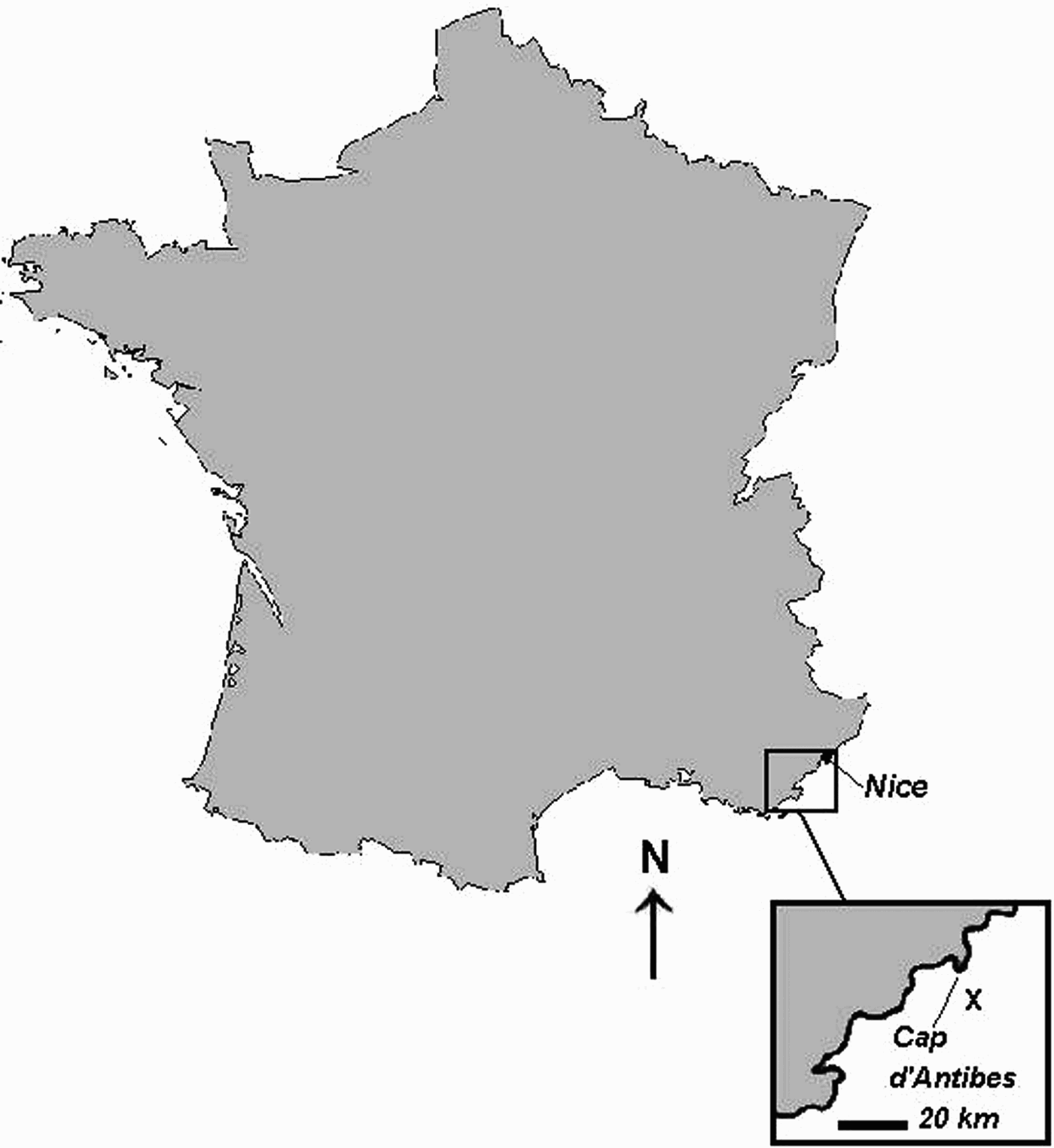
A Klein's sole has been observed during a night dive, 20 m depth, at the ‘tombant du Cap Gros’, Cape Gros, Cap d'Antibes, France (43°33′145″N 7°08′352″E) (Figure 1). Pictures have been taken using a Canon A620 camera in an Ikelite underwater tank.
Map showing the localization (X) of the dives in Cap d'Antibes (August 2008).

RESULTS
Klein's sole is brownish on its eyed side, with irregular white or dark lines, spots and ocelli; median fins, dorsal, caudal and anal, present a distal black continuous margin (Hemstra & Gon, 1986; Desoutter, Reference Desoutter and Quero1990). As this latter feature is diagnostic for this species among Mediterranean soles, the observed animal was identified as a Klein's sole. Desoutter-Meniger (Reference Desoutter-Meniger1997) described this species on the basis of other complementary features, such as the position of the anterior blind-side nostril or the presence of scales on the median fins, but these cannot really be used for an identification while diving. The observed Klein's sole was approximately 20 cm long in total length. Even if these data are only reported from a single animal, some aspects of its biology have been observed: changing of colour, predation and infestation by a parasite.
Changing of colour
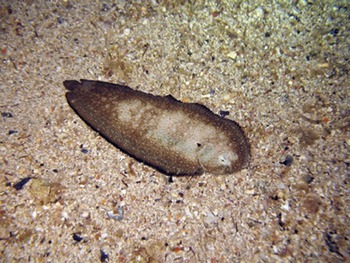
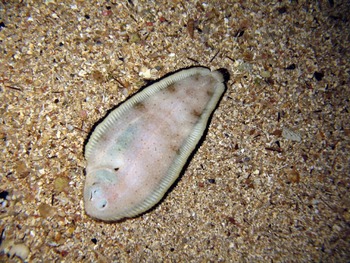
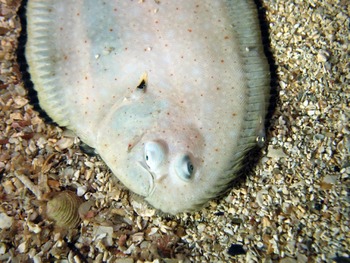
Figure 2 shows Klein's sole changing colour when surprised and illuminated: the eyed side becomes whitish in a few seconds. The modification occurs first around the eyes, the head and the central portion of the body, the distal parts of the body becoming whitish a few seconds later. Moreover (Figure 3), when completely whitish, the irregular and thick brownish stripes become more visible; black distal margins of the median fins are present and scattered little orange spots can be seen on the whole eyed-side (Figures 3 & 4).
A Klein's sole, Synapturichthys kleinii, changing colours. Note that the beginning of this modification occurs first on the head and around the eyes.

Klein's sole entirely whitish with well visible irregular brownish marks and black distal margins on median fins.

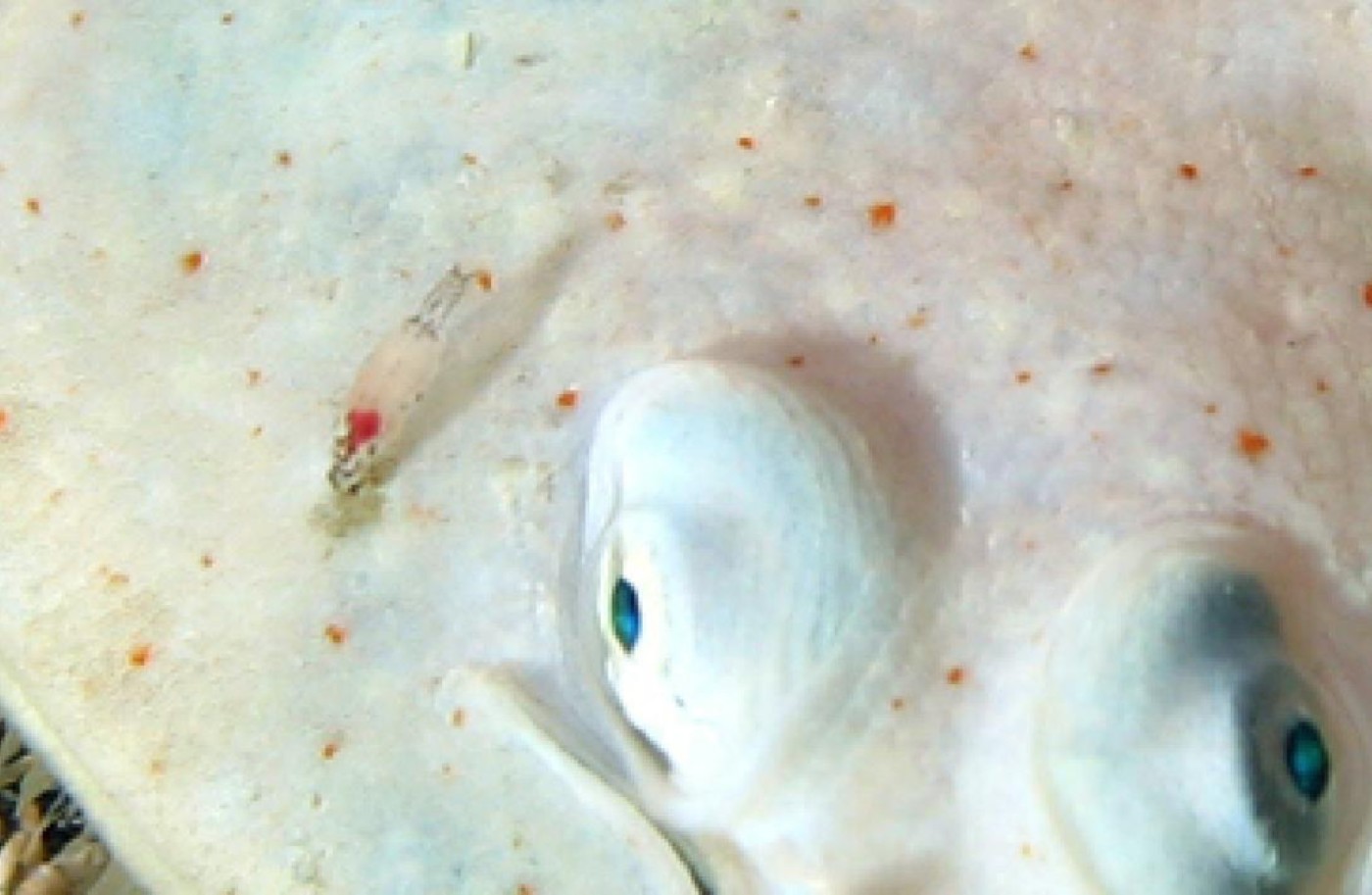
Anterior part of a Klein'sole, Synapturichthys kleinii. Note the prey, a juvenile teleostean fish, close to its upper eye, and a juvenile gnathid parasite on its right cheek.

Predation
A school of small teleostean juveniles was present around the examined sole (Figure 4), its predatory behaviour has been observed. The sole was lying quietly on the bottom and made regular and brisk upwards head lifts to catch some of them. This species seems to be, at least here, an ambush predator, waiting for prey on the bottom.
Infestation by parasite
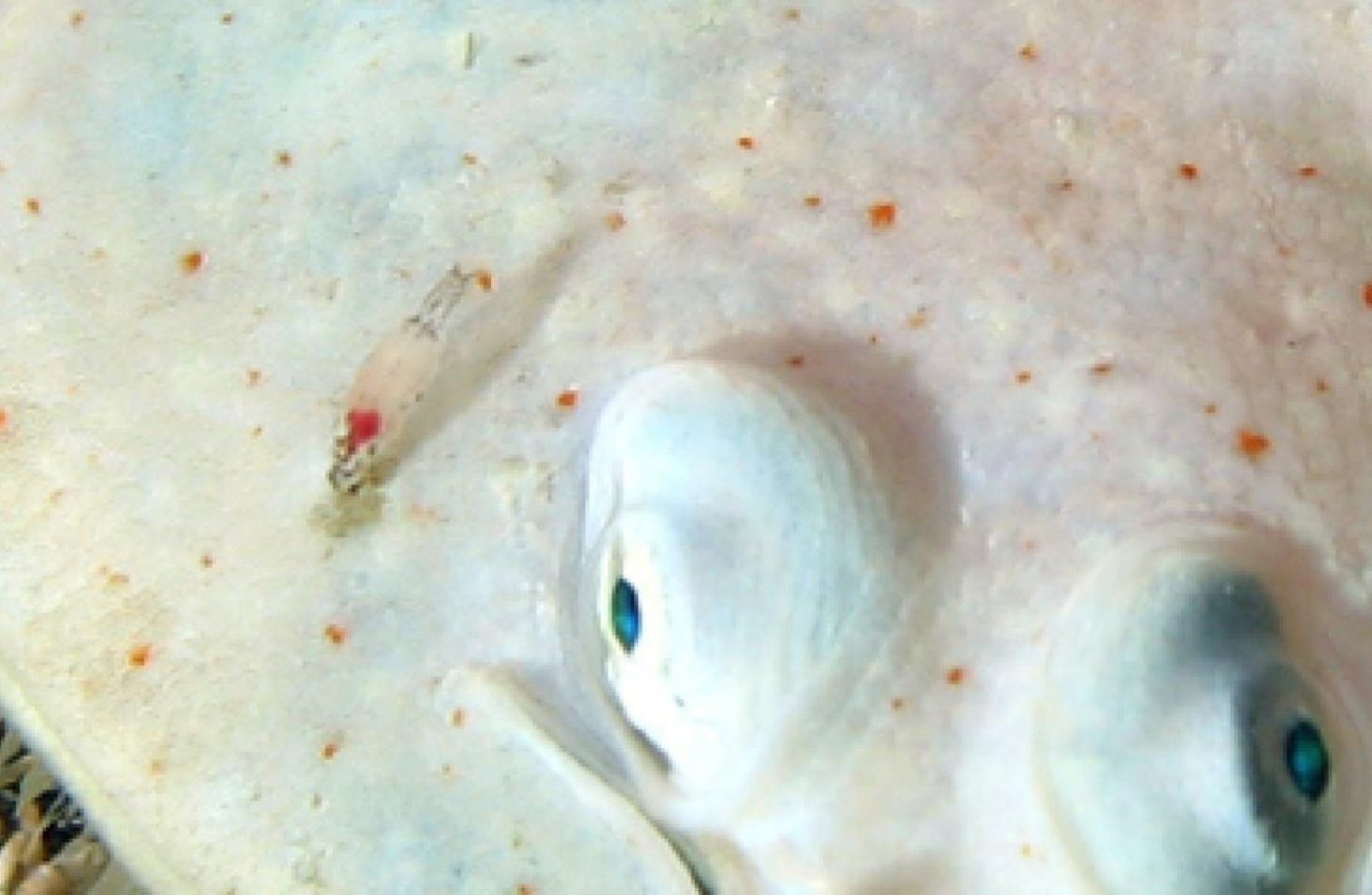
A close look on the animal (Figures 4 & 5) shows that it is infected by an ecto-parasite. A larval gnathid (Isopodes) was hanging on the right cheek of the sole. This crustacean larva was beginning its suction, as only a small blood drop is visible in its abdomen (Figure 5).
Detail of the juvenile gnathid parasite, with a little blood drop in its abdomen.
DISCUSSION
These biological phenomena have unfortunately been observed on only a single animal. But, as this Klein's sole is rare and its biology is poorly known, this work documents the biology of this species and represents the first report of these biological features. No report concerning the changing of colour for this species was mentioned before; it confirms that sight plays a key role in the chromatic adaptation of flatfish. This species, being an ambush predator, has quite an unusual behaviour among soleids. de Groot (Reference de Groot1971), Braber & de Groot (Reference Braber and de Groot1973) and Cabral et al. (Reference Cabral, Lopes and Loeper2002) indicate that soleid species consume mainly less mobile and sedentary prey. The solenette, Buglossidium luteum (Risso, 1810), (Nottage & Perkins, Reference Nottage and Perkins1983; Darnaude et al., Reference Darnaude, Harmelin-Vivien and Salen-Picard2001; Cabral et al., Reference Cabral, Lopes and Loeper2002), the common sole, Solea solea (L., 1758), (de Groot, Reference de Groot1971; Braber & de Groot, Reference Braber and de Groot1973; Lagardère, Reference Lagardère1987; Cabral, Reference Cabral2000; Cabral et al., Reference Cabral, Lopes and Loeper2002; Sá et al., Reference Sá, Bexiga, Vieira, Veiga and Erzini2003), the Senegalese sole, Solea senegalensis Kaup, 1858, (Cabral, Reference Cabral2000; Sá et al., Reference Sá, Bexiga, Vieira, Veiga and Erzini2003; Derbal et al., Reference Derbal, Chaoui, Draredja, Kara and Faure2006), the sand sole, Pegusa lascaris (Risso, 1810), (Marinaro & Bouabid, Reference Marinaro and Bouabid1983; Cabral et al., Reference Cabral, Lopes and Loeper2002), the wedge sole, Dicologlossa cuneata (Moreau, 1881), (Belghyti et al., Reference Belghyti, Aguesse and Gabrion1993; Cabral et al., Reference Cabral, Lopes and Loeper2002), the Portuguese sole, Dagetichthys lusitanica (Capello, 1868), (Cabral et al., Reference Cabral, Catarino, Figueiredo, Garcia and Henriques2003), catch their prey (epibenthic fauna; Polychaeta, Molluscs, Crustaceans …) from the substrate and then have different techniques to collect food. This is the first record on the nature of the food and its capture for Synaptrichthys kleinii. The presence of a gnathid larva on the Klein's sole has not been described before. Teleostean fish are regularly and abundantly infected by juvenile gnathids (Jones & Grutter, Reference Jones and Grutter2005). Derbel et al. (Reference Derbel, Boudaya and Neifar2007) described a new species of monogenean parasite in the gills of Synaptrichthys kleinii and Marques et al. (Reference Marques, Santos and Cabral2006) did not indicate such cases of macroparasites on this soleid species. Thus this is the first report of such a parasitism on the Klein's sole. In spite of the fact that they were realized on a single animal, these observations, conducted during dives, complete our knowledge on the ecology of Klein's sole. We do hope that future observations will confirm them and help to understand the biology of a rarely met soleid species: Synapturichthys kleinii (Risso, 1827).
ACKNOWLEDGEMENTS
We are indebted to P. Noel (UMR 5178 CNRS-UPMC-MNHN, Paris, France) for his identification of the larval gnathid parasite, Dominique Baron (IUFM de Bretagne, Brest, France) for her review of the text and the team of Doris website (http://doris.ffessm.fr/accueil.asp) for comments and encouragements. The comments of two anonymous referees on a first version of the manuscript greatly improved this article.