

Introduction
Parliamentarians spend part of their time in the Assembly and part in their electoral districts. They attend local community events and meetings, take public positions on salient (local) issues, and ‘go public’ in the (local) media. Yet, legislators assist constituents in their dealings with public authorities and look after the district’s social and economic needs. In other words, parliamentarians take care of their constituencies but, at the same time, they share across the globe the goals to be re-selected and re-elected (Mayhew, Reference Mayhew1974) and how they can ‘connect’ to voters (Fenno, Reference Fenno1978). Members of parliament (MPs) focus all their activities and behaviors at local and national level seeking votes of their constituents and their strategies are shaped by electoral institutions (Carey and Shugart, Reference Carey and Shugart1995). According to the literature on representative roles (Wahlke et al., Reference Wahlke, Eulau, Buchanan and Ferguson1962), parliamentarians can have a local or a nationwide focus of representation. Recent studies (Searing, Reference Searing1994) have shown that parliamentarians differ considerably in the extent to which they focus on their constituency, and this variation can be partly explained by looking at electoral systems (Martin, Reference Martin2011).
The European Parliament (EP) is an interesting research laboratory to investigate political representation, leading to a rich literature on this issue. But representation is a complex concept that can be studied from various perspectives. Most researches have long tended to focus on ‘descriptive’ representation. They compared the social characteristics of the representatives with those of the represented to determine to what extent the EP can be considered as a microcosm of European societies (Norris, Reference Norris1997). Inspired by the theoretical model of policy congruence (Miller and Stokes, Reference Miller and Stokes1963), Rose and Borz (Reference Rose and Borz2013) analyze the match between citizens and their representatives by examining the opinion congruence of voters and members of the EP (MEPs) on the left/right and pro/anti-integration scales in EP elections. Some scholars, on the other hand, have considered representation as a dynamic process where the focus is on how MEPs conceive and carry out their mandate (Farrell and Scully, Reference Farrell and Scully2010). They showed that ‘there is no univocal interpretation of the European mandate’ (Costa, Reference Costa2002: 9). MEPs have many different and sometimes contradictory allegiances and face potentially infinite possibilities for actions on a finite quantity of time, energy, and resources and have thus to make choices and prioritize some aspects of their mandate (Farrell and Scully, Reference Farrell and Scully2007). MEPs select their representational priorities in many ways and follow different behavioral paths, including their territorial orientation and constituency service (Farrell and Scully, Reference Farrell and Scully2007). Indeed, the relation to voters and to the territory is a key dimension of the parliamentary mandate and can have an impact on MEPs’ activities.
However, there is a very limited body of empirical research on territorial and constituency representation in the context of the EP (Farrell and Scully, Reference Farrell and Scully2010). Some researches have stressed the importance of cultural factors in relation to the geographical representation rather than strategic-electoral considerations (Katz, Reference Katz1997). Others have shown that electoral systems have some kind of influences in shaping MEPs’ attitudes toward constituency representation (Wessel, Reference Wessel1999; Farrell and Scully, Reference Farrell and Scully2007). They suggest, on this regard, to consider a micro-level analysis to understand how MEPs interpret their role as representatives at European level.
This article explores the territorial dimension of the European mandate by focusing on two national delegations: the Italian and French MEPs. The choice of these two national delegations is threefold: first of all, Italian and French electoral systems for the EP are different. In Italy, MEPs are elected under a proportional system with the opportunity for electors to express up to three preferences. Also in France the electoral system is proportional, but French voters do not have the opportunity to express preferences. This distinction creates a different relationship between representatives and represented (Strøm, Reference Strøm1997): where electors can express (at least) one preference their relationship is closer and legislators have to serve (also) their needs to obtain the re-election; where voters cannot revise the ballot rank, the main principal of representatives is the party, then incumbents have less incentives to pursuit constituency’s political goals. Second, Italian and French MEPs are elected within sub-national constituencies: five in ItalyFootnote 1 and eight in France.Footnote 2 The comparative analysis of these two national delegations gives us the opportunity to investigate the kind of relationship that exists between legislative behaviors of MEPs and electoral systems. In fact, our main hypothesis is that electoral institutions shape the representational style of MEPs: we evaluate if different electoral settings impact on constituencyFootnote 3 orientation of MEPs. The variance of the electoral system dimensions in the two cases (Italy and France) gives us the best opportunity to test the above-mentioned hypothesis. Lastly, Italy and France are two founding Member States and currently show a similar opinion toward the EU (Eurobarometer no. 83).
Our hypotheses are directly derived from the existing literature and, therefore, they may be seen as not particularly original. However, the innovative aspect of this work comes from the data we use to test them: written parliamentary questions (PQs).Footnote 4 The findings illustrated in the Results section support the hypothesis that electoral systems shape constituency orientation in the EP.
In contrast to floor speeches or roll-call votes, PQs (especially written questions) are mostly independent of control by the party leadership (Martin, Reference Martin2011). Furthermore, analyzing PQs enables researchers to assess parliamentarians’ behavior without relying on their recollection or self-analysis as is the case in legislator surveys. Instead PQs offer a direct and reliable estimate of the true interest and role orientation of parliamentarians (Martin, Reference Martin2011; Russo, Reference Russo2011).
Representation and constituency services at EU level: the analytical framework
Wahlke et al. (Reference Wahlke, Eulau, Buchanan and Ferguson1962), in their seminal study of four US state legislatures (California, New Jersey, Ohio, and Tennessee), describe the origin of different legislative roles as a mix between personal characteristics and ‘ecological characteristics of political units’ (Wahlke et al., Reference Wahlke, Eulau, Buchanan and Ferguson1962: 22) (i.e. ethnic and socio-economic character, party composition, political organization, and level of voter interest). This research distinguishes between two dimensions of representational roles: the focus and the style of representation. The first one is related to the geographical orientation and describes if legislators represent (mainly) their constituencies, the party, the nation, or other ‘principals’ in their activities. Focus refers to the extent to which representatives are guided in their decisions by a concern for general or more specific interests (Blomgren and Rozenberg, Reference Blomgren and Rozenberg2012). The second dimension refers to the modalities of representation. Wahlke et al. (Reference Wahlke, Eulau, Buchanan and Ferguson1962) identifies three main styles of representation: Trustee, Delegate, and Politico. Trustees follow their own judgment and conscience and see themselves as free agents. They are not bound by any mandate, either by a party or by the constituency. Delegates, on the other hand, see themselves as having a mandate from someone. They are (morally) obliged to follow instructions, even in cases where it is contrary to their own values. The role of the politico mixes the trustee and the delegate. Depending on situations, representatives hold one of these two roles, either simultaneously, with the possibility of a role conflict, or in sequence (i.e. they can see themselves as delegates in local issues, and as trustees for other issues).
These two dimensions are of primary importance in order to understand legislative roles and behavior and, in particular, they must be maintained separated from an analytical point of view. As Blomgren and Rozenberg (Reference Blomgren and Rozenberg2012: 12) suggested ‘how you represent something or someone says nothing about what or whom you represent’. This means that the representative style (how you represent) can be that of a free agent (trustee) but the representative focus (what or whom you represent) might be a specific group within the constituency.
In this work, we concentrate on the focus of representation that is on the territorial orientation of MEPs. We analyze what is the geographical scope of legislators when they are in Brussels and Strasbourg and in particular, what affects their constituency orientation. Are they representing their constituency? Or, are they more interested in national affairs? In fact, MEPs might use questions to (alternatively or simultaneously) obtain information about their electoral constituency, to control national government activities (Jensen et al., Reference Jensen, Proksch and Slapin2013), to check the European Commission (ECOM) (Proksch and Slapin, Reference Proksch and Slapin2010), or to collect information over the EU foreign policies or about international crises. In this article, therefore, the territorial dimension is defined by the geographical scope and must differentiate among four levels of specificity: the electoral constituency, the national, the European, and the extra-European level.
Observing parliamentarians’ activities is the most direct way to measure their strategic plans. In fact, representatives who decide to play the role of constituency servant will actually focus on their constituency with observable actions: speaking, spending time in their constituency, proposing or amending bills, and asking questions to the executive. According to the perspective adopted in this paper, the variability in the behaviors of representatives can be understood by considering that parliamentarians have different objectives (individual preferences) and operate under different conditions (institutions) (Strøm, Reference Strøm1997). A core assumption in political science is ‘institutions matter’ (March and Olsen, Reference March and Olsen1989). Political institutions affect actor behaviors by restricting their range of strategic options. Institutions do so by allowing and constraining possible activities: they exclude some types of behavior and make others more or less likely. In this perspective, the behavior of actors is guided by their preferences, but constrained by the institutional framework.
In particular, electoral systems are the institutions that most powerfully affect legislators’ behavior (Strøm, Reference Strøm1997). In this article, the basic idea is that electoral rules create incentives for representatives to shape how they act in office (Mayhew, Reference Mayhew1974). A rising number of comparative work, following Fenno’s (Reference Fenno1978) study of US Congressional ‘Home Styles’ and Mayhew’s (Reference Mayhew1974) ideas on the ‘electoral connection’, has investigated whether electoral systems creating incentives for a ‘personal vote’ induce a more constituency-oriented legislative behavior (Bowler and Farrell, Reference Bowler and Farrell1993; Shugart, 2001).
More in general, how legislators think about representation styles, and the manner by which they behave, are governed to a large extent by the institutional framework within which they operate. As legislators seek to maximize their probability of getting (re)elected, they adhere to the incentives and constraints produced by institutions. Whereas under certain institutional conditions legislators will be more prone to emphasize their distinctiveness and individualistic characteristics, at the expense of their co-partisan, other institutional environments encourage representatives to maintain a low profile, following party leadership. In the next section, we focus on the effects produced by electoral systems on legislative behaviors.
Electoral institutions and legislative behaviors
An increasing body of comparative and case-study works has investigated whether electoral systems influence legislative behavior and, in particular, voting cohesion. Even if empirical findings do not support completely the ‘electoral connection’ hypothesis (Martin, Reference Martin2012), many scholars insist on this line of enquiry. In particular, it seems to be generally accepted in the literature that different electoral systems provide different incentives for incumbents to cultivate personal reputation (Carey and Shugart, Reference Carey and Shugart1995). In particular, two main electoral institutions shape the relationship between politicians and electors: ballot structure (BS) and district magnitude (DM).Footnote 5
BS is the first dimension affecting legislative behavior. In open systems where re-election is mainly in the hands of voters, as in open-list proportional systems, single member district or single transferable vote (STV), MPs are incentivized to cultivate their image and to differentiate themselves from other candidates. In this type of electoral systems, the number of personal preferences that each candidate receives is determinant in selecting who wins seats. Parties play no roles in this phase, while voters have all in charge. Conversely, where rules tie up MPs electoral fortunes to party decisions, like in closed-list proportional representation (PR), parliamentarians have fewer incentives to promote themselves during legislative activities. In this system, parties present the list of candidates and voters cannot influence the order at all. In party-centered electoral systems, incumbents have greater incentives to adhere to party leaders’ wishes in the hopes of securing a prominent position on party list in the next elections.
A second dimension with potential effects on legislative behavior is DM. In particular, Carey and Shugart (Reference Carey and Shugart1995) show a non-linear relationship between openness of ballot and size of districts. In closed electoral systems when DM increases, the incentives for personal reputation decline; conversely, when DM increases in all the other systems, the value for politicians to distinguish themselves rises. In open systems with large districts, incumbents deal with both inter- and intra-party competition: they must distinguish themselves from members of rival parties as well as their co-partisans. The opposite happens in closed systems, where small districts incentivize personal votes more than large multi-members constituencies.
From this point of view, the EP is a particularly interesting environment to analyze: MEPs are elected under similar but not identical electoral rules (Farrell and Scully, Reference Farrell and Scully2010) and for this reason it is a special laboratory to understand legislative behavior and its relationship with electoral systems. Hix (Reference Hix2004) found that national parties are more able to control MEPs behavior where the electoral systems are based on closed-lists within small districts. Conversely, open-lists and large districts incentivize MEPs to vote following party groups, and against national party lines. Bowler and Farrell (Reference Bowler and Farrell1993) indicated a strong empirical relationship between electoral systems used for European elections and MEPs constituency orientations. In countries adopting candidate-centered electoral systems, like the single member district in the United Kingdom until 2004 or the STV in Ireland, MEPs spend more time in their constituencies. Those elected under proportional systems are more concentrated on national parties and EPG interests. Farrell and Scully (Reference Farrell and Scully2010) outlined similar conclusions, highlighting how electoral systems shape MEPs legislative behaviors and, in particular, their geographical orientation. An exception that they found is the United Kingdom. Despite elected in 2004 under a closed-list system, UK MEPs tended to place greater attention on their constituency.Footnote 6 The British anomaly can be explained using Katz’s (Reference Katz1997) suggestion about the role of the so-called ‘cultural effect’. He underlined that cultural factors are more important than simply strategic-electoral considerations related to electoral systems. Katz, therefore, concluded that the constituency orientation among British MEPs is affected by the ‘political culture’ of parliamentarians with a Westminster background.
In this article, the first goal is to see how the two components of electoral systems affect the importance of the constituency for Italian and French national delegations in the EP. The first two hypotheses are therefore as following:
Hypothesis 1 The importance of constituency representation increases when DM decreases.
Hypothesis 2 The importance of constituency representation is higher in systems that allow voters to choose between candidates from the same party.
In addition to these first two hypotheses, following Carey and Shugart (Reference Carey and Shugart1995), we test also the effect of DM in different systems allowing or not voters to express intra-party choice. When voters are allowed to choose among candidates of the same party (open and semi-open lists), a higher DM means more co-partisan competitors, and therefore higher incentives for them to cultivate their personal reputation by being more constituency-oriented. On the contrary, in systems that do not allow intra-party choice (closed lists or two rounds), constituency-orientation is not expected to increase with DM. Therefore, our third hypothesis is as following:
Hypothesis 3a If MEPs are elected under open ballot, the higher the DM the higher the constituency salience in PQs.
Hypothesis 3b If MEPs are elected under closed ballot, the lower the DM the higher the constituency salience in PQs.
Unpacking legislative behavior using PQs
After election MPs vote, speak, ask questions, amend laws, and work both in committees and party bodies. All their behaviors are primary oriented to build and improve their reputation in order to increase their chance of re-selection and re-election (Mayhew, Reference Mayhew1974). PQs are used to control executive activities but also to build up a political profile oriented to re-election (Wiberg, Reference Wiberg1995). PQs are relatively free from any kind of constrains imposed by party leadership, and this is particularly true for written questions. Thus, parliamentarians are free to use them every time they want. Certainly, party leadership might exercise some kind of indirect influence or pressure over MEPs, but actually the bulk of the questions is in the hands of legislators. Questions are frequently reported in media, noticed in newspapers, and gain TV attention (especially at local level). Some parliamentarians are said to contact the media before asking questions to create more publicity and audience (Bailer, Reference Bailer2011). Remarkably, media tend to pay more attention to questions (especially to oral ones) than to many other legislative activities. This means that legislators can build and improve their political image and reputation among their relevant groups using questions.
Following Martin (Reference Martin2011) and Russo (Reference Russo2011), we suggest that content analysis of PQs introduces an original method for measuring legislators’ focus on personal vote-earning and offers distinct advantages over existing measures of role activity. The improvement arises from the fact that PQs are a quantitative indicator of the roles performed by legislators that is quite free from many of the measurement problems associated with other methods of uncovering legislative behavior. In particular, Martin (Reference Martin2011) suggests that drafting and tabling a question is not a costless exercise in terms of time and opportunity costs. As a consequence, the number of questions tabled by parliamentarians reveals how much time they take from other activities. Second, unlike most other parliamentary activities (i.e. voting behavior or parliamentary speeches) party leadership does not control directly PQs, hence PQs ‘provide a more reliable perspective on the choice parliamentarians themselves make for focusing on parochial, national, or international issues’ (Martin, Reference Martin2011: 475). Third, problems of bias inherent in observational, interview, and survey-based research are eliminated because (potentially) the behavior of all legislators can be examined. PQs are registered and (usually) publicly accessible, making it easier for researchers to collect data on all PQs asked by legislators during the terms. Finally, moral problems linked to self-analysis and perceptions of legislative activities are removed because the analysis of PQs provides a direct measure of role behavior.
PQs are just one of several tools that legislators can use to represent local interests. Perhaps different legislators choose different tools to cultivate personal votes. If so, looking at one single mechanism to undertake service to a constituency provides an incomplete picture of legislative behavior. Yet, the content analysis of PQs indicates that questions are a standard tool for constituency representation and a part of legislators re-selection and re-election strategies (Rasch, Reference Rasch2011). Analysis of PQs, then, is a novel method for unpacking variation in legislators’ behavior and personal vote-earning strategies.
MEPs territorial orientation: data and methods of analysis
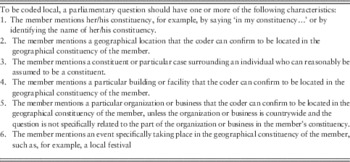
This study analyzes all written questions tabled to the ECOM by Italian and French MEPs during the sixth term (2004–09) and focuses on territorial orientation of each legislator.Footnote 7 Data on PQs have been collected by hand-codersFootnote 8 instructed to examine and identify PQs characteristics. In particular, the coders determined whether the question had constituency, national, European, or extra-European orientation. In total, 5343 questions were coded and they cover all MEPs (N=199) from Italy (111 MEPs) and France (88 MEPs) in the period from July 2004 to May 2009.
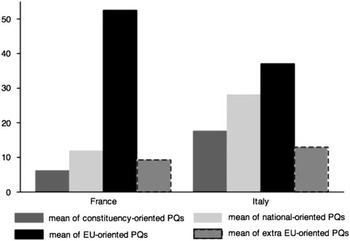
Figure 1 shows the mean frequency for Italian and French delegations. Both mainly focus on the EU-oriented questions (especially French MEPs), while a relevant difference emerges regarding constituency questions. French legislators (elected under a closed PR system) ask very few questions oriented to constituency even if the ‘cumul de mandats’ (‘accumulation of mandates’) should favor close relations with voters (Brouard et al., Reference Brouard, Costa, Kerrouche and Schnatterer2013). Conversely, Italian MEPs (elected under an open system) are much more interested in local issues, even if within the national parliament they show a low level of constituency orientation MPs (Russo, Reference Russo2011). From these figures our main hypothesis about the electoral system’s influence appears plausible, although more empirical investigation would be needed to confirm it. Attention to extra-EU issues is limited for both delegations, while questions concerning national matters are particularly relevant (at least in rough numbers) for Italian MEPs.
The geographical scope of parliamentary questions (PQs). Data show the mean of written questions asked by each Italian and French members of European Parliament during the sixth term (2004–09). Official data from the European Parliament.

Electoral systems are an important factor in shaping legislative behavior, but other factors – like (inter alia) legislative offices, party offices, or policy positions – exert influence on constituency-orientation of incumbents (Strøm, Reference Strøm1997; Martin, Reference Martin2011; Pilet et al., 2012). In the next section, we test empirically for the likelihood that other variables could shape the attention that MEPs give to their electoral district.
Explaining constituency-oriented questions: a statistical test
To determine whether and how electoral incentives shape MEPs’ constituency behavior, we focus on the PQs related on constituency. Our dependent variable is the total number of questions focused on electoral constituency of each MEP. This variable is a non-negative count with (potentially) no upper limit, where value indicates how many times a given event (PQ) has occurred. Moreover, data are over-dispersed (see Table 1), that is, their variance is larger than the mean. For these reasons, a simple regression cannot be used and the most appropriate statistical model is the negative binomial regression (Cameron and Trivedi, Reference Cameron and Trivedi2009). As we use individual-level data (about MEPs), macro-level data (BS), as well as meso-level data (DM), some might argue that the appropriate statistical technique would be a multi-level regression. This, however, is not possible, as we have only two units for the macro level (two countries, two electoral systems) (Achen, Reference Achen2005).
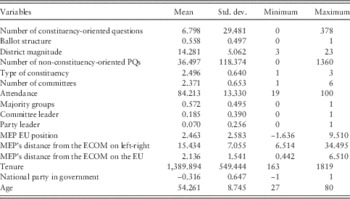
Descriptive analysis of dependent and independent variables

PQs=parliamentary questions; MEP=member of European Parliament; ECOM=European Commission.
According to the comparative literature, the incentive to cultivate personal votes is linked directly to the level of intra-party competition as shaped by the electoral system characteristics (Carey and Shugart, Reference Carey and Shugart1995). Thus, our main independent variables deal with two separate dimensions of electoral systems used for the EP elections: BS and DM. BS is expressed by a dummy variable with two values: 1, for proportional systems that allow voters to choose between candidates from the same party, and 0 for electoral systems that do not. The DM shows the number of seats distributed within the constituency of each MEP. Finally, in order to look at the differentiated effect of DM in systems allowing or not for intra-party choice (Hypotheses 3a and 3b), we include an interaction term (BS×DM), where our measure of DM is combined with the BS variable. The interaction variable is the product of the DM and BS, therefore it has an outcome of 0 for the system without intra-party choice, and a value between 3 and 23 for legislators elected in district where voters can use preferential votes.
To test our hypotheses, we will work in two steps. First, the separate effects of the two components of the electoral system (DM and BS) are tested in Model 1, and it assumes a linear relation between each component of the electoral system (Hypotheses 1 and 2). The Model 2 follows the logic of Hypotheses 3a and 3b and includes an interaction term (DM×BS) to differentiate the effect of DM when intra-party choice is an option offered to voters or not.
In addition, a series of control variables have been included in the models. First of all, no institution exists in isolation. Legislative rules also constrain questioning activities in parliaments (Rasch, Reference Rasch2011): in particular, open vs. restricted right to use PQs is relevant in explaining the number of questions asked and who is in charge to question the executive. Most prominently MEPs could, at least in principle, use their speaking time to address issues important to their constituents. This venue, however, is closely regulated in the EP. With predefined subjects of debates and speaking time being allocated by EPGs, MEPs’ ability to speak on their individual priorities and constituency issues is limited. A second venue could be the issuing of bills. Again this process is mostly dominated by EPGs (Hix et al., Reference Hix, Noury and Roland2007). For these reasons, we expect written questions to be a completely free choice for legislators, and can be used by low-ranked MEPs to come out from the backstage. Two types of leading position can be found in the EP: party group and committee leadership positions. In order to test this alternative hypothesis, in the Model 2 we introduce two dummy variables expressing: value 1 when MEPs are in the Bureau of the Group or they are party leader, 0 if not (‘party leader’); value 1 when MEP is Chair or Vice-Chair of Committee, otherwise 0 (‘committee leader’).
At the same time we controlled for two groups of variables likely to affect MEPs activities. In the first group there are variables concerning MEP characteristics. First, we included MEPs’ ideological position on pro-anti European integration stances (‘MEP position on EU integration’) in order to test Proksch and Slapin’s (Reference Proksch and Slapin2010) euro-skeptic model. They suggest that MEPs who are more skeptical about the EU integration process can use PQs as a tool for obstruction as well as oversight. To calculate MEPs’ policy positions on this issue we used an established exogenous measure of national party positions: the Manifesto Research Group Project (Budge et al., Reference Budge, Klingemann, Volkens, Bara and Tanenbaum2006). The variable uses the national party policy position as proxy to infer the legislator’s preference on the EU. The measurement reveals that the greater is the value, the more integrationist is the MEP’s position and it is referred to the closest national elections to the EP elections in 2004.Footnote 9 Second, PQs are (mainly) used to control the executive, to request information and to obtain personal or collective aims related to electoral arena (Rasch, Reference Rasch1994). For these reasons, MEPs who belong to parties far away from the ECOM policy preferences should be more involved in ‘fire alarm’ and ‘policy patrol’ activities (McCubbins and Schwartz, Reference McCubbins and Schwartz1984). PQs, in particular, give them the opportunity to gain publicity among their like-minded ‘principals’ (voters, national party, and EPG). Therefore, we calculated the Euclidean distance on left-right and EU integration dimensions between each MEP and the ECOM (MEP distance to ECOM on left-right dimension and MEP distance to ECOM on EU integration dimension). To derive the score we subtracted the MEP policy positionFootnote 10 on left-right dimension and EU integration process from position taken by ECOM on these two policy issues. To measure the ECOM ideal point on the two dimensions we used a simple mean of party positions represented within it. The underline assumption is that ‘actors in EU institutions have broadly similar policy preferences to the political party to which they belong’ (Warntjen et al., Reference Warntjen, Hix and Crombez2008: 1247)Footnote 11 and composition and policy positions of the ECOM derive from an update of Political Make-Up data set (Warntjen et al., Reference Warntjen, Hix and Crombez2008). Third, MEPs attending plenary and legislative activities are, on the one hand, more involved in EP actions and, on the other, have more chance to write questions to the European executives. Members missing legislative activities have fewer opportunities to ask questions. Therefore, we also control for MEP’s presence (‘attendance’) in the chamber using official data from the EP. The variable represents the percentage of attendance in plenary sessions. The activities of MEPs can be influenced also by the number of days (‘tenure’) they pass in Brussels and Strasbourg as parliamentarians. MEPs who have shorter legislative tenure have fewer opportunities to ask questions and to be involved in activities related to their constituency. Furthermore, we know from previous work (Proksch and Slapin, Reference Proksch and Slapin2010) that committee membership affects questioning in the EP. It may be that those who are members of two or three committees are likely to ask more questions as they have several policy briefs to deal with. To test this, we collect data on the number of committees (‘N committees’) of which each MEP was a member in the sixth term. We control also for the age of MEPs. A past study (Sozzi, Reference Sozzi2016) demonstrated that PQs are used by young MEPs to cultivate their image and reputation. Following this type of reasoning, we can also suppose that younger MEPs are prevalently constituency-oriented in order to cultivate their personal image at local level. The ‘age’ variable shows the age of each MEP at the beginning of the legislative term in 2004.
The second group is composed by three variables describing MEPs’ party government or opposition status at national as well as supranational level. Jensen et al. (Reference Jensen, Proksch and Slapin2013) argued that parties in opposition at national level can use EP activities to control and ‘publicly shame’ their government. Following their point of view, members from national opposition parties use PQs at supranational level for domestic reasons. Proksch and Slapin (Reference Proksch and Slapin2010) suggested a slightly different (and complementary) explanation of PQs in the EP. The authors argue that opposition parties and MEPs are more likely to use the ‘European chain of delegation […] to scrutinize the ECOM and reduce informational asymmetries on EU affairs’. PQs are, in other words, the best opportunity for opposition parties and MEPs to check the executive at EU level. In order to test the influence of national government-opposition status on oversight activities in the EP we included, first, a dummy variable representing if MEP’s national party is in government during the whole period considered in this article (from July 2004 to June 2009) (value 1), if his party spend sometimes in opposition and sometimes in government variable (value 0), if national party is in opposition throughout the period of investigation (value −1) (‘national party in government’).Footnote 12 At the same time, legislative and office resources are distributed in the EP among EPGs on a proportional vein, creating a ‘procedural cartel’ able to control legislative activities (Hix et al., Reference Hix, Noury and Roland2007). Members who belong to the cartel are consequently much more involved in legislative activities (especially as rapporteur) than MEPs outside the cartel. We include a dummy variable that takes value 1 if the MEP belongs to EPP, PES, and ALDE and value 0 otherwise (‘majority group in EP’). Moreover, the variable ‘Non-constituency-oriented questions’ shows the total number of PQs asked by each MEP without direct references to the electoral constituency. This variable is meant to capture the activism in asking questions for each parliamentarian. Finally, the European Social Funds allocates money across regions according to their level of development. MEPs from more subsidized regions should ask more questions to control grant opportunity for their regions. The variable ‘constituency type’ expresses the index of development of each constituency and it is calculated as follow: regions are distributed within three categories according to their level of economic and social development (1: less developed regions; 2: transitional regions; 3: more developed regions). The index is the mean of levels of each region within the constituency.Footnote 13
Table 1 provides descriptive statistics of our dependent and independent variables.
Results
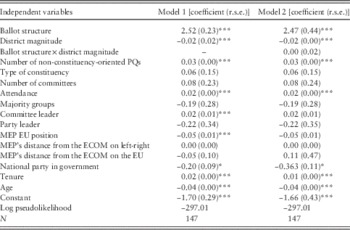
The results of our analysis are detailed in Table 2. First of all, both our main independent variables (BS and DM) are in the expected direction and are statistically significant. We can see that MEPs elected via open ballot ask more constituency-oriented questions than legislators selected under closed systems. At the same time, DM follows the Hypothesis 2: the larger the district, the lower the intra-party competition; therefore, MEPs are less incentivized to cultivate personal reputation using constituency-oriented questions. The number of questions with focus on constituency is strictly related to the general level of questioning activism of each parliamentarian. Attendance is positively correlated with constituency service. This result is not surprising: attendance increases the opportunity for parliamentarian to ask for questions focused on constituency issues. Similar conclusions can be underlined for tenure: the tenure variable is positive and significant, that is MEPs with longer tenure in the EP are more likely to focus their activities on local interests. Moreover, the Eurosceptic model suggested by Proksch and Slapin (Reference Proksch and Slapin2010) is also confirmed by our data. MEPs with more integrationist positions ask lesser questions than legislators endorsing more Eurosceptic positions. Finally, younger MEPs are more likely to ask constituency-oriented questions. They use PQs as an instrument to increase their reputation and image among relevant constituents. Conversely, leadership positions are not statistically significant even if they are in the expected direction, suggesting that MEPs holding higher positions in the EP and in the EPGs have others instruments for self-promotion. Nevertheless, the number of committees, the type of constituency, and MEP’s distance from the ECOM positions are not relevant variables (i.e. they are not statistically significant). Finally, MEPs who belong to government parties at national level, accordingly to Proksch and Slapin (Reference Proksch and Slapin2010), are less likely to ask questions oriented to constituency and the coefficient is always significant. Model 2 shows results for the interaction variable between BS and DM. The sign of the coefficient is in the expected direction even if it is not statistically significant. All the others variables maintain their direction and significance.
Determinants of constituency orientation in parliamentary questions (PQs)

Negative binomial regression; the dependent variable is the total number of constituency-oriented questions asked by Italian and French members of European Parliament (MEPs).
***P⩽0.01, **P⩽0.01, *P⩽0.1
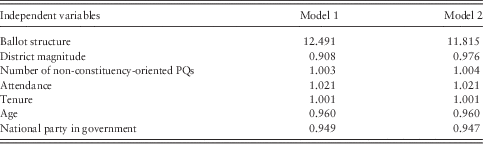
The coefficients of negative binomial model illustrate the expected change in log count for a one-unit increase of the independent variable. To better understand and to make more intuitive the substantive effects of variables over constituency-orientation of MEPs, we report in Table 3 the ‘incidence rate ratio’ (IRR) (Cameron and Trivedi, Reference Cameron and Trivedi2009) of statistically significant variables in Models 1 and 2. The IRR coefficient show the effect of a one-unit increase of the independent variables on the dependent variable (the number of constituency-oriented questions), holding all the other variables in the model constant, and it makes possible to calculate the effect in percentage. Coefficients in Table 3 demonstrate that the BS has a large impact on the number of constituency-oriented PQs. In fact, MEPs elected with an open ballot ask 1.149% more questions than members elected with a closed electoral system. Conversely, DM shapes negatively the constituency relevance of MEPs’ behavior. An increase of one unit in DM decreases by 9.2% the number of constituency-oriented questions. Moreover, the coefficient represented in Table 3 shows that, compared with MEPs from opposition parties, members belonging to government parties ask 5.1% less questions. The number of constituency targeted questions is weakly related to the more general level of questioning activism: one additional question not linked to the constituency increases the number of constituency questions by 0.3%. At the same time, an increase of one unit in the attendance increases by 2.21% the constituency focus of MEPs’ questioning activities. With regard to individual characteristics of MEPs, Table 3 confirms that if the age of members increases by 1 year, the number of constituency-oriented questions decreases by 4%. Finally, tenure has a very limited impact on questioning activities of MEPs: an additional day of seniority produces an increase of 0.1% in the number of constituency-oriented PQs. The IRR coefficients related to Model 2 provide almost the same substantive evidences for each independent variables, with no significant differences respect to the Model 1.
Effect of a one-unit change of the independent variables on the number of constituency-oriented parliamentary questions (PQs) (incidence rate ratio)

Variables are statistically significant in negative binomial regression (see Table 2).
Conclusions
In this article, we have analyzed a classic question regarding the link between electoral institutions and constituency orientation of legislators. Our main hypotheses focused on the impact of BSs and DM in questioning activities of the Italian and French MEPs during the sixth term of the EP (2004–09). Findings have shown that despite the lack of electoral connection of the MEPs, electoral institutions shape the legislative behavior of the Italian and French parliamentarians. In particular, this article suggests that the main differences between the two national delegations in the EP are primarily explained by electoral incentives.
Carey and Shugart (Reference Carey and Shugart1995) suggested that party-centered systems provide less incentive for legislators to focus on personal reputation, while candidate-centered systems encourage MPs to cultivate individual image. Electoral rules create constraints and incentives on the manner in which legislators cater for their ‘competing principals’ (Carey, Reference Carey2009). For example, in a closed-list proportional system party leadership arguably exercises a strong control over a legislator’s probability of gaining re-election. Under such system, legislators need to avoid differentiating themselves from their co-partisans, therefore the incentives to emphasize a personal reputation are minimal. Conversely, in a fully open-list system party leaders have no control over the final rank of candidates. This means that candidates compete not only with rival parties but also with rivals within their own party. Under this type of electoral institution, they must distinguish themselves from their co-partisans by underling their personal reputation.
Evidences from Italian and French delegations in the EP corroborate this theoretical hypotheses: Italian MEPs, elected under an open system, are much more constituency-oriented than French MEPs, elected under a closed ballot. Open electoral systems, in this perspective, incentivized legislators to cultivate a personal relationship with constituency. Conversely, MEPs elected under closed systems are not subjected to this kind of incentives and they play a legislative role with a geographical and territorial scope far away from their constituency. Furthermore, BS is not the only dimension of electoral systems that is relevant for legislative behavior. DM works in the expected direction: the higher DM is, the lower the importance attributed to constituency representation. This result confirms what suggested by Wessel (Reference Wessel1999: 221): ‘Legislators in smaller districts are more visible and more accessible to their constituents, whereas members of larger delegations may be better able to escape the pressures of constituents’.
Differences in electoral systems incentives to cultivate personal reputation and constituency links are not without implications for political representation at EU level. While, on the one hand, differences in electoral institutions for the EP elections can create an ideal laboratory for political scientists, on the other, they have an impact on the representational role played by MEPs. As long as national peculiarities persist, no homogeneous political representation can arise at the EU level, failing to create a real connection between representatives and represented (Wessel, Reference Wessel1999). MEPs come from different cultural, political, and institutional environments, and their conception of legislative role is affected by these discrepancies. Different models of representation coexist within the EP (Farrell and Scully, Reference Farrell and Scully2007) and despite high hopes in the 1970s, the experience is that after eight rounds of elections, the EP elections have failed to establish an ‘electoral connection’ between EU citizens and politics at the EU level. Results in this article suggest that a uniform electoral system for the EP with small multi-member districts with some form of ‘open’ BS would increase incentives for MEPs and candidates to raise their profile directly with the citizens, which in turn would increase public awareness and participation in EP elections, and so enlarge the legitimacy of both the EP and the EU.
Acknowledgments
The author thank the referees, the editors of the journal, and guest editors for helpful comments and suggestions.
Funding
The research received no grants from public, commercial, or non-profit funding agencies.
Data
The replication dataset is available at http://thedata.harvard.edu/dvn/dv/ipsr-risp.
Appendix
How to code parliamentary questions