Introduction
Mass-casualty incidents (MCIs) pose substantial challenges to emergency medical services (EMS) when the number of casualties temporarily exceeds available on-scene resources. During the early operational phase—often within the first 10-20 minutes—decisions related to triage prioritization, information transmission, and transport coordination are particularly critical for preventing avoidable morbidity and mortality.Reference Kamler, Taube and Koch 1 , Reference Vassallo, Moran and Cowburn 2
Prehospital triage systems are designed to support rapid prioritization under such conditions. One of the most widely used approaches is Simple Triage and Rapid Treatment (START), which classifies patients into priority categories based on ambulation status, respiratory effort, perfusion, and mental status. Although START is intended to facilitate fast and reproducible decision-making, international evidence indicates that its diagnostic performance varies considerably in both real-world incidents and simulation studies.Reference Marcussen, Bräuner and Alstrøm 3 , Reference Marcussen, Bräuner and Alstrøm 4 , Reference Ledbury, Glasgow and Tallach 5
On May 19, 2025, a mass-casualty incident occurred outside Beida Elementary School in Sanxia District, New Taipei City, Taiwan, when a vehicle lost control and struck pedestrians during school dismissal. The incident resulted in 16 casualties, including 4 out-of-hospital cardiac arrest (OHCA) patients, and prompted activation of the START protocol. Although the 13 patients ultimately transported were transferred to receiving hospitals within approximately 20 minutes, subsequent field documentation and after-action materials revealed multiple operational challenges related to the triage process—encompassing initial sorting, assessment, life-saving interventions, reassessment, and transport prioritization—as well as information flow and technology use during the early response phase.
Despite Taiwan’s mature EMS infrastructure, detailed field-based evaluations of MCIs remain limited, and few published reports describe operational timelines, tactical decision-making, and system constraints encountered during fast-moving urban incidents. This report addresses this gap by presenting a structured operational account and system-level analysis of the Sanxia event. By integrating scene observations, dispatch timelines, and responder documentation, this field report examines challenges related to incident command organization, triage consistency, digital tool integration, and the utilization of auxiliary personnel. The findings aim to inform future improvements in prehospital MCI preparedness in Taiwan and provide transferable insights for other urban EMS systems operating under similar constraints.
Narrative
Following an initial report at 16:01, EMS units were dispatched at approximately 16:08 to an urban mass-casualty incident in Sanxia District, Taiwan. Upon arrival, responders encountered a fragmented scene consisting of a primary impact area and a secondary cluster located in an adjacent alley. Initial assessments identified patients across a range of injury severities, including out-of-hospital cardiac arrest, severe trauma, and ambulatory injuries.
Early response activities occurred under conditions of temporal compression, with multiple EMS units initiating patient contact, assessment, and treatment before a formal triage officer or unified transport prioritization structure was fully established. Triage decisions were made using START criteria, with reassessment occurring as additional information became available and resources arrived on scene. A total of 13 patients were ultimately transported to receiving hospitals, including 4 black-, 2 red-, 5 yellow-, and 2 green-tagged patients, while coordination of transport destinations relied primarily on verbal communication and dispatch support. The remaining 3 green-tagged patients were treated on scene and did not require ambulance transport.
Throughout the response, patient care, reassessment, and transport coordination progressed in parallel. Although an electronic MCI management system was available, system activation occurred after all patient transports had been completed. Consequently, operational coordination during the early phase relied on handwritten notes, radio communication, and real-time verbal updates among responding units. The incident was resolved within a short operational window, with all transported patients transferred to receiving hospitals by approximately 16:44.
Discussion
The Sanxia urban mass-casualty incident illustrates how operational context shaped triage processes, information flow, and coordination during the early response phase. Spatial fragmentation of the scene, concurrent task demands, and rapid patient movement influenced decision-making under time pressure and limited early centralized oversight.
Scene configuration and operational context
As illustrated in Figure 1, the Sanxia incident involved spatially dispersed casualty clusters, including a primary impact zone and a secondary cluster in an adjacent alley. This fragmentation limited early centralized oversight and required parallel assessments across multiple zones, complicating situational awareness during the initial operational phase. Prior studies of urban MCIs have similarly shown that nonlinear casualty distribution may delay command consolidation and increase reliance on decentralized decision-making during early response.Reference Kamler, Taube and Koch 1 , Reference Vassallo, Moran and Cowburn 2
Schematic layout of the Sanxia mass-casualty incident scene showing collision points, vehicle path, casualty distribution, and ambulance positions (A1-A11). Schematic layout of the Sanxia mass-casualty incident scene illustrating key roadways, collision points, vehicle trajectory, major casualty cluster, secondary injury site, ambulance staging positions (A1-A11), and the location of the Incident Command Post (ICP). Landmarks such as nearby preschools and the elementary school are shown to provide spatial context for responder access and patient distribution. The diagram is not to scale.

Initial triage patterns and execution context
Initial patient assessment using the START protocol demonstrated overall alignment with subsequent transport and management priorities (Table 1). During the early operational phase, reassessment identified one initially ambulatory patient requiring additional evaluation, reflecting the dynamic nature of triage rather than a fixed misclassification. This finding underscores that triage during MCIs is a continuous process shaped by evolving patient conditions and resource availability, and that timely reassessment represents an operational strength rather than a failure of initial triage.Reference Marcussen, Bräuner and Alstrøm 3 , Reference Marcussen, Bräuner and Alstrøm 4
Summary of casualty characteristics and initial START triage classification

Note: Responder reflections documented at least one instance in which an ambulatory patient was initially categorized as green based on rapid assessment, and subsequently identified during reassessment as requiring additional observation. This finding is consistent with the appropriate execution of the reassessment process under dynamic MCI conditions, allowing prioritization decisions to be adjusted as clinical information evolves. Precise clinical parameters were not available, but no delay in life-saving intervention or priority transport was identified.
Temporal compression, multitasking, and information flow
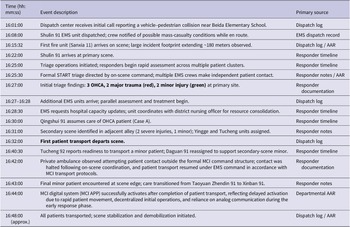
The operational timeline presented in Table 2 demonstrates that triage, treatment, communication, and transport coordination occurred within a highly compressed interval, with multiple EMS units initiating patient contact before formal triage leadership and transport prioritization were fully established. Such temporal compression mirrors patterns described in prior analyses, in which early responder actions precede formal command consolidation.Reference Kamler, Taube and Koch 1 , Reference Rush, Lauria and DeSoucy 6
Chronological timeline of key operational events during the Sanxia mass-casualty incident

Note. Times are reported in local time and reflect reconstructed operational timelines based on dispatch records, responder documentation, and departmental after-action materials. Minor discrepancies of several seconds may exist due to asynchronous logging across sources. Event descriptions represent operational milestones rather than continuous activities. AAR, After-Action Report.
Under these conditions, multitasking demands increased reliance on informal communication pathways. In the Sanxia incident, handwritten notes, verbal updates, and radio reports served as primary mechanisms for information exchange during the critical early minutes. A private ambulance briefly attempted patient contact outside the formal MCI command structure; this was promptly corrected through on-scene coordination, after which transport proceeded under established EMS command and protocols. Activation of the MCI digital system occurred after completion of patient transport, reflecting the rapid pace of patient movement and reliance on analog communication during early response. These adaptations reflect operational realities during early MCI response rather than deviations from triage principles, particularly when reassessment and transport decisions must be continuously updated as scene conditions evolve.Reference Kamler, Taube and Koch 1 , Reference Vassallo, Moran and Cowburn 2
Digital system usability and operational adoption
Although an electronic MCI tracking platform was available, Table 2 indicates that system activation occurred only after all patients had been transported, limiting its operational relevance during the initial response window. Consequently, patient tracking and hospital notification relied on analog methods, with transport outcomes summarized in Table 3. While coordination was ultimately successful within a short operational interval, the absence of a shared digital platform constrained real-time situational awareness during early scene operations.
Patient distribution across receiving hospitals during the Sanxia mass-casualty incident

* Note: Transport destinations reflect real-time decision-making based on patient prioritization, hospital capacity updates, transport availability, and on-scene coordination during the incident. This table is descriptive and does not evaluate the clinical appropriateness of individual transport destinations or imply optimal hospital selection under ideal conditions.
This observation does not imply that digital tools would necessarily have altered clinical outcomes in this brief time frame. Rather, it highlights how usability, activation burden, and responder familiarity influence whether digital systems are adopted under peak operational stress. Prior literature emphasizes that effective digital integration in MCIs depends not only on system availability but also on training, recurrent use, and maintenance of operational competencies.Reference Apiratwarakul, Cheung and Tiamkao 7 , Reference Tahernejad, Sahebi and Abadi 8
Integration of auxiliary personnel
Non-EMS personnel, including school staff and community volunteers, were present during the response and primarily provided emotional support, reassurance, and basic scene containment for uninjured or distressed individuals. While not substituting for clinical roles, these contributions likely reduced peripheral demands on EMS personnel during early operations. Although the absence of formal integration into the incident command structure did not result in observable operational failure in this incident, disaster medicine literature suggests that predefined auxiliary roles may enhance system flexibility in larger or more prolonged MCIs.Reference Jetten, Seesink and Klimek 9 , Reference Markou-Pappas, Lamine and Ragazzoni 10
Triage uncertainty and system-level interpretation
Aggregated examples of context-dependent triage uncertainty are summarized in Table 4, illustrating where decision ambiguity emerged across initial sorting, reassessment, and transport prioritization. These patterns reflect the influence of cognitive load, fragmented scene layout, bystander input, and documentation constraints, rather than failures to recognize life-threatening conditions or perform appropriate interventions.Reference Marcussen, Bräuner and Alstrøm 3 , Reference Marcussen, Bräuner and Alstrøm 4 No evidence indicated delayed or inappropriate life-saving interventions, missed deterioration, or incorrect priority transport decisions. Instead, observed variability reflects inherent uncertainty in prioritization under time pressure and evolving operational conditions.Reference Marcussen, Bräuner and Alstrøm 3
Aggregated examples of triage decision uncertainty and contributing operational factors

System-level implications and limitations
While this analysis relied on reconstructed timelines and focused on operational processes rather than patient-level outcomes within a single jurisdiction, it provides actionable insights into urban mass-casualty incident response. The Sanxia incident illustrates that, even with established protocols, triage decision-making is strongly shaped by execution context, including cognitive load, scene fragmentation, and concurrent task demands. In addition, limited early use of digital tools and the absence of predefined auxiliary roles underscore the importance of aligning response systems with the realities of compressed operational timelines. Future incorporation of structured clinical outcome analysis into post-incident reviews may help inform targeted improvements in system design, operational protocols, and responder training competencies.
Author contribution
Wei-Hsiang Huang conceptualized the study, participated in on-scene field operations, conducted data reconstruction and system-level analysis, drafted the initial manuscript, and performed critical revisions. The author approved the final version of the manuscript and accepts full responsibility for the integrity and accuracy of the work.
Sources of financial or material support
This research received no external funding from public, commercial, or nonprofit organizations.
Competing interests
The author declares no conflicts of interest related to this study.
Ethics approval
This study was reviewed and approved by the Institutional Review Board of Cardinal En Chu Kong Hospital, New Taipei City, Taiwan (Protocol No. ECKIRB1140701). No identifiable patient information was accessed.
Use of AI technology
A generative artificial intelligence tool (ChatGPT, OpenAI GPT-5; accessed October 2025) was used solely for language polishing and formatting assistance. The AI tool did not generate scientific content, conduct data analysis, or contribute to study design or interpretation. All analytical decisions, interpretations, and conclusions were independently developed, verified, and finalized by the author.