Introduction
Headstrong, The National Centre for Youth Mental Health is a registered charitable organisation which engages in service delivery, research and engagement related to the mental health needs of young people aged 12–25 years. Jigsaw is an early intervention mental health service developed by Headstrong which provides mental health services and supports to young people across Ireland in close collaboration with statutory, voluntary and community mental health and related services. Jigsaw is now established in 10 communities with catchment areas of 150 000–250 000 (Clondalkin, Donegal, Dublin 15, Galway, Kerry, Meath, North Fingal, Offaly, Roscommon and Tallaght). The core objectives of Jigsaw are to (1) ensure young people have access to youth-friendly, integrated mental health supports in their community; (2) build capacity of frontline workers and volunteers to support young people’s mental health, and (3) promote community awareness around mental health. Jigsaw was designed to contribute to improved integration of mental health services and supports for young people aged 12–25 years, and to deliver an important service needed within the community mental health services landscape.
Each Jigsaw site is at a different stage of development but all are operational, staffed by multi-disciplinary teams of allied health professionals who work in a brief (one to six sessions), CBT informed and solution focused way. The varying professional backgrounds and training of staff allows for flexibility in the specifics of the approach taken with each young person depending on their presenting needs. Young people are interviewed using the HEADSS framework (Goldenring & Cohen, Reference Goldenring and Cohen1988) to determine presenting issues and this information is brought to a weekly referral meeting where decisions regarding the suitability of the service for the young person are made. Young people who present with moderate to severe mental health difficulties requiring more than a brief intervention are beyond the scope of Jigsaw. To date, more than 8000 young people have received a service from Jigsaw.
Headstrong’s emphasis on developing youth mental services originated with research and service development in Australia over the past 2 decades, led by Professor Patrick McGorry and his colleagues (Muir et al. Reference Purcell, Jorm, Hickie, Yung, Pantelis, Amminger, Glozier, Killackey, Phillips, Wood, Harrigan, Mackinnon, Scott, Hermans, Guastella, Kenyon, Mundy, Nichles, Scaffidi, Spiliotacopoulos, Taylor, Tong, Wiltink, Zmicerevska and McGorry2009). Based on demonstrated need, innovation and model efficacy the Australian government has invested heavily in early intervention services for young people through the deployment of community-based headspace centres throughout the country (Clayton & Illback, Reference Clayton and Illback2013; McGorry et al. Reference McGorry, Bates and Birchwood2013). As of 2014, there are 55 such centres (scaling to 100 by 2016). Analyses of the demographic and clinical characteristics of young people accessing these centres have shown that they are providing crucial and effective point of service access for a heterogeneous cohort of young Australians with high levels of psychological distress (Purcell et al. Reference Purcell, Jorm, Hickie, Yung, Pantelis, Amminger, Glozier, Killackey, Phillips, Wood, Harrigan, Mackinnon, Scott, Hermans, Guastella, Kenyon, Mundy, Nichles, Scaffidi, Spiliotacopoulos, Taylor, Tong, Wiltink, Zmicerevska and McGorry2014; Rickwood et al. Reference Twigg, Barkham, Bewick, Mulhern, Connell and Cooper2014). An independent evaluation of the initiative found that most young people attending the centres reported reduced psychological distress post-intervention and were satisfied with the service they received (Muir et al. Reference Purcell, Jorm, Hickie, Yung, Pantelis, Amminger, Glozier, Killackey, Phillips, Wood, Harrigan, Mackinnon, Scott, Hermans, Guastella, Kenyon, Mundy, Nichles, Scaffidi, Spiliotacopoulos, Taylor, Tong, Wiltink, Zmicerevska and McGorry2009).
Needs analyses conducted by Headstrong revealed that there are limited resources and supports available to young people in their communities (Illback et al. Reference McGorry, Bates and Birchwood2010; Clayton & Illback, Reference Clayton and Illback2013). For example, young people participating in these needs analyses perceived mental health services available to them as unable to meet demand and difficult to access in a timely manner. Although there has been development in Child and Adolescent Mental Health Services (CAMHS) in line with recommendations in A Vision for Change (Department of Health & Children, 2006), many child and adolescent services remain significantly under resourced and therefore considerable waiting lists have accrued. This is problematic as young people who require assessment and intervention lose valuable time waiting for essential services (Clayton & Illback, Reference Clayton and Illback2013).
Needs analyses also identified numerous obstacles to procuring services and supports within the current system of care, including ‘poorly articulated pathways to care and the lack of a coherent system to triage based on level of need and perceived risk’ (Illback et al. Reference McGorry, Bates and Birchwood2010: 425). In terms of referral criteria many specialised mental health services in Ireland deal with moderate and severe mental health problems and rely on formal diagnoses, meaning there are a lack of services for those experiencing mild and emerging mental health problems. In addition, the situation for 16–18 year olds remains variable. The doors of some CAMHS are only open to those under 16 years of age whereas others serve those under 18 years of age. This means there are less clear pathways to care for 16–18 year olds and, as a result, these young people do not always receive developmentally appropriate care in a timely manner.
It is apparent that there is a need for a responsive service to meet the needs of young people with mild and emerging mental health difficulties to complete the continuum of care for young people in Ireland. Jigsaw proposes to fill this gap in the mental health landscape, to complement other mental health services, and to contribute to the integration of these services so that they can work together to support young people’s mental health in their own communities. Jigsaw is not intended to supplant or replace other mental health services and supports (Clayton & Illback, Reference Clayton and Illback2013). Rather, it is proposed that the experience of young people with mental health problems will be improved if each service across the continuum of mental health works collaboratively and cohesively within their scope of practice.
This paper has two main objectives: to profile the young people who avail of a service in Jigsaw and to provide emerging evidence that Jigsaw’s goal-focused early intervention model facilitates the reduction of psychological distress.
Method
Participants
Participants (n=2420) were all young people who received support, directly or indirectly, from a Jigsaw service between 1st January and 31st December 2013. This consisted of 1237 brief interventions (51.1%), 354 brief contacts (14.6%) and 829 case consultations (34.3%). Brief interventions involve between one to six sessions of goal focused therapeutic support (average number of sessions per person is 4.4 and average length of engagement is 13 weeks). Brief contacts are direct engagements with young people whose mental health needs exceed the scope of practice of Jigsaw, or young people who do not require more extensive support. Case consultations involve indirect support of young people through engagement with parents, professionals and others about a young person’s mental health needs.
Procedure
Information about all young people who received support from Jigsaw in 2013 was recorded using the electronic Jigsaw Data System (JDS). When engaging with Jigsaw, all young people (and parents/guardians, where appropriate) are asked to consent to their details being logged on the JDS and anonymously analysed for research and evaluation purposes. For this study, the authors accessed anonymised information regarding age, gender, presenting issues and consultation/referral pathways for young people who received support from Jigsaw for a case consultation or brief contact (n=1183). More detailed demographic information including referral pathways, age, gender, presenting issues and type of support provided was analysed for young people engaging with Jigsaw for a brief intervention (n=1237).
Levels of psychological distress were also assessed in young people engaging with Jigsaw for a brief intervention using the Clinical Outcome Routine Evaluation (CORE) questionnaires; either the CORE-10 (Connell & Barkham, Reference Connell and Barkham2007; 17–25 year olds) or YP-CORE (Twigg et al. Reference Twigg and McInnes2009; 12–16 year olds). These measures were introduced in September 2013 to be completed by young people during their first (n=709) and final (n=315) sessions in Jigsaw. The CORE questionnaires assess commonly experienced symptoms of anxiety and depression, and associated aspects of social functioning. Items are scored on a four-point Likert scale, and the range on both measures is 0–40, with higher scores indicating higher levels of distress. The CORE-10 has established cut-off points for levels of psychological distress, with a score below 10 representing non-clinical levels of distress and a score of 11 or above denoting clinical distress. Within the non-clinical range, there are two categories representing healthy and low levels of distress, while scores in the clinical range of distress can be further subdivided into mild, moderate, moderate/severe and severe categories. It is not currently possible to determine clinically significant change on the YP-CORE but rates of reliable change can be measured (Twigg & McInnes, 2010). The CORE-10 and YP-CORE have been widely used in evaluation of counselling services, and the psychometric properties of these scales are well-established (Bewick et al. Reference Bewick, Gill, Mulhern, Barkham and Hill2008; Twigg et al. Reference Twigg and McInnes2009; McKenzie et al. Reference Muir, Powell, Patulny, Flaxman, McDermott, Oprea, Gendera, Vespignani, Sitek, Abello and Katz2011). In this study, reliability was assessed using Cronbach’s α, which was 0.773 for the CORE-10 and 0.781 for the YP-CORE.
Ethical approval for this study was granted by University of Kentucky (USA) Office of Research Integrity. Ethics Committees in Ireland are typically not authorised to provide ethical reviews to unaffiliated researchers; therefore, a collaborator of Headstrong’s programme of research secured a thorough ethics review through his direct affiliation with this university. The review was based on legal and ethical standards consistent with Irish standards including parental consent for those under age 18 and standard components of informed consent.
Data analysis
Quantitative data for this study were analysed using the Statistical Package for the Social Sciences (SPSS) Version 21. Descriptive statistics and χ 2 analyses were used to analyse demographic data and information on presenting issues, while paired sample t-tests and multiple analysis of variance (MANOVA) were used to examine differences on the CORE questionnaires.
Results
Participant profile
There was almost a gender balance in young people engaging with Jigsaw in 2013, with 56.5% females (n=1367) and 43.5% males (n=1053). As illustrated in Fig. 1, the 15–17 years age category had the highest number of young people.
Age profile of young people (n=2420) engaging with Jigsaw in 2013.

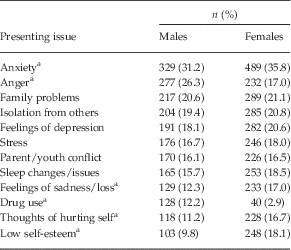
Young people presented to Jigsaw with a range of difficulties. As Table 1 shows, the most common presenting issues for females were anxiety, family problems and isolation from others, while the most common presenting issues for males were anxiety, anger and family problems. χ 2 analysis revealed females were significantly more likely than males to experience anxiety, χ 2=5.449; df=1; p=0.020, thoughts of hurting self, χ 2=14.539; df=1; p<0.001, low self-esteem, χ 2=33.527; df=1; p<0.001, and feelings of sadness/loss, χ 2=10.746; df=1; p<0.001. On the other hand, males were significantly more likely than females to present with anger, χ 2=31.2013; df=1, p<0.001 and drug use, χ 2=78.434; df=1; p<0.001.
Most common presenting issues for males (n=1053) and females (n=1367) in 2013

a Denotes a significant difference between males and females.
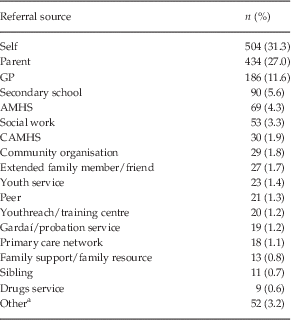
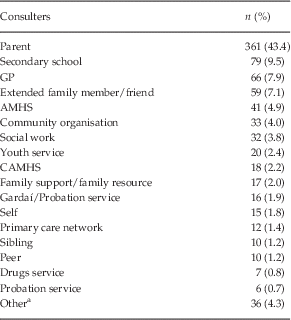
As shown in Table 2, young people were referred to Jigsaw from various sources, most often self, parent, general practitioner (GP), secondary school, and AMHS. Of those who consulted with Jigsaw regarding the mental health of specific young people (see Table 3), the majority were parents, secondary schools, GPs, extended family/friends or from AMHS.
Referral sources for brief interventions and brief contacts (n=1608)
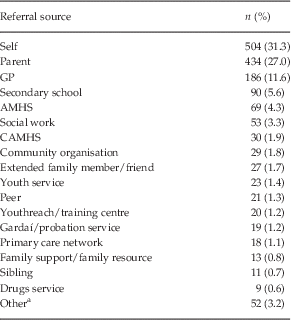
GP, general practitioner; AMHS, adult mental health services; CAMHS, Child and Adolescent Mental Health Services.
a Other includes parenting programmes, residential and aftercare services, third level institutions, sexual health services, hospital and homeless service.
Consulters (n=829)

GP, general practitioner; AMHS, adult mental health services; CAMHS, Child and Adolescent Mental Health Services.
a Other includes Youthreach/training centres, social welfare services, traveller support groups, residential and aftercare services and third level institutions.
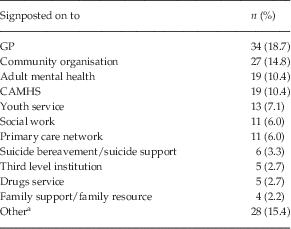
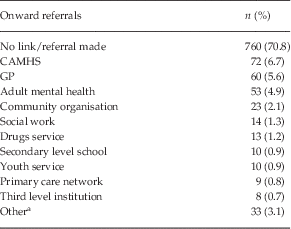
Signposting is the provision of basic information about other services when it is clear that Jigsaw is not the most appropriate service for the young person’s needs. Of those who consulted with Jigsaw or were not suitable for the service, most were signposted to GPs, community organisations, AMHS services, CAMHS, and to youth services (see Table 4). On the other hand, as shown in Table 5, the majority of young people exiting Jigsaw after a brief intervention were not referred on to another service. However, where young people were directed to another service, most onward referrals were to CAMHS, GPs and AMHS.
Signposted on to – case consultations and brief contacts (n=182)

GP, general practitioner; CAMHS, Child and Adolescent Mental Health Services.
a Other includes intellectual disabilities services, sexual assault services, Gardaí/probation services and citizen advice services.
Onward referrals – brief interventions (n=1072)
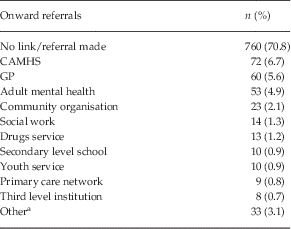
CAMHS, Child and Adolescent Mental Health Services; GP, general practitioner.
a Other includes counselling/psychology services, family support/family resource centres, Youthreach/training centres and sexual assault services.
Psychological distress
Overall, young people who engaged with Jigsaw for a brief intervention self-reported high levels of psychological distress, with similar CORE-10 (M=19.72; s.d.=6.9) and YP-CORE (M=19.44; s.d.=7.43) scores. Analysis of CORE-10 data revealed 89% of participants presented to Jigsaw with clinical levels of psychological distress pre-intervention, and 52% reported moderate/severe or severe levels of psychological distress. However, after engaging with Jigsaw, the majority of participants had healthy (47.2%) or low (28.8%) levels of psychological distress (see Fig. 2). With regards to clinically significant and/or reliable changes across time, 62% of young people showed a reliable and clinically significant improvement on the CORE-10, while 22% showed a reliable improvement only. Furthermore, 68% of participants showed a reliable improvement on the YP-CORE.
Pre- (n=709) and post-intervention (n=315) levels of distress on CORE-10.
Inferential analysis revealed young people showed a significant difference in pre- and post-intervention levels of psychological distress as measured by the CORE-10, t(157)=22.249; p<0.001, CI95=11.63, 13.89 (Cohen’s d=0.8), with lower levels of psychological distress reported post-intervention (M=7.56; s.d.=5.37) compared with pre-intervention (M=20.33; s.d.=6.92). Young people also showed a significant reduction in psychological distress on the YP-CORE, t(149)=16.839; p<0.001. CI95=9.33, 11.81 (Cohen’s d=0.7), with scores being significantly lower post-intervention (M=8.98; s.d.=7.05) compared with pre-intervention (M=19.55; s.d.=6.92).
In order to explore the impact of age and gender on levels of distress pre- and post- intervention, participants who completed the CORE-10 were divided into two age groups: 17–20 years and 21–25 years. MANOVA of CORE-10 data revealed no significant interaction between variables, F(2, 137)=2.705; p=0.070, and there was no significant difference based on age, F(2, 137)=1.349, p=0.263 and gender, F(2, 137)=0.445, p=0.641. As scoring of the YP-CORE by age and gender is currently under investigation by its authors it was considered inappropriate to examine these effects in the current study.
Discussion
Results of this study revealed almost half of the young people who received support from Jigsaw were male. This is a major strength of the service given that previous research suggests that males do not seek help as frequently as females (Dooley & Fitzgerald, Reference Dooley and Fitzgerald2012, Reference Dooley and Fitzgerald2013). A recent study by Gaynor and Brown (Reference Gaynor and Brown2013) found that a significant proportion of males who referred themselves to community-based psycho-educational workshops had not consulted with their GP. This suggests adult males may be more likely to self-refer to informal community based mental health supports than to their GP. Although participants in this study were adult males, the findings from the current research suggest a similar pattern may be emerging in the younger population, with males feeling more comfortable self-referring (informally) to a community organisation when experiencing mental health difficulties. Analysis also revealed that the most frequent users of the Jigsaw service were 15–17 year olds. As outlined earlier, treatment of this age group in CAMHS and AMHS services can be inconsistent, which further highlights the service need provided by Jigsaw.
Anxiety emerged as the top presenting issue for males and females. This finding is consistent with the My World Survey, which illustrated that anxiety was prevalent among young people in Ireland, particularly among young adults (Dooley & Fitzgerald, Reference Dooley and Fitzgerald2012). Although there was overlap in the frequency of top presenting issues, significant gender differences were observed for a number of their concerns. Specifically, males were more likely to present with anger issues and drug use while females were more likely to present with anxiety, feelings of sadness/loss, thoughts of hurting self and low self-esteem. These findings corroborate those of Cannon et al. (Reference Cannon, Coughlan, Clarke, Harley and Kelleher2013) who discovered that 19–24 year old females were more likely to experience a mood disorder compared with their male peers, while males in this age range were more likely to meet criteria for substance use disorders.
There was a diversity of consultation and referral sources, both formal and informal. The top two referral pathways to Jigsaw were self and parent and this indicates the accessibility of the Jigsaw service. These most common referral pathways, as well as frequent referrals from health care providers, education services and community organisations are comparable to those of headspace (Muir et al. Reference Purcell, Jorm, Hickie, Yung, Pantelis, Amminger, Glozier, Killackey, Phillips, Wood, Harrigan, Mackinnon, Scott, Hermans, Guastella, Kenyon, Mundy, Nichles, Scaffidi, Spiliotacopoulos, Taylor, Tong, Wiltink, Zmicerevska and McGorry2009). Given the large number of young people who attended for brief intervention it is evident that Jigsaw offers a much needed service for young people with mild and emerging mental health difficulties. Jigsaw signposts and/or refers young people with moderate to severe mental health difficulties on to more appropriate services. In this way, Jigsaw does not duplicate existing services but plays an increasingly key role in the continuum of mental health care for young people in Ireland. Moreover, ensuring that young people access the service most appropriate to their need has the potential to reduce waiting times, and to ensure that young people access support in a timely, cost-effective and responsive manner.
CORE questionnaires administered to young people pre- and post- intervention to evaluate their levels of distress provide emerging evidence of the effectiveness of the Jigsaw model. Indeed, the findings suggest that Jigsaw was successful in reducing their levels of psychological distress. It is important to note that high levels of self-reported psychological distress do not necessarily indicate the presence of a mental health disorder. Where young people present to Jigsaw with moderate/severe levels of psychological distress which indicate a significant mental health problem, the Jigsaw team supports them to access a service which is more appropriate to their needs.
Strengths and limitations of the study
The JDS is a major strength of Jigsaw. It records real time information about the young people attending Jigsaw and allows for accurate analysis of the demographic characteristics, presenting issues, type of service offered, referral pathways and more. It also provides important outcome data, such as the CORE. This study would benefit from a control group. As noted by Muir et al. (Reference Purcell, Jorm, Hickie, Yung, Pantelis, Amminger, Glozier, Killackey, Phillips, Wood, Harrigan, Mackinnon, Scott, Hermans, Guastella, Kenyon, Mundy, Nichles, Scaffidi, Spiliotacopoulos, Taylor, Tong, Wiltink, Zmicerevska and McGorry2009), self-reported levels of distress should be interpreted with caution as a multitude of other influences on young people’s lives make it difficult to attribute any changes directly to the use of a specific service. Ideally a double blind randomised controlled trial with the inclusion of a control group would more accurately assess the efficacy of the Jigsaw model. Unfortunately, this is extremely logistically challenging for mental health services research. In addition, a follow-up evaluation of the long-term benefits of this early intervention service would further enhance the evidence base for the Jigsaw programme.
Conclusion
There are a number of impediments to young people procuring mental health services within Ireland’s current system of care. This study illustrated how Jigsaw ameliorates some of those obstacles by offering a free, no waiting list service for young people with mild and emerging mental health difficulties, who do not need a formal referral to engage with the service. Following their important findings, Cannon et al. (Reference Cannon, Coughlan, Clarke, Harley and Kelleher2013) argue that early intervention youth mental health programmes have the potential to minimise the impact of mental health problems on young people, their families, and wider society. The current study corroborates this and portrays the value of early and brief intervention services for young people’s mental health. Future research will focus on the effectiveness of Jigsaw services. Avenues currently being explored include analysis of the goal setting process undertaken during brief interventions, examination of community organisations’ collaboration over time and feedback from professionals, significant others, mental health services, and community organisations regarding their experience of interacting with Jigsaw.
Acknowledgements
The work of Headstrong is supported by government funding provided by the Irish Health Service Executive and previously by philanthropic funding from the One Foundation and Atlantic Philanthropies.