

Nationalism: Both a Democratic and Authoritarian Resource
We are witnessing a global rise in nationalism and decline in support for democracy. As these two trends are appearing in the same places at the same times—Hungary, India, Poland, Turkey, and perhaps most prominently, the United States—some have understandably blamed nationalism for democracy’s retreat. We suggest that nationalism can be a systematic cause of democratic erosion but that this depends upon the type of nationalism. We argue that exclusive nationalism can undermine democracy and undergird authoritarianism, while inclusive nationalism can in fact serve as a powerful democratic resource.
We conduct a comparative historical inquiry in South and Southeast Asia—a part of the world loaded with the kind of divided societies that have long been seen as terrible terrain for democracy. Some countries in southern Asia have overcome sharp ethnic and religious rifts and have established lasting democracy while others have seen such deep divisions underpin durable authoritarianism. We trace differences in democratic and authoritarian trajectories to divergent definitions of the nation that prevailed in struggles for independence and that continue to provide a political resource in contemporary political contexts.
We specifically argue that the triumph of a more inclusive founding conception of the nation helps explain the puzzling historic democratic success of India while the formal codification of a more exclusive vision of the nation sheds new light on historically durable authoritarianism in Malaysia. More broadly, we posit that the nature of a country’s founding national narrative shapes both prospects for democracy and probable pathways for regime breakdown.
Our essay underscores that ideas about inequality can both block democracy and bolster authoritarianism. This stands in contradistinction to most scholarly explanations for democracy, which prioritize the deleterious effects of material inequality. Founding narratives of nation are also important resources for democracy, and when such narratives hierarchically rank citizens, the consequent inequalities of citizenship can prove as ominous for democracy as material inequalities. Differing types of nationalism provide a lasting resource for actors seeking to establish, defend, and attack democracy.
To speak of the nation is to speak of equality in its most fundamental political terms. Founding national narratives determine who is included in the polity, and on what basis. They influence whether a formal equality of citizens comes into being: Are all ethnic and religious groups treated similarly? Is the nation primarily defined by old feudalistic elites with hereditary power or by newly mobile groups who decry existing hierarchies? Is a national language chosen that helps offer equal access across ethnic groups to public education and state employment, or one that effectively asserts one group’s supremacy? When new nations answer these questions in exclusionary terms, they make democratization as well as democratic endurance more difficult (Tilly Reference Tilly2007).
Comparative-historical studies linking types of nationalism to democracy beyond Europe have been rare in political science.Footnote 1 When local elites in European colonies adopted the language of nationalism during the twentieth century, they imagined new nations (Emerson Reference Emerson1960; Anderson Reference Anderson1983). They did so either by espousing or eschewing identity cleavages along lines of race, ethnicity, religion, and caste. In making these decisions, elites generated the foundational myths, symbols. and narratives of nation that would become crucial ideational resources in ongoing political battles (Hall and Lamont Reference Hall and Lamont2013). These ideational resources structured whether such newly de-colonized democracies would deepen and endure in ways that the literature has not adequately excavated.
The founding definition of a nation has enduring repercussions for democracy both because these definitions prove resilient over prolonged periods and because they are regularly used to legitimate political actions (Brubaker Reference Brubaker1992). The definitions of citizenship articulated during founding moments of nation-building substantially “vary in terms of how racial, ethnic, and regional identities get configured, and in what ways certain groups are included or excluded” (Lieberman Reference Lieberman2003, 3-4). When these ideological visions are articulated by nationalist movements with sufficient power to popularize and defend them, they stipulate the foundational principles of a polity in path-dependent ways, often by codifying such narratives in founding constitutions. Powerfully if unevenly, the codification of these ideas provides a nation’s citizens with a sense that ‘We the People’ either includes or excludes people like them.
Nationalism and Regimes: Our Definitions and Arguments
The nation is a modern political community. Nations are underpinned, to various degrees and in various ways, by nationalism: the “identity binding together individuals who share a sense of large-scale political solidarity, often aimed at creating, legitimating or challenging states” (Marx Reference Marx2003, 5). Whether “imagined communities,” “invented traditions”, or “lies that bind,”’ (Anderson Reference Anderson1983; Hobsawm and Ranger Reference Hobsbawm and Ranger1983; Appiah 2017), nations are the sine qua non identities that underpin our system of sovereign states. Imagined as they may be, the narratives of nation underpinning state power are powerful sources of social solidarity (Richerson et al. Reference Richerson, Baldini, Bell, Dempa, Frost, Hillis, Mathew, Newton, Naar, Newson, Ross, Smaldino, Waring and Zefferman2016).
We develop two arguments here. First, we argue that civic and popular forms of nationalism, which jointly comprise inclusive nationalism, have propitious long-term implications for building and maintaining democracy, or a political regime that combines competitive elections with basic civil and political liberties for all citizens. Inclusive nationalism arms a range of political actors with an historical narrative that continually legitimates access to broad and equal political rights for all citizens, rendering the systematic deprivation of minority rights less likely.
Our second argument is that ethnic and elitist forms of nationalism, which combine to forge exclusive nationalism, help to perpetuate autocratic regimes by continually legitimating minority exclusions, in parallel fashion to how inclusive nationalism legitimates lasting inclusion. Exclusive nationalism is not simply the absence of inclusive nationalism; it is its own phenomenon and it can shore up authoritarianism over time in addition to menacing democracy in times of crisis.
To evidence these claims, we conduct a historical case comparison, tracing the ways in which founding national identities have been repeatedly employed by dominant political actors at pivotal regime moments to support democracy in India and authoritarianism in Malaysia. A civic and popular conception of the Indian nation has historically restrained, but not entirely obstructed, the chauvinist majoritarianism that is now ascendant in India while ethnic and elitist nationalism has historically legitimated state repression to sustain authoritarianism in Malaysia. In both cases, historically articulated forms of national identity have been recurrently harnessed as a legitimating ideational resource during pivotal regime moments.
It would be essentialist to claim that countries possess only one type of nationalism or that founding national narratives cannot change. Yet the foundational moment of nation-building does exert a pronounced influence on a country’s political regime across time because the founding narrative of nation popularized by national leaders becomes sticky through its retelling in census, map, and museum (Anderson Reference Anderson1983), in history books (vom Hau Reference Vom Hau2009), in its commemoration in public celebrations and museums (Zubrzycki Reference Zubrzycki2016), and its codification in the foundational rules for sharing power such as constitutions (Bali and Lerner Reference Bali and Lerner2017).
These sources of national narratives also help to suggest when dominant national narratives may change. The “losers” in the battle to define the nation at its founding do not simply die off. When two conditions obtain, national narratives are particularly vulnerable to change: First, when the ideational hegemony of a national narrative fades as the nation’s founding leadership dies off; and second, when well-organized political forces successfully popularize competing conceptions of the nation in spaces of national commemoration. Sometimes, as is currently happening in both India and Malaysia, organized groups may be successful in introducing a break from the narrative and bringing an alternative vision of the nation into power, at least for a time. Their ultimate success depends on the codification of new narratives. In short, nationalist narratives can be successfully altered by well-organized forces in power for prolonged periods of time. Because this requires sustained effort, national narratives are not infinitely malleable.
To be clear, we do not claim that inclusive nationalism is either a necessary or sufficient condition for democracy. Our more modest, probabilistic causal claim is that inclusive nationalism is a historical “critical antecedent” that ceteris paribus makes democracy more likely (Slater and Simmons Reference Slater and Simmons2010). Because democracy is a regime type with multiple defining dimensions, democracies can also break down in multiple ways. For example, an inclusive founding national narrative may do little to prevent a military coup.
All else being equal, we posit a causal association between the founding national narrative and the ease with which organized political movements are able to systematically target political minorities. Where nationalist movements and parties managed to build winning coalitions behind a vision of the nation that was relatively inclusive, the prospects for democracy were stronger than in countries where the victorious founding coalition defined the nation along more exclusive lines. This is because, where citizenship inequalities were articulated, political entrepreneurs could more readily find fault lines along which to assert authoritarian power over “second-class” citizens. Where nationalist movements and parties built winning coalitions that were popular, the prospects for democracy were also stronger than in countries where the victorious founding coalition defined the nation through such elites.
We argue that democracy has firmer roots when the nation is defined in inclusive terms at the nation’s inception. A combination of civic and popular nationalism provides a bulwark against democratic backsliding by, respectively, arming democracy’s defenders with the historical legitimacy of traditionally inclusive creeds and positing that “the people” define the nation. More inclusive narratives about who constitutes the national “we” deny political entrepreneurs the mantle of historical rightfulness when politicians seek to scapegoat minorities. It also helps to defend democracy against backsliding by giving the widest range of citizens a stake in regime survival and by denying exclusionary and authoritarian political agents the raw historical material for dividing and conquering their democratic rivals.
More exclusive forms of nationalism similarly embolden would-be autocrats and their most fervent supporters to take whatever means necessary to defend citizens with “first-class” attributes such as religion, ethnicity, race, or inherited status against “second-class” political challengers. Political and economic crises in such contexts can easily be blamed on communities that are not central to the national imagination. Authoritarian actions can more readily be justified as essential to keep the “less-than-fully-national minorities’” putative political ambitions in check.
Since inclusion itself is a defining trait of democracy, these claims might be accused of being true by definition. Yet we empirically identify the type of national narratives that emerged within anti-colonial movements before postcolonial regimes were put in place, while a formal democracy was often installed by departing colonial regimes. We argue that power struggles between organized actors during the period when national narratives were relatively uncontested (Beissinger Reference Beissinger2002) subsequently influenced whether those formal democracies would strengthen or crumble. Our arguments thus employ temporal sequence to underpin our claims of causation (Gryzmala-Busse Reference Gryzmala-Busse2011).
Theoretical Contributions
Our argument, causally linking types of founding nationalisms to democratization and to both authoritarian and democratic endurance, yields three contributions to scholarly research. Our first contribution is to bring into dialogue scholarship on nationalism and democracy and thus generate new debates about how nationalism causally maps onto democracy. Keen political observers have long emphasized that a common national identity conduces stability and even democracy. Tocqueville opined that “patriotism and religion are the only two motives in the world which can permanently direct the whole of a body politic to one end” (2002, 70); Mill posited that “united public opinion” (2004, 547) was necessary to the working of representative government. Yet despite these prescient observations, little comparative scholarship beyond Europe has specifically investigated why and when nationalism facilitates democracy or authoritarianism.
Instead, the classic scholarship on nationalism has been preoccupied with its origins and spread, often at moments of national inception, describing both a liberal “civic” nationalism consisting of any like-minded group of people aspiring to a state-like organization (Gellner Reference Gellner1983; Hobsbawn and Ranger Reference Hobsbawm and Ranger1983; Miller Reference Miller1995; Tamir Reference Tamir1993)Footnote 2 and an “ethnic” nationalism that uses non-voluntary characteristics such as ethnicity, language or religion as the basis for common origin (Kohn Reference Kohn1944; Smith Reference Smith1991). Such scholarship typically investigated the emergence of nationalism within Europe and the Americas, while those scholars who researched nationalism in the newly sovereign countries of Asia and Africa underscored how the creation of nation-states was often not accompanied by widespread popular identification with these new nations (Deutsch Reference Deutsch1953; Emerson Reference Emerson1960; Bendix Reference Bendix1964).
Meanwhile, classic scholarship on democracy has privileged material explanations for democratization and democratic endurance. While we know that economic development (Lipset Reference Lipset1959; Przeworksi et al. Reference Przeworksi, Alvarez, Cheibub and Limongi2000), the rise of new elites (Moore Reference Moore1966; Ansell and Samuels Reference Ansell and Samuels2014), economic inequality (Boix Reference Boix2003; Acemoglu and Robinson 2006) and natural resource endowments (Ross Reference Ross2012) all significantly affect a country’s democratic prospects, the explanatory purchase of strictly distributive explanations have steadily declined with time (Bermeo and Yashar Reference Bermeo and Yashar2017).
In bringing these two literatures into conversation, we emphasize that founding national narratives are resources with discrete political implications—by showing how types of nationalisms can systematically map onto democratization trajectories in two of the most populous and comparatively understudied regions of the world. Thus, we draw attention to the distinctly ideational manner in which individuals conceive of their interests and elaborate novel ways in which ideas about relative status can interact with material interests to drive political behavior.
Our research marries a well-established literature on civic versus ethnic nationalisms to an emergent recognition that nationalism also varies in the extent to which national narratives are firmly embedded among popular sectors of society. Nationalism only sometimes moves beyond an elite political-territorial understanding of the nation and propagates a nationalism that portrays “popular classes … as protagonists of national history” (Vom Hau Reference Vom Hau2008, 336). Inclusive nationalism must thus overcome not only codified stratification between ethnic, racial, and religious communities, but also the divide between traditional, feudalistic elites on one hand and “ordinary people” (Bermeo Reference Bermeo2003) on the other. Exclusive nationalism legitimizes political stratification along class or ascriptive lines by positioning either traditionalist, feudalistic elites or representatives of a single ethnic or regional community as the true historical champions of nationhood. Vertical cleavages between elites and masses and horizontal cleavages between ethnic and religious groups are not broken down when the nation is defined exclusively, with deleterious implications for democracy.
Our second contribution is to expand upon an emerging group of scholars who show that nationalism, rather than just a phenomenon to be explained, can itself help explain an array of political outcomes. When the nation is defined in relatively inclusive terms through a nation’s “founding narrative” (Straus Reference Straus2015), a wide array of virtuous political outcomes becomes more likely: the provision of more public goods (Miguel Reference Miguel2004; Lieberman Reference Lieberman2003), attraction of foreign direct investment for economic development (Liu Reference Liu2015), protection of minorities from mass killing or genocide (Straus Reference Straus2015), and the avoidance of subsequent conflict and violence (Cederman, Wucherpfennig, and Hunziker Reference Cederman, Wucherpfennig and Hunziker2016).
Yet such works do not examine whether different types of nationalisms systematically impact the long-run possibilities for creating or maintaining democracy. Modernization theory, for example, held that urbanization, higher levels of education, accompanying rationality and mass media consumption would be the engines driving the establishment of both nationalism (Deutsch Reference Deutsch1953; Rustow Reference Rustow1970, 30; Wallerstein Reference Wallerstein1987, 31), and democratic political institutions (Lipset Reference Lipset1959, 41; Inglehart and Welzel Reference Inglehart and Welzel2009). But modernization theory did not suggest that nationalism itself would drive patterns of democracy. The closest exception is Bunce (Reference Bunce2005), who argues that the timing of nationalist movements relative to the fall of communist regimes—but not the type of founding nationalism—explains subsequent democratization trajectories across post-Communist Europe. Recent scholarly literature amply recognizes the lasting footprint of nationalism: e.g., Darden (Reference Darden2013) emphasizes how the emergence of mass literacy crystallizes enduring narratives of nation in collective consciousness and Beissinger (Reference Beissinger2002) shows how structural advantages, institutional constraints, and “tidal effects” determined whether nationalist mobilization succeeded in gaining autonomy from Soviet rule. These arguments all share an emphasis on certain periods of nation building as acutely formative in determining narratives of nation.
Our third contribution is to bring the experiences of Asian countries into dialogue with the empirically oriented theories of nationalism that have theorized extant typologies by excavating the European, American, Russian, and to far lesser extent, Latin American experiences of nationalism. Learning from Asian and African experiences with colonialism is important because the applicability of the European experience with nationalism to the vast stretches of peoples and polities around the globe remains an open question (Emerson Reference Emerson1960). For example, while Anderson (Reference Anderson1983) and Darden (Reference Darden2013) prioritize mass vernacular literacy in stimulating the imagining of the national community in Europe, nationalism emerged in India and Malaysia before this condition obtained.
Operationalizing Nationalism
Our claim that founding nationalisms condition regime types is no less portentous than the most important causal associations in the democratization literature. Much like other variables that have been shown to correlate with democratic outcomes across the globe, we argue that inclusive nationalism is a critical resource for democracy. As with these other recurring correlates, the key task when it comes to empirically establishing causal effects lies in identifying the mechanisms through which types of nationalism affect regime type.
We argue that nationalisms most critically differ along a continuum ranging from inclusive to exclusive. We operationalize this continuum along the following four dimensions: First, do founding narratives, as articulated by leading nationalists, clearly specify a religious basis of citizenship? Second, are ascriptively defined historical elites given preferential status in founding constitutions or similar documents?Footnote 3 Third, are founding language rights monolingual or multilingual, and do they reinforce group privilege? Fourth, did the nationalist struggle break down longstanding social cleavages by mobilizing the masses into politics as protagonists in a triumphant new national history? Wherever hereditary elites maintain a constitutionally protected preeminent status, nationalism remained exclusive, even if it is not founded on ethnic or religious bias. These four categories empirically capture the degree to which founding nationalists sought to create an inclusive nationalism across regions, religions, languages, and classes.
Why do we analyze India and Malaysia? An India-Malaysia comparison allows us to tackle a vital yet underappreciated comparative puzzle in the Asian context. India and Malaysia both emerged in the mid-twentieth century as newly sovereign states with an array of democratic challenges, including a highly contentious social cleavage between a majority and multiple minority groups. Malaysia, with its higher levels of economic development, higher levels of literacy, weaker separatist threats to territorial integrity, and lower levels of ethnolinguistic fragmentation, is theoretically more likely to be a democracy—the opposite of what we find.
India and Malaysia also provide examples of strongly articulated inclusive and exclusive nationalisms respectively. India was defined in an inclusive manner by virtue of its codified secular ideals; its public rejection of caste hierarchy; its embrace of linguistic diversity and rights; and its rejection of the hereditary ruling rights of princes, all of which were programmatically adopted within a well-organized Congress party before independence. Malaysia also emerged from colonial rule with a well-organized nationalist movement, but the ruling United Malays National Organization (UMNO) party propagated and codified a more exclusive brand of nationalism that specifies Islam as the official national religion; asserts ethnic Malays as the only group deserving of “indigenous” privileges; grounds this ethnic Malay primacy in the unquestionable position of hereditary sultans as formal sovereigns; and strongly emphasizes language rights of Malays in national politics.
And finally, we choose India and Malaysia as comparison cases because they both possessed a well-organized nationalist movement with sufficient organizational strength to install its vision of nationalism. For nationalism’s regime effects to be fully realized, a specific type of nationalism must become institutionalized in a country’s political life by a winning coalition committed to furthering and upholding it. Whether the nationalist movement leading the charge for independence managed to further a coherent ideological vision during the initial nation-building process is critical for establishing a clear kind of nationalism. By this standard, both India and Malaysia abundantly qualify.
Founding National Narratives in India and Malaysia
India: Inclusive Nationalism and Lasting Democracy
Before independence, India’s nationalist movement developed a national identity that was both popular and inclusive by the standards of any nationalist movement then emerging across the post-colonial world. The Indian National Congress was founded in 1885 by the colonially educated indigenous elite to lobby for elections into nominated colonial councils and the holding of civil service examinations in India rather than in Britain. When the colonial regime refused to grant political reforms, India’s nationalist movement began to espouse an inclusive nationalist identity that could refute the colonial claim that Congress did not represent India.
India’s inclusive nationalism, 1920–1947. Congress-defined Indian nationalism was inclusive in three distinct respects: 1) religion/caste; 2) language rights; and 3) non-violent mass mobilization. First, Congress’s commitment to secular nationalism was witnessed in its public rejection of Hinduism and its caste system, particularly as the organizing basis for the nation. Precolonial and colonial India was utterly defined by caste—a pervasive, endogamous category that was recognized and thus reinforced in nearly all social interactions. During the 1920s and 1930s, Congress began limited mobilizations against public distinctions of caste, encouraging cross-caste social interaction and an abatement of caste-based discrimination in order to help meld together a national community that could refute the colonial claim that Congress did not represent a nation.Footnote 4
In an historical context when it was revolutionary, treating religious categories equally necessarily meant a partial rejection of Hinduism, the religion of approximately three-quarters of colonial India, as the basis of the emergent Indian nation. Secular ideals were thus written into Congress’s founding charter. While many Congress leaders were also involved in Hindu reform movements, they drew a definitive line between private identities and public recognition. At its annual meeting in 1931 for example, Congress adopted a formal policy that prohibited the Congress from adopting any policy to which a majority of either Hindu or Muslim members objected—thereby providing for a minority veto on any policy that was deemed sensitive. The same year, at a time when most European nations had yet to do so, India adopted universal adult franchise internally and argued that universal franchise was an essential step in the fight for purna swaraj or total independence. As a matter of policy and practice, India’s nationalist movement rejected any formal recognition of Hinduism—the religion of approximately three-quarters of the new country—as defining of national identity.
Second, Congress’s nationalism was linguistically inclusive in a country that spoke over a thousand languages and in which upwards of thirty languages were spoken by a million people or more. Congress’s 1920 re-organization, strategically designed to maximize engagement in the national movement, created twenty-one linguistically homogenous regions that rendered nationalist organizing more accessible. Congress made no effort to exclude particular regional tongues from the nationalist movement and explicitly rejected the use of a single national language, which would have been exclusionary whether it was Hindi (which would have politically and economically advantaged the northern Hindi belt of the country) or English (which would have granted India’s thin elite layer of English speakers privileged access to public power).
Third, Congress encouraged mass mobilization and popular engagement in the nationalist movement, arguably to the greatest extent it could while still enabling cohesion. One creative way in which it encouraged popular inclusion in public events was through the novel manipulation of clothing. Progressively throughout the pre-independence decades, Congress leaders swapped western clothes for khadi, a homespun cloth produced by an extremely active organization set up by and affiliated with the Congress movement (Trivedi Reference Trivedi2003, 11-14). The wearing of homespun cloth enabled the illiterate majority to participate in the nationalist movement, helping to blur socio-economic hierarchies. The wearing of khadi definitionally rejected the hierarchical distinctions of caste status and created a space in which individuals were encouraged to conceptualize of themselves as equals in a limited public sphere—a necessary precursor to inclusive citizenship.
The inclusivity of Congress-defined nationalism was also expressed through its near-absolute embrace of satyagraha or non-violent civil disobedience. Literally translated by Gandhi as “truth-force,” satyagraha meant a binding commitment to openly breaking unjust laws without recourse to violence. Non-violent civil disobedience, arguably the ideological core of the Indian nationalist movement, encouraged all castes, classes, and regions to participate in the nationalist movement on the basis of equality without fear of polarizing violence.
By independence, this secular, linguistically inclusive, and non-violent vision of the nation had been broadly popularized and institutionalized. The presence of such inclusive nationalism explains Congress’s decision to codify universal adult franchise within the Indian constitution. Congress leaders dominated the post-independence Constituent Assembly and hailed from largely upper-caste and middle-class backgrounds. Comprising an elite demographic, these leaders could have chosen to limit adult suffrage through some hierarchical qualification. Yet Congress leaders had organized mass political support through popularizing an inclusive Indian nationalism for decades. Since an inclusive national identity had been long imagined and institutionalized within the movement, the Congress-dominated Constituent Assembly codified universal adult suffrage within the Indian constitution.
The inclusive conceptualization of Indian nationalism critically succored the creation of Indian democracy after independence. India’s inclusive national narrative—built upon the cornerstones of secularism, linguistic pluralism and nonviolent mass mobilization—has been used to protect democracy in three pivotal political moments in Indian history: 1) forcing the central government to accede to linguistic re-organization of states; 2) restoring liberal constraints upon the executive during the Emergency; and 3) legitimating dissent under a contemporary government attempting to redefine the Indian nation as a Hindu nation.
Inclusive nationalism resolves language stalemate, 1947–1956. India’s thorniest governance problem after independence centered upon whether states would be organized by language. A failure to resolve this question, which bloomed into mass protests, may well have led to democratic breakdown. Yet this contentious issue was resolved in 1956 through policy, despite the objections of national leadership. India’s inclusive nationalism was weaponized by regional political actors to force the national government to re-organize its states upon a linguistic basis. During the anti-colonial movement, India’s nationalist leaders had regularly promised to create new, linguistically homogenous states, with Congress organizing itself along linguistic lines by 1920 and adopting a policy goal of creating linguistic states in its 1946 election manifesto. In 1947 however, after Partition and the attempted secession of several states, Congress leaders hoped to backtrack upon the promise of linguistic self-determination. Prime Minister Nehru and other members of the nationalist high command grew opposed to the linguistic re-organization of states on the grounds that it would encourage secessionist tendencies.
Rather than rejecting linguistic states outright, the government delayed a decision. Only after the supporters of linguistic states invoked the principles of nationalism did the government relent, underscoring the power of nationalism as a deployable political resource. In 1947, the Dar Commission stated that though creating linguistic states possessed “a strong appeal to the imagination of many our countrymen" and acknowledged "a large volume of public support in their favour." But it also asserted that "the first and last need of India at the present moment is that it should be made a nation" and that "everything which helps the growth of nationalism, has to go forward, and everything which throws obstacles in its way has to be rejected” (Constituent Assembly of India 1948, 36). A subsequent report acknowledged that Congress had previously “given its seal of approval to the general principle of linguistic provinces” but that “if public sentiment is insistent and overwhelming, we, as democrats, have to submit to it” (Report of the Linguistic Provinces Committee 1949, 9-15).
Because linguistic organization proponents appropriated the core nationalist principle of non-violent civil disobedience, nationalist leaders found it difficult to ignore or repress the movement. Two contradictory elements of the national identity were at stake in the states’ reorganization issue—national unity and the principle of democratic self-determination. Nehru’s opposition to the movement, consistent across Congress leadership, stemmed from his commitment to a national unity that he felt was threatened. Nehru’s decision to concede and create linguistic states despite his own opposition grew out of his commitment to the defining principles of Indian nationalism, foremost among them that a mass, non-violent struggle should not be violently subdued.
By the early 1950s, it was clear that there was insistent, widespread public support for linguistic re-organization of states. Yet Nehru still unambiguously opposed it. He eventually acceded to the demand because not to do so would contradict the principle of satyagraha that Congress leaders had positioned as central to Indian nationalism less than a decade before.
It was directly after advocates for linguistic reorganization employed Gandhian hunger-fasts that Nehru relented in his adamant opposition to linguistic states (Guha Reference Guha2003). In October 1952, a Gandhi associate and former Congressman Potti Sriramalu undertook a fast unto death for the creation of a separate state of Telegu speakers to protest the vague equivocations of both the prime minister and the chief minister of Madras. On December 3, Nehru wrote in a letter: “Some kind of fast is going on for the Andhra Province and I get frantic telegrams. I am totally unmoved by this and propose to ignore it completely.” At no time did Nehru seriously consider putting down protests with force. When Sriramalu’s death led to the breakout of large-scale protests, the attacking of government buildings, and the killing of several protesters, Nehru publicly announced that the state of Andhra would come into being the very next day.
At the height of his power, at a time when the prime minister’s position on every major issue won the day, it is instructive to examine the only clear example of Nehru adopting a policy that he clearly opposed. Why did Nehru not simply employ violence to put down linguistic mobilization, as had been done in Pakistan on the very same issue? Forcibly putting down non-violent civil disobedience would have unequivocally contradicted the methods and ideals that the nationalist movement had so recently utilized to legitimate their call for colonial independence. The content of Indian nationalism critically motivated Nehru to relent and allow the reorganization of Indian states along linguistic lines, setting in a process that continues to the present day.
Inclusive nationalism, emergency and opposition, 1969–1977. One of India’s darkest democratic moments to date occurred in 1975 when political opposition was arrested, media freedoms were widely curtailed, and civil liberties disappeared. During this crisis, known as the Emergency, both the incumbent prime minister Indira Gandhi as well as the opposition coalition consistently invoked Indian nationalism to legitimate their goals.
Indira Gandhi rose to power following the death of Prime Minister Jawaharlal Nehru in 1964. When she declared the Emergency, it was abundantly clear that she was performing a naked power grab. Yet it is noteworthy that Indira attempted to justify the quashing of democratic institutions by invoking a key tenet of Indian nationalism—secularism. Indira’s most consistent message when she spoke in the months after the declaration was that she was protecting secularism from being undermined by an alliance between the Jayaprakash movement and the Hindu nationalist Rashtriya Swayamsevak Sangh. For example, in a TV interview on August 1, 1975, five weeks after the Emergency was declared, Gandhi stated that
“Indian democracy will be threatened when any party of the extreme Right or extreme Left comes to power. It is being weakened by those who, claiming to be non-violent and democratic, give respectability to and ally themselves with fanatic religious organizations and with parties wedded in terrorism. What holds India together is the trust that all regions and all its religious groups will have a fair deal.” (Gandhi Reference Gandhi1975, 63, emphasis added)
Ultimately, Indira’s political opposition ousted her from power during the next national election by focusing on a different tenet of the Indian nation—voice and representation concomitant with democracy. On January 18, 1977, Indira unilaterally released political prisoners, dissolved the parliament, and called for elections in March. During the eight weeks that opposition lobbied the electorate for their vote, a heretofore splintered opposition remarkably unified to field a single electoral candidate in most areas of the country. The popular appeals of the opposition Janata front consistently emphasized democracy and political freedoms (Weiner Reference Weiner1977).
Weakening of the inclusive narrative, 1977–present. In recent years, India’s narrative of national inclusivity has been deeply challenged by the Modi government’s electoral success and consequent propagation of an exclusive Hindu nationalism. That India’s historically inclusive nationalism has not prevented Modi’s rise is not entirely an indictment of our argument because the causes of any government’s success in a national election are never solely a referendum on a single issue, much less the nature of nationalism.
Analysis of the 2014 election suggests that Modi and the BJP came to power primarily by emphasizing economic development through less market intervention in the economy (Chhibber and Verma Reference Chhibber and Verma2014); by more effectively turning out voters through its impressive grassroots organization (Sridharan Reference Sridharan2014); and by projecting an image of a successful state ministership in Gujarat (Sud Reference Sud2012) in the context of the manifold corruption scandals that marked the incumbent UPA government.
At the same time, Modi clearly promoted an alternative vision of India’s nationalism that was exclusive by defining the Indian nation as a Hindu one. Modi’s election posters loudly proclaiming “I am a Hindu. I am a patriot. I am a nationalist” (Tudor 2018). In the 2019 election, when national economic development failed to materialize, the Modi government unsurprisingly turned towards a celebration of Hindu nationalism (Chandra Reference Chandra2017). Still, Modi owed his victory in 2019 at least as much to his charisma, the grassroots organizational infrastructure of the BJP and a pro-development reputation regarding his vision of Hindu nationalism as to his Hindu majoritarian narrative of nation (Slater and Tudor Reference Slater and Tudor2019). That India’s main opposition party chose as its candidate a political dynast also mattered (Guha Reference Guha2019).
The Modi government has successfully mainstreamed a narrative of Hindu nationalism among the majority Hindus—but not among Christian, Sikh and Muslim minorities—by fusing Hindu symbols and patriotism (Sardesi and Attri Reference Sardesai and Attri2019; Chandra Reference Chandra2017). That the rights of non-Hindus have consequently come under systemic attack is evidence of the causal link between the dominant national narrative and the basic civil liberties that partly define democracy. As a renowned scholar of nationalism wrote “of all cults, that of the ancestors is most legitimate, for it makes us who we are” (Renan Reference Renan and Giglioli1882). Because the BJP and Modi understand the importance of the national narrative, they are selectively commemorating Hinduism at the expense of a more syncretic religious history. The policy emphasis on redefining the Indian nation as Hindu is amply evidenced by the rewriting of textbooks to elevate Hinduism, the creation of a new national holiday to honor a key Hindu figure, the omission of the word “secular” from the preamble to the Indian constitution on National Day, the renaming of Muslim streets, the removal of Muslim names in textbooks, and the omission of Muslim monuments, among others (Tudor 2018).
We predict that this redefining of the Indian nation in Hindu terms will have deleterious effects upon the rights of India’s non-Hindu citizens, and that is precisely what independent organizations have already begun to document. Communally divisive language in speeches by elected officials in India has increased 500% between 2014 and 2018, and 90% of the religiously motivated hate crimes in the last decade occurred after Modi took power (Human Rights Watch 2019). The police have systematically “stalled investigations, ignored procedures or even played a complicit role in the killings and cover-ups of crimes [against minorities]” and the “obvious impunity for the string of crimes [against minorities] that have taken place, and their shameful valorization by some leaders, is distinctly a strong factor in their continuation” (Daruwala, cited in Human Rights Watch 2019). To the extent that Hindu nationalism solidifies as the dominant national narrative of India, we expect that Indian democracy will continue to diminish in the realm of civil liberties.
Malaysia: Exclusive Nationalism and Lasting Authoritarianism
That Malaysia gained independence in 1957 as a procedural democracy had little if anything to do with nationalism. It was due instead to British colonialists’ insistence on electoral competition as a condition for withdrawal, plus the dominant United Malays National Organization (UMNO) party’s confidence that it would not lose free and fair elections—especially since it had managed to forge an unbeatable electoral coalition with parties representing Malaysia’s ethnic Chinese (Malayan Chinese Association, or MCA) and Indian (Malayan Indian Congress, or MIC) minorities on a politically subordinate basis. To take just the most obvious marker of this ethnic subordination: it was an article of faith within the ruling coalition that the prime ministership and all other leading positions (except at times the finance ministry) would always remain in the hands of Malays. This was despite the fact that Malays constituted only 49% of the new country’s population when independence was gained, while ethnic Chinese (38%) and Indians (11%) comprised a similar 49% in their own right (Hirschman Reference Hirschman1980, 111).
As UMNO’s electoral confidence waned by the mid-late 1960s, it had no compunction about installing a regime type better suiting its nativistic and feudalistic vision of the nation. The subsequent half-century endurance of UMNO’s authoritarian dominance had much to do with the fact that UMNO and its allies had forged a founding ethnic bargain that was decisively exclusive, and that would prove more important to sustain than democracy itself. As Anderson (Reference Anderson1998) once put it, Malaysia’s “permanent authoritarian government” has “everything to do with a collective determination on the part of the Malay ethnic group (52 per cent) to monopolize real political power in the face of large Chinese (35 per cent) and the smaller (10 per cent) Indian minorities.”
Origins of Malaysia’s exclusive nationalism, 1945–1957. Little anticolonial mobilization arose in British Malaya before World War II. The majority ethnic group, religiously Muslim Malays, was ruled indirectly, as the British came to peaceful terms in the late nineteenth century with multiple state-level indigenous rulers, or sultans. Yet a massive influx of Chinese and Indian migrants transfigured the demographic character of “Tanah Melayu” (land of the Malays). Malay-Muslim aristocrats sought colonial protection and patronage. The Malay population remained weakly politicized and regionally compartmentalized in state-level ethnic associations, while the swelling Chinese minority was treated as “sojourners” with no real political standing.
Nascent nationalism thus embraced feudalism and nativism. Only Malays were “indigenous,” and only their sultans were sovereign. The war and Japanese occupation rattled this equilibrium, however. While the Malay sultans and their followers mostly collaborated with the Japanese, Chinese Malayans often resisted and suffered terribly. When the war suddenly ended in 1945, the upshot was dramatically increased Malay-Chinese conflict and a steep imbalance in political organization across communities: while the Chinese-dominated Malayan Communist Party (MCP) had gained much strength as the leading anti-Japanese resistance movement, the Malay community lacked any organized movement to protect its interests as the British returned.
Considering that massive in-migration had brought the Chinese to nearly equivalent size as the Malay population, this Chinese organizational advantage was perceived as existentially threatening to Malay interests. Malay nightmares of losing their protected indigenous status came to fruition in late 1945 when the British published a white paper calling for fully equal citizenship for all locally born individuals, be they Malay, Chinese, Indian, or other, and for the dethroning of Malay sultans as hereditary rulers. Instead of shifting power away from feudal Malay interests, the British inadvertently rallied Malay support to the sultans’ cause. The departing colonialists’ plan proved to be “a serious miscalculation about the continuing importance of the Rulers to Malays as symbols of Malay predominance on the peninsula in the face of economic and demographic pressure from the Chinese and Indian communities” (Smith Reference Smith1995, 201).
The Malay response to the proposed Malayan Union was emphatic: thousands poured into the streets in early 1946 to insist both that the sultans’ sovereign standing and the privileged position of “indigenous” Malays vis-à-vis “immigrant” communities be upheld. The Malay protests of 1946 would have lasting political consequences. From them emerged UMNO, essentially a new alliance of the fragmented pre-war state-level Malay associations. UMNO instantly became the most important nationalist movement in British Malaya, and would quickly become its most powerful political party as independence approached.
Confronted with forceful mass Malay mobilization, the British had little choice but to accede to Malay demands on the inviolability of the position of the sultans and the principle of “ketuanan Melayu” (Malay primacy or supremacy). As negotiations on a new constitution for an independent Federation of Malaya proceeded, these principles remained sacrosanct, ensuring that the new nation would be born with a tiered definition of political citizenship in which the feudal Malay ruling aristocracy remained constitutionally ascendant. A movement to protect the power of colonially entrenched elites resulted in a dominant type of nationalism in Malaysia that was ascriptively defined and stratified.
UMNO was not in a position simply to impose its nativist vision as independence loomed in 1957, however. The British remained on the scene for a full decade longer than in India because there was an ethnic Chinese-led communist insurgency that virtually all Malays, Chinese elites, and British colonialists desperately wished to see defeated.Footnote 5 The British maintained massive economic interests in Malaya and would not depart the scene politically unless elites from all ethnic groups were accommodated.
The constitution forced UMNO to compromise—but not yield—in multiple sensitive areas. The Chinese demand for formal citizenship to be defined by place of birth rather than parental status carried the day. Although neither Chinese nor Tamil were recognized as official languages, UMNO accepted English as an additional national language to Malay for at least ten years after independence. This allowed English-speaking Chinese and Indian elites to access the state on something resembling equal footing with their Malay counterparts as long as Malaysia remained a functioning democracy (1957-1969). But the same could not be said for the Chinese and Indian masses, few of whom habitually spoke English, who saw their languages sidelined in the public education system and silenced entirely in the operations of the postcolonial Malaysian state apparatus. A similar arrangement unfolded for religion, as Islam was recognized as the only official faith, even as minority religions were assured of non-intervention if not state support. In sum, Malays yielded on the crucial citizenship question; but non-Malays offered “a vivid demonstration of goodwill” by conceding most of what Malays demanded on matters of religion, language, education, and special ethnic rights more generally (Heng 1988, 235).
Exclusive nationalism and democratic fraying, 1957-1969. This hierarchical conception of citizenship was ominous but not immediately fatal for democracy. Constitutionally enshrined Malay favoritism did not prevent UMNO from forging a winning coalition with parties representing Malaya’s Chinese and Indian minorities. “The Alliance” romped to victory in the founding 1955 municipal elections in Kuala Lumpur, and enjoyed a supermajority in the parliament after independence in 1957. The bargain was clear: non-Malay businesses would enjoy protected property rights in a resolutely capitalist and internationalized economic system, and would, in exchange, bankroll Alliance parties through campaign financing as well as the Malay-dominated state through progressive direct taxation (Slater Reference Slater2010).
Malays were assured of continued political supremacy in this bargain. When this later came under challenge, the UMNO-led state would set aside its ostensible democratic principles to protect its ethnic pre-eminence. Yet such an authoritarian reaction was neither inevitable nor instantaneous: so long as UMNO and its Alliance could prevail in relatively free and fair elections against multi-ethnic opponents decrying Malay primacy, there was no urgency to putting democracy on ice.
Ethnic politics would take a more authoritarian turn after 1963, when the formation of Malaysia as an expanded federation brought the Chinese-dominated city of Singapore into the fold. This produced a stiff leadership challenge from Lee Kuan Yew’s Chinese-dominated People’s Action Party (PAP). Lee’s PAP refused to adhere to the constitutionally enshrined notion of Malay primacy, and sought to replace “Malay Malaysia” with an ethnically and religiously inclusive “Malaysian Malaysia.” In the Malay-language press, “the message was clear: Lee wanted a Chinese Malaysia, he was a traitor to the cause of all Malays, and he was oppressing the Singapore Malays and would oppress all Malays if given the opportunity” (Tilman Reference Tilman1976, 29).
Either Singapore had to go or democracy had to go. UMNO’s exclusive nationalism was simply not ideologically compatible with Lee’s bid for national power under his inclusive “Malaysian Malaysia” platform. Singapore was expelled from Malaysia in 1965 after a deeply foreshadowing spell of emergency rule. But the cancer of Chinese political ambition had not been fully excised, as the Democratic Action Party (DAP) lingered as the PAP’s successor. Language became the most contentious issue, as the privileged position of Malay was up for reconsideration in 1967. When the MCA refused to push for Mandarin to gain equal status, working-class Chinese voters began fleeing en masse to the opposition.
Ironically, a national election would kill democracy. In the polls of May 1969, Chinese-led labor parties made huge electoral inroads against the UMNO-led Alliance, threatening to deny it a two-thirds supermajority for the first time. Before the counting could be completed, however, ethnic riots broke out in Kuala Lumpur and other major cities. The issue was not merely the national tally, but what appeared to be an explosive 14–14 deadlock between Alliance and opposition in the state of Selangor, where the capital city of Kuala Lumpur was located. If the final tally were to give the opposition a majority of state seats, it threatened to position a Chinese chief minister “above” the Sultan of Selangor himself, bringing the fundamental question of the Malay rulers’ sovereignty to a head.
For UMNO leaders and their Malay followers, one observer at the time noted that “disenchantment arose not merely over the outcome of the 1969 elections but with democracy itself.” The problem was “that the state and federal results of the 1969 elections in the Malayan states gave rise to anxiety and even alarm among UMNO activists and sympathizers that political power was ‘slipping out’ of ‘indigenous’ into ‘immigrant’ hands. Doubts began to arise as to the ability of the democratic system to guarantee an indefinite hold by the Malays on political power” (Goh 1971, 17).
The lesson of the 1969 election and riots was clear. If democracy could not reliably deliver supermajorities to a Malay-led ruling coalition in a nation that was Malay-dominated by definition, democracy was expendable. “Until May 1969, democracy was accepted without murmur—in fact, it was extolled by the modern-minded leaders of UMNO—because its operation in practice did not hinder UMNO from enjoying and exercising a preponderance of political power,” Goh argues. “As soon as signs appeared that suggested that this enjoyment might not be permanent, doubts as to the equity and efficacy of democracy began to emerge” (Goh 1971, 40).
It is noteworthy that the UMNO-led Alliance did not need to lose elections outright for it to jettison democracy. Losing its two-thirds majority was enough, because that is the threshold of power required to fundamentally alter politics through constitutional amendments. If democracy could not deliver the Alliance its two-thirds majority, the Malay-first principles in the national constitution on matters of language, religion, and the Sultans’ supremacy would no longer be inviolate.
Asserting ethnic hierarchy through authoritarian hegemony, 1971-1998. Authoritarian controls were imposed before Malaysia returned to electoral politics in 1971 under the leadership of an expanded UMNO-dominated National Front (Barisan Nasional, or BN). To some degree, this simply represented a reassertion of the original bargain exchanging Malay political domination for lightly fettered capitalism. Yet the BN promised dramatically increased economic redistribution across ethnic lines, from Chinese business to the Malay multitude, under the New Economic Policy. Contrary to canonical models of authoritarian political economy, the ruling BN did not assert its strong-armed grip to redistribute wealth from the many to an elite few. It did so to redistribute resources from the second-class Chinese minority in Malaysia’s hierarchically defined nation to the first-class majority, the Malays.
Exclusive nationalism asserted itself in the sphere of language as well. This shift had already taken place as of 1967, when the UMNO-led Alliance government passed a new National Language Act rescinding the official status of English and anointing Malay the sole language of state. Yet fully vernacular and English-medium schools were still permitted to operate. After UMNO’s authoritarian turn, Malaysia’s language regime became “power-concentrating,” forcing all English public schools to switch to Malay, and all Chinese and Tamil schools to offer courses in Malay (Liu Reference Liu2015, 105). Thus the officially recognized lingua franca, so vital in the construction of an inclusive nationalism, was decisively displaced by the ethnic language of Malaysia’s Malay majority.
The BN was now decisively authoritarian; and it would not even deign to be electorally authoritarian until the constitution was Malay-supremacy-proofed. “To prevent the acrimonious debate that preceded the rioting the Alliance intended to introduce several constitutional amendments which would remove from the political arena some Malay privileges that had previously been based on informal understanding among the Alliance elite” (Tilman Reference Tilman1976, 33). Under the threat of being disbanded, parliament approved by a whopping 125–17 margin a series of “amendments that removed practically all contentious Constitutional provisions from the arena of public discussion. Language policies, the special position of Malays and other bumiputras, sovereignty of the Rulers, and citizenship—none of these could any longer be discussed publicly, whether in the media, at public gatherings, or even in Parliament” (Tilman Reference Tilman1976, 35).
Exclusive nationalism and electoral authoritarianism would thus be tightly married in one of the contemporary world’s most long-lasting regimes. Time and again, authoritarian controls and crackdowns would be justified by the overarching need to protect Malay sovereignty from those who would challenge it. From the early 1970s until the late 1990s, this marriage of exclusive nationalism with authoritarian rule went practically unchallenged.
Authoritarian exclusion and multi-ethnic democratic opposition, 1998–2018. The Asian Financial Crisis of 1997–1998 marked the beginning of the end for Malaysia’s UMNO/BN authoritarian domination. The crash sparked a factional split between Prime Minister Mahathir and his popular deputy, Anwar Ibrahim, who was sacked and imprisoned on highly politicized corruption and sexual misconduct charges. It was telling that Anwar had gotten his start in politics in the 1970s as an activist for both rural welfare policies and pro-Malay national language policies. Anwar’s recruitment into UMNO exemplified how UMNO could combine ethnic chauvinism with pro-Malay economic distribution to keep even Malay youth activists supporting the old-guard authoritarian party.
When Anwar was sacked and slandered, it helped to shatter this Malay-led authoritarian hegemony—though it would take two long, hard decades for more inclusive Malay nationalists to generate the collective action and popular appeal necessary to defeat UMNO/BN’s organization. During the weeks between his shocking dismissal and expected imprisonment, Anwar sparked the first mass democracy movement in Malaysia’s postcolonial history. Given Anwar’s own history as an activist for rural Malays, the core of his movement came from the Malay-Muslim community. Yet Anwar also quickly reached out beyond his core ethnic constituency to mobilize support from non-Malay non-governmental organizations and opposition parties as well, including the Chinese-dominated DAP: the descendant of Singapore’s PAP. The battle royal between Mahathir’s UMNO/BN and the Anwar-led “reformasi” movement thus rapidly assumed the character of a fight between the authoritarian regime’s favored hierarchy against a youthful coalition supporting more of an inclusive vision of the nation (Walid Reference Walid2017).
The fact that Anwar’s movement sought not only to topple the Mahathir regime, but proposed to reshape the Malaysian nation from a deeply entrenched exclusive version into a more inclusive mold, helps explain the severity and scope of state repression that was leveled against it. For the first time, a genuinely multiethnic movement and coalition had arisen to demand democratic reforms in tandem with a relaxation of Malay-first politics and economics. Anwar’s new Keadilan (Justice) party traversed ethnic lines and transcended purely ethnic appeals in a manner that had no precedent in Malaysia’s postcolonial history, and invited the full wrath of the Malaysian state’s coercive apparatus as a result.
Although Mahathir Mohamad stepped aside as prime minister in 2003, the struggle between exclusive nationalist authoritarian incumbents and inclusive nationalist democratic opponents continued. When the multi-ethnic opposition coalition made major electoral strides in 2008 and 2013, denying the BN its two-thirds majority for the first time, Prime Minister Najib Razak publicly blamed the result strictly on disloyal Chinese voters. As the Najib regime began to crumble under the weight of colossal corruption scandals, it retreated into Malay chauvinism to compensate, threatening repression against anyone questioning the sovereign status of Malay sultans. Hence the marriage of feudalism, nativism, and authoritarianism remained as tight in Malaysia during the Najib years as it had been throughout the BN era.
Yet in Malaysia as in India, the strongest opponents of the prevailing definition of the nation remained politically active, and eventually managed to overturn the government through the ballot box. After recruiting former UMNO stalwart Mahathir Mohamad to challenge the disgraced Najib Razak, Malaysia’s multiethnic opposition finally unseated the BN in the 2018 polls. Doing so required not merely overcoming an impressive battery of authoritarian controls, but the legacies of politics being organized along entirely ethnic lines throughout Malaysia’s independent history. Whether the new government’s marriage of convenience with an old Malay hardliner like Mahathir will prevent it from challenging Malay-first policies remains an open question.
South and Southeast Asia More Widely
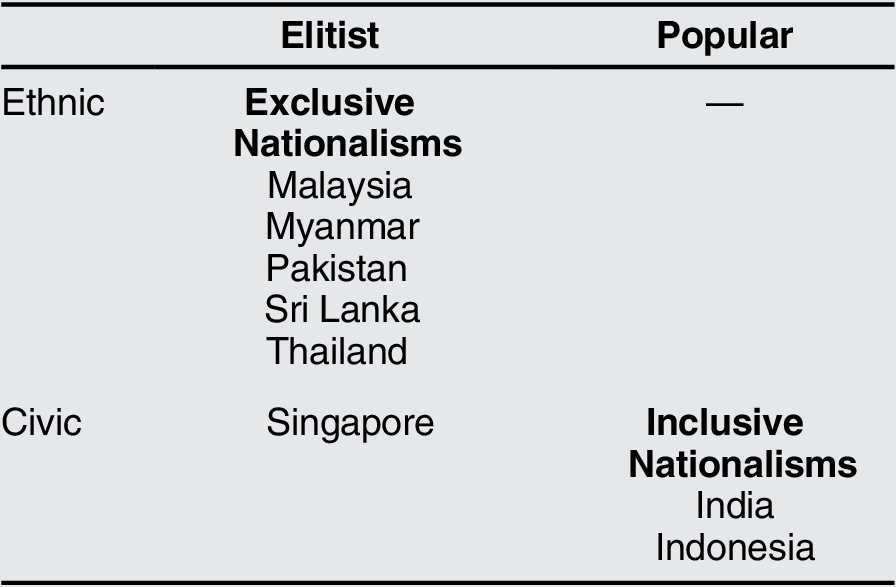
We have argued that founding nationalist narratives shape democratic and authoritarian prospects and process-traced two countries’ regime trajectories across time. Do these dynamics hold true more broadly across South and Southeast Asia? To help address concerns about generalizability, we briefly relate how founding types of nationalism have influenced regime trajectories across six additional southern Asian cases—Indonesia, Thailand, Singapore, Pakistan, Myanmar, and Sri Lanka. The founding types of nationalisms are captured in table 1. Our theory predicts democracy in the lower-right quadrant, authoritarianism in the upper-left quadrant, and is indeterminant in the cell where nationalism is ethnically inclusive yet exclusionary in its elitism.
Founding nationalisms across Asia

Indonesia’s founding nationalism is almost as inclusive as India’s—and relatively inclusive nationalism has helped to stabilize the world’s largest Muslim democracy over time. Violent mass-nationalist revolution against the Dutch made ordinary Indonesians the heroes of the new nation (Anderson Reference Anderson1972). Javanese was eschewed as a national language despite that ethnic group’s demographic dominance. Instead victorious nationalists chose Bahasa Indonesia, a language much more widely spoken across the archipelago, easier to learn, and freer from singular ethnic connotations than Javanese (Liu Reference Liu2015). Indonesia’s founding national narrative is slightly more exclusivist than India’s with respect to religion, however. Though Islam was not enshrined as the national religion, the founding nationalist creed of Pancasila mandates belief in a singular God (Menchik Reference Menchik2016). This defines atheists and many heterodox believers out of the national community, and helps explain why anti-communism was the key cleavage around which a deadly authoritarian regime ruled from the mid-1960s until the late 1990s (Slater Reference Slater2010). Yet when economic crisis battered Indonesia’s authoritarian New Order, popular democratic mobilization among student groups drawing from the same social streams that once overthrew the Dutch melded inclusive nationalism with electoral democracy once more (Hefner Reference Hefner2000). Today Indonesian democracy has fended off its strongest Islamic and authoritarian electoral challenges, with popular-nationalist forces gaining decisive victories in both 2014 and 2019. An inclusive founding national creed has thus proven a resilient resource for democracy in Indonesia.
Unlike both India and Indonesia, Thailand is a paradigmatic case of elitist and, to a less dramatic extent, ethnic nationalism. This has provided ready fodder for repeated authoritarian interventions. The nation’s greatest symbolic heroes are the “modernizing kings” of the late nineteenth century, rivaled only by the military, which claims legitimacy and commands nationalist credit for imposing constitutionalist constraints on the throne in its coup of 1932, which lacked popular involvement. The lack of a mass popular struggle for the nation has meant that the monarchy and military remain national guardians, intervening with little hesitation whenever their leaders believe democracy is leading the Thai nation astray. The elitist flavor of Thai nationalism has recently soured even further through its mixing with ethnic chauvinism, which has deep historical grounding in the self-serving supremacism of “central Thais” (Keyes Reference Keyes2014). Populist politician Thaksin Shinawatra’s enormous appeal among the poorer and presumptively backward citizens of the Northeast, who are predominantly Lao and speak a distinctive dialect from the official national language, has helped make Thaksin and his party widely unacceptable to central Thais, who confront no historic rationale for giving their ethnic little brothers and sisters an equal role in running the Thai nation. Even in May 1992, the one occasion when mass nationalist protest managed to overturn a military regime, democracy was only restored because the king intervened on the democracy movement’s behalf.
Pakistan’s founding nationalism, elitist and exclusivist as it was, has consistently been used to undermine democratic politics through minority exclusion. The core nationalist cry for Pakistan was “Islam in danger,” marrying religion with nation from its inception (Tudor Reference Tudor2013). To generate support for creating Pakistan in pre-independence regional elections, religious, landed elites known as pirs were mobilized to deliver votes. The elitist, exclusivist character of nationalism has been regularly invoked to justify military intervention into democratic politics (Shaikh Reference Shaikh2009). The very first major democratic setback in Pakistan reflected the first instance of what soon became a characteristic pattern in Pakistani politics—that religion was used as a legitimating tool for political gain, with debilitating consequences for a cornerstone of democracy—the protection of minority rights. The first instance of martial law in Pakistan occurred in January 1953 to put down protests against the appointment of a non-orthodox defence minister and was the first step towards the 1958 military coup that definitively ended Pakistan’s democratic experiment. Since the founding decade, military regimes have in critical moments sought support from key religious leaders, who in turn demand strict adherence to Pakistan’s intolerant blasphemy laws and persecution against sects. During ostensibly democratic governments, the military has regularly used religious disturbances to destabilize civilian governments, which in turn renders civilian governments ever more reluctant to protect the rights of religious minorities.
Myanmar’s founding nationalism was similarly elitist and exclusivist in character with deleterious democratic effects. Though Myanmar witnessed a democratic opening in 2011, this tentative democratic experiment has faltered upon the same grounds as Pakistan’s—the systematic exclusion of minority rights. A close marriage between religious and political authority has long existed in Burma. Before and during colonial times, “natives that became converts were called kalas because in the opinion of the Burmese, they had embraced the religion of kalas and had become bona fide strangers, having lost their nationality” (Bigandet 1996). Rather than re-interpreting religion to enable nationalism independently of religion, Burma’s incipient nationalist movement was explicitly ethno-religious in nature. The Young Men’s Buddhist Association and the Dobamaa Asiayone prioritized both Buddhism and Burman ethnicity (Khin Yi 1988). While ethno-religious and federalist visions of Burma briefly dueled surrounding independence, the ethno-religious vision won out under Prime Minister U Nu (ruling between 1947-58, 1960-62), who codified Buddhism as the state religion through the State Religion Promotion Act of 1961. While five decades of military rule followed Ne Win’s coup of 1962, the democratic opening of 2011 and its first free and fair elections have not brought about a full transition to democracy, in large measure because the military’s ethnic cleansing campaign against Rohingya Muslims in the northwest of Myanmar has the tacit support of much of the population who sees this group as foreign. Myanmar’s relatively exclusive nationalism will continue to form a major stumbling stone in its path towards democratization because a majority of well-educated Burmese also view Muslims as threatening to the national identity (Khin Mar Mar Kyi and Walton Reference Kyi and Walton2017).
Like Myanmar and Pakistan, Sri Lanka’s nationalism was an elite and exclusivist affair grounded in religious revivalism. Absent the creation of a popular, inclusive nationalism, an exclusivist Sinhalese Buddhist nationalism quickly emerged as a potent political force that has been widely acknowledged to drive Sri Lanka’s deadly civil war. The late nineteenth century witnessed burgeoning Buddhist revivalism that asserted Sinhalese Buddhists, and not the heretofore politically dominant Tamil minorities, as the true owners of Sri Lanka’s history, a history which had since been polluted by minorities. Modelled on the Indian National Congress, the Ceylon National Congress was founded in 1919. But because it grew later and self-determination was progressively granted without popular struggle, the organization never engaged in mass mobilization. In fact, the movement argued for an income restriction on the franchise. Moreover, since English-speaking elites from among the majority Sinhalese Buddhists and minority Tamils appealed primarily to members of their own community, little effort was invested in a unified and supra-ethnic or supra-religious nationalism. Shortly after independence in 1948, the successor to the Ceylon National Congress was defeated by the Freedom Party, which rode a wave of Sinhalese Buddhist populism and polarizing incidents of minority-majority violence. Though there were attempts to reconcile increasingly isolated Tamils within the national fold, these were regularly frustrated by potent opposition from powerful Buddhist leaders. Tamil political mobilization moved from non-violent protest to guerrilla attacks on symbols of the Sinhala-dominated state in the name of separatism. By the 1980s, the Sinhala-Tamil cleavage spurred on a civil war which raged for the better part of twenty years. While electoral democracy returned formally and broadly to the country in 2009 with the defeat of the Tamil Tigers, the broad dangers of both Sinhalese and Tamil ethno-nationalism continue to pose dangers to the consolidation of Sri Lankan democracy.
Singapore’s founding nationalism is one of the only ones in Southeast Asia that is indeterminant for democracy in our theory. It combines the exclusionary elitism of Thai nationalism with the ethno-religious inclusivity of Indonesia. Few countries consistently highlight the contribution of a single man’s efforts to the successful building of a new nation more than Singapore lionizes Lee Kuan Yew in its historiography qua hagiography. The mass-popular side of the nationalist movement was purged from the party in the 1960s for its communist leanings, leaving the pro-British and technocratic wing of the ruling People’s Action Party (PAP) free to define the nation’s glory in terms of development rather than democracy. Nationalism is elitist in character with respect to language: underpinned by the greater role played by English (a language most Singaporeans must first learn in school) than Mandarin Chinese (the city-state’s predominant mother tongue) in the state’s affairs; purging communists and sidelining the Chinese-speaking popular majority went hand in hand. In terms of ethnicity and religion however, Singaporean nationalism is formally extremely inclusive and secular. This has not made democratization inevitable, any more than Singapore’s astonishing economic development has. But in the same way that development would provide a helpful resource for sustaining democracy, Singapore’s relatively inclusive nationalism along the critical lines of ascriptive identity would make democracy more likely to consolidate if and when the country democratizes.
Conclusion
In an era of rising nationalist fervor and eroding support for democracy, understanding the conditions under which nationalism either promotes democracy or bolsters authoritarianism is of critical importance to political scientists, activists, and policymakers alike. We advance the argument that types of nationalism systematically influence the likelihood of both democratic and authoritarian endurance across time.
We undertake a comparative historical analysis of two diverse developing countries that popularized two starkly different kinds of nationalism before achieving independence. Founding national narratives differed dramatically in their embrace of religious, ascriptive, linguistic, and popular identities. These divergent narratives have been repeatedly deployed by dueling political actors to legitimate different regimes and policies.
In India, where founding nationalism was relatively inclusive, significant, regular minority oppression (one route to democratic breakdown) was less acceptable than in Malaysia, where the founding national narrative instead embraced situationally-fixed identities and where citizens understood their communal interests as ranked by those identities. Nonetheless, as we have detailed, when the founding national leadership dies off and well-organized oppositional political movements mount a systematic challenge to a founding national narrative, these founding narratives can strain and shift, as has happened in both India and Malaysia today.
Democracies and dictatorships in the post-colonial world continue to be shaped by historical narratives popularized at founding moments of the nation and codified into founding institutions such as constitutions. The building blocks of the nation at its founding—whether ethnicity, race, caste, or creeds—shape political conversations and struggles in the present. We hope that future research will more explicitly engage with nationalism as an ideational driver of regime outcomes.