Non-technical Summary
Specimens of the crab Lathahypossia aculeata and their epibionts from middle Eocene volcanic sediments in NE Italy are examined. The crab skeletons are fouled by numerous tubes of a new species of serpulid worm. This material represents the first evidence of fossil crabs and associated serpulid determined at species level and so far the first record of the genus Propomatoceros for the Cenozoic. Abundance, frequency, and distribution pattern of serpulid tubes on the crabs are investigated, as well as the possible relationship between the encrusters and their host.
Introduction
The presence of skeletobionts (sensu Taylor and Wilson, Reference Taylor and Wilson2002) on crustaceans is frequently reported in the fossil record. Relatively common are encrustations by mollusks, barnacles, bryozoans, and serpulids on decapods (Stachowitsch, Reference Stachowitsch, Keegan, Ócéidigh and Boaden1977; Conover, Reference Conover1979; Feldmann and Fordyce, Reference Feldmann and Fordyce1996; Feldmann, Reference Feldmann2003; Fernandez-Leborans, Reference Fernandez-Leborans2010; Key et al., Reference Key, Hyžný, Khosravi, Hudáčková, Robin and Ataabadi2017). The incidence of these biotic relationships is even greater in the Recent (Maldonado and Uriz, Reference Maldonado and Uriz1992; Dick et al., Reference Dick, Donaldson and Vining1998; Gordon and Wear, Reference Gordon and Wear1999; Key et al., Reference Key, Winston, Volpe, Jeffries and Voris1999; Jakobsen and Feldmann, Reference Jakobsen and Feldmann2004; Waugh et al., Reference Waugh, Feldmann, Crawford, Jakobsen and Thomas2004).
A serpulid–decapod association from middle Eocene volcanoclastics at Main quarry in the northeast of Italy is here studied, representing the first record of fossil serpulids on crustaceans from this geographic area. The outcrop is well known for its faunal content, given by a crab association showing high species richness and exceptional state of fossilization (e.g., Busulini et al., Reference Busulini, Tessier and Visentin1982, Reference Busulini, Tessier, Visentin, Beschin, De Angeli and Rossi1983, Reference Busulini, Tessier and Visentin1984; Beschin et al., Reference Beschin, Busulini, De Angeli and Tessier2002, Reference Beschin, Busulini, De Angeli and Tessier2004). Although the collected crustaceans in western Veneto consist of hundreds of species and thousands of specimens (De Angeli and Garassino, Reference De Angeli and Garassino2006; De Angeli et al., Reference De Angeli, Garassino and Pasini2019), the associated serpulid specimens have been found encrusting exclusively one species, Lathahypossia aculeata (Busulini, Tessier, and Visentin, Reference Busulini, Tessier and Visentin1984). They belong to a new species that is here described, which includes numerous specimen tubes found attached on the appendages (chelipeds and legs) and ventral part of the crabs.
Serpulids (family Serpulidae, class Polychaeta) are sessile, suspension-feeding worms that build a protective carbonate tube. They originated in the late Paleozoic (Sanfilippo et al., Reference Sanfilippo, Rosso, Reitano and Insacco2017) and live in virtually all marine environments (e.g., Ippolitov et al., Reference Ippolitov, Vinn, Kupriyanova and Jäger2014). Serpulid worms are known to show symbiotic relationships—mutualism, commensalism, or parasitism—with different groups, from corals to crustaceans or cephalopods (Martin and Britayev, Reference Martin and Britayev1998; Kupriyanova et al., Reference Kupriyanova, Nishi, ten Hove and Rzhavsky2001; Taylor and Wilson, Reference Taylor and Wilson2003; Andrew et al., Reference Andrew, Howe, Paul and Donovan2011; Vinn et al., Reference Vinn, Naimi and Cherif2021, Reference Vinn, Hoeksema, Kołodziej and Kozlová2023a, Reference Vinn, Słowiński, Zatoń, Alkahtane, El Hedeny and Al Farrajb).
Fossil records of serpulids encrusting crustacean decapods are scarce and range only from Late Cretaceous to Miocene. The oldest record is that of Tsudy and Feldmann (Reference Tsudy and Feldmann1988) who describe tiny serpulid tubes of Rotularia sp. encrusting the claws of some specimens of Hoploparia stokesi (Weller, Reference Weller1903) (Astacidea) from the Late Cretaceous in Antarctica. The authors assume that the worms are in juvenile stages of a species with free-living adults and that the infestation might represent post-mortem attachments. Still in the Late Cretaceous (Cenomanian), Breton and Collins (Reference Breton and Collins2011) report from the Paris basin (France) a single undetermined serpulid specimen epibiont on the dorsal carapace of Caloxanthus formosus Milne-Edwards, Reference Milne-Edwards1863 (Brachyura). Cenozoic records of Brachyura and Anomura encrusted on their dorsal carapace or claw by unidentified serpulids are also from the lower Paleocene in Denmark (Jakobsen and Feldmann, Reference Jakobsen and Feldmann2004; Jakobsen et al., Reference Jakobsen, Fraaije, Jagt and Van Baker2020). Further European records of undetermined serpulids on dorsal carapaces of Brachyura are from the early Eocene in Spain (Artal et al., Reference Artal, Ferratges, Van Bakel and Zamora2022) and from the Miocene of Hungary (Müller, Reference Müller1984; Hyžný and Dulai, Reference Hyžný and Dulai2021). From this latter locality, a single tube was reported encrusting Cancer styriacus Bittner, Reference Bittner1884 figured in both related papers although never mentioned in the caption. From outside Europe, the reports are even fewer: unidentified serpulids on the dorsal carapace and pereiopods of four well-preserved crab species from Eocene to Miocene sediments from northwest Oregon and southwest Washington State (Tashman et al., Reference Tashman, Feldmann, Schweitzer and Thiel2018) and a single large tube of Placostegus sp. and six unnamed spirorbins on the dorsal carapace of a newly described crab from the Miocene in New Zealand (Feldmann and Fordyce, Reference Feldmann and Fordyce1996).
In the Holocene, records of colonization by serpulids on crabs are also rare. Gallardo (Reference Gallardo1969) described a new species, ?Salmacina chilensis, found encrusting a brachyuran from the Chilean Pacific coast. In the Arabian Sea coasts, Knight-Jones et al. (Reference Knight-Jones, Knight-Jones, Oliver and Mackie1997) reported a further new serpulid species, Hyalopomatus chanceri, on another crustacean, the spider crab Encephaloides sp., and put forward the hypothesis of a symbiosis. Another Pacific record is that from British Columbia with several Serpulidae spp. infesting together with several other encrusters three Cancer species (McGaw, Reference McGaw2006). Gili et al. (Reference Gili, Abelló and Villanueva1993) also reported infestation of the spirorbine Spirorbis patagonicus Caullery and Mesnil, Reference Caullery and Mesnil1897 on the portunid crab Bathynectes piperitus Manning and Holthuis, Reference Manning and Holthuis1981 from eastern Atlantic (southern Namibia).
Lathahypossia aculeata (Busulini, Tessier, and Visentin, Reference Busulini, Tessier and Visentin1984) was an epibenthic species inhabiting soft bottoms from shallow shelf (Beschin et al., Reference Beschin, Busulini, De Angeli and Tessier2002; Zampieri, Reference Zampieri2022). Its exoskeleton must have constituted one of the few available hard substrata for the serpulids and had a relatively short lifespan due to molting (shedding of the crab’s exoskeleton).
The present study on the Eocene decapod collections from Main quarry aims to: (1) provide a specific determination for the encrusting serpulid, so far reported only at family level in the scarce literature on this topic; (2) give further data on fossil serpulid–crab association, focusing on the serpulid distribution pattern on the crab exoskeleton, and to provide information on their ecology/behavior and on relationships between the molting cycle of the crabs and the settlement and growth of serpulids; (3) hypothesize the type of symbiotic serpulid–host relationship, given that the serpulids have not been detected on any other crab species found associated in the same fossil deposit.
Geological setting
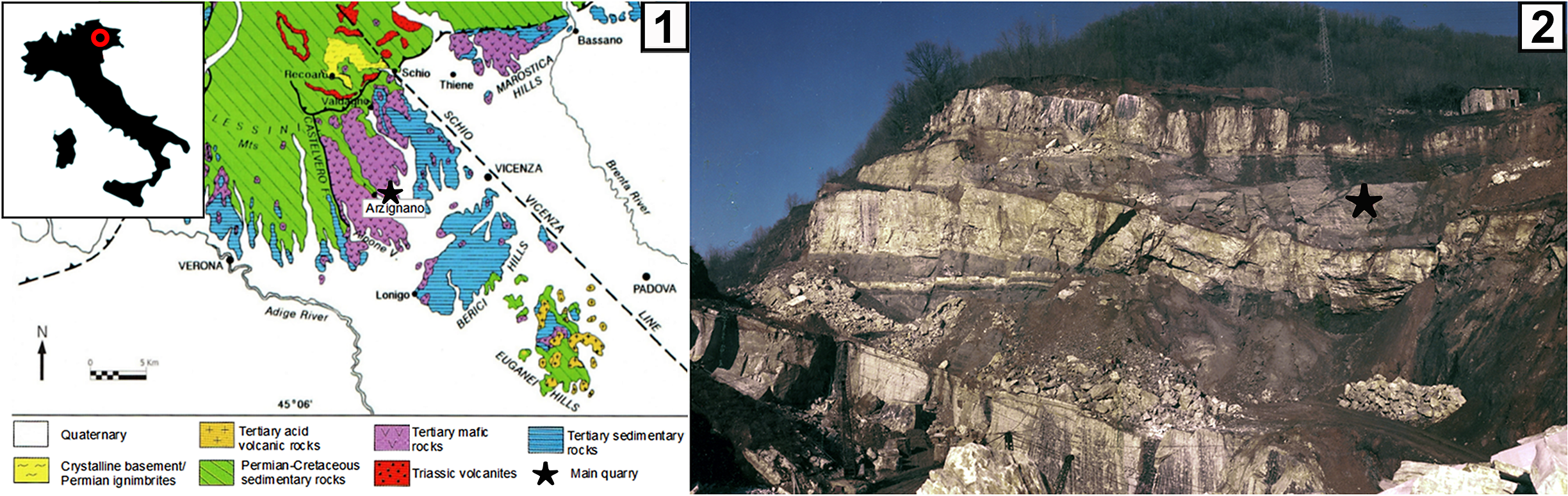
The crabs and associated serpulids examined here come from Eocene volcanoclastites interlayered in limestones cropping out in a disused quarry located on the southern slope of Main Mount (45°31’48’’N, 11°19’05’’E) near Arzignano (western Veneto, Northeast Italy; Fig. 1.1). The quarry (Fig. 1.2), exploited until the 1980s for raw materials known as “Marmi di Chiampo” (Chiampo marble), is well known for the numerous findings of fossilized crustaceans (e.g., Busulini et al., Reference Busulini, Tessier and Visentin1982, Reference Busulini, Tessier, Visentin, Beschin, De Angeli and Rossi1983, Reference Busulini, Tessier and Visentin1984; Beschin et al., Reference Beschin, Busulini, De Angeli and Tessier2002, Reference Beschin, Busulini, De Angeli and Tessier2004).
(1) Geological map of the area near Arzignano in the eastern Lessini Mountains (western Veneto, NE Italy) and location of the fossiliferous outcrop in the Neogene mafic rocks “Chiampo Marble” (from De Vecchi and Sedea, Reference De Vecchi and Sedea1995, modified); (2) The Eocene volcano-arenitic fossiliferous levels cropping out at the Main quarry during the 1980s. Star indicates the level from which the studied crabs have been sampled.

The limestones belong to the informal unit “Calcari Nummulitici” (Nummulitic Limestone), originated during middle Eocene by sediments deposited within a volcano-tectonic graben. This tectonic structure, called the Alpone–Agno graben or semigraben, is about 20 km wide and 35 km long and is delimited to the west by the east-northeast-dipping Castelvero Fault. It was active from the late Paleocene to the middle Eocene during the so-called Venetian Tertiary Volcanism (Barbieri et al., Reference Barbieri, De Zanche and Sedea1991; Barbieri and Zampieri, Reference Barbieri and Zampieri1992; Zampieri, Reference Zampieri1995). The volcanic deposits were produced in situ and partially derived from the surrounding margins (Mietto, Reference Mietto1998).
In the study area, three nummulitic calcarenite banks crop out, interlayered by two basaltic volcaniclastic deposits originated from reworking of Eocene submarine volcanic rocks (Zampieri, Reference Zampieri2022). The carbonate banks are tilted eastward, where the interlayered volcaniclastics increase their thickness. The basal bank is lower Eocene in age and was quarried in the past due to its thickness and excellent quality. The other two nummulitic banks date back to middle Eocene.
The crustacean remains analyzed here come from the fossiliferous volcano-arenitic level of the sequence interlayered between these two middle Eocene banks (Fig. 1.2). Fossil content includes mostly mollusks (gastropods and bivalves) and subordinate corals, crustaceans, large foraminifera, echinoderms, and coralline algae referred to the “San Giovanni Ilarione Horizon” (middle Eocene). The paleoenvironment would be an inner shelf shallow bottom with high hydrodynamic energy, exposed to ashes and toxic substances produced by volcanic eruptions (De Zanche, Reference De Zanche1965; Beschin et al., Reference Beschin, Busulini, De Angeli, Tessier and Ungaro1991).
Studies carried out in the past decades about the crustacean content (Busulini et al, Reference Busulini, Tessier and Visentin1982, Reference Busulini, Tessier, Visentin, Beschin, De Angeli and Rossi1983, Reference Busulini, Tessier and Visentin1984; Beschin et al., Reference Beschin, Busulini, De Angeli and Tessier2002, Reference Beschin, Busulini, De Angeli and Tessier2004) confirm the importance of the Main quarry fossil assemblages that testify to high biodiversity for this part of the Tethys during the Lutetian.
Materials and methods
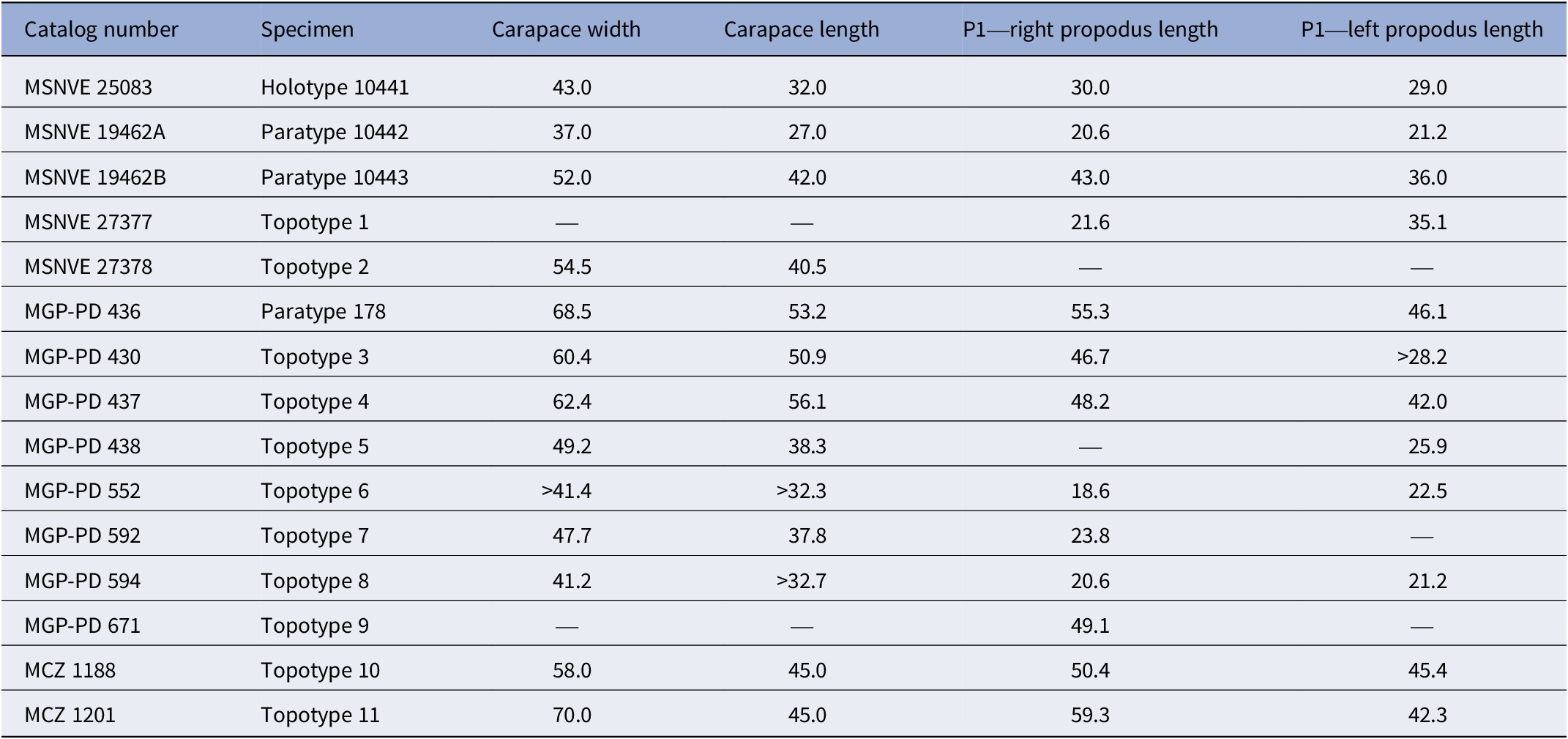
The specimens of the crab Lathahypossia aculeata (Busulini, Tessier, and Visentin, Reference Busulini, Tessier and Visentin1984) originate from collections housed in three Museums of the Veneto region (Table 1).
Measurements (in mm) of carapace and propodi of chelipeds (P1) of Lathahypossia aculeata (Busulini, Tessier, and Visentin, Reference Busulini, Tessier and Visentin1984) specimens (holotype, paratypes, and topotypes) belonging to the Museum collections MSNVE (Venice), MGP-PD (Padua), and MCZ (Montecchio Maggiore, Vicenza). Most specimens preserve the entire carapace, the thoracic sternum, the pleon, chelipeds, and parts of other pereiopods

A total of 15 crabs were here examined, and their main diagnostic characters were measured (Table 1). For each specimen, the catalog number and diagnostic morphometric characters are reported.
The higher rank taxonomic placement follows Schweitzer et al. (Reference Schweitzer, Feldmann, Garassino, Karasawa and Schweigert2010).
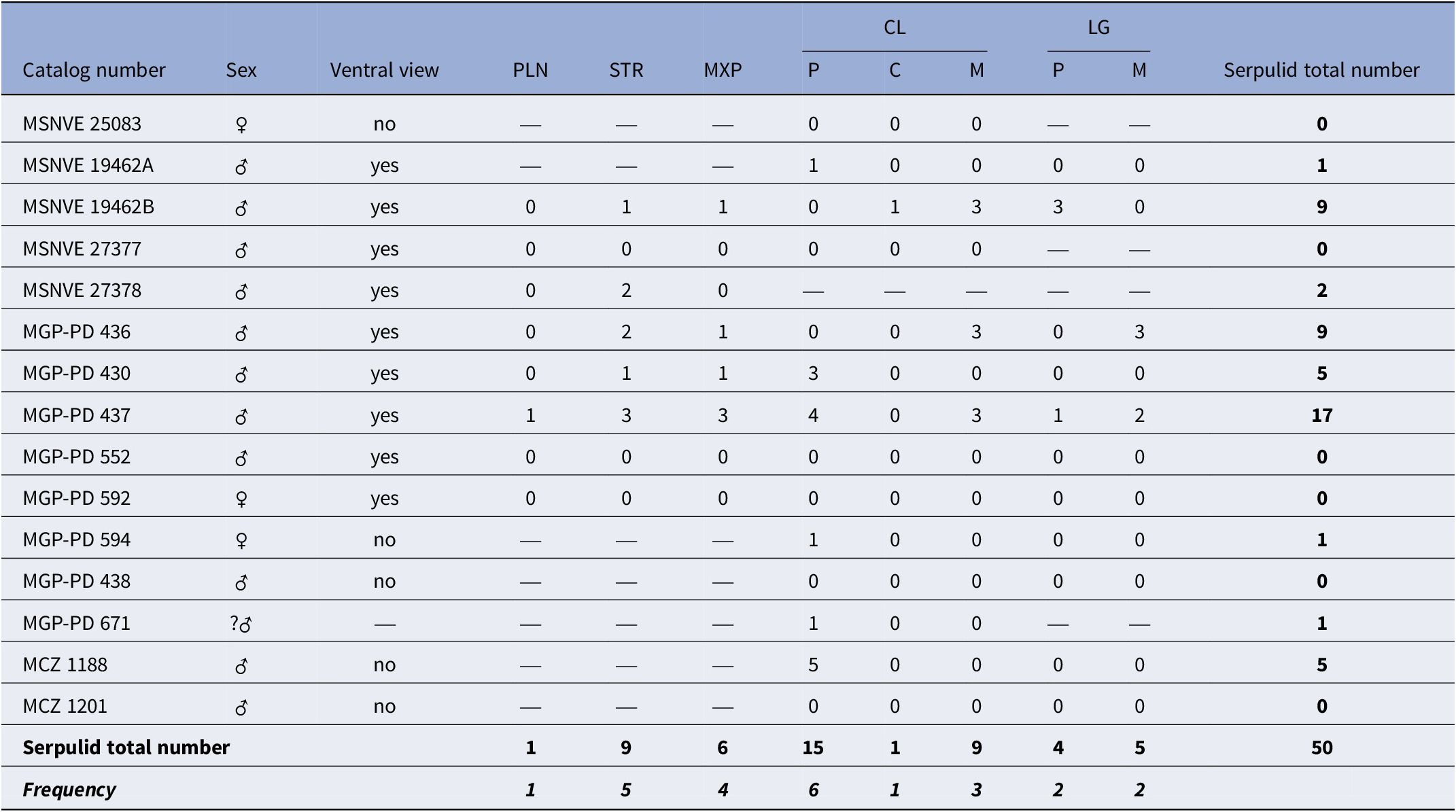
The serpulid tubes found attached on different parts of each male/female crab were determined and counted (Table 2). If the ventral side was hidden, the sex was deduced from the characters of the chelipeds (Busulini et al., Reference Busulini, Tessier and Visentin1984). Males show a strong reduction of the number of spines on the larger propodus (more frequently the right one); conversely, in females the claws are the same size and there is a larger number of spines. The specimen MGP-PD 671 consists solely of the propodus of a right claw belonging to a probable male.
Number of serpulid tubes and their frequency on different sectors of the exoskeleton of male/female Lathahypossia specimens. PLN = pleon; STR = thoracic sternites; MXP = third maxillipeds; CL = chelipeds; LG = legs; P = propodus; C = carpus; M = merus. Note that the carapaces are uncolonized by serpulids on both their dorsal and ventral sides. In some specimens, possible epibiosis are not observable since the ventral side is obliterated by lithified sediment

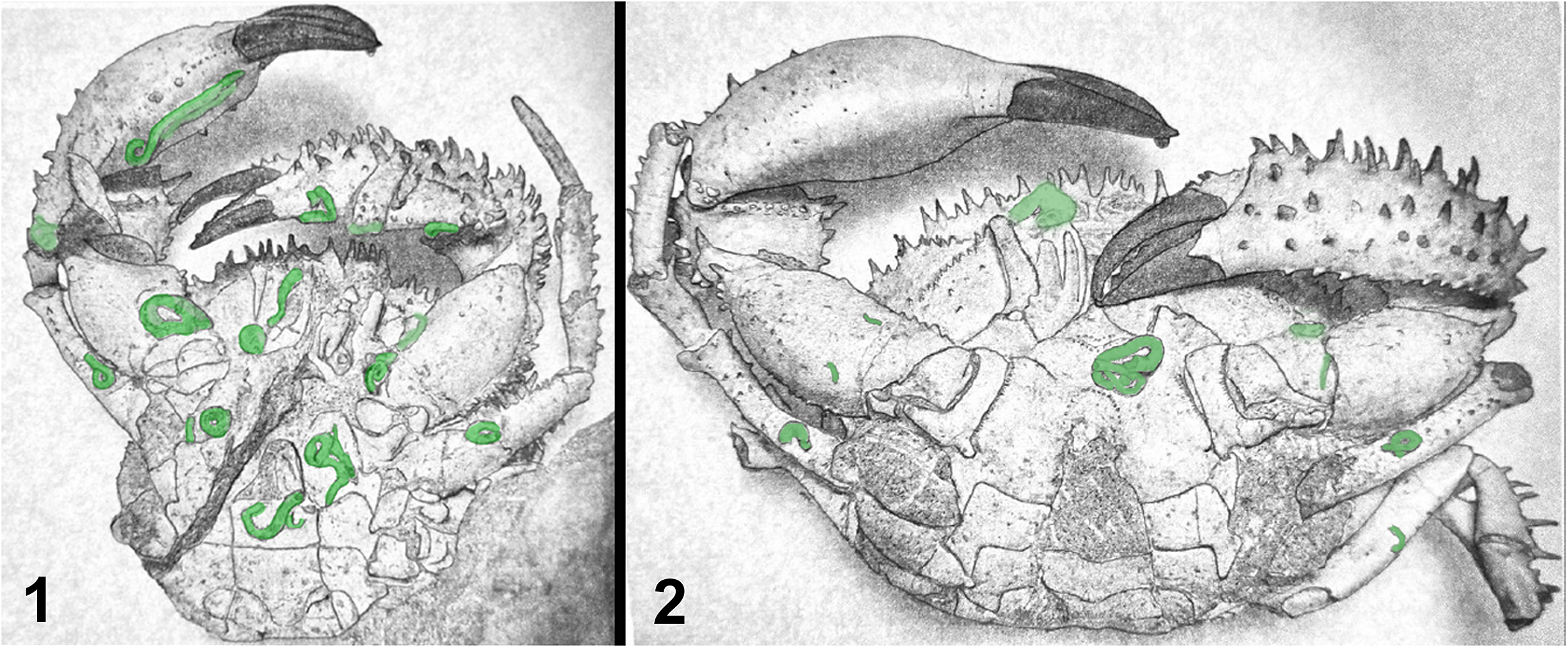
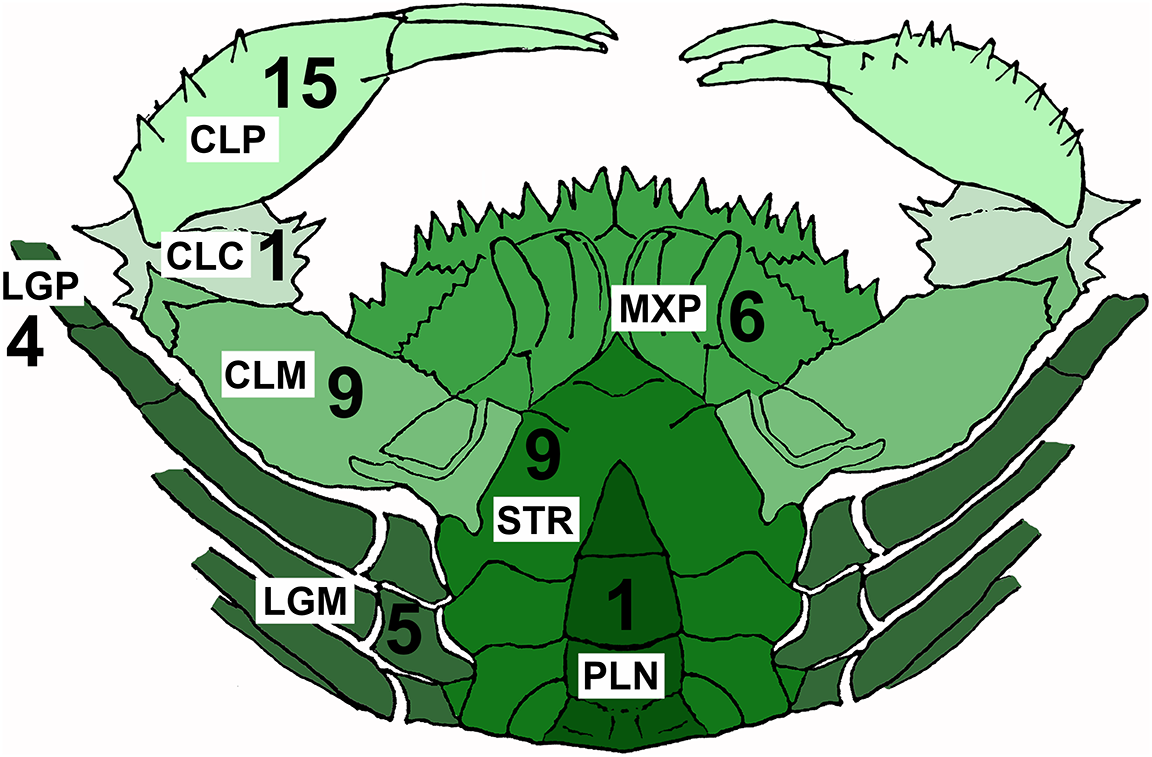
To facilitate the counting of serpulids on all crabs, the distribution of the tubes was drafted on ventral sides of the encrusted crabs and on the appendages using Adobe Photoshop CC software as exemplified in Figure 2, showing two of the redrawn crabs with the encrusting serpulid specimens contoured. Specimens of L. aculeata and their encruster serpulids were photographed using a Nikon Coolpix 4500 camera (Figs. 3, 4).
Drawing of the ventral view of two crabs displaying tube encrustations highlighted in green. (1) Specimen MGP-PD 437. (2) Specimen MGP-PD 436.

The number of tubes encrusting each crab is recorded in Table 2. The crab specimens that show their ventral surface obliterated by cemented sediment are indicated with dashes to evidence missing information about the possible presence of tube encrustations. To examine the distribution pattern of skeletobionts, carapace and appendages of the crabs were divided into eight sectors (Fig. 5). The frequency of encrusters on each sector was determined by recording the number of crabs colonized by serpulids, to quantify the total number of sectors occupied by each specimen of Promomatoceros and, thus, its preferential distribution.
Repositories and institutional abbreviations
Types, figured, and other specimens examined in this study are deposited in the following institutions: Natural History Museum “Giancarlo Ligabue” (MSNVE), Venice, Italy; Museum of Nature and Humankind collections of Geology and Paleontology, University of Padua (MGP-PD), Padua, Italy; Museum of Archeology and Natural Sciences “Giuseppe Zannato” (MCZ), Montecchio Maggiore, Vicenza, Italy.
Systematic paleontology
Order Decapoda Latreille, Reference Latreille1802
Infraorder Brachyura Linnaeus, Reference Linnaeus1758
Section Eubrachyura de Saint Laurent, Reference de Saint Laurent1980
Subsection Heterotremata Guinot, Reference Guinot1977
Superfamily Xanthoidea MacLeay, Reference MacLeay and Smith1838
Family Xanthidae MacLeay, Reference MacLeay and Smith1838
Genus Lathahypossia Schweitzer et al., Reference Schweitzer, Artal, Van Bakel, Jagt and Karasawa2007
Type species
Titanocarcinus aculeatus Busulini, Tessier, and Visentin, Reference Busulini, Tessier and Visentin1984, by original designation.
Included species
Lathahypossia aculeata (Busulini, Tessier, and Visentin, Reference Busulini, Tessier and Visentin1984) and Lathahypossia multispinosa Beschin, Busulini, and Tessier, Reference Beschin, Busulini and Tessier2022 (late Eocene, NE Italy).
Lathahypossia aculeata (Busulini, Tessier, and Visentin, Reference Busulini, Tessier and Visentin1984)
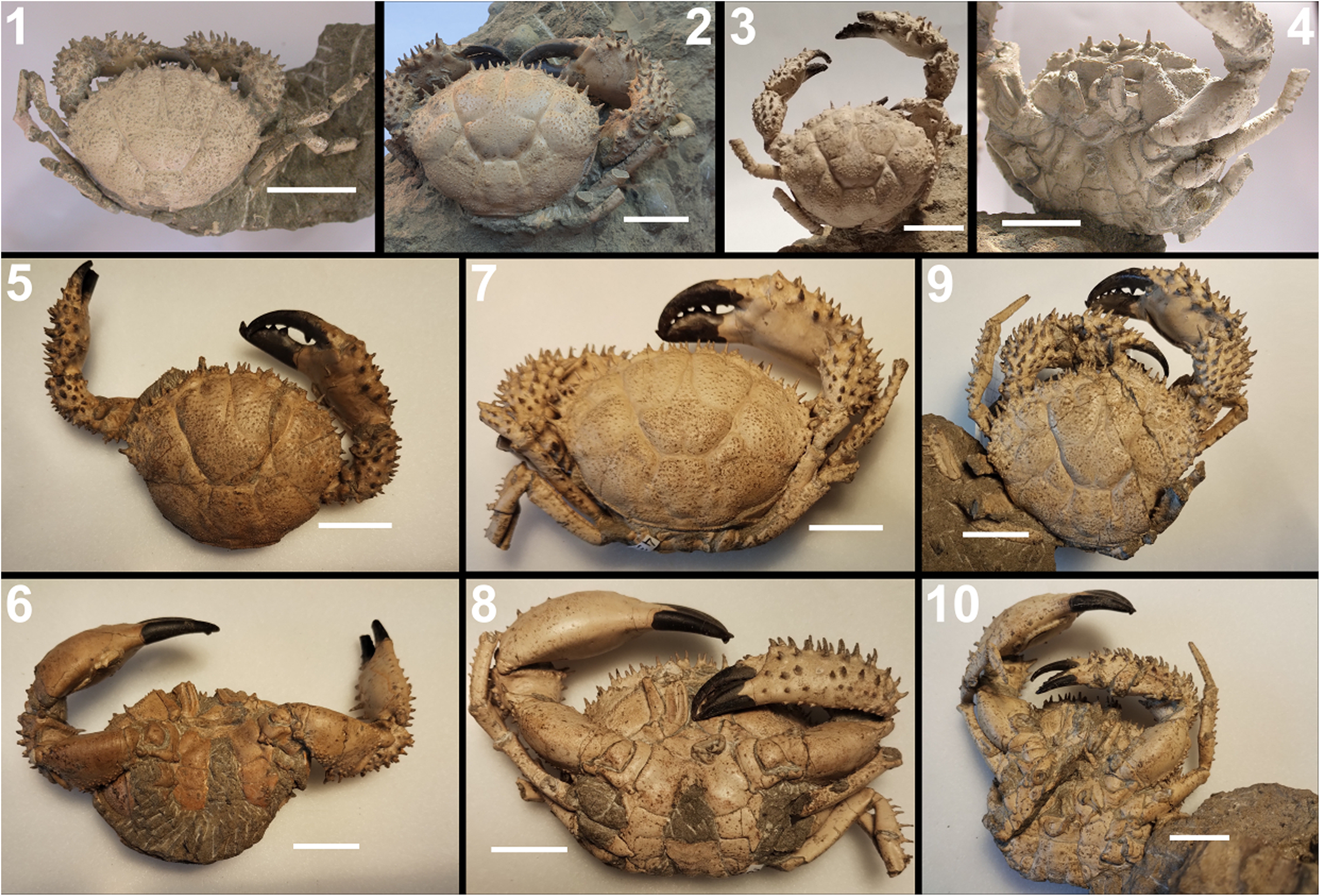
Lathahypossia aculeata (Busulini, Tessier, and Visentin, Reference Busulini, Tessier and Visentin1984) from middle Eocene volcanoclastites at Main quarry, Arzignano (Vicenza). (1) Holotype, MSNVE 25083 dorsal view. (2) MCZ 1188 dorsal view. (3) Paratype, MSNVE 19462B dorsal view. (4) Paratype, MSNVE 19462B ventral view. (5) MGP-PD 430 dorsal view. (6) MGP-PD 430 ventral view. (7) Paratype, MGP-PD 436 dorsal view. (8) Paratype, MGP-PD 436 ventral view. (9) MGP-PD 437 dorsal view. (10) MGP-PD 437 ventral view. Scale bars = 2 cm.

Reference Busulini, Tessier and Visentin1982 Titanocarcinus aff. T. raulinianus Busulini et al., p. 82, fig.3.
*Reference Busulini, Tessier and Visentin1984 Titanocarcinus aculeatus Busulini, Tessier, and Visentin, p. 110, pl. 1, figs. 1–3, pl. 2, figs. 1, 2, pl. 3, figs. 1, 2.
Reference Beschin, Busulini, De Angeli and Tessier2002 Titanocarcinus aculeatus Beschin et al., p. 20, text fig. 15, pl. 4, fig. 3.
Reference Schweitzer, Artal, Van Bakel, Jagt and Karasawa2007 Lathahypossia aculeata; Schweitzer et al., p. 292.
Reference Beschin, De Angeli, Checchi and Zarantonello2012 Lathahypossia aculeata; Beschin et al., p. 72, text fig. 64, pl. 10, fig. 5.
Reference Jagt, Van Bakel, Guinot, Fraaije, Artal, Castro, Davie, Guinot, Schram and von Vaupel Klein2015 Lathahypossia aculeata; Jagt et al., Reference Jagt, Van Bakel, Guinot, Fraaije, Artal, Castro, Davie, Guinot, Schram and von Vaupel Klein2015, p. 898, text fig. 71d.
Reference Schweitzer, Feldmann and Karasawa2020 Lathahypossia aculeata; Schweitzer et al., Reference Schweitzer, Feldmann and Karasawa2020, p. 2, fig. 1.4.
Reference Ossó and Ng2023 Lathahypossia aculeata; Ossó and Ng, p. 268, pl.1, figs. 1–3.
Holotype
Specimen with claws and almost complete legs (MSNVE 25083) from the middle Eocene of the Cava Main, Arzignano, NE Italy (Busulini et al., Reference Busulini, Tessier and Visentin1984, pl.1, figs. 1–3).
Occurrence
Middle Eocene of the Veneto region (NE Italy): Arzignano and Cornedo Vicentino (Vicenza) (Busulini et al., Reference Busulini, Tessier and Visentin1984; Beschin et al., Reference Beschin, De Angeli, Checchi and Zarantonello2012).
Material
Fifteen specimens from Main quarry (Arzignano, Vicenza, NE Italy) (Table 1): MSNVE 19462A (Fig. 6), MSNVE 19462B (Figs. 3.3, 3.4, 6), MSNVE 25083 (Fig. 3.1), MSNVE 27377, MSNVE 27378, MGP-PD 430 (Fig. 3.5, 3.6), MGP-PD 436 (Figs. 2.2, 3.7, 3.8), MGP-PD 437 (Figs. 2.1, 3.9, 3.10), MGP-PD 438, MGP-PD 552, MGP-PD 592, MGP-PD 594, MGP-PD 671 (P1 propodus), MCZ 1188 (Fig. 3.2), MCZ 1201.
Remarks
The first report of Lathahypossia aculeata dates back to Busulini et al. (Reference Busulini, Tessier and Visentin1982), who described some specimens of “Titanocarcinus aff. raulinianus” from the middle Eocene of Main quarry at Arzignano. Later, Busulini et al. (Reference Busulini, Tessier and Visentin1984) considered those specimens as part of the type series of the new species “Titanocarcinus aculeatus” within the Xanthidae, often found in extraordinary conditions of preservation within volcaniclastic outcrops in that quarry.
Afterward, Schweitzer et al. (Reference Schweitzer, Artal, Van Bakel, Jagt and Karasawa2007), in their revision of the genus Titanocarcinus Milne-Edwards, Reference Milne-Edwards1863, which they considered a heterogeneous taxon, suggested similarities of “T. aculeatus” to the extant Hypothalassia Gistel, Reference Gistel1848. Two living species and one fossil species are referred to Hypothalassia: H. armata (de Haan, Reference de Haan1835), the type species, from the Pacific; H. acerba Koh and Ng, Reference Koh and Ng2000 from Australia waters; and H. campolongensis Beschin, Busulini, and Tessier in Beschin et al., Reference Beschin, Busulini, Fornaciari, Papazzoni and Tessier2018 from the late Eocene of the Berici Hills (Vicenza) (for the structure of the front, the number of frontal spines, and the articulation of the dorsal regions of the carapace, this last species, attributed by Ossò and Ng, 2023, to Lathahypossia, is here maintained within Hypothalassia). Schweitzer et al. (Reference Schweitzer, Artal, Van Bakel, Jagt and Karasawa2007) erected the new genus Lathahypossia for “T. aculeatus” (this word is an anagram of Hypothalassia) within the family Hypothalassiidae Karasawa and Schweitzer, Reference Karasawa and Schweitzer2006 (Eriphioidea MacLeay, Reference MacLeay and Smith1838).
More recently, the species has been systematically revised by Ossò and Ng (Reference Ossó and Ng2023) and referred to the Xanthidae again (Busulini et al., Reference Busulini, Tessier and Visentin1984) thanks to newly found specimens having exceptional preserved ventral parts. As a consequence of this last study that makes the fossil species diverge from Hypothalassia, a further analysis to define its current systematic attribution would be appropriate (Beschin et al., Reference Beschin, Busulini and Tessier2022).
Class Polychaeta Grube, Reference Grube1850
Subclass Canalipalpata Rouse and Fauchald, Reference Rouse and Fauchald1997
Order Sabellida Fauchald, Reference Fauchald1977
Family Serpulidae Rafinesque-Schmaltz, Reference Rafinesque-Schmaltz1815
Subfamily Serpulinae Rafinesque-Schmaltz, Reference Rafinesque-Schmaltz1815
Genus Propomatoceros Ware, Reference Ware1975
Type species
Propomatoceros sulcicarinatus Ware, Reference Ware1975
Original diagnosis
Tube of medium or large size with a dorsal median keel and a subtriangular transverse section, becoming subcylindrical distally. Tube cemented through most of its length, but the anterior portion is seemingly elevated from the substrate. Lateral surfaces of the tube with slender growth lines, arched anteriorly toward the upper keel. Keel typically projected over the aperture in the shape of a denticle.
Propomatoceros lathahypossiae new species Sanfilippo
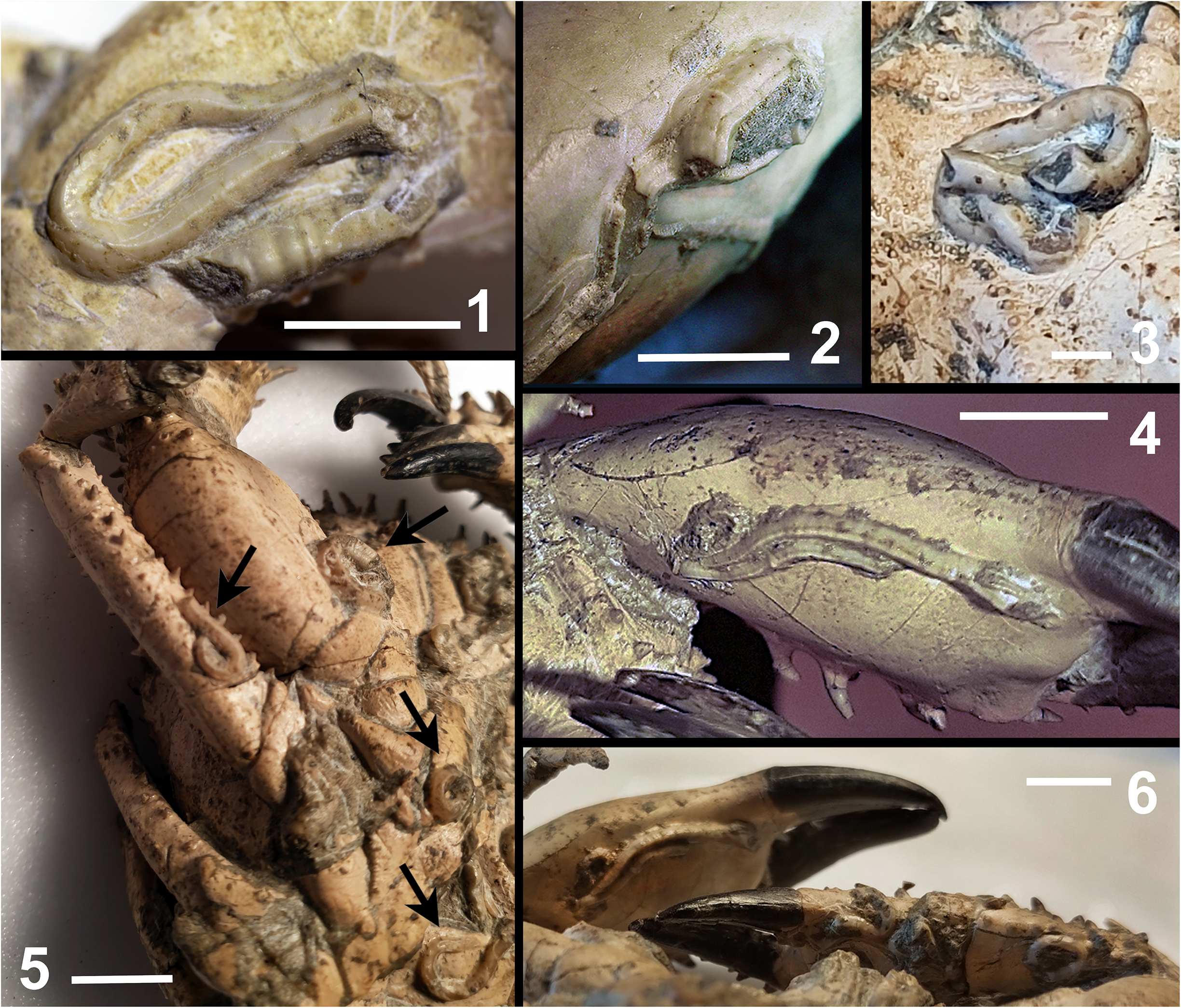
Propomatoceros lathahypossiae n. sp. (1) Holotype (MSNVE 19462C) on the right-cheliped merus of crab MSNVE 19462B. Note anterior part of the tube that shows transversal smooth rings. (2) Paratype 1 (MGP-PD 430a) on the right-cheliped propodus of crab MGP-PD 430, with aperture intact bearing the dorsal keel anteriorly projected. (3) Paratype 2 (MGP-PD 436a) and paratype 3 (MGP-PD 436b) irregularly folding on themselves encrusting the thoracic sternites of crab MGP-PD 436. (4) Subparallel tubes of paratype 4 (MGP-PD 437a) and paratype 5 (MGP-PD 437b) attached on the right-cheliped propodus of crab MGP-PD 437. (5) Diverse tubes (arrowed) encrusting the ventral side of crab MGP-PD 437. (6) Tubes on internal sides of the chelipeds of crab MGP-PD 437a. Scale bars = 1 cm.

Holotype
MSNVE 19642C (Fig. 4.1): tube 3.2 cm long attached on the right cheliped merus (CLM) of the crab MSNVE 19462B. Damaged on the dorsal part and incomplete at distal end.
Paratype 1
MGP-PD 430a (Fig. 4.2): tube 2.8 cm long attached on the right-cheliped propodus (CLP) of the crab MGP-PD 430. Damaged on the proximal part, with intact apertural edge.
Paratypes 2 and 3
MGP-PD 436a and MGP-PD 436b (Fig. 4.3): irregularly folded and partially overlaying tubes 1.8 and 1.2 cm long attached on the thoracic sternites (STR) of the crab MGP-PD 436.
Paratypes 4 and 5
MGP-PD 437a and MGP-PD 437b (figs. 4.4, 4.6): subparallel tubes 2.2 and 1.6 cm long, attached on the right-cheliped propodus (CLP) of the crab MGP-PD 437.
Diagnosis
Tube medium-sized, slightly increasing in diameter along its length, entirely attached. Tube triangular in cross section, with a dorsal median smooth keel on its top and circular thickenings in the distal part. Small triangular expansions at the contact with the substrate. Thin longitudinal striae at the base of the keel.
Occurrence
“San Giovanni Ilarione Horizon” (within middle Eocene volcanoclastites), Arzignano (Vicenza, NE Italy).
Description
The tube is medium-sized, up to 3.2 cm long, slightly increasing in diameter from 1 mm on initial part to 2.3 mm at the aperture. Tube may be slight to very sinuous, forming one or two U-shaped folds, or irregular wraps on itself, triangular in cross section, sometimes becoming subtriangular to almost circular in its distal end. Here transversal circular thickenings of different widths may occur. Aperture simple, bearing a tooth-like projection on its top. Peristomes are absent. The tube laterals show small triangular expansions at the contact of the substrate. A longitudinal smooth median keel occurs dorsally. This tends to attenuate until it disappears when the distal end becomes subcircular. Very thin striae mark the contact between basal expansions and lateral tube sides, which also occur on the two basal sides of the median keel. The tube surface is smooth. The tube cross section is triangular to subtriangular at early ontogenetic stages, becoming subcircular at later stages. The tube wall is about 0.30 mm thick.
Etymology
Named after the species name of the hosting crab.
Remarks
The genus Propomatoceros was introduced by Ware (Reference Ware1975) for Late Triassic–Late Cretaceous forms of the genus Pomatoceros = Spyrobrancus, which has a wider stratigraphic occurrence (ranging from Late Cretaceous to Holocene) and whose tubes, unlike in Propomatoceros, lack erect distal ends and lateral ornamentation. Owing to the simple morphology and ornamentation and the few diagnostic characters of the genus, Propomatoceros includes a plethora of species, most of questionable status or uncertain generic assignment (see Ippolitov, Reference Ippolitov2007, and Vinn and Wilson, Reference Vinn and Wilson2010, for further comments and the general status of this genus).
The thin longitudinal striae, the circular rings in the distal part, and the aperture with a pointed dorsal projection are the distinctive characters of P. lathahypossiae. Specimens described here resemble in their characters (denticle over the aperture, slender dorsal keel) the species P. sulcicarinatus Ware, Reference Ware1975, erected for specimens from the Aptian of England (Luci et al., Reference Luci, Garberoglio and Lazo2013) but differ by having a thinner keel and different peristome-like thickenings. The new species also shows affinities with Propomatoceros semicostatus Regenhardt, Reference Regenhardt1961 from the same Lower Cretaceous of England (Luci et al, Reference Luci, Garberoglio and Lazo2013) but has a lower triangular profile in cross section and a less sharp keel.
The genera Dorsoserpula Parsch, Reference Parsch1956, Filogranula Langerhans, Reference Langerhans1884, and Placostegus Philippi, Reference Philippi1844, are similar to Propomatoceros for the keeled tube, triangular in cross section. Dorsoserpula, spanning from Late Jurassic to Late Cretaceous (middle Oxfordian to latest Maastrichtian: 160–66 Ma; Ippolitov et al., Reference Ippolitov, Vinn, Kupriyanova and Jäger2014), shares the dorsal keel but the usually triangular cross section of the tube may be sometimes circular for all its length. Furthermore, species of Dorsoserpula possess a longitudinal lateral small tube embedded along the expanded attachment flange and show a tendency to grow forming a spiral cage around filiform substrata. The genus Filogranula, documented from the late Early Jurassic to the Recent (Toarcian, ~180 Ma; Ippolitov et al. Reference Ippolitov, Vinn, Kupriyanova and Jäger2014), has peristomes in the attached portions and a toothed keel, especially in some one-keeled species. Placostegus known from the Early Jurassic (late Oxfordian, ~158 Ma) until Recent, also differs in the tube growth having a developed erect part and a pronounced spinose keel.
Results
The measurements of main diagnostic characters carried out on the specimens of Lathahypossia aculeata show that all 15 examined decapods correspond to adult specimens (Table 1). As many as nine crabs out of the total number are colonized by serpulids (Table 2), no other group of sclerobiont organisms having been found. Only three specimens of L. aculeata are female, and these are free of encrustations except for a single tube on a cheliped (Table 2).
As a whole, encrustations occur only on the ventral sides of the crabs and on appendages. In particular, specimen MGP-PD 437 hosts the greater number of skeletobionts (17) followed by specimens MSNVE 19462B and MGP-PD 436, each encrusted by nine serpulids. The number of serpulids per remaining crabs ranges from five to one. A total of 50 serpulid specimens were recorded (Fig. 5; Tale 2), most of them localized on the CLP and CLM cheliped sectors (24 tubes), as well as on thoracic sternites (nine tubes). The third maxillipeds are colonized by six specimens while a single tube encrusts pleon (PLN) and cheliped carpus (CLC). Pereopods were overall colonized by nine specimens: LGM (5) and LGP (4). Interestingly, serpulids preferentially colonized the chelipeds on their internal side, which faces directly toward the crab’s mouth (Fig. 4.4, 4.6).
Abundance and distribution pattern of the serpulid Propomatoceros lathahypossiae n. sp. on different ventral sectors of the crab for all studied specimens of Lathahypossia aculeata. PLN = pleon; STR = thoracic sternites; MXP = third maxillipeds; LGM = leg meri; LGP = leg propodi; CLM = cheliped merus; CLC = cheliped carpus; CLP = cheliped propodus.

The most frequently colonized sectors were the propodi of chelipeds (CLP) and the thoracic sternites (STR), shared by six crabs out of the 15 examined (Table 2).
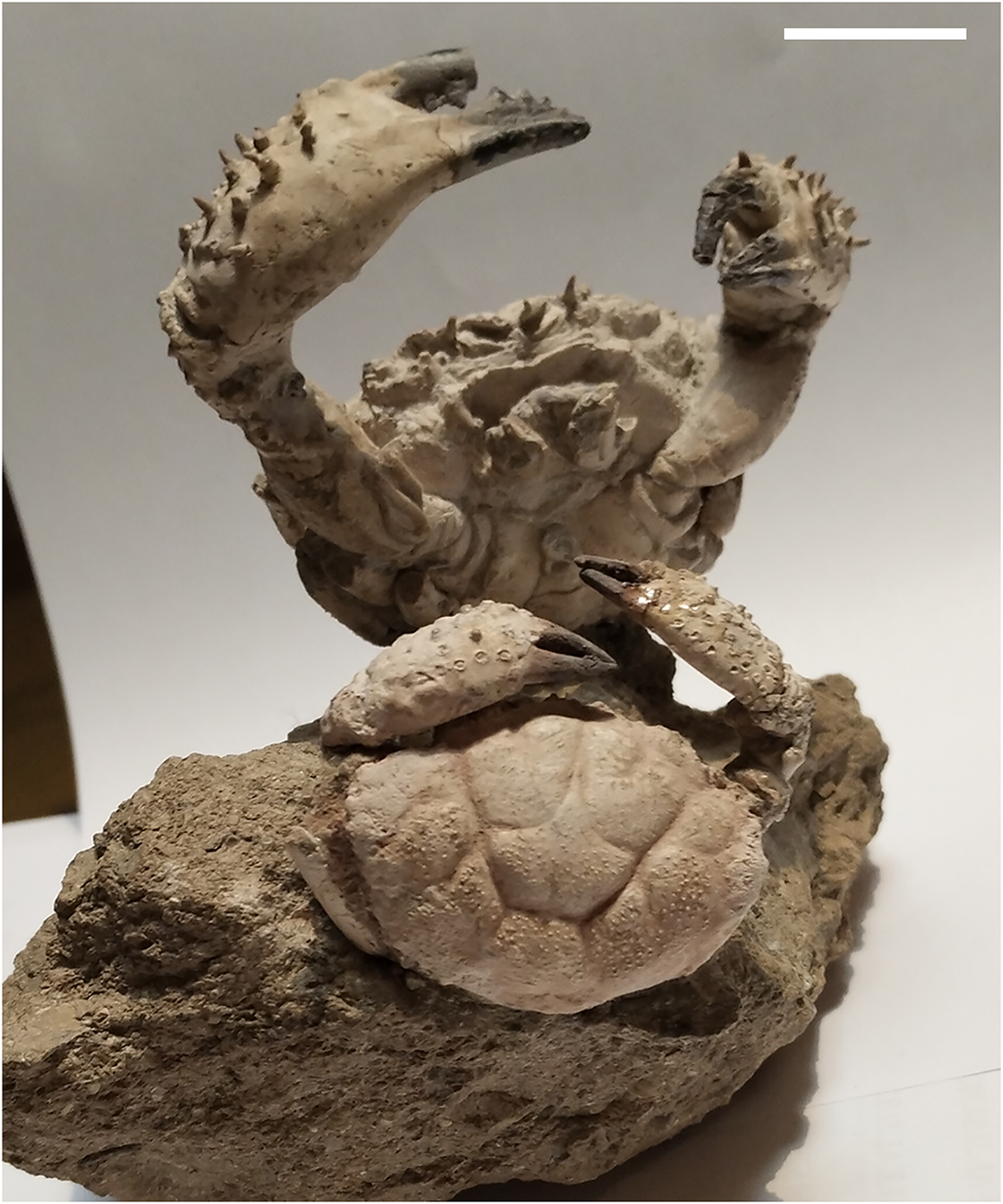
All examined crabs show very good preservation status. The articulated parts of the exoskeleton are generally connected, and ornamentations such as spines and aculeus are intact. Similarly, the serpulids show a discrete to good degree of preservation, as demonstrated by the unabraded top keel of the tubes. Field observations during the sampling of crabs (C.B., personal observation, 2002) highlighted that the specimens in the sediment showed living position and none of them is preserved with the carapace lifted upward and flipped forward in open positions characteristic of molts and of corpses as an early consequence of decay (Bishop, Reference Bishop1986). Rather, the individuals were all found in life position, some with their claws open and pointing upward (Fig. 6). Among the serpulids that encrust the ventral carapace, most of the tubes show the openings facing toward the anterior part, while in the serpulids that colonize the claws, the openings are directed mainly toward the tips (Fig. 4.6).
Two adult male specimens (MSNVE 19462A and MSNVE 19462B) in escape position with claws open and pointing upward, suggesting death due to sudden burial by volcanic sediments. Scale bar = 2 cm.

Discussion
Studies on fossil skeletobiont–host associations (sensu Taylor and Wilson, Reference Taylor and Wilson2002, Reference Taylor and Wilson2003) are dedicated mainly to the Paleozoic and Mesozoic, with Cenozoic examples less investigated (Taylor and Wilson, Reference Taylor and Wilson2003, for a review). In this view, the present study contributes new data on the knowledge of Neogene serpulid–crab associations, with insights so far not addressed on serpulid species determination, their distribution pattern, and host–encrusters relationships.
The studied crabs belonging to Lathahypossia aculeata from Eocene volcanic sands at Main quarry (Arzignano) were probably living on soft bottoms, and their exoskeletons constituted small hard substrates on which sessile organisms such as serpulids could settle and live.
As a whole, the crustacean fauna from this deposit is very rich. From the first report by Busulini et al. (Reference Busulini, Tessier and Visentin1982), over the years 68 species have been recognized and hundreds of specimens considered (Beschin et al., Reference Beschin, Busulini, De Angeli and Tessier2004; De Angeli et al., Reference De Angeli, Garassino and Pasini2019). Some of these species are known only through their carapaces (e.g., Periacanthus horridus Bittner, Reference Bittner1875 and species of the genus Micromaia), which are likely to be parts of exuviae or displaced disarticulated corpses.
Conversely, specimens of a few other species such as L. aculeata have been found right-side-up and thoroughly preserved with carapace, thoracic sternum, abdomen, chelipeds, and parts of other pereiopods.
Taphonomic observations permit evaluation of whether specimens of L. aculeata at the time of their burial were still alive. The chelipeds and remains of walking legs raised upward (Fig. 6) as in specimens MSNVE 19462B and MGP-PD 437 could indicate an escape position attempting to emerge from the sediments that suddenly buried them following Bishop (Reference Bishop1986). Open third maxillipeds shown by MSNVE 19462B (Fig. 6), such as by MSNVE 27378, might be a sign of respiratory distress before death (Crawford et al., Reference Crawford, Casadío, Feldmann, Griffin, Parras and Schweitzer2008; Hyžný et al., Reference Hyžný, Hudáčková and Szalma2015). Other specimens of L. aculeata are in the so-called normal position with chelae tucked along the front and with walking legs arranged at the sides of the carapace; they might have died smothered and rapidly buried by sediments (MCZ 1188, MCZ 1201, MSNVE 25083, MSNVE 19462A, MGP-PD 436).
Such taphonomic assumptions allow us to hypothesize that these crabs probably died in situ owing to a volcaniclastic flow and did not undergo any transport. Consequently, if burial caused the crab death, we could assume that the skeletobionts were true epibionts because they encrusted their hosts during life, as suggested by Lescinsky (Reference Lescinsky, Briggs, and Crowther and Palaeobiology2001). Furthermore, the adult size of most serpulids allows us to assume that they developed on the crabs during a relatively long inter-molt phase. This inter-molt stage in crabs that are wider than 4.5 cm has been observed to last at least 30 days (McGaw, Reference McGaw2006). Since molting is a process more frequent in juveniles, the large size of the carapaces (Table 1) suggests that the crabs may have been mature specimens, possibly in their terminal molt stage. Experimental studies (Feldmann et al., Reference Feldmann, Schweitzer, Dattilo and Farlow2011) indicating rapid tube growth rates for serpulid epibionts (1.3 mm per day for four weeks), suggest that the epibionts under study would have grown rapidly after settling on the living crabs. Thus, it is presumable that the crab exoskeletons could be covered by serpulids within days or weeks post-molt.
As stressed by Dick et al. (Reference Dick, Donaldson and Vining1998), the frequency of occurrences and the number of skeletobionts can be related to the host size and age, as crabs in late ontogenetic stages usually are larger than younger individuals of the same species and are more frequently fouled than those that are smaller. In addition, the observed preference of serpulids for male specimens can likely be related to the carapace size, as suggested by McGaw (Reference McGaw2006), who observed a higher abundance of modern epibionts on male crabs than females, which are smaller. About the distribution pattern of serpulids on their host, fossil records from literature data show that encrustations are exclusively documented on the dorsal carapaces, contrary to what has been observed for examined Eocene crabs, which are colonized exclusively on their ventral side. According to McGaw (Reference McGaw2006), we explain this different pattern with the ecological need of some serpulid species whose photo-negative larvae prefer to colonize more sciaphilic microhabitats such as the bottom-facing ventral parts of crabs. The abundance of serpulids also on the claws, and particularly on the internal side of the propodus that faces the mouth (Figs. 4.4, 4.6, 5) could be explained by the advantage of benefiting from residual food particles in the area near the mouth.
The association between the serpulid and the host appears to be species specific since the occurrence of the newly described serpulid has not been detected on any other crab or type of substratum in the study area. This is corroborated by modern records of new serpulid species growing exclusively on a specific crab (Gallardo, Reference Gallardo1969; Knight-Jones et al., Reference Knight-Jones, Knight-Jones, Oliver and Mackie1997). The symbiotic relationship shown by the serpulid P. lathahypossiae and its host, L. aculeata, is observable also in the fossil records among serpulids and corals (Garberoglio and Lazo, Reference Garberoglio and Lazo2011), interpreted either as mutualism or commensalism by different authors (Martin and Britayev, Reference Martin and Britayev1998; Floros et al., Reference Floros, Samways and Armstrong2005; Garberoglio and Lazo, Reference Garberoglio and Lazo2011; Vinn et al., Reference Vinn, Hoeksema, Kołodziej and Kozlová2023a). Thus, the advantage of the serpulid would be to achieve a sheltered substrate to settle, to get protection by the crab against predators. In addition, the abundance of encrusters on the internal chelipeds could be explained by the fact that the serpulids take advantage of the proximity to the crab’s mouth where suspended food particles occur. Thus, the serpulid–crab relationship documented here could be interpreted as commensalism.
Despite the taxonomic attribution of fossil serpulids (represented exclusively by their tubes) being often problematic, owing to a limited number of characters, especially in some genera displaying simple morphologies, the morphological characters of the encrusting specimens found on L. aculeata allowed us to unequivocally assign them within the genus Propomatoceros Ware, Reference Ware1975. It is considered a dustbin genus for all the single-keeled serpulid tubes with triangular to circular cross section (Vinn et al., Reference Vinn, Kupriyanova and Kiel2013). The description of fossil species of Propomatoceros (e.g., Ware, Reference Ware1975; Vinn and Wilson, Reference Vinn and Wilson2010; Garberoglio and Lazo, Reference Garberoglio and Lazo2011; Vinn et al., Reference Vinn, Kupriyanova and Kiel2012, Reference Vinn, Kupriyanova and Kiel2013; Luci et al., Reference Luci, Garberoglio and Lazo2013) showed no similarities with our Eocene specimens because most Propomatoceros species differ considerably in tube size, morphology, and ornamentation. The newly described species represents the first record of the genus from the Cenozoic, since its stratigraphic range until now did not exceed the upper Cretaceous (Ippolitov et al., Reference Ippolitov, Vinn, Kupriyanova and Jäger2014).
Conclusions
Collections of xanthid crabs (Lathahypossia aculeata) and their epibionts from middle Eocene volcanoclastites in NE Italy have been examined. All of the 15 examined decapods are adult specimens. The crab skeletons are fouled by numerous tubes of a newly described serpulid species, Propomatoceros lathahypossiae.
The studied association represents the first record of the genus Propomatoceros from the Cenozoic and, so far, the first Italian record of serpulids on crabs. Apart from the New Zealand finding of serpulids determined at the genus level (Placostegus sp.), all other reports mention only the presence of unidentified serpulids. Thus, the fossilized serpulid reported here is the first one with specific identification. The occurrence of the genus Propomatoceros after the Cretaceous/Tertiary mass extinction points to its survival through this catastrophic event.
The crabs presumably died in situ owing to an instantaneous burial under a volcaniclastic sediment flow. It can be assumed that the skeletobionts lived on the crab hosts contemporarily and interacted with them in ecological time, growing on the crabs during a relatively long inter-molt phase. The large size of the carapaces suggests that the crabs may have been mature specimens, possibly in their terminal molt stage.
The observed preference of serpulids for male specimens can likely be related to the carapace size, since a higher abundance of modern epibionts on male crabs is known.
The distribution pattern of serpulids showing selective colonization of some sectors of the crab exoskeletons provided information on the ecology/behavior of the skeletobiont species and on relationships with the host. The type of symbiotic serpulids–host relationship, given that the encrusting serpulids have not been detected on any other crab species or type of substrate in the same fossiliferous deposit, could be species specific. The serpulid–crab relationship documented here is interpreted as commensalism.
Acknowledgments
We are grateful to M. Fornasiero (Museum of Nature and Humankind of the University of Padua), B. Favaretto (Natural History Museum “Giancarlo Ligabue” of Venice), and R. Battiston (Museum of Archaeology and Natural Sciences “Giuseppe Zannato” of Montecchio Maggiore, Vicenza) for facilitating examination of the holotype and other type specimens of L. aculeata. We are also grateful to A. Rosso (Department of Biological, Geological and Environmental Sciences, University of Catania) for helpful suggestions. The English language was revised by the native speaker R. Wilson. This is the Catania Paleoecological Research Group contribution no. 513.
Author contribution
The material for this study has been identified by C.B., A.B., G.T. (decapod), and R.S. (serpulid). The manuscript was largely written by R.S., C.B., A.B., and G.T. All authors read and commented on the final version of the manuscript. All authors collaborated on interpreting data and writing and revising the final manuscript.
Competing interests
The authors declare no competing interest.