INTRODUCTION
Relief of unbearable suffering in patients with terminal illness, with or without a malignancy, is the main goal of palliative care. Symptom control, teamwork, and holistic care are the means employed to ameliorate the various problems faced by patients suffering from incurable diseases. However, despite state-of-the-art care, some patients continue to experience distressing end-of-life symptoms, including pain, agitation, delirium, dyspnea, and/or other suffering. These refractory symptoms may be physical or psycho-existential (Cherny & Portenoy, Reference Cherny and Portenoy1994). They have a major negative impact on patient well-being and functioning, and often interfere with the chance for a peaceful dying process. Palliative sedation is sometimes utilized in terminal patients with intractable symptoms, but its use has also been questioned on ethical grounds (Billings & Block, Reference Billings and Block1996). Palliative sedation is the process of inducing and maintaining deep sleep in order to relieve refractory symptoms.
Various levels and durations of sedation have been described: mild sedation (i.e., “conscious” or “proportional” sedation) versus deep sedation (i.e., “total” or “heavy” sedation), and intermittent sedation (i.e., “controlled,” “night,” “respite,” or “temporary” sedation) versus continuous sedation (Committee on National Guideline for Palliative Sedation, 2009).
Continuous deep sedation (CDS), defined as the administration of drugs to keep a patient in deep sedation until death, can be applied as an option of last resort in cases of refractory distress that cannot be adequately treated otherwise (Lo & Rubenfeld, Reference Lo and Rubenfeld2005). It is reportedly provided to 3.1–52% of terminally ill patients (Ventafridda et al., Reference Ventafridda, Ripamonti and De Connno1990; Fainsinger et al., Reference Fainsinger, Walker and Bercovici2000; Menten, Reference Menten2003; Kohara et al., Reference Kohara, Ueoka and Takeyama2005), with the variation attributed to differences in defining CDS, the retrospective nature of most studies, and cultural, religious, and ethnic population differences (Cowan & Palmer, Reference Cowan and Palmer2002; Rousseau, Reference Rousseau2000). In CDS, the intention is to relieve refractory symptoms in the imminently dying patient, never to kill the patient. When killing the patient or hastening a patient's death is the intention or co-intention, what is being done is not palliative sedation.
The palliative sedation therapies investigated in our survey were continuous and deep sedation at the end of life, which was defined as the continuous use of sedative medications to relieve unbearable distress by achieving unconsciousness until death.
Symptoms are defined as refractory if all other possible treatments have failed, or it is estimated by team consensus, based on repeated and careful assessments by skilled experts, that no methods are available for alleviation within the timeframe and risk–benefit ratio that the patient can tolerate. Team consensus stands for consensus among patient, family members, attending physician, and multidisciplinary care providers. In an MDTC, the emphasis is on collaborative decision making and treatment planning, where the core team members of relevant specialists participate through the MDTC to share their knowledge and make collective evidence-based recommendations for patient management.
Aims of the Study
1. To explore the efficacy of an MDTC concerning decision-making surrounding application for continuous deep sedation until death.
2. To understand the satisfaction and emotional distress of bereaved families related to continuous deep sedation.
METHODS
We performed a systemic retrospective analysis of the medical and nursing records of all 1581 cancer patients who had died at the PCU (palliative care unit) in Higashi Sapporo Hospital between April 2005 and August 2011. We examined palliative sedation in terms of CDS in combination with or without the withholding of artificial nutrition or hydration (ANH), not including mild and intermittent sedation. The level of sedation should be the lowest necessary to provide adequate relief of suffering. Deeper sedation should be adopted when mild sedation has proved ineffective. We have adopted the following definition of CDS: “intentional administration of sedative drugs and combinations required to reduce the consciousness of a terminal patient as much as necessary to adequately relieve one or more refractory symptoms until death” (Bilsen et al., Reference Bilsen, Cohen and Chambaere2009).
Multidisciplinary Team Conference (MDTC)
Are there no other proper palliative medications for symptom relief prior to selection of CDS? A more thorough definition of a refractory symptom is needed. Success in controlling some symptoms not only depends on the severity of unbearable suffering but also on the quality of the assessment and management afforded the patient. Relevant information should be obtained from the patient, the family, and the healthcare providers involved; this should lead to an adequate assessment of a patient's condition. An MDTC would be a significant means of ensuring palliative care service coordination.
Continuous deep sedation can only be administered safely and appropriately when a multidisciplinary team is involved in the decision-making process. Prior to administration of CDS, an MDTC should be performed for all patients considered for receiving CDS by the responsible physician. The members of the MDTC should include attending physicians, palliative care physicians, registered general nurses, clinical pharmacists, medical social workers, a music therapist, occupational therapists, a chaplain (2007–2011), and nutritionists. Higashi Sapporo Hospital has all such multidisciplinary care providers on staff.
In large part, CDS should be selected if: (1) the suffering is intense, (2) the suffering is definitely refractory, (3) death is anticipated within hours or a few days, and (4) the patient's wishes are explicit.
The main outcome measures included the frequency and characteristics of CDS (patients' background, all target symptoms, medications used for sedation, duration, patient distress, palliative consultation, family's satisfaction, and perceived distress). We mailed anonymous questionnaires to bereaved families in August 2011, and included informal caregivers.
The medication dosage and the artificial food and fluid intake were assessed based on a chart review.
Questionnaire
The surveys were done with complete anonymity. Questionnaires were sent to a total of 22 bereaved family members. Of these, two were mailed back due to wrong addresses, so that 20 were returned for analysis.
Patient and family satisfaction surveys were sent to 20 patients/families (90.9%), and we obtained responses from 13 (65.0%). They were requested to report on three variables related to their experiences and thought process during palliative sedation — (1) the level of family satisfaction with CDS and (2) the level of family-received distress — and were given a questionnaire concerning their decision-making process.
The level of family satisfaction with CDS was rated on a 5-point Likert-type scale from 1 (“very dissatisfied”) to 5 (“completely satisfied”), and the level of the family-perceived distress was rated on a 5-point Likert-type scale from 1 (“not distressed at all”) to 5 (“very distressed”).
RESULTS
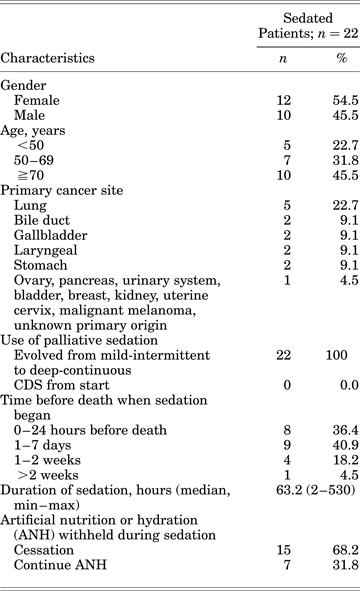
During the period studied, the total number of admissions to the PCU was 1675; 1581 of these patients died there. Of all 1581 deceased patients, 22 (1.39%) had received CDS. The median age of CDS patients was 67 (range 44–88) years, and 12 patients (54.5%) were women. In all cases, patients had terminal cancer and uncontrolled suffering requiring admission to the PCU (Table 1).
Characteristics of patients who received CDS

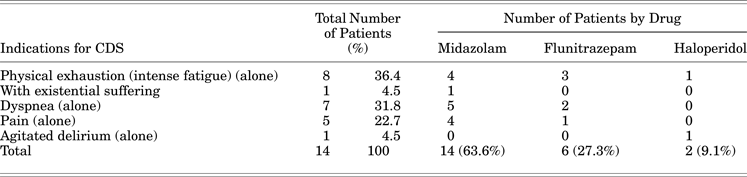
The indications for CDS are summarized in Table 2. Refractory symptoms — including physical exhaustion (intense fatigue) 8 (36.4%), dyspnea 7 (31.8%), and pain 5 (22.7%) — were the most frequently mentioned. Agitated delirium 1 (4.5%) and physical exhaustion with existential suffering 1 (4.5%) were less common.
Clinical indications and agent used for CDS
Palliative sedation was performed with slowly increasing doses of i.v. sedatives, aimed at achieving effective symptom control. When this was obtained, doses were reduced and sedation continued intermittently with documentation of level of consciousness, comfort, drinking, eating, and communication skill. In 22 cases, mild and intermittent sedation resulted in deep and continuous sedation at the end of life (Table 1).
The most commonly used sedation-inducing drug was midazolam, which is considered the first drug of choice for the purpose of palliative sedation (Cherny & Radbruch, Reference Cherny and Radbruch2009). Table 2 shows that midazolam was used in 63.6% (14/22) of cases of CDS. We also employed another benzodiazepine, flunitrazepam (27.3%; 6/22). Antipsychotics (haloperidol) were used in 9.1% (2/22) of cases. The mean daily dose of midazolam was 22.5 mg/24 hr (range 5–100 mg), of flunitrazepam 6.0 mg/24 hr (range 2–8 mg), and of haloperidol 10 mg/24 hr.
Morphine or some other opioid was already being administered to treat pain or dyspnea in 19 of 22 (86.4%) patients. Thus, of all the patients, 13.6% (3/22) received a sedative without morphine or other opioid, 86.4% (19/22) received a combination of a sedative and morphine or other opioid, and 0% (0/22) received morphine or other opioid without sedative. No patients were administrated opioid alone as the drug of choice for CDS.
For most patients, CDS was begun within a week of death (77.3%), with a mean duration of 63.2 hours (range, 2–530).
Decision-Making Process
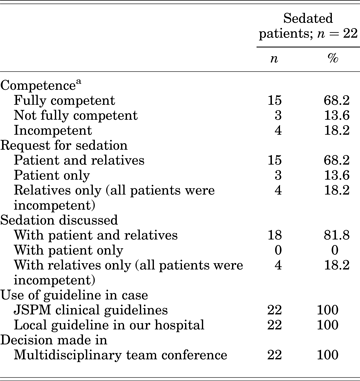
The records indicated that in 81.8% of cases the decision to use CDS was discussed either with the patient or the patient's relatives (Table 3). In the remaining 18.2%, these data were missing, because the patient was no longer competent to make such decisions.
Decision-making process
aCompetence was defined as follows: the patient was able to judge and decide carefully about his/her situation at the moment when the decision to begin CDS was taken.
The decision to use CDS was made after a thorough interdisciplinary assessment by multidisciplinary care providers. An MDTC was performed for all patients. When a patient was no longer competent to give consent, the decision had to be discussed with a representative.
Four patients receiving CDS were not able to communicate a request for CDS due to decreased cognitive function. It is extremely important that a consensus be reached between medical providers and the patient's family about: (1) the aim of the treatment (to relieve suffering and not shorten life), (2) the appropriate procedure to achieve this aim, and (3) the likely consequences.
The merits of including the patient and family in the decision-making process are indisputable. The medical staff should provide information about CDS to families and allow them enough time to discuss the decision.
Cases of Inappropriate Indications for CDS After MDTC Decision
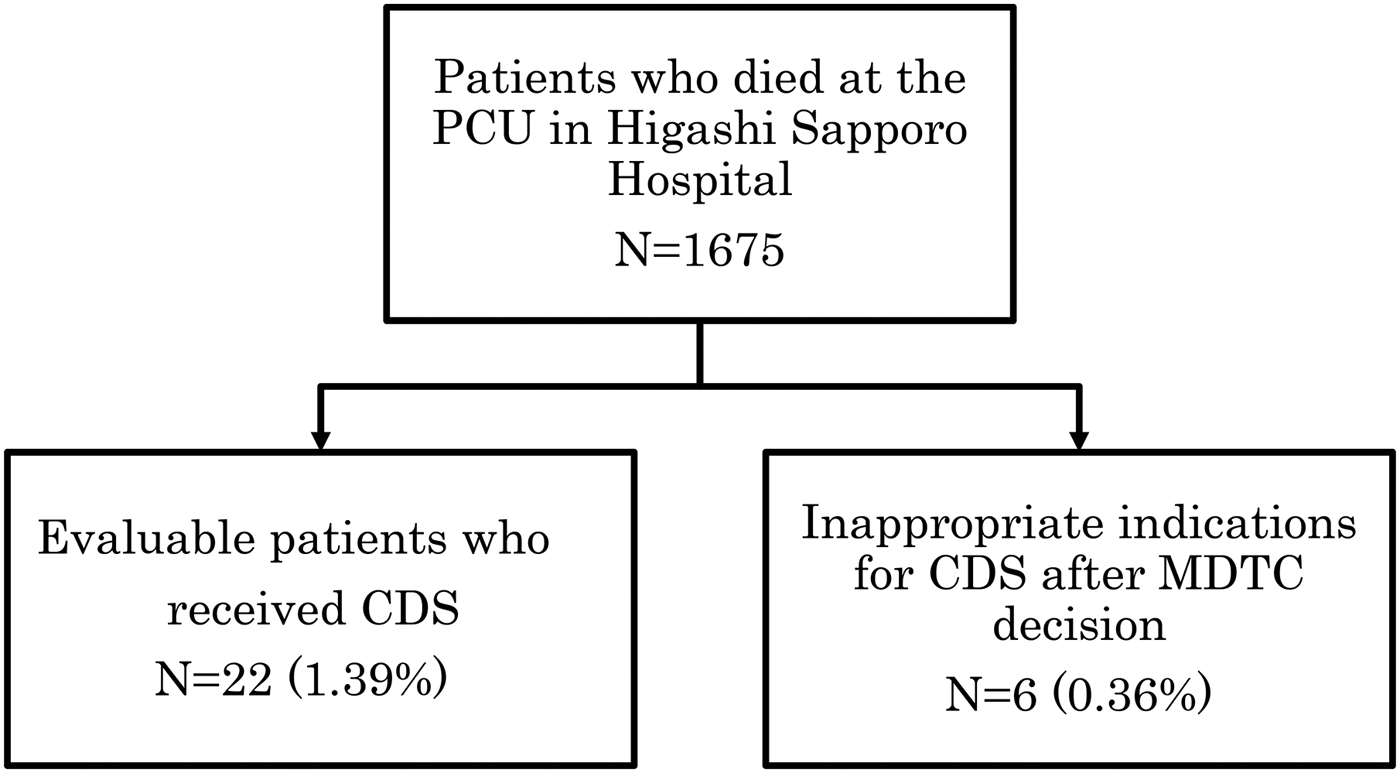
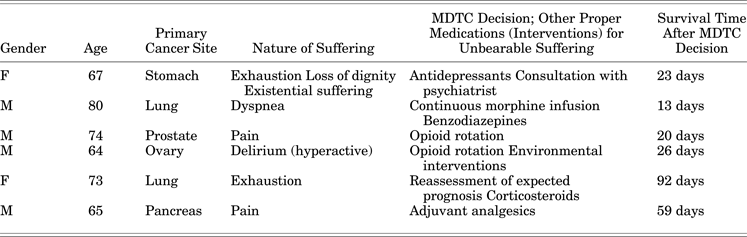
Figure 1 depicts the process of patient selection for our study. According to the MDTC, 6 (0.38%) of 1581 patients did not meet the appropriate criteria for CDS and so did not receive it. These six were considered for CDS by the attending physicians before the MDTC, who thought that all other pharmacological treatments, such as appropriate titration of opioids in the case of pain or appropriate dosing of neuroleptics for delirium, had been exhausted. Moreover, nonpharmacological approaches, such as distraction and relaxation techniques in the case of dyspnea/existential suffering, had been maximized. However, refractory suffering in these six patients could not be adequately controlled despite intensive efforts by attending physicians. An MDTC was thus performed to determine whether the indications for CDS were present. Table 4 summarizes the six cases of inappropriate indications for CDS after an MDTC decision. Multidisciplinary supportive and palliative teams can be highly effective in alleviating physical and psychosocial distress. Physicians should consult with these experts whenever possible in the presence of severe refractory symptoms.
Flowchart for patient inclusion in the study.
Six cases of inappropriate indications for CDS after MDTC decision
It is important that the decision to begin CDS be made not only with the agreement of the attending physician, patient, and family, but also with the other healthcare professionals involved in the care of the patient, including the palliative care physicians, registered general nurses, clinical pharmacists, medical social workers, and other colleagues.
Artificial Nutrition or Hydration (ANH)
Artificial hydration is defined as the administration of quantities of more than 500 ml of fluids per day. We have argued that the decision to employ CDS to treat refractory symptoms must be made independent of the decision to withhold ANH. These decisions should be considered individually for each patient, taking into account the patient's wishes. Artificial hydration should be offered to sedated patients only when the benefit will outweigh the harm, and advice from palliative care specialists should be sought before sedation. In our study, from the start of sedation, seven patients (31.8%) still received artificial hydration and continued to do so until the day of death (Table 1). None of the patients received artificial food. In 15 patients (68.2%), MDTC members decided on voluntary cessation of ANH because artificial hydration could prolong their suffering or exacerbate it by increasing peripheral edema, ascites, and bronchial secretions.
Questionnaire
The family was generally comfortable with the practice of CDS: completely satisfied (38.5%, n = 5), very satisfied (38.5%, n = 5), and not sure (23.1%, n = 3). More than 60% of families, however, exhibited a high level of emotional distress related to CDS: very distressed (15.4%, n = 2), distressed (46.2%, n = 6), slightly distressed (30.8%, n = 4), and not so distressed (7.7%, n = 1). About a third of the families (30.8%, n = 4) reported that they were distressed about the inability to communicate with a patient. Moreover, 23.1% (n = 3) of families reported that sedation might shorten the patient's life and that there might be another way to achieve symptom relief. In addition, 7.7% (n = 1) of families thought it was important that sedated patients receive the same dignified care as conscious patients had.
One bereaved family reported concerns about legal issues. They thought that CDS might be just another form of euthanasia, which is illegal in Japan. We replied by explaining the difference between CDS and euthanasia.
The level of family dissatisfaction with CDS seemed to be determined by high levels of persistent emotional distress in patients following CDS, the feeling that there might be other ways to provide symptom relief, and the fear of shortening the patient's life.
DISCUSSION
This is, to our knowledge, the first study to investigate the effectiveness of an MDTC in decision making surrounding the application of CDS for terminally ill cancer patients.
Continuous deep sedation should only be considered if a patient is in the very last stages of their illness, with an expected prognosis of hours or days at most. Intermittent or respite sedation may be indicated earlier in a patient's trajectory to provide temporary relief while waiting for treatment benefit from other therapeutic approaches (Cherny & Radbruch, Reference Cherny and Radbruch2009). The point of palliative sedation is not to reach a certain level of consciousness (e.g., coma) but to find a solution for refractory symptoms and therefore lower the level of consciousness only as much as needed (Broeckaert, B. & Leuven, Reference Broeckaert and Leuven2011).
Procedural guidelines for the use of sedation in the management of refractory sedation at the end of life are important for guiding clinical practice to ensure that the pitfalls are avoided and that sedation is employed in an appropriate setting. The Japanese Society for Palliative Medicine published such clinical guidelines in May 2010. Hopefully, this should lead to decisions being made by the physician responsible for treatment. Palliative sedation is regarded as a normal medical procedure, though one used rarely and only under exceptional circumstances. The elements of the decision include the aim, level (superficial or deep), and duration (intermittent or continuous) of sedation, and the choice of correct medication and dosage. Notes on the decision-making process and the considerations that play a role in it are to be recorded in a patient's file, including any consultation that has taken place with the patient and/or family, between the care providers, and with any specialists involved. Overuse of sedation might result in unnecessary reduction in patient consciousness, leading to poor quality of the remainder of life, while underuse of sedation could cause suffering during the end-stage of life. The treatment should only be considered if the patient is in the very last stages of their illness, with an expected prognosis of hours or days at most.
The use of an MDTC is becoming increasingly common in the management of complex diseases. These meetings are gatherings of healthcare professionals with or without patients for the purpose of discussing individual cases and recommending a management plan.
Boxer and colleagues (Reference Boxer, Vinod and Shafiq2011) reported that an MDTC was associated with better treatment, which potentially can improve quality of life for patients with lung cancer. According to the European Association for Palliative Care (EAPC) framework for palliative sedation, whenever possible, the medical rationale for sedation as well as the decision-making process should be based on input from the multidisciplinary palliative care team, rather than from the treating physician alone (Cherny & Radbruch, Reference Cherny and Radbruch2009). Case discussion and team conferences may be suitable platforms to facilitate this process.
The ethical validity of palliative sedation has been questioned because of the perception that it may hasten death (Billings & Block, Reference Billings and Block1996). However, recent evidence does not demonstrate any shortening of survival in appropriately selected patients who receive palliative sedation (Claessens et al., Reference Claessens, Menten and Schotsmans2011). It should be emphasized that the intention of this practice was exclusively to relieve refractory symptoms. In the case of palliative sedation, terminally ill patients die as result of their illness; nobody is killing or being killed, not at the level of intention, nor at the level of the action itself, nor at the level of the results. Palliative sedation does not hasten death (except in extremely exceptional cases); there are no differences in survival between groups of sedated and nonsedated patients (Claessens et al., Reference Claessens, Menten and Schotsmans2008).
It seems noteworthy to explain that physical exhaustion was the most frequently mentioned indication for the use of CDS and that agitated delirium was mentioned in only 4.5% of sedated patients. We employed the Memorial Delirium Assessment Scale to help with screening and diagnosis (Breitbart et al., Reference Breitbart, Gibson and Tremblay2002). Management of delirium usually included a thorough assessment for possible reversible causes, such as opioids, psychoactive drugs, or dehydration, and correction of these causes if possible. Haloperidol was used as a first-line therapy to control symptoms of delirium. If symptoms did not improve after upward titration of the haloperidol, some patients received second-line therapy with atypical antipsychotics or chlorpromazine. In severe and progressive cases of delirium, CDS was considered as a last resort. In patients who suffer with delirium, the use of sedatives can be reduced or avoided by appropriate assessment and management.
Prevalence of CDS
The prevalence of CDS was only 1.39% in our population. Our study found that palliative sedation was not commonly used, with an incidence lower than that reported by most others. A large difference in prevalence among hospital-based PCUs has been reported. Rietjens and colleagues (Reference Rietjens, van Zuylen and van Veluw2008a; Reference Rietjens, van Delden and Onwuteaka-Philipsen2008b) reported a prevalence of 43%, whereas Menten (Reference Menten2003) reported a prevalence of only 3.13%. Timely anticipation of palliative sedation is an important aspect of a careful decision-making process, which may ultimately provide patients and relatives with a good death.
Continuous deep sedation results in considerable distress for families as well as for healthcare professionals (Bruera, Reference Bruera2012). To alleviate bereaved family distress, clinicians should share the responsibility for facilitating grief and for providing seamless emotional support (Morita et al., Reference Morita, Ikenaga and Adachi2004; Bruinsma et al., Reference Bruinsma, Rietjens and Seymour2012).
Relevant information should be obtained from the patient, the family, and the healthcare providers involved, and this should lead to an adequate assessment of the patient's condition.
Special Considerations for the Use of Sedation in Situations of Refractory Existential or Psychological Distress
There is no consensus on the appropriateness of palliative sedation for psycho-existential suffering of terminally ill patients (Morita, 2004).
One of our patients had physical exhaustion with psycho-existential suffering (Table 2) and received some specialized psychiatric, psychological, and religious care. Prior to CDS, only superficial and intermittent sedation had been performed.
Maltoni and colleagues (Reference Maltoni, Scarpi and Rosati2012) discuss concerns with respect to the use of palliative sedation in patients with psychological distress. It has been posited that CDS for intolerable psycho-existential suffering should only be performed in exceptional cases, if the proportionality and autonomy principle is applied (Rousseau, Reference Rousseau2001; Hunt, Reference Hunt2002; Morita, Reference Morita2004). The procedure should only be considered after repeated trials of respite sedation with intermittent therapy.
LIMITATIONS
Our study has some limitations. First, the questionnaires were mailed in August 2011 for bereaved family of patients who died between April 2005 and August 2011. Everyone does not take the same amount of time to grieve. For some people, grief lasts a few months; for others it may take years. This varies from individual to individual. It might thus be inappropriate to compare bereaved family experiences at different timepoints. Second, since ours was a retrospective study, we were not able to comment on the severity of symptoms but merely knew whether or not a symptom was present. Finally, we were not able to present the degree of patient distress before CDS because of the nature of the retrospective analysis.
Physicians should not utilize CDS as an easy alternative. The procedure is actually performed as a compassionate act as a part of palliative care (Maltoni et al., 2012). Although our findings concern a single Japanese hospital, we believe they will be of interest to palliative care physicians attempting to establish CDS policies within Japan and to physicians in other countries comparing the frequency of utilization of CDS to the published literature.
CONCLUSIONS
The prevalence of CDS will decrease when it is carried out for appropriate indications. Despite the availability of the aforementioned guidelines, the skills needed to appropriately perform palliative sedation cannot be assumed to be present in every physician. Continuity of teamwork, good coordination, exchange of information, and communication between the various care providers are essential to the decision-making process in palliative sedation. Lack of any of these may lead to inadequate assessment, information discrepancies, and distress.