Introduction
In 1944, Alexander Wetmore reported a partial skeleton of a remarkable bird, which was found three years before in the middle Eocene (late Bridgerian/early Uintan age) Washakie Formation of the Sand Wash Basin in Wyoming (the species was originally assigned a late Eocene age, but see McCarroll et al., Reference McCarroll, Flynn and Turnbull1996 concerning the age of the Washakie Formation). Wetmore (Reference Wetmore1944) described the fossil as Eocathartes grallator and identified it as a flightless relative of New World vultures (Cathartidae). Because the genus name was preoccupied, it was later emended to Neocathartes (Wetmore, Reference Wetmore1950).
Olson (Reference Olson1985) first recognized that Neocathartes grallator belongs to the Bathornithidae, a taxon established by Wetmore (Reference Wetmore1933a). He further proposed that Neocathartes is a synonym of Bathornis, the type genus of the Bathornithidae, and pointed out that Bathornis grallator is very similar to B. veredus, which was described by Wetmore (Reference Wetmore1927). Initially likened to the Cathartidae and the charadriiform Burhinidae (thick-knees), bathornithids were soon recognized as stem group representatives of the Cariamiformes (Wetmore, Reference Wetmore1933a, Reference Wetmore1933b; Cracraft, Reference Cracraft1968, Reference Cracraft1971; Olson, Reference Olson1985).
Cariamiformes include only two extant species, which occur in South America and are classified in the taxon Cariamidae (seriemas). They are related to one of the most iconic groups of fossil birds from South America, the Phorusrhacidae or “terror birds”, which were diversified in the mid-Cenozoic (e.g., Alvarenga and Höfling, Reference Alvarenga and Höfling2003; Degrange et al., Reference Degrange, Tambussi, Taglioretti, Dondas and Scaglia2015a).
Various stem group Cariamiformes were, however, also described from fossil sites in North America and Europe (Mayr, Reference Mayr2009a). The best represented of these belong to the Idiornithidae, which occurred in the early Eocene to Oligocene of Europe, where they may have even persisted into the early Miocene (Mourer-Chauviré, Reference Mourer-Chauviré1983; Mayr, Reference Mayr2009a; De Pietri and Mayr, Reference De Pietri and Mayr2014). These birds were long assigned to the taxon Idiornis, which has recently been identified as a junior synonym of Dynamopterus, to which most idiornithids are now assigned (Mourer-Chauviré, Reference Mourer-Chauviré2013). Another European cariamiform taxon is Elaphrocnemus, which was formerly also assigned to the Idiornithidae, but is more likely to be outside a clade that includes Dynamopterus, phorusrhacids, and cariamids (Mayr, Reference Mayr2002, Reference Mayr2009a; Mayr and Mourer-Chauviré, Reference Mayr and Mourer-Chauviré2006).
In addition, there were various flightless, or nearly so, cariamiform-like birds in the Paleogene of Europe. The oldest species of these stems from the early Eocene of Messel in Germany and was described as Aenigmavis sapea (Peters, Reference Peters1987). Originally considered an Old World representative of the Phorusrhacidae, Ae. sapea is clearly distinguished from phorusrhacids (Alvarenga and Höfling, Reference Alvarenga and Höfling2003). It was subsequently proposed that the species—and a very similar one from the middle Eocene German locality Geiseltal—actually belongs to the taxon Strigogyps, which was established by Gaillard (Reference Gaillard1908) for a distal tibiotarsus from unknown (late Eocene or Oligocene) strata of the Quercy fissure fillings in France (Mayr, Reference Mayr2005, Reference Mayr2007).
The confusing taxonomy of European flightless cariamiforms is further complicated by the fact that Gaillard (Reference Gaillard1939) described a second species of Strigogyps, S. minor, from the Quercy fissure fillings, which is based on a humerus. This species was transferred by Mourer-Chauviré (Reference Mourer-Chauviré1981) to the new taxon Ameghinornis, as A. minor, to which she also referred coracoids and carpometacarpi from the Quercy fissure fillings (Mourer-Chauviré, Reference Mourer-Chauviré1981, Reference Mourer-Chauviré1983). These fossils were likewise considered to be phorusrhacids, but although the bones indeed show a notable similarity to the corresponding elements of the Phorusrhacidae, there are some distinct differences in detail (Alvarenga and Höfling, Reference Alvarenga and Höfling2003). Because of the resemblance of the “A. minor” humerus to that of the Messel fossils, Mayr (Reference Mayr2005) considered it likely that this bone belongs to the same species as the tibiotarsus described as Strigogyps dubius. It was, however, noted that the coracoid and carpometacarpus assigned to “A. minor” are distinguished from those of the Messel and Geiseltal fossils, which are now classified as Strigogyps (Mayr, Reference Mayr2005).
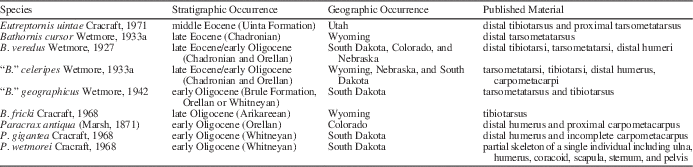
The North American bathornithids were revised by Cracraft (Reference Cracraft1968, Reference Cracraft1971), who recognized nine species in the taxa Eutreptornis, Bathornis, and Paracrax (Table 1). A true understanding of the affinities and evolutionary significance of these birds has been hampered by the fact that the skeletal anatomy of most taxa remained very poorly known. Recognition of bathornithid affinities of B. grallator, which is arguably the best known North American cariamiform species, not only postdated Cracraft’s revisions, but also overlapped with an in-depth study of Paleogene European cariamiforms (Mourer-Chauviré, Reference Mourer-Chauviré1983). As a consequence, no detailed comparisons have as yet been performed between B. grallator and any of the European taxa. Such comparisons were further aggravated by the fact that in the original description of the B. grallator holotype some important osteological details went unnoticed or were incorrectly portrayed.
Species of the Bathornithidae recognized by Cracraft (Reference Cracraft1968, Reference Cracraft1971), with data on their stratigraphic and geographic occurrences and the published fossil material

B. grallator is not only one of the earliest cariamiforms and the oldest record of Cariamiformes in North America, but the holotype specimen is also one of the most complete and best-preserved records of a stem group cariamiform outside South America. As such, the species is of great evolutionary significance, and a restudy of the holotype has long been overdue. In addition to a redescription of the material, the present study also addresses the taxonomic composition of the Bathornithidae and their phylogenetic affinities.
Materials and methods
Institutional abbreviations
AMNH, American Museum of Natural History (New York); CM, Carnegie Museum of Natural History, Pittsburgh, USA; NMB, Naturhistorisches Museum, Basel, Switzerland. For specific osteological features, the terminology follows Baumel and Witmer (Reference Baumel and Witmer1993), whereas English terms are maintained for major bones as a whole.
Phylogenetic analysis
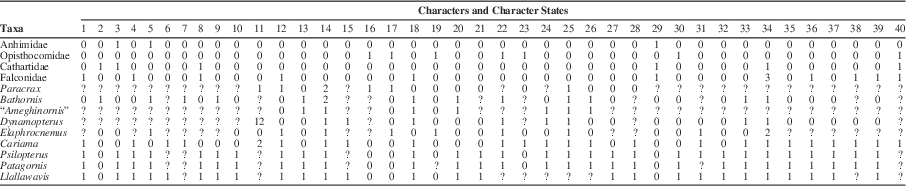
To assess the affinities of Bathornis, a phylogenetic analysis of 40 morphological characters was performed (see appendices for character descriptions and character matrix). This analysis was run with the heuristic search modus of NONA 2.0 (Goloboff, Reference Goloboff1993) through the WINCLADA 1.00.08 interface (Nixon, Reference Nixon2002), using the commands hold 10000, mult*1000, hold/10, and max*. Bootstrap support values were calculated with 1000 replicates, ten searches holding ten trees per replicate, and TBR branch swapping without max*. The trees were rooted with the Anhimidae. Tree length (L), consistency index (CI), and retention index (RI) were calculated. One character (11) was coded as additive.
The following fossil species were included in the analysis (if no reference is indicated, scoring is based on own examination of the specimens): Bathornis grallator, B. celeripes (Wetmore, Reference Wetmore1927, Reference Wetmore1937; Olson, Reference Olson1985); Paracrax wetmorei, P. gigantea; “Ameghinornis minor” (Mourer-Chauviré, Reference Mourer-Chauviré1981, Reference Mourer-Chauviré1983); Dynamopterus gallicus and D. minor (Mourer-Chauviré, Reference Mourer-Chauviré1983, Reference Mourer-Chauviré2013), D. cf. itardiensis (Mayr, Reference Mayr2000); Elaphrocnemus phasianus (Mourer-Chauviré, Reference Mourer-Chauviré1983, Mayr and Mourer-Chauviré, Reference Mayr and Mourer-Chauviré2006, and own examination); Psilopterus lemoinei (Sinclair and Farr, Reference Sinclair and Farr1932 and own examination); Patagornis marshi (Andrews, Reference Andrews1899); Llallawavis scagliai (Degrange et al., Reference Degrange, Tambussi, Taglioretti, Dondas and Scaglia2015a). In addition, the following extant taxa were examined and scored after the species in parentheses (all in the collection of Senckenberg Research Institute Frankfurt): Anhimidae (Chauna torquata), Opisthocomiformes (Opisthocomus hoazin), Cathartidae (Cathartes aura), Falconidae (Polyborus plancus), Cariamidae (Cariama cristata).
Systematic paleontology
Class Aves Linnaeus, 1758
Order Cariamiformes Verheyen, 1957
Family Bathornithidae Wetmore, Reference Wetmore1933a
Included genera
Bathornis Wetmore, Reference Wetmore1927.
Diagnosis, emended
Bathornithidae are distinguished from other Cariamiformes by the combination of the following characters: (1) ventral surface of rostrum maxillae not roofed by the medially co-ossified processus palatini of praemaxillae; (2) lacrimal fused with frontal and ectethmoid, with the three bones forming a solid unit; (3) main plane of processus postorbitalis parallel to paramedian axis of skull; (4) coracoid with greatly reduced processus acrocoracoideus, (5) cup-like cotyla scapularis, and (6) shallow incisura nervi supracoracoidei; (7) tarsometatarsus greatly elongated, measuring more than length of humerus; (8) hallux well developed; (9) ungual phalanges with sulcus neurovascularis.
Bathornis Wetmore, Reference Wetmore1927
Bathornis grallator (Wetmore, Reference Wetmore1944)
Bathornis grallator (Wetmore, Reference Wetmore1944) from the middle Eocene of Wyoming (holotype, CM 9377), skull in (1) right lateral, (3) ventral, and (5) dorsal view in comparison to (2, 4, 6) the reconstructions of Wetmore (Reference Wetmore1944). (7, 8) Mandible in (7) left lateral and (8) dorsal view. Neurocranium and beak of the fossil are now separated and were assembled for the photos; note also that the dorsal nasal bar is now broken. The arrows in (4) indicate erroneously assumed processus basipterygoidei, and the framed area in (6) denotes the incorrectly reconstructed rostrolateral rim of the orbit. In (2) and (4) the original lettering was removed. Scale bar equals 20 mm.
Bathornis grallator (Wetmore, Reference Wetmore1944) from the middle Eocene of Wyoming (holotype, CM 9377). (1–3) Skulls (dorsolateral view) of (1) B. grallator, (2) Cariama cristata (Cariamidae), and (3) Coragyps atratus (Cathartidae). (4–6) Tips of upper jaws in ventral view of (4) B. grallator, (5) C. cristata, and (6) C. atratus. (7) Upper and lower beak of B. grallator in articulation. (8) Neurocranium of B. grallator in right lateral view. cho, choanal opening; lac, lacrimale; pal, palatinum; pmp, processus maxillopalatinus; pmx, processus maxillaris of palatinum; pop, processus postorbitalis; sup, processus supraorbitalis; zyg, processus zygomaticus. Scale bars equal 20 mm.
Bathornis grallator (Wetmore, Reference Wetmore1944) from the middle Eocene of Wyoming, skull details. (1) Neurocranium in dorsolateral view. (2, 3) Detail of otic region in (2) lateral and (3) ventrolateral view. (4) Otic region of Cariama cristata in ventrolateral view. (5, 6) Detail of lacrimal-ectethmoid complex of (5) B. grallator and (6) C. cristata. (7, 8) Left quadrate in ventral view of (7) B. grallator and (8) C. cristata. (9–11) Left quadrate and jugal bar of (9, 10) B. grallator (in 10 the matrix was digitally removed) and (11) C. cristata. cdl, condylus lateralis; ect, ectethmoidale; idn, incisura ductus nasolacrimalis; lac, lacrimale; orb, processus orbitalis of quadrate; pop, processus postorbitalis; por, processus orbitalis of lacrimale; psm, processus suprameaticus; sup, processus supraorbitalis; unc, os uncinatum; zyg, processus zygomaticus. Scale bars equal 20 mm.
Bathornis grallator (Wetmore, Reference Wetmore1944) from the middle Eocene of Wyoming (holotype, CM 9377). (1–5) Right pterygoid in (1) medial, (2) dorsal, (3) dorsolateral, (4) lateral, and (5) ventral view. (6–8) Right pterygoid of Cariama cristata in (6) medial, (7) lateral, and (8) ventral view. (9–11) Right pterygoid of Coragyps atratus in (9) medial, (10) lateral, and (11) ventral view. (12) B. grallator, ossified tracheal rings. (13, 14) B. grallator, axis and atlas in (13) dorsal and (14) right lateral view. (15, 16) C. cristata, axis and atlas in (15) dorsal and (16) right lateral view. (17) B. grallator, ?13th praesacral vertebra (dorsal view). (18) 13th praesacral vertebra of C. cristata. (19–21) B. grallator, 14th or 15th vertebra in (19) dorsal, (20) right lateral, and (21) caudal view. (22–24) 15th vertebra of C. cristata in (22) dorsal, (23) right lateral, and (24) caudal view. bpt, facies articularis basipterygoidea; fac, facies articularis caudalis; fap, facies articularis palatina; liz, lacuna interzygapophysialis; pvt, processus ventralis; spi, processus spinosus; tra, tracheal rings. Scale bars equal 10 mm.
Bathornis grallator (Wetmore, Reference Wetmore1944) from the middle Eocene of Wyoming (holotype, CM 9377), wing and pectoral girdle bones. (1, 3) B. grallator, right scapula as it is preserved and (2, 4) with proximal end digitally reassembled; the dotted area indicates the reconstructed part of the shaft. (5, 6) B. grallator, right coracoid in (5) dorsal and (6) ventral view. (7, 8) Right coracoid of Cariama cristata in (7) dorsal and (8) ventral view. (9, 10) Fragment of distal end of right humerus in (9) caudal and (10) cranial view. (11, 12) B. grallator, fragment of distal end of right ulna in (11) ventral and (12) distal view. (13) Proximal portion of right ulna of C. cristata in cranial view. (14–16) B. grallator, proximal portion of right ulna in (14) cranial, (15) dorsal, and (16) caudal view. (17, 18) B. grallator, incomplete left carpometacarpus in (17) dorsal and (18) ventral view. (19, 20) Right carpometacarpus of C. cristata in (19) dorsal and (20) ventral view. (21) B. grallator, left phalanx proximalis digiti majoris. acr, acromion; brd, osseous bridge connecting processus acrocoracoideus and processus procoracoideus; cdd(h), condylus dorsalis of humerus; cdd(u), condylus dorsalis of ulna; csc, cotyla scapularis; ctd, cotyla dorsalis; ctv, cotyla ventralis; faa, facies articularis alularis; fas, facies articularis sternalis; ins, incisura nervi supracoracoidei; ocn, olecranon; pac, processus acrocoracoideus; sct, sulcus scapulotricipitalis; std, sulcus tendineus; tbc, tuberculum carpale; tir, tubercle at incisura radialis; vpr, ventral projection at base of os metacarpale minus. Scale bars equal 20 mm.
(1, 3, 5) partial left humerus of Bathornis grallator (Wetmore, Reference Wetmore1944) from the middle Eocene of Wyoming (holotype, CM 9377) in comparison to (2, 4, 6) the humerus of “Ameghinornis minor” from an unknown horizon of the middle Eocene to Oligocene Quercy fissure fillings in France (from Gaillard, Reference Gaillard1939, fig. 4). (1, 2) caudal view, (3, 4) ventral view, (5, 6) cranial view. The dotted lines in (1) and (5) indicate the reconstructed hypothetical outline of the complete distal end of the B. grallator humerus. mdr, midline ridge. Scale bars equal 20 mm.
Bathornis grallator (Wetmore, Reference Wetmore1944) from the middle Eocene of Wyoming (holotype, CM 9377), pelvis, and femur. (1, 3) fragmentary pelvis of B. grallator in (1) dorsal and (3) right lateral view. (2, 4) Pelvis of Cariama cristata in (2) dorsal and (4) right lateral view. (5) B. grallator, fragmentary portion of left ilium and pubis in lateral view, with (6) the corresponding part of the pelvis of C. cristata (the dotted line indicates the approximate position of the fossil fragment). (7) Right femur of C. cristata in cranial view. (8, 9) Fragmentary right femur of B. grallator in (8) cranial and (9) caudal view; the grey area in (8) indicates the reconstructed (and hypothetical) shape of the broken caput femoris. act, foramen acetabuli; ctr, crista trochanterica; fio, foramen ilioischiadicum; fob, foramen obturatum; ftr, fossa trochanteris; iob, impressiones obturatoriae; lic, linea intermuscularis cranialis; pub, pubis. Scale bars equal 20 mm.
Bathornis grallator (Wetmore, Reference Wetmore1944) from the middle Eocene of Wyoming (holotype, CM 9377), tibiotarsus and tarsometatarsus. (1–4) Right tibiotarsus in (1) lateral, (2) cranial, (3) medial, and (4) caudal view. (5–8) Right tarsometatarsus in (5) dorsal, (6) lateral, (7) medial, and (8) ventral view. Scale bars equal 20 mm.
Bathornis grallator (Wetmore, Reference Wetmore1944) from the middle Eocene of Wyoming (holotype, CM 9377), right foot. Identity of the pedal phalanges as inferred by (1) Wetmore (Reference Wetmore1944) and (2) in the present study. The dotted line indicates a reconstructed proximal part of the penultimate phalanx of the third toe; the asterisked phalanges were found in articulation (according to Wetmore, Reference Wetmore1944). (3) Pedal phalanges of Cariama cristata (phalanges of hallux and third toe from right foot, those of second and fourth toe from left foot of same individual and mirrored). The toes are numbered; the first four phalanges of the fourth toe of Cariama are shown in articulation, the ends of the phalanges are indicated by the arrows. snv, sulcus neurovascularis. Scale bars equal 20 mm.
Holotype
CM 9377, partial skeleton including largely complete skull, several fragmentary vertebrae, the right coracoid, right scapula, and partial left humerus, a fragment of the distal end of the right humerus, the proximal portion of the right ulna, an incomplete left carpometacarpus, a partial pelvis, fragments of both femora, a right tibiotarsus and tarsometatarsus, pedal phalanges of the right foot, as well as various other small bones and bone fragments, including the right pterygoid and ossified tracheal rings.
Occurrence
Sand Wash Basin, Wyoming, locality 196; Washakie Formation, late Bridgerian/early Uintan (McCarroll et al., Reference McCarroll, Flynn and Turnbull1996).
Description and comparison
As noted by Olson (Reference Olson1985), the Bathornis grallator holotype underwent some damage since its description, which is particularly true for the skull (Fig. 1). In addition to the lost caudal ends of the mandible, the upper beak is now separated from the neurocranium and the dorsal nasal bar is broken and missing.
Overall, the skull of B. grallator resembles that of the Cariamidae (Fig. 2.1, 2.2), but there are some distinct differences in detail. The upper beak is proportionally shorter and dorsoventrally deeper than that of extant seriemas and has a somewhat broader and more rounded tip. Its section ventral of the nostrils is dorsoventrally deeper than in the Cariamidae. The ventral surface of the rostrum maxillae is furthermore not roofed by the medially co-ossified processus palatini of the praemaxillae as it is in the Cariamidae and many other birds, but forms a deeply concave hollow as in the Cathartidae (Fig. 2.4–2.6). The processus maxillares of the palatina contact each other and may have been fused, with the contact zone forming the caudal margin of a large choanal opening; whether processus maxillopalatini are also involved in that part of the palate is not clearly discernible. The pars maxillaris of the palatinum is ventrally offset from the os maxillare.
A particularly remarkable difference between the skull of B. grallator and that of other cariamiform birds is the fact that in B. grallator the lacrimal is fused with the frontal and the ectethmoid, with the three bones forming a solid unit (Fig. 3.1). This condition also occurs in the Cathartidae and the presumably closely related extinct Teratornithidae, whereas in the Cariamidae and the Phorusrhacidae examined for the present study the lacrimals are not fused to either the frontals or the ectethmoids. Unlike in cathartid vultures, however, the lacrimal of B. grallator forms a sharp caudal edge, which projects into the orbital rim; with regard to this feature, Wetmore’s (Reference Wetmore1944) reconstruction of the skull is incorrect and remarkably different from the actual specimen (Fig. 1.5, 1.6). Only the right lacrimal is preserved, and although the caudal portion of its “head” is slightly damaged, a well-developed, caudally directed processus supraorbitalis, which occurs in Phorusrhacidae and Cariamidae, appears to have been absent. The lateral margin of the processus orbitalis of the lacrimale exhibits a distinct incisura ductus nasolacrimalis. An uncinate bone, which is present in both Cariamidae and Phorusrhacidae (Degrange et al., Reference Degrange, Tambussi, Taglioretti, Dondas and Scaglia2015a), is not preserved.
The jugal bar is more robust than that of the Cariamidae, but less so than the jugal bar of phorusrhacids. The processus postorbitalis is wider than in the Cariamidae and has a different orientation, with its main plane being parallel to the paramedian (sagittal) axis of the skull, whereas it is oriented in a more transversal plane in the Cariamidae (Fig. 3.2–3.4). The processus zygomaticus of B. grallator (Fig. 3.2, 3.3) is shorter than that of the Cariamidae (Fig. 3.4) and more closely corresponds with that of the Cathartidae. The processus suprameaticus (Fig. 3.2, 3.3) is well developed as in the Phorusrhacidae, whereas this process is indistinct in the Cariamidae (Fig. 3.4). The dorsal surface of the neurocranium is vaulted. The fossae temporales are less deep than in Cariama. Most of the basicranial area is broken and the remaining portions are too poorly preserved for a meaningful examination of osteological details.
Wetmore (Reference Wetmore1944) noted that the holotype of B. grallator includes “the anterior end of the right pterygoid,” but actually the entire right pterygoid is preserved (Fig. 4.1–4.5). The bone is stouter than the pterygoid of Cariama and has a smaller caudal portion (Fig. 4.6–4.8). Wetmore (Reference Wetmore1944) noted that “a basipterygoid process [is] indistinctly evident,” but the pterygoid lacks a well-defined facies articularis basipterygoidea. This facet is sharply delimited in the Cathartidae (Fig. 4.9–4.11) and Phorusrhacidae (Gould and Quitmyer, Reference Gould and Quitmyer2005, fig. 1), in which basipterygoid processes are present. Accordingly, it is here concluded, that Bathornis lacked these processes (contra Wetmore, Reference Wetmore1944, fig. 2 and Agnolín, Reference Agnolín2009, p. 25).
The left quadrate is in its original position, but the bone is very poorly preserved (Fig. 3.7, 3.9). Wetmore’s (Reference Wetmore1944) detailed reconstruction therefore appears to be hypothetical, unless it was based on a now lost right quadrate. Overall, and as far as comparisons are possible, the bone resembles the quadrate of the Cariamidae. The processus orbitalis appears to have been rather short; the processus oticus has a mediolaterally broad tip. The condylus caudalis forms a shelf-like caudal lip as in the Cariamidae, the condylus medialis seems to be broken.
The mandible has proportionally somewhat deeper rami than the mandible of the Cariamidae. Contrary to the latter, it also lacks a fenestra rostralis mandibulae (the opening in the left ramus mandibulae visible in Fig. 1.7, 1.8 is an artefact of breakage; see the right ramus mandibulae in Fig. 2.7).
A few ossified tracheal rings are preserved (Fig. 4.12), which went unnoticed by Wetmore (Reference Wetmore1944). Ossified tracheal rings occur in numerous unrelated birds and were also reported for the Phorusrhacidae (Degrange et al., Reference Degrange, Tambussi, Taglioretti, Dondas and Scaglia2015a).
Most of the vertebrae are poorly preserved. The series includes the axis and atlas, which are still in articulation (Fig. 4.13, 4.14), as well as fragments of nine further vertebrae. Of the atlas, only the arcus atlantis is preserved, which is craniocaudally wider than that of the Cariamidae (Fig. 4.15, 4.16). The axis has a similar shape to that of the Cariamidae, but the processus spinosus is narrower and more ridge-like, and the processus ventralis is bulkier and more ventrally prominent (Fig. 4.14, 4.16). Most of the other vertebrae are too fragmentary for a meaningful description. One of the more complete vertebrae is represented only by its dorsal portion (Fig. 4.17). This vertebra lacks a well-developed processus spinosus, and by comparison with Cariama (Fig. 4.18) it may represent the 13th presacral vertebra (it was identified as the 11th by Wetmore, Reference Wetmore1944, fig. 7). Another vertebra that was identified as the 12th by Wetmore (Reference Wetmore1944, figs. 5, 6) is here considered to be the 14th or 15th (Fig. 4.19–4.21). It exhibits a long processus ventralis, but is craniocaudally narrower than the corresponding vertebrae of Cariama (Fig. 4.22–4.24), with the facies articularis caudalis being dorsoventrally deeper and the lacuna interzygapophysialis much more marked.
A breakage line indicates that the cranial portion of the scapula was broken and was reassembled by the preparator, who also reconstructed a missing part of the shaft (Wetmore, Reference Wetmore1944, fig. 8 and Fig. 5.1–5.4). As restored and figured by Wetmore (Reference Wetmore1944), the bone exhibits a very peculiar shape, which is not matched by any other bird. In fact, however, its cranial extremity appears to have been incorrectly added to the remainder of the bone, with the facies articularis humeralis facing medially instead of laterally. With the cranial extremity digitally disassembled and mounted in a correct orientation, the shape of the scapula is more similar to that of the Cariamidae, although the cranial portion of the shaft seems to lack the straight section found in the scapula of extant seriemas (unless this part of the bone is missing in the fossil).
The coracoid of B. grallator has a distinctive morphology, and in overall shape it resembles the coracoid that was assigned to the European cariamiform “Ameghinornis minor” (compare Fig. 5.5 and 5.6 with Mourer-Chauviré, Reference Mourer-Chauviré1981, figs. 3–6). Wetmore (Reference Wetmore1944) figured only the ventral aspect of the bone, and gave an all-too brief description, which omitted important features. Although the extremitas omalis is slightly abraded, it appears to be largely complete and is proportionally somewhat longer than in “A. minor.” The processus acrocoracoideus is greatly reduced and very short, with a rounded tip and no facies articularis clavicularis. The processus procoracoideus is broken, but was wide at its base. The cotyla scapularis is deeply excavated and cup-like; it appears to be less extensive mediolaterally than in “A. minor,” but the medial portion of the cotyla may be broken or abraded. The medial margin of the shaft exhibits a distinct but shallow incisura nervi supracoracoidei. The extremitas sternalis is damaged, but its sternolateral corner is complete and indicates that the processus lateralis was short. In sterno-omal direction, the facies articularis sternalis is deeper than that of the Cariamidae. The extremitas sternalis of the coracoid of “A. minor” is proportionally smaller and the dorsal portion of the facies articularis sternalis is narrower in sterno-omal direction.
The left humerus lacks most of the proximal and a part of the distal end. By comparison with the very similar “Ameghinornis minor” humerus, the remaining portions of the bone nevertheless indicate that the proximal end was greatly reduced (Fig. 6). The crista deltopectoralis appears to have been low. The area between the caput humeri and the crus dorsale fossae—on the caudal surface of the bone—is markedly concave. Distal of this area, the proximal portion of the shaft forms a marked midline ridge, medial and lateral of which the shaft steeply slopes. In “A. minor,” this ridge is less marked and the shaft of the B. grallator humerus is less curved than that of “A. minor.” The midsection of the shaft is craniocaudally very wide, although this may be a result of the taphonomic distortion of the bone. The distal end of the left humerus is poorly preserved and both condyli are broken; the fossa musculi brachialis appears to have been very shallow. As in the Cariamidae, the processus flexorius is strongly ventrally projected. The B. grallator holotype also includes a fragment of the dorsodistal portion of the right humerus, which was not mentioned by Wetmore (Reference Wetmore1944) and allows the recognition of the condylus dorsalis and a distinct sulcus scapulotricipitalis (Fig. 5.9, 5.10). The latter feature further distinguishes the humerus of B. grallator from that of “A. minor,” in which the sulcus scapulotricipitalis is less well developed (compare Figs. 5.9 and 6.2).
The proximal end of the ulna (Fig. 5.14–5.16) is clearly distinguished from the proximal ulna of the Cariamidae. The shaft is dorsoventrally compressed and the caudal surface of its proximal portion forms a ridge. The olecranon is unusually bulky and more prominent than in both Phorusrhacidae and Cariamidae. The impressio brachialis is also proportionally longer than that of the Cariamidae, the cotyla ventralis is somewhat deeper. Agnolín (Reference Agnolín2009) noted a concave distal rim of the cotyla ventralis as a diagnostic feature of Bathornis, but this observation was based on a misinterpretation of the drawing in Wetmore (Reference Wetmore1944). The incisura radialis is distinctly raised and forms a marked tubercle (Fig. 5.14), which is absent in the Cariamidae. A fragment of the proximal end of the left ulna, which was mentioned by Wetmore (Reference Wetmore1944), could not be located. However, a small bone fragment, which went unnoticed by Wetmore (Reference Wetmore1944), is here identified as the distal end of the left ulna (Fig. 5.11, 5.12) and is dorsoventrally narrower than the distal ulna of the Cariamidae. The original length of the ulna of B. grallator is difficult to estimate, but the preserved portions indicate that is was not as abbreviated as in phorusrhacids.
The holotype includes the left carpometacarpus (Fig. 5.17, 5.18), which has similar proportions to that of the Cariamidae (Fig. 5.19, 5.20) and likewise resembles the carpometacarpus of “A. minor” (Mourer-Chauviré, Reference Mourer-Chauviré1981, figs. 7–10). Although most of the proximal end of the bone is missing, the processus alularis is preserved and has a ball-shaped facies articularis alularis. The shape of this articulation facet is similar to that of the Cariamidae and phorusrhacids (e.g., Chandler, Reference Chandler1994; Degrange et al., Reference Degrange, Noriega and Vizcaíno2015b), and distinguishes Bathornis from non-cariamiform birds. As noted by Wetmore (Reference Wetmore1944), the sulcus tendineus is very weakly marked, which is also true for the sulcus tendineus of other cariamiform birds. The os metacarpale minus is of equal width through its length and does not narrow distally; its distal portion is craniocaudally wider than in the Cariamidae. On the ventral surface of its proximal end there is no ventrally directing projection, which is found in “A. minor,” as well as in Dynamopterus, Phorusrhacidae, and Cariamidae, although there remains a possibility that this projection is broken in B. grallator.
The phalanx proximalis digiti majoris (Fig. 5.21) is craniocaudally narrower than that of the Cariamidae. I could not locate the phalanx digiti alulae figured by Wetmore (Reference Wetmore1944) in his reconstruction of the wing of B. grallator. Carpal bones are not preserved.
The pelvis includes the synsacrum and much of the praeacetabular portion, which is narrow as in the Cariamidae (Fig. 7.1–7.4). As in the latter, the cristae iliacae dorsales are co-ossified over their entire length. The preserved portion of the left ischium also corresponds well with the Cariamidae (Fig. 7.5, 7.6). Most of the caudal portion is missing, but the remaining parts indicate that this part of the pelvis was mediolaterally narrower than in the Cariamidae.
Fragments of both femora are preserved. The more complete one is the proximal portion of the right femur (Fig. 7.8, 7.9). Except for its very base, the caput femoris is broken. Most of the crista trochanteris is likewise missing, but the remaining parts indicate that the crista was prominent as in the Cariamidae, whereas it is low in the Phorusrhacidae. A prominent crista trochanteris is also indicated by the deep fossa trochanteris. Unlike in cathartid vultures and other diurnal birds of prey, there is no pneumatic foramen in the lateral portion of the cranial surface of the proximal end. The linea intermuscularis cranialis is well marked and very long, and the impressiones obturatoriae on the caudal surface of the proximal end of the femur form a distinctly raised area.
The tibiotarsus is crushed, so that the shaft may appear somewhat wider than it originally was. The proximal end of the bone is missing and the distal end is damaged. As far as comparisons are possible, the bone resembles the tibiotarsus of B. veredus (Fig. 8.1–8.4 and Wetmore, Reference Wetmore1937). It does not exhibit a pons supratendineus, which is present in B. veredus, but the corresponding area is poorly preserved and it is here assumed that absence of this osseous bridge is due to breakage.
As already noted by Olson (Reference Olson1985), the elongated tarsometatarsus also resembles the corresponding bone of Bathornis veredus (compare Fig. 8.5–8.8 with Olson, Reference Olson1985, fig. 6), whereas it is proportionally shorter and stouter than the tarsometatarsus of the Cariamidae. The proximal end is missing and the distal end is likewise damaged, with the trochleae metatarsorum II and IV being broken and the trochlea metatarsi III lacking a part of its distal portion. The plantar surface of the bone is slightly concave and a crista medianoplantaris is absent. A fossa metatarsi I is not discernible.
The fossil includes 12 pedal phalanges or parts thereof. Wetmore (Reference Wetmore1944) stated that 13 phalanges are preserved, but figured only 11, which may indicate that he did not consider all of the preserved phalanges to come from the same foot (although he noted that “allocation to right or left sides is not attempted”; Wetmore, Reference Wetmore1944, p. 67). However, because only the right tibiotarsus and tarsometatarsus are preserved, it is reasonable to suppose that all of the phalanges belong to the same foot. This assumption is also supported by the fact that all phalanges differ in size and/or proportions, which indicates that no duplicate phalanges from the left foot are included in the material. Altogether, there are three ungual and nine non-ungual pedal phalanges, so that only one non-ungual and one ungual phalanx would be missing if the foot had the total phalangeal count.
My identification of the pedal phalanges differs from Wetmore (Reference Wetmore1944) in that I consider the phalanx identified as first (proximal) phalanx of the second toe by him to be the second phalanx of the third toe. The phalanx, which is here identified as the first phalanx of the second toe was not depicted by Wetmore (Reference Wetmore1944). Regardless of whether Wetmore’s (Reference Wetmore1944) identification is followed or mine, the proximal phalanx of the second toe is more slender and proportionally longer than the corresponding phalanx of the Phorusrhacidae and Cariamidae (Fig. 9), in which the proximal end of this phalanx furthermore exhibits a much more marked tendinal sulcus.
According to Wetmore (Reference Wetmore1944), the third and fourth phalanges of the fourth toe were found in articulation. Because in birds with abbreviated central phalanges of the fourth toe, the second and third phalanges have the same length, it is likely that the fourth toe of B. grallator had abbreviated second and third phalanges and a slightly longer penultimate (fourth) one. In the Phorusrhacidae (e.g., Degrange et al., Reference Degrange, Tambussi, Taglioretti, Dondas and Scaglia2015a) and Cariamidae, by contrast, the penultimate phalanx is as abbreviated as the second and fourth. With regard to the proportions of the pedal phalanges, B. grallator is therefore clearly distinguished from Phorusrhacidae and Cariamidae and resembles the putatively cariamiform early Eocene Strigogyps as well as early Eocene representatives of the Idiornithidae (Mayr, Reference Mayr2000).
Although the B. grallator holotype does not include an os metatarsale I and a fossa metatarsi I is not visible on the tarsometatarsus, I concur with Wetmore’s (Reference Wetmore1944) identification of one phalanx as that of the hindtoe; an alternative interpretation of this phalanx as the penultimate one of the fourth toe seems unlikely, because in that case the two central phalanges of the fourth toe would have a different length. The presence of a fairly well-developed hindtoe distinguishes B. grallator from both Phorusrhacidae and Cariamidae, in which the hindtoe is very short. Furthermore unlike in the Phorusrhacidae and Cariamidae, the ungual phalanges of B. grallator exhibit sulci neurovasculares, are somewhat less sharply curved, and have a less well defined tuberculum flexorium (Fig. 9).
Results of the phylogenetic analysis
The primary analysis resulted in eight most parsimonious trees, the consensus tree of which is shown in Figure Reference Degrange, Tambussi, Taglioretti, Dondas and Scaglia10.1. The analysis supported a clade formed by Cariamidae and Phorusrhacidae, to the exclusion of Bathornis, Ameghinornis, and Dynamopterus (Idiornithidae). This clade is supported by nine apomorphies, the following two of which were unambiguously optimized in the analysis (numbers in parentheses refer to the character list in the appendix): (35) proximal phalanx of hallux very short, measuring less than half of the length of the proximal phalanx of the third toe; (37) penultimate phalanx of fourth toe abbreviated, not significantly longer than second and third phalanges of this toe. Other characters optimized as apomorphies of this clade are: (1) skull with well developed, caudally projecting processus supraorbitales; (4) rostrum maxillae roofed by medially co-ossified processus palatini of praemaxillae; (12) coracoid, articulation surface for scapula forming a shallow facies; (31) tibiotarsus, crista cnemialis cranialis well developed and markedly cranially projecting; (36) proximal phalanx of second toe abbreviated; (38) ungual phalanx of second toe strongly curved and sharply hooked; (39) ungual phalanges without sulci neurovasculares.
(1) Strict consensus tree of eight most parsimonious trees resulting from the primary analysis of the character matrix in the appendix (L=79, CI=0.55, RI=0.66). (2) Strict consensus tree of 15 most parsimonious trees (L=77, CI=0.57, RI=0.68) obtained after exclusion of “Ameghinornis” from the analysis. Full circles denote unambiguously optimized characters, open circles homoplastic ones; the numbers refer to the characters in the Appendix. Unsupported nodes are collapsed in all trees; bootstrap support values are indicated next to the internodes.
Bathornis, Ameghinornis, and Dynamopterus resulted in a polytomy together with the clade (Cariamidae + Phorusrhacidae), and the following five characters were optimized as unambiguous apomorphies of a clade including these taxa: (7) pterygoid, proximal end dorsoventrally expanded; (15) furcula with weakly developed or completely reduced scapi clavicularum (unknown for Bathornis and “Ameghinornis”); (24) carpometacarpus, proximal end of os metacarpale minus bearing a well-developed tubercle on its ventral side (absent in Bathornis); (26) carpometacarpus, sulcus tendineus shallow and inconspicuous; (33) tarsometatarsus greatly elongated and slender, measuring more than the length of the humerus. Another character (11: coracoid with processus procoracoideus directed towards hook-like processus acrocoracoideus) cannot be assessed for Bathornis and the Phorusrhacidae, in which the extremitas omalis of the coracoid is reduced. Two further apomorphies of this node either represent a reversal into the primitive state (17: humerus robust and stout) or are homoplastic and occur in, for example, the Falconidae (18: humerus, distal end ventrally inflected with ventrally projecting processus flexorius).
The analysis did not resolve the affinities of Paracrax and Elaphrocnemus, which were placed in a polytomy together with Opisthocomiformes. In four of the eight trees resulting from the analysis, Opisthocomiformes, Elaphrocnemus, and Paracrax were shown to be successive sister taxa of a clade including Bathornis, Dynamopterus, Phorusrhacidae, and Cariamidae. In two trees, Elaphrocnemus and Paracrax resulted as sister taxa and in two other trees, a clade including Opisthocomiformes, Elaphrocnemus, and Paracrax was recovered.
None of the nodes of the primary analysis was retained in the bootstrap analysis. Regarding the purpose of the present study it is, however, of significance that after exclusion of the poorly known “Ameghinornis”, a clade formed by Cariamidae and Phorusrhacidae, to the exclusion of Bathornis and Dynamopterus, received a moderate bootstrap support of 73% (Fig. 10.2).
Discussion
Taxonomic composition of the Bathornithidae
Agnolín (Reference Agnolín2009) already removed Paracrax from the Bathornithidae, and in all of the bones that can be directly compared, Bathornis grallator is indeed very different from Paracrax wetmorei and the very large P. gigantea. This is particularly true for the coracoid and the humerus, which are both much more massive in Paracrax than in Bathornis (Fig. 11). Unlike in Bathornis, the coracoid of Paracrax features a well-developed processus acrocoracoideus, and the scapula exhibits a large pneumatic foramen at the base of the acromion, which is indicative of a higher degree of pneumaticity of the skeleton. Although differences per se do not prove a non-relationship, neither the present analysis nor that of Agnolín (Reference Agnolín2009) supported close affinities between Paracrax and Bathornis.
Right humeri (cranial view) and left coracoids (dorsal view). (1, 6) Cariama cristata. (2, 7) Bathornis grallator (holotype, CM 9377; both bones mirrored). (3, 8) Paracrax wetmorei (holotype, AMNH F.A.M. 42998). (4, 9) Elaphrocnemus phasianus (humerus: NMB Q.W.1755, mirrored; coracoid: NMB Q.D.242). (5, 10) Opisthocomus hoazin (Opisthocomiformes, both bones mirrored). ins, incisura nervi supracoracoidei; pac, processus acrocoracoideus; ppc, processus procoracoideus. Scale bars equal 10 mm.
Olson (Reference Olson1985, p. 149) noted that the species assigned to Bathornis show a considerable diversity in hypotarsus morphology and that the “the simple block-like hypotarsus of B. veredus is completely unlike the hypotarsus of B. celeripes or B. geographicus, which is elongate and complex, with grooves and canals”. Mayr (Reference Mayr2009a) pointed out that there exists a possibility that the leg bones assigned to “B.” celeripes and “B.” geographicus belong to Paracrax antiqua or P. wetmorei, the hindlimb elements of both of which are unknown. As further detailed by Mayr (Reference Mayr2009a), and at least judging from the published figures, a humerus referred to “B.” celeripes by Wetmore (Reference Wetmore1958) closely resembles a humerus, which was assigned to Paracrax antiqua by Cracraft (Reference Cracraft1968). Direct comparisons of these specimens are, however, required to support or refute the hypothesis of close affinities. In case such can be verified, “B.” celeripes and “B.” geographicus would have to be transferred to the taxon Paracrax.
The affinities of B. cursor and B. fricki cannot be reliably established based on the known fossil material assigned to these species. This is also true for the putative bathornithid (sensu Cracraft, Reference Cracraft1971) Eutreptornis uintae, which is very different from Bathornis —as exemplified by B. veredus—in hypotarsus morphology.
Accordingly, it is here suggested to restrict Bathornithidae to the taxon Bathornis, with the latter including the species B. grallator, B. veredus, and—possibly, owing to the limited material known—B. cursor and B. fricki. It was already detailed by Olson (Reference Olson1985), that Bathornis grallator and B. veredus are very similar in the bones that can be compared in both species (compare Fig. 8.5–8.8 with Olson, Reference Olson1985, fig. 6). Agnolín (Reference Agnolín2009) even considered B. grallator to be a junior synonym of B. veredus, but some caution may be appropriate, because, with a middle Eocene (late Bridgerian/early Uintan) age, B. grallator is at least six million years older than the late Eocene (Chadronian) B. veredus.
As yet, no incontestable evidence has been put forth for cariamiform affinities of Paracrax. Although the extremitas omalis of the coracoid is reminiscent of that of seriemas in shape, it is proportionally larger than in the Cariamidae and Idiornithidae (Fig. 11). If the tarsometatarsi assigned to “Bathornis” celeripes and “B.” geographicus are indeed those of Paracrax, the taxon further differs from Bathornis, idiornithids, phorusrhacids, and cariamids in the shorter tarsometatarsus and in that the hypotarsus is not block-like, but exhibits a canal for, presumably, the musculus flexor digitorum longus. Unlike B. grallator and other cariamiforms, at least “B.” celeripes lacks a hindtoe (Wetmore, Reference Wetmore1933b).
Although the present analysis did not resolve the affinities of Paracrax, some of the resulting trees hint at a sister group relationship between Paracrax and Elaphrocnemus and at the possibility that both taxa are more closely related to the Opisthocomiformes (hoatzins) than to the Cariamiformes. Especially the stout humerus of Paracrax resembles that of Elaphrocnemus (Fig. 11). Apart from the more strongly developed processus procoracoideus and the hook-like facies articularis, the coracoid of Paracrax also agrees with that of Elaphrocnemus in that it exhibits a shallow facies articularis scapularis rather than a cup-like cotyla as in Bathornis. Resemblances between the humerus of Elaphrocnemus and that of the Opisthocomiformes were already noted by previous authors (Mourer-Chauviré, Reference Mourer-Chauviré1983), and the humeri of Paracrax and Elaphrocnemus are very different from those of undisputed cariamiform birds, in which the bone is more slender and has a more ventrally protruding distal end (Fig. 11). The sternum of Paracrax furthermore has a greatly reduced midsection of the keel and with regard to this feature strikingly resembles the sternum of the Opisthocomiformes (see Cracraft, Reference Cracraft1968). The peculiar sternal morphology of hoatzins is due to the huge crop of these birds, which in turn represents an adaptation to their folivorous diet (e.g., Grajal, Reference Grajal1995). It is likely that the strong similarities of the sternum of Paracrax and extant Opisthocomiformes are the result of similar functional constraints, i.e., the space requirements of a very large crop. If so, this would suggest an herbivorous diet of Paracrax, which would sharply contrast with the typically carnivorous diet of cariamiform birds. A more detailed assessment of the affinities of Paracrax, however, has to await a clarification of the identity of the aforementioned hindlimb bones assigned to “Bathornis” celeripes and “B.” geographicus and would further require the inclusion of other potentially related fossil taxa, such as the early Eocene Salmilidae (Mayr, Reference Mayr2002), which is beyond the scope of the present study.
Phylogenetic affinities of bathornithids
Before attempting to address the phylogenetic relationships of Bathornis within Cariamiformes, it is important to discuss the evidence for cariamiform affinities of the taxon. This question is so much the more of significance, because Bathornis remains were repeatedly misidentified as those of cathartid vultures (see introduction). Moreover, Cariamiformes resulted in a clade together with the Falconidae (falcons) in molecular analyses (Ericson et al., Reference Ericson, Anderson, Britton, Elzanowski, Johansson, Källersjö, Ohlson, Parsons, Zuccon and Mayr2006; Hackett et al., Reference Hackett2008; Jarvis et al., Reference Jarvis2014), and Bathornis grallator shows some overall resemblance to the equally long-legged Masillaraptor, a putatively falconiform bird from the early Eocene of Messel (Mayr, Reference Mayr2006, Reference Mayr2009a, Reference Mayr2009b).
In addition to an overall resemblance of the skull and similar limb proportions, a classification of Bathornis into Cariamiformes is supported by the following derived characters: (1) partes maxillaria of palatina medially contacting; (2) humerus with distal end ventrally inflected and processus flexorius projecting ventrally; (3) carpometacarpus with strongly bowed os metacarpale minus, and (4) ball-shaped facies articularis alularis; (5) tarsometatarsus with block-like hypotarsus without canals or furrows for the deep flexor tendons of the foot (only known from Bathornis veredus; see Mayr, Reference Mayr2016, for a survey of hypotarsus morphologies in birds); and (6) second to fourth phalanges of fourth toe shortened, albeit not to the same degree as in the Phorusrhacidae and Cariamidae. Especially character (4), the ball-shaped facies articularis alularis of the carpometacarpus, is here considered to be a diagnostic apomorphy of Cariamiformes. Apart from characteristics related to its reduced wings, Bathornis differs from Masillaraptor in that the tip of the beak is less deeply hooked, the skull lacks long, caudally projecting processus supraorbitales, and the penultimate phalanx of the fourth toe is proportionally shorter.
An analysis by Agnolín (Reference Agnolín2009) recovered a sister group relationship between Bathornis, (scored after B. grallator) and the Phorusrhacidae, and three characters were optimized as apomorphies of a clade including these taxa: (1) a robust jugal bar with a convex dorsal margin, (2) a high and robust “processus postorbitalis” of the quadrate (because the quadrate has no postorbital process, this description presumably refers to the processus orbitalis of that bone), and (3) a reduced processus acrocoracoideus and processus procoracoideus of the coracoid. Although the hypothesis of a sister group relationship between the North American Bathornis and the South American Phorusrhacidae is of potential biogeographic interest, none of these characters constitutes strong evidence. The quadrate of the B. grallator holotype is very poorly preserved and the shape of the processus orbitalis is not clearly discernible (contra Wetmore’s, Reference Wetmore1944 reconstruction of the bone). Although the jugal of B. grallator is indeed more robust than that of the Cariamidae, it is not as much so as that of phorusrhacids. Being related to the flightlessness of the involved taxa, the reduced processus acrocoracoideus of the coracoid is also a rather weak character, so much the more as the coracoid of Bathornis is much more similar to that of flightless European Cariamiformes, with which it has not been compared by previous authors (see below). A derived similarity shared by Bathornis and phorusrhacids, which was not listed by Agnolín (Reference Agnolín2009), is the fact that the main plane of the processus postorbitalis is oriented parallel to the paramedian (sagittal) axis of the skull.
The origins of phorusrhacids are largely obscure, and it is tempting to assume that they dispersed from North America during the Paleogene. If Bathornis is the sister taxon of phorusrhacids, the ancestor of the clade including both taxa most likely was a flightless bird. However, no land connections are known, which would have permitted a Paleogene distribution of a flightless bird between North and South America (e.g., Smith et al., Reference Smith, Smith and Funnell1994; see, however, Mourer-Chauviré et al., 2013, who assumed a trans-Atlantic dispersal of phorusrhacids between South America and Africa).
All in all, I do not consider the character evidence for a clade including Bathornis and phorusrhacids to be compelling. The derived similarities shared by Bathornis and phorusrhacids mainly concern the wing and pectoral girdle bones and may therefore be due to convergence in these flightless birds, and the analysis performed in the present study recovered Bathornis outside the clade (Phorusrhacidae + Cariamidae).
The affinities between Bathornis and Old World flightless Cariamiformes
The skeletal anatomy of Bathornis grallator, especially the greatly reduced processus acrocoracoideus of the coracoid, indicates that this species was flightless (Wetmore, Reference Wetmore1944; Olson, Reference Olson1985). As detailed in the introduction, flightless cariamiforms were also reported from the Old World Paleogene, and the affinities between these and B. grallator are of potential evolutionary and biogeographic interest.
The Strigogyps species from the German localities Messel and Geiseltal are clearly distinguished from B. grallator in numerous osteological details. Among others, the legs are more robust, with a shorter and stockier tarsometatarsus, and the coracoid is not strut-like as in B. grallator (Mayr, Reference Mayr2005, Reference Mayr2007). The distal end of the tibiotarsus of Strigogyps dubius from the Quercy fissure fillings differs from that of Bathornis in that it lacks a pons supratendineus, which in Bathornis appears to be present (as exemplified by B. veredus; see Wetmore, Reference Wetmore1937). The association of the flightless Messel and Geiseltal Cariamiformes with Strigogyps is here upheld, but the exact affinities of the Quercy fossils described as “Ameghinornis minor” by Mourer-Chauviré (Reference Mourer-Chauviré1981) are more difficult to unravel.
As noted in the introduction, I have previously (Mayr, Reference Mayr2005) suggested that the “A. minor” humerus belongs to Strigogyps dubius. At that time, comparisons with the B. grallator holotype had to be restricted to the published illustrations, which do not allow an assessment of critical osteological details. Examination of the actual specimen has now shown that the coracoid, humerus, and carpometacarpus of “A. minor” show a close resemblance to the corresponding skeletal elements of the similarly sized B. grallator, although some minor differences do exist (see description). Without further fossils and a better stratigraphic correlation, it may not be possible to unambiguously assess whether the “A. minor” humerus belongs to Strigogyps or to the other bones assigned to “A. minor” by Mourer-Chauviré (Reference Mourer-Chauviré1981). Clearly, however, the coracoid and carpometacarpus assigned to “A. minor” are very different from the corresponding bones of Strigogyps and show a close resemblance to B. grallator. For the purpose of the present analysis it has been assumed that all bones assigned to “A. minor” by Mourer-Chauviré (Reference Mourer-Chauviré1981) belong to this species, but it is noted that an analysis, in which the humerus characters were scored as unknown for “A. minor,” did not change the resulting tree topology.
The exact age of most specimens referred to “A. minor” is uncertain, but one coracoid stems from the early Oligocene locality Itardiès (Mourer-Chauviré, Reference Mourer-Chauviré1983), which belongs to the mammalian stratigraphic level MP 23 and has an age of about 31 million years. At least this latter fossil is therefore 14–18 million years younger than the late Bridgerian/early Uintan B. grallator holotype, but B. veredus specimens are known from Orellan deposits, which are only approximately three to four million years younger than the strata of the Itardiès locality. Although there was a maximum faunal interchange between Europe and North America in the earliest Eocene, during the Eocene Thermal Maximum (e.g., Mayr, Reference Mayr2009a; Solé, Reference Solé2014), mammalian dispersal in both directions took also place at later times. The carnivorous Palaeogale, for example, first occurs in North America towards the Chadronian (late Eocene), whereas the earliest European records are from the Whitneyan (early Oligocene), with a dispersal across Asia being most likely (e.g., Woodburne, Reference Woodbure2004). A similar dispersal route could have been taken by a flightless cariamiform, in which case—based on the stratigraphic occurrence of the fossils—a dispersal from North America seems to be more likely than one in the other direction.
Neither the Northern Hemispheric paleogeography nor the morphology of the fossils would therefore conflict with a sister group relationship between Bathornis grallator and “Ameghinornis minor,” and a clade including both taxa was recovered in some of the trees resulting from the present analysis. Unfortunately, the fossil material of “A. minor” is limited to the three aforementioned wing and pectoral girdle bones. This makes it difficult to unambiguously establish the affinities of “A. minor” and B. grallator relative to each other, because flightlessness may have led to an alikeness of the wing and pectoral girdle bones if the stem species of both species had similar osteologies.
The occurrence of flightlessness in continental environments is a comparatively rare event and mainly concerns species of palaeognathous and galloanserine birds (e.g., the large Eocene gastornithids). It is therefore noteworthy that flightless Cariamiformes appear to have been widespread and occurred on at least three continents, that is, in South America (Phorusrhacidae), North America (Bathornithidae), and Europe (“Ameghinornis” and possibly, and depending on the exact affinities of this taxon, Strigogyps). A putative phorusrhacid, Lavocatavis africana, was also reported from the early or middle Eocene of North Africa (Mourer-Chauviré et al., Reference Mourer-Chauviré, Tabuce, Mahboubi, Adaci and Bensalah2011), although this species is only known from a femur and further skeletal elements are requisite for an unambiguous identification (the same is true for recent claims that Eleutherornis from the middle Eocene of Europe represents a phorusrhacid; Angst et al., Reference Angst, Buffetaut, Lécuyer and Amiot2013). Owing to the uncertain relationships between Bathornis and “Ameghinornis,” it remains elusive how often flight capabilities were lost in Cariamiformes, but these birds appear to have been more prone to flightlessness than many other avian taxa.
The two extant species of seriemas are essentially terrestrial birds, which rarely fly and are not capable of sustained flight over long distances (Gonzaga, Reference Gonzaga1996). Their diet consists of larger insects and small vertebrates, which are caught by the walking birds on the ground (Gonzaga, Reference Gonzaga1996). Judging from the similar bill shape and limb proportions, it is likely that long-legged extinct cariamiform birds broadly agreed with their extant relatives in feeding habits.
Foraging on ground level is a prerequisite for the loss of flight capabilities in birds, and medium-sized to large cursorial birds, which feed on plants or terrestrial animal, are more likely to lose their flight capabilities than, for example, highly aerial or arboreal species. Certainly, the life habits of cariamiform birds therefore predestined these birds for losing their flight capabilities in suitable environments.
A factor of particularly critical importance for the evolution of flightlessness in birds is the absence of terrestrial predators, which is why most extant flightless birds are found on remote oceanic islands devoid of mammalian carnivores. The carnivoran faunas of Europe and North America were broadly similar in the Eocene and early Oligocene. Although B. grallator coexisted with carnivorous mammals, these mainly belonged to the Creodonta and Mesonychia (e.g., Rasmussen et al., Reference Rasmussen, Conroy, Friscia, Townsend and Kinkel1999; Friscia and Rasmussen, Reference Friscia and Rasmussen2010). Only in the Oligocene were these replaced by true carnivorans (van Valkenburgh, Reference van Valkenburgh1999), and it was hypothesized that occurrence of the latter terminated the existence of flightless birds in continental Europe (Mayr, Reference Mayr2011). A meaningful correlation between the extinction of flightless North American cariamiforms and the first occurrence of carnivorans, however, is more difficult and depends on whether early Oligocene bathornithids and the late Oligocene B. fricki, if indeed a representative of Bathornithidae, were flightless. The identification of further material of these species is therefore essential for an improved understanding of the evolutionary history of cariamiform birds in North America.
Acknowledgments
I am indebted to Amy Henrici (CM) and Carl Mehling (AMNH) for access to fossil specimens and to Sven Tränkner for taking the photos of the extant bones. I further thank the reviewers, Federico Degrange and Cécile Mourer-Chauviré, for comments, which improved the manuscript.
Appendix 1. Character descriptions
1.Skull with well developed, caudally projecting processus supraorbitales: no (0), yes (1).
2.Lacrimal, ectethmoid, and frontal fused: no (0), yes (1).
3.Processus basipterygoidei: absent (0), present (1).
4.Rostrum maxillae roofed by medially co-ossified processus palatini of praemaxillae: no (0), yes (1).
5.Processus postorbitalis, wide and with main plane being parallel to the paramedian axis of the skull: no (0), yes (1).
6.Os uncinatum: absent (0), present (1).
7.Pterygoid, proximal end dorsoventrally expanded: no (0), yes (1).
8.Maxilla with hooked tip: absent (0); present (1).
9.Jugal bar robust: no (0), yes (1).
10.Upper beak dorsoventrally very deep and mediolaterally compressed: no (0), yes (1).
11.Coracoid, not as follows: processus procoracoideus directed towards hook-like processus acrocoracoideus, both processes are in close contact but do not meet or fuse (1); processus procoracoideus connected with processus acrocoracoideus by an osseous bridge (2). This character was coded as additive. It is not comparable in Bathornis and phorusrhacids, in which the processus acrocoracoideus is greatly reduced.
12.Coracoid, articulation surface for scapula: forming a concave and cup-like cotyla scapularis (0); forming a shallow or convex facies articularis scapularis (1).
13.Coracoid, processus acrocoracoideus extremely reduced: no (0), yes (1).
14.Coracoid, well developed foramen nervi supracoracoidei: present (0), absent (1), incisura nervi supracoracoidei present (2). The foramen in Opisthocomus represents a pneumatic opening.
15.Furcula with weakly developed or completely reduced scapi clavicularum: no (0), yes (1).
16.Sternum elongated, with keel greatly reduced, especially in its midsection: no (0), yes (1).
17.Humerus robust and stout, ratio length of bone: distal width <5 and ratio length of bone: diameter of shaft in midesction <11: no (0), yes (1).
18.Humerus, distal end ventrally inflected with ventrally projecting processus flexorius: no (0), yes (1).
19.Humerus, fossa musculi brachialis a well-defined, centrally positioned, ovate depression: no (0), yes (1).
20.Humerus, proximal end reduced and comparatively small: no (0), yes (1).
21.Ulna very short, measuring only about 3/4 of the length of the humerus: no (0), yes (1).
22.Carpometacarpus, os metacarpale minus distinctly bowed: no (0), yes (1).
23.Carpometacarpus, portion of trochlea carpalis between processus pisiformis and os metacarpale minus distinctly raised: no (0), yes (1). “Ameghinornis” and Dynamopterus were scored as unknown, because the published illustrations do not allow an unambiguous assessment of this feature.
24.Carpometacarpus, proximal end of os metacarpale minus bearing a well developed tubercle on its ventral side: no (0), yes (1).
25.Carpometacarpus, distal surface of facies articularis alularis: saddle-shaped or weakly convex (0), markedly convex, ball-shaped (1)
26.Carpometacarpus, sulcus tendineus: well-delimited (0), very shallow and inconspicuous (1).
27.Pelvis mediolaterally strongly compressed: no (0), yes (1).
28.Pelvis, well-defined, lateral process dorsal of antitrochanter: absent (0), present (1).
29.Femur, pneumatic foramen in craniolateral section of proximal end: absent (0), present (1).
30.Femur, well-developed crista trochanteris: present (0), absent (1).
31.Tibiotarsus, crista cnemialis cranialis: small (0), well developed and markedly cranially projecting (1).
32.Tibiotarsus, prominent tubercle distal of pons supratendineus: absent (0), present (1).
33.Tarsometatarsus greatly elongated and slender, measuring more than the length of the humerus: no (0), yes (1).
34.Tarsometatarsus, hypotarsus: not as follows (0), block-like, with flat plantar surface, which guides all plantar tendons; crista medialis very low, and sulcus for the tendon of musculus flexor digitorum longus very shallow (1); two well-developed crests, which delimit a sulcus for the tendon of musculus flexor digitorum longus (2); with two widely separated crests, which encompass all flexor tendons (3). See Mayr (Reference Mayr2016) for a survey of hypotarsal morphology in birds.
35.Proximal phalanx of hallux very short, measuring less than half of the length of the proximal phalanx of the third toe: no (0), yes (1).
36.Proximal phalanx of second toe abbreviated, significantly shorter than penultimate phalanx: no (0), yes (1).
37.Fourth toe, penultimate phalanx abbreviated, not significantly longer than second and third: no (0), yes (1).
38.Ungual phalanx of second toe strongly curved and sharply hooked: no (0), yes (1).
39.Ungual phalanges, sulci neurovasculares: present (0), absent (1).
40.Phallus: present (0), absent(1). Absence of a phallus is an apomorphy of Neoaves.
Appendix 2. Data matrix used for the phylogenetic analysis