Between 2009 and 2014, a debate on ethnic policy reform raged between academics in China. The debate was triggered by two successive high-profile incidents of ethnic unrest: the March 2008 violent disturbances and “extremist” attacks on non-Tibetan ethnic groups in Lhasa, resulting in widely disparate claims over the actual human and property losses, and the July 2009 communal violence across Xinjiang, which resulted in 192 dead and thousands wounded.Footnote 1 Both incidents were widely captured by the international media and cast an unwanted spotlight on China's ethnic policy.
Two rival academic cliques gradually took the lead in the debate: the status quo clique, which supported ethnic policy built on ethnic identification and preferential policies towards ethnic minorities, and the reform clique, which advocated the reform of ethnic policies in a bid to dilute ethnic differences and promote a core national identity.Footnote 2 The term “clique” is used here to identify a group of scholars who loosely align themselves to a set of common academic arguments and/or political preferences regarding ethnic minority issues. These alliances can be fluid and are charged with varied opinions. Members of these cliques may enjoy strong linkages with state institutions and the Chinese Communist Party (CCP) through knowledge production and the education sector. The outcome of this debate became pivotal in shifting ethnic policy in China post-2009.
The published literature provides a comprehensive picture of how this debate unfolded. Barry Sautman analyses the debate from the perspective of preserving ethnic minority rights and offers a stinging critique of the reform clique.Footnote 3 He argues that its proposals would inevitably lead to greater ethnic tensions. Meanwhile, James Leibold unravels the intricate connection between key academics in the debate and the government elites, contending that the current ethnic policy will persist into the foreseeable future.Footnote 4 Mark Elliot argues that the reform clique's attempt to depoliticize ethnic issues in China is very likely to fail because ethnicity is tied up with the party-state's long-term stability maintenance agenda.Footnote 5 Elliot's argument is supported by Yan Sun, who outlines a double-pronged development regarding China's ethnic policy since 2014. At the national level, the status quo clique has prevailed (evidenced by the fact that China's regional ethnic institutions remain largely intact), while the reform clique has gained ground at the local level (as evidenced by the fact that several ethnic minority preferential policies were scrapped).Footnote 6
Building on the above literature, this article uncovers the linkage between China's knowledge regime and the state's policymaking process. It tracks how an academic discourse in China is translated into political decision-making via knowledge providers’ linkages with the party-state.Footnote 7 Academics and policymakers generally share personal and institutional connections which enable the former to channel academic opinions to the latter.Footnote 8 Indeed, an academic's ability to influence policymaking by offering policy advice, through means such as attending government meetings and writing policy proposals, is commonly seen as an important indicator of competency and standing.Footnote 9 Therefore, what seems to be a purely academic debate in China may well lead to substantial policy changes.
This article uses the case study of a debate over school textbooks in the Xinjiang Uyghur Autonomous Region (XUAR) to interrogate how ethnic policy reform in Beijing affects the policy process at the local level. The case began in 2009 and persisted until the debate on ethnic policy reform concluded in late 2014. This study builds on Leibold's observations about the interplay between political and academic elites in China and examines how these connections affect the decision-making process of the CCP and the State Council.Footnote 10 In this case, the reform clique persuaded the CCP's central leading small group (CLSG) on Xinjiang (zhongyang Xinjiang lingdao xiaozu 中央新疆领导小组) to suspend the use of the existing textbook on ethnic unity education (minzu tuanjie jiaoyu 民族团结教育) in the XUAR. This textbook was written by academics associated with the status quo clique in 2009, and it was used as a standard textbook elsewhere in China (i.e. outside Xinjiang) until 2018.Footnote 11 In its place, the reform clique pushed for changes to the curriculum and a new textbook was specifically written for use in the XUAR. The reform clique has since gained ground with regards to influencing China's ethnic policy, which is gradually swinging in the direction of greater ethnic integration, meaning that ethnic minority groups in China are increasingly forced to adopt the language, culture and customs of the ethnic Han majority.
The paper is structured around two questions. First, what makes an agent in China's knowledge regime prevail over others in influencing decision-making processes? And second, what are the broader implications of the textbook reform regarding the Chinese government's policy towards ethnic minorities?
This paper argues that key academic proponents of China's ethnic policy debate have mobilized their close relationships within the CCP ranks and the State Council to support their respective causes. The reform clique has gained greater prominence in national-level discussions because of its ability to bond with and influence higher-level decision-making bodies by aligning its interests with the CCP elites. This discussion provides an in-depth analysis of the actual policy impact of the academic debate at the local level. Following the XUAR ethnic unity education textbook reform, the influence of key players in the reform clique persisted at the national level and the CCP has continuously incorporated their language into the emerging political discourse. This highlights the symbiotic relationship that exists between China's knowledge regime and policymakers.
This paper employs the concept of a “knowledge regime” as part of its analytical framework.Footnote 12 It further develops the concept of a (specifically) Chinese knowledge regime by comparing the influence of different knowledge providers on the policymaking process. It then applies process tracing to examine the development of important stages of the textbook reform case to reveal causal connections. This method helps to unlock the erstwhile “hidden” political decision-making process in China by looking at the roles and connections of/between different players at key stages of the case. To casual readers, this article gives insight to the close policy–academic symbiotic relationship that came under increasing scrutiny following claims that China acquired intelligence through mainland Chinese academics; to students of Chinese ethnic policy studies and nationalism studies, this piece adds a detailed case study to the evolution of China's policy towards nation-building. Most importantly, however, this study seeks to demystify the policymaking process in China by highlighting the channels through which external (academic) influence is exercised.Footnote 13
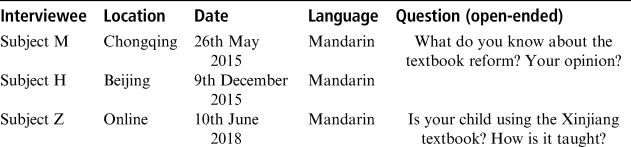
The data examined in this study comprise both primary sources (including policy papers and interviews) and secondary data (including periodicals and news reports). The outline of the case derives primarily from Cao Zhiheng 曹志恒 and Du Xuewei's 杜雪巍 2014 paper, which comprehensively examines the Xinjiang textbook reform case.Footnote 14 Cao and Du's official positions allowed them to acquire relatively reliable information about the case: Cao was a journalist at the Xinjiang branch of the Xinhua News Agency, while Du was director of the XUAR state-owned Tianshan.net News Centre Digital Publishing Centre.Footnote 15 The present study also triangulates the key stages of the case by recruiting three interviewees whose names are coded to protect their identities (see Table 1). Subject M is a scholar from the XUAR in the pro-reform clique. Subject H is a scholar from Beijing supporting the status quo clique. Both interviewees had direct contact with the key players in the case. Subject Z is an ethnic Han parent from the XUAR whose child was taught using the reformed Xinjiang ethnic unity textbook. Key dates and events in the case are also triangulated by using related policy papers and news reports from trusted sources to accurately capture the flow of events.
Interview Details

The paper is divided into four sections. The first section describes the analytical framework of this study, focusing on the knowledge regime–policy nexus. It then provides a brief background of the academic debate on ethnic policy reform by describing the ideologies and leading scholars of the two cliques. The third section goes on to analyse the Xinjiang ethnic unity education textbook reform case using a process tracing method and applies the knowledge–policy nexus framework to identify key dynamics in the decision-making process. Looking beyond the case, the fourth section analyses the national ethnic policy shift triggered by the academic debate and the significance of the textbook reform to the policy change.
Three Variables in the Knowledge Regime–Policy Nexus in China
This paper studies the struggle between agents of knowledge regimes in China in terms of their ability to channel knowledge into policy. The concept of a “knowledge regime” underpins the analytical framework of this study. John Campbell and Ove Pedersen first drew the link between the national political economy and the operation of nation-specific knowledge regimes.Footnote 16 By a “knowledge regime,” they mean a “collective appellation of policy research organizations.”Footnote 17 According to their ideal typology, knowledge regimes are divided into four quadrants across two variables: (1) the type of the economy (liberal or coordinated between private enterprises and state-owned enterprises), and (2) the nature of the policymaking process (centralized or decentralized). These variables give different characteristics to each ideal type of knowledge regime according to their political and economic conditions.
Karthik Nachiappan argues that the knowledge regime in China falls into the ideal type of a politically tempered knowledge regime, where a centralized decision-making process is found within a liberal market economy. In this typology, “a plurality of think tanks … operate and vie for influence; but their presence does not equivalently translate into influence, which is heavily tilted to think tanks that have established linkages with the party-state establishment” (emphasis added).Footnote 18 This corresponds to Leibold's analysis, mentioned in the introduction, which holds that both the status quo and the reform cliques used their connections with the state and Party mechanisms to argue their different cases in regard to China's ethnic policy.Footnote 19
Whether or not China falls into the typology of a politically tempered knowledge regime is not the key focus of this paper. However, we find two aspects of Nachiappan's study helpful in analysing the interaction mechanism between the knowledge regime and the decision-making circle. First, China's knowledge regime has been pluralizing rapidly since Xi Jinping 习近平 proposed a “new think tank with Chinese characteristics” in 2010. Today, it includes public and private think tanks, individuals, government research units and academic cliques fostered through a loose alliance of shared policy outlooks.Footnote 20 In the context of this paper, the reform clique is an alliance made up of academics from Tsinghua University and the XUAR Academy of Social Sciences, while the status quo clique comprises scholars from the Minzu University of China and the Chinese Academy of Social Sciences. Hence, there are multiple research organizations, institutes of higher learning and individuals working on similar policy areas.Footnote 21 Second, the single most important asset of the agents of knowledge in China, the linkages that connect knowledge regimes to the decision-making bodies (i.e. institutional and personal connections), have become increasingly networked and complex.Footnote 22 Since decision-making power is concentrated within the party–state, agents in the knowledge regime must utilize their “capital” – that is, their connections within the party-state hierarchy – to compete with others and channel their knowledge into policies.
“Capital” in this knowledge–policy struggle can be understood in the form of three variables. The first variable is the degree to which an agent in the knowledge regime and the decision-makers share a common ideological goal. These intellectuals are attuned to the thinking inside the Party and play the role of articulating and defending the views of various wings of the state hierarchy. Decision-makers are receptive only when a piece of policy advice is compatible with their policy preferences.Footnote 23 This is a precondition that determines whether a linkage can exist between the knowledge provider and the decision-makers.
The second variable is the administrative level within the party-state hierarchy to which the knowledge providers are linked. Xufeng Zhu's study suggests that there is a positive correlation between a think tank's influence on policy and the administrative level of the decision-making body to which it is linked.Footnote 24 The higher the level of the decision-making body in the party-state hierarchy, the more capital a linking knowledge provider acquires in the knowledge–policy struggle.
The third variable is the nature of the linkage between the knowledge provider and the decision-making body. This can be understood in terms of two dimensions: personnel connections and institutional connections. In China, there are growing numbers of academics-turned-cadres or academics-cum-cadres in the party-state hierarchy.Footnote 25 There are two types of personnel connections discussed in the relevant literature, but this study considers only the first type, where an academic concurrently holds a position in an academic institution and a decision-making body in the party-state hierarchy. In this case, such an academic is not only a policy advisor but also decision-maker at the same time. This is the most direct form of capital, such that advice or suggestions from these academics can be easily translated into public policy through internal channels such as “internal meetings” (neibu huiyi 内部会议) and “internal reference” (neican 内参).Footnote 26 There is also a second but more informal type of personal connection, namely, guanxi 关系 – a Chinese term referring to the web of social relations that individuals use to gain or secure resources.Footnote 27 In this context, guanxi refers specifically to the network developed between an agent of the regime with officials from the decision-making body.Footnote 28 This type of connection often involves necessitating relationships as an essential form of social capital in Chinese culture.Footnote 29 Owing to space limitations, the present study will not consider this issue and type of connection as part of its analysis but will focus instead on concrete and observable linkages.
Institutional connections provide a structured link between an academic and a policymaking body, usually in the form of a contractual or delegate–agent relationship.Footnote 30 This type of connection is external and less influential than a personnel connection, although advice and suggestions can still flow relatively unhindered through institutionalized channels to the party-state.
The Debate: Ideologies, Leaders and Connections
In this ethnic policy debate, which ran from 2009 to 2014, the status quo clique's position originates from the Marxist-Leninist-Stalinist theory of ethnicity, where harmonious inter-ethic relationships are deemed highly dependent on the equality of economic development across ethnic groups and regional ethnic autonomies.Footnote 31 These scholars advocate preserving China's existing ethnic categories, which have been in place since the 1950s.Footnote 32 They argue that ethnic autonomy remains the best method for tackling the underdeveloped economic and social conditions often seen in ethnic minority regions. In policy terms, each ethnic group is granted constitutional rights and preferential policies. While ethnic integration is the final goal, explicit recognition of ethnic differences should be preserved until socio-economic status gaps are overcome.Footnote 33
The status quo clique was led by two key Beijing-based proponents: Jin Binggao 金炳镐 and Hao Shiyuan 郝时远, both of whom enjoyed close and institutionalized connections with the State Council. Jin Binggao, a renowned academic at the Minzu University of China, is considered an influential and founding figure of the status quo clique who “actively constructs the discipline of ethnic theories” in China.Footnote 34 Outside his academic portfolio, Jin serves as a consultant to the State Ethnic Affairs Commission (SEAC), the ministry primarily in charge of ethnic policymaking and implementation. Hao Shiyuan is director of the Institute of Ethnology and Anthropology of the Chinese Academy of Social Science (CASS), which is a leading think tank of the State Council.Footnote 35 These strong connections between these individuals and the State Council allow them to wield substantial influence over ethnic policy making on a national level.
The reform clique argues from the perspective of a “melting pot” formula, claiming that the CCP should “encourage natural ethnic mingling and a shared sense of civic belonging.”Footnote 36 This clique also proposes the “depoliticization” (qu zhengzhihua 去政治化) and “attenuation” (danhua 淡化) of ethnic identities, meaning that the Party should discontinue over-privileging individual ethnic identities through appropriate policies.Footnote 37 Furthermore, it argues that the distribution of preferential policies should be based on regional rather than ethnic differences.
The leading scholars of the reform clique are closely related to the Party either through membership of the national think tank or by directly working for the Party's decision-making organs. Ma Rong 马戎 is a prominent supporter of the reform clique. He was among the first scholars to have advocated the melting pot formula in China. As a Peking University professor, Ma has been the recipient of project funding from the Ministry of Education (MoE), the United Front Work Department (UFWD) and the SEAC since the early 1990s.Footnote 38 Ma proposed the “melting pot” idea in 2007, although at that time his paper was largely regarded as an academic endeavour with minimal policy implications.Footnote 39 In 2011, Hu Angang 胡鞍钢 and Hu Lianhe 胡联合, two influential figures of the reform clique, took up Ma's idea and published a paper on the “second generation of ethnic policy” (di'erdai minzu zhengce 第二代民族政策).Footnote 40 Hu Angang is the director of the National Conditions Institute, an influential institute at Tsinghua University, whose annual “National Report” “has become the central and local government decision-making important reference [sic]” and is linked to at least seven major policy reforms in China since the 1990s.Footnote 41 Hu Lianhe is Hu Angang's colleague at Tsinghua University and worked for the CLSG on Xinjiang (the highest decision-making entity concerned with XUAR issues) from 2012. He became the deputy director of the UFWD Xinjiang Bureau in 2017.Footnote 42 After the publication of their 2011 paper, Hu and Hu became the flag bearers of the reform clique and attracted fierce criticism from the status quo clique.Footnote 43
The Ethnic Unity Education Textbook Reform Case
Applying a process tracing method, the reform of the ethnic education textbook in the XUAR can be divided into three stages according to different actors’ involvement and periodic outcomes.
Stage 1 (December 2008–July 2009)
In December 2008, two State Council ministries, the MoE and SEAC, together began to write a series of ethnic unity education textbooks (minzu tuanjie jiaokeshu 民族团结教科书) for primary and high school students nationwide.Footnote 44 The urgent need to foster ethnic unity after the 2008 Lhasa riots likely provided the impetus for the new textbooks. Jin Binggao was hired as the chief editor of the textbooks, given his status as a consultant for the SEAC.Footnote 45 In 2009, four textbooks were written and were supposed to be introduced into the curriculums of all primary and high schools in China by the end of that year.Footnote 46 Under the MoE's decree, ethnic unity education became mandatory for all students from Grade 1 to Grade 12.Footnote 47 Furthermore, the content of ethnic unity education was incorporated into the junior and senior high school entrance examinations nationwide.Footnote 48
Stage 2 (July 2009–September 2009)
In late 2009, shortly after the 5th July Urumqi riots, Ji Guangnan 戢广南 and Ma Pinyan 马品彦, two scholars from the XUAR Academy of Social Sciences, challenged the use of the national textbook in the XUAR and wrote a report to the Xinjiang Department of Education (XDE).Footnote 49 They argued that the content of the textbook underplayed ethnic Han contributions in ethnic minority regions and that discussion questions such as “Which ethnicity do you belong to?” may exacerbate ethnic segregation in the classroom.Footnote 50 The XDE subsequently forwarded the report to the MoE.Footnote 51 The Division of Ethnic Education in the MoE asked Jin to make revisions, which he rejected.Footnote 52 The national textbooks were translated into ethnic minority languages, including Uyghur, and circulated nationally as well as in the XUAR in September 2009.Footnote 53
Stage 3 (Early 2010–July 2010)
In early 2010, Ji and Ma, together with two other Xinjiang academics, Pan Zhiping 潘志平 and Meng Nan 孟楠, presented a neican 内参 (internal reference document) entitled, “The issues of partiality and inappropriateness of the Ministry of Education's national unity education textbooks should be corrected” (jiaoyubu minzu tuanjie jiaoyu jiaocai qingxiangxing wenti he butuo zhichu yingyu jiuzheng 教育部民族团结教育教材倾向性问题和不妥之处应予纠正), to the CLSG on Xinjiang.Footnote 54 They claimed that the national textbooks would intensify ethnic divisions among primary and high school students by over-emphasizing ethnic differences, because asking learners to identify ethnic minorities in their class and answer questions such as “what is the main religion of your ethnicity?” accentuates differences between groups, rather than stressing a sense of shared national belonging. Ji and Ma offered three recommendations: 1) the national textbook should be suspended in the XUAR; 2) the MoE should re-examine and rewrite the national textbook; and 3) other relevant national bodies should make corresponding adjustments to foster greater national identity through ethnic unity education.Footnote 55
This time, these early reform clique members appealed to a decision-making body of higher authority than the MoE. The CLSG is a Party-coordinating body led by CCP elites, and a mechanism for the central CCP to address special issues.Footnote 56 As a Party organ, the CLSG enjoys higher political status than ministries from the State Council. The CLSG has the final say in relevant administrative issues. In 2009, the CLSG on Xinjiang was headed by Zhou Yongkang 周永康, then a member of the Standing Committee of the Political Bureau (PBSC) and the head of the Central Political and Law Commission.Footnote 57 Other members of the CLSG included Li Changchun 李长春, also then a PBSC member and the director of the CCP Central Spiritual Civilization Steering Committee; Liu Yandong 刘延东, the-then head of the UFWD and a member of the Political Bureau; and Liu Yunshan 刘云山, then a member of the Political Bureau and head of the Central CCP Publicity Department.
The CLSG responded swiftly to the report and adopted the policy paper's first and second suggestions in July 2010.Footnote 58 It issued a directive signed by all four group members who were based in Beijing. The directive temporarily suspended the national ethnic unity education textbook in the XUAR and instructed the XDE to write another set of ethnic education textbooks that would “best suit the special situations in the XUAR.”Footnote 59 Meanwhile, the document also ordered a revision of the MoE's national ethnic unity education textbook.
The XDE appointed Ji Guangnan as the chief editor of the Xinjiang version of the ethnic education textbooks (hereafter, “Xinjiang textbooks”).Footnote 60 In late 2010, three local textbooks were published by the Xinjiang Education Publishing House, including The Great Ethnic Unity (Xinjiang minzu tuanjie 新疆民族团结) for Grade 1 to 6 students, and Xinjiang: Ethnic Unity (Xinjiang minzu tuanjiepian 新疆民族团结篇) for Grade 7 to 9 students.Footnote 61 In December 2012, The Great Unity of the Chinese Nationality (Zhonghua minzu datuanjie 中华民族大团结) for Grade 10 to 12 students was published.Footnote 62
The local compilation committees applied a distinctively nationalist-oriented approach to narrating and explaining China's ethnicity and nationality. Whereas the national textbook stresses the cultural, social, linguistic and religious differences among ethnic groups, the Xinjiang textbook – contrary to Nimrod Baranovitch's observation in the 2000s – does not define ethnicity and avoids discussing ethnic differences.Footnote 63 For example, in an exercise in Chapter 1 of the national textbook General Knowledge on Ethnic Theories (Minzu lilun changshi 民族理论常识), students are asked to fill in a chart to compare ethnic Daur and ethnic Mongolian languages, dressings, marriage, cuisines, festivals, etc.Footnote 64 Students are also asked to “analyse religion's role in the formation of ethnicity.”Footnote 65 In the corresponding Xinjiang textbook, The Great Unity of the Chinese Nationality, however, ethnic groups and ethnic minority individuals are wrapped within the narratives of a national body, using phrases such as “people from all ethnic groups in Xinjiang donated to the anti-Japanese war” and that “ethnic Xibo immigration to western China [occurred] to protect the nation,” disregarding the controversy around whether or not ethnic Xibo migration to Xinjiang predated China's emergence as a modern nation-state in 1912.Footnote 66
The Xinjiang textbook also replaces previous ethnicity discourses with exhalted historical narratives of the “Chinese nation.” For example, the textbook's claims that the Chinese nation is “one of the most ancient minzu in the world” once again glosses over the historical nuances of the modern inception of the Chinese “nation” in the late 19th century.Footnote 67 It also interprets the Great Wall as “evidence of the collective Chinese nationality” rather than as a symbol of the ethnic Han emperors’ military enterprise against nomadic ethnic groups.Footnote 68 In comparison, the last section in the national textbook discusses the “great rejuvenation of the Chinese nation,” even if to belatedly say that such rejuvenation can only be achieved “by the collective effort of all ethnic groups.”Footnote 69
Furthermore, the coverage of ethnic tensions in the textbooks is very different. The national textbook dedicates three of its four chapters to “causes and solutions” when discussing China's ethnic problems (minzu wenti 民族问题). It acknowledges that the ethnic issue is a fundamental (genben 根本) social issue in China.Footnote 70 Its solution to China's ethnic issue mirrors that of the status quo clique: by “speeding up development in ethnic minority regions.”Footnote 71 In comparison, the Xinjiang textbook avoids extensive discussions on ethnic issues and instead stresses the importance of patriotism and national unity. It glosses over the issue of “the three forces” (sangu shili 三股势力, i.e. extremism, terrorism and ethnic separatism) in its “discussion and sharing” exercises as a counter example of national unity.Footnote 72
At the beginning of Stage 2, the status quo clique withstood the reform clique's early charge. The direct connection with the MoE through Jin maintained a strong institutional linkage that was not to be easily undermined.Footnote 73 The reform clique submitted its report via the XDE to the MoE, which was a roundabout and indirect approach to exerting external influence on ethnic policymaking. Institutional connections were not observable at that point. However, the conditions changed in Stage 3, when the reform clique pushed ahead of the status quo clique, largely owing to its carefully constructed narrative that aligned with the national security priorities of the CCP in Xinjiang. Between 2009 and 2012, one of the primary duties of the CLSG on Xinjiang was to maintain national securityFootnote 74 – but it was also charged with public education.Footnote 75 During this stage, the reform clique aligned itself to the CLSG's political agenda by claiming that it held the key to solving the security issues in ethnic minority regions. It advocated discontinuing the emphasis on ethnic differences through policy means and proposed the redistribution of national resources according to regional development levels rather than ethnicity. It argued that this would “lower ethnic tensions amongst the population,” because people would identify themselves first as Chinese citizens rather than as members of a specific ethnic group.Footnote 76
Furthermore, the reform clique strategized its approach by ideologically orienting itself to Zhou Yongkang's concept of “ethnic contact, exchange and blending” (minzu jiaoliu jiaowang jiaorong 民族交流交往交融, also known as sanjiao 三交) to support its argument.Footnote 77 It is important to note that Zhou was the head of the CPLC from 2007 to 2012, and was a ranking member of the Standing Committee of the Political Bureau in the CLSG.Footnote 78 The reform clique's argument gained prominence in the struggle with the status quo clique by coalescing with Zhou's concept. The controversial work of Hu and Hu in 2011 was an example of such an endeavour. They argued that sanjiao works towards preventing the Chinese nation-state from being torn apart along ethnic lines and is essential for national “development and prosperity” because it strengthens national cohesion and belonging.Footnote 79 The reform clique also uses the sanjiao policy to manifest the central CCP leadership's changing attitude towards ethnic policy in favour of a stronger national identity, a tack followed by Zhu Weiqun 朱维群, another outspoken supporter of the reform clique.Footnote 80
Therefore, by using national security as a selling point and tying its research closely to Zhou Yongkang's signature discourse, the reform clique managed to form a solid ideological connection with the CLSG, a move which laid the foundation for more personnel connections later on.
One of the key figures in the reform clique was Ma Pinyan. On top of his academic appointment in the XUAR Academy of Social Sciences, Ma was also inducted into the East Turkistan (dongtu 东突) research group of the CLSG on Xinjiang in 2009 to provide expert knowledge on separatist movements to the CCP elites.Footnote 81 During Stage 2, Ma and Ji utilized their positions as academics in the Academy of Social Sciences to connect with the MoE system, but the lack of direct institutional connection rendered the effort futile. In Stage 3, however, Ma utilized his other position as a policy advisor to send an internal reference (neican) directly to the CLSG.Footnote 82 Through this direct channel, the reform clique found political patrons who were sympathetic to its cause.
There is little evidence to suggest that the status quo clique had a direct connection with the CLSG on Xinjiang. Rather, its connection with the party-state remained at ministerial and state level (with the MoE). Since the MoE is hierarchically lower than the CLSG, the reform clique gained a higher level of influence than the status quo clique during Stage 3.
The reform clique's success was therefore an outcome of the combination of several advantages over the status quo clique. An ideological connection between the CLSG and the reform clique was created because the reform clique manoeuvred closely to the CLSG's priority on national security. The reform clique's most decisive advantage, however, was the institutional connection that Ma mobilized in Stage 3 as a research member of the CLSG.
After the reform: subsequent academic and policy debates
Following the Xinjiang textbook case, Hu and Hu's paper on the “second generation of ethnic policy” intensified the academic debate on ethnic policy reform nationwide.Footnote 83 Under the guise of an academic debate, the two cliques had been competing in the surrounds of China's ethnic policy issue. Following through on its position on the Xinjiang textbook case, the reform clique propositioned that by putting less emphasis on ethnic differences, ethnic minorities – and particularly those in the XUAR – would consider themselves Chinese citizens first and foremost, and thus “feel less attached to overseas religious or ethnic groups.”Footnote 84 The status quo clique attacked the reform clique as “ethnically and regionally biased” and for promoting “ethnic assimilation.”Footnote 85
The debate took an even more heated turn between 2011 and the spring of 2014, but it suddenly and quickly wound down after the Central CCP Xinjiang Work Forum in May 2014, when the CCP general secretary Xi Jinping drew a line under the debate by declaring that the ethnic policy in China remained “Marxist, Leninist, and Stalinist.”Footnote 86 At the same time, however, Xi also pointed out that future ethnic work should focus on “enhancing identification with the great motherland of China, the Chinese nation, Chinese culture, and Socialism with Chinese characteristics.”Footnote 87 This statement subsequently became known as the “four identities” (sige rentong 四个认同) and was reinforced during the Central Ethnic Work Conference in September 2014.
Notwithstanding contradictions presented in his statement, Xi effectively married the arguments from both the status quo and reform cliques to form state policy. It remains to be seen how the CCP will reconcile these conflicting ideologies, but it is obvious that the reform clique has gained a foothold in China's ethnic policymaking. National identity, championed in the “melting pot formula,” has been given a more prominent place in the national political discourse on ethnic minority policy than was previously the case.
Discussion: Shifts in National Ethnic Policy
The increasing need for security is a primary cause of the CCP's adoption of the national identity discourse from the reform clique. The Xinjiang textbook case demonstrates that the CCP's focus on national security increased soon after the 2008 and 2009 unrest in Tibet and Xinjiang. In 2010, the fifth Central CCP (CCCP) Tibet Work Meeting laid down the baseline principle for all ethnic work as “enhancing ethnic unity and guaranteeing long-term social stability” (gonggu minzu tuanjie, quebao changzhi jiu'an 巩固民族团结,确保长治久安).Footnote 88 In the same year, the first central CCP Xinjiang Work Meeting concluded that economic development and security maintenance in the XUAR would form the twin pillars for the CCP's approach to the region.Footnote 89 Meanwhile, the CLSG on Xinjiang issued the order to suspend the distribution of national ethnic unity textbooks in favour of the Xinjiang edition. These actions in 2010 indicated that securitizing the XUAR had reached a level of national importance and that the perceived need for security in the XUAR means the region has become a bellwether for ethnic policy change across China.
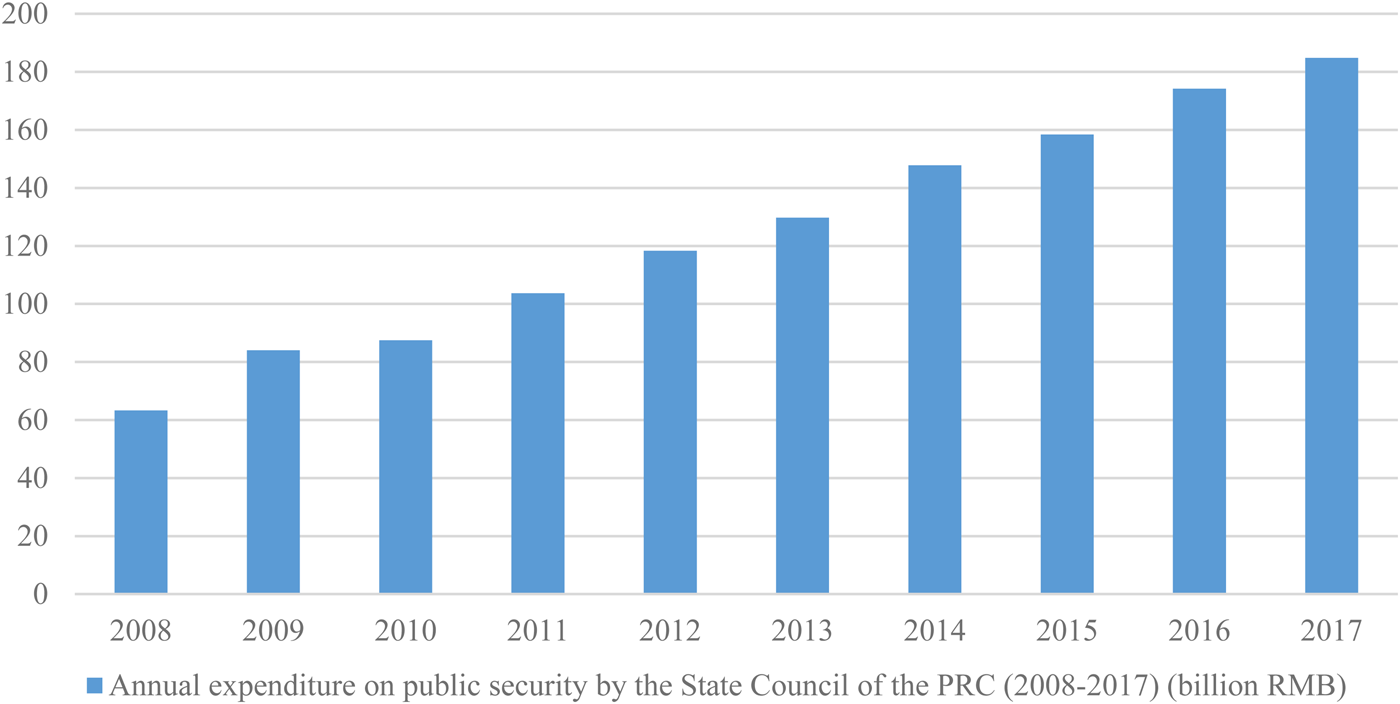
Furthermore, the continuous increase of public security spending by the State Council after 2008 clearly demonstrates the party-state's growing emphasis on securitization (Figure 1). Between 2008 and 2016, the State Council nearly tripled its annual expenditure on public security from 63.3 billion yuan to 174.2 billion yuan.Footnote 90 National public safety expenditure increased by 47.5 per cent in 2009 compared to 2008 after the unrest in the XUAR, reaching a total of 128.7 billion yuan.Footnote 91 The additional expenditure was mainly spent on purchasing public security equipment and increasing funding for public security offices at the grassroots level in central and western China.Footnote 92 At the local level, expenditure on public safety in the XUAR increased by 92.8 per cent in 2017 compared with 2016.Footnote 93 It is likely that the increased expenditure was spent on police recruitment and police station construction.Footnote 94
Annual Public Safety Expenditure of the State Council of the PRC, 2008–2017
Source:
Ministry of Finance 2018.

The increased securitization in China post-2008 has given extra capital to the reform clique because it aligns its argument with national security. It also established an ideological connection with the party-state by connecting education on national identity with national security through the Xinjiang textbook case. This research therefore throws light on the reform clique's role in the process of securitization during Xi's era.
Post-2012: leaning even more towards the reform clique?
With security issues receiving greater focus, the reform clique's “national identity” solution became an appealing option in the CCP's efforts to alleviate regional ethnic tensions and other security concerns. Following the fifth central CCP Tibet Work Meeting in May 2014, in September of the same year Xi reiterated the “four identifications” discourse in the central CCP Ethnic Work Forum.Footnote 95 In 2015, Xi added a fifth “identity” – that the ethnic minority population should (politically) identify with the CCP – at the sixth central CCP Tibet Work Forum.Footnote 96 Since then, the “five identifications” have been institutionalized as a core value of the CCP through Xi's reiterations in all subsequent major central CCP meetings on ethnic issues. The Xinjiang textbooks quickly incorporated them as “core examination content” (hexin kaodian 核心考点).Footnote 97 The CCP's position on ethnic issues has gradually converged with that of the reform clique, with repeated endorsements from Xi himself.
Key players from the Xinjiang textbook reform case have continued to have an impact on the national policy shift. As of 2017, Ma Pinyan remained a research professional in the East Turkistan research group of the CLSG on Xinjiang.Footnote 98 Another reform clique member, Hu Lianhe, one of China's leading terrorism and counter-terrorism experts, was appointed deputy office director of the CLSG on Xinjiang around 2012, when Zhou Yongkang was in charge of the group.Footnote 99 With this appointment, Hu was expected to wield considerable influence over the CLSG's research agenda and decision-making process. Zhou's subsequent fall from power has had little evident effect on the influence of the reform clique, because Hu was subsequently promoted to deputy director of the ninth division of the UFWD, a new office established in May 2017 that is dedicated to carrying out administration regarding ethnic and religious issues in the XUAR.Footnote 100 Since the Xinjiang textbook case, the reform clique has made significant inroads into building up its personnel and institutional links with the Party organs.
Conclusion
This paper has discussed the variables that facilitate some agencies in China's knowledge regime to prevail over others in the struggle to gain policy influence in the context of increasing scrutiny over the symbiotic relationship between Chinese policymaking circles and academia. The article highlights channels through which external (in this case, academic) influence can be exercised. It contributes to the understanding of China's ethnic policy reform debate by analysing the Xinjiang ethnic unity education textbook. The textbook reform case serves as an illustration of the actual policy outcomes of the debate: that the reform clique has been making significant progress at the local level.
The connections an agent has with the party-state are the most important assets in China's knowledge regime. This study has shown that those knowledge providers who boast strong ideological ties with decision-makers, as well as institutional or personnel connections with superior decision-making bodies, possess great “capital” and competitive advantage. Both the status quo clique and the reform clique utilized their connections with the government to influence the ethnic policymaking process. In Stage 2, the status quo clique withstood a challenge from the early reform clique because it had an institutional connection with the MoE through Jin. At Stage 3, the reform clique prevailed because it utilized its institutional connection with the CLSG on Xinjiang via Ma. The reform clique also benefited from an ideological connection with the CLSG by aligning its argument closely with the sanjiao discourse and national security issues.Footnote 101
The Xinjiang textbook reform marked a significant shift in China's national ethnic policy towards emphasizing national identity at the expense of ethnic identity. Following the 2010 case studied in this paper, the CCP has incorporated the reform clique's language into national-level political discourse, presumably owing to the increasing need to maintain national security in ethnic minority areas. In 2014, during the fifth central CCP Tibet Work Forum, Xi married the arguments of both the status quo and reform cliques.Footnote 102 Moreover, the reform clique strengthened its connection with the CLSG through Ma Pinyan and Hu Lianhe's personnel connections, since the latter was the deputy office director of the group from 2012 to 2015 and afterwards promoted to become the head of the UFWD's Ninth Bureau.
At the point of writing, the Xinjiang textbooks continue into Chen Quanguo's 陈全国 term as the XUAR CCP secretary.Footnote 103 Chen was known for his iron-fisted control over ethnic affairs during his time as the Tibet Autonomous Region Party secretary (2011–2016).Footnote 104 The efficacy of these textbooks notwithstanding, all developments appear to suggest the trajectory of China's ethnic policy is set, as identity education and securitization remain Beijing's key tools for governing Xinjiang.Footnote 105
Acknowledgements
The authors sincerely thank James Leibold, Wu Fengshi and Sarah Rogers for their valuable advice and generous support. Our gratitude also goes to the editors and anonymous reviewers for their helpful comments.
Conflicts of interest
None.
Biographical notes
Taotao ZHAO obtained her PhD in politics and governance in the Asia Pacific from the University of Melbourne, Australia, in 2018. She is a specialist on ethnic policymaking and implementation processes in China, with a focus on the ethnic Tibetan areas. Dr Zhao's research interests also include central–local government relations, think-tank competition and agency coordination in China.
Sow Keat TOK is working on China and its policy behaviour towards “sovereignty,” with particular attention to China–HKSAR and China–Taiwan relations. His research interests also include China's foreign relations, policy discourses, state–Party relations, central–local relations, nationalism and identity, politics in Taiwan and the HKSAR, elite politics and leadership succession.