Significant outcomes
-
The present study suggest that mental well-being was significantly lower among the younger participants during the first lockdown in 2020 of the Covid-19 pandemic compared to a pre-pandemic sample from 2016.
-
Internal locus of control was lower compared to a population from 2017, especially among the younger participants.
-
No significant differences were found for general health between any of the populations.
Limitations
-
The cross-sectional design of the study prevents causal interpretation.
-
The 2020 sample may include participants more willing to engage in research on pandemic and crisis, and may therefore not be representative for the general population.
-
No confounder-control was conducted, yet stratified analyses were used minimising this risk.
Introduction
Studies on the mental health effects in relation to the Covid-19 pandemic have found high levels of stress among the general population both in the initial difficult phases and also during more stable phases (Kowal et al., Reference Kowal, Coll-Martín, Ikizer, Rasmussen, Eichel and Studzińska2020; Pieh, et al., Reference Pieh, Budimir and Probst2020; Pierce et al., Reference Pierce, Hope, Ford, Hatch, Hotopf and John2020; Vindegaard & Benros, Reference Vindegaard and Benros2020; Xiong et al., Reference Xiong, Lipsitz, Nasri, Lui, Gill and Phan2020). Studies from previous pandemics such as SARS-Cov.1 and H1N1 have also provided evidence that a new virus may potentially have a major negative impact on distress levels, mental well-being, and physical health, as well as social behaviour (Brooks et al., Reference Brooks, Webster, Smith, Woodland, Wessely and Greenberg2020; Lau et al., Reference Lau, Griffiths, Choi and Tsui2010; Omoleke et al., Reference Omoleke, Mohammed and Saidu2016; Peng et al., Reference Peng, Lee, Tsai, Yang, Morisky and Tsai2010). This may be attributed to the uncertainty of the situation, and the worry about getting infected or infecting others with a potentially lethal virus. Further, measures taken on a societal level to prevent the virus from spreading like lockdown of essential daily life activities may increase the worry among the population and cause individuals to feel less in control of their own life, which may also affect mental well-being. In Denmark, unprecedented measures were taken on a societal level beginning March 11th, 2020. These measures were introduced as measures to ‘flatten the curve’ and ‘protect society’s most vulnerable’ and included lockdown of all education, all elective procedures in hospitals and clinics, closing of all shops other than the supermarkets and pharmacies, lockdown of all non-essential government services on national, regional, and local levels as well as most religious services, allowing only for very limited access to funeral services and weddings. Moreover, the government prohibited crowds 1000+ later down to 50+, and finally 10, and borders were closed for everybody without a legitimate purpose (e.g. returning citizens, work, visiting close relatives) (Nyhederne TV2, Reference Nyhederne2020a, b). The stringency level imposed by the Danish authorities in the Spring 2020 was according to the Oxford Covid-19 Government Response Tracker rather similar to the global government response (Hale et al., Reference Hale, Webster, Petherick, Phillips and Kira2020).
The Danish health care system is tax-financed and thus free for all, and the extensive measures were intended to provide security for all citizens by making sure that those who would contract the virus would have all access to relevant level of care (i.e. ventilators of which the population was informed we had a total of 1000 to a population of 5 million in the beginning of the pandemic). The lockdowns and other measures were supported by social and economic measures supporting both businesses (e.g. reimbursement of lost revenue due to lockdown) and families (e.g. extension of paid sick leave and unemployment benefit). While the aim of these measures was safety and harm reduction, the perceived threat and the major changes communicated through the media and experienced by the population might have increased levels of distress among persons experiencing poor general health (Vindegaard & Benros, Reference Vindegaard and Benros2020) or psychiatric disorders (Gobbi et al., Reference Gobbi, Płomecka, Ashraf, Radziński, Neckels, Lazzeri, Dedić, Bakalović, Hrustić, Skórko, Es Haghi, Almazidou, Rodríguez-Pino, Alp, Jabeen, Waller, Shibli, Behnam, Arshad, Barańczuk-Turska, Haq, Qureshi and Jawaid2020). Others have identified a mediating effect of the perceived sense of control on the psychological burden posed by the changes (Brailovskaia & Margraf, Reference Brailovskaia and Margraf2021). Yet, few studies have been able to establish evidence on possible changes in physical and mental health from before the onset of the pandemic, since this requires longitudinal data sampled before and after the pandemic. One study including the same Danish participants before and after the Covid-19 pandemic found only minor increases in illness worry, emotional distress, and symptom levels (Petersen et al., Reference Petersen, Dantoft, Jensen, Pedersen, Frostholm and Benros2021). Another study compared a pre-pandemic representative Danish sample to a study conducted in the first phase of the lockdown, and this study suggested significant decreased mental well-being for the 2020 sample (Sønderskov et al., Reference Sønderskov, Dinesen, Santini and Østergaard2020). Thus, diverging findings have been found regarding the mental state of the Danish population during the initial phase of the Covid-19 pandemic. The objectives of this study were to investigate the Covid-19 pandemic’s influence on physical and mental health further in a representative sample of Danish adults compared to two pre-pandemic samples by use of standardised measure of well-being (WHO-5), as well as self-reported general health (single item), and locus of control (single item). Results may point out potentially vulnerable populations, who need a special attention after this pandemic, and could be used for future preventive purposes. Although situated in a Danish context, we believe this study is relevant to societies, which experienced the hardship of the Covid-19 pandemic in terms of insecurity of the consequences of the virus in itself and also reacted with many restrictions at the societal level.
Our hypotheses were that we would observe a significant lower level of psychological well-being and general health in the 2020 sample compared to the pre-pandemic samples, and that we would observe younger age groups to be the most affected in terms of higher significance levels. Finally, we investigated levels of internal locus of control, which we hypothesised to be significantly lower in the 2020 sample compared to a pre-pandemic sample.
Methods and materials
The study includes three samples representative of the 18+ years Danish population with regard to gender, age, region, socio-economic position, and education. Data for the 2020 sample were collected from 14th May till 21st May 2020. Two pre-pandemic samples collected in 2016 (N = 3.405), and another collected in 2017 (N = 3.355) represents the comparison with the 2020 sample (N = 1.538). The three samples are described in detail in other publications (Andersen et al., Reference Andersen, Christensen, Kühle, Jakobsen, la Cour and Pedersen2021; Nielsen et al., Reference Nielsen, Hinrichsen, Santini and Koushede2017; Toubøl & Frederiksen, Reference Toubøl, Frederiksen and Frederiksen2019). All samples are convenient samples of adults consenting to participate in self-administrated online surveys.
Measures
The WHO-5 Well-being Index was presented by the World Health Organization in 1998 emerging from definition of health as not only absence of illness, but also well-being and measuring subjective well-being or positive quality of life (Topp et al., Reference Topp, Østergaard, Søndergaard and Bech2015). The Index is based on the rating of five statements on a scale from 5 to 0 allowing for the calculation of a raw score (theoretical range 0–25) which multiplied by 4 provides an index from 0 to 100, with 0 reflecting best positive quality of life while a cut-off for potential case for distress is at 50. In 2020 data, a ‘Do not know’ option was added in order to standardise the WHO-5 with other measures included in the survey. We observed 0.2% missing in the pre-pandemic sample from 2016 and 3.3% in the 2020 sample. We consider this of no significant importance, and no measures were taken to replace missing data.
Self-reported health status was captured by the use of a study-specific single item regarding general health with participants rating own current health status using a total of five categories (’Excellent’, ‘Best’, ‘Average’, ‘Poor’ and ‘Very poor’ health) with the answer ‘Don’t know’ also being included here. Allowing for a comparison between samples analysis regarding general health, a variable describing ‘good health’ including ‘good’, and ‘excellent’ poor health which includes both ‘poor’ and ‘very poor’ self-reported general health versus was generated.
Sense of control was measured by an item regarding the internal locus of control (’Some people think, they have full control over how their day-to-day living unfolds, while others feel, that their actions have no influence on how things turn out for them’). Participants rated their sense of internal control from 0 (No influence at all) to 10 (Extremely high influence). In order to compare levels of control, we dichotomised this variable into ‘Low control’ (1–5) and ‘High control’ (6–10).
Included in the analyses of the 2020 sample are only participants with no-missing items on the WHO-5 allowing for calculation of index score regarding well-being, while participants from the 2016 and 2017 samples are included in analyses regarding general health and locus of control regardless of missing WHO-5 scores. In analyses regarding general health or locus of control, only participants with valid data are included.
Statistical analysis
Possible differences between the 2020 sample and 2016 in levels of psychological well-being were investigated using a two-sample Z-test of proportions using STATA version 17. Differences between 2020 sample and 2017 sample in levels of general health and internal locus for control was also investigated using two-sample Z-test of proportions (R version 4.1.0).
Results
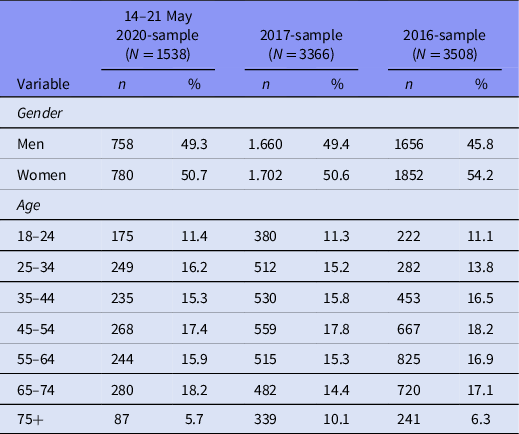
The 2020 sample included 758 men and 780 women. The 2016 sample included 1656 men and 1852 women. Finally, the 2017 sample included 1660 men and 1702 women (Table 1).
Descriptives

n: frequencies; %: percent.
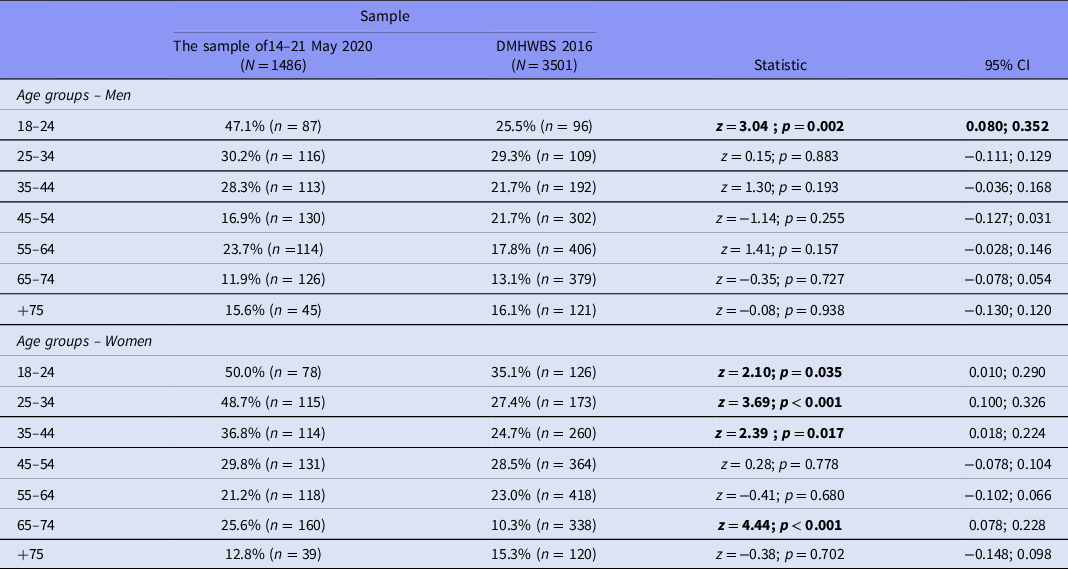
Testing the hypothesis that participants in the 2020 sample would report poorer psychological well-being than the 2016 sample, we found statistically significantly more men reporting at-risk levels of well-being (WHO-5 < 50) in 2020 compared to 2016 among the youngest men (18–24 years). Among women statistically significant differences were found in age groups between 18–44 and 65–76 years. Results are presented in Table 2.
Self-reported wellbeing in 2020 and 2016: proportions of persons reporting low well-being (WHO-5 < 50) in 2020 and 2016

Significant differences between groups are shown as bold values in the table.
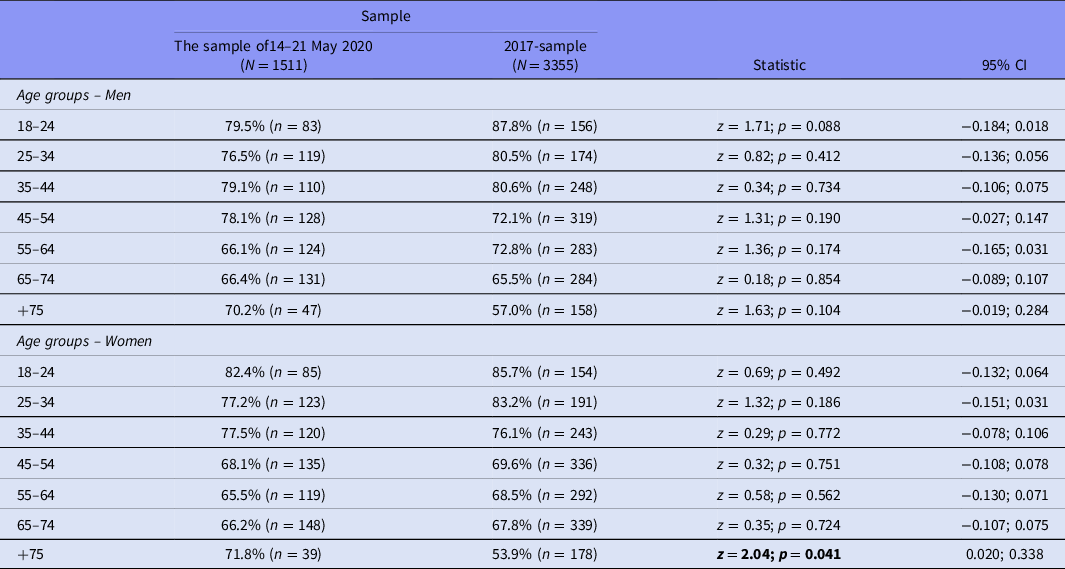
Testing the hypothesis that the proportions of men and women in all age groups reporting good general health would be lower in 2020 compared to 2017, we observed tendencies of deterioration of the perceived general health in the population between 2017 and the survey collected (14–21 May 2020) in the late part of the Danish first lockdown. However, none of the figures are significant. Although we observed significant deterioration among women aged 75 or above, our hypothesis that all age groups would show lower general health in 2020 was not confirmed (Table 3).
Self-reported general health in two samples of Danish adults; proportions of persons reporting ‘good or very good health’ during 14–17 May 2020 and in 2017

Significant differences between groups are shown as bold values in the table.
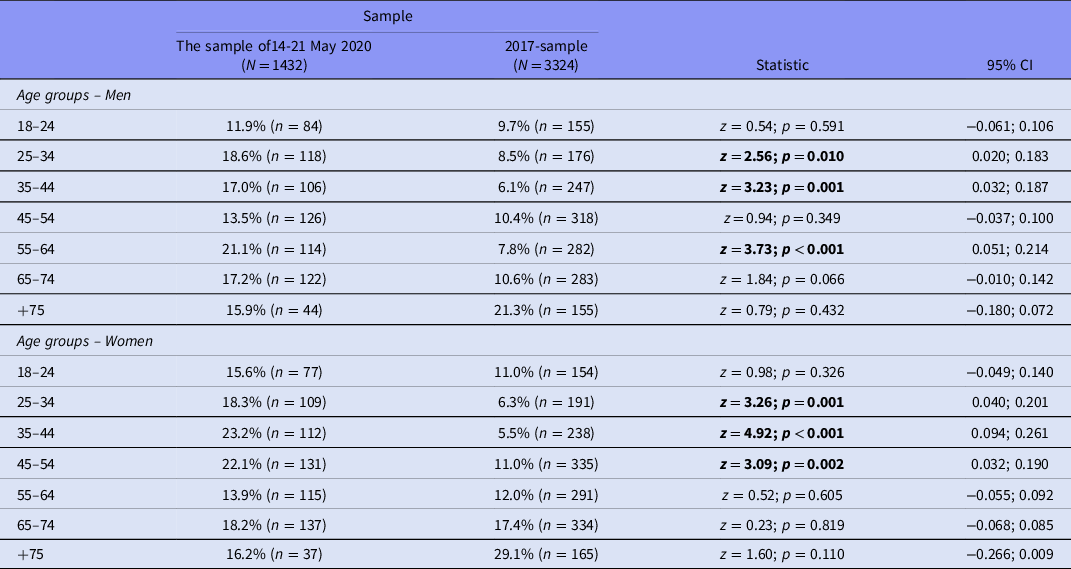
Finally, with regard to internal locus of control, we found that younger women (25–44 years) in 2020 reported significantly lower internal locus of control compared to the 2017 sample, whereas both younger (25–34 years) and middle-aged men (55–74 years) in 2020 reported lower internal locus of control compared to the 2017 sample (Table 4).
Self-reported locus of control in two samples of Danish adults; proportions of persons reporting ‘external locus of control’ during 14–17 May 2020 and in 2017

Significant differences between groups are shown as bold values in the table.
Discussion
The analyses in this study confirmed the hypothesis that the 2020 sample would report statistically significant lower levels of psychological well-being, when compared with the 2016 sample indicating that the Covid-19 pandemic may have resulted in poorer psychological well-being among a Danish adult population. This was true for certain age groups, and our hypothesis that younger participants would show much lower levels of well-being was partly confirmed, since we also saw elderly women reporting highly significantly lower levels of well-being. Results resemble the findings from Sønderskov et al. (Reference Sønderskov, Dinesen, Santini and Østergaard2020), who used the same pre-pandemic sample from 2016 as comparison regarding well-being. Worry in connection to the virus may be one explanation (Burdzovic Andreas & Brunborg, Reference Burdzovic Andreas and Brunborg2021), but studies suggest that social isolation and lockdown of everyday activities may also have led to loneliness and higher levels of depression (Santini & Koyanagi, Reference Santini and Koyanagi2021). Further, other studies also find that especially the younger people have been more affected in terms of decreased mental health and well-being (Pedersen & la Cour, Reference Pedersen and la Cour2021; Sønderskov et al., Reference Sønderskov, Dinesen, Santini and Østergaard2020). Thus, some specific groups may be in need of further investigation and relevant intervention.
We observed tendencies of deterioration of general health in the 2020 sample compared to the 2017, however not at a statistically significant level in all age groups. Thus, the pandemic in itself as well as the effects of the restrictions such as less exercising and daily activity did not seem to affect the general health of the participants. However, longitudinal data are needed to investigate the long-term effects of the pandemic on general health.
Finally, we found both women and men in 2020 to report significantly lower levels of internal locus of control compared to the 2017 sample. This was especially true for younger men and women. We interpret that the Covid-19 has created unpredicting circumstances and different restrictions have taken away the individual sense of freedom and ability to take control over everyday living for a shorter or longer period (Krampe et al., Reference Krampe, Danbolt, Haver, Stålsett and Schnell2021). Since May 2020 we have seen the pandemic evolved over time and restrictions such as lockdowns were lifted and reintroduced again several times. Thus, future studies should investigate whether the population will regain their sense of control. We may speculate that the younger generations may be more vulnerable for developing longer lasting reduced locus of control, which may also affect mental health in a negative direction. Therefore, special attention to younger age groups should be given in the nearby future to prevent the younger generation to develop reduced autonomy with the risk of deteriorated mental health. Qualitative studies may facilitate a deeper understanding of the consequences of the Covid-19 pandemic both in the initial phase and especially long-term effects, and are needed in future studies.
Identification of both high risk of reduced well-being and groups of patients with lower risk of negative effect on well-being from the pandemic will be important as health care systems must prioritise resources in order to prevent another health crisis due to the emergence of new patient groups in times of economic hardship due to the pandemic itself.
Strength and limitations
The strength of the study is representative samples. Limitations include the relatively small 2020 sample and the cross-sectional nature of the design. Comparing samples from 3 to 4 years ago makes it difficult to conclude any causal relation, whether lower levels of well-being in 2020 is really an effect of the pandemic, or whether it is caused of unusual high levels of well-being in 2016 and 2017. Further, results should be interpreted with care, since samples like the 2020 sample may be opt for bias: It is likely that participants willing to participate in this sort of study may be more worried or affected by the pandemic, thereby being selected although the sample was chosen among a representative panel. Further, we did not control for confounder variables, however since data was analysed as proportions of each age groups for the two genders, respectively, we find that the risk for serious confounders are minor. Finally, the use of single-item measures like the one used on locus of control is not ideal.