1. INTRODUCTION
The subject of maritime navigation has been defined by the International Maritime Organization (IMO), as: Maritime navigation is the process of planning, recording and controlling the movement of the craft from one place to another. The meanings of the other basic terms and notions used in this paper are now defined.
Maritime safety is the safety of life and property at sea, and the safety of the marine environment from pollution by ships.
Maritime security is the security from terrorism, piracy and similar threats, as well as effective interdiction of all illegal activities at sea such as pollution of the marine environment; illegal exploitation of sea resources; illegal immigrations; smuggling drugs, persons, weapons and other matters that can be used for terrorist activities (Jones, Reference Jones2006).
The main and the most important type of human activity at sea is the shipping industry. Therefore, the term maritime safety and security is commonly understood as the safety and security of shipping. The main component parts of the shipping industry are the following:
• transportation of goods and people at sea,
• sea tourism and similar activities,
• servicing the ships' traffic by ports and their facilities.
Taking the above into consideration it can be stated that the term safety and security of maritime navigation is understood as follows:
• safety of people and property at sea,
• safety of the marine environment from pollution by ships,
• antiterrorist security of ships and port facilities.
It should also be stressed that the term safety and security of maritime navigation constitutes the equivalent of the term maritime safety and security, and in this sense they are applied in this paper.
The rest of the paper is organised to present the international system of maritime safety and security in Section 2, national systems in Section 3 and the Vessel Traffic Monitoring and Information System (VTMIS) of the European Union in Section 4.
2. INTERNATIONAL SYSTEM OF MARITIME SAFETY AND SECURITY
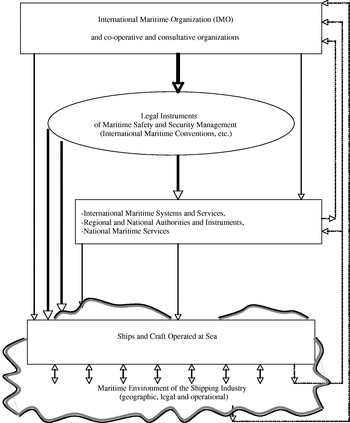
An acceptable level of maritime safety and security is being achieved as the result of operation of the International, i.e. World Maritime Safety and Security System. Thus international maritime safety and security is the “product” of this system which is shown diagrammatically in Figure 1 and which can be defined as:
“International Maritime Safety and Security System is the set of international, national and regional organizations, institutions, systems and services, operated and cooperated according to the International Regulatory Framework – whose main objective is maintaining the proper level of maritime safety and security on the world-ocean areas”.
The Organizational Structure of the International Maritime Safety and Security System.

Figure 1, shows the main components of the International Maritime Safety System and the relations between them. Within the central box:
The International Maritime Systems and Services comprise mainly:
• World-Wide Navigational Warnings Service (WWNWS),
• Global Navigation Satellite System (GNSS),
• Global Maritime Distress and Safety System (GMDSS).
The Regional and National Authorities and Instruments are the regional and national authorized maritime Institutions responsible for safety and security matters, and their legal instruments.
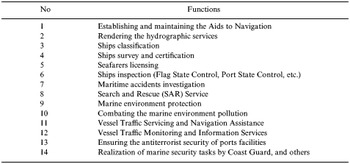
The National Maritime Service means the maritime service, as a rule, the governmental one, whose main objective is maintaining and/or ensuring the particular element of maritime safety and security. The best known maritime services are the hydrographic, and the Search and Rescue (SAR) services. However the names, structures and range of competences of these services differ considerably in maritime countries. Therefore, the functions that must be realized by national maritime services are listed in Table 1.
The Basic Functions of National Maritime Services.

3. NATIONAL MARITIME SAFETY AND SECURITY SYSTEM
A National Maritime Safety and Security System is a constituent part of the International Maritime Safety and Security System. The main objective of the National system is to ensure the acceptable level of maritime safety and security of the ships and craft operated within the national maritime areas, including the ports. The set of all the National systems together with the International Maritime Systems and Services constitute the International Safety and Security System.
All National maritime systems are similar, except for the navigational conditions within their areas which result from the different features of their particular geographic environments. Nevertheless the form and organizational structures of the authorized maritime Institutions and Services may differ considerably.
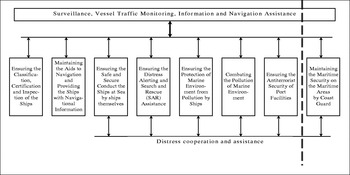
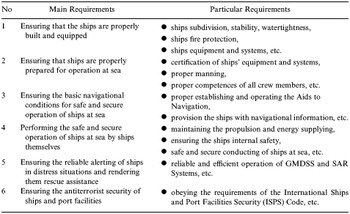
Ensuring an acceptable level of maritime safety and security of ships and craft operated on the national maritime areas means that the basic requirements regarding the ships and craft, as well as regarding operational environments, must be fulfilled. In Table 2, the basic requirements for ensuring the safety and security of ships and craft operated at sea are enumerated. The functional structure of the required National Maritime Safety and Security System that ensures the necessary level of safety and security of ships and craft operating within the national maritime areas is shown in Figure 2.
The Functional Structure of a National Maritime Safety and Security System.

Basic Requirements for Ensuring the Safety and Security of Ships and Craft Operated at Sea.

4. VESSEL TRAFFIC MONITORING AND INFORMATION SYSTEM OF EUROPEAN UNION
Vessel Traffic Monitoring and Information System (VTMIS) is a Regional Maritime Safety and Security System. The main initial objective of such systems was to increase marine protection from pollution by ships. However the main objective now is to increase the antiterrorist security of shipping in the maritime areas covered by this system.
The establishment of the European Union's VTMIS began in 2002 with Directive 2002/59/EC of the European Parliament and the Council of 27 June 2002. The main objective of establishing this system was to prevent and protect from such disastrous consequences that occurred as the result of the catastrophe of the tanker Erica that sank 40 miles off Brittany on 12 December 1999. The main functions of the VTMIS were formulated by the above Directive as:
“Setting up a Community Vessel Traffic Monitoring and Information System should help to prevent accidents and pollution of sea and to minimize their impact on the marine and coastal environment and on the economy and health of local communities”.
However soon after this formulation, the VTMIS was designated to realize a second function that can be expressed as:
“Contributing to increase the antiterrorist security of shipping industry on the maritime areas of the European Union”.
This second function of VTMIS was driven by the package of legislative measures adopted by the IMO's Member States in London, in December 2002.
In order to characterize more precisely and comprehensively the subject of VTMIS, the following statements explain “what is and what is not VTMIS” (European VTMIS, 2006):
• VTMIS of EU is the regional system whose main objective is increasing the safety of the marine environment from pollution by ships, and increasing the level of antiterrorist security of shipping industry on the European Union's maritime areas.
• VTMIS of EU is the system composed of the national component systems of VTMIS of all the maritime countries being the Members of the European Union.
Only one component of the whole European Union's VTMIS is operated by the EU Commission (by the European Maritime Safety Agency – EMSA). This component constitutes the European Union's Computerized Data Exchanging Centre; i.e. the Centre of the SafeSeaNet System.
The essence of the VTMIS's activity consists of:
• monitoring the ships' traffic, gathering the information regarding the volume of traffic and its contents, and information regarding the amount and kinds of transported hazardous materials in particular ports of the EU;
• exchanging this information between the maritime countries of the EU, as well as rendering this information accessible to authorized institutions participating in the process of sea transportation and in process of ensuring the safety and security of shipping industry.
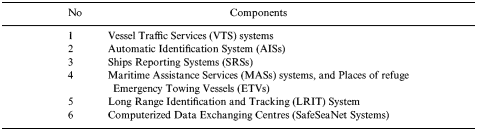
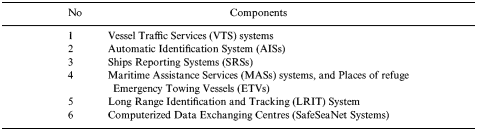
The components of Vessel Traffic Monitoring and Information System of European Union are given in Table 3.
Main Components of the European Union VTMIS.
The operational environment of the VTMIS uses two global maritime systems:
• Global Navigation Satellite System (GNSS);
• Global Maritime Distress and Safety Systems (GMDSS).
In addition, as a result of the catastrophe of tanker Prestige that sank off the Spanish coast on 14 November 2002, the Maritime Assistance Service (MAS) was established together with the Places of refuge and Emergency Towing Vessels (ETVs).
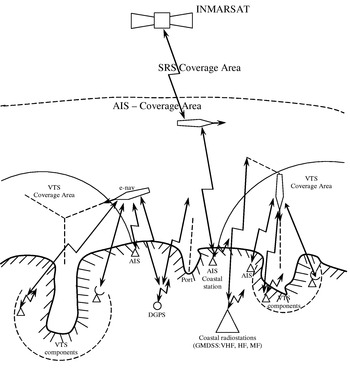
Figure 3 shows diagrammatically the three first components of the EU VTMIS. The fourth and last component system, Long Range Identification and Tracking (LRIT) system, will be included within the VTMIS and fully implemented by the end of 2008.
VTMIS: with three component systems (VTS, AIS, SRS), the assistance systems (DGPS, INMARSAT and coastal radiostations VHF, HF, MF).

5. CONCLUSIONS
The very fast progress of science and technologies, together with changes in the world political and economic situation, the intensification of traditional maritime dangers, especially for the marine environment, and the appearance of new maritime threats, such as that of maritime terrorism, have resulted in the permanent adaptation of the traditional maritime safety systems to meet the new situations. In addition there is the implementation of systems such as the European Union's VTMIS. All these measures improve the international maritime safety and maritime security system.