Introduction
Research into the early life developmental stages of fish represents the basis of fisheries biology; it affects the understanding of biology and ecology of species, identifying the factors that influence the selection of spawning and nursery areas, as well as the distribution and migration of certain species. Previous research activities related to the ecology of leptocephali from the Congridae family showed that spawning of Conger conger (Linnaeus, 1758) occurs from Egypt to the Sargasso Sea, in the North-east Atlantic and the Mediterranean (Schmidt, Reference Schmidt1931; Cau & Manconi, Reference Cau and Manconi1983; Strehlow et al., Reference Strehlow, Antunes, Niermann and Tesch1998; Taylan & Hossucu, Reference Taylan and Hossucu2015). Typical depths for this species goes from 0 down to 1171 m (Mytilineou et al., Reference Mytilineou, Politou, Papaconstantinou, Kavadas, D'Onghia and Sion2005), usually between 0 and 100 m.
Ariosoma balearicum (Delaroche, 1809) is widespread in the western and eastern Atlantic Ocean (Robins & Ray, Reference Robins and Ray1986) and has also been reported from the Red Sea and Indian Ocean (Bauchot & Blache, Reference Bauchot and Blache1979). In the North-eastern Atlantic Ocean, A. balearicum is found in the Azores (Porteiro et al., Reference Porteiro, Menezes, Afonso, Monteiro, Santos, Borges, Costa, Cunha, Gabriel, Gonçalves, Martins, Melo, Parente, Raposeiro, Rodrigues, Santos, Silva, Vieira and Vieira2010), along the Iberian peninsula with a northern boundary of 48°N (Strehlow et al., Reference Strehlow, Antunes, Niermann and Tesch1998), and in the Mediterranean Sea (Robins & Ray, Reference Robins and Ray1986; Busalacchi et al., Reference Busalacchi, Rinelli, De Domenico, Profeta, Perdichizzi and Bottari2010) and Adriatic Sea (Bojanić-Varezić et al., Reference Bojanić-Varezić, Tutman, Matić-Skoko, Pallaoro, Tičina and Dulčić2012; Anibaldi et al., Reference Anibaldi, Benassi Franciosi, Massari, Tinti, Piccinetti and Riccioni2016), as well as in the Hellenic Seas (Papaconstantinou, Reference Papaconstantinou1988). It has a maximum length of 34 cm and inhabits depths ranging from 20–100 m in the Adriatic Sea (Bojanić-Varezić et al., Reference Bojanić-Varezić, Tutman, Matić-Skoko, Pallaoro, Tičina and Dulčić2012), 112–391 m in the southern Tyrrhenian Sea (Busalacchi et al., Reference Busalacchi, Rinelli, De Domenico, Profeta, Perdichizzi and Bottari2010), but it was also found at 732 m depth in the eastern Atlantic (Smith, Reference Smith1990). Usually this species occurs in waters with less than 100 m depth (Smith, Reference Smith and Böhlke1989).
Gnathophis mystax (Delaroche, 1809) is restricted to the eastern Atlantic Ocean, where it is distributed from southern Portugal, the Canary Islands (Bauchot, Reference Bauchot, Fischer, Bauchot and Schneider1987) and the Azores (Menezes et al., Reference Menezes, Sigler, Silva and Pinho2006) to Morocco (Bauchot, Reference Bauchot, Fischer, Bauchot and Schneider1987). This species also occurs in the Mediterranean Sea (Carpentieri et al., Reference Carpentieri, Colloca and Ardizzone2007), including the Gulf of Cadiz (Torres et al., Reference Torres, Ramos and Sobrino2012), Ionian Sea (Granata et al., Reference Granata, Flick and Martin2012), the Hellenic Seas (Papaconstantinou, Reference Papaconstantinou1988) and Tyrrhenian Sea (Busalacchi et al., Reference Busalacchi, Rinelli, De Domenico, Profeta, Perdichizzi and Bottari2010). It inhabits a depth range of 75–800 m.
Existing data on the presence of leptocephali in the Adriatic Sea refer to the first record of Ariosoma balearicum in the middle Adriatic Sea (Jabuka Pit) (Bojanić-Varezić et al., Reference Bojanić-Varezić, Tutman, Matić-Skoko, Pallaoro, Tičina and Dulčić2012), while recent data have focused on the species composition of southern Adriatic Sea leptocephali (Anibaldi et al., Reference Anibaldi, Benassi Franciosi, Massari, Tinti, Piccinetti and Riccioni2016). Findings of adult specimens refer also to the area of the southern Adriatic Sea, although these data indicate very rare findings of A. balearicum (Šoljan, Reference Šoljan1948; Jardas, Reference Jardas1996; Ungaro et al., Reference Ungaro, Marano, Marsan, Martino, Marzano, Strippoli and Vlora1999).
As with the determination of fish larvae of other species, the determination of leptocephali involves the application of general parameters in order to define which family an individual belongs to. After determining the family, there are specific identification characteristics that enable the determination of the species. There are a number of identification keys, among which D'Ancona (Reference D'Ancona1931, Reference D'Ancona1956), Smith (Reference Smith1979, Reference Smith and Böhlke1989) and Miller & Tsukamoto (Reference Miller and Tsukamoto2004) can be considered the most useful. Fish larvae undergo very important morphological, morphometric and pigmentary changes during their development, and identification should be based on several categories (morphology, morphometry, meristic, special characteristics and pigmentation). Since development is a dynamic process that involves various changes in place and time, the determination of species based only on certain specific characteristics (as number of myomers) is not recommended, but a detailed study of each category separately should be done.
The objective of this paper is to examine differences in morphometric characteristics of Congridae eel leptocephali and to compare these with historical data from the available literature. The results will provide a better understanding and further knowledge about the ecology of leptocephali from the Congridae family in the southern Adriatic Sea.
Materials and methods
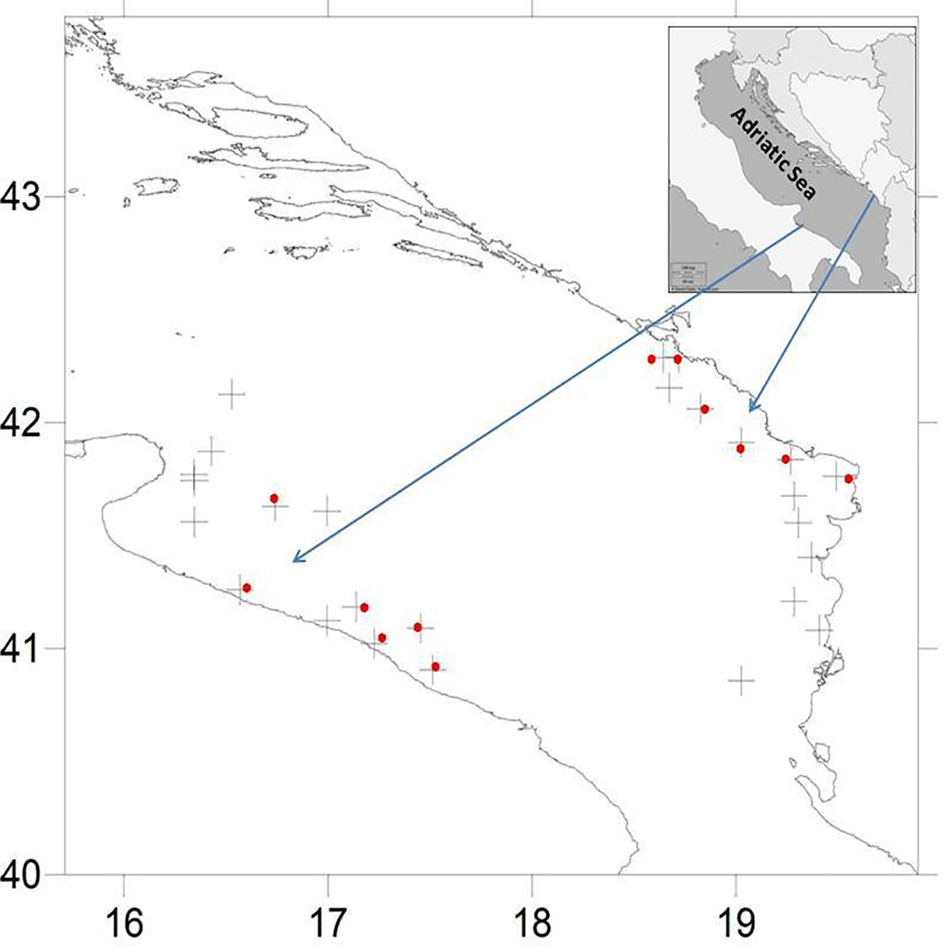
During the acoustic monitoring of small pelagic fish species and ichthyoplankton within the Italian MEDIAS (MEDiteranean International Acoustic Survey) GSA 18 project and its extension in the ambit of the FAO AdriaMed project from 2011 until 2016, a total of 25 leptocephali of three Congridae species were caught as bycatch of pelagic trawls in the area of southern Adriatic Sea (Figure 1) on board RV ‘Dallaporta’ (Leonori et al., Reference Leonori, Tičina, De Felice, Vidjak, Grubišić and Pallaoro2012; Machias et al., Reference Machias, Pyrounaki, Leonori, Basilone, Iglesias, De Felice, Bonanno and Giannoulaki2013).
Study area with location of leptocephali catch for all investigated years (+ pelagic trawl stations; +• pelagic trawl stations with leptocephali).

Samples were caught by midwater sampling trawl ‘Volante’ (18 mm codend, about 10 m vertical opening and 12 m horizontal opening) at depths ranging from 50 to 132 m. Between 20–25 hauls per year were carried out throughout the GSA 18 (Geographical Sub-Area – Resolution GFCM/33/2009/2) in the study period. Trawls were monitored by means of Simrad ITI trawl eye and temp-depth net CTD probe.
All pelagic hauls lasted 30 min on average. After the sampling, leptocephali were stored in 70% alcohol, and processed in the laboratory in order to obtain morphometric characteristics and species determination, following the method adopted by D'Ancona (Reference D'Ancona1931) and Smith (Reference Smith and Böhlke1989). In order to overcome the shrinkage of individuals resulting from the fixation process, rehydration was performed with filtered seawater for 30 min before measurement. For the measurement of all parameters, a NIKON SMZ 800 stereomicroscope was used, which is equipped with a camera and an external unit for measurements. Two readers made the myomere counts, after which the average value was taken, in cases of minor deviation of the number of myomers.
Following the MEDIAS protocol (MEDIAS HANDBOOK, 2019), along with acoustic survey, hydrographic data up to a maximum depth of 200 m were taken using the Seabird 911 plus probe, and these data were used in this paper to represent the basic hydrographic parameters of the study area. CTD stations were regularly distributed along the acoustic transects in order to measure temperature, salinity, fluorescence, turbidity and dissolved oxygen in the water column.
Results
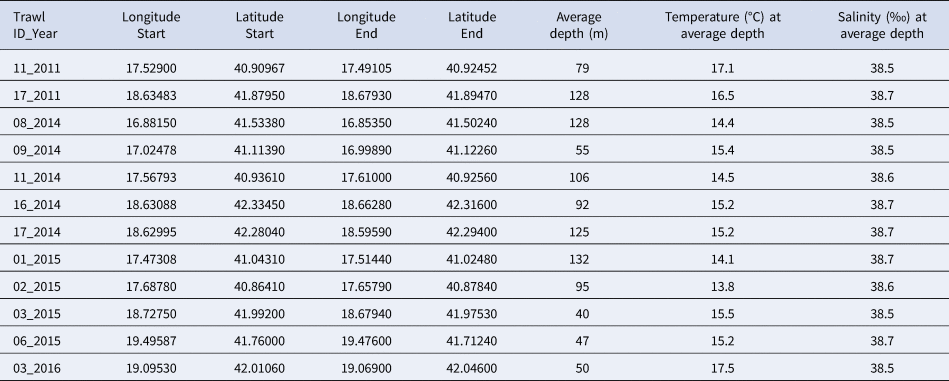
Water temperature and salinity of haul positions ranged from 13.8–17.5°C and from 38.5–38.7, respectively. In Table 1 the sampling data, location and environmental oceanographic values are presented.
Sampling data with basic oceanographic parameters at pelagic trawl locations

In total, 25 specimens of Congridae leptocephali were measured (Supplementary Tables S4–S10). All specimens were in pre-metamorphic stage, or less than 20 cm in total length (TL) (Blache, Reference Blache1977).
Ariosoma balearicum (Delaroche, 1809)
Larvae of Ariosoma are transparent, with a leaf-like body, very long gut and the dorsal fin origin near the posterior end of the body. The lateral pigment consists of melanophores outlining the myosepta immediately below the midline and forming a series of short diagonal lines from head to tail. The ventral pigment consists of small melanophores below the gut anteriorly, switching to the top of the gut behind the liver. A series of small melanoflores lies on the dorsal midline from head to tail. Small specimens have larger, more widely spaced melanophores along the dorsal and ventral midlines but they disappear with growth. Several ophichthids have similar lateral pigment, but they can be distinguished from Ariosoma by the shorter gut with its characteristic swellings or arches (Supplementary Figure S3A–C). The characteristic pigment of Ariosoma larvae is lost early in metamorphosis; such early metamorphic specimens are fairly common and can be confusing (Smith, Reference Smith1979).
During the period from 2011–2016, through accidental catches, a total of four leptocephali of A. balearicum were found (Supplementary tables S4–S5).
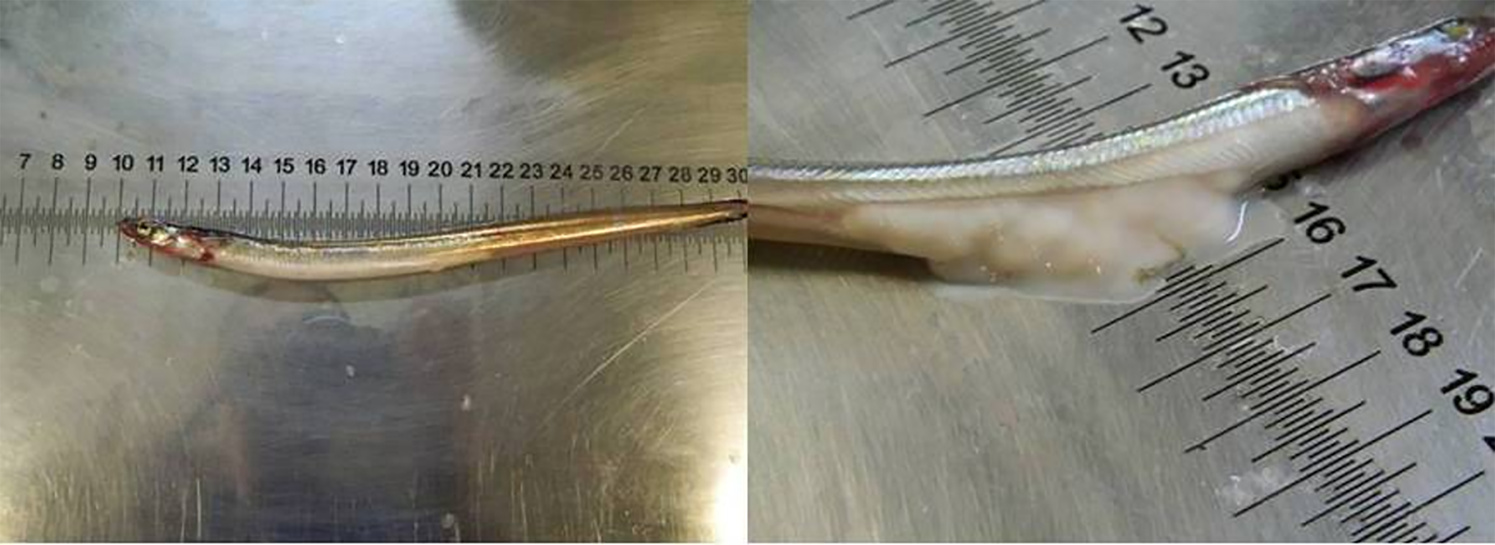
Although A. balearicum leptocephali were not found during 2014, one adult individual was found in the advanced stage of reproductive development (Figure 2).
Adult male of Ariosoma balearicum with visible development of reproductive tract.

Conger conger (Linnaeus, 1758)
Conger conger leptocephali (Supplementary Figures S4A–C) have a very elongate body, compressed laterally, with “W” shaped myomeres and a very long simple tubular gut along the ventral margin of the body. The larvae have small heads and oval eyes, slightly elongated in a dorso-ventral direction. The upper jaw is shorter than the lower one. Pigmentation is represented by seven pigment spots more or less large along the intestine, 10 smaller points are behind the anus at the base of the anal opening, others are on the tail. The anal fin extends forward until just behind the fourth abdominal point and approximately at this level the dorsal fin starts, both shortly behind the half of the TL (coincides with the observations of D'Ancona, Reference D'Ancona1956). Dorsal, caudal and anal fins are joined. The dorsal fin extends anteriorly, but does not reach half of the TL. Larvae have small pectoral fins which are very evident; pelvic fins are absent.
During the period 2011–2016, a total of 15 leptocephali of C. conger were found (Supplementary Tables S6–S7).
Gnathophis mystax (Delaroche, 1809)
Gnathophis mystax (Supplementary Figure S5A–C) has several characteristics that allow relatively simple determination of this species. It has some pigmented spots under the jaw and above the eyes, with a certain number of equal pigments on the sides of the intestine, with some of them standing out mostly by their size. The anus is located on about 2/3 of the TL. The dorsal fin extends a little farther than the anus, while the pectoral is quite distinct (coincides with the observations of D'Ancona Reference D'Ancona1956). One of its most distinctive morphological features is the shape of its last hypural, which shows a pronounced dorsal hump. This characteristic can be used to distinguish this species from similar Conger larvae. In addition, Gnathophis leptocephali have longer and more acute snouts (coincides with the observations of Reference SmithSmith 1979).
During the period 2011–2016, a total of six leptocephali of G. mystax were found (Supplementary Tables S8–S9). Comparative data on the number of myomers in the three studied species are given in Supplementary Table S10.
Discussion
Research into the early life development stages of eels is very rare, especially for the southern Adriatic Sea area. The largest part of the data relates to basic morphological characteristics, as well as the determination of the age structure, while there are few assumptions about the behaviour and spawning areas of the species from the Congridae family.
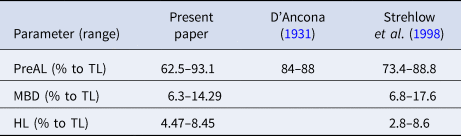
In our work, the most numerous specimens caught were C. conger leptocephali, which were found during all the investigated years at depths between 40 and 132 m. Comparative analysis of morphometric characteristics coincide to a major extent with available data (Table 2). Unfortunately, in the papers published for the Adriatic Sea area (Anibaldi et al., Reference Anibaldi, Benassi Franciosi, Massari, Tinti, Piccinetti and Riccioni2016; Bojanić-Varezić et al., Reference Bojanić-Varezić, Matić-Skoko, Tutman and Vilibić2017), there is a lack of morphometric data, so it was not possible to compare them.
Comparison of morphometric characteristics of Conger conger larvae

PreAL, preanal length; MBD, max body depth; HL, head length; TL, total length.
Gnathophis mystax was found at relatively shallow depths (40–79 m) and due to the lack of comparative data for detailed morphometric characteristics it was not possible to assess similarity to previous studies. Strehlow et al. (Reference Strehlow, Antunes, Niermann and Tesch1998) provide only data for the mean number of myomers (138) for individuals with TL from 104–150 mm for the central Atlantic area.
Comparative morphometric data for A. balearicum show certain deviations between the analysed parameters, which indicate that the species should not be strictly identified by the range of results given in other papers, but by the use of detailed taxonomic characteristics and pigmentation (Table 3).
Comparison of morphometric characteristics of Ariosoma balearicum larvae

PreAL, preanal length; MBD, max body depth; HL, head length; TL, total length.
Previous data for A. balearicum in the Adriatic Sea show very rare findings. This species was mentioned for the first time in the area of the southern Adriatic Sea (Šoljan, Reference Šoljan1948; Jardas, Reference Jardas1996) without any detailed data, only reporting rare findings of adult individuals as accidental catches in trawl nets. Ungaro et al. (Reference Ungaro, Marano, Marsan, Martino, Marzano, Strippoli and Vlora1999) also found only one adult in the area of the south-western coast of the Adriatic Sea. The first observations of A. balearicum leptocephali in the Mediterranean area relates to two individuals in the north Aegean region, during the study of the distribution of larval stages of fish conducted in 1995 using a bongo plankton net (Somarakis et al., Reference Somarakis, Drakopoulos and Filippou2002). Bojanić-Varezić et al. (Reference Bojanić-Varezić, Tutman, Matić-Skoko, Pallaoro, Tičina and Dulčić2012) give the first finding of A. balearicum leptocephali at just one station in the area of the middle Adriatic Sea during research carried out in 2011. A study conducted between 2010 and 2012 (Anibaldi et al., Reference Anibaldi, Benassi Franciosi, Massari, Tinti, Piccinetti and Riccioni2016) showed the presence of 39 individuals of A. balearicum in the central and southern Adriatic Sea.
Our results of the total number of myomers indicated that the number of myomers in three of the four individuals of A. balearicum is higher than the data published so far (145–149), although all other identification characteristics are the same as in A. balearicum. Miller (Reference Miller2002) mentions the fact that in A. balearicum there are several different geographic ‘lines’ that differ in the number of myomers, which suggests that there are different populations of this species in different areas of the North Atlantic Ocean. Since the results of the number of myomers presented in this paper do not match with the existing results (Supplementary Table 8), it is possible that there is an additional, Adriatic line, and that there is a distinction between high- and low-count forms.
Strehlow et al. (Reference Strehlow, Antunes, Niermann and Tesch1998) indicate the possibility of the existence of another species from the genus Ariosoma that has a higher number of myomers compared with A. balearicum. Smith (Reference Smith and Böhlke1989) associated all specimens studied by Blache (Reference Blache1968, Reference Blache1977) which have a higher number of myomers with Ariosoma anale. However, three individuals collected during our research could not be A. anale, because of the different identification characteristics, especially lack of three lateral rows of the pigment series.
The conclusion that A. balearicum spawns in the southern Adriatic Sea is indicated by the fact that the early developmental stages of A. balearicum in the Adriatic Sea were first described before 1937 and published in the Monograph ‘Uova, larvae e stadi giovanili di Teleostei’ (D'Ancona, Reference D'Ancona1956) as well as by the fact that during the survey conducted in 2014 one individual was found in advanced stage of development of the reproductive tract. The finding of A. balearicum leptocephali in the southern Adriatic Sea during the acoustic survey conducted in 2011, as well as leptocephali and adult specimens found in 2014 and 2016, most probably indicates the establishment of resident populations of this species in the Adriatic Sea.
Regarding the two other species, C. conger and G. mystax, we also found a different range in the total number of myomers. By comparing all available data related to the number of myomers, it can be concluded that this is not an adequate sole identification characteristic, and that it should not be taken into account in the determination process. The number of myomers often overlap among the different species (Aoyama et al., Reference Aoyama, Mochioka, Otake, Ishikawa, Kawakami, Castle, Nishida and Tsukamoto1999, Reference Aoyama, Wouthuyzen, Miller, Inagaki and Tsukamoto2003, Reference Aoyama, Wouthuyzen, Miller, Minegishi, Minagawa, Kuroki, Suharti, Kawakami, Sumardiharga and Tsukamoto2007; Kuroki et al., Reference Kuroki, Aoyama, Miller, Wouthuyzen, Arai and Tsukamoto2006, Reference Kuroki, Aoyama, Miller, Watanabe, Shinoda, Jellyman and Tsukamoto2008; Miller, Reference Miller2009), while myomere counts could be a less accurate identification characteristic, due to the difficulty in counting the tiny myomeres in the tail of each leptocephalus (Miller et al., Reference Miller, Wouthuyzen, Ma, Aoyama, Suharti, Minegishi and Tsukamoto2011). Given the high probability of error during counting (even in cases where counting is carried out by several people), this is not an adequate sole characteristic for identifying species.
Given the small number of individuals, as well as the fact that they were caught during different years, it is difficult to map their distribution. Certainly, further research should be directed towards genetic confirmation of species, especially for Ariosoma-like leptocephali, as well as detailed analyses of water dynamics in order to determine the movement of larvae in relation to hydrodynamics. What can be concluded is that the deep waters of the southern Adriatic basin are very likely the spawning area of species from the Congridae family. This conclusion is indicated by comparative analyses of all the available data presented in this paper.
Supplementary material
The supplementary material for this article can be found at https://doi.org/10.1017/S0025315421000229.
Acknowledgements
Special thanks go to the captain and the crew of the research vessel RV ‘Dallaporta’ and the scientific staff for their assistance during the acoustic surveys, especially G.C. who directed trawl operations on board.
Financial support
This work was supported by the FAO AdriaMed project (Scientific Cooperation to Support Responsible Fisheries in the Adriatic Sea) and by the European Community and the Italian MIPAAF – Ministry of Agriculture, Directorate of Fishery, in the ambit of Data Collection Framework programs, MEDIAS (MEDiterranean International Acoustic Survey) GSA 18 project.