Facility-specific antimicrobial stewardship programs are now recommended in acute-care and non–acute-care settings to improve antimicrobial prescribing patterns and patient outcomes, including the development of antimicrobial resistance.Reference Barlam, Cosgrove and Abbo 1 Accurate measurements of use are therefore imperative in diverse clinical settings to allow for internal and external benchmarking for quality improvement interventions.
Three methods are available to quantify antimicrobial use: daily defined dose (DDD), which is recommended by the World Health Organization (WHO); days of therapy (DOT); and stop–start days (SSD). 2 – Reference Zagorski, Trick and Schwartz 4 DDD normalizes a total dispensed dosage using a standard adult dose for each antimicrobial. DOT is measured by the number of days an antimicrobial is received regardless of dosage strength or frequency received in a day. SSD measures the total number of days of continual antimicrobial exposure.
Among the population of patients receiving chronic hemodialysis (CHD), DDD and DOT may underestimate true antimicrobial exposure. Drugs with prolonged elimination in the setting of renal dysfunction may present a consistent level of exposure and therefore risk, including development of antimicrobial resistance. However, this level of exposure may be underestimated when quantifying only days of drug receipt and a normalized dose.Reference Zagorski, Trick and Schwartz 4
In this proof-of-concept study, we quantified the degree of variation in antimicrobial use among patients receiving CHD using DDD, DOT, and SSD. Additionally, we calculated a “correction factor” for frequently used antimicrobials to standardize DDD and DOT measurements to SSD, and we used this correction factor to simulate DDD and DOT misestimation of the true antimicrobial exposure in a healthcare population with a variable proportion of patients receiving CHD.
METHODS
Data for this study were collected at 2 outpatient CHD units in Boston, Massachusetts. During a 12-month prospective period, all doses of parenteral antimicrobial administered in the CHD units were documented from electronic medication administration records and confirmed using written nursing documentation of medication administration. Findings from this study pertaining to antimicrobial utilization rates and appropriateness of indication have been previously published.Reference Snyder, Patel, Kallen, Strom, Tucker and D’Agata 5 , Reference Snyder, Patel, Kallen, Strom, Tucker and D’Agata 6 This study was approved by the institutional review board at the investigators’ and study site institutions.
Antimicrobial exposure for the 5 most commonly used parenteral antimicrobials (ie, vancomycin, cefazolin, ceftazidime or cefepime, gentamicin, daptomycin) were quantified using 3 methods. DDD was defined as the ratio of total grams dispensed from the pharmacy and administered to the patient divided by the reference adult daily total dose, using the WHO online database. 2 Moreover, 1 DOT was defined as the administration of an antimicrobial on a single day, regardless of the strength or number of doses administered.Reference Polk, Fox, Mahoney, Letcavage and MacDougall 3 In this population, parenteral doses were administered at a frequency no greater than once per dialysis session. SSD was defined as the difference in the number of days between the first receipt of a prescribed antibiotic and the last day the drug was dispensed, plus 1 day to account for antimicrobial exposure given the prolonged elevation in serum antimicrobial concentration among patients with end-stage renal disease.Reference Zagorski, Trick and Schwartz 4 All 3 methods of quantifying antimicrobial exposure were expressed using a denominator of 100 patient months, which was calculated using the number of days patients in the study were receiving CHD care in the study units (including intervening nondialysis days).
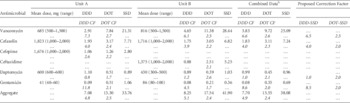
For each antimicrobial analyzed, a correction factor was calculated by dividing the SSD, the measure most likely to represent actual antimicrobial exposure, by DDD and DOT, which underestimate antimicrobial exposure. For example, in the “combined unit” data, the correction factor for vancomycin DDD was calculated as 6.6 (SSD/DDD=25.09/3.83) (Table 1). This correction factor was then applied to a hypothetical scenario in which hospitals with varying proportions of patients on CHD receiving a given antimicrobial can apply the correction factor to their DDD or DOT estimates to derive a more valid estimate of antimicrobial exposure.
Antimicrobial Use in 2 Hemodialysis Units Estimated Using 3 MethodsFootnote a

NOTE. DDD, daily defined dose; DOT, days of therapy; SSD, stop–start days; CF, correction factor.
a Data are reported in units of antimicrobial exposure (DDD, DOT, or SDD) per 100 patient months.
b The sum of individual antimicrobial exposure totals may not equal the total antimicrobial measure due to rounding. Combined data are not provided for cefepime and ceftazidime because these agents were not used in both units A and B.
RESULTS
During the 12-month follow-up of the open cohort, 278 patients received at least 1 session of outpatient hemodialysis. Total follow-up times for unit A, unit B, and combined data were 35,192, 39,752, and 74,944 patient days, respectively. A total of 1,003 parenteral antimicrobial doses were administered, including the following: vancomycin, 619 (61.7%); cefazolin, 195 (19.4%); cefepime, 37 (3.7%); ceftazidime, 88 (8.8%), daptomycin, 28 (2.8%); gentamicin, 22 (2.2%); and ertapenem, 14 (1.4%). Table 1 presents the antimicrobial use data for the 5 most common drug/drug classes as characterized using DDD, DOT, and SSD methodology, as well as calculated correction factors, for unit A, unit B, and combined data.
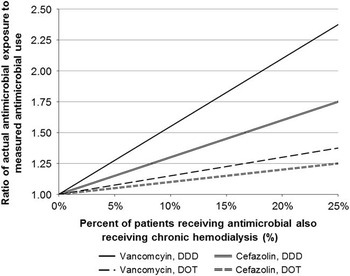
Using the proposed correction factors for the 2 most commonly used antimicrobials, vancomycin and cefazolin (DDD-SSD correction factors, 6.5 and 4.0, respectively; DOT-SSD correction factors, 2.5 and 2.0, respectively), the theoretical misestimation of antimicrobial exposure is presented in Figure 1 for a healthcare facility population with varying proportions of patients receiving CHD. For a healthcare population in which 5% of patients receiving antimicrobials also receive CHD, DDD methodology could underestimate antimicrobial exposure by 27.5% for vancomycin and 15.0% for cefazolin, and DOT methodology could underestimate antimicrobial exposure by 7.5% for vancomycin and 5.0% for cefazolin. In a healthcare population in which 20% of patients receiving antimicrobials also receive CHD, the underestimation would be 110% for vancomycin and 60% for cefazolin using DDD methodology and 30% for vancomycin and 20% for cefazolin using DOT methodology.
Hypothetical relationship between the proportion of patients in a healthcare population who receive hemodialysis, and the misestimation of antimicrobial exposure using defined daily dose (DDD) and days of therapy (DOT) methodology, for vancomycin and cefazolin.
Note: This hypothetical scenario assumes a similar indication for and duration of antimicrobial therapy in the CHD and non-CHD populations.

DISCUSSION
Data from patients receiving CHD in the hospital setting may lead to misestimation of total antimicrobial use when using the commonly employed DDD or DOT methodology. In this study, we used a rigorously collected dataset of antimicrobial use among patients receiving CHD to quantify the discord between SSD and non-SSD estimations of antimicrobial exposure. We demonstrated the potential impact on misestimation of antimicrobial exposure in a facility with CHD patients using non-SSD methodologies.
There are two significant reasons that antimicrobial exposure rather than antimicrobial utilization may be of importance: (1) interfacility comparisons of antimicrobial use and (2) accurate estimation of the risk for development antimicrobial resistance. Increasingly, healthcare facilities are mandated to report (including publically) infection-related health quality outcomes, and antimicrobial use may become a commonly reported metric. Given concerns about the validity of interfacility comparisons of other metrics,Reference Lin, Hota and Khan 7 the validity of methods used to make interfacility comparisons of antimicrobial exposure should be addressed before these methods become firmly established.
The correction factors proposed here are limited in generalizability by several factors: (1) institutions other than the study institutions may be unique in patient and prescribing practices; (2) dose adjustments for weight or hepatic metabolism of antimicrobials may not have been fully accounted for; (3) this analysis was restricted to an adult population, and different antimicrobial prescribing practices may be applied in a pediatric population. Further studies are warranted to repeat our findings and extend them to different populations.
By comparing precise calculations of DDD, DOT, and SSD estimates of antimicrobial use in a CHD population and extrapolating the effect of these differences to the overall calculations of antimicrobial use in the hospital setting, we have shown that measurements of antimicrobial use in a population that includes patients receiving CHD may be significantly misestimated and therefore partly invalidate interfacility comparison of antimicrobial use at the hospital level. Applying a correction factor to the measured DDD based on the fraction of the population with renal impairment may provide a more valid metric for interfacility comparison of antimicrobial exposure.
ACKNOWLEDGMENTS
Financial support: E.M.D. received grant support from the Agency for Healthcare Research and Quality (grant no. R18 HS021666) and from the National Institutes of Health (grant no. K24 AI119158).
Potential conflicts of interest: All authors report no conflicts of interest relevant to this article.