Language impairment and reading impairment are two of the leading causes of academic failure (Dockrell, Lindsay, & Palikara, Reference Dockrell, Lindsay and Palikara2011). Early identification of risk for reading and language impairment is important to provide early intervention in order to reduce the incidence of subsequent reading, language, and other academic difficulties (e.g., Scanlon, Anderson, & Flynn, Reference Scanlon, Anderson and Flynn2008). The purpose of the present study was to examine risk for reading and language impairment in students educated in a second language (L2). The early identification of L2 students who are at risk for reading and/or language impairment is complicated because these students are usually still in the process of acquiring the language of instruction and, thus, indications of underperformance in language or reading could reflect their incomplete acquisition of the L2 rather than an underlying impairment related to language or reading acquisition (Paradis, Genesee, & Crago, Reference Paradis, Genesee and Crago2010). An alternative identification strategy is to use diagnostic tests in the students’ first language (L1) to predict risk. A goal of the present study was to examine the utility of such an approach. An additional goal was to examine whether risk for reading and language impairment comprise different risk profiles, a point we return to later.
Our focus was on majority language, English-speaking students attending early total French immersion (FI) programs in which all instruction, including reading instruction, was provided in French, their L2, during kindergarten and Grade 1. While the students in the current study spoke the majority language of the broader community in which they were living (Canada), education through an L2 is even more common among students who speak a minority language by virtue of being immigrants (e.g., Turkish-speaking children whose families have immigrated to Germany) or being raised in families in which a minority language is used in the home (e.g., Spanish-speaking children living in the United States.). We refer to all such learners as L2 students but acknowledge there may be both similarities and differences in the risk profiles of different types of L2 learners. Because the goal of the present study was to examine the feasibility and utility of using L1 indicators of risk for reading and language impairment to identify L2 students who are at risk, we review research that has examined predictors in L1 as well as L2 students in each domain.
DYSLEXIA
Developmental dyslexia, or specific reading impairment, is a neurologically based, persistent condition characterized by difficulty with accurate and/or fluent word recognition and poor decoding and spelling that are not due to limited intellectual ability, sensory deficit(s), or inadequate instruction. It is estimated to affect between 5% and 20% of school-age children and is thought to have a genetic component (Shaywitz & Shaywitz, Reference Shaywitz and Shaywitz2005); unlike primary language impairment (PLI), to be discussed shortly, the incidence of dyslexia does not differ for boys and girls (Shaywitz, Shaywitz, Fletcher, & Estabar, Reference Shaywitz, Shaywitz, Fletcher and Estabar1990).
Extensive research on monolingual children, primarily English speakers, indicates that children with dyslexia have poor phonological processing skills and limited knowledge of the alphabetic principle (e.g., Bowey, Reference Bowey, Snowling and Hulme2005). With respect to phonological processing, three domains have been examined: phonological awareness (PA), phonological access or recoding, and phonological memory. Although there is evidence that all three are linked to decoding ability in general and to dyslexia in particular, PA has been found to be the most significant and consistent predictor, at least in the case of languages with deep orthography such as English, as much as 2 to 5 years later. It has been found that the decoding abilities of monolingual children with dyslexia improve significantly following systematic and explicit instruction in letter-sound knowledge and PA, arguing that phonological processing, and PA in particular, are causally and not just statistically related to word decoding (for a review, see National Institute for Literacy, 2008). Difficulty with reading comprehension has been less extensively studied than decoding, but most researchers agree that reading comprehension is dependent on a range of abilities that, in addition to decoding, include vocabulary, syntax, working memory, and the ability to make inferences, integrate information, and understand story structure (e.g., Oakhill, Cain, & Bryant, Reference Oakhill, Cain and Bryant2003). Studies on reading comprehension indicate further that predictors that are most significant in the early stages of learning to read may lose their importance and be replaced by different predictors later. Storch and Whitehurst (Reference Storch and Whitehurst2002), for example, provide evidence that oral language skills play an important role in reading comprehension in Grades 3 and 4 but a nonsignificant role in Grades 1 and 2.
There is growing evidence concerning readers with deficits in reading comprehension whose difficulties are not or are less significantly related to difficulties with word decoding. While some researchers believe that these poor comprehenders have difficulties with reading comprehension specifically, and not with (oral) listening comprehension (Bishop & Snowling, Reference Bishop and Snowling2004), others have proposed that they may have oral language skills that are subclinically deficient, that is, too mildly impaired to be diagnosed as a clinical language impairment (e.g., Catts, Adlof, & Ellis Weismer, Reference Catts, Adlof and Weismer2006). If indeed poor comprehenders also have subclinically impaired language abilities, one would expect that predictors of risk for language impairment would also predict reading comprehension difficulties. The extent to which reading and oral language difficulties overlap in L2 learners was explored in the present investigation.
With respect to individual differences and risk for reading difficulties in L2 students, there is evidence that the same components of letter-sound knowledge and phonological processing, and especially PA, are equally important in predicting L2 decoding ability and difficulty. Specifically, there are significant correlations between L1 and L2 phonological processing abilities, and again especially PA, and between L1 and L2 word reading ability (e.g., Riches & Genesee, Reference Riches, Genesee, Genesee, Lindholm–Leary, Saunders and Christian2006). Of particular relevance to the present study, research on English-speaking students in the primary grades of early FI has revealed significant positive correlations between scores on English and French word decoding tests and, consistent with studies of individual differences in L1 reading acquisition, that phonological processing skills, and especially PA, are significant predictors of word decoding outcomes. Moreover, these relationships are evident cross-linguistically as well as intralinguistically; thus, English-L1 phonological processing abilities are significantly correlated with French-L2 decoding abilities (e.g., Comeau, Cormier, Grandmaison, & Lacroix, Reference Comeau, Cormier, Grandmaison and Lacroix1999; Jared, Cormier, Levy, & Wade-Woolley, Reference Jared, Cormier, Levy and Wade-Woolley2011).
There is also evidence, albeit limited, that L1 reading comprehension is significantly correlated with L2 reading comprehension (e.g., Reese, Garnier, Gallimore, & Goldenberg, Reference Reese, Garnier, Gallimore and Goldenberg2000). As has been found for reading comprehension in English-L1 students, reading comprehension in English-L2 students depends on diverse language skills in addition to decoding, including: vocabulary, oral proficiency, listening comprehension, and knowledge of text structure (for a review, see August & Shanahan, Reference August and Shanahan2006). In a longitudinal study of FI students in Canada, Jared, Cormier, Levy, and Wade-Woolley (Reference Jared, Cormier, Levy and Wade-Woolley2006) found that nonverbal IQ, receptive grammar, and PA, which were assessed in English in spring of kindergarten, were the best predictors of Grade 3 French reading comprehension, in this order of importance. Students’ knowledge of French (i.e., vocabulary) at kindergarten entry did not correlate significantly with reading outcomes, arguably because these students had had so little exposure to French that there was insufficient variance in their French abilities for significant correlations with later reading abilities to emerge. These students were attending programs in predominantly English-speaking cities. In the only study of at-risk readers in L2 immersion programs that we know of, Bournot-Trites and Denizot (Reference Bournot-Trites and Denizot2005) found that kindergarten and Grade 1 immersion students who were considered at risk for reading difficulty in French according to their performance on a battery of French language tests (including knowledge of letter names, PA, and word and nonword repetition) were also identified as at risk based on their performance on a similar battery of English language tests.
PLI
PLI, more commonly referred to as specific language impairment (SLI), is a developmental language disorder characterized by a marked impairment in oral language relative to age expectations that is not due to frank sensorimotor, neurological, socioemotional, or nonverbal cognitive deficits (Rice, Reference Rice, Hoff and Shatz2007). PLI has been estimated to affect 3% to 10% of kindergarten children (Tomblin et al., Reference Tomblin, Records, Buckwalter, Zhang, Smith and O'Brien1997) and more boys than girls (Law, Boyle, Harris, Harkness, & Nye, Reference Law, Boyle, Harris, Harkness and Nye2000). Although there is ongoing debate about the fundamental nature of the deficits that underlie PLI and its causes, for purposes of the present study we focused on morphosyntax because there is considerable evidence that impairment in this domain is salient in children with PLI (e.g., Rice, Reference Rice, Hoff and Shatz2007), especially among English-speaking children. The specific morphosyntactic difficulties experienced by children depend on the grammatical properties of their language (Paradis, Crago, Genesee, & Rice, Reference Paradis, Crago, Genesee and Rice2003). Research on English-speaking children with PLI indicates that they have significant difficulties with tense and verb agreement morphology; thus, these are often taken by some to be clinical markers of PLI in English-speaking children (e.g., Paradis et al., Reference Paradis, Crago, Genesee and Rice2003). Findings from studies that have sought to predict language impairment in monolingual children indicate that tests of expressive morphosyntax are severe predictors of significant and persistent language difficulties (e.g., Simon-Cereijido & Gutierrez-Clellen, Reference Simon-Cereijido and Gutierrez-Clellen2007).
Children with PLI in English have also been shown to exhibit deficits on tests of verbal memory, including nonword repetition (e.g., Graf Estes, Evans, & Else-Quest, Reference Graf Estes, Evans and Else-Quest2007), which are generally thought to depend on phonological short-term memory and/or phonological working memory (Baddeley, Gathercole, & Papagno, Reference Baddeley, Gathercole and Papagno1998) and on tests of sentence repetition, which are thought to depend on both long- and short-term components of verbal memory and possibly other linguistic processes (e.g., Alloway & Gathercole, Reference Alloway and Gathercole2005). In comparative studies of the predictive accuracy of each type of task, both Archibald and Joanisse (Reference Archibald and Joanisse2009) and Botting and Conti-Ramsden (Reference Botting and Conti-Ramsden2001) found that sentence repetition was a more significant concurrent predictor of PLI in English-L1 speakers than was nonword repetition; thus, sentence repetition was used as a predictor of risk for language impairment in the present study. Few prospective predictive studies of impairment in monolingual children have considered the significance of the wide range of identified predictors simultaneously (although see Dale, Price, Bishop, & Plomin, Reference Dale, Price, Bishop and Plomin2003), and yet this information is critical when making decisions regarding service delivery.
Far fewer studies have examined correlates of language impairment in children who learn more than one language, and we are not aware of any research that has examined prospective predictors of language impairment in learners who are still in the process of acquiring the L2, a goal of the present study. Our study examined prospective rather than concurrent predictors of risk, thereby laying the groundwork for early intervention. Gutierrez-Clellen and Simon-Cereijido (Reference Gutierrez-Clellen and Simon-Cereijido2007, Reference Gutierrez-Clellen and Simon-Cereijido2010) and Paradis et al. (Reference Paradis, Crago, Genesee and Rice2003) examined the specific morphosyntactic deficits of Spanish–English and French–English simultaneous bilinguals, respectively, who had been diagnosed with PLI. Both groups of researchers found that these children exhibited the same profile of language-specific deficits in each language as monolingual children with PLI. Studies of successive bilinguals with PLI have similarly shown that they exhibit patterns of deficits in their L2 that are similar to those of monolingual native speakers of those languages (e.g., Paradis, Reference Paradis2010). It is generally argued that bilingual individuals with language impairment demonstrate impairment in both languages and that identification of bilingual and L2 children who might be affected by PLI should include assessments in both languages to confirm that their language difficulties are symptomatic of an underlying impairment and not due to loss of the L1 or incomplete acquisition of the L2.
Distinctiveness of dyslexia and PLI
There has been a longstanding debate about whether language and reading impairment comprise distinct, the same, or overlapping impairments (Bishop & Snowling, Reference Bishop and Snowling2004). Some researchers argue that reading and language impairment are different manifestations of the same underlying processing deficit (e.g., Corriveau, Pasquini, & Goswami, Reference Corriveau, Pasquini and Goswami2007); others that they are different disorders with different underlying deficits (e.g., Catts, Adlof, Hogan, & Ellis Weismer, Reference Catts, Adlof, Hogan and Ellis Weismer2005); and yet others view them as similar but different disorders where deficits that underlie one disorder place a child at risk for the other disorder (e.g., Fraser, Goswami, & Conti-Ramsden, Reference Fraser, Goswami and Conti-Ramsden2010). Many extant studies are biased in favor of finding evidence of comorbidity of reading and language impairment because they are based on samples that are selected for at least one or the other disability. Few studies have examined the incidence of language and reading impairment or difficulty in nonselected samples prospectively (but see Catts et al., Reference Catts, Adlof, Hogan and Ellis Weismer2005; Silva, McGee, & Williams, Reference Silva, McGee and Williams1985), an additional goal of the present study.
Of the studies that have used nonselected samples, only Catts et al. (Reference Catts, Adlof, Hogan and Ellis Weismer2005) compared children with dyslexia only and children with PLI only. They found that when dyslexia was defined in terms of poor word decoding abilities with normal full scale IQ, about 20% of kindergarten children with PLI met the criteria for dyslexia in Grades 2, 4, and 8, in comparison to the base rate for dyslexia of 8.6% in their total sample of 527 children. They also found that approximately 15% of children identified as having dyslexia in Grades 2, 4, or 8 met the criteria for PLI in kindergarten, as compared to the usual base rate for PLI of approximately 5% to 7% in the general school-age population (e.g., Law et al., Reference Law, Boyle, Harris, Harkness and Nye2000). Catts et al. argued that dyslexia and PLI are best viewed as distinct disorders but may be comorbid in some children; and they further propose that one would expect a particularly high incidence of comorbidity in clinical populations because of the severity of their disorder(s) and much lower incidence of comorbidity in nonclinical populations. Unfortunately, language skills were not reassessed after kindergarten and prereading/reading skills were not assessed in kindergarten in this study, making it impossible to determine the extent to which both oral and written language deficits may have coexisted in this sample at the outset or at the end of the study.
Catts and his colleagues also examined whether and to what extent children with either PLI only, dyslexia only, or PLI and dyslexia had phonological processing difficulties, in comparison to children who were typically developing. It is surprising and contrary to the results of numerous other studies (e.g., Fraser et al., Reference Fraser, Goswami and Conti-Ramsden2010) that children with PLI only performed significantly better than children with dyslexia only or children with PLI and concomitant dyslexia on these tasks. The children with PLI only did not differ significantly from controls in phonological processing abilities, leading the authors to argue that an underlying phonological deficit did not account for the overlap across these two clinical populations. Again, language skills were not assessed after kindergarten in Catts et al.'s (Reference Catts, Adlof, Hogan and Ellis Weismer2005) study, potentially masking cases who may have had language impairment but, as a result of kindergarten testing that did not fully tap into areas of difficulty, went undetected early on. To our knowledge, no studies have examined overlap in reading and language impairment in L2 learners, the focus of the present research.
THE PRESENT STUDY
This study is part of a longitudinal investigation of L2 reading and oral language development in English-speaking students in an early total FI program. Initial reading instruction in this program was exclusively in French in kindergarten and Grade 1; the reading curriculum in these grades reflected a balanced approach with both phonics and whole-language features. The present study focuses on Grade 1 students who are deemed to be at risk for L2 reading and/or oral language difficulties. Three specific questions were addressed. (a) Are the risk profiles for reading and language difficulties in L2 students the same or different and in what ways? (b) Can risk for reading and language learning in an L2 be predicted prospectively using L1 predictors? (c) How early in schooling can significant predictions of risk for each type of disability be made using L1 predictors?
Throughout the remainder of this article, we use the term “difficulty” in lieu of “impairment” when referring to poor oral language and reading performance by the at-risk children because “impairment” denotes difficulties of a clinical nature and it may be premature to confidently identify these L2 students as clinically impaired. The below-average children in this study, nevertheless, can be considered at risk for impairment in reading or language because they meet the primary inclusionary criterion for impairment; namely, performance on a reading or language test that falls below 1 SD of the mean. Moreover, they do not appear to meet any exclusionary criteria, such as significantly low general intelligence or sensory/emotional/neurocognitive impairments.
METHOD
Participants
The children participating in this study were attending an early total FI program in a suburban community outside Montreal. As noted earlier, all kindergarten and Grade 1 instruction, including reading, was conducted in French by native French-speaking teachers. The reading curriculum included features of both whole language and phonics approaches. The geographical area served by these schools includes primarily French-speaking families, but there are numerous pockets of English-speaking and bilingual (French and English) families as well; the families represent a range of socioeconomic backgrounds. These schools were selected because they included a relatively high proportion of children who were learning French as an L2. To ensure that they were all still in the process of acquiring French, only children whose language exposure at home and in the community was only or primarily in English were included; some minimal exposure to French is likely in the case of all students. Most parents who did not volunteer to participate in the study did so because their child did not qualify. Children with developmental or acquired disorders other than reading or oral language impairment were excluded (e.g., autism spectrum disorders, Down syndrome). Written consent was initially obtained for 90 children, although 4 children discontinued (2 children moved, 1 child switched from immersion to core English, and consent was not received in Grade 1 for one child). The remaining 86 (50 girls) children completed kindergarten and Grade 1 testing. These children were in 12 classrooms in 7 schools.
The participating children were classified as monolingual English or English-dominant based on (a) information provided by parents in response to a questionnaire (Parent Questionnaire) about language exposure at home and in daycare; (b), scores on standardized French (Échelle de vocabulaire en images Peabody [EVIP]) and English (Peabody Picture Vocabulary Test [PPVT]) receptive vocabulary tests administered in fall kindergarten (see the description of EVIP and PPVT below); and (c) testers’ impressions following initial meetings with each child. Overall, the children's average standard score was 106 on the PPVT and 73 on the EVIP. In fall kindergarten, the children ranged in age from 4 years 9 months to 6 years with a mean age of 5 years 6 months. According to our questionnaire results, the mean number of years of the mother's education was 14 years (a college degree, i.e., 1 or 2 years of education after high school). This is comparable to the Canadian average of 13.2 years (Statistics Canada, 2006). Closer inspection of the data indicated that there was a bimodal distribution, with peaks at college degree and bachelor's degree; the range was secondary 5 to doctoral level. All testing was conducted individually in a quiet room in each child's school.
Materials
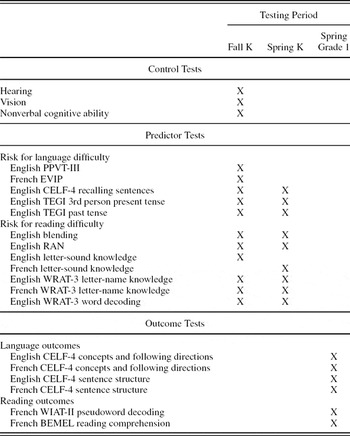
Various control tests were administered to all children in fall kindergarten. Language and reading-related predictor tests were also administered in fall kindergarten (Time 1) and again in spring kindergarten (Time 2). Administering the predictor tests twice during kindergarten allowed us to compare the accuracy of predictions made at the beginning versus the end of kindergarten. The selection of the predictor tests was based on our review of the relevant research and on practical considerations. Language and reading-related outcome measures were administered to all children in spring Grade 1 (Time 3), almost two full school years after the first administration of the predictor tests. Table 1 provides a summary of the tests administered at each time point. A questionnaire was completed by all parents in fall kindergarten. A brief description of all tests and the questionnaire follows.
Tests administered at each time point

Note: K, kindergarten; PPVT-III, Peabody Picture Vocabulary Test, Third Edition; EVIP, Échelle de vocabulaire en images Peabody; CELF-4, Clinical Evaluation of Language Fundamentals, Fourth Edition; TEGI, Test of Early Grammatical Impairment; RAN, Rapid Automatized Naming and Rapid Alternating Stimulus Tests; WRAT-3, Wide Range Achievement Test, Third Edition; WIAT-II, Wechsler Individual Achievement Test, Second Edition; BEMEL, Batterie d’échelles multidimensionnelles pour l'évaluation de la lecture.
Questionnaire
Parents were asked to complete a questionnaire at Time 1 about language background, family history, socioeconomic status, and the child's health, developmental milestones, and exposure to reading and books. Questionnaire information was used to aid in the identification of language dominance, socioeconomic level, and preexisting developmental or acquired disorders.
Control measures
The following control measures were administered individually to each child at Time 1: hearing screening, vision screening, and nonverbal cognitive ability.
Hearing screening was conducted using a calibrated, portable audiometer. Under earphones, hearing was tested in each ear separately at 500, 1000, 2000, and 4000 Hz. To pass the hearing screening, children had to reliably respond at a minimum of 20 dB at 1000, 2000, and 4000 Hz, in at least one ear. All children passed the hearing screening.
Vision screening was conducted using the Rosenbaum Pocket Vision Screener, a near-vision visual acuity screener based on the Snellen eye chart. Each child had to identify letters and numbers presented at a distance of 14 in., one eye at a time. To pass, the child had to correctly name at least all but two items in one row at an acuity level of 20/30 or better, in each eye. Vision screening was postponed until Time 2 or, if necessary, Time 3, if a child could not reliably identify letters or numbers that comprised the test. One child failed the vision screening; he was retained in our study because he was fitted with glasses shortly after our screening.
Nonverbal cognitive ability was assessed individually using the Coloured Progressive Matrices (CPM; Raven, Raven, & Court, Reference Raven, Raven and Court1998). Each child was required to look at a visual pattern and determine which of six individual pieces best completed the test pattern. Internal reliability is reported to range from r = .70 to .80. No child had below-average performance on this measure.
Language-related predictor tests
Oral language skills, which were used as predictors, were assessed using tasks of vocabulary, grammar, and sentence repetition. All of these tests, except the PPVT, were administered in fall and spring of kindergarten.
The third edition of the PPVT, form A (PPVT-III; Dunn & Dunn, Reference Dunn and Dunn1997) was administered only at Time 1 to assess English receptive vocabulary. As per standard administration, each child was required to point to the picture from a plate of four pictures that best represented a word spoken by the examiner. Internal reliability for this test is reported to be .94. The EVIP, form A (Dunn, Thériault-Whalen, & Dunn, Reference Dunn, Thériault-Whalen and Dunn1993) was administered to assess French receptive vocabulary. The EVIP is a standardized French adaptation of the PPVT-R. Internal reliability is reported to be .82.
The ability to recall and repeat increasingly long and grammatically complex sentences in English was assessed using the Recalling Sentences subtest of the Clinical Evaluation of Language Fundamentals–4 (CELF-4; Semel, Wiig, & Secord, Reference Semel, Wiig and Secord2003). The Recalling Sentences subtest of the CELF is widely used to identify English-speaking children with language impairment (e.g., Archibald & Joanisse, Reference Archibald and Joanisse2009). At age 5 and 6, internal reliability is reported to be above .90. As per standard test administration, children were required to repeat increasingly long and grammatically complex sentences without altering meaning or grammar. Up to 3 points could be deducted per sentence for recall errors.
Expressive grammar in English was assessed using the Test of Early Grammatical Impairment (TEGI; Rice & Wexler, Reference Rice and Wexler2001). Two subtests of the TEGI were administered: third-person present tense and past tense (regular and irregular). These were selected because difficulties with verbal morphology are characteristic of English-speaking children with PLI (Paradis et al., Reference Paradis, Crago, Genesee and Rice2003). As per standard test administration, the child is prompted, with the help of pictures and verbal models, to produce subject + verb (present or past tense) phrases (e.g., “Here, the girl is skating. Here, she is finished. Tell me what she did.”). Full credit is given if the verb is correctly marked for tense; otherwise, a score of 0 is given. The TEGI was designed to identify risk for oral language impairment in English among 3- to 8-year old children. Stability coefficients range from r = .82 to .95.
Reading-related predictor tests
The tests used to predict risk for Grade 1 reading outcomes assessed phonological processing, letter-sound/letter-name knowledge, and decoding in English. These tests were administered in both fall and spring of kindergarten.
Phonological processing was assessed using tasks that examine PA, phonological access, and phonological memory. PA was assessed at Time 1 and Time 2 using an experimental English blending task, a measure that assesses the ability to combine sounds to form real words (Comaskey, Savage, & Abrami, Reference Comaskey, Savage and Abrami2009). Children were auditorily presented with two or three isolated syllables comprising a consonant followed by a vowel (CV: “t-ea”), a vowel followed by a consonant VC: “ea-t”), or a consonant followed by a vowel and a consonant (CVC: “b-ea-t”) and then were asked to put them together (i.e., blend) to make a word. Each syllable was phonologically balanced across syllable conditions (e.g., tea-eat-beat). One point was given for each correct answer, for a maximum score of 9 points. Interrater reliability was k = 0.99 (Time 1) and k = 0.92 (Time 2). The Spearman–Brown reliability was r = .92 (Time 1) and r = .94 (Time 2).
Phonological access was also assessed at Time 1 and Time 2 using the Rapid Automatized Naming and Rapid Alternating Stimulus Tests (RAN/RAS; Wolf & Denckla, Reference Wolf and Denckla2005; original English version). Children were required to rapidly name a series of objects, colors, letters, numbers, and a combination of letters, numbers, and colors. There is evidence that alphanumeric naming is closely associated with decoding accuracy and quite specifically with fluency (e.g., Savage & Frederickson, Reference Savage and Frederickson2005), while nonalphanumeric naming may be more closely associated with general language deficits (e.g., Catts, Gillespie, Leonard, Kail, & Miller, Reference Catts, Gillespie, Leonard, Kail and Miller2002). Because fluency was not one of the outcome variables in the present study, only results for the nonalphanumeric (objects) subtest were included in our analyses. Scores on this test corresponded to the total number of seconds within which each test plate was completed by the child. Each subtest was administered only if the child could independently name the five practice items of each subtest (e.g., the number test plate was only administered if the child could independently name the 5 different numbers that appeared on this plate). Test–retest reliability is reported to range from 0.81 to 0.98.
Letter-sound knowledge was assessed in English at Time 1 and in French at Time 2. The same letters were assessed in the same random order in English and in French. Each child was presented with 23 uppercase letters printed in large font on a cue card and asked to produce the sound made by each letter (the letters k, b, and y were practice items). One point was given for each correct answer, for a maximum total of 23 points. The Spearman–Brown internal reliability was r = .90 (English) and r = .91 (French).
Letter-name knowledge in English was assessed at Time 1 and at Time 2 using the Wide Range Achievement Test, Third Edition: blue reading subtest (WRAT-3; Wilkinson, Reference Wilkinson1993), a measure of a child's ability to recognize and name letters. Children were asked to name 15 uppercase letters. One point was given for each correct answer, for a maximum total of 15 points. Median test coefficient alphas ranged from r = .82 to .95. Letter-name knowledge in French was assessed at Time 1 and at Time 2 using a French adaptation of the WRAT-3: letter identification section of the blue reading subtest (Wilkinson, Reference Wilkinson1993). Children were asked to name 15 uppercase letters. Interrater reliability was k = 0.96 (Time 1) and k = 0.94 (Time 2), and the Spearman–Brown reliability was r = .94 (Time 1) and r = .96 (Time 2).
Word decoding in English was assessed at Time 1 and Time 2 using the WRAT-3: word identification section of the blue reading subtest. Children were asked to read as many words as possible from a list of 42 typewritten, lowercase words. One point was given for each correct answer, for a maximum total of 42 points. Median test coefficient alphas ranged from r = .82 to .95.
Tests of reading outcomes
Pseudoword decoding in French was assessed at the end of Grade 1 (Time 3) using the Wechsler Individual Achievement Test, Second Edition: French Canadian (original French version; Wechsler, Reference Wechsler2005). Only the pseudoword identification subtest (Décodage de pseudo-mots) was administered, and not the word decoding subtest, because the former is not confounded with vocabulary knowledge and, thus, is regarded as a “purer” measure of decoding. Pseudoword identification involved reading pseudowords out loud accurately. Full points were given for each word read accurately. Testing was discontinued after seven consecutive errors. Reliability coefficients for this subtest are reported to be r = .97.
Reading comprehension was assessed at Time 3 using the Batterie d’échelles multidimensionnelles pour l'évaluation de la lecture (Cormier, Desrochers, & Sénéchal, Reference Cormier, Desrochers and Sénéchal2006, original French version), an experimental measure of reading achievement in French. Only the word comprehension and sentence comprehension subtests were administered. For word comprehension, each child read 30 single words (e.g., banane [banana]), one at a time, and pointed to the picture of the category that the word belonged to (body part, clothing, bird, fruit, or color). For sentence comprehension, the child read 28 sentences ranging from 3 to 11 words in length (e.g., Jean est couché [John is lying down]), one at a time, and pointed to the picture that matched the sentence from a set of four pictures. One point was given for each correct answer. The Spearman–Brown reliability was r = .87 (words) and r = .87 (sentences).
Tests of oral language outcomes
Tests of English and French language outcomes were administered at the end of Grade 1 in order to determine each child's language status as at risk or not at risk. Comprehension and recall of abstract linguistic concepts in English was assessed using the concepts and following directions subtest of the CELF-4. According to the test developers, this subtest assesses the ability to interpret spoken instructions that contain concepts and to recall specific information in the correct sequence. As per standard test administration, instructions were read out loud and the child was required to respond by pointing to pictures that correspond to the oral descriptions presented by the examiner (e.g., “Point to the ball to the right of a house”). Internal reliability for this subtest is above .90 for ages 6 and 7. Receptive grammar in English was assessed using the sentence structure subtest of the CELF-4. This subtest evaluates a child's comprehension of syntax. As per standard test administration, children were required to point to one picture among four that best corresponds to a spoken sentence presented by the examiner (e.g., “The first two children are in line, but the third child is still playing.”). Internal reliability for this subtest is reported to be above .70 for ages 6 and 7. French versions of the concepts and following directions subtest and the sentence structure subtest of the CELF-4, adapted by the Department of Speech-Language Pathology of The Montreal Children's Hospital, were also administered at Time 3.
Procedure
The battery of predictor tests was administered to each child in October/November of kindergarten (Time 1). A second battery of predictor tests was administered in April/May of kindergarten (Time 2), and a battery of outcome tests was administered to each child in April/May of Grade 1 (Time 3). The order of test administration was the same for all participants at each testing time.
Testing conditions
Each session lasted between 20 and 45 min, and each child was generally seen only once per day. Sessions were all conducted individually in a quiet room free of distractions. Total number of sessions varied between four and seven per child. French and English tests were not administered on the same day, unless the child had limited French skills, because it was felt that an entire session conducted exclusively in French would leave some children feeling discouraged. The same test was never given in both languages on the same day. Each child was seen by at least two, sometimes three, different examiners over the course of testing. Each assistant was trained and supervised by an experienced and certified clinical speech-language pathologist (C.E.).
RESULTS
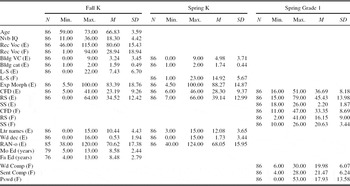
Inspection of the fall-kindergarten data (using the descriptives procedure of SPSS to generate z scores for each raw score for each test) revealed that the following had skewed distributions: TEGI total (mean of TEGI 3rd person –s and TEGI past tense), English WRAT-3, and CPM. See Table 2 for the means and standard deviations of each test in fall kindergarten. Distributional normality was achieved by applying a square root transformation (English WRAT-3), reversing the scores and applying a square root transformation (TEGI total), or reversing the scores and applying a natural log transformation (CPM). The TEGI total, the English WRAT-3, and the CPM each contained between one and three outliers (>|3.0| SD). Despite applying the above transformations, one outlier remained among the CPM scores (z = +3.11), and two remained among the English WRAT-3 scores (both z = −3.37). These outlier data were kept in the analyses reported here because results did not differ when they were removed. It was further noted that there was an elevated rate of zero scores for the English CVC-blending task, indicating that this task may have been too challenging for many children. We therefore recoded all blending task scores as binary categorical scores: children who were unable to blend at least one item were given a code of 1, and those who succeeded at blending at least one item were given a code of 2. Only blending-VC was entered into our analyses because regression analyses including CV and CVC revealed that they did not contribute significantly to the prediction of reading scores beyond the variance accounted for by blending-VC scores.
Means and standard deviations for all variables included in the analyses

Note: Values represent raw scores. K, kindergarten; Min., minimum; Max., maximum; Nvb IQ, nonverbal IQ; Rec voc, receptive vocabulary; (E), English; (F), French; Bldg CV, VC, CVC, blending CV, VC, CVC; Bldg cat, blending categorical variable; L-S, letter-sound knowledge; Exp morph, expressive morphology; CFD, concepts and following directions; RS, recalling sentences; Ltr names, letter-name knowledge; Wd dec, word decoding; RAN-o, rapid automatized naming of objects; Mo/Fa ed, mother/father educaton; Wd comp, word comprehension; Sent comp, sentence comprehension; Pswd, pseudoword decoding.
Inspection of the spring-kindergarten data revealed that the TEGI total, the English WRAT, and the objects subtest of the RAN/RAS had skewed distributions. See Table 2 for the means and standard deviations of each test in spring kindergarten. Distributional normality was achieved by reversing the scores and applying: a square root transformation (TEGI total), a natural log transformation (objects subtest of RAN/RAS), or a square root transformation only (English WRAT). The TEGI total, the English WRAT, and the objects subtest of English RAN/RAS contained between one and three outliers each. Despite applying transformations, one outlier remained among the TEGI total scores (z = +3.62) and the objects subtest scores of the RAN/RAS (z = +3.84). Again, analyses with and without the outliers did not differ and, therefore, analyses including the outliers are reported here. Once again, it was noted that there was an elevated rate of zero scores for the English blending tasks (though less so than in fall kindergarten). We therefore recoded these scores as binary categorical scores, as before. For reasons stated earlier, blending VC was again the only blending subtest entered into the analyses. Subsequent analyses were conducted using both the nontransformed and transformed scores. There was no significant difference in the amount of variance explained or the individual component loadings and, thus, analyses using nontransformed scores are reported for ease of interpretation.
Underlying component structure of predictor tests
In order to first examine whether there are distinct latent variance components for the predictor tests of language and reading development, principal components analyses (PCA) were run separately on the fall- and spring-kindergarten predictor test scores. With the exception of letter-sound knowledge, which was assessed in English in fall kindergarten and in French in spring kindergarten, and English receptive vocabulary, which was only assessed in fall kindergarten, all measures included in the analyses had been administered in both fall and spring kindergarten and in English at both times. As per Kaiser's (Reference Kaiser1960) rule, only components with eigenvalues greater than 1 were retained. Furthermore, given a sample size of 86, we considered only component loadings above the critical value of .56 (p < .01, two tailed; Stevens, Reference Stevens2002). Results for the fall-kindergarten analysis are discussed first, followed by results using the spring-kindergarten scores.
Fall kindergarten
A preliminary sphericity test (Bartlett, Reference Bartlett1950) was run, as well as a preliminary measure of sampling adequacy (Kaiser–Meyer–Olkin [KMO]; Kaiser, Reference Kaiser1970). These tests confirmed that the variables were correlated (Bartlett: χ2 = 212.842, df = 28, p < .001; KMO sampling adequacy = 0.786). With the exception of age and nonverbal cognition, the predictor variables administered in kindergarten were retained for the final PCA: English blending, English letter-name knowledge (WRAT-3), English word decoding (WRAT-3), English rapid automatized naming of objects (RAN/RAS-objects subtest), English sentence repetition (CELF-4 recalling sentences subtest), English expressive morphology (TEGI total), English letter-sound knowledge, and English receptive vocabulary (PPVT-III).
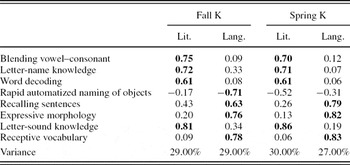
PCA of the final list of variables revealed that two (Varimax) rotated components accounted for 58% of the total variance in the fall-kindergarten results. The first component, which accounted for 29% of the variance, included predictor tests related to reading: letter-sound knowledge, blending, letter-name knowledge, and word decoding. The second component, which accounted for an additional 29% of the variance, included tests related to oral language: receptive vocabulary, expressive morphology, rapid automatized naming of objects, and sentence repetition. When age and nonverbal cognitive ability were included in the PCA, the variance accounted for by the first component was reduced to 22%, and the variance accounted for by the second was reduced to 20%. Two additional components emerged. The third component accounted for 15% of the variance and nonverbal cognitive ability and word decoding loaded significantly onto it, and a fourth component accounted for 10% of the variance and age loaded significantly onto it. No substantive change in the structures of Components 1 and 2 resulted. The PCA results were almost identical when Equamax nonorthogonal rotations were applied, further confirming the significance of the components delineated earlier. See Table 3 for the results of the fall-kindergarten PCA.
Factor loadings from principal components analyses of fall- and spring- kindergarten predictor scores

Note: Bold values are significant.
Spring kindergarten
A preliminary sphericity test and measure of sampling adequacy confirmed that the variables were correlated, Bartlett (χ2 = 192.744, df = 28, p < .001; KMO sampling adequacy = 0.729). With the exception of English receptive vocabulary (PPVT-III), which was administered only in fall kindergarten, all predictor variables administered in spring kindergarten were retained for the final PCA: English blending, English letter-name knowledge (WRAT-3), English word decoding (WRAT-3), English rapid automatized naming of objects (RAN/RAS-objects subtest), English sentence repetition (CELF-4 recalling sentences subtest), English expressive morphology (TEGI total), French letter-sound knowledge, and English receptive vocabulary (PPVT-IIIA). PCA of the results for these tests revealed two significant (Varimax) rotated components accounting for 57% of the total variance. The first component, which accounted for 30% of the variance, was related to predictors of reading and letter-sound knowledge, blending, letter-name knowledge, and word decoding loaded significantly onto this component. The second component accounted for an additional 27% of the variance and was related to oral language skills; predictor tests of receptive vocabulary, expressive morphology, and sentence repetition loaded significantly onto this component. When age and nonverbal cognitive ability were included in the analysis, the variance accounted for by the first component was reduced to 22% and word decoding no longer loaded significantly; the variance accounted for by the second component was reduced to 21%; and an additional third component emerged that accounted for 12% of the variance and nonverbal cognitive ability loaded significantly onto it. The results were almost identical when Equamax nonorthogonal rotations were applied. See Table 3 for results of the spring-kindergarten PCA.Footnote 1
Predicting difficulty
Having established that there indeed appear to be distinct sets of latent variables among the predictor tests for oral language learning and reading acquisition, discriminant analyses were then conducted to identify the specific kindergarten L1-predictor tests that best discriminated between at-risk and not at-risk subgroups, as determined by the children's end of Grade 1 language and reading results in French L2. A student was classified as “at risk” if he or she scored more than 1 SD below the mean on the relevant criterion test and “not at risk” if he or she scored within 1 SD of the group mean on the criterion test, to be described in the next section. Risk for word decoding difficulty, reading comprehension difficulty, and oral language difficulty were analyzed and are discussed separately. In the case of risk for oral language difficulty, we consider either L1 or both L1 and L2 language performance because most children were still in the early stages of acquiring French by the spring of Grade 1 and, therefore, we felt that their L2 oral language results alone were insufficient to classify their risk status. This is different from the case of risk for L2 reading difficulty because the students had received reading instruction in kindergarten and Grade 1 entirely in their L2, French, making it the more appropriate language for identifying risk for difficulty.
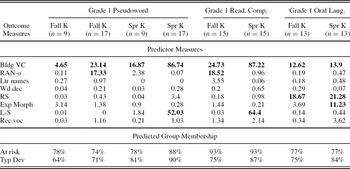
The predictor measures we used have all been found to predict reading and language outcomes in monolingual native speakers, as reviewed above. The same eight kindergarten predictor tests were used in the discriminant analyses as had been used in the PCA analyses. Each test was entered stepwise into the analysis. A ratio of at least 10 times as many cases as independent variables was maintained throughout our analyses. This is well over the minimum recommendation of 4 to 5 times as many cases to independent variables but below the cutoff of 20 that is recommended for ensuring reliability (Stevens, Reference Stevens2002); thus, replication of these results is warranted in the future. At the same time, however, our goal is to uncover models that can be applied to small sample sizes as this is what is most ecologically similar to a classroom setting where teachers and professionals seek to identify a few struggling students among a class of fewer than 30 students. Separate analyses were run using the fall-kindergarten and the spring-kindergarten predictor scores in order to see if one set of predictors was more accurate. See Table 4 for the results from each analysis. For each outcome, results using the fall-kindergarten predictor tests are discussed first, followed by the results using the spring-kindergarten predictors.
F values from the discriminant analyses of the predictions of French Grade 1 outcomes using English kindergarten predictors

Note: Bold values are significant. F values reported. Read. Comp., reading comprehension; Lang., language; Spr, spring; K, kindergarten; Bldg VC, blending vowel–consonant; RAN-o, rapid automatized naming of objects; Ltr names, letter-name knowledge; Wd dec, word decoding; RS, recalling sentences; Exp morph, expressive morphology; L-S, letter-sound knowledge; Rec voc, receptive vocabulary; Typ dev, typically developing.
Risk for decoding difficulty
Risk for decoding difficulty was based on performance on the pseudoword decoding test in French (Wechsler Individual Achievement Test pseudoword decoding subtest) only, rather than word decoding scores or both pseudoword and word decoding scores, to ensure that risk status was based purely on decoding ability and not on memory of familiar whole words. Using this criterion, the at-risk subgroup comprised 9 children (4 boys, 5 girls) and the not at-risk subgroup comprised 77 children (32 boys, 45 girls).Footnote 2
Fall kindergarten
The kindergarten test of blending in English was a unique and significant predictor of risk for pseudoword decoding difficulty in French, F (1, 83) = 4.65, p = .034. Using this variable, group membership was predicted with 78% accuracy (i.e., 7 out of 9 children correctly classified) for the at-risk group and with 64% accuracy (49 out of 77 children correctly classified) for the not at-risk group. In other words, sensitivity of English blending in kindergarten in predicting French decoding in Grade 1 is 78% and specificity is 64% (see Table 4, column 1).
In order to increase the size of our at-risk group and thereby render our statistical analyses more robust, we ran the analyses a second time, including both children with decoding deficits only and children with decoding and oral language deficits combined in our at-risk decoding group. This increased the number of children in the at-risk decoding subgroup from 9 to 17; more specifically, 9 children had decoding problems only, while 8 children had both decoding and oral language difficulties.Footnote 3 While this sample is less pure than that used in the previous analysis, it is arguably a more rigorous test of whether risk for decoding and oral language difficulty are distinct because it includes some children with both risk profiles. Despite this, discriminant analysis using this group revealed that reading-related kindergarten predictors, specifically tests of blending, F (1, 83) = 23.137, p < .001, and rapid automatized naming of objects, F (2, 82) = 17.332, p < .001, in English were unique and significant predictors of this combined reading risk group. Arguably, rapid automatized naming of objects emerged as a significant predictor of decoding using the fall-kindergarten predictors because our risk group included children who were also at risk for oral language impairment. Recall that rapid automatized naming emerged as a significant variable in the language but not the literacy component in the PCA of the kindergarten predictor tests. That rapid automatized naming did not emerge as a significant predictor of risk using the spring-kindergarten predictors could be due to letter-sound knowledge and VC blending skills being so powerful that they overrode rapid automatized naming. In any case, using blending and rapid automatized naming of objects in fall kindergarten, group membership was predicted with 74% accuracy (i.e., 15 out of 17 children correctly classified) for the at-risk group and with 71% accuracy (49 out of 69 children correctly classified) for the not at-risk group (see Table 4, column 2).
Spring kindergarten
English blending was a unique and significant predictor of risk for pseudoword decoding difficulty in French at the end of Grade 1, F (1, 84) = 16.873, p < .001. Using this predictor, group membership was predicted with 78% accuracy (7 out of 9 children) for the at-risk group and with 81% accuracy (62 out of 77 children) for the not at-risk group (see Table 4, column 3).
We ran the discriminant analysis a second time, including both children with decoding deficits only and children with decoding and oral language deficits combined in our decoding at-risk group (n = 17). In this case, English blending, F (1, 84) = 86.742, p < .001, and French letter-sound knowledge, F (2, 83) = 52.025, p < .001, were unique and significant predictors of this risk profile. Using these two predictors, group membership was predicted with 88% accuracy (15 out of 17 children) for the at-risk group and with 90% accuracy (62 out of 69 children) for the not at-risk group (see Table 4, column 4).
Risk for reading comprehension difficulty
Students’ scores on both the Batterie d’échelles multidimensionnelles pour l'évaluation de la lecture French word comprehension and sentence comprehension subtests combined were used to classify risk status. Using this criterion, 15 children were in the at-risk subgroup and 71 in the not at-risk subgroup. Of note, all but one of the children at risk for reading comprehension difficulty also met the criterion for risk for decoding difficulty. The same eight predictor tests that had been used in the PCA were retained for these discriminant analyses. We ran the analysis twice, once using the fall-kindergarten predictor scores and once using spring-kindergarten predictor scores.
Fall kindergarten
Blending, F (1, 83) = 24.728, p < .001, and rapid automatized naming of objects, F (2, 82) = 18.519, p < .001, in English were unique and significant predictors of at-risk status for reading comprehension difficulty in French at the end of Grade 1. These two variables predicted group membership with 93% accuracy (14 out of 15 children) for the at-risk group and 75% accuracy (53 out of 71 children) for the not at-risk group. It seems likely that rapid automatized naming of objects emerged as a significant predictor of reading comprehension in this analysis for the same reasons proposed earlier (see Table 4, column 5).
Spring kindergarten
English blending, F (1, 84) = 87.224, p < .001, and French letter-sound knowledge, F (2, 83) = 64.405, p < .001, were unique and significant predictors of risk for reading comprehension difficulty in French at the end of Grade 1. Using these two tests, group membership was predicted with 93% accuracy (14 out of 15 children) for the at-risk group and with 87% accuracy (62 out of 71 children) for the not at-risk group (see Table 4, column 6).
Risk for oral language learning difficulty
Risk-group membership was based on performance on the CELF-4 concepts and following directions subtest and the CELF-4 sentence structure subtest, both administered in English in the spring of Grade 1. Risk for L2 language difficulties would normally take into account risk for both L1 and L2 language development since by, definition, language impairment should appear in both languages; otherwise, it is better considered variation in typical L2 development (Paradis et al., Reference Paradis, Crago, Genesee and Rice2003). However, using this criterion yielded an L2 oral language at-risk group of only 3 children, making statistical analyses unreliable. Thus, we resorted to identifying an oral language at-risk group based on the students’ L1 oral language results at Time 3. This procedure can be justified on the grounds that to be considered at risk for L2 language difficulties, L2 learners would generally also have to be considered at risk for or have L1 language difficulties. In order to have a risk group comprising at least 10 children, we also included children who were at risk in both L1 oral language and L2 decoding. Thus, our procedure, although not ideal, because it uses L1 oral language results only, nevertheless subsumes all L2 learners in this study who meet a critical criterion for risk for L2 difficulties, namely, risk for L1 difficulties. As was argued in the case of risk for decoding difficulties, although this sample is less pure than that used in the previous analyses, it is arguably a more rigorous test of whether risk for decoding and oral language difficulty are distinct because it includes children with both risk profiles. This procedure yielded a subgroup of 13 children, which is sufficiently large to produce reliable results using discriminant analysis. More specifically, there were 13 children in the English at-risk subgroup and 73 in the English not at-risk group.Footnote 4 Six children (2 boys, 4 girls) were at risk in L1 oral language only, and 7 (6 boys, 1 girl) were at risk in L1 oral language and L2 decoding.
Fall kindergarten
Analyses using this at-risk group revealed that sentence repetition, F (1, 83) = 18.669, p < .001, and blending, F (2, 82) = 12.621, p < .001, in English assessed in kindergarten were unique and significant predictors of risk for English-L1 oral language difficulties at the end of Grade 1 and, thus by inference also risk for L2 language difficulties. Using these two variables, group membership was predicted with 77% accuracy (10 out of 13 children) for the at-risk group and with 75% accuracy (55 out of 73 children) for the not at-risk group (see Table 4, column 7).
Spring kindergarten
In these analyses, sentence repetition, F (1, 84) = 21.28, p < .001, blending, F (2, 83) = 13.90, p < .001, and expressive morphology, F (3, 82) = 11.23, p < .001, in English were unique and significant predictors of risk for English-L1 oral language difficulties at the end of Grade 1. Using these three variables, group membership was predicted with 77% accuracy (10 out of 13 children) for the at-risk group and with 84% accuracy (61 out of 73 children) for the not at-risk group. Arguably, blending emerged as a significant predictor of oral language difficulties using both the fall- and spring-kindergarten predictors because there were a number of children in the at-risk group who, in addition to being at risk for oral language difficulties, were at risk with respect to reading. This is consistent with our fall-kindergarten and spring-kindergarten PCA results indicating that blending is significantly correlated with reading tasks and least correlated with oral language predictors (see Table 4, column 8).
DISCUSSION
In order to determine if there are distinct risk profiles associated with language and reading difficulties (and possibly clinical impairment) in L2 students, we first examined whether predictors of reading and oral language development in English as an L1 constitute separate underlying components. PCA of the fall-kindergarten and spring-kindergarten data revealed that there were two latent components that accounted for a majority of the variance in our kindergarten predictor tests. Moreover, these two components could easily be conceptualized in terms of oral language and reading abilities. Together, these two components accounted for more than 50% of the variance in the scores on the fall- and spring-kindergarten predictors.
Further evidence for the distinctiveness of oral language and reading abilities and, by inference, difficulties, emerged in our finding that children who performed greater than 1 SD below the mean on the oral language outcome tests generally did not score more than 1 SD below the mean on the tests of reading at the end of Grade 1. More specifically, 7% of the children in our sample (27% of the entire at-risk subgroup) scored more than 1 SD below the mean on the oral language tests only, 10.5% of the children (41% of the at-risk subgroup) scored more than 1 SD below the mean on pseudoword decoding only, and 8% of the children (32% of the at-risk subgroup) scored more than 1 SD below the mean on both oral language and word decoding tests. In short, while the percentage of children who demonstrated difficulty in both domains is greater than chance (i.e., less than 5%, or children who are borderline or below normal either in terms of their reading or oral language abilities, but within normal limits in the other domain), there is not extensive overlap. These results are consistent with those of Catts et al. (Reference Catts, Adlof, Hogan and Ellis Weismer2005) who found that 8% of their entire sample met diagnostic criteria for dyslexia, 6% met criteria for PLI, and 15% met criteria for both dyslexia and PLI, suggesting that PLI and dyslexia are distinct though potentially comorbid conditions. These results imply that professionals working with children who are at risk for oral or reading difficulties should not assume they have difficulty in both; rather, they should assume differentiated risk unless assessment indicates otherwise.
A primary aim of the study was to assess the validity and utility of L1 predictors of L2 reading and oral language difficulties. Discriminant analyses revealed that blending in English in fall kindergarten and spring kindergarten was a significant predictor of both word decoding and reading comprehension difficulty in French at the end of Grade 1. In addition to blending, rapid automatized naming in fall kindergarten and letter-sound knowledge in spring kindergarten were also significant predictors of reading comprehension at the end of Grade 1. The important contribution of letter-sound knowledge and PA (i.e., blending) is not surprising since the predictive role of these variables in learning to read is supported by an abundance of L1 and L2 reading research (e.g., Comeau et al., Reference Comeau, Cormier, Grandmaison and Lacroix1999; for a review see August & Shanahan, Reference August and Shanahan2006). It is interesting that, in fall kindergarten, rapid automatized naming of objects rather than letter-sound knowledge was a predictor of reading difficulty, in addition to blending. Arguably, letter-sound knowledge in fall of kindergarten was not a significant predictor of reading difficulty in Grade 1 because the children had just begun to learn the sounds of letters of the French alphabet systematically at that time. As a result, this was a difficult task for them at the beginning, but not at the end, of kindergarten. That rapid automatized naming emerged as a significant predictor of reading in Grade 1 only when we included children at risk for oral language difficulties along with children who were at risk for reading difficulties in our analyses suggests that it is somehow linked to oral language. This is consistent with findings in our earlier study where rapid automatized naming was predictive of reading comprehension, a task that is closely dependent upon oral language, but was not predictive of decoding (Erdos, Genesee, Savage, & Haigh, Reference Erdos, Genesee, Savage and Haigh2011).
That the predictors of pseudoword decoding and reading comprehension were the same might seem surprising because it is thought that reading comprehension entails a broader range of oral language skills than does decoding (e.g., Cain & Oakhill, Reference Cain and Oakhill2006; for reviews, see also August & Shanahan, Reference August and Shanahan2006; Johnston, Barnes, & Desrochers, Reference Johnston, Barnes and Desrochers2008). However, it should be recalled that all but one child in the present study met criteria for both decoding and reading comprehension difficulties and, thus, the reading comprehension difficulties of these children are probably directly linked to their word decoding difficulties. It may also be that comprehension at this grade level is largely dependent on word-by-word reading or that the comprehension test used at this level was too easy; thus, looking at older students using comprehension tasks that are more demanding is important (see also Storch & Whitehurst, Reference Storch and Whitehurst2002). At the same time, it is interesting to note here that Jared et al. (Reference Jared, Cormier, Levy and Wade-Woolley2011) also found that PA in English assessed in kindergarten was a significant predictor of reading comprehension in French L2 in Grade 3, suggesting that L2 readers may rely on word-by-word reading even when reading more complex texts in higher grades.
Taken together, these findings suggest that, although other research has found that performance on tests related to oral language are important for reading comprehension among students beyond the initial stages of learning to read (e.g., Kirby & Savage, Reference Kirby and Savage2008), performance on tests related to decoding are significant predictors of risk for reading comprehension difficulties early on. It follows then that an important starting point in identifying the underlying difficulties of children with L2 reading comprehension difficulties is decoding and, in particular, their PA skills. It may be, however, that the reading comprehension difficulties of struggling readers beyond Grade 1, when children have to read to learn rather than learn to read, are different. Furthermore, that virtually all the children in the present study who were experiencing difficulty with decoding were also experiencing difficulty with reading comprehension calls into question the existence of a third group of poor comprehenders whose decoding and oral language abilities are intact; in fact, there was only one child who met such criteria in our study.
Due to the small number of children at risk for oral language difficulties in L1 and the even smaller number of children with oral language difficulties in both L1 and L2, it was necessary to run our statistical analyses using a “mixed” group of children who performed more than 1 SD below the mean on either oral language alone or both oral language and reading; risk in these cases was based on L1 performance. In effect, we were stacking the odds against finding distinct sets of predictors for reading and oral language difficulties. Despite this, we found predictors of oral language difficulty that differed from predictors of reading difficulty, namely sentence repetition and expressive grammar, in addition to PA, were the best predictors of end of Grade 1 oral language risk status. With a larger group of children at risk for oral language difficulties only, it would not be unlikely to find that only oral language scores (and not scores on literacy tasks) are predictors of risk for oral language difficulties.
In all our analyses, predictions made on the basis of spring-kindergarten results were more accurate than predictions made on the basis of fall-kindergarten results, but reasonable predictions were nonetheless made using the fall-kindergarten results. These findings argue against a wait and see approach to identifying oral language and/or reading difficulty in L2 learners. These predictors were able to predict risk for reading and/or language learning difficulties with accuracy of 71% and upward. The most significant practical implication of the present findings is that assessments conducted in L2 students’ L1 can be used to identify, with reasonable accuracy, those who are at risk for reading and/or language difficulties and, thus, could benefit from additional support early on.
In conclusion, we have provided evidence that argues for distinct risk profiles for oral language and reading development in students learning through an L2, as has been argued for L1 children (see also Catts et al., Reference Catts, Adlof, Hogan and Ellis Weismer2005), and have presented evidence that speaks to the feasibility of early identification of L2 children who are at risk for oral and/or written language difficulties on the basis of their performance on L1 measures administered in kindergarten.
Limitations
This study has limitations. First, a causal link cannot be established between our predictor and outcome variables as a result of the correlational nature of the study. Nonetheless, the present results could be used as the foundation for an intervention study, whereby we would attempt to further validate our findings and possibly establish a causal link between the predictor and outcome variables. Second, another limitation is our small sample size, especially of the at-risk groups, and the obvious statistical constraints that resulted from this. However, as previously stated, we were interested in exploring models that could be applied to classroom settings where sample sizes are typically similarly small. Third, a further limitation is that the distribution of our sample was nonnormal in some respects, namely 10% of our sample fell below 1 SD with respect to their performance on decoding tasks, 17% fell below 1 SD with respect to their performance on reading comprehension tasks, 7% fell below 1 SD with respect to their performance on oral language (L1, L1 and L2) tasks. Although not ideal, our slightly elevated number of at-risk students permitted us to more fully examine this population statistically. It is the most important, however, that we are missing a control group of children instructed in L1 with whom we can cross-validate our findings. Although we have been recruiting such a control group, recruitment is ongoing because there is a much smaller proportion of children meeting our recruitment criteria (namely, being English dominant) who attend English-L1 programs in Quebec. Fourth and finally, our results pertain specifically to a dual language learning situation where the two languages are of equal status and, thus may differ from what we would obtain if the L1 was a minority language. However, as stated earlier, there are reasons to believe that our findings would probably have at least some generalizability to contexts where the L1 is a minority language, as is the case for most immigrant children.
Practical implications
The most significant practical implication of these results is that L2 learners can be screened for risk for L2 reading and oral language difficulties using their L1 and that screening can be both sensitive and specific if carried out as early as the beginning of kindergarten. Our results further suggest that it is not only appropriate but also feasible to gear intervention strategies to the specific domain of difficulty rather than taking a more general approach because a good proportion of children do not appear to have overlapping impairments.
ACKNOWLEDGEMENTS
This research was supported by a grant to Fred Genesee from the Social Sciences and Humanities Research Council of Canada and the Canadian Language and Literacy Research Network.