Between 1850 and 1875, the population of New York City (at the time comprising only the island of Manhattan) rose from roughly half a million to well over a million. Constant arrivals from Europe (primarily from modern-day Germany and Ireland but also from other nations) had an obvious impact on the social and cultural structure of the city, the most recognizable being ethnic diversity, multiculturalism and cosmopolitism – the three components that still distinguish the city today. The production and consumption of music during those years reflected that impact: monochromatic and undistinguishable from other important cities in the East Coast in the early decades of the nineteenth century, it became, in the third quarter, as wide-ranging, diverse, and dynamic as the most culturally advanced European cities, or perhaps even more. The database Music in Gotham: The New York Scene, 1862–1875 (musicingotham.org) has unearthed such a vast number of performances and ‘musical events’ of all kinds that one could easily assume that New York was an unrivalled cultural centre even as early as the years of the Civil War. John Graziano, director of the project, had evidence of this when he asserted, ‘[T]o a greater extent than many of its European counterparts, New York in the mid-nineteenth century was a cosmopolitan melting pot’.Footnote 1 Adrienne Fried Block, who co-founded the project, agreed:
In the mid-nineteenth century, New York’s musical life was rich, multifarious, and unequalled in the United States. In a typical evening, there could be a dozen or more events: orchestral, band, solo, and chamber music concerts, and programs by choral and family singing groups. Every theatre employed an orchestra or at least a trio or a pianist, whether accompanying opera, drama, variety acts, vaudeville, or pantomime. Minstrel shows, however, relied on their casts of actors who played instruments, sang, and danced.Footnote 2
The discovery and classification of those ‘multifarious’ and highly diversified musical events that took place on each of those ‘typical days’ and the transcription and collation of any records of them is what Music in Gotham began to do several years ago.Footnote 3 Although the website does not provide updates on the published contents, I have been able to ascertain that, as of January 2018, all or nearly all of the musical events that took place in New York between September 1862 and May 1868 have been recorded and published.Footnote 4 In other words: the musical seasons between the 1862–63 season and the 1867–68 season are complete (though to be sure, the project’s staff continues to edit published records whenever new details are found). In total, there are 36,472 events. Many of the materials pertaining to the following years, up to the 1874–75 season, when the project will be finished, have already been compiled and catalogued, and they will be posted to the website once all of the documentation has been completed.
Music in Gotham collects data from numerous primary sources. These include all of the city’s legendary ‘penny-press newspapers’ (The New York Herald, The New York Post, The New York Sun, The New-York Daily Tribune, and The New-York Times); six journals devoted to music (Dwight’s Journal of Music, Musical Review and World, New York Musical Gazette, New York Musical World, New-Yorker Musik-Zeitung, Orpheonist and Philharmonic Journal); magazines (Frank Leslie’s Illustrated Newspaper, Harper’s New Monthly Magazine, The Knickerbocker Monthly, and Scribner’s Monthly); the minutes of the Philharmonic Society of New York; and the diaries of Strong and two other individuals, William Steinway (founder of the firm Steinway & Sons, born Wilhelm Steinweg, 1835–1896) and the lawyer and amateur baritone John Ward. In addition, it relies on 19 secondary sources, including various encyclopaedias, a catalogue of sheet music, and the writings of several musicians who participated or witnessed the musical activity of New York at the time. Two foreign-language newspapers, the weeklies Le Courrier des États-Unis and Der New-Yorker Staats-Zeitung und Herold help document the musical life of the city’s influential French and German communities (the programmes and reviews of those sources have been translated by the project’s creative team). Since many of these immigrants (particularly the large German-speaking community) led relatively secluded lives within the confines of their ethnic neighbourhoods, with few interferences from the dominant English-speaking group, their vibrant musical life likewise functioned in relatively sealed circuits. One of the project’s most praiseworthy accomplishments is the discovery of many first-rate performances that took place within the limits of the not-so-little ‘Little Germany’, or Klein Deutschland, the large area in lower Manhattan where German entertainment thrived.Footnote 5
When Music in Gotham began its journey, few nineteenth-century American newspapers were digitized. In the last ten or so years, the situation has changed dramatically and many digitized databases have become available. There are free-of-charge websites like Chronicling America: Historical American Newspapers, as well as resources like Proquest Historical Newspapers, Historical Newspaper Collections, and America’s Historical Newspapers, which are subscription-based but easily available to any scholar with ties to an institution of higher education. Moreover, individuals are also able to subscribe to large databases of papers such as newspapers.com and genealogybank.com. Thanks to these resources, researchers no longer need to spend countless hours scrutinizing microfilms and reading the fading pages of thousands of newspapers, often in poorly managed facilities. Instead, they can conduct their research from the comfort of their office or home desks. It is now possible to download, scan and print full pages or columns, or extract specific articles. One could erroneously presume that this circumstance might diminish the usefulness of Music in Gotham: it does not. The databases mentioned above have a disadvantage. The magnitude of the information they contain is overwhelming and, besides, it is not classified or organized in a convenient manner. Articles and announcements are often difficult to locate in the scanned pages of newspapers. Categories such as ‘music’ or ‘entertainment’ did not appear in specific sections, like they do today, but were ensconced in the middle of ordinary columns and surrounded by unrelated articles and news reports. Reading from fading scanned images can be a frustrating and cumbersome task. The scope of Music in Gotham is, to the advantage of the researcher, geographically and chronologically constrained. Moreover, it contains data gathered from newspapers that are currently not digitized (and are unlikely to be digitized any time soon; Der New-Yorker Staats-Zeitung or Le Courrier des États-Unis come to mind). Music in Gotham’s effortless access to that information, where all kinds of words are searchable, is immensely valuable to anyone who is involved in the study of New York’s music life, whether historian, musicologist, performer, or, significantly, instructor or university student.
Two things distinguish this database: comprehensiveness and inclusiveness. In the nineteenth century, newspapers, magazines and journals were the main vehicle for the dissemination of information on cultural events. Advertisements and reviews contained the bulk of that information, but a lot of valuable material was placed in other, less conspicuous sections, which sometimes slip the eye of the most diligent scholar: letters to the editor, gossip and social columns, or news about cultural events, including ethnic or religious festivals, publishers’ lists, advertisements of instrument manufacturers, and so forth. Music in Gotham includes all of them, even the most seemingly inconspicuous ones, and classifies them accordingly.
The website’s essential function is to provide easy access to information about musical ‘events’ of all kinds: any stage activity that incorporated a musical performance, professional or semi-amateur, will find a space in the site. These include orchestral and chamber concerts, recitals and opera productions, but also genres often neglected by traditional historiography, like vaudeville, pantomime, burlesque, minstrel shows and theatrical plays that included incidental music. Any event where there is evidence that music was played finds a place in the database. In its attempt to make the database useful to a large and diverse group of researchers, Music in Gotham does not privilege one type of musical event over another. Having said that, the collected data pertaining to certain types of ‘low brow’ entertainment, like variety acts and minstrel shows, is often scarce. Users will find hundreds of titles of acts and company names in the database, but, sometimes, little else. Music in Gotham is useful to all researchers but probably more advantageous to the scholar specializing in concert music and opera.
The philosophy and modus operandi of Music in Gotham revolves around the idea of creating daily musical events. The first step is detecting and registering the event as it appears in advertisements and announcements, and in the reviews of all the available newspapers and journals. Because certain events are advertised only in one or two sources, scouring all available sources is an essential part of the preliminary task. Likewise, some sources gave detailed programmes, including names of composers, titles of compositions, and a full list of performers or cast, while others simply printed a laconic sentence or two. There may be discrepancies from one source to another, which the Music in Gotham staff acknowledge, research and, whenever possible, resolve. For each event, the creative team collates all the gathered data, which includes essential information (date, venue, composer, compositions and performers) as well as auxiliary data like ticket price, time of the performance, organization name and members’ names, or whether the concert is part of a series, a benefit, or a rehearsal, among other things.
An important asset of Music in Gotham is its design: fresh-looking, clear and with a variety of fonts (three) that make it both professional and comfortable to look at. It is an altogether user-friendly website which does not require the user to register, log in and out, or refresh the page every once in a while. Upon opening the webpage, the upper part of the main page gives the site’s user the option to click on nine tabs (‘About’, ‘Support’, ‘Recent news’ and so on). There is also an information section, with a very exciting announcement: the forthcoming link to Grove Music Online and the archives of the New York Philharmonic. In one of those tabs, ‘Collaborate’, the editors encourage users to submit corrections or pieces of information about a particular event that may not have been properly acknowledged. If a user thinks that a record needs an adjustment, she can fill in an online form detailing the precise item that needs a correction or an update, for which she will have to include a source as evidence.
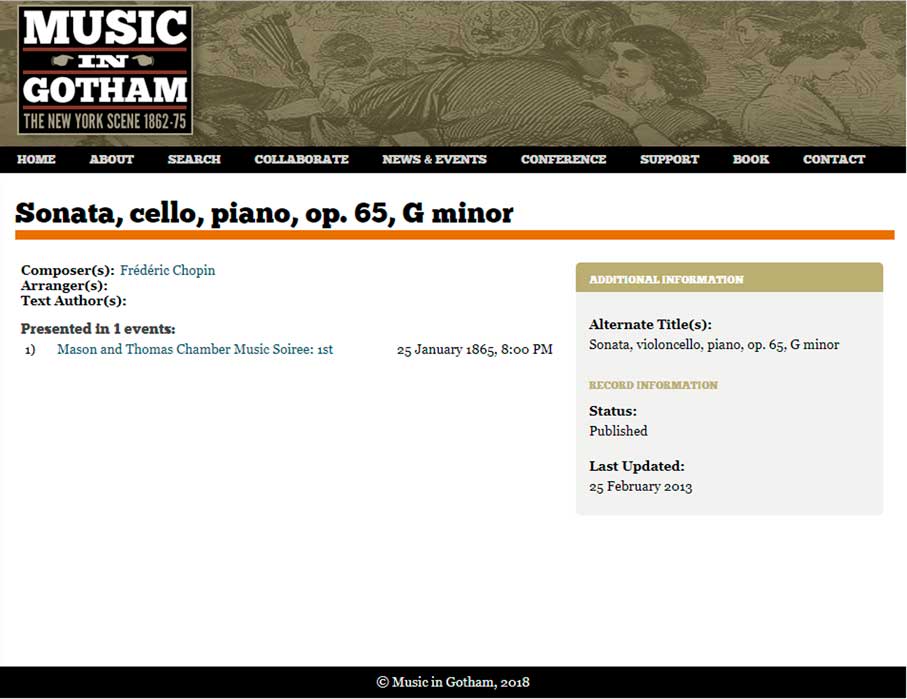
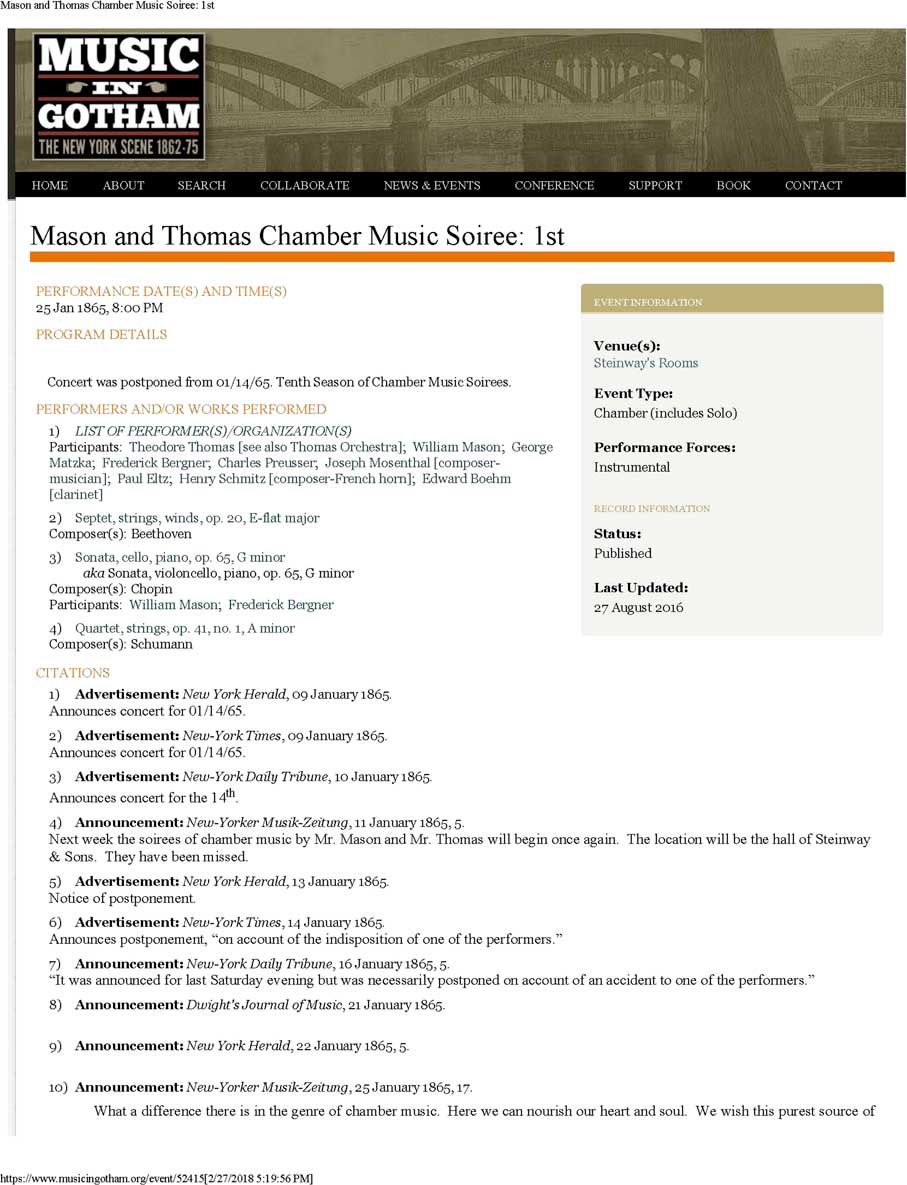
There are three approaches for researching any event: ‘General’, ‘Focused’, and ‘Advanced’. The project’s ‘Basic Search Help’ explains that the ‘General’ Search is ‘the broadest standard search that will look for a given term or name across all aspects of the database’. Users can filter their search through five main categories, including people, works, venues, organizations, events and citations (a list of all the times the name or topic appears in a review or announcement), or they can select ‘all’, thus avoiding any filters. In the ‘General’ search, therefore, the user is presented with a broad category made of four mutually dependent layers of data. It is a useful approach when one needs to get an idea of the full scope of a chosen topic. Since I am interested in performances of Chopin’s music in New York in the 1860s, I began with the broadest search I could think of: the topic was ‘Chopin’ and the category, ‘All’. Expectedly, the search returned one name (incidentally, Music in Gotham still uses Frédéric, rather than Fryderyk, the standard name in recent years among non-French speaking scholars; it seems that the editors have decided to maintain the name as it appeared most frequently in the press at the time). ‘Chopin’ yielded an astonishingly high number of works (48) by the composer performed between 1862 and 1868, some of them seldom performed anywhere in the world at the time, like the Allegro de Concert, op. 46, or the Cello Sonata, op. 65. Music in Gotham identifies the title, key and opus number of the composition whenever possible – a commendable effort by the editing team, since work titles often appeared incomplete in newspaper advertisements, or contained errors. If, after consulting all available sources, a piece cannot be identified, the database registers it as ‘unidentified’. In the case of Chopin – a composer who wrote many short, ‘character pieces’ – this situation expectedly applies more often than in other composers. I clicked ‘Sonata, cello, piano, op. 65, G minor’ and learned that it was presented in one event, on 25 January 1865, at the first concert of the tenth season of the ‘Mason and Thomas Soirees of Chamber Music’ organized by pianist William Mason (1829–1908) and violinist and conductor Theodore Thomas (1835–1905). I also obtained information about the performers, the content of the programme, the venue, the price of the ticket and additional information, including updated information about the record (see Fig. 1).
Result for a General Search for Chopin’s Cello Sonata, op. 65
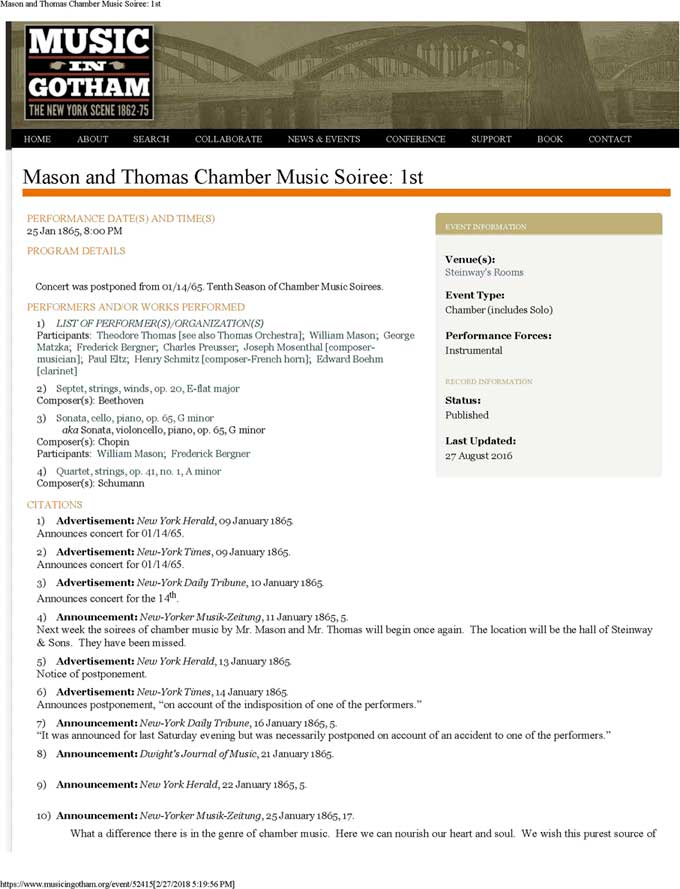
By clicking on the ‘event’, I was able to gather a great deal of relevant information about the event, including type of performance (‘instrumental’) venue (Steinway Rooms, at 71–73 East Fourteenth Street), the complete list of performers, the full programme, the sources where the event was acknowledged, the date of the performance, and the number of times the event had been cited (whether it was advertised, announced or reviewed), among other relevant details (see Fig. 2, detail). The user can always expand or refine the search, because most of those persons, places, and facts are clickable.
A complete record for an event provides information about the performers, programme, and citations. The box on the right includes information about the venue, the type of event, the medium. In addition, the status of the record (‘published’) and the last time it was updated.
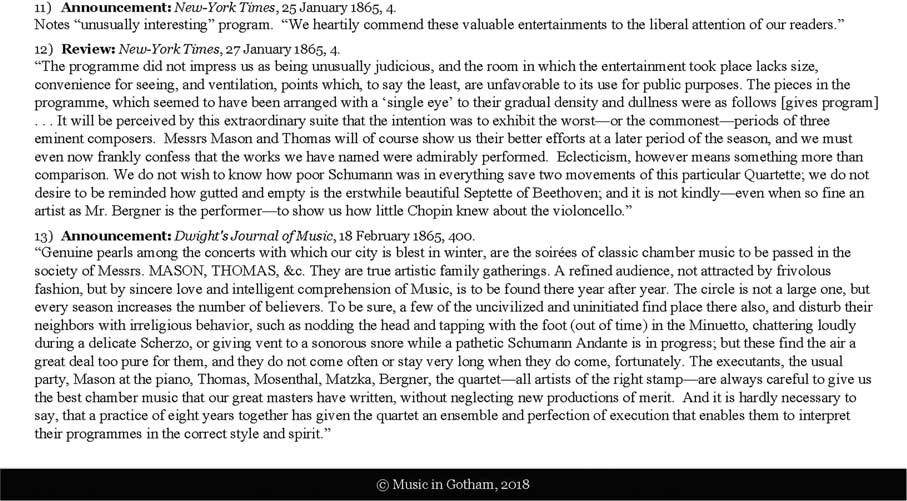
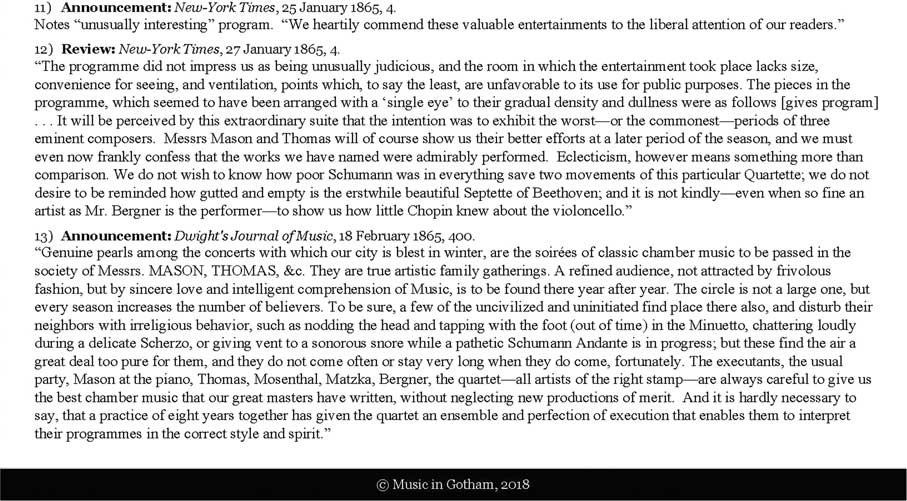
More interestingly, the user has access to the full text of the two sources that reviewed or announced extensively the event (in this case, Dwight’s Journal of Music and The New-York Times, see Fig. 3).
Detail of page showing the content of a review, as it appeared in the New-York Times on 27 January 1865 and two ‘announcements’, one in the New-York Times, on 25 January 1865, and another in Dwight’s Journal of Music, on 18 February 1865.
The user will find the ‘Focused’ search function more advantageous, because it offers the ability to refine the search. Each of the five main categories (there is no ‘search all’ option here) contains smaller subdivisions. Within the ‘People’ search, musicians are classified under five categories, including name, gender, profession (e.g., conductor, impresario, dancer …), voice type, and instrument. Thus, if a user who does not know (or cannot remember) the name of a particular performer can still find him or her by searching under the remaining four categories, which also have smaller layers of data. In the ‘Works’ search, compositions are specified by title, composer, arranger and text author. The ‘Venues’ search includes name and location of a venue, and the ‘Organization’ search, the name of the company or the type of organization. Finally, in the ‘Events’ search, the specifics include title, specific date, date range, venue, event type, performance forces, proprietor, lessee, manager, director, ballet director and choreographer. For example, I entered ‘female’ and ‘piano’ in a ‘Focused’ search for people and the database returned a list of 66 performers that included the number of events in which each had participated. Clicking on a name produced a list of all the associated events, and each of these had the type of detailed record I described above for the ‘Mason and Thomas’ concert that included Chopin’s Cello Sonata.
The ‘Advanced’ search function lets the user combine categories across different parts of the database, from the broadest to the most specific. The researcher can add one or more variables in a search to obtain results that are even more precise than in the ‘Focused’ search, because it allows searching within a specific date range. The auto-fill function lets the user know if the composer (performer, work, venue …) exists in the database; clicking on the ‘Add’ button enables the researcher to further narrow the results. For example, I was able to find all the times pianist Sebastian Bach Mills (1839–1898) performed with the Philharmonic Society of New York (the search yielded ten events, including a rehearsal open to the public). Or all the times Mills played Chopin with the Philharmonic (four times). Or the complete number of performances of the show The Bowery Boys at Tony Pastor’s Opera House in February 1866 (seven times).
Likewise, a user can find all the performances given on a chosen day – and realize how shockingly vibrant and diverse the New York musical scene was at the time: I chose at random 3 February 1864, and found that, on that day, there were 21 events, of which 19 correspond to musical performances (the database also includes an article, printed in the New-York Times, on money paid by ‘The City of New-York’ to various musicians for their services). The performances included one ‘concert’ at Cosmopolitan Hall; two opera performances, one in Italian (Don Giovanni) and one in English (Maritana); five plays that contained music, including one at the New-Yorker Stadts-Theater; two minstrel shows; an amateur (presumably) performance at ‘Widow Anna Schürmann’s Concert Salon’; a masked ball; a ‘vocal’ concert; and five shows listed as ‘variety or vaudeville’. Since each of those events is searchable, I gained immediate access to all the details regarding each event (cast, programme, citations, etc.). Unfortunately, there is a duplicate (the ‘concert’ at Cosmopolitan Hall), a circumstance that may presumably occur elsewhere in the database, and that one hopes will be corrected. There is also a performance at the New Bowery Theatre that included a number of works, although the database does not indicate whether they contained any music, and an ‘event’ titled Married Life, by Buckstone (the English actor and playwright John Baldwin Buckstone, 1802–1879) with no genre assigned to it. I clicked on the latter and found that Married Life had been performed 21 times between February 1863 and March 1868. Some of the records showed contradictory information: in the earlier ones, the editors warned that there was no evidence of music, while in the later ones, the piece was listed as a ‘play with music’. These later entries (those from 1868) contained more information, for example the cast. I was therefore ready to assume that Married Life was indeed a play, but I still could not assume that there was music in it, since none of the members of the cast were listed as singers or musicians of any kind. Moreover, the very succinct reviews quoted in the database made no mention of any music having been performed.
These issues notwithstanding, Music in Gotham is an extraordinarily reliable database that accomplishes more than one might expect. Music scholars seeking information about music performances of all kinds in New York City in the years around the Civil War will find it very practical. It saves a great deal of time that would have otherwise been spent perusing pages in search of a review, buried in the corner of an inconspicuous newspaper’s page or surfing various websites at the same time. During my research on the reception of Chopin's music in New York in mid-century for example, I particularly appreciated the possibility of combining specific elements across various levels of information within events. Music in Gotham gave me the opportunity to create lists of works and performers. I was able to weight the recurrence of certain works over others, calibrate their impact (or lack thereof) and answer questions regarding reception issues. For example, I was able to learn that Mills was apparently very fond of Chopin's Berceuse, op. 57, and the Étude in C-sharp minor, op. 25, no. 7, for he often included them in his programmes and gave them as encores. Without the possibility of combining two parameters (performer and works), I would have probably missed that association.
A database as inclusive as Music in Gotham should primarily attract musicologists, performers and cultural historians. It has proved to be a useful tool throughout my research on Chopin’s music in New York in mid-century. For example, I have been able to assess audience numbers and habits and address the contribution of women to the early dissemination of Chopin’s music: reviewers (all male) often made interesting comments about the presence of female concertgoers in instrumental concerts, their behaviour and attentiveness, which led me to hypothesize that they knew Chopin better than their male counterparts, probably because they played his music at home.
Other disciplines and areas of research can also benefit from the database. Because it contains so much information about the daily activities of New York musicians in the period in question, Music in Gotham should be a treasure for biographers. There is material for conducting analyses of class and ethnicity (again, the German settlers come to mind), gender (the subject of women’s involvement in the musical life of the city in the 1860s is a fascinating one), and reception issues. The database contains abundant information that historians specialized in New York’s history (for example, the effects of the Civil War on the cultural habits of the city’s population), geography and urbanism could find extremely valuable. The astonishing number of musical events that Music in Gotham chronicles, their diversity, will also dazzle the fiction writer, and in fact, any enthusiast of New York history. Yet it is precisely in this regard that Music in Gotham meets a possible weakness. In recent decades, musicology has transcended some of its established concentrations, participating in fields commonly ascribed to other disciplines, including cultural studies, aesthetics, social sciences or philosophy. Criticism and reception issues are now discussed within parameters that include, for example, gender and ethnicity. The reviews transcribed in the database contain all the materials necessary for carrying out these eclectic types of analysis, but reviews are unfortunately not searchable. A possible solution would be to add a new category into the Advanced Search function – one that included a list of subject matters or topics. For example, a ‘Keyword’ search that yielded, by default, topics such as ‘Women’, ‘Civil War’ (or ‘Politics’), ‘Ethnicity’, and so on. Some users might find that added category very useful.
The potential of Music in Gotham as a powerful tool for teachers and students needs to be emphasized. Graduate and undergraduate students who feel overwhelmed in the early stages of a research paper can benefit from using a website that is easy to navigate. I have been able to test its effectiveness in the classroom on several occasions, in lectures and in-class activities, and my undergraduate students have used it in some of their assignments and projects (I have not yet used the database in a graduate seminar but expect to do so when the occasion arises). I have used it to dispel false presumptions about the popularity of certain composers and the reception given to their works (Chopin comes to mind, but so does, for example, Haydn, whose music was performed more often that one might presume). One of my undergraduate students, currently working on a project about child prodigies, has found priceless information about María Teresa Carreño (1853–1917), the Venezuelan piano prodigy who made her debut in the city in 1862 (she would later become a renowned pianist, composer, singer, conductor and entrepreneur).
Music in Gotham provides scholars of numerous fields, teachers and students with vast, detailed information about the rich cultural life of New York City. Unfortunately, only half of the projected years have been uploaded to the website. While the project’s full potential will only become evident when the data for all the years to 1875 have been uploaded, even in its partially complete status it is a highly dependable tool. In its presentation, scope of materials and attention to detail, Music in Gotham should set the standard for other similar databases.