Obesity is a medical condition in which excess body fat produces a negative effect on health, reduces life expectancy and increases the likelihood of several illnesses, among others, heart disease, breathing difficulties during sleep, type 2 diabetes, certain types of cancer and osteoarthritis (Haslam & James, Reference Haslam and James2005). For all that reasons, obesity is today considered by authorities in Western societies, like the World Health Organization (WHO), one of the highest risks to public health (WHO, 2011). For example, in Spain, the country where this study has been carried out, obesity has increased significantly in the last few years, reaching currently a prevalence rate of 23% (Gutierrez-Fisac et al., Reference Gutiérrez-Fisac, Guallar-Castillón, León-Muñoz, Graciani, Banegas and Rodríguez-Artalejo2012). In this study we analyze how the perceived quality of an individual's daily life or health-related quality of life (HRQoL), that includes physical and psychological aspects, may be affected by the social consequences associated to the disease of obesity.
Subjective well-being
Several meta-analyses show that obesity is related with less psychological HRQoL. For example, it has been found that obese individuals suffer more depression (de Wit et al., Reference de Wit, Luppino, van Straten, Penninx, Zitman and Cuijpers2010), anxiety (Gariepy, Nitka, & Schmitz, Reference Gariepy, Nitka and Schmitz2010), stress (Wardle, Chida, Gibson, Whitaker, & Steptoe, Reference Wardle, Chida, Gibson, Whitaker and Steptoe2011) and have less self-esteem (Miller & Downey, Reference Miller and Downey1999) and a poorer mental health (Magallares & Pais-Ribeiro, Reference Magallares and Pais-Ribeiro2013) than normal weight people. Although several investigations have studied the relationship between the mentioned above variables and obesity, not many researchers have focused on the positive aspects of psychological HRQoL in patients with obesity (see for example, Swencionis et al., Reference Swencionis, Wylie-Rosett, Lent, Ginsberg, Cimino, Wassertheil-Smoller and Segal-Isaacson2013).
According to some authors (Seligman & Csikszentmihalyi, Reference Seligman and Csikszentmihalyi2000) is important to study the positive psychological human functioning, like subjective well-being (SWB), and not just focus on the negative aspects of psychological HRQoL, like for example, depression or anxiety. In other words, Positive Psychology (PP) is not just the study of pathology, weakness, and damage; but it is also the study of strength and virtue (Seligman & Csikszentmihalyi, Reference Seligman and Csikszentmihalyi2000). Additionally, understanding individual differences in SWB is of key interest in PP, particularly the issue of why some people are less happy than others (Seligman & Csikszentmihalyi, Reference Seligman and Csikszentmihalyi2000), like for example obese people. Finally, it is important to remark that PP is particularly concerned with the study of SWB (Diener, Reference Diener2000). Unfortunately, the PP is not an approach very common in the obesity field (Siwik et al., Reference Siwik, Kutob, Ritenbaugh, Cruz, Senf and Shatte2013).
SWB has two components, one cognitive (evaluation of the satisfaction with one’s life as a whole) and the other one emotional (positive and negative affect). The first component receives the name of life satisfaction and the second one affect balance. Therefore, SWB refers to a person's own assessment of their happiness and satisfaction with life (Ryan & Deci, Reference Ryan and Deci2001). Research has demonstrated that maintaining positive levels of life satisfaction is crucial to successful adaptation in life (Diener & Diener, Reference Diener and Diener1996). Additionally, it is important to remark that SWB is positively related to physical HRQoL (Leontopoulou & Triliva, Reference Leontopoulou and Triliva2012). Finally, some authors have found a negative link between SWB and obesity although more studies need to be conducted to confirm this pattern (Böckerman, Johansson, Saarni, & Saarni, Reference Böckerman, Johansson, Saarni and Saarni2014). For this reason, in this investigation we have decided to study psychological HRQoL of obese patients from a PP approach.
Discrimination of obese people
Obese people suffer a strong social discrimination (Puhl & Heuer, Reference Puhl and Heuer2009). Discrimination is the more active part of weight stigma, the mark that a person can carry as a result of their weight and the negative view others hold of them because of this, and it occurs when someone is treated differently because of their weight (Puhl & Heuer, Reference Puhl and Heuer2009).
Obese individuals have to face discrimination in many social areas (Puhl, Heuer, & Brownell, Reference Puhl, Heuer, Brownell, Kopelman, Caterson and Dietz2010). For instance, there is evidence of discrimination at every stage of the employment cycle (Giel, Thiel, Teufel, Mayer, & Zipfel, Reference Giel, Thiel, Teufel, Mayer and Zipfel2010). There is also evidence of discrimination in healthcare and educational contexts. It has been shown that doctors tend to be prejudiced against obese people (Hansson, Näslund, & Rasmussen, Reference Hansson, Näslund and Rasmussen2010) and that overweight kids are the usual targets of teasing, insults, and weight remarks (Zeller, Ingerski, Wilson, & Modi, Reference Zeller, Ingerski, Wilson and Modi2010). It is also present at every day activities, as shown by the fact that obese people are considered less attractive and that they have fewer chances of finding a partner (Falkner et al., Reference Falkner, Neumark-Sztainer, Story, Jeffery, Beuhring and Resnick2001). Additionally, it has been showed that the mass media, films and TV shows present a very negative image of obese people (McClure, Puhl, & Heuer, Reference McClure, Puhl and Heuer2011). In this paper we suggest that these social reactions to an excessive body weight may be linked to a poorer psychological and physical HRQoL in obese patients.
It is important to make a distinction between two types of discrimination that obese people suffer. Overt or blatant discrimination refers to discrimination which is open and is not hidden in any given way (Pettigrew & Meertens, Reference Pettigrew and Meertens1995). On the other hand, subtle discrimination is a broad range of subtle behaviors and events that perpetuate inequities for members of stigmatized groups. However, these behaviors are non-actionable in the sense that they are not likely to be formally contested in a court of law (Pettigrew & Meertens, Reference Pettigrew and Meertens1995). Some investigations show that overt and subtle forms of discrimination have an important effect on the HRQoL of the individuals who suffer the rejection (Noh, Kaspar, & Wickrama, Reference Noh, Kaspar and Wickrama2007). Finally, some authors suggest the importance of measuring subtle discrimination in the case of obese populations because nowadays direct forms of discrimination are less frequent than subtle ways of expressing prejudice toward obese individuals (King, Shapiro, Hebl, Singletary, & Turner, Reference King, Shapiro, Hebl, Singletary and Turner2006).
It is important to remark that few studies have examined the association between rejection and the psychological consequences of this exclusion, although some investigations have showed the link that exists between discrimination and a poor psychological (Carr & Friedman, Reference Carr and Friedman2005; Hatzenbuehler, Keyes, & Hasin, Reference Hatzenbuehler, Keyes and Hasin2009; Schafer & Ferraro, Reference Schafer and Ferraro2011) and physical (Latner, Durso, & Mond, Reference Latner, Durso and Mond2013; Tsenkova, Carr, Schoeller, & Ryff, Reference Tsenkova, Carr, Schoeller and Ryff2011) HRQoL. Even medical researchers are acknowledging that excess body weight is harmful for health not solely on a physiological basis, but in part because of the stress associated with enduring an unfavorable social trait (Muennig, Reference Muennig2008). Additionally, a recent study suggests that weight discrimination may have a mediating role in the relationship between physical HRQoL and positive and negative affect, the cognitive aspect of SWB (Vilhena, Pais-Ribeiro, Silva, Cardoso, & Mendonça, Reference Vilhena, Pais-Ribeiro, Silva, Cardoso and Mendonça2014). For this reason, this research will analyze the relationship between overt and subtle discrimination and physical and psychological HRQoL in obese patients.
According to the reviewed literature, it is expected a negative relationship between overt and subtle discrimination and SWB (Carr & Friedman, Reference Carr and Friedman2005). Additionally, it is expected a negative relationship between overt and subtle discrimination and physical HRQoL (Tsenkova et al., Reference Tsenkova, Carr, Schoeller and Ryff2011). Finally, it will be tested if the discrimination experiences suffered by the obese patients, both overt and subtle, are mediating the relationship between physical HRQoL and SWB (Vilhena et al., Reference Vilhena, Pais-Ribeiro, Silva, Cardoso and Mendonça2014).
We believe that our work is innovative because a PP approach has been used rarely in the obese field (see for example, Jalbert & Wright, Reference Jalbert and Wright2012). At the same time, overt and subtle forms of discrimination are studied in relation to psychological and physical HRQoL in obese patients, which has been used for other collectives but not for overweight populations (see for example, Noh et al., Reference Noh, Kaspar and Wickrama2007).
Method
Sample
Participants (N = 111) were obese outpatients from the Hospital Valme (Seville, Spain). Their average Body Mass Index (BMI) was 38.34 kg/m2 (SD = 4.52). Mean age was 43.99 years (SD = 12.97). There were 37 men and 74 women. All patients were obese, with a BMI ≥ 30, so they were at severe levels of weight following the definition of the WHO (2011).
Among the patients there were not any cases of specific eating disorders associated to their obesity. With respect to other clinical characteristics, the patients attended the Clinical Nutrition Unit (CNU) with the main objective to lose weight so no other data were collected for the proposal of this study.
Procedure
All participants attended the Hospital Valme, where they were treated in the CNU. After having obtained the Unit Headmaster’s permission and the patients’ informed consent, participants completed the questionnaires and scales individually without time limits. A nutritionist supervised the procedure, instructing the participants about how to complete the questionnaires and scales until they were completely sure about their fully understanding of the instructions. Data collection was developed in a suitable setting so the attainment of the task could be reached easily. All the participants volunteered to take part in the study and none of them received any kind of reward after fulfilling the task. The anthropometric measures (weight, height) were taken by the members of the Unit who treated the patients so with enough experience of working in this type of studies. All participants who were invited attended regularly the CNU and none of them refused to participate in this study.
With respect to the inclusion/exclusion criteria, all patients who were attending the CNU regularly and with a good adherence were invited to participate. Patients with other diagnostics (for example eating disorders) were excluded as well as those who were not able to follow the treatment as outpatients due to medical complications or difficulties to go on a diet.
Instruments
To measure SWB Spanish versions of the Positive and Negative Schedule (PANAS) (English version: Watson, Clark, & Tellegen, Reference Watson, Clark and Tellegen1988; Spanish version: Sandín et al., Reference Sandin, Chorot, Lostao, Joiner, Santed and Valiente1999) and the Life Satisfaction Scale (English version: Pavot & Diener, Reference Pavot and Diener1993; Spanish version: Cabañero et al., Reference Cabañero, Richart, Cabrero, Orts, Reig and Tosal2004) were used.
The PANAS is a 20-item measure that evaluates positive (10 items) and negative affect (10 items) that is answered with a 6-point Likert scale (from 1, strongly disagree, to 6, strongly agree). Positive and negative affect scores were computed by averaging items of positive or negative affect scales respectively. Cronbach’s alpha coefficient was .82 for the positive affect subscale and .85 for the negative affect subscale which proves that both measures have a high reliability (Cronbach & Shavelson, Reference Cronbach and Shavelson2004). To calculate the affect balance score we subtracted negative affect from the positive affect score. A positive score reflects the predominance of positive affect over negative affect.
Life Satisfaction Scale is a 5 item measure with a good reliability (α = .84). A 6-point Likert scale (from 1, strongly disagree, to 6, strongly agree) was used. A score was computed by averaging the items of the scale. Higher scores on Life Satisfaction Scale reflect greater psychological HRQoL.
To measure discrimination the Multidimensional Perceived Discrimination Scale (English and Spanish version: Molero, Recio, García-Ael, Fuster, & Sanjuán, Reference Molero, Recio, García-Ael, Fuster and Sanjuán2012) was used. This scale consists of 10 items that measure, in a 6-point Likert scale, two aspects of perceived discrimination: Overt Discrimination and Subtle Discrimination. Two scores were computed, one for each dimension, by averaging the corresponding items for each of these dimensions. Higher scores on Overt Discrimination reflect more blatant rejection. Higher scores on Subtle Discrimination reflect more indirect rejection. Cronbach’s alpha coefficients obtained for present study were .81 and .79 respectively.
To measure physical HRQoL the physical component summary of the Short-Form 36 or SF-36 (English version: Ware & Sherbourne, Reference Ware and Sherbourne1992; Spanish version: Alonso et al., Reference Alonso, Regidor, Barrio, Prieto, Rodriguez and de la Fuente1998) was used. The SF-36 consists of 36 items distributed by eight HRQoL domains (physical functioning, role limitations due to physical problems, bodily pain, general health, vitality, social functioning, role limitations due to emotional problems, and mental health) that comprise two summary measures: the physical component summary (the first four domains) and the mental component summary (the last four domains). A score was computed by averaging the items of the first four domains (physical component). Higher scores on the physical component reflect greater physical HRQoL. Cronbach’s alpha coefficients obtained for present study was .95.
Participants supplied also information about their sex, level of education and working situation.
Statistical analyses
To test if overt and subtle discrimination were a mediating variable linking physical HRQoL and SWB, procedures outlined by Baron and Kenny (Reference Baron and Kenny1986) were followed. According to these authors, the first step in testing for mediation is to check for statistically significant association between the independent and dependent variables. Baron and Kenny (Reference Baron and Kenny1986) say that the next step is to establish a statistically significant association between the independent variable and the mediator. Finally, Baron, and Kenny (Reference Baron and Kenny1986) argue that the final step is to determine if the inclusion of the mediator decreases the relation between the independent and dependent variables. In the case of true mediation, the association between the independent variable and the dependent variable would be reduced to zero and in partial mediation just a decrease of the association accompanies the inclusion of the mediator in the model.
It is important to remark that others models may be tested using the Baron and Kenny procedure (1986) but we wanted to see if discrimination was the meditational variable. In the field of obesity, as in many others, when the Baron and Kenny (Reference Baron and Kenny1986) procedure is reported usually just a model, the one that is coherent with the reviewed literature, is discussed (see for example, Díez-Fernández et al., Reference Díez-Fernández, Sánchez-López, Mora-Rodríguez, Notario-Pacheco, Torrijos-Niño and Martínez-Vizcaíno2014).
Results
To test for possible differences between men and women, sex group comparisons were examined. T-test showed that there are non-significant differences in any of the analyzed variables (affect balance, satisfaction with life, overt discrimination, subtle discrimination and physical HRQoL) between both groups. To test whether these variables varied as a function of age, correlations between age and all variables analyzed were also calculated, but these were non-significant. The same procedure was also used in the case of BMI but there were no differences. Since no differences were found on the analyzed variables either in terms of gender, age or BMI, all data were analyzed together.
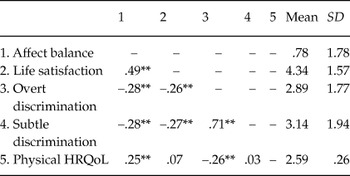
Pearson`s correlations were made in order to see the relationships between the variables of the current study. Table 1 shows, a negative correlation between SWB (affect balance and life satisfaction) and overt and blatant discrimination. Additionally, overt discrimination is negatively related to physical HRQoL. These results seem to partially support the first two hypotheses of the research. It is important to remark that no significant correlation was found between physical HRQoL and subtle discrimination, as it was hypothesized.
Correlations between the variables

** p < .01.
Prior to conducting the regression analyses, and in order to avoid potential problems with overlap between variables, multicollinearity tests were conducted. Since all the tolerance indices were greater than 1 - R2, none of the variables had to be removed or aggregated in the analyses.
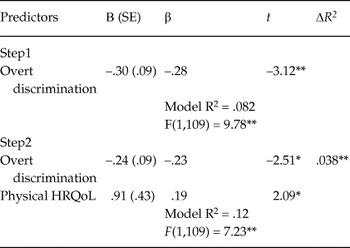
To test if discrimination was a mediating variable linking physical HRQoL and SWB, procedures outlined by Baron and Kenny (Reference Baron and Kenny1986) were followed. In this investigation, physical HRQoL is the independent variable, and as we saw before (Table 1), it had a statistically significant association with affect balance but not with life satisfaction (the dependent variables). For this reason, the meditational analysis was only conducted with affect balance. Additionally, in Table 1 it can be seen that physical HRQoL was also statistically significant associated with overt discrimination but not with subtle discrimination. For this reason, the meditational analysis was only conducted with overt discrimination. Finally, a regression analysis was conducted, entering overt discrimination into the equation on Step 1, and physical HRQoL on Step 2. Therefore, the mediating role of overt discrimination would be tested if on Step 2 beta of discrimination is statistically significant and the beta of the independent variable is less than those correlations which were found between each of independent variables and the dependent variable (affect balance). The results of the regression analysis can be seen in Table 2.
Hierarchical regression analysis to predict Affect Balance

* p < .05; **p < .01.
According to these regression analyses, it can be said that the relationships between physical HRQoL and affect balance was mediated by overt discrimination as it was hypothesized (see Figure 1). Associations between these independent and dependent variables were reduced, but non zero, indicating that overt discrimination is a partial mediator.
Mediational analysis with Physical HRQoL (independent), Overt Discrimination (mediational) and Affect Balance (dependent).
Standardized β coefficients, and reduced standardized β coefficients (in parentheses) when Overt Discrimination is introduced as a mediating variable between Physical HRQoL and Affect Balance.

To test if the reduction in the relationship between the independent (physical HRQoL) and the dependent variable (affect balance) is significant, when the mediating variable (overt discrimination) is included in the regression model, the procedure outlined by Sobel (Reference Sobel and Long1988) was followed. Sobel test was 1.82 (p < .05), indicating that the relationships between physical HRQoL and affect balance were significantly reduced with the inclusion of overt discrimination as a mediator.
Also, the procedure proposed by Holmbeck (Reference Holmbeck2002) was followed to determine the percentage reduction in a bivariate association when the mediator is taken into account. It was found that the magnitudes of the relationships between physical HRQoL and affect balance were reduced to 76% when overt discrimination was included as a mediating variable.
These results seem to support the third and last hypothesis of the research.
Discussion
According to our results the discrimination, both overt and subtle, that obese people suffer in their life is negatively related with SWB, a variable that, despite its importance, has not been studied so much to date as other medical variables. In other words, obese people who suffer direct and indirect forms of social discrimination report less affect balance and life satisfaction.
Additionally, we have found find that weight discrimination is negatively related to physical HRQoL, in this case just overt discrimination, which is consistent with a growing body of research that identifies that perceived discrimination poses a threat to health (Williams, Neighbors, & Jackson, Reference Williams, Neighbors and Jackson2003), but, as it was mentioned in the introduction section, weight-based discrimination had been largely left out of the studies (Tsenkova et al., Reference Tsenkova, Carr, Schoeller and Ryff2011). These findings challenge the vision that posits that only severe levels of weight (BMI) threat through direct physiological means the physical HRQoL of obese individuals. According to our results, it is suggested that the social processes of perceived overt discrimination related to weight are responsible, at least in part, for the effects of severe obesity on physical HRQoL. Our findings are potentially important because they suggest that being rejected because of one’s weight can actually contribute to make worse the physical HRQoL of obese individuals. In other words, social factors are implicated in health problems associated with obesity beyond the physiologic causes.
It is important to remark to no significant effects were found in the relationship between physical HRQoL and subtle discrimination. According to some authors (King et al., Reference King, Shapiro, Hebl, Singletary and Turner2006), weight discrimination research usually show that the incidence of major discriminatory acts and overtly prejudiced attitudes have dropped in the last few years but these negative attitudes towards obese individuals openly expressed may have been supplanted by more covert forms of prejudice that manifest in subtle and indirect discriminatory behaviors towards obese people. Although we have not found a significant correlation between subtle discrimination and physical HRQoL, we believe that it is still important to measure these new ways of expressing prejudices toward people with weight problems. As we have said before, the relationship with SWB was negative and significant, which gives an idea of the importance that may have subtle ways of discrimination to explain the psychological HRQoL of obese patients. Finally, a recent meta-analysis shows that both forms of discrimination are related with less physical and psychological HRQoL (Jones, Peddie, Gilrane, King, & Gray, Reference Jones, Peddie, Gilrane, King and Gray2013). Unfortunately, there are not many studies analyzing how subtle discrimination affects people with weight problems.
According to our results, the nature of the positive relationship between physical HRQoL and SWB is not direct, because overt discrimination mediates the relationship between them. It has been found that overt discrimination was a partial mediator in the relationship between physical HRQoL, measured with the physical component of the SF-36, and affect balance (the emotional component of SWB). This result suggests that obese people with a poor physical health will report less positive experiences, especially when they also suffer direct rejection in their everyday lives. This result confirm the meditational nature of overt discrimination in the relationship between physical and psychological HRQoL in obese patients as recently have been found in obese samples (Vilhena et al., Reference Vilhena, Pais-Ribeiro, Silva, Cardoso and Mendonça2014) and with other stigmatized groups (Ortiz-Hernández, Compeán-Dardón, Verde-Flota, & Flores-Martínez, Reference Ortiz-Hernández, Compeán-Dardón, Verde-Flota and Flores-Martínez2011).
Finally, we have found, as other authors (Leontopoulou & Triliva, Reference Leontopoulou and Triliva2012), that SWB is positively related to physical HRQoL. In other words, obese patients that perceive that they have a good physical HRQoL report more affect balance. It is important to remark, that no significant correlation was found in the case of life satisfaction. Finally, the participants’ BMI does not correlate with both psychological and physical HRQoL which can be explained by the fact that only obese participants were part of the final sample and no control group was recruited to compare the results (Brandheim, Rantakeisu, & Starrin, Reference Brandheim, Rantakeisu and Starrin2013).
Considering the cross-sectional design of the study, we can only speculate that a higher level of discrimination contributes to a worse psychological and physical HRQoL. However, a bidirectional effect may be the case, in which HRQoL outcomes may predict discrimination levels. For example, people with a bad psychological and physical HRQoL may stay at their houses and feel more isolated which can made them feel discriminated by their weight.
The current study is subject to some limitations that deserve mention. First of all, in the research self-reports has been used. It would be necessary, for future investigations, to conduct studies with the same goals but using also more objective criteria and evaluating the same constructs with alternative measures (clinical interview, psychiatric and medical evidences) instead of using only self-reports.. In the second place, it is a cross-sectional study and only longitudinal studies can provide insight into how obesity, SWB, overt and subtle discrimination, and physical HRQoL interact with different daily life stressful experiences. In the third place, psychological well-being (the potentialities of human beings like self-acceptance, positive relation with others, autonomy, environmental mastery, purpose in life, and personal growth) has not been measured (Swencionis et al., Reference Swencionis, Wylie-Rosett, Lent, Ginsberg, Cimino, Wassertheil-Smoller and Segal-Isaacson2013). Despite these limitations, the study provides new data with potential applications.
These limitations considered, the current study offers new directions for the study of obesity, discrimination and HRQoL. With the growing prevalence of obesity, it is becoming increasingly important to understand the ways in which social variables have an influence on HRQoL of individuals with weight problems. As we have seen, there is a strong social stigma of obesity and the stress this stigma poses for the HRQoL of individuals with weight problems is a variable to take into account (Sikorski et al., Reference Sikorski, Luppa, Kaiser, Glaesmer, Schomerus, König and Riedel-Heller2011).