Introduction
Sugarcane is cultivated in more than 70 countries and territories, and products such as sugar and ethanol are an important component of the economy of many countries, including Brazil (Nocelli et al. Reference Nocelli, Zambon, Silva, Morini, Fontanetti and Bueno2017). Several soil management techniques are used in sugarcane cultivation to increase the productivity of the agricultural system (Bordonal et al. Reference Bordonal, Carvalho, Lal, Figueiredo, Oliveira and La Scala2018). However, these approaches may negatively affect the soil fauna (Siqueira et al. Reference Siqueira, Silva, Moreira, Santos and Silva2016).
Ants are important components of the edaphic fauna, and one of the few organisms identified as soil builders (Folgarait Reference Folgarait1998, Sanders & Van Veen Reference Sanders and Van Veen2011). In general, ants act as ecosystem engineers and provide regulatory services, such as pest control. In addition, ants influence the functioning of the soil they inhabit and may be used as indicators of soil quality (Lavelle et al. Reference Lavelle, Decaëns, Aubert, Barot, Blouin, Bureau, Margerie, Mora and Rossi2006, Del Toro et al. Reference Del Toro, Ribbons and Pelini2012, Sanabria et al. Reference Sanabria, Lavelle and Fonte2014), because the richness and composition of their communities are influenced by changes in land use (Dalle Laste et al. Reference Dalle Laste, Durigan and Andersen2018).
Plantations that do not use chemical inputs, such as insecticides (i.e., fipronil, a broad-spectrum insecticide against insects) and herbicides (i.e., atrazine), are considered more sustainable (Azadi et al. Reference Azadi, Schoonbeek, Mahmoudi, Derudder, De Maeyer and Wiltlox2011). This management approach promotes biodiversity, nutrient cycling, and biochemical activities (Kshirsagar Reference Kshirsagar2006) and supports natural enemies (Landis et al. Reference Landis, Wratten and Gurr2000, Santos et al. Reference Santos, Naranjo-Guevara and Fernandes2017), such as ants, which are an important group of insects for pest control (Wielgoss et al. Reference Wielgoss, Tscharntke, Rumede, Fiala, Seidel, Shahabuddin and Clough2014, Offenberg Reference Offenberg2015).
Despite its use of advanced technology, the production chain of the sugarcane–ethanol industry generates large quantities of waste, including vinasse, a liquid byproduct of ethanol fermentation. Each litre of alcohol produced generates approximately 15 litres of vinasse (Carrilho et al. Reference Carrilho, Labuto, Kamogawa, Prasad and Shih2016). Vinasse has a high organic matter content (Christofoletti et al. Reference Christofoletti, Francisco, Pedro-Escher, Gastaldi and Fontanetti2016) and is typically applied to the soil through fertirrigation of sugarcane crops. However, although vinasse makes the production system more sustainable, some studies suggest that its low pH and chemical conductivity may negatively impact the environment, altering the physicochemical traits of the soil and affecting the biota (Christofoletti et al. Reference Christofoletti, Escher, Correia, Marinho and Fontanetti2013).
In addition to vinasse, agricultural pesticides are frequently used in sugarcane crops (Morini et al. Reference Morini, Silva, Zambon, Nocelli, Fontanetti and Bueno2017). Previous studies have shown that sugarcane crops treated with fipronil and fertigated with vinasse had a lower diversity of epigeic and hypogeic ants (Saad et al. Reference Saad, Souza-Campana, Bueno and Morini2017) and straw mulch ants (Silva et al. Reference Silva, Saad, Souza-Campana, Bueno and Morini2017), which may be related to the addition of fipronil during planting or ratooning of this crop. Thus, we studied ground-dwelling ant assemblages in three different sugarcane management systems: with both fipronil and vinasse; with fipronil and no vinasse; and with vinasse and no fipronil (i.e., an organic management system). Specifically, we investigated whether the richness and composition of ground-dwelling ant fauna and the feeding/foraging types in the assemblages were influenced by the management system. Since no chemical inputs were used in the organic management system, which is beneficial for ant community diversity, we expected a different species composition and higher species richness with this system, including a greater proportion of predator species.
Methods
Study area
We studied three sugarcane management systems, grouped according to the approach adopted to control the initial infestation of soil pests and to the use of vinasse as a fertilizer supplement. We sampled two sites managed according to each system, as follows: (i) application of both fipronil and vinasse (FV: 22.303500ʼS, 47.436778ʼW; 22.219361ʼS, 47.399500ʼW); (ii) application of fipronil without vinasse (F: 22.309278ʼS, 47.386722ʼW; 22.252889ʼS, 47.701194ʼW); and (iii) application of vinasse without fipronil; hereafter, organic management system certified for IBD certifications (OM: 21.185800ʼS, 48.245000ʼW; 21.181000ʼS, 48.242300ʼW).
In each sugarcane field, sampling was performed 4–5 months after ratooning. Ratooning is a key agricultural practice to maintain cane and sugar yields as the number of ratoon crops increases (CNA/SENAR 2007), also increasing annual production (Fabris et al. Reference Fabris, Foloni, Calonego, Santos, Santos and Silva2013).
At the initial phase of ratooning, fipronil was applied once in furrows, which were parallel to planting rows, to control pests in the soil. The insecticide was sprayed in the furrow using a disc furrow opener with spraying nozzles. Herbicides for weed control and synthetic fertilizers were also applied as part of routine agricultural practice. In the sugarcane management systems with fipronil (FV, F), herbicide or synthetic fertilizer was used at the initial phase of ratooning.
All study sites had the same environmental conditions: (i) dry winter (June to September) and rainy summer (December to March); (ii) same age of cultivation (approximately 30 years to FV and F; and 10 years to OM – IBD – Certification Biodynamic Institute); (iii) straw mulch covering the soil with sugarcane harvested without burning for about 10 years; and (iv) same source of vinasse. Since vinasse composition varies depending on how the sugarcane is processed (Cabello et al. Reference Cabello, Scognamiglio and Teran2009), we standardized the systems based on the origin of the vinasse.
Ant sampling and feeding/foraging types
At the centre of each site, 15 pitfall traps, which consisted of plastic cups (diameter = 20 cm) with 100 mL of solution (98 mL of water mixed with 2 mL of detergent), were placed along a 150-metre linear transect. Transects were parallel to cultivation rows, and traps were 10 m apart. In total, 90 pitfalls (6 sites × 15 traps) were installed. In each site, the traps were deployed for 48 h and collected during the most active period for the ant fauna (in the summer).
Ants were first divided into subfamilies and genera following Baccaro et al. (Reference Baccaro, Feitosa, Fernandez, Fernandes, Izzo, Souza and Solar2015) and then sorted into species and morphospecies according to Suguituru et al. (Reference Suguituru, Morini, Feitosa and Silva2015). Species were classified according to their resource exploitation habits (diet). We classified each species as a predator, omnivore, or fungivore (Hölldobler & Wilson Reference Hölldobler and Wilson1990, Tobin Reference Tobin, Hunt and Nalepa1994, Brown Reference Brown, Agosti, Majer, Alonso and Schultz2000). The classification of feeding/foraging types followed Brandão et al. (Reference Brandão, Silva, Delabie, Panizzi and Parra2012). Vouchers were deposited at University of Mogi das Cruzes, in Mogi das Cruzes, São Paulo, and at São Paulo State University, in Jaboticabal, São Paulo.
Data analysis
Species richness
All analyses took into consideration species incidence frequencies, and not the number of individuals captured (Gotelli & Colwell Reference Gotelli and Colwell2001). Thus, the maximum incidence frequency a species could reach was 90 occurrences (if the species was collected in all sites and all traps), 15 by site. We compared species richness among sugarcane crops based on the expected number of species in each system using rarefaction sampling based on sample sizes. We used the R package iNEXT (Hsieh et al. Reference Hsieh, Ma and Chao2016, R Core Team 2020) to compute species richness estimates with 84% confidence intervals (CIs – upper and lower bounds) (MacGregor-Fors & Payton Reference MacGregor-Fors and Payton2013). We used the confidence intervals to determine whether ant assemblages differed among the three systems with regard to species richness; two groups were considered different if their 84% CIs did not overlap.
Species composition
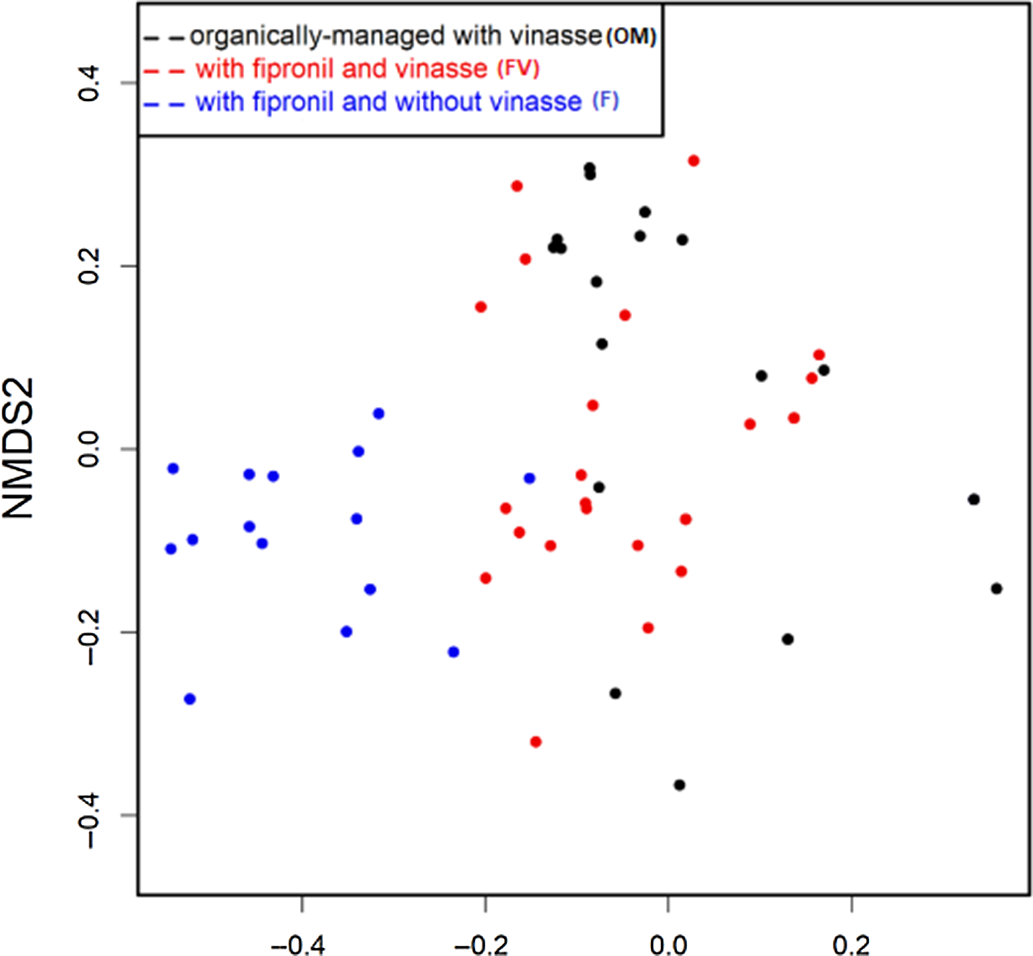
To summarize the structure of the ant assemblage, we ordered the samples using Nonmetric Multidimensional Scaling (NMDS) (metaMDS function in R package vegan), based on the Bray–Curtis dissimilarity index (with incidence of each species). We also tested for differences in ant species composition among systems (factor with three levels) using Permutational Multivariate Analysis of Variance (PERMANOVA). We ran 999 random permutations using the ‘adonis’ function of the R vegan package. Multiple pairwise comparison using adonis from the vegan package was performed using the ‘pairwise.adonis’ function (Martinez Arbizu Reference Martinez Arbizu2020, R Core Team 2020). Since this test is sensitive to data dispersion, we also performed a multivariate homogeneity analysis using the ‘betadisper’ function of the vegan package to assess whether the systems differed in dispersion; significance was determined by 999 permutations.
Results
Species richness and feeding/foraging types
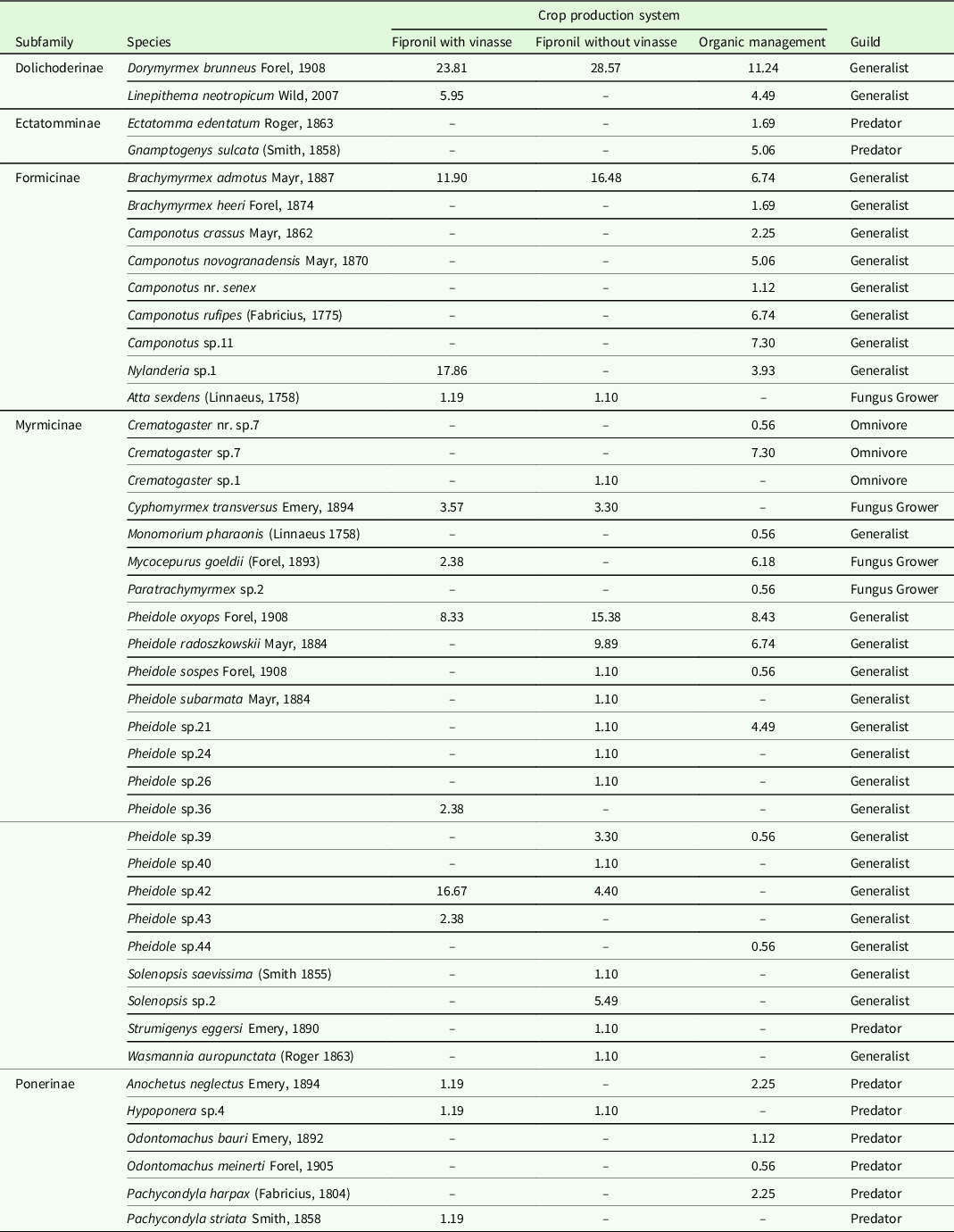
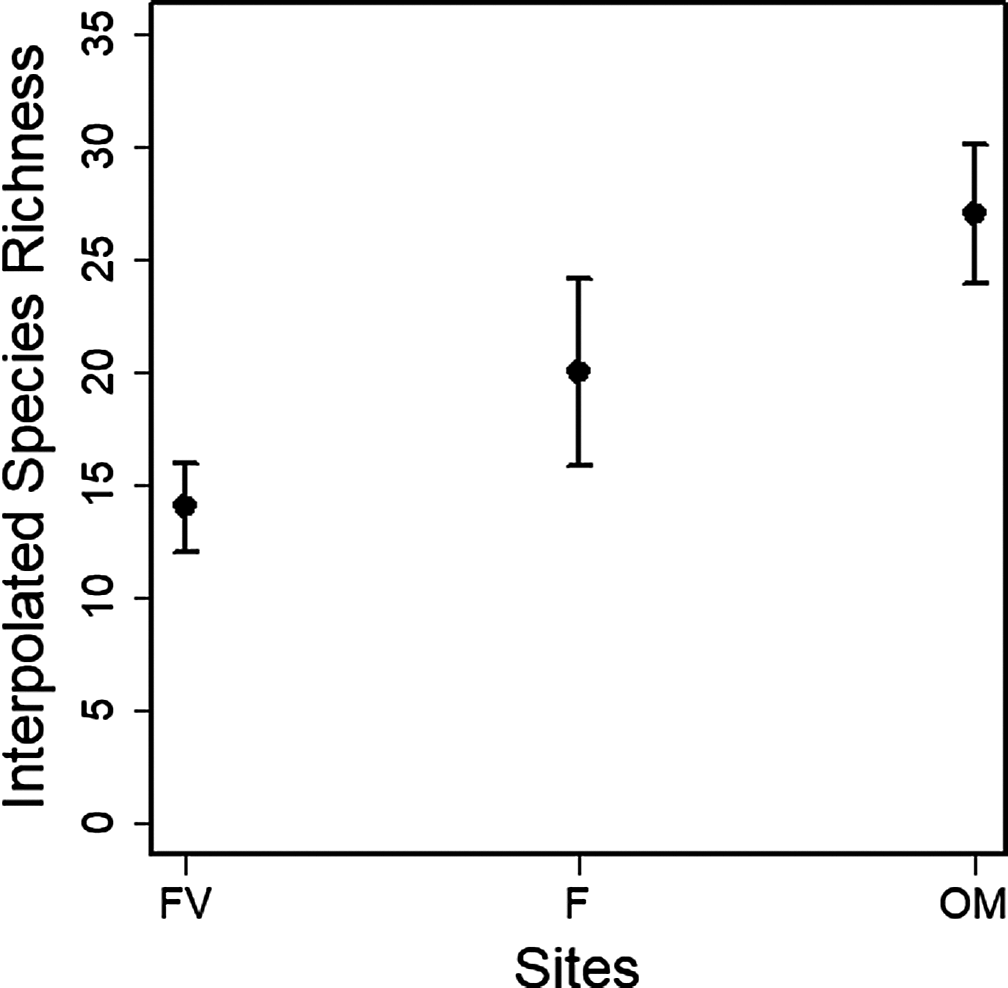
In total, five subfamilies, 21 genera, and 43 species or morphospecies of ants were recorded (Table 1). The most frequent species across all systems were Dorymyrmex brunneus Forel, 1908 (18.6%), Brachymyrmex admotus Mayr, 1887 (10.4%), and Pheidole oxyops Forel, 1908 (10.1%) (Table 1). The organic management system was richer in unique species (15 species), while the fipronil plus vinasse system was the poorest (2 species) (Table 1). The organic management system had significantly higher species richness than the systems with fipronil and vinasse, but did not differ from the system that used fipronil without vinasse (Figure 1).
Frequency of occurrence (%) and guilds (according to Brandão et al. Reference Brandão, Silva, Delabie, Panizzi and Parra2012) of ants in sugarcane crops under different production systems

Interpolated species richness in sugarcane crops under different production systems, based on 30 pitfall traps in each system (15 traps/transect), and 84% confidence intervals. (FV: application of both fipronil and vinasse; F: application of fipronil without vinasse; OM: organically managed field).

Across all management systems, generalists were dominant (61.3%), followed by predators (20.4%), fungus growers (9%), and omnivore (6.8%) species. The richness of generalist species of ants was higher in the sugarcane system with organic production and in the system managed with fipronil and without vinasse. Predatory species richness was higher in the organic management system (Table 1). We recorded the generalist predators Anochetus neglectus Emery, 1894; Gnamptogenys sulcata (Smith, 1858); Odontomachus bauri Emery, 1892; O. meinerti Forel, 1905; and Pachycondyla harpax (Fabricius, 1804) exclusively in the organic management system. Pachycondyla striata (Smith 1858) was the only species unique to the system with fipronil and vinasse (Table 1).
Species composition
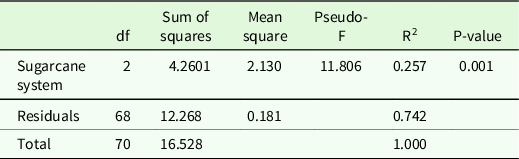
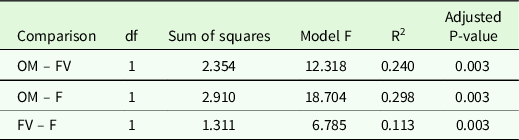
The PERMANOVA analysis indicated that system type explained 26% of the variation in ant assemblage composition (Pseudo-F2,68 = 11.60, P = 0.001) (Table 2). We did not find different levels of dispersion based on sugarcane management system (betadisper, F2,68 = 2.501, P = 0.075). Analyses using post-hoc pairwise tests revealed significant differences in all pairwise comparisons (Table 3). Our results in relation to the NMDS ordination suggest that the composition of species in the sugarcane production systems without vinasse (F) is not the same when compared with the other systems (Figure 2).
Summary of PERMANOVA analysis of differences in ant assemblage structure among different sugarcane systems. The PERMANOVA was based on a Bray–Curtis similarity matrix of presence–absence data and 999 permutations

Results of post-hoc pairwise comparisons of ant assemblage structure (PERMANOVA) for each pair of distances between each of the three sugarcane systems. FV: application of both fipronil and vinasse; F: application of fipronil without vinasse; OM: organically managed field

Nonmetric multidimensional scaling (NMDS) plot of ant assemblages in sugarcane crops under different production systems based on pairwise Bray-Curtis distances between pitfall samples. NMDS Stress = 0.13.

Discussion
Our study analyzed the richness and composition of ground-dwelling ant fauna in different sugarcane production systems (with the insecticide fipronil with or without vinasse or organic production). Comparisons among sugarcane systems suggest that organically managed fields have a different species composition and significantly higher ant species richness than the system with vinasse and fipronil. The two systems managed with fipronil shared 50% of ant species, with assemblages consisting mostly of omnivorous, surface-feeding species. In addition to the absence of chemical inputs, organically managed systems also have more organic matter, which has beneficial chemical and physical effects on soil structure (Magdoff & Weil Reference Magdoff, Weil, Magdoff and Weil2004) and soil communities (Bavec & Bavec Reference Bavec, Bavec, Blanco, Lo and Roy2015). In our study, the application of fipronil and vinasse in sugarcane fields was not beneficial for ground-dwelling ants, as previously observed by Saad et al. (Reference Saad, Souza-Campana, Bueno and Morini2017) and Silva et al. (Reference Silva, Saad, Souza-Campana, Bueno and Morini2017), although our low replication prevents generalizations. Our results suggest that, in addition to harming predatory ants (i.e., Ectatomma edentatum Roger, 1863; G. sulcata, O. bauri, O. meinerti, and P. harpax), fipronil also affected Camponotus assemblages, since no species of this genus was recorded in the systems where the insecticide was applied. Camponotus spp. provide significant ecosystem services, such as predation (Morais et al. Reference Morais, Barcello and Redaelli2006) and pollination (Del-Claro et al. Reference Del-Claro, Rodrigues-Morales, Calixto, Martins and Torezan-Silingardi2019). On the other side, our results also suggest that fipronil application did favour other generalist species, such as B. admotus and D. brunneus.
Dorymyrmex brunneus has been recorded in sugarcane cultures before (Rossi & Fowler Reference Rossi and Fowler2004, Souza et al. Reference Souza, Stingel, Almeida, Lazarini, Munhae, Bueno, Archangelo and Morini2010a, Reference Souza, Stingel, Almeida, Munhae, Mayhé-Nunes, Bueno and Morini2010b), including organically managed fields (Santos et al. Reference Santos, Naranjo-Guevara and Fernandes2017). Since this ant species feeds on eggs and larvae of the sugarcane borer, Diatraea saccharalis (Fabricius, 1794) (Lepidoptera: Crambidae) (Oliveira et al. Reference Oliveira, Almeida, Souza, Munhae, Bueno and Morini2012), its presence is important for natural pest control. Although fipronil favours D. brunneus populations and has broad-spectrum activity against numerous insect pests (Fent Reference Fent and Wexler2014), this insecticide also reduces the diversity of non-target invertebrates (Pisa et al. Reference Pisa, Amaral-Rogers, Belzunces, Bonmatin, Downs, Goulson, Kreutzweiser, Krupke, Liess, McField, Morrissey, Noome, Settele, Simon-Delso, Stark, Van der Sluijs, Van Dyck and Wiemers2015), which may be a food source for predatory ants. Thus, we suggest that, although insecticides are not completely selective against ant assemblages in general, their application to the soil can affect species that are important for biological control (i.e., predatory ants) and should be used with caution in pest management programs.
Vinasse application can increase crop yield and improve soil structure compared to production systems without vinasse (Schultz et al. Reference Schultz, Lima, Pereira and Zonta2010), but this may have a negative effect on P. oxyops, a predatory ant (Gomes et al. Reference Gomes, Santiago, Campos and Vasconcelos2019). Therefore, studies addressing best practices for sustainable management of sugarcane systems are necessary to preserve ant species.
Conclusion
Our results suggest that, when the goal is to maintain ant diversity in the agricultural system, sugarcane crops managed with vinasse without fipronil are the best approach. The results of previous studies (i.e., Saad et al. Reference Saad, Souza-Campana, Bueno and Morini2017, Silva et al. Reference Silva, Saad, Souza-Campana, Bueno and Morini2017) that showed negative effects of vinasse on ant diversity in sugarcane plantations might be better explained by the use of fipronil. In addition, since decreasing the use of agrochemicals is one of the main challenges in agriculture, this practice can help maintain the sustainability of the crop. Our data suggest that the search for a more sustainable management of sugarcane crops needs to be a priority for Brazilian environmental public policy programs aimed at the preservation of edaphic fauna (i.e., ants); especially because in Brazil, there is only a small planted area (40 thousand hectares) with organically managed sugarcane when compared with the area of non-organic production (8.5 million hectares). Thus, despite the low replication of our study, our main results contribute to determining the relationship between production systems and invertebrate soil fauna in sugarcane fields.
Acknowledgements
Ants were collected under permit No. 57174-1 from the Biodiversity Authorization and Information System (SISBIO)/Chico Mendes Institute for Biodiversity Conservation (ICMBio)/Brazilian Ministry of the Environment (MMA).
Author contributions
Conceptualization: Souza-Campana, D.R.; Morini, M.S.C.; Bueno, O.C. Data Collection: Morini, M.S.C.; Souza-Campana, D.R.; Santos, L.O; Fernandes, O.A.; Futikami, B.S. Data Analysis: Souza-Campana, D.R.; Silva, R.R. Methodology: Morini, M.S.C.; Fernandes, O.A., Souza-Campana, D.R. Writing and Editing: Souza-Campana, D.R.; Morini, M.S.C.; Silva, R.R.; Fernandes, O.A.
Financial support
This work was supported by the São Paulo Research Foundation (FAPESP) (grant numbers 2012/50197-2, 2014/50280-2); the Foundation for Teaching and Research Support (FAEP); and the National Council for Scientific and Technological Development (CNPq) (grant number 300690/2019-3).
Conflicts of interest
None.