




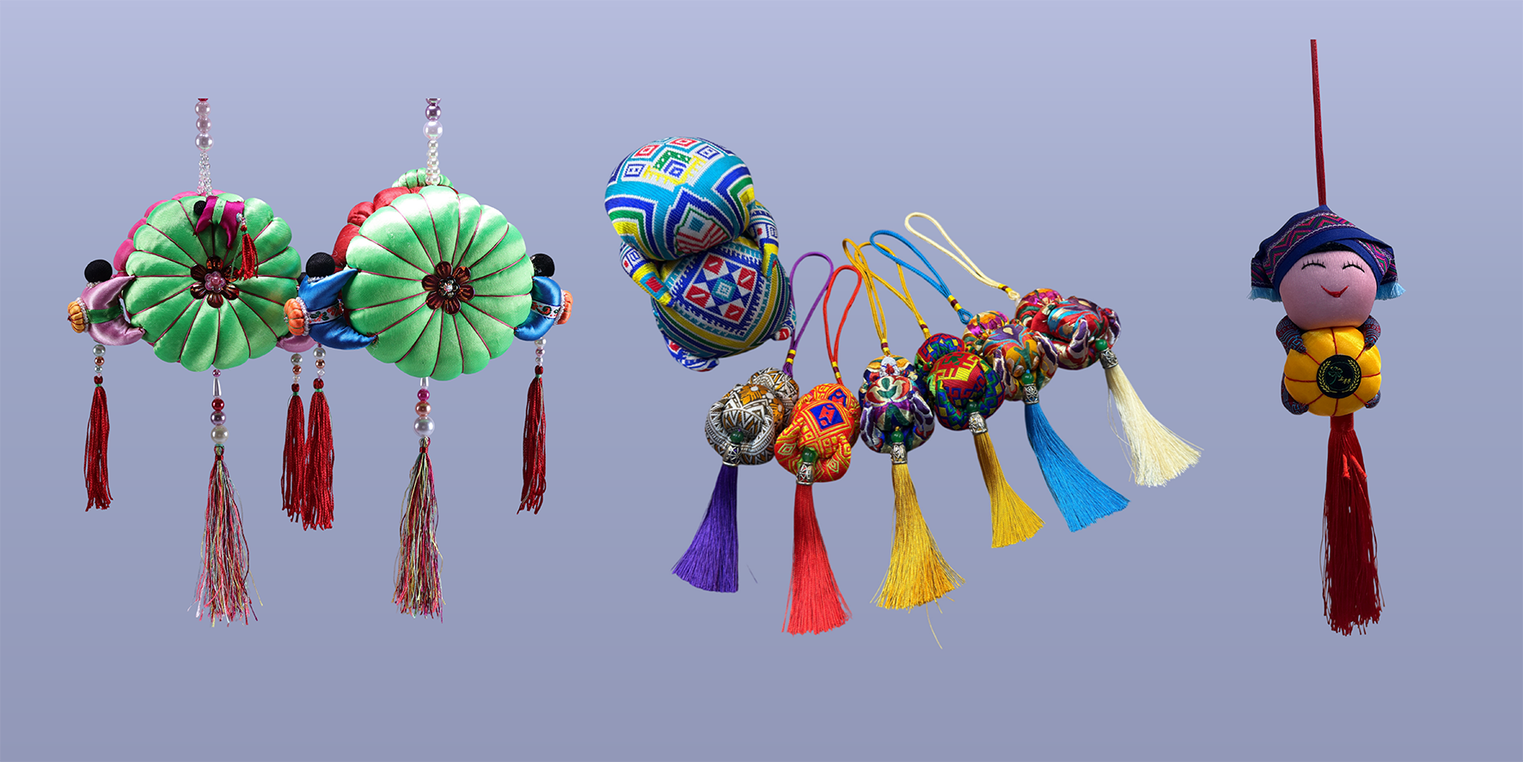
An exhibition installer pauses in front of a display case during an installation at the China National Museum of Women and Children in Beijing. Inside are Dragon Boat Festival toys from Guangxi: men en gua (璊摁瓜, paired cloth monkeys hugging pumpkins), mo mie (麽乜, a cloth doll holding a dragon ball), and duhe gong (渡河公, a cloth doll hugging a pumpkin), all stitched in bright reds, blues, yellows, and greens (Figure 1). He squints at the climate-controlled vitrine, then turns to a companion and remarks, “This looks like a gift shop.”
(Left to right) men en gua, mo mie, and duhe gong. Source: Photo by the first author.

The exhibition, Childhoods in China: Nurture, Play, and Growing Up (27 May–27 June 2025), was organised by the Chinese National Museum of Ethnology and hosted at the China National Museum of Women and Children as a partner venue.Footnote 1 It showcased contemporary childhood across the country’s 56 recognised ethnic groups. In spring 2025, the Chinese National Museum of Ethnology’s curators commissioned the toys from makers in Guangxi certified under China’s intangible cultural heritage system and used that state endorsement to support their acquisition. The Chinese National Museum of Ethnology took custody of the toys, displayed them, and later kept them in storage. But they were never registered as national cultural property.
Why did the toys come to rest inside the museum yet outside its registered collection, when they had arrived with state-issued credentials and a place in the exhibition already secured? One tempting explanation, frequently met in public discourse in China and beyond, is that Chinese museums have inherited a cultural preference for antiquity. A long Sinological tradition has provided the richest expression of this, along two lines of thought: one locating the persistence of the Chinese past in intangible practices that people continue to perform; the other locating it in the endurance of tangible objects whose survival across dynasties has been seen to embody the continuity of history itself. Yet the Dragon Boat Festival toys sit awkwardly with both interpretations. Their makers are certified under the state’s intangible cultural heritage system as bearers of a living tradition, which should place the toys squarely within the first vision and make them strong candidates for registration as national cultural property, yet they were never registered. The second vision can perhaps explain their exclusion, to some extent, since the toys carry none of the tangible evidence of antiquity that this tradition reveres. This explanation cannot, however, then shed light on why the museum commissioned the toys, sealed them behind glass, and kept them after the exhibition closed. Neither rationale, on its own, can account for the in-between state of the toys at the Chinese National Museum of Ethnology. Consequently, the alleged Chinese preference for antiquity is not the answer but rather the question we here set out to analyse.
One of us (M.J.) spent 10 months embedded within the Chinese National Museum of Ethnology, drafting acquisition language with curators, sitting in on appraisal sessions, and standing on the exhibition floor during installation. This fieldwork experience showed the exclusion of the toys taking shape site by site. The proposal, the intake form, the appraisal table, and the display case each gathered their own people and instruments, and each read the toys through a different routine. Every judgement was defensible on its own terms, yet each pulled the toys towards the same position. We call this pull the gravity of antiquity: the invisible yet irresistible attraction towards the old that a museum’s existing collection and the instruments calibrated to this body of material together exert on whatever arrives next, producing an exclusion that no single decision intends but that they cannot help but uphold.Footnote 2 This attraction works by grading each arrival against standards that the collection already satisfies. The toys, their passage through these phases brought to a halt by the inertia generated by each successive phase, came to rest before they could reach one final site of judgement: the expert appraisal panel. We use a second commissioned object from the same exhibition, a set of coming-of-age costumes created by Mosuo people in Yunnan Province, to illuminate that stage. The pages that follow walk through these encounters one by one.
1. What happened to the toys
The museum’s curators identified the Dragon Boat Festival toys as essential to the exhibition. In Zhuang and Dong communities in southwest China, families stitch cloth figures for children each year during the festival, in keeping with regional customs that take many forms across the country. The toys are believed to ward off evil and protect children’s health.Footnote 3 They come in many forms, from pieces stitched at home by individual makers or in small workshops to figures mass-produced for the tourist market. So, what to collect and exhibit?
1.1. The proposal
Contemporary collecting, as both a practice and a body of scholarship, asks museums to help the present survive into the future rather than preserve only that which time has already filtered.Footnote 4 In China’s state-run museum system, that premise has no established foothold. With older objects, scarcity, age, and prior scholarship help establish their credibility and national significance before any proposal can be written. Contemporary objects come without that inheritance of recognition. They remain in circulation, reproducible, and competing with countless near-identical things that have not entered the museum. Before the toys could be accessioned as registered collection objects, curators had to make the case to those in leadership responsible for reading and assessing their acquisition proposal, and to the experts who might be asked to appraise it, that these recent cloth figures stand for something beyond themselves. It could be a practice, a community, or a category of material culture worthy of institutional commitment.
A suitable language was readily available, though it had been built up by a parallel state apparatus outside the museum system. China’s intangible cultural heritage regime, established by the State Council in 2005 and codified in the 2011 Intangible Cultural Heritage Law, certifies living practices through a four-tier hierarchy of national, provincial, municipal, and county lists.Footnote 5 At each tier, it also designates specific practitioners as intangible cultural heritage representative inheritors (daibiaoxing chuancheng ren 代表性传承人), individuals officially credentialed by the state to transmit a recognised practice. The intangible cultural heritage regime offers what the museum’s own system lacks: a ready-made and state-backed framework for grading the cultural weight of a living practice. But this recognition is attached to practices and representative inheritors rather than to individual things. It could help curators argue that the toy-making tradition mattered, but it could not by itself turn a newly stitched toy into registered museum property. Curators at the Chinese National Museum of Ethnology proposed buying sets from representative inheritors certified in these toy-stitching traditions, and one set of mo mie was donated directly by one such inheritor. The acquisition proposal that curators drafted borrowed the authority of those intangible cultural heritage listings, citing the practice’s heritage status and the inheritors’ credentials, hoping these would at least give leadership a recognised vocabulary with which buying new cloth toys could be defended.
1.2. The intake
The proposal spoke the strongest language available for a living practice, yet it was a language the museum’s own registers could not endow with the weight of prior classificatory norms. The toys themselves still had to be placed, one by one, inside the Chinese National Museum of Ethnology’s categories. They came from Guangxi to the collection manager, who took custody, checked their accompanying documents, and opened on her computer the preliminary collections information sheet (cangpin yuanshi ziliao dan 藏品原始资料单), the intake form that the Chinese National Museum of Ethnology uses to log new acquisitions and to decide what kind of object the museum now holds. Until she had completed this form, the status of the toys would remain open. The museum could receive, store, and even exhibit an object before deciding whether to enter it into the state-protected collection.
The form gave her two routes. She could send the objects for expert appraisal, where three specialists would weigh their authenticity, age, materials, craftsmanship, and what the system calls collectable value against the “historical, artistic, and scientific” standard that the 1986 Measures for the Administration of Museum Collections (hereafter the 1986 Measures) had restated from the 1982 Cultural Relics Protection Law (hereafter the 1982 Law).Footnote 6 A favourable judgement would likely permit the objects to enter into the General Register of Collections (cangpin zong dengji zhang 藏品总登记账, hereafter the Register). This is the permanent ledger that the 1986 Measures established as the threshold where objects enter a museum’s holdings as state cultural property under the 1982 Law. Alternatively, she could log the objects as auxiliary material (fuzhu pin 辅助品), a category that would allow the museum to keep and use the object without entering it into the Register. Auxiliary material could remain in the museum and be displayed without further reporting obligations or the permanent collection identity of registered state cultural property.
Between these two routes, she chose the second. She did not dismiss the toys when they arrived. She had hoped, as she told us, that they might one day enter the Register. The choice tracked something she had learned over years of working in the Chinese National Museum of Ethnology’s registered-collection storeroom, home to bronzes and ceramics whose age, scarcity, and fragility supply a ready justification for permanent inclusion. The Dragon Boat Festival toys offered no equivalent ground. Their materials were everyday cloth and thread, and the inheritors who supplied these sets, or others in the same villages, could stitch similar examples the following month. Intangible cultural heritage certification, she also knew, would not help her at this stage. The intangible cultural heritage regime recognises practices and the people who carry them, but the Register evaluates singular objects against the historical, artistic, and scientific standard. Consequently, she classified the toys as auxiliary material. The toys went to the Chinese National Museum of Ethnology’s separate auxiliary-material storeroom, where they could be held indefinitely without acquiring the legal status that state cultural property holds under the 1982 Law, and without being reported upward into the national inventory of movable cultural relics that the National Cultural Heritage Administration compiles from each museum’s Register. Future collection managers learn the Register’s shape from whatever sits in the registered-collection storeroom, so this decision kept similar objects out of the mass against which the next arrival would be judged.
1.3. The appraisal
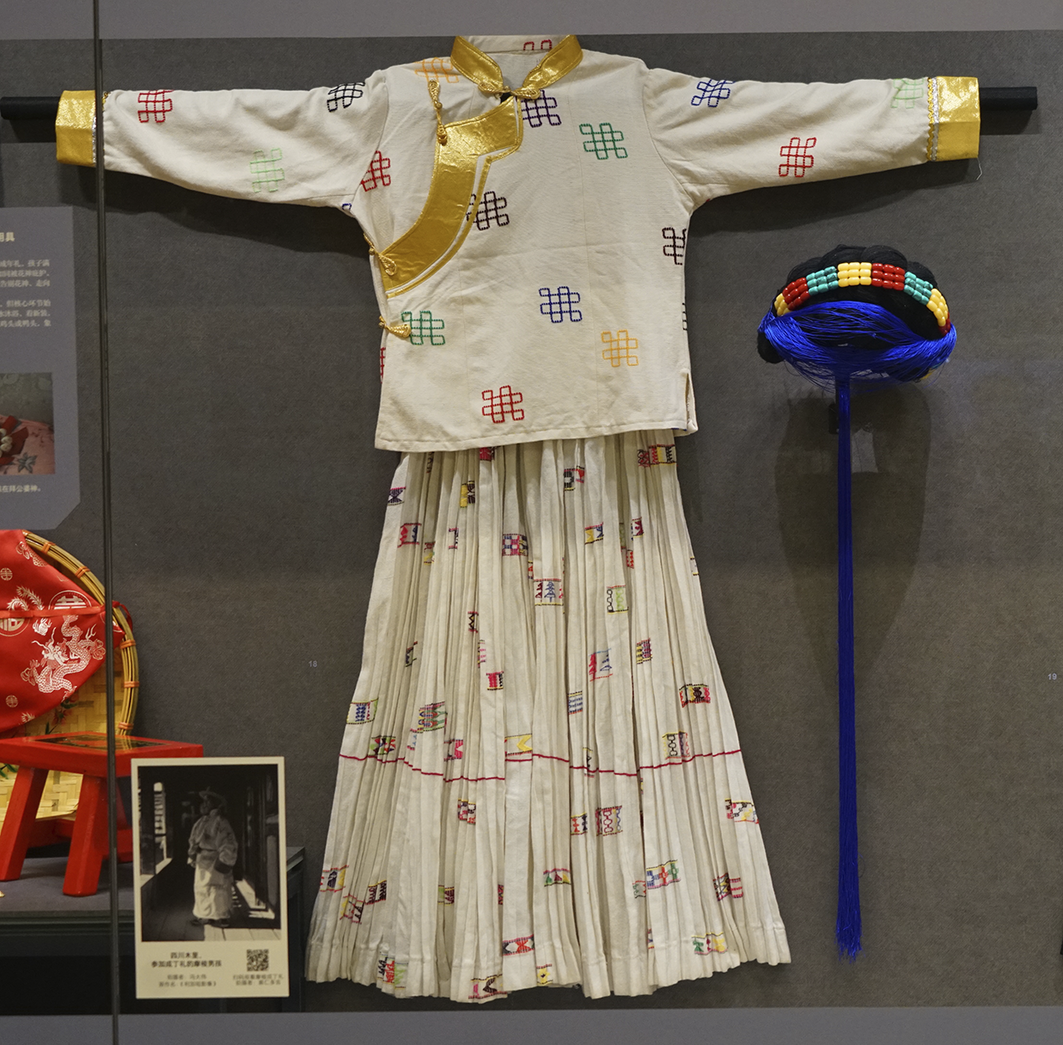
Pre-classified as auxiliary material, the Dragon Boat Festival toys never reached the appraisal table. A set of coming-of-age costumes from the Mosuo people in Yunnan Province, also commissioned for Childhoods in China, did reach this phase (Figure 2). As the collection manager explained, the Chinese National Museum of Ethnology held almost no Mosuo collection, and their coming-of-age sets had become difficult to obtain on the market. Both conditions gave the collection manager grounds to forward them for formal expert appraisal. At that stage, the question of collectability moved from her desk to a panel of three external specialists. The panel had been assembled for the occasion: its members held posts elsewhere, in universities and other institutions, and became the Chinese National Museum of Ethnology’s experts only at this table, in front of the objects and the form. The appraisal form used at the Chinese National Museum of Ethnology took its structure from the 1986 Measures. But alongside historical, artistic, and scientific value, the form added a fourth, cultural value, a category that the Chinese National Museum of Ethnology had introduced to handle objects whose interest lay in their cultural rather than chronological depth.
Mosuo coming-of-age costumes on display. Source: Photo by the first author.

On the day of the appraisal, one specialist joked to a colleague that the costumes looked like they had been made shang zhou (上周). In Mandarin, this phrase, meaning “last week,” sounds almost the same as a shorthand reference to the ancient Shang (c.1600–1046 BCE) and Zhou (c.1046–221 BCE) dynasties, which ruled over parts of what is now China thousands of years ago. They laughed at the absurdity of this anachronistic comparison. The joke set freshly stitched costumes against the deepest reference point in the Chinese collecting tradition, and it was this chronological gap that prompted laughter. The form’s fourth column had made room for cultural value, but in the room the conversation reached first for age. The costumes were registered as recent before anything else. To assess such objects, the specialists would have had to defend a framework for grading objects with a claim that did not rest on age, and the appraisal system did not yet supply the grounds for this. In China’s museum appraisal system, an expert rating becomes part of an object’s permanent record and can be reviewed by supervisory bodies. A weakly supported judgement is therefore professionally compromising and administratively traceable. What the panel weighed, alongside the costumes, was their own exposure.
The specialists accepted the costumes while noting they were “too new.” Scarcity in circulation and absence from the Chinese National Museum of Ethnology’s existing holdings allowed them to argue that the costumes were not merely contemporary, however, but endangered. Acceptance thus came from rewriting newness as a different kind of loss, folding the costumes back into the system’s preferred grammar, where the museum collects what time would otherwise take away. The Dragon Boat Festival toys, abundant and reproducible, came with no such rewriting available and so never reached the table. Yet their exclusion and the costumes’ admission converge on the same standard. Even when a contemporary object enters the Register, it does so only with recourse to the language of imminent loss.
1.4. The display case
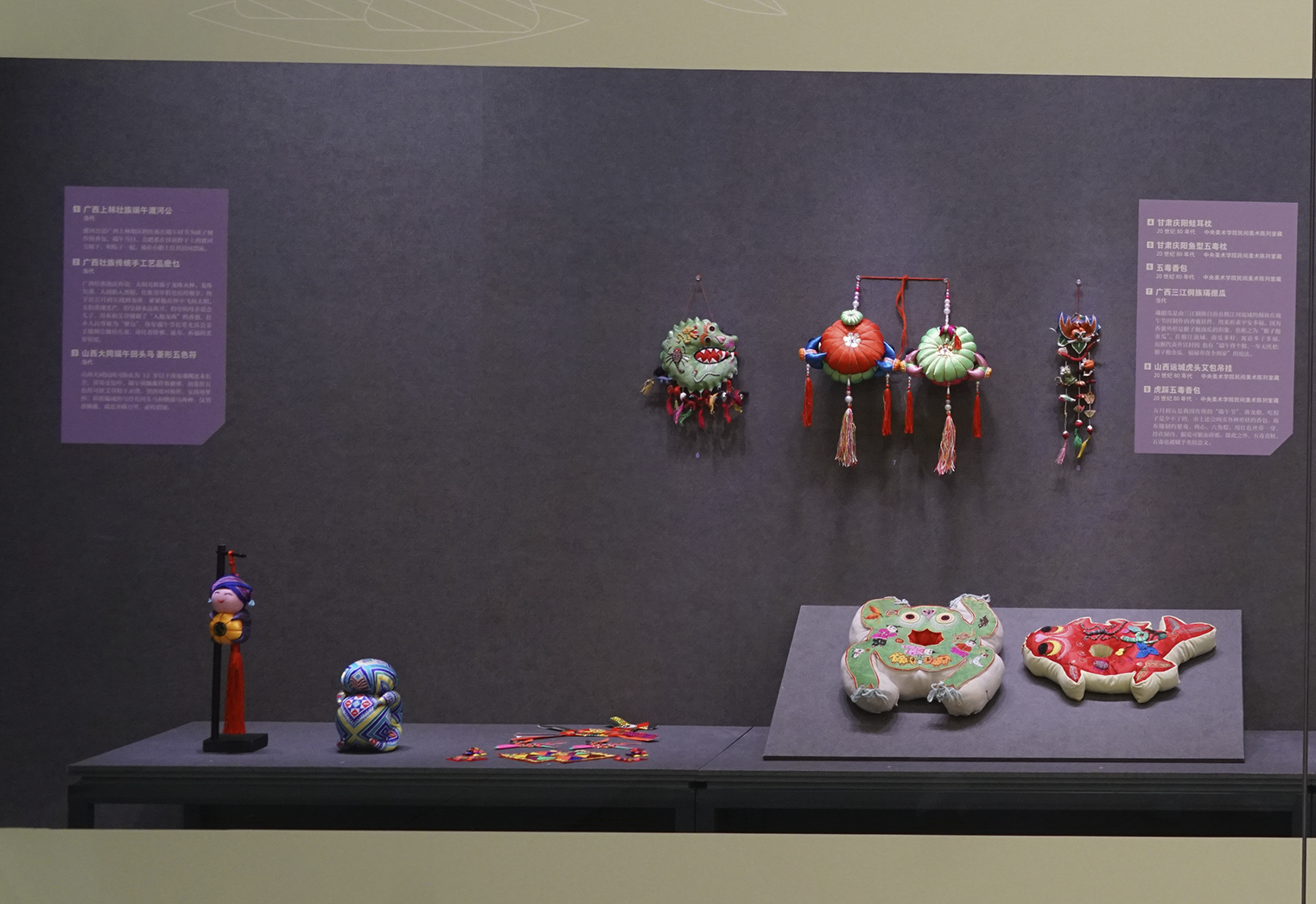
The toys had already been classified as auxiliary material when the exhibition opened, yet they still had to pass one more checkpoint. This time it was not a form but the display case itself. On installation day, a staff member from the China National Museum of Women and Children watched the team place the cloth figures into the display cases and asked, “You’re exhibiting these?” (Figure 3). The cases had remote-controlled seals, precision lighting, and full temperature and humidity control. Every specification existed to slow the decay of old and fragile materials. A cloth figure stitched the previous year by a living practitioner did not need that level of protection. To the staff member, the match between object and housing looked wrong.
Dragon Boat Festival toys on display. Source: Photo by the first author.

Figure 3. Long description
The display is organised against a dark gray textured wall with two purple informational plaques containing Chinese text on the far left and far right.
On the wall between the plaques, three items are hanging from left to right:
- A green, circular dragon-like herbal sachet with a red mouth and colorful tassels.
- A pair of men en gua connected by a red cord with long red and pink tassels.
- A vertical, multi-tiered tiger head-shaped herbal sachet with small colorful figures.
In the foreground, two display surfaces hold several items:
- On the left flat pedestal, there is a du he gong, a mo mie, and several small horse-shaped and diamond-shaped amulets.
- On the right slanted display board, there are two embroidered ear-easing pillows: one shaped like a green frog and the other like a red fish.
The exhibition installer who had earlier said the case “looks like a gift shop” reached the same conclusion. Neither of them spoke from inside the curatorial team, but both arrived at the same judgement: the case was protecting something that did not need (or deserve) that level of protection. When a museum displays something that visitors could buy at a market stall or find in their own homes, the protective glass stops reading as preservation and starts reading as excess. The case itself, after decades of use with old and fragile materials, has become part of the visual grammar through which visitors and staff alike learn to read the value of objects. A contemporary object entered that grammar at a disadvantage.
The toys ended their passage inside the museum yet outside the Register. The curators wrote the strongest case available, the collection manager filed the toys where years of experience in the registered storeroom had taught her such things should belong, and the onlookers at the vitrine said aloud what the conservation glass already implied. The specialists never saw the toys, though the Mosuo costumes had already shown the cost of admission: newness rewritten as loss, a rewriting that the current abundance of the toys could not support. Each scene was assembled separately, and the Chinese National Museum of Ethnology provided the working arrangement where they fell under the influence of the same invisible yet irresistible force, an inertia that issues from the weight of what the museum already keeps and reaches each scene through whatever medium lies at hand: paper, shelf, risk, glass. This is the gravity of antiquity at work. Its strength lies in how individual actors, who each sought different things, nevertheless tended towards the same destination. A leader from the Chinese National Museum of Ethnology measured it in passing at the exhibition site, remarking that such toys needed no acquisition at all: “We can borrow some from our own staff.”
2. The historian’s paradise?
At first glance, this exclusion of the new appears to confirm an officially endorsed and persistently popular view of Chinese culture as uniquely oriented towards antiquity, one often heard today in exhibition prefaces, media commentary, and state rhetoric alike. Of the 100 shows on the 2025 media “Hot Exhibitions” list, 84 centred on the ancient world.Footnote 7 The government-led “Reading China in Museums” shortlist for the same year showed only 5 percent engaging with contemporary themes.Footnote 8 Among the award-winning exhibitions in the Chinese Museums Association’s “Top Ten Outstanding Museum Exhibitions in China” between 1997 and 2025, 69 percent focused primarily on ancient culture.Footnote 9 Recent state rhetoric gives the same view current sanction, presenting the unbroken continuity of Chinese civilisation as one of its defining features: “Chinese civilization is distinguished by its continuity … If not through the prism of its extensive history of continuity, one would not be able to understand ancient China, contemporary China, let alone China of the future.”Footnote 10 Against this backdrop, a cloth figure filed as auxiliary material can look like one more confirmation of a familiar claim: that Chinese museums remain governed by a deep cultural attachment to the ancient past.
Sinologists and Sinophiles beyond China’s borders have given that view its fullest statement, and their terms still echo wherever Chinese museums are explained by way of Chinese culture. Writing in 1921, for example, American agricultural botanist Walter Tennyson Swingle (1871–1952) singled out Chinese historical records as “the longest and most continuous … of any existing nation.” These records were of such “unsurpassed completeness,” he argued, that “China might very properly be called the paradise of the historian.”Footnote 11 His compatriot and fellow scholar of China, Arthur F. Wright (1913–1976) likewise claimed four decades later that “no people on earth possesses so voluminous a record of their past as the Chinese,” among whom “the historian [enjoys] an authority and prestige unknown in the West.”Footnote 12 The late Belgian-Australian Sinologist and literary critic Pierre Ryckmans (1935–2014), too, understood China to be “a land so suffused with history [that] the presence of the past is constantly felt.”Footnote 13 For Ryckmans, Swingle, and Wright, this was a civilisation that never let go of its past, one where museums now seem to protect the ancient as an extension of that long attention. From this Sinological tradition, two lines of thought can be seen to branch out.
One argument locates Chinese antiquity in transmitted practices and inherited names rather than in surviving monuments and artefacts. The continuity it values lives in what generations keep doing and saying: in ritual forms that are re-performed, in dynastic and place names that travel across millennia, in craft lineages that derive their authority from their unbroken inheritance. Ryckmans cites the cultural comparison at the heart of French poet and archaeologist Victor Segalen’s (1878–1919) “Aux dix-mille années” (1912), where European veneration of stone is set against a Chinese permanence carried in “slow, uninterrupted generations.”Footnote 14 For Ryckmans, “the vital strength [that] the Chinese tradition displayed for 3,500 years” lay in the fact that this tradition “never let itself be trapped into set forms [and] static objects.”Footnote 15
Another argument locates antiquity in specific objects, the survival of which across dynasties carries continuity forward, and which continue to set the implicit standard for what a Chinese museum object should be. The ceremonial bronzes invoked in the specialist’s shang zhou pun are its modern example. The canonical lore of the Nine Tripods (jiuding 九鼎) is their archetypal precedent. These bronze vessels are said to have been cast by Yu the Great and passed across the Xia (the earliest, semi-legendary dynasty in Chinese historiography), Shang, and Zhou dynasties as a precondition for legitimate rule. In art historian Wu Hung’s account, the Tripods’ transmission “became synonymous with the progression of History” itself and their possession “not so much the consequence of historical events as the prerequisite.”Footnote 16
These two persistent lines of thought do not amount to a museum theory, but they do make a cultural explanation of the Chinese National Museum of Ethnology’s hesitation feel intuitive. If transmitted practice carried the cultural weight that Ryckmans described, however, then certification through the intangible cultural heritage regime, the contemporary state apparatus most explicitly built to recognise such practice, should have made the Dragon Boat Festival toys unusually strong candidates for the Register. Similarly, if collectable antiquity resided chiefly in objects whose authority arises from age, survival, and dynastic association, then newly made ethnographic materials should have been weak candidates across the board. Yet the Mosuo costumes pull against this expectation. They were no older than the toys, stitched by living hands in the same year, using materials no more historical, and the panel admitted them while acknowledging that they were “too new.” Scarcity and a gap in the Chinese National Museum of Ethnology’s holdings supplied a defensible historical claim where the toys’ abundance could not. What stayed constant across both outcomes was the demand for a historical claim that could be defended administratively, with scarcity standing in where age was unavailable.
3. Living with gravity
The museum’s repeated turn to antiquity began in small, individually defensible judgements. An object that arrived as an example of a category distinguished by age and scarcity found every stage prepared for it, from a proposal that could cite rarity to a display case built for fragility, and it passed from hand to hand without any need for argument. The Dragon Boat Festival toys arrived new. Their certification tied them to a recognised living practice, and the tie held well enough to secure purchase, custody, and a month behind conservation glass. It gave way at the question of permanence, however, when the museum had to decide what it would hold forever.
Every routine is sensible on its own ground, yet each one grades whatever arrives against what the collection already contains, and so a newly acquired object is pulled, judgement by judgement, towards the margin where the toys now sit. That pull, the force of attraction that an existing collection and the instruments calibrated to it exert on whatever arrives next, is the gravity of antiquity.
Sinologists felt this pull before we named it. Ryckmans described China as a land so suffused with history that the presence of the past is constantly felt, and he was right. Anyone who works for even a short stretch of time at the Chinese National Museum of Ethnology, among the bronzes in the registered storeroom and the accession forms that ask first about age, comes to sense what the institution expects of an object. Where the Sinological tradition falls short, however, is in the framing of that expectation as an effect of the mind of a civilisation. Our fieldwork found its source instead in the collection itself, and in the instruments that have grown up around keeping it. What looked like a cultural disposition can then be recognised as the daily work of an arrangement.
Like its physical namesake, the gravity of antiquity begins with mass, the bronzes and ceramics that fill the registered storeroom and the instruments calibrated to their kind. The more an object resembles that mass, the more smoothly it can be drawn into its orbit. The less the resemblance, the further out it settles. Every admission adds to the mass that exerts the force of attraction. Every exclusion confirms a boundary that the next collection manager will inherit as common sense. The gravity of antiquity feeds on this traffic, and it will continue to grow stronger as long as new things keep arriving. The toys are caught in that renewal. Before the present can be kept as permanent, it must borrow the evidentiary weight of age, and the toys have none to borrow.
Nothing can be done about the gravitational mass of the earth, yet a museum’s gravity works through instruments that can be recalibrated. A revised appraisal form would loosen one corner, a different storeroom routine or a new way of showing recent things another, and each corner that gives eases the grip of the rest, the way a stuck drawer slowly but surely comes free.
The Dragon Boat Festival toys are still at the Chinese National Museum of Ethnology, classified as auxiliary material, absent from the national database, stitched last year by hands that are still stitching. They are waiting. Not to grow old. To be let in.
Author contribution
Conceptualization: M.J., A.B.; Data curation: M.J.; Formal analysis: M.J., A.B.; Investigation: M.J.; Methodology: M.J.; Project administration: M.J.; Resources: M.J.; Supervision: A.B.; Writing - original draft: M.J., A.B.; Writing - review & editing: M.J., A.B.
Funding statement
This research received no specific grant from any funding agency.
Conflicts of interests
The first author conducted the fieldwork reported in this article while serving as an intern at the Chinese National Museum of Ethnology. The authors declare no other competing interests.
Ethical standards
The fieldwork received approval from the Australian National University Human Research Ethics Committee (Protocol H/2024/0820).

 Open access

