Children with Congenital Heart Disease (CHD) have many reasons to have suboptimal nutrition preoperatively, perioperatively, and postoperatively. Reference Wong, Cheifetz, Ong, Nakao and Lee1–Reference Mitting, Marino, Macrae, Shastri, Meyer and Pathan3 Providing adequate nutritional support is important in the overall recovery from critical illness and is associated with decreased morbidity. Reference Larsen, Goonewardene and Field4–Reference Mehta, Bechard and Cahill8 Multiple factors affect clinical decisions regarding initiation time, type, and advancement of nutrition in children with CHD. Reference Hehir, Easley and Byrnes9 Feeding recommendations provided by The American Society for Parenteral and Enteral Nutrition are based largely on expert opinion and adult data with few large multicentre studies in children with CHD to guide practice. Currently, there is no published consensus on best practices in nutritional therapy for postoperative patients with CHD. Reference Mehta, Skillman and Irving10–Reference Joffe, Anton and Lequier13 The goal of this survey-based study was to report the current nutritional practices in perioperative and postoperative patients, describe current beliefs and knowledge about nutrition management, and to quantify variability in timing, amount, and mode of nutritional support selection by providers caring for postoperative children with CHD in Paediatric Cardiac Intensive Care Units.
Methods
A cross-sectional electronic survey was developed based on literature review and an expert panel. Survey instruments in previous studies were reviewed and scored based on importance and applicability for postoperative children with CHD Reference Howley, Kaufman and Wymore11,Reference Kerklaan, Fivez and Mehta12,Reference Tume, Balmaks and Cruz14 (Supplementary material 1). Pilot testing was performed on five physicians who work in a Paediatric Cardiac Intensive Care Unit for clarity and face validity. Changes were made and questions were revised or removed due to redundancy with a second round of pilot testing to three additional cardiac intensivists. The final survey instrument consisted of 62 questions. This study was determined to be exempt by the Wayne State University Institutional Review Board. The survey was chosen to be part of the Call for Surveys competition held by the Paediatric Cardiac Intensive Care Society. The survey was emailed by the Paediatric Cardiac Intensive Care Society to its members with a link to Survey Monkey (San Mateo, California) with a waiver of consent. The survey was available for 6 weeks from 19 November, 2018 to 31 December, 2018. A reminder email was sent 3 weeks after the first email. Participation was completely voluntary, and no subject identifiers were obtained. The final data were analysed with SAS version 9.4 (Cary, NC). We report descriptive statistics. Pearson’s Chi-square test was used to analyse the distribution of categorical variable by groups, provided the assumptions of the test were met. Fisher−Exact test was used for the analysis, and ordinal variables were analysed by Mantel−Haenszel test for the linear trend. Statistical significance level was set at p value of less than 0.05.
Results
Survey respondent and hospital characteristics
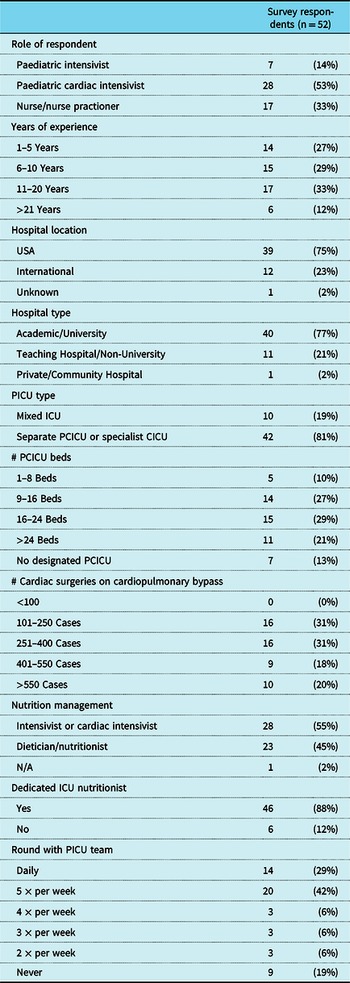
Survey information was sent to 940 the Paediatric Cardiac Intensive Care Society members and out of the 418 opened emails (45.5%), a total of 52 members (12.4%) completed the survey. The respondents included 14% paediatric intensivist, 53% paediatric cardiac intensivist, and 33% nurse or nurse practitioner. Respondents had a median of 10 years of experience. Seventy-five percent of the respondents were practising in the United States of America and 77% at an academic or university hospital. The majority of the respondents (81%) worked at an institution with a separate Paediatric Cardiac Intensive Care Unit with about 50% having more than 16 dedicated beds. Medium- to large-sized programmes made up the majority of respondents (69%), as shown in Table 1.
Survey respondent and hospital characteristics.

CICU = Cardiac Intensive Care Unit; PCICU = Pediatric Cardiac Intensive Care Unit; PICU = Pediatric Intensive Care Unit
Nutritional support
Paediatric Cardiac Intensivists reported they were the primary managers of postoperative nutrition 55% of the time and 45% of respondents reported that a Dietician or Nutrition Team primarily managed. Most units had a dedicated nutritionist and >70% of respondents reported that the nutritionist or dietitian rounded with the team at least five times per week (Table 1). Practitioners from academic hospitals were more likely to round with a dedicated nutritional team (p = 0.006).
Current beliefs and knowledge about nutritional management
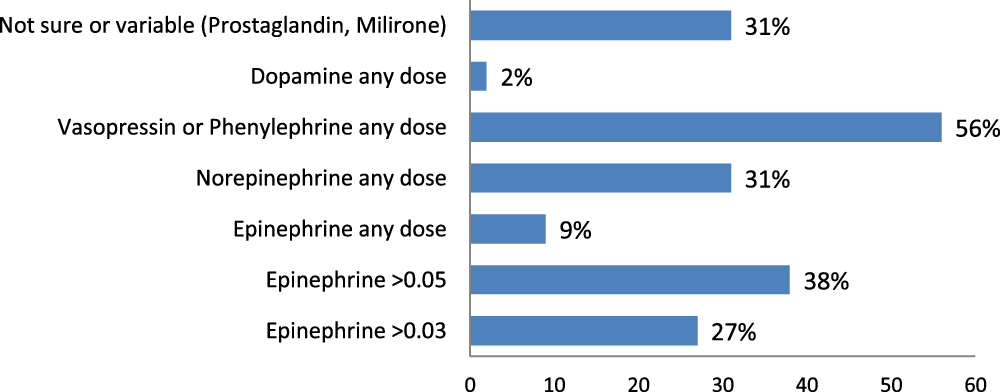
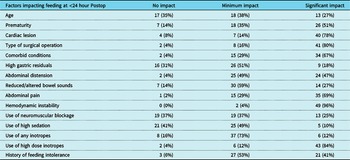
More than half of respondents (54%) reported deferring to nutritionist/dietitian for caloric requirement and 46% of respondents used standard estimation. Table 2 shows factors that were identified to have the most significant impact on starting feeds at less than 24 hours postoperative. The factors included prematurity, type of surgical operation, comorbid conditions, haemodynamic instability, and high dose of inotropes. Factors that were reported to increase the likelihood of feeding at less than 24 hours postoperatively were stable cardiovascular dynamics, adequate systemic blood pressure, low serum lactate, and daily fluid goal to enable feeding. Forty-three percent of the respondents denied that a specific surgical procedure would impact their decision to enteral feed postoperatively. However, of those who answered yes, single ventricle physiology was the most common cardiac lesion that would delay initiation of enteral nutrition. Almost all of the respondents (98%) reported that they would feed patients on inotropic or vasoactive support. However, when asked to specify which inotrope a respondent would not initiate feeds on, almost half responded vasopressin or phenylephrine at any dose (Fig 1). When asked specifically about impact of serum lactate on enteral feeding, 31% of respondents reported that serum lactate does not affect their decision to start enteral feeding and 42% reported enterally feeding with a lactate <2 mmol/L. Additionally 40% of respondents reported that they do not use serum lactate to stop enteral feeding.
Type of inotrope that would preclude enteral feeding.

Factors impacting feeding at <24 hours post operation.

Indirect calorimetry
Despite indirect calorimetry being the standard of care for caloric measurement according to the 2017 ASPEN guideline, only 27% reported using this modality to calculate resting energy requirement. Practitioners from academic hospitals were more likely to utilise indirect calorimetry than respondents from non-academic hospitals (p = 0.011). Of those respondents who use indirect calorimetry, 94% reported adjusting the caloric goal based on the resting energy requirement obtained by indirect calorimetry. Interestingly, more than half of those who reported using indirect calorimetry did not know the indications, frequency of recordings, and clinical actions they would take based on measurements. The practitioners with less clinical experience were less likely to use indirect calorimetry (p = 0.025). Institution with standardised feeding protocols were less likely to use indirect calorimetry (p = 0.022).
Timing of nutrition
Factors that impact early feeding included prematurity, cardiac lesion, type of surgical operation, comorbid condition, abdominal pain, hemodynamic instability, and use of high dose inotropes. Substantial practice variability in initiation of feeds and factors that would affect starting and advancing of feeds were identified. Only 21% of respondents reported starting feeds within 24 hours after surgery for CHD. At 48 hours post-operation, 79% of respondents reported that children were continuing to receive less than half their caloric intake from enteral feeds. Overall academic hospital compared to non-university and private or community hospitals were most likely to feed patients within 24 hours after an operation (p = 0.014).
Achieving nutrition goals
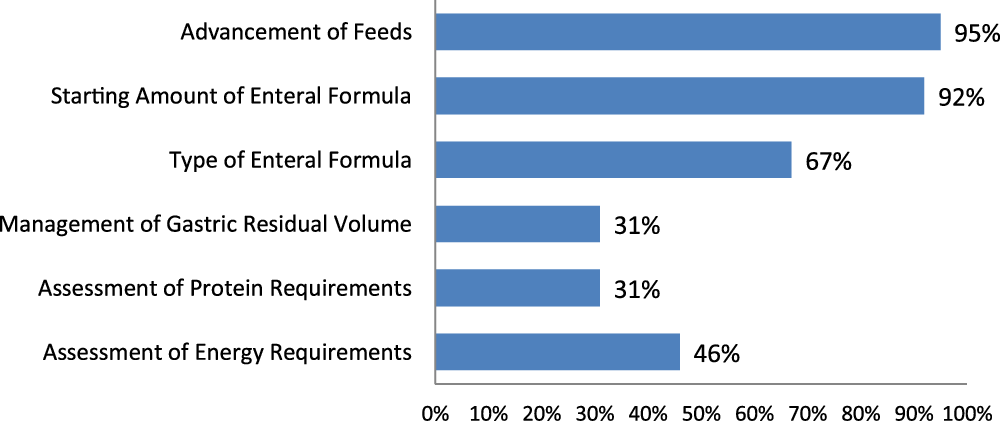
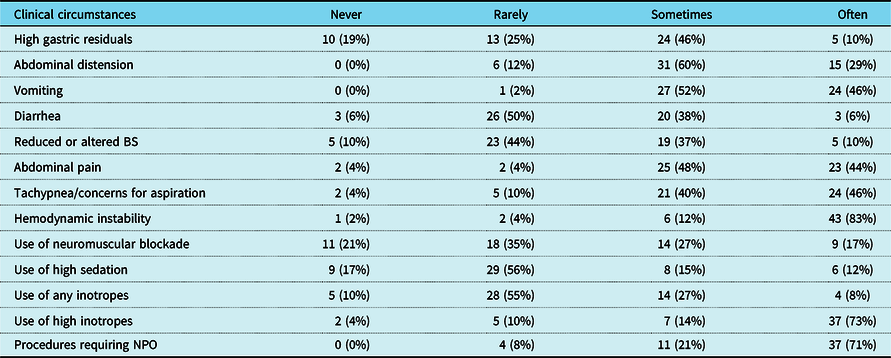
When respondents were asked about achieving goal feeding intake they reported that at 48 hours postoperative, only two-thirds of the patients met feeding goals. They reported a third of patients do not even meet half of goal feeds by 48 hours. In total, 75% of respondents reported having written protocols to guide or direct enteral feeding in postoperative patients with CHD. The majority of these protocols included starting amount and type of enteral formula and volume to advance feeds (Fig 2). Having a feeding protocol was associated with reported feeding within 24 hours postoperation (p = 0.014) and having >50% goal intake by 48 hours postoperative (p = 0.025). Respondents reported clinical factors influenced changes in their feeding plan. These clinical factors included emesis, abdominal pain, tachypnoea, concerns for aspiration, haemodynamic instability, use of high inotropes, and procedures requiring feeds to be held (Table 3).
Post-operative nutrition protocol topics.

Impact on enteral feeding.

Mode of nutrition
Seventy-seven percent of respondents preferred gastric feeding over jejunal feeding. For patients on mechanical ventilator support, 63% reported providing continuous feeds and 24% reported providing intermittent feeds. For non-mechanically ventilated patients, the majority (75%) of respondents provided intermittent feeds and only 8% provided continuous feeds. About 67% reported using prokinetic agents if patients were not tolerating feeds postoperatively.
Discussion
Nutritional studies performed on critically ill children show that malnutrition is associated with longer periods of ventilation, higher risk of hospital acquired infection, longer admission in the ICU and overall hospital stay, and increased mortality. Reference Bechard, Duggan and Touger-Decker15-Reference Wong, Han and Sultana17 The current practice guideline for nutritional support therapy in patients admitted to the ICU is highlighted in the 2017 guideline published by ASPEN. This landmark paper highlights the first collaboration between ASPEN and the Society of Critical Care Medicine. The guideline recommends a detailed nutrition assessment within 48 hours of admission and re-evaluation with a dedicated nutritionist at least weekly for timely nutrition assessment, optimal delivery, and individualised adjustment. Our study aimed to assess the current feeding practices in postoperative CHD patients in the context of the current practice guideline.
Implementation of a practice guideline is more challenging than simply having the resources available. In our survey of Pediatric Cardiac Intensive Care Unit providers, the majority of the institutions had the support available with a dedicated nutritionist that rounds with the team at least five times a week. Yet, substantial variability in practice exists. Few survey respondents report following ASPEN Nutritional guidelines.
In order to accurately measure the caloric needs and to avoid under or overfeeding, the guideline recommends indirect calorimetry should be used to measure energy expenditure. However, our study highlights a significant under utilisation of obtaining measured resting energy expenditure. Most of the respondent reported using different types of equations to estimate resting energy expenditure even though research shows inaccuracy compared to measured resting energy expenditure in critically ill children. Reference Meyer, Kulinskaya and Briassoulis18–Reference Hardy, Dwyer, Snelling, Dallal and Adelson21 Only 27% of respondents reported using indirect calorimetry. Even those who reported using indirect calorimetry did not seem familiar with limitations, frequency of measurements, and adjustments that would be made based on these measurements. This suggests a disconnect between the resource and the knowledge of what this measurement should be used for. Another possibility is that indirect calorimetry was not used in these patients due to limitations in technology or concern about inaccurate measurement in the setting of chest tubes, high supplemental oxygen requirement, nitric oxide use, or uncuffed endotracheal tube. Unfortunately, we are unable to determine the reason for not using indirect calorimetry in our study. Respondents from academic hospitals were more likely to utilise indirect calorimetry, which may be a reflection of availability of this resource.
Children with complex CHD, especially single ventricle lesions, have high frequency of growth delay and poor weight gain. Reference Wong, Cheifetz, Ong, Nakao and Lee1,Reference Floh, Slicker and Schwartz2,Reference Newcombe and Fry-Bowers22 Factors contributing to nutritional deficiency include heart failure, stress of surgery, gastrointestinal dysfunction, and reduced energy intake. Low weight at the time of surgical intervention is associated with increased mortality and weight loss after heart surgery predicts late death in these infants. Reference Wong, Cheifetz, Ong, Nakao and Lee1–Reference Curzon, Milford-Beland and Li5 Per ASPEN guideline, the goal target energy intake is to reach more than 2/3 of daily energy requirement by the end of first week in the ICU. However, postoperative patients with CHD are a unique patient population, with different subset of factors that can impact early feeding. This is highlighted by our study in which only a quarter of the respondents reported feeding within 24 hours postoperatively.
According to our results, only single ventricle physiology was reported to affect the respondents’ decision to initiate feeds. Studies have shown that necrotising enterocolitis is more common in patients with CHD, especially those patients who have single ventricle physiology. Reference McElhinney, Hedrick and Bush23–Reference Ferguson, Gandiya, Kaselas, Sheth, Hasan and Gabra25 The ASPEN guideline recommends enteral mode of feeding in critically ill children is preferred within 24–48 hours of admission. Our study showed that academic hospitals are more likely to feed patients within 24 hours postoperatively and that having a feeding protocol was associated with early feeding and increased feeding amount by 48 hours postoperatively. Evidence supporting the importance and safety of feeding postoperative patients with CHD even those with single ventricle physiology exists, and this area needs more investigation to determine the preferred guideline. Reference Newcombe and Fry-Bowers22,Reference Slicker, Hehir and Horsley26,Reference Braudis, Curley and Beaupre27 Enteral feeding is preferred in critically ill children and can be safely delivered even in those receiving vasoactive medications, Reference Panchal, Manzi and Connolly28 which is consistent with the practice of the majority of our respondents.
This study is limited because despite our best efforts, we did not perform large-scale validity testing of the survey instrument. We may have inadvertently overlooked important questions that affect clinical decision making in feeding. The low response rate was noted with the survey, which could have caused unintentional selection bias and limits generalisability.
Conclusion
Substantial variation in feeding practice still exists despite the ASPEN guidelines from 2017. This variation in timing, amount, and mode of feeding was reported to be based on clinical parameters that have unproven validity. In this study, we report infrequent use and limited knowledge of indirect calorimetry. Of note, the presence of institutional feeding protocols increased the likelihood of early feeding and achieving goal feeds by 48 hours postoperative. This study shows large variability of nutritional practices and factors that affect clinician decision-making despite the majority of respondents having access to dedicated nutritionists. Very few centres reported use of indirect calorimetry in postoperative paediatric cardiac intensive care patients, and many respondents lacked knowledge about applications in this population. Additional work to determine optimal feeding pathways and assessment of caloric needs in this population is needed. We hope this study aids in identification of priorities for future research, education, and need for specific feeding guidelines for patients with CHD.
Supplementary material
To view supplementary material for this article, please visit https://doi.org/10.1017/S1047951121005229
Acknowledgements
None.
Financial support
This research received no specific grant from any funding agency, commercial, or not-for-profit sectors.
Conflict of interest
None.