Introduction
Squamarina Poelt is a lichen genus established by Poelt (Reference Poelt1958) with S. gypsacea (Smith) Poelt as the type species. The species has two varieties, S. gypsacea var. gypsacea and S. gypsacea var. subcetrarioides (Zahlbr.) J. Nowak & Tobol. (Nowak & Tobolewski Reference Nowak and Tobolewski1975). The latter was originally described as Lecanora fragilis Zahlbr. var. subcetrarioides Zahlbr. from Slovakia (Keissler Reference Keissler1925), and later invalidly (Art. 41.5) combined into Squamarina by Pišút (Reference Pišút1971).
Squamarina gypsacea var. gypsacea and S. gypsacea var. subcetrarioides have the same secondary metabolites but are very different in thallus morphology, and this difference was attributed to their occurrence in different habitats (Poelt & Krüger Reference Poelt and Krüger1970). Squamarina gypsacea var. gypsacea is mainly distributed in the Mediterranean zone and characterized by a squamulose thallus. The squamules are roundish, originally scattered and later contiguous (Poelt Reference Poelt1958; Timdal Reference Timdal1983).
Squamarina gypsacea var. subcetrarioides, on the other hand, is restricted to alpine regions and is characterized by a lobed to squamulose thallus that deeply and frequently divides into small squamules (Poelt Reference Poelt1958; Poelt & Krüger Reference Poelt and Krüger1970). Although S. gypsacea is the type species of its genus, molecular phylogenetic studies on this species are still very limited (Zhang et al. Reference Zhang, Wang, Li, Printzen, Timdal, Niu, Yin, Wang and Wang2020). In this study, we investigated material of the two varieties of S. gypsacea from Austria, Greece, Norway, Spain and Switzerland, and generated DNA sequence data of S. gypsacea var. subcetrarioides for the first time. Our morphological and phylogenetic results show that the two varieties should be treated as two different species.
Materials and Methods
Materials and morphological observation
Fifteen specimens of the two varieties of Squamarina gypsacea were studied here. Specimens were deposited in the following herbaria: Senckenberg Forschungsinstitut und Naturmuseum (FR), Kunming Institute of Botany, Chinese Academy of Sciences (KUN), Botanische Staatssammlung München (M) and the University of Oslo (O). Morphological features were studied using a Nikon SMZ745T dissecting microscope. Apothecia and thalli were sectioned by hand with a razor blade and microscopic traits were observed and measured using a Nikon Eclipse Ci-S microscope. Lugol's iodine (I) was used to examine ascus apical structures and 10% KOH (K) to test whether the granules dissolved in the apothecia and thalli. Secondary metabolites were detected by 1,4-Phenylenediamine (P) spot reactions and thin-layer chromatography (TLC) in solvent system C (Orange et al. Reference Orange, James and White2001).
DNA isolation, PCR and phylogenetic analysis
Genomic DNA was extracted from thallus fragments of dry specimens using the AxyPrep Multisource Genomic DNA Miniprep Kit 50-prep (Qiagen). Polymerase chain reactions (PCR) were performed in an automatic thermocycler (C 1000TM). The PCR settings and the primers for ITS, nrLSU, RPB1, RPB2 and mtSSU follow Zhao et al. (Reference Zhao, Zhang, Zhao, Wang, Leavitt and Lumbsch2015). PCR products were sequenced by TsingKe Biological Technology (Kunming, China). To examine the phylogenetic relationships of the two varieties S. gypsacea var. gypsacea and S. gypsacea var. subcetrarioides, topologies based on the 5-locus matrix of Squamarina, including all molecular sequences of the available species and our newly generated sequences, were established. According to previous studies, we selected two species of Squamarinoideae, Herteliana schuyleriana Lendemer and H. gagei (Sm) J. R. Laundon, as outgroup (Lendemer Reference Lendemer2016; Lumbsch & Leavitt Reference Lumbsch and Leavitt2019; Zhang et al. Reference Zhang, Wang, Li, Printzen, Timdal, Niu, Yin, Wang and Wang2020).
Geneious R8 was used to assemble the raw sequences and generate a single matrix of the five markers. The matrices for each marker were individually aligned with MAFFT using the web service (http://mafft.cbrc.jp/alignment/server/index.html). Single-gene trees were reconstructed using IQ-TREE (http://iqtree.cibiv.univie.ac.at/) to assess the conflict amongst individual genes and no significant incongruence was detected. We concatenated the matrices of each marker using SequenceMatrix v. 1.7.8 and PartitionFinder 2 (Lanfear et al. Reference Lanfear, Frandsen, Wright, Senfeld and Calcott2017) was used to estimate the best-fitting substitution model for each dataset for maximum likelihood (ML) and Bayesian inference (BI) analyses. The models selected were: TIM + G for ITS1 (pos. 1–221) and ITS2 (pos. 381–586); TrN + I + G for 5.8S (pos. 222–380), nrLSU (pos. 587–1297), RPB1-B codon 1 (pos. 1348–1419\3), RPB1-B codon 3 (pos. 1350–1419\3), intron 2 (pos. 1420–1484); K80 + G for intron 1 (pos. 1298–1347), intron 3 (pos. 2691–2730), RPB1-C codon 3 (pos. 1487–1994\3) and RPB2-7 codon 3 (pos. 1997–2690\3); F81 + I for mtSSU (pos. 2731–3477), RPB1-B codon 2 (pos. 1349–1419\3), RPB2-7 codon 2 (pos. 1996–2690\3) and RPB1-C codon 2 (pos. 1486–1994\3); F81 for RPB1-C codon 1 (pos. 1485–1994\3) and RPB2-7 codon 1 (pos. 1995–2690\3). Bayesian reconstructions of phylogenies were performed with MrBayes v. 3.1.2 (Huelsenbeck & Ronquist Reference Huelsenbeck and Ronquist2001), using four Markov chains running for two million generations, and trees were sampled every 100 generations. The first 25% of runs was discarded as burn-in. For model parameters allowed to vary, we used flat Dirichlet priors on substitution rates and nucleotide frequencies, a flat beta on transition-transversion rates, a gamma Dirichlet with mean of 10 on tree and branch lengths, a uniform (0, 200) on the gamma distributed rate heterogeneity across sites, a uniform (0, 1) on the proportion of invariant sites, and a uniform distribution on tree topologies. Subset rates were modelled as fixed and equal. We considered the sampling of the posterior distribution to be adequate when the average standard deviation of split frequencies was < 0.01. Tracer v. 1.6 (Rambaut & Drummond Reference Rambaut and Drummond2003) was used to assess chain convergence by checking the effective sampling size (ESS > 200). ML analyses were performed with RaxmlHPC, using the General Time Reversible model of nucleotide substitution (GTR). Support values were inferred from the 70% majority-rule tree of all saved trees obtained from 1000 non-parametric bootstrap replicates. Trees were visualized in FigTree v. 1.4.0 (Rambaut Reference Rambaut2012).
Results and Discussion
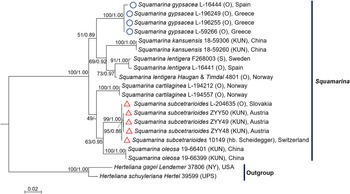
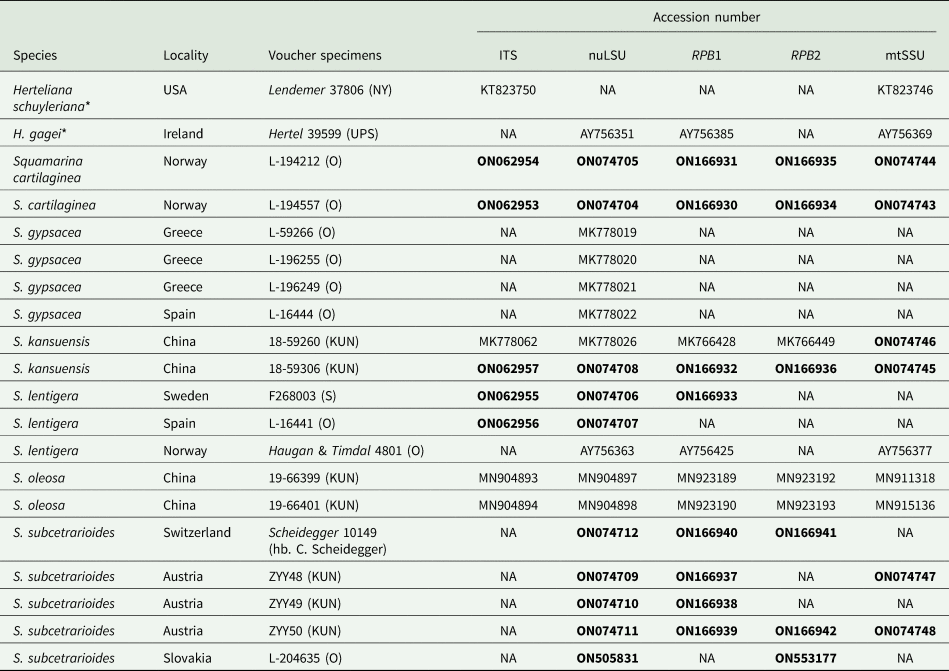
Thirty-five sequences of ITS, nrLSU, RPB1, RPB2 and mtSSU were newly generated in this study for the taxa Squamarina cartilaginea (With.) P. James, S. kansuensis (H. Magn.) Poelt, S. lentigera (Weber) Poelt and S. gypsacea var. subcetrarioides (Table 1). Our topologies recovered samples of S. gypsacea var. subcetrarioides in a highly supported clade (ML = 99, BI = 1.00) that was phylogenetically distant from S. gypsacea var. gypsacea (Fig. 1). The former was recovered as sister to S. oleosa (Zahlbr.) Poelt, whereas S. gypsacea var. gypsacea clustered with S. lentigera and S. kansuensis. The two varieties also differ in morphology and geographical distribution. Squamarina gypsacea var. gypsacea is mainly distributed in the Mediterranean region, and is characterized by a squamulose thallus that is scattered when young and contiguous with age (Timdal Reference Timdal1983). Whereas S. gypsacea var. subcetrarioides is mainly distributed in the alpine zone (Poelt Reference Poelt1958; Poelt & Krüger Reference Poelt and Krüger1970), and is characterized by the lobed thallus that is contiguous when young then frequently cracked with numerous small squamules growing from the margin of cracks. Therefore, we propose to raise S. gypsacea var. subcetrarioides to the species level as S. subcetrarioides (Zahlbr.) Y. Y. Zhang. The sister species S. oleosa differs from S. subcetrarioides in the light yellowish apothecial disc with distinct concolorous pruina, the absence of isousnic acid, and in the restricted distribution in Yunnan Province, China.
Phylogenetic tree of Squamarina generated from maximum likelihood (ML) analysis based on the concatenated matrix of ITS, nrLSU, RPB1, RPB2 and mtSSU sequence data. ML bootstrap values and posterior probabilities (PP) from the Bayesian analysis are given adjacent to nodes (ML/PP). The two previous varieties of the type species of Squamarina are highlighted with different coloured shapes. In colour online.

Voucher information and GenBank Accession numbers for sequences of Squamarina used in the phylogenetic analyses in study. Newly obtained sequences are in bold. NA = not available; * = outgroup.

Taxonomy
Squamarina subcetrarioides (Zahlbr.) Y. Y. Zhang comb. & stat. nov.
MycoBank No.: MB 843548
Lecanora fragilis Zahlbr. var. subcetrarioides Zahlbr. Annalen des Naturhistorischen Museums in Wien 38, 143 (1925).—Squamarina gypsacea (Sm.) Poelt var. subcetrarioides (Zahlbr.) J. Nowak & Tobol., Porosty Polskie, 1119 (1975).
Type: Slovakia, ad rupes calcareas conglomeratas prope vicum Sulov, elev. 350–400 m, H. Suza s. n., distributed as Krypt. Exs. Vindob. No. 2856 (W-0207523—holotype; M-0163618, GZU-000294606, GZU-000294607, O-L-211871—isotypes!).
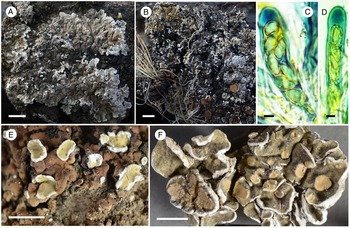
A–D, Squamarina subcetrarioides (Zahlbr.) Y. Y. Zhang comb. & stat. nov. A, immature thallus (KUN66844). B, mature thallus and apothecia (KUN66843). C & D, ascospores and apex structure of ascus in Lugol's solution (KUN66843). E & F, Squamarina gypsacea. E, immature thallus and apothecia (O-059266). F, mature thallus and apothecia (O-016444). Scales: A, B, E & F = 5 mm; C & D = 5 μm. In colour online.

Thallus lobate to squamulose, relatively loosely attached to the substratum, 2–7 cm wide. The growth form of the thallus differs between immature and mature stages. Immature thallus rosettes centrally continuous, green, epruinose; marginally lobed, lobes deeply and frequently divided, paler than the centre, whitish pruinose, margins having a white rim. Apothecia usually not present at this stage. Mature thalli irregular in outline, becoming transversely cracked to appear squamulose, numerous small, white-rimmed and dissected squamules growing from the mature thallus. Apothecia commonly present at this stage. Lower surface white to pale brown, with scattered rhizinose strands. Rhizinose strands dark brown, non-branched, thick, carbonized and fragile. Upper cortex 45–55 μm thick, filled with pale brown granules (dissolving in 10 % KOH (K)); epinecral layer gelatinized, continuous, filled with pale brown granules (dissolving in K); medulla white, with numerous calcium oxalate crystals; lower cortex absent.
Apothecia common, scattered, rounded, 2–6 mm diam.; disc pale ochraceous with indistinct white pruina, slightly concave; thalline margin entire, partly pruinose, persistent. Hymenium 75–80 μm, inspersed with pale brown granules (dissolving in K); epihymenium 10–17 μm, with pale brown granules (dissolving in K) and calcium oxalate crystals, subhymenium 20–27 μm, containing calcium oxalate crystals in groups; hypothecium 150–200 μm, with pale brown granules (dissolving in K); cortex of thalline margin identical with upper cortex of thallus, algal layer not extended above hypothecium. Asci subcylindrical, 57–75 × 10–15 μm, apex Porpidia-type; paraphyses simple, c. 2 μm thick; ascospores subfusiform to ellipsoid, 11–17 × 5–7 μm.
Chemistry
Medulla P+ yellow; containing isousnic, usnic, psoromic and 2ʹ-O-demethylpsoromic acids (detected by TLC).
Ecology and distribution
Growing on calcareous soil in the alpine zone. World distribution: European Alps and Carpathians.
Notes
Squamarina subcetrarioides is characterized by the rosette-forming thallus when immature, becoming fragmented and irregular in outline with age, the presence of numerous small squamules, the pale ochraceous disc with indistinctive white pruina, and the white to pale brown lower surface with scattered rhizinose strands. This species was treated as a variety of the type species, S. gypsacea, but the latter differs in the squamulose thallus and the roundish squamules that are slightly or not divided, scattered when young, then continuous to irregularly overlapping (Poelt Reference Poelt1958; Timdal Reference Timdal1983) (Fig. 2E & F). Apothecia can be present in the very early stages, while they are usually missing in immature thalli of S. subcetrarioides. Squamarina concrescens (Müll. Arg.) Poelt is also similar to S. subcetrarioides in the thallus morphology but differs in its lobes or squamules having an upturned margin with exposed white medullary hyphae, and in its restricted distribution in the Mediterranean zone (Poelt Reference Poelt1958; Poelt & Krüger Reference Poelt and Krüger1970).
Additional specimens examined
Squamarina subcetrarioides. Austria: Salzburg: Lungau, Tamsweg, Grossek-Speiereck, 47°7ʹ54ʺN, 13°38ʹ17ʺE, 2162 m, on soil, 2019, Yanyun Zhang ZYY48 (KUN 66843), ZYY49 (KUN 66844), ZYY50 (KUN 66845). Upper Austria: Gamskarkogel, Höllengebirge, O. Ö., Kalkalpen, 1700 m, an Karbonatgestein, 1967, F. Grims 8382 (FR-0058553), 8383 (FR-0058554).—Slovakia: Zilina, Súl'ovské skaly, 1.5 km NW of Súl'ov-Hradná Village, 49°17ʹ8ʺN, 18°58ʹ59ʺE, 580 m, on steep rock wall, calcareous rock, 23 v 2016, S. Rui & E. Timdal (O-L-204635).—Switzerland: Graubünden: Scuol, Vald’ Assa, Truoi Nov, 2040 m, on Trockene Kalkfelsflur, 2017, C. Scheidegger 10149 (hb. C. Scheidegger).
Squamarina gypsacea. Greece: Kavála, Thassos, along dirt road from Maries to Theologos, near Vatos, 40°70ʹ16ʺN, 24°66ʹ16ʺE, 590 m, on E-facing limestone wall in/above steep pine forest, 31 v 2000, S. Rui & E. Timdal (O-59266).—Spain: Alicante: between Callosa d'en Sarrià and Confrides, 38°68ʹ33ʺN, −0°22ʹ66ʺE, 260 m, 6 x 1985, E. Timdal (O-16444).
Acknowledgements
The authors thank the curators of Karl-Franzens-Universität Graz (GZU), the Botanische Staatsammlung München (M), the Swedish Museum of Natural History (S), and Prof. Christoph Scheidegger (Zürich, Switzerland) for the loan of specimens and permission to extract DNA from the samples. They are also grateful to Dr Peter Bilovitz (Graz, Austria) for providing literature. This study was supported by grants from the National Natural Science Foundation of China (no. 31970022) and the Anhui Provincial Education Department (no. 2022AH050207). This work also benefited from the sharing of expertise within the DFG priority programme SPP 1991 ‘Taxon-Omics’ and support from DFG grant PR567/19-1 to CP.
Author ORCIDs
Yanyun Zhang, 0000-0002-0902-5066; Einar Timdal, 0000-0003-4524-0617.