

In rebus obscuris diuersas ponimus opiniones, ut non tam scribere quam loqui tibi coram uideamur. (St Jerome, Letters 72.4)
The aim of the following pages is to study how anger interacted with a number of fundamental transformations in the history of the ideas on communication and intellectual exchange from the late Middle Ages to the Renaissance. My hypothesis will be developed in three closely related arguments.
First, the creation and development of the systems of the sins of the tongue by late medieval scholasticism provided a moral background to interaction and intellectual exchange that stressed dangers for the faithful. This moral aspect of communication continues in the writings of the humanists of the fifteenth and sixteenth centuries. Among the wide variety of items provided by the numerous systems of the sins of the tongue, contentio, which consisted either in disputing with deceit or with the sole goal of defeating the opponent in the discussion without regard for the truth, is a constant. And, by ascribing it to capital sins such as anger, envy, or vainglory, scholasticism set the ethical limits to learned interaction. Some of the most influential approaches to the sins of the tongue identified contentio as a perversion of truth, on the one hand, and as opposed to caritas, on the other.
Furthermore, far from what has been traditionally argued, the “systems” of the sins of the tongue, albeit a product of medieval scholasticism, did not remain encapsulated in medieval culture; instead, their impact can easily be traced through their technical use by fifteenth- and sixteenth-century men of letters. With regard to contentio, early humanists used the term to refer to the practice of intellectual exchange among scholastic thinkers that was opposed to the positive description of the ideas of learned interaction provided and developed by them. This “system” of the humanists, as should probably have been expected, was built upon two main concepts — amicitia, also in the form of sodalitas, and sapientia — and partly developed following the models of learned dialogue inherited from classical antiquity, mainly Plato and Cicero. This form of interaction, due to its open form, its ability to introduce and endorse different positions on a given topic, and its defense of their equal weight in a discussion, has traditionally been associated with the disputatio in utramque partem.
Second, although this ideal of learned interaction enjoyed much success in fifteenth-century literature and has been regarded as quintessential to fifteenth-century humanism, some Renaissance intellectuals, Lorenzo Valla among them, perceived in this formula and its enactment the danger of becoming a fixed set of conventions and a realm for self-indulgence, as it neither seemed to foster truth as its main goal, but rather to imitate and reenact the truth of the ancients, nor to provide tools for contesting error or for emulating, that is, surpassing, the achievements of the past. Valla, known for his acrimonious character, developed a new intellectual position in this context, which involved, first and foremost, a reevaluation of contentio supported by both medieval scholasticism and contemporary sources. To Valla, the restoration of bona contentio came together with the defense of the nobility of spirit of a scholar who wants to foster truth according to a more perfect system of intellection than that offered by classical tradition. He would call this libertas dicendi. But, together with libertas dicendi, which is a manifestation of individual freedom, Valla developed his position further on in libertas philosophandi, which does not imply just the individual freedom to speak, but also the renegotiation of shared ideas concerning different realms of thought — the disciplines or artes — and, therefore, a social and intellectual right and virtue. Consequently, as happened in classical and early Christian times, the culture of the humanists, through its defense of amicitia and prudentia, paved the way for the two main preconditions — isonomia or a shared set of rules for discussion, and isegoria or a shared right to take the floor — for parrhesia: a violent eruption of truth and the right to defend it in this context, although Valla never used the term.
From this point of view, it is easy to see Valla's influence on the founders of the Reformation, as both contemporary scholars and early reformers themselves do not hesitate to admit. However, I maintain in building my third argument, this account tells only a part of the story, insofar as it does not explain how the first manifestations of the Reformation, when compared to other late-medieval and early modern “heresies,” were received and discussed by the early sixteenth-century intelligentsia. Besides the historical, economic, military, political, and social circumstances that form the background of the Reformation, I would like to stress in the following pages that these radical transformations had already become part of the communicative culture of Renaissance humanists by the first decade of the sixteenth century. To demonstrate this, I will examine one of the first humanistic encyclopaedias published in the sixteenth century, the Commentaries on Urban Matters (1506) by Raffaele Maffei, which, in book 28, On Honesty, prefigures how dissidence will manifest itself in Christianity in the forthcoming decades and, in view of the evolution of intellectual exchange as presented here, clarifies the different approaches of Erasmus and Luther as reformers of the Church.
Sources for the Study of Conversation and Intellectual Exchange in the Middle Ages
Although our understanding of the history of communication from the late Middle Ages to the end of the sixteenth century has seen important advances during the last three decades,Footnote 1 a comprehensive history of the ideas that pertain to disputation, dialogue, and intellectual exchange and their role in early modern perceptions of heterodoxy, free-thinking, freedom of speech, skepticism, and tolerance remains yet unwritten. An important challenge for this area of research consists in the diversity and number of classical and Renaissance sources that need to be considered; however, equally exacting is the requirement to study the role played by medieval culture in such a history. Renaissance scholars should consider at least five different assortments of medieval texts for this task to be accomplished. Three of them combine theoretical and practical issues, while the other two are essentially theoretical and philosophical.
The first set is composed of the documents that grounded the medieval ideal of courtesy and advanced its further development. Even though the late medieval manuals of courtly conversation are comparatively far less abundant than their Renaissance counterparts, observations on good manners and polite talk are disseminated in a wide variety of testimonies. This corpus is important for our understanding of two complementary historical trends: first, the rise of the concept of urbanitas linked to the ideals of courtesy and polite conversation, and second, the way that scholasticism — when juxtaposed with the culture of Italian humanists of the Quattrocento and with their recovery of classical tradition — provided instruction on the arts of disputation and negotiation to secretaries, diplomats, noblemen, courtiers, and princes.Footnote 2 As is well known, there is also a non-scholastic approach to the subject through the literary practices and models developed in and for the court, mostly written in the vernacular.Footnote 3
A second group of texts, which records or describes disputationes, although adopted by the same stepfather, scholasticism,Footnote 4 shows a divergent origin; its development was intrinsically linked to the education of religious orders and became ubiquitous in the faculties of arts, theology, medicine, and canon law, as has been studied by Martin Grabmann, Alfonso Maierù, Brian Lawn, Alex Novikoff, and Olga Weijers, among many others.Footnote 5 Here not only the practice of disputation, quaestiones, sophismata, and magisterial disputations offers a challenging variety in praxis and scope to scholars with respect to the different statutes of an ever growing number of universities across Europe, but also the evolution of disputation as a form of exposition of truth against doubt, heresy, error, and unbelief presents unique complications for scholarship.
There is yet a third collection of polemical texts characterized by a mixture of both theory and praxis. Composed in the form of dialogue and strongly monological in aims and methods, this collection is linked to the literature of the eratopokriseis and of the problemata, zetemata, aitiai, and aporemata. In this group, the compendia of sapiential literature, catechisms, manuals for conversion, contrasts between confessions, and, of course, a massive number of pedagogical dialogues on diverse matters should be included.Footnote 6
In contrast with the three aforementioned groups, there are still two more that offer a theoretical approach to disputation. Thus, a fourth set is the technical discourse on disputation and the theories of argumentation, which can be easily traced in the medieval transmission of Boethius's De topicis differentiis; the recovery of and commentaries on Aristotle's Prior and Posterior Analytics; Topics, Sophistical Refutations (the logica nova), and Rhetoric; the glosses and first editions of Cicero's De inventione; and Ps-Cicero's Ad Herennium. This corpus, as Karin Margareta Fredborg has shown, makes some traditional assumptions about the relation of rhetoric and dialectic during the late Middle Ages fairly problematic.Footnote 7
The fifth and last collection of texts is built upon a specific conceptual approach to the morality of language — the “systems” of the sins of the tongue — and presents two particularities when compared to the other four. First, the origin of this corpus is fundamentally medieval, and as such these texts provide priceless information on how scholastic thinkers tried to establish a theoretical paradigm for the ethics of language according to Christian morals. Second, insofar as the main concern of these systems was to perform theoretical and comprehensive analyses on the ways to commit sin through the use of words, they draw heavily from canon law, and at the same time they had a strong impact on the proscription of all kinds of attacks against the Church's authority and dogma. The thirteenth century was the golden age of these systems, but, as is the case with respect to the other four groups mentioned, they enjoyed a quite fruitful afterlife, although they are comparatively much less studied by scholars of the Renaissance.Footnote 8
The acknowledgement that they were not only known, but also deeply transformed in the hands of fourteenth- and fifteenth-century humanists, offers a fresh approach to many questions related to the history of the ideas that address communication in early modern Europe. One of these sins, contentio, sheds unexpected light on how anger gained a place in the culture of the humanists and in the establishment of a place for religious contestation in Christianity. As such, the vice of contentio maintains close links with the recovery of parrhesia during the Renaissance, and, accordingly, with the communicative premises that paved the way for the Reformation, although there are several other factors that were vital to the historical process. To demonstrate these links will be the core concern of these pages.
The Systems of the Sins of the Tongue
Around the fourth and fifth centuries of our era, Christianity reshaped classical ideas on communication and conversation by shifting the focus of attention to an ethical point of view. As an important part of this transformation, monastic rules were instituted to limit communication among monks by imposing a strict observance of silence, and at the same time, Christian intellectuals started to develop analytical judgments about human interaction and language, creating what we could call a Christian proto-pragmatics and proto-psychology.Footnote 9
The unsystematic set of ideas contained in these texts found further development in the lavish number of moral, pastoral, and theological treatises that gradually explored the many ways to commit sin through words. The most common approach was to provide a number of vices of the tongue, ordered according to the gravity of the attack against God's authority. The most trivial sin was “wordiness” and the most important was “vanity”; a casual observer would correctly infer that these ideas drew not only on Christian morals but also on communication issues.
With the rise of urban life and commerce in Europe, including the risk of new heresies, the contact of different confessions, and the establishment of precarious yet flourishing academic culture outside the monasteries, medieval scholars of the ninth to the twelfth centuries approached the culture of disputation in a new light, which transcended the narrow limits established by the erotapocritical tradition.Footnote 10 This revival was accompanied by the resurgence of the study of rhetoric and dialectic, spreading a culture of disputation that became ubiquitous in late medieval intellectual life, which was accompanied by an ever-increasing denunciation of its excesses from monasteries, schools, and ecclesiastical authorities alike.Footnote 11
As a consequence, around the twelfth and the thirteenth centuries, scholasticism approached the old topic of the “vices of the tongue” with a much more methodical understanding. In this new approach, language, morals, and salvation were addressed through what has been called the systems of the sins of the tongue. “System” conveys here an analytical attitude, rather than the ambition to provide a fixed and universally accepted listing and classification of sins. As a matter of fact, neither their number, nor their name, nor their origin, nor any attempt at taxonomy enjoyed consensus among medieval authors. Nonetheless, they frequently concurred that the opposition between the sins of the tongue and the four cardinal and the three theological virtues was the most satisfactory method to address the subject.Footnote 12 By doing so, they were able to illustrate how language could raise an obstacle for men to acquire wisdom, or, even worse, open up a path to their perdition.
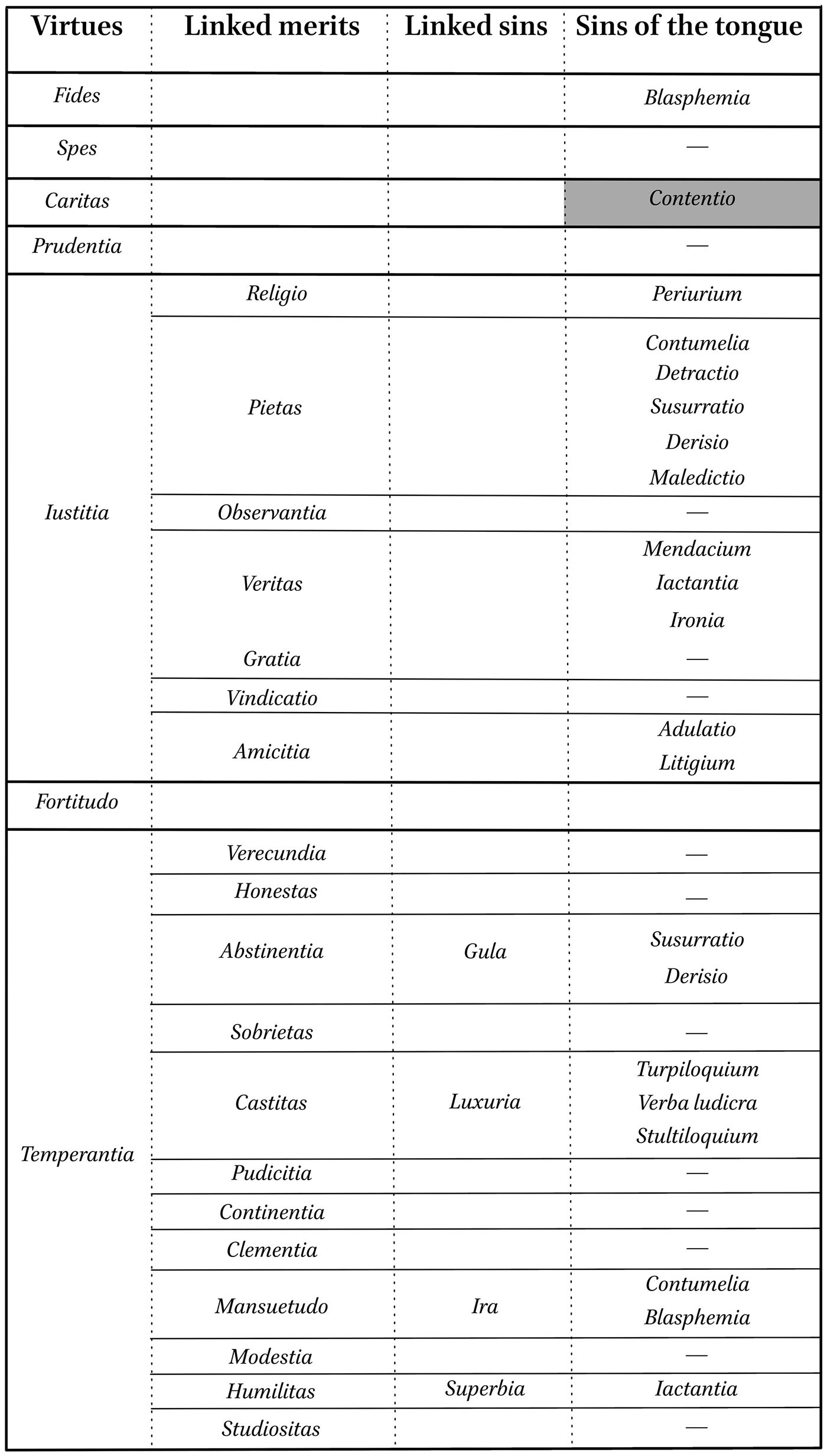
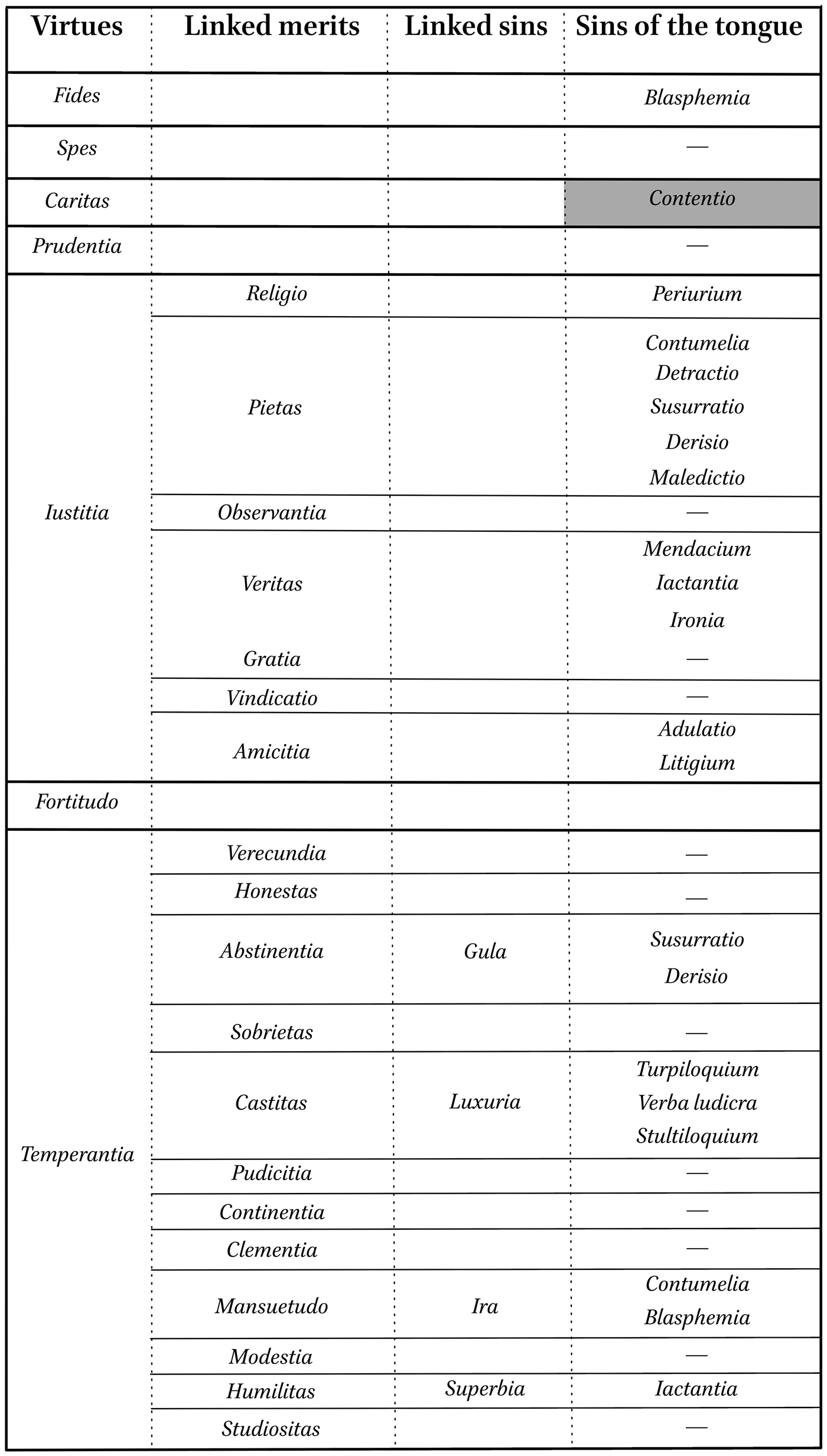
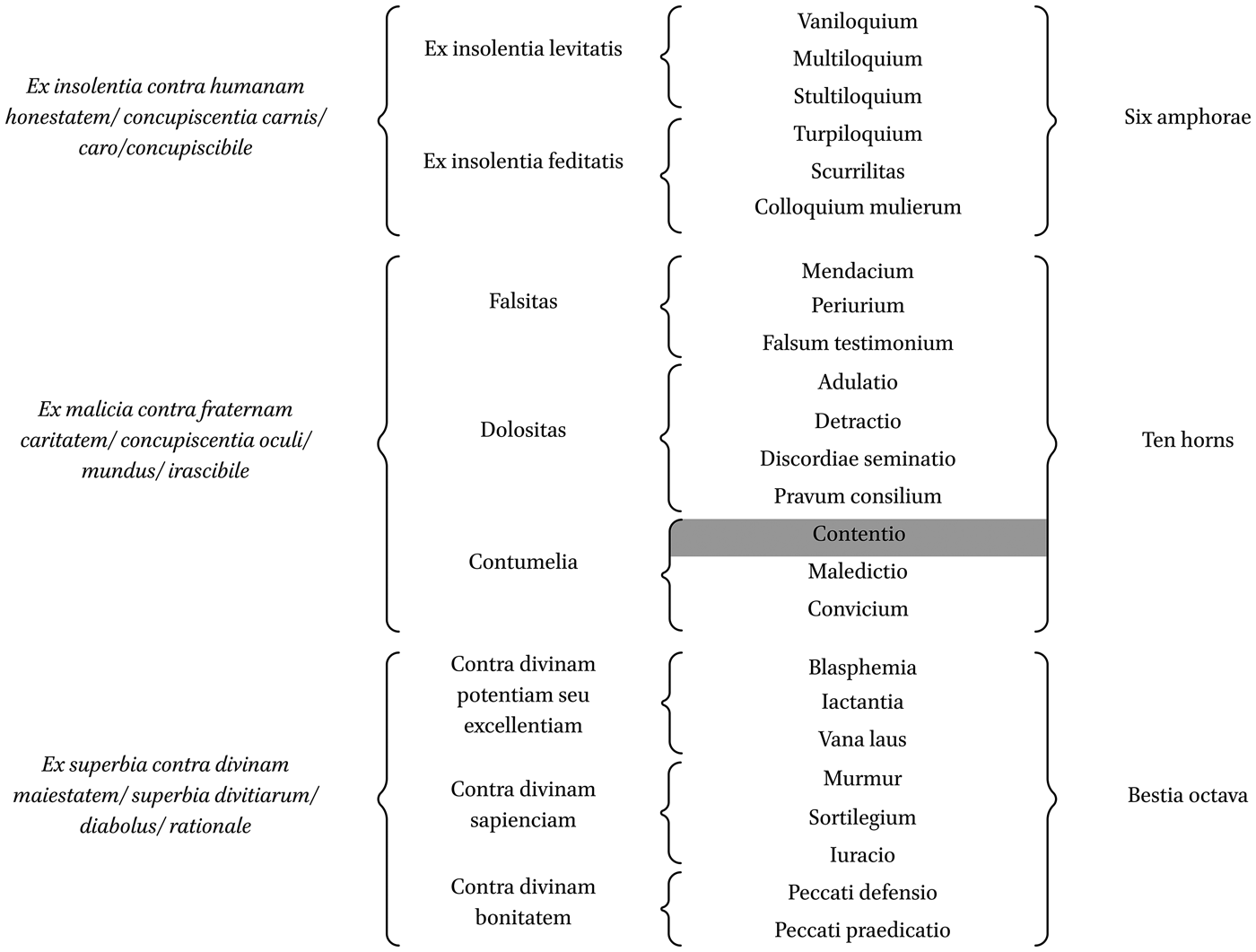
The success of this procedure was assured when Thomas Aquinas employed it in the Summa Theologiae (1265–74) [see fig. 1]; but it was not, by any means, the only possible approach, and some of his contemporaries came to the task with much more sophisticated strategies. Ps-Grosseteste's De lingua (ca. 1250–70), for instance, presented a fairly complex fusion of principles drawn from primitive monastic rules in addition to a good theoretical knowledge of the sinful tongue encapsulated in an allegorical interpretation of the beast of the Apocalypse [see fig. 2]. Aquinas and Ps-Grosseteste shared a well-populated list of sins,Footnote 13 as did William Peraldus and several other influential authors,Footnote 14 yet not only do some names differ among them, but also even those that find agreement often appear opposed to diverse virtues and linked to unlike vices.
The “system” of the sins of the tongue, ca. 1100–1350. Distribution according to Thomas Aquinas's Summa Theologiae IIa-IIae, adapted from Casagrande and Vecchio, I peccati della lingua (Rome, 1987), 209.
The “system” of the sins of the tongue, ca. 1100–1350. Distribution according to Ps-Grosseteste's De lingua, adapted from Casagrande and Vecchio, I peccati della lingua (Rome, 1987), 159.
For the sake of my argument, an equally popular and much less exacting catalogue of sins of the tongue provides valuable insights. In the Speculum quadruplex or Speculum maius (ca. 1255), widely read — for better or for worse — from the thirteenth until the seventeenth century,Footnote 15 Vincent of Beauvais dealt twice with the problem.Footnote 16 In the fourth book of the Speculum doctrinale, ten sins of the tongue were extensively discussed, adorned, and, at times, illuminated with a good number of proverbs taken from both classical and Christian traditions.Footnote 17 Besides this thorough and influential treatment, the following passage, hidden in the first pages of the Speculum historiale, might be Beauvais's most succinct approach to the sins of the tongue. It reads as follows:
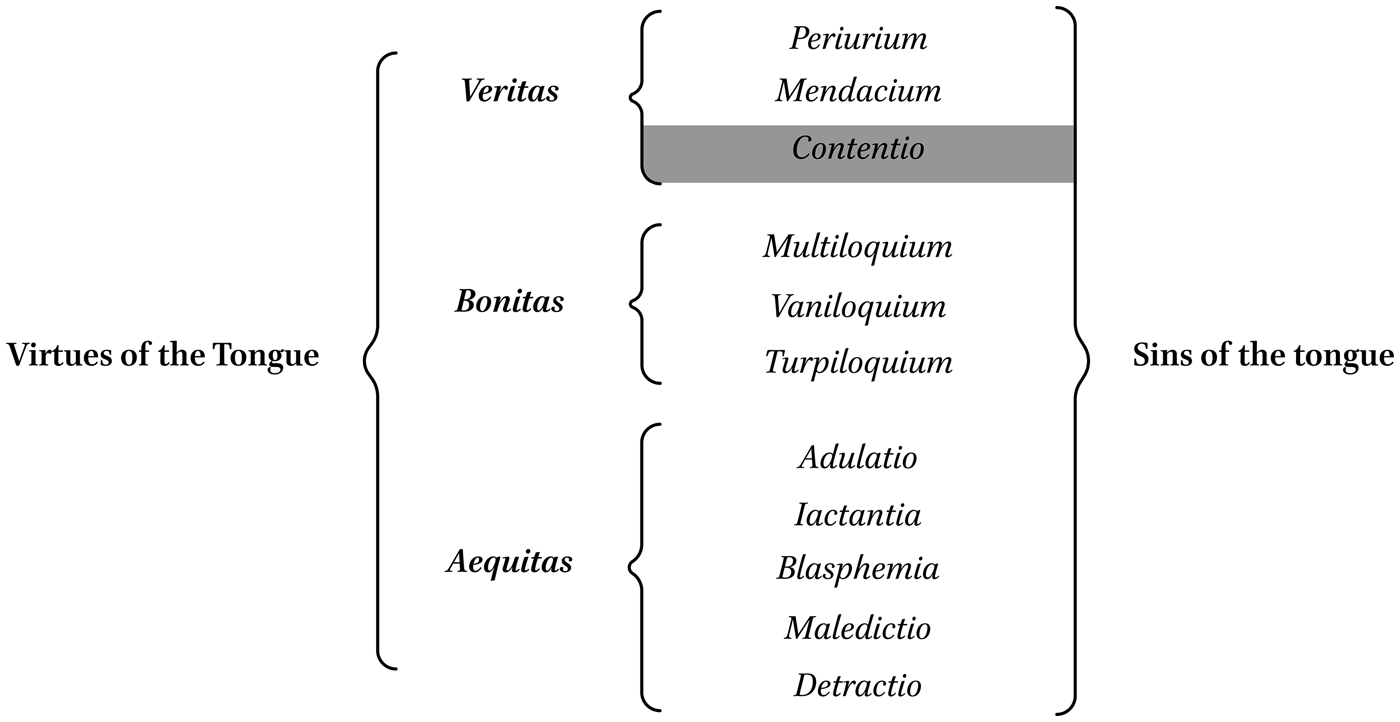
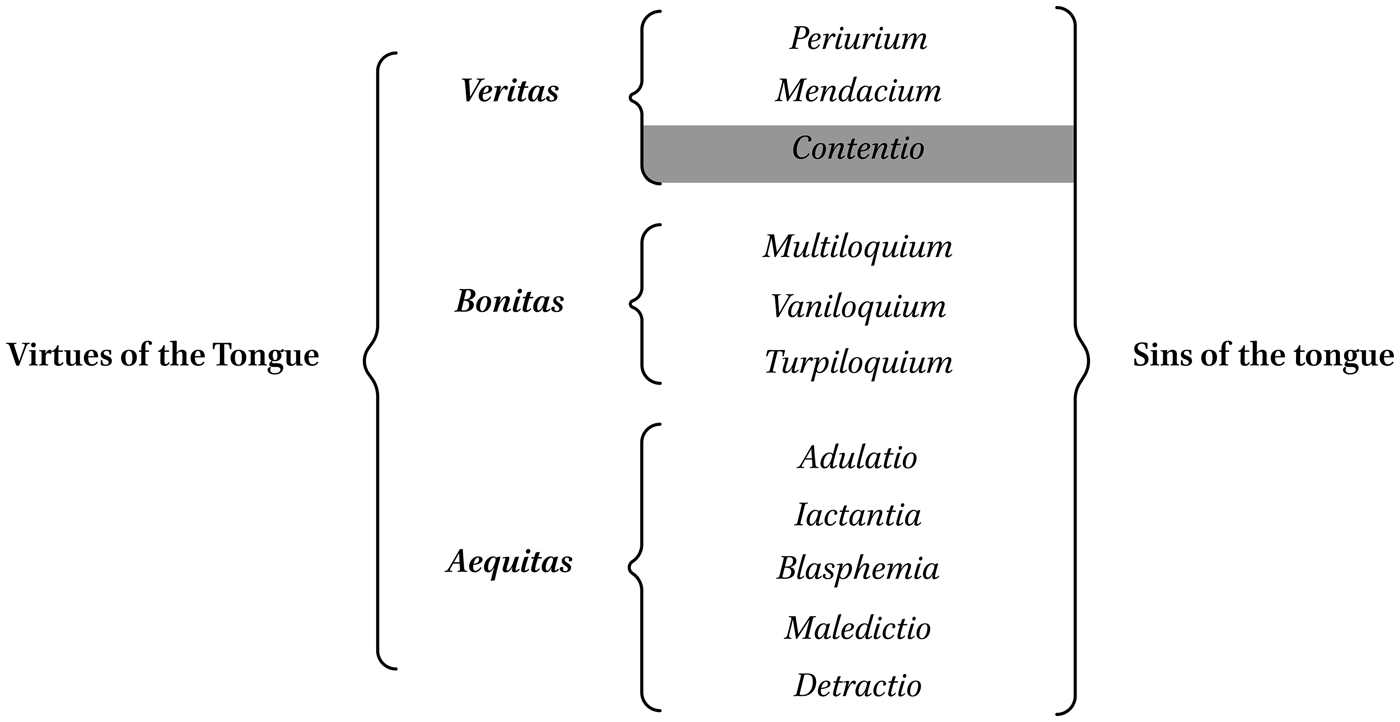
As truth, goodness, and justice or righteousness are the three virtues required in speech, the sin that comes from the mouth is multiple. Sin is committed against truth in three different ways: either if truth is violated, which would be lying; or if it is disregarded, which would be perjury; or if truth is distorted, which would be contentio. Against goodness sin is committed in two ways: against honesty with buffoonery and against utility through empty words and talkativeness or wordiness. Against righteousness sin is committed in two ways, namely, by praise and blame. In praise when something unworthy is praised as if it would be the opposite, which can be done in two ways: either praising others, where the sin would be flattery, or praising oneself, which would be boasting. In vituperation similarly, when God is reviled, which would be by blasphemy, and when one's neighbor is slandered, and this in two ways: either by requesting punishment, which would be cursing or blaming, and this in two ways: either openly, where the sin is contumely, or covertly, where the sin is detraction. Lying is threefold, namely, pernicious, forced, or jocular.Footnote 18
This second take on the problem was hardly original, insofar as Beauvais brought into play the three commonly accepted virtues of expression — truth, goodness, and righteousness — in addition to the eleven sins of the tongue [fig. 3].Footnote 19 But, for my purposes, Beauvais's list will be drastically reduced to highlight just one of the oldest and more frequently cited sins of the tongue: contentio.Footnote 20
The “system” of the sins of the tongue, ca. 1100–1350. Distribution according to Vincent de Beauvais's Speculum historiale.
Transforming the Middle Ages in a Culture of Contentio
In what follows, I will highlight the notion signified by contentio in the writings of leading figures in late medieval culture and in the humanists of the fifteenth and sixteenth centuries. From classical antiquity to the end of the fifteenth century, contentio was employed in a number of technical and non-technical uses. Among these uses, as a form that is cognate with contendere, contentio generally meant a confrontation, either verbal, physical, or political,Footnote 21 or an effort — extended in time or not — made to achieve a goal.Footnote 22 With regard to the former, contentio had at least four different uses in classical and medieval rhetoric: as an equivalent to Greek antithesis or antitethon, that is, the comparison of two things or ideas opposed or contradictory,Footnote 23 as the juxtaposition of dialogue (contentio) and continuous discourse (sermo),Footnote 24 as a juridical and political disputation (contentio) opposed to familiar and philosophical conversations (sermo),Footnote 25 and as the set of voice inflections and gestures employed in the discussion itself.Footnote 26 During the Middle Ages, contentio acquired new technical uses. In the realm of poetics, it was used to refer to a poetical debate or confrontation in the culture of the troubadours, although it belies the influence of a much more ancient genre.Footnote 27 It was also in the Middle Ages that canon law fixed contentio as a transgression against the authority of the Church and Christian dogma, as we see in the Decretum Footnote 28 and the Epistles of Ivo of Chartres,Footnote 29 or in the Decretum Gratiani,Footnote 30 to give some widely read and highly influential examples.
In the restricted realm of the sins of the tongue, we can use the following definition, provided by Radulfus Ardens in his Speculum universale (ca. 1190):
Contentio is an attack on the truth through the boldness of shouting. Generally speaking, we also call contentio any dispute that exceeds its limits. This happens when an interlocutor seems to be defending the truth and refuting falsehood yet, in reality, he is doing just the opposite. This is typical among heretics and those who foster the division of the Church, and sophists in dialectics, and slanderers at the court of law.Footnote 31
However, this apparently crystal clear division among the different uses of the term and its identification as a sin in a watertight corpus of treatises devoted to the technicalities of Christian morals of language is nothing but a mirage. As a matter of fact, the widely accepted contraposition contained in the Elementarium logicae, attributed to William of Ockham, between contentio and scientia,Footnote 32 or the estimation of contentio as the worst thinkable vice in the art of disputeFootnote 33 pale when we pay attention to the permeability of contentio as a sin of the tongue in works on education, on history, on political thought and legal theory, commentaries on literary works and literary polemics, letters, journals, and, for what interests us more here, in writings on theologyFootnote 34 and ecclesiology.Footnote 35 Consequently, two facts need to be stated once and for all. First, that the knowledge and implications of the systems of the sins of the tongue went well beyond twelfth- and thirteenth-century scholasticism and, second, that to correctly value and understand the evolution of the term contentio a more accurate approach than the one provided by its development in this context is needed. To do so, and despite the complexity and contradictions of the systems themselves, we can remain within the bounds of the texts already mentioned and use them as a guide to understanding how fourteenth- and fifteenth-century humanists operated one of the most decisive inversions for the history of free-thinking in early modern Europe.
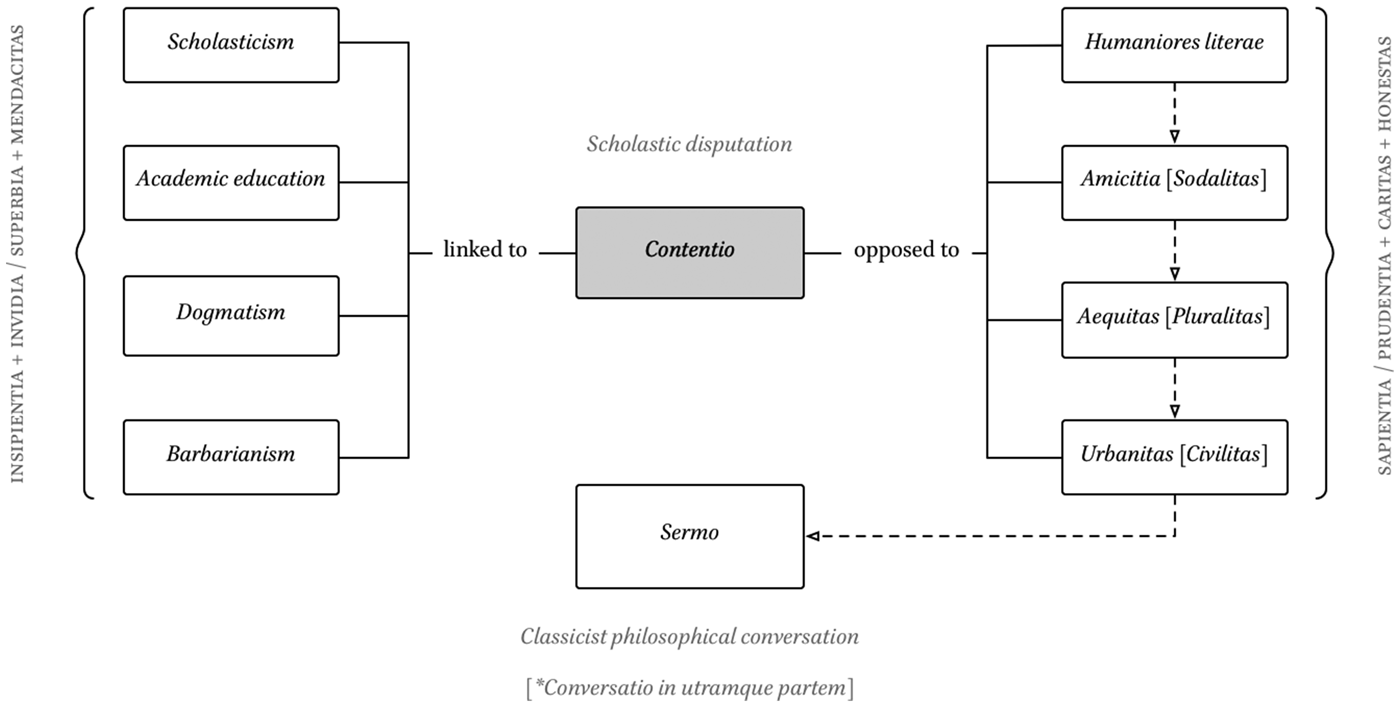
In short, Aquinas and Ps-Grosseteste considered contentio a sin opposed to caritas,Footnote 36 while Beauvais and Ps-Ockham assessed it as a perversion of truth. Humanists, for their part, outlined a positive approach to linguistic interaction that considered its performative, rational, and pragmatic strands;Footnote 37 these aspects could be readily compared with the aims and methods of the systematic presentation of the sins of the tongue. I will coin here the term sermo for the ethical and oratorical model that they forged, following a distinction found in the works of Cicero and Quintilian.Footnote 38 In this context, sermo transcends general and technical uses of the term in classical and medieval Latin, involving, among other things, an explicit opposition to the sin of contentio. Reconsidered and modified in the course of at least two centuries of scholasticism, the conceptual model of contentio would be employed by humanists, paradoxically, to attack the practices of intellectual exchange among their more systematic critics, the British and French scholastic thinkers.Footnote 39 Therefore, it is far from accidental that the core concerns of humanism with regard to sermo can easily be identified with the social and intellectual values of caritas/amicitia and the quest for sapientia/prudentia through honestas [see fig. 4].Footnote 40
The “humanistic turn,” ca. 1350–1450.
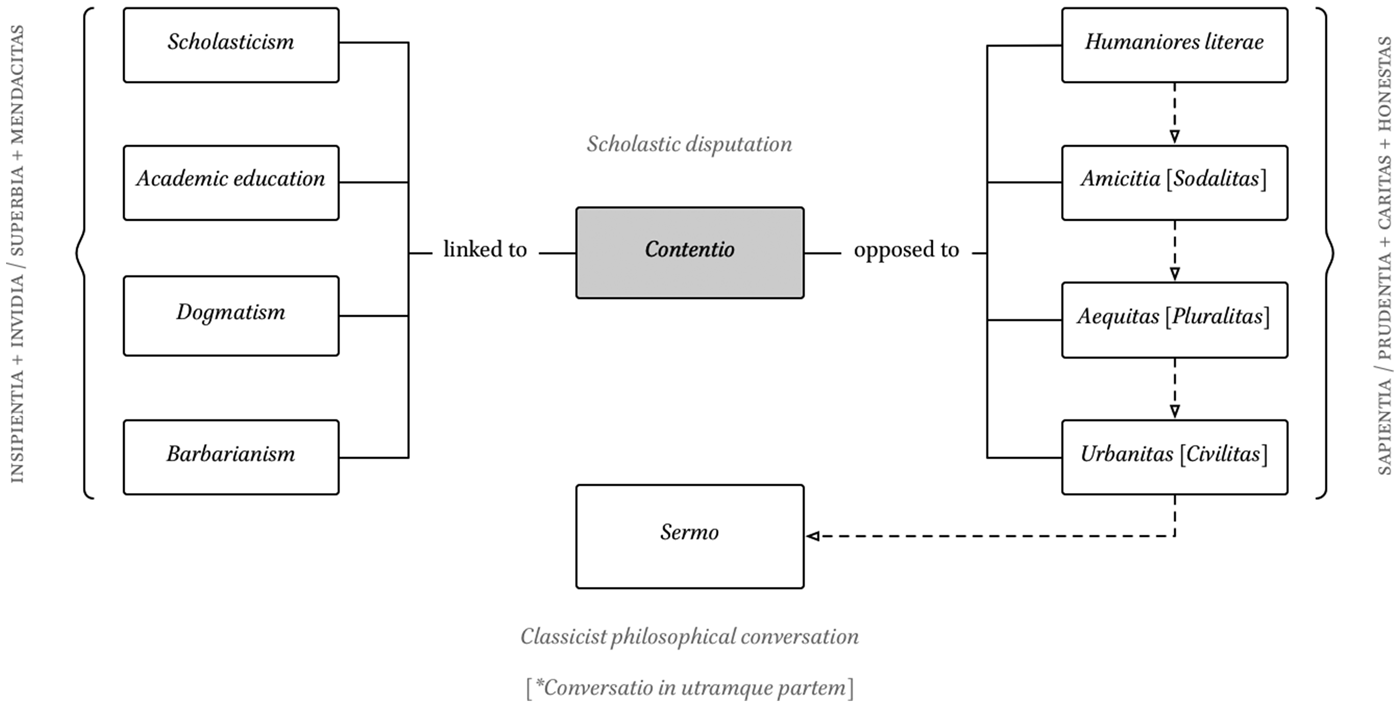
The constitution of these principles during the fifteenth century was manifested in the development of a commonly accepted intellectual position regarding literary dialogue, letter writing, and conversation that has been usually identified with the recovery and implementation of Cicero's disputatio in utramque partem.Footnote 41 This new paradigm for dialogue coexisted, nonetheless, with a number of traditional forms of academic and literary disputation, including the erotapocritical tradition,Footnote 42 the wide range of private and public disputations held in the universities,Footnote 43 the vast tradition of the quaestiones,Footnote 44 the new genre of school colloquia,Footnote 45 and a fresh philosophical and literary humorist stream that owed much to the recovery and imitation of Lucian of Samosata.Footnote 46 In summary, the disputation in both, or more, sides of the question confronted not only the possibility of leaving the topic under scrutiny open, which was especially suitable for all kinds of materia dubia; but also, and equally important, it combined a number of fashionable ideas on behavior, representation, and interaction that would prove quite fruitful in their transformation during the Renaissance.Footnote 47 However, by the middle of the fifteenth century, as this new groundwork for intellectual exchange reached maturity, some authors started to look critically to the implications of the varied dimensions of sermo. Some of these ramifications would be addressed by Lorenzo Valla.Footnote 48
From “Bona Contentio” to “Libertas Dicendi” to “Libertas Philosophandi”
Finished by mid-1440, although it was first made available in 1448–49 and not printed until 1471, Valla's Latin grammar, the Elegantiarum libri sex, was widely read in its time — as the more than sixty-seven extant manuscripts and around one hundred and fifty early printed editions attest — and used by humanists all across Europe. The general preface to the work attracted the attention of Italian and Northern humanists alike: Valla offered an entry to humanism through the foundation of all disciplines, grammar. The work ushered in a new intellectual and cultural sensibility that brought scholars such as Rudolph Agricola to Italy and left an indelible mark on novices such as Erasmus of Rotterdam, to mention two well-known examples.Footnote 49 Thus, our familiarity with Valla's work has conditioned its interpretation as an emblem of a new understanding of culture and education, of the exultant joy of a philological method that yielded sound fruits,Footnote 50 rather than as a critical discussion that delves into central aspects of the communicative principles established for sermo by previous generations of humanists.
In this sense, Valla's call to arms can be read as a movement towards freeing classical learning from the perils of a stately and self-indulgent stagnation. By assuming the opposition between iracundia (irascibility) and ira (anger), widely acknowledged by Italian humanists before him and cohesive with Aquinas's approach to this particular emotion,Footnote 51 Valla opens up sermo to a violent eruption of truth that grants a value for anger with ramifications in rhetoric, ethics, politics, and even theology. In this way, the culture of contentio would be characterized by iracundia; in other words, in late medieval scholasticism the confrontation of views and intellectual positions serves no purpose except feeding the pride of the contenders and therefore remains motionless with regard to the final goal of language, that is, the advancement of learning. On the other hand, the culture of sermo, as established by previous generations of humanists, would foster the restoration of a number of intellectual virtues and cultural institutions endorsed by classical tradition, at the risk of becoming a series of empty conventions that would fail to recover and surpass the cultural grandeur of the ancients. For Valla, ira (anger) could serve as a disruptive element that plays a pivotal role in the culture of sermo, insofar as its value would be not emotional but intellectual — the indignation of one who sees truth obscured by error, falsehood, or ignorance of classical letters, or obscured in classical letters themselves, and sees outbursts in verbal anger as a manifestation of his nobility of spirit and as an act that leads to the restitution of truth.Footnote 52
From a communicative point of view, Valla was not drawing his ideas out of thin air. Drawing from the Rule of St. Benedict, Aquinas had granted in the Summa, and in his Commentaries on II Timothy, on Titus, and on Peter Lombard's Sentences, the existence of a praiseworthy contentio (contentio laudabilis) when verbal (moderate) rage should be used for the impugnment of falsehood.Footnote 53 Not long before Aquinas, Alexander of Hales considered in the Summa Halensis (ca. 1250) the necessity to defend truth, to foster research, and to acquire training, as sufficient reasons for defending the use of contentio (bona contentio);Footnote 54 in subsequent generations, it is easy to find endorsements of good contentio in a number of highly influential orthodox Catholic thinkers.Footnote 55 However, humanists also played a role in the appreciation of verbal irascibility in some respects, insofar as their culture was certainly not one free of acrimonious invectives, both against scholasticism and among themselves.Footnote 56 Besides their attacks on each other, it is important to stress that most of them would have agreed that verbal violence could serve in private interaction as a proof of honesty (sinceritas, honestas) of the speaker, and that outspokenness should be considered in this context as a sign of trust and true friendship (amicitia).Footnote 57 Actually, Valla's concept of restoration (restitutio), as expressed twice in the general preface to the Elegantiae, is nothing but an expansion of these intellectual positions, which he developed from the beginning of the 1440s.Footnote 58
In his well-known letter to Joan, or Giovanni, Serra (13 August 1440), there is a passage in which Valla strikes back at his critics with a number of adjectives that they had attributed to him.Footnote 59 In the systems of the sins of the tongue, all of them are usually linked to contentio:
I have slandered your masters; take up their defense for your own praise and glory, especially with the favor and applause of so many waiting to be won! … Surely, there must be one man among such a crowd brave enough to write against me rather than simply barking with the rest of the pack. But if none of you dares respond in writing, that is an admission that you are unequal to the challenge, that your case is weak and that you are a wicked slanderer [improbum calumniatorem]; that it is not I but you who are envious [invidum], you who are proud [superbum], you who are spiteful [malignum] and slow-witted [stolidum]; that you are aware of your weakness and prefer to trade words instead of blows, snarling like a dog instead of fighting like a man.Footnote 60
Valla will recall this epistle in his prologue to the De professione religiosorum (1441–42), written after a confrontation with a Franciscan friar held on January 1441, in which the development of his position is of utmost importance for my argument. To explain his attitude towards his enemies, Valla links his combative stance to the core concerns of contentio as a means to prove truth with a forensic approach, hence the allusion to Cato the Elder.Footnote 61 More importantly, he refines it with clear ethical and philosophical implications, those of ancient parrhesia:
I come back to the second part, that I always attack somebody. In this regard, I recently wrote to my great friend Serra a long and rich apologetic letter. Those who expect from me an answer must know that my practice has been to date, and will be even more from now on, to follow both the style and the opinion of the ancient Greeks and Latins and to speak freely according to their custom.Footnote 62
This link is even clearer in his preface to De Constantini donatione (1440), where the references both to classical and to early Christian parrhesia leave no doubt about Valla's position:
If the man who said, “I am unwilling to write against those who have the power to proscribe” should be thought to have acted as prudently as he spoke, how much more should I act similarly towards someone who does not even allow that possibility of proscription? … Unless by chance we think that the supreme pontiff will bear these assaults with greater tolerance than others would. Hardly, since Ananias, the high priest, in the presence of the tribune who was sitting as judge, ordered Paul to be struck on the mouth because he said that he passed his life with good conscience [Paulo, quod bona se conscientia conversatum esse diceret], and Phasur, holding the same office, threw Jeremiah into prison for his outspokenness [Ieremiam ob loquendi libertatem coniecit in carcerem]…. But there is no reason why this double threat of danger should trouble me or keep me from my plan. For the supreme pontiff is not allowed to bind or release anyone contrary to human and divine law, and giving up one's life in the defense of truth and justice is a mark of the greatest virtue, the greatest glory, the greatest reward…. Anxiety be gone, let fears retreat far away and worries disperse! With a bold spirit [forti animo], great confidence, and good hope, the cause of truth [veritatis], the cause of justice [iustitie], and the cause of God [Dei] must be defended. No one who knows how to speak well can be considered a true orator unless he also dares to speak out…. Did not Paul, whose words I have just used, reproach Peter to his face before the church, “because he was reproachable,” and leave this in writing for our instruction? But I am not a Paul who can reproach Peter: I am rather a Paul who imitates Paul in such a way — which is something much greater — as to become one spirit with God [Immo Paulus sum, qui Paulum imitor, quemadmodum, quod multo plus est, unus cum Deo spiritus efficior], since I scrupulously obey his mandates.Footnote 63
In this compelling introduction, in which the sack of Rome seems to be announced with prophetic overtones,Footnote 64 Valla performs three important operations. The first is the claim that many of the practices of the Church of his time are nothing but the result of misinterpretations, either based on mischievous interests of prelates through the ages or attributable to their lack of knowledge,Footnote 65 which the oratio exemplifies in its presentation of the donation as a forgery.Footnote 66 From a communicative perspective, this denunciation is presented with the call for a restoration of the Church as an “interpretative community” where all its members — with the ability and knowledge to do so — should share the right to contest the corruptions of Christian doctrine and institutions.Footnote 67 The second operation, Valla's mention of truth, justice, and God as sufficient reasons to challenge such perversions, interests us in that it is clearly connected with the justification of anger and contentio both in the scholastic take on the sins of the tongue and in the political thought of Quattrocento humanists.Footnote 68 His third and last movement is momentous, in that Valla suggests that the relation of the faithful with God should not be mediated by secular or ecclesiastical authority; therefore, the defense of his position is that of a radical Christianity, fairly close to some of the parameters that will shape the Lutheran Reformation.
In a later epistle (25 October 1443), in which Valla asks Guarino of Verona for Pliny the Younger's Panegyric of Trajan, not of Nerva, he further develops the ground on which the De donatione was built:
There is said to be an oration of Pliny's, which is not just eloquent but of surpassing eloquence. If you have seen it yourself, please write to me to let me know. It is an oration in praise of Nerva, delivered before Nerva himself. Pliny himself mentions it in his first epistle, in which he says that he has imitated Calvus, the so-called Latin Demosthenes. All the same, I am surprised to hear him say that “it consists of almost nothing but forensic disputatiousness [in contentione],” if it is entirely taken up with praise. If you have it and can send it to me, I will return the favor by sending you my oration, itself consisting of almost nothing but forensic disputatiousness, On the Fraudulent and Falsely Trusted Donation of Constantine.Footnote 69
This passage makes it difficult to accept Salvatore Camporeale's argument that, for Valla, De donatione is based on “a demonstrative mode of argumentation, not a judicial one.”Footnote 70 In truth, this passage forces us to reconsider also Valla's qualification of the work as his “purest piece of oratory.”Footnote 71 In the discussion of his letter to Giovanni Tortelli (25 May 1440), Valla states that the subject of De donatione is “canon law and theology, though it contradicts all canonists and all theologians.”Footnote 72 My contention is that Valla is not merely acting in his oration pro suo more or just following Quintilian.Footnote 73 His choice of the term contentio seems to have been motivated by two different reasons. The first is closely related to his conception of dialectic as dependent on rhetoric, and, therefore, of his oratio as a discourse that goes beyond the first of the traditional three officia oratoris, that is, docere or probare. The second is that Valla is acting here as an orator whose aim cannot be reduced to winning the argument, but rather “to favor what is honorable” and to contribute “to a good and happy life,” counseling “against what is disgraceful and harmful”; hence he affirms the rhetorical excellence of the oratio.Footnote 74 Further, there is a third point related to the communicative culture in which Valla developed his career.Footnote 75 Contentio signals here the opening of a space for verbal violence, which he himself calls truculentia at the end of De donatione,Footnote 76 and which elsewhere is identified with St. Paul's (s)word:Footnote 77 a space for the expression of indignation through verbal violence which expands — and this would be the final goal of his oratio — a form of inalienable freedom (libertas dicendi) into two interconnected forms of liberation, in other words, two forms of caritas.Footnote 78 One is linked to the realms of thought (disciplinae or artes) outside theology but essential to theological judgment (libertas philosophandi),Footnote 79 while the other relates to the renegotiation of the ideas — and texts — shared by the community of the faithful and steeped in the nature of individual and institutionalized faith (libertas theologandi or libertas Christiana).Footnote 80
It should be noted, however, that Valla's approach leaves aside the best known literary realm of freedom for Quattrocento humanists, that is, Lucianic dialogue. In his letter to Cardinal Landriani (21 January 1444), Valla's disassociation from the Lucianic tradition is far from trivial, even if he admits that he can understand the comparison made by his critics.Footnote 81 Although contemporaries of Valla could envision a function of Lucianic dialogue to deal with political, philosophical, and religious matters under the veil of fiction,Footnote 82 we should take into account that Valla neither played his ideas sub persona (in truth, just the opposite), nor did he write satire as such, and that the use of Lucianic parrhesia was clearly mediated during the fifteenth century by the image of ancient Greek comedy as a perfect example of how a virtue could be easily perverted.Footnote 83
In sum, in the hands of Valla, verbal anger (contentio) took shape in a form of individual freedom as clearly differentiated from as dependent on bona contentio, and developed in an unexpected direction the ethics of friendship of the culture of the sermo. Parallel to classical antiquity and early Christianity, the culture of humanists, through its defense of amicitia and prudentia, paved the way for the two main preconditions — isonomia or a shared set of rules for discussion and isegoria or a shared right to take the floor — for parrhesia: a violent eruption of truth and the determination to defend it, although neither Valla nor most of his contemporaries ever used the term.Footnote 84
The Institutionalization of Parrhesia in Rennaisance Letters
Decades ago, both Setz and Camporeale defended the important role that libertas, as enacted in Valla's De donatione, played as a source of inspiration in the first writings by von Hutten and Luther.Footnote 85 Likewise, countless studies have highlighted the weight of economic, social, political, exegetical, educational, and philological circumstances that supported the rise and triumph of the Reformation. But, to my knowledge, we still lack an explanation based on simple communicative notions — if these terms are appropriate — that help to explain why the Reformation was considered susceptible to intellectual discussion by the European intelligentsia as a whole. The next step in the history of evolution of contentio could help to explain a difference, even if minor, between previous heresies, such as those of Cecco d'Ascoli, Pietro de Abano, John Wycliffe, Biagio Pelacani, John Huss, and Jerome of Prague, and that of Luther. In addition, this analysis shall stress the importance of the set of communicative premises shared by all the parties involved in the Reformation; as a result, it will argue that the two main critical factions against the Catholic Church in the second decade of the sixteenth century — Erasmus on the one side, the one led by Luther on the other — are the consequences of an impulse rooted in the influence of Lorenzo Valla.
Surprisingly, perhaps, a key text to study the parameters of bona contentio and parrhesia relevant to the interaction with other critical manifestations of the need for reformation of the Catholic Church is the fourth encyclopaediaFootnote 86 published by a humanist in the sixteenth century: Raffaele Maffei's (1451–1522), Thirty-Eight Books of Commentaries on Urban Matters (Commentariorum rerum urbanorum libri XXXVIII). Dedicated to Pope Julius II, this massive volume of 547 folios appeared in 1506 from Johann Besicken's press in Rome accompanied by Maffei's translation into Latin of Xenophon's Oeconomica.Footnote 87 It was intended both as a compendium of the knowledge of his time and, in Grafton's words, as a digest of “the whole corpus of Greek works on history and geography into an orderly, accessible, and fairly compact form.”Footnote 88 Thus, the three parts in which the Commentaries are divided — Geographia, Anthropologia, and Philologia — present an example of state-of-the-art humanist learning in utramque linguam at the very beginning of the sixteenth century and a successful one, as its more than eight editions attest.Footnote 89
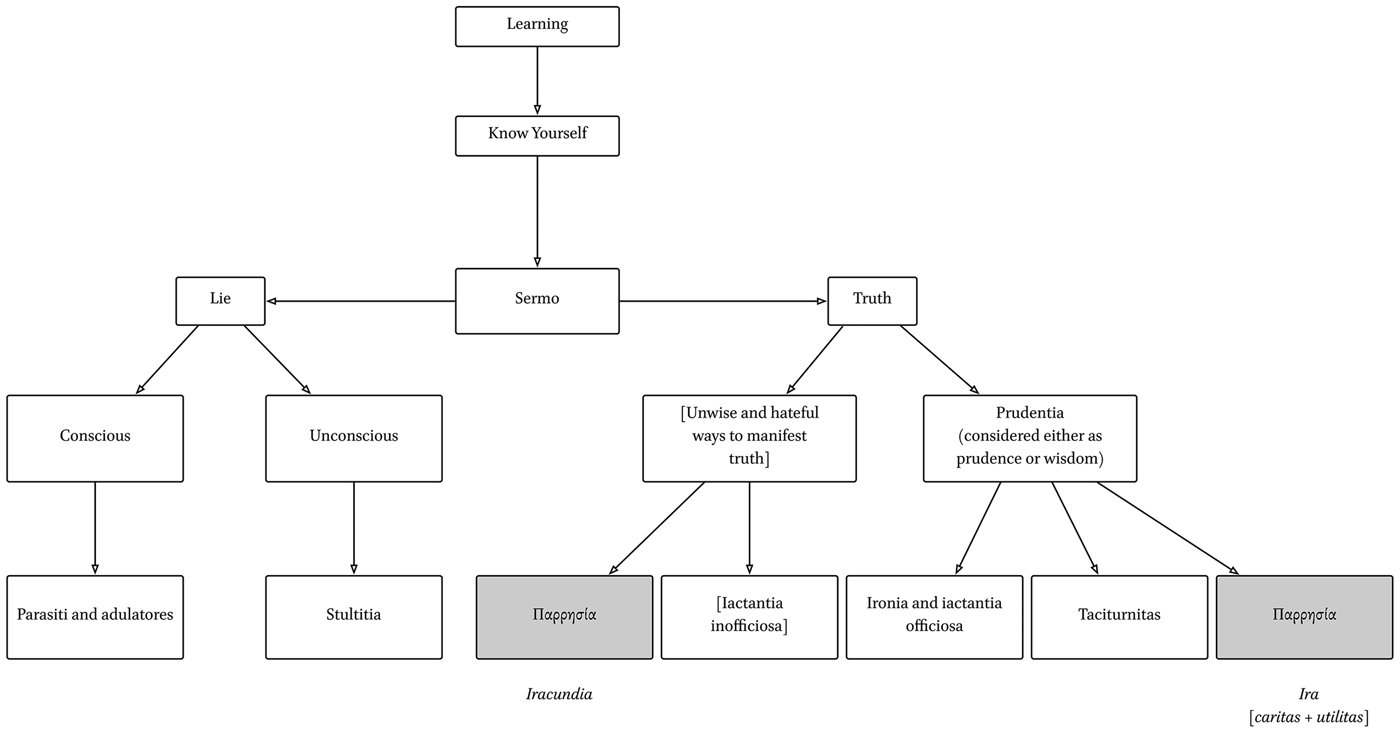
Located in the third part of the Commentaries, Philologia, book 28, On Honesty and Its Parts (De honesto et eius partibus), appraises the problem of truth. Despite my reconstruction of its structure [fig. 5], Maffei approaches the topic in a linear fashion, not analytically, relying heavily upon the authority of Aristotle, Quintilian, Athenaeus, and Plutarch. Thus, having treated in its first chapters the importance of the knowledge of liberal arts for the instruction of the soul and the role of the philosopher as an educator of the prince;Footnote 90 the value of education in every stage of life;Footnote 91 the inextricable link between knowledge, justice, and prudence, coupled with wisdom as the finest form of freeing oneself from mundane servitudes;Footnote 92 the view that every form of education leads both to philosophy and to theology;Footnote 93 the estimation for the philosophers in ancient times;Footnote 94 and an anthology of sayings by the Seven Sages of Greece and by the Stoics,Footnote 95 Maffei devotes chapter seven to the saying carved at the pronaos of the temple of Apollo at Delphi — know thyself — as the point of departure of his exposition on how language should manifest truth to open up a path to wisdom, and on how ethics and self-awareness relate to political power or, for that matter, to any kind of authority.Footnote 96
The systematization of parrhesia according to Raffaele Maffei's Commentariorum rerum urbanorum libri XXXVIII, book 28. De honesto et eius partibus (1506).
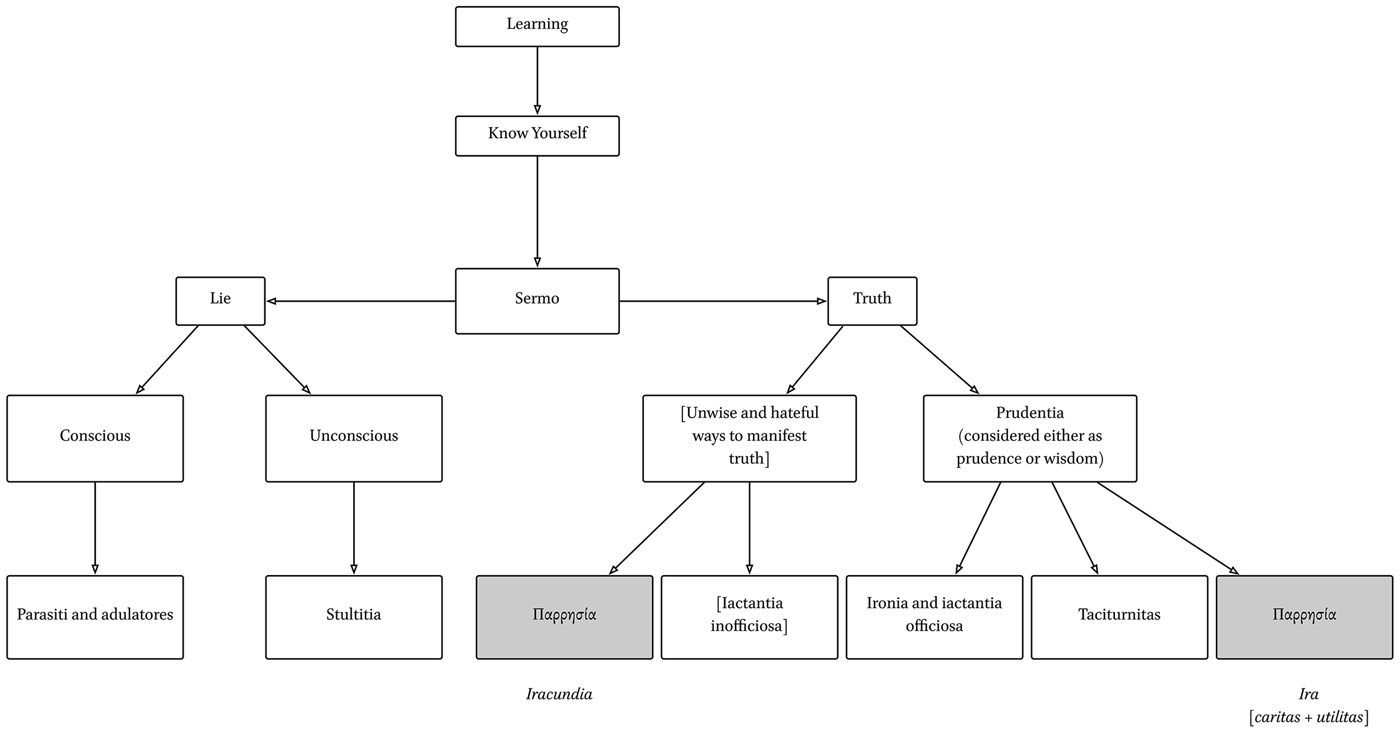
At the beginning of this second part of the De honesto, Maffei introduces those expressions that are despicable in themselves or that provoke hate in the listener. The former are reduced to two forms of lying, intended and unintended. Intended lying is epitomized by flatterers and parasites,Footnote 97 while unintended lying stems from the lack of knowledge (stultitia) of the speaker.Footnote 98 The latter are related to truth. As Maffei has stated before, prudentia should be the core principle of honesty, and, consequently, depending on its use or misuse, we have applaudable or hateful ways of presenting truth. Hateful truth could be manifested either in what he calls “boasting” (iactantia) or in parrhesia. With regards to boasting, Maffei offers a via media between Aristotle and PlutarchFootnote 99 and provides examples of both dutiful and remiss boasting, suggesting that the latter should be considered among the hateful ways of presenting truth.Footnote 100 As in the case of iactantia, his examples show that he contemplates a negligent use of outspokenness, as shown in the actions of Thersites, Drances, Demochares, Cleitus, or Aristomenes, which are, according to Maffei's examples of iracundia, opposed here to caritas and amicitia.Footnote 101
What interests us the most, however, is his forthcoming explanation of the three ways to express truth according to prudentia and self-awareness. In the first place, there is the coupling of “dutiful boasting” (iactantia officiosa) and “dutiful irony” (ironia officiosa) that has been mentioned before. Following Plutarch, Maffei defends boasting when circumstances require the speaker to recall his or her achievements in order to make a statement. This should be done, he affirms, without provoking envy or disaffection in the listener. Irony is an acceptable form of honesty when it is directed to acquire or manifest truth, for instance, when Socrates says that he knows nothing.Footnote 102 A second form of honestas can be found in silence (taciturnitas), traditionally considered the safest form of prudence, that is, to speak little and only when the opportunity recommends doing so.Footnote 103 In his garnering of adages and apophthegmata, Maffei draws heavily from the most popular collections of the time, both classical and contemporary: Plutarch's De garrulitate, Stobaeus's Eclogae, and Filippo Beroaldo's Commentaries on Apuleius's Golden Ass and his Oratio proverbialis;Footnote 104 however, he also mentions two deities, Harpocrates and Angerona, that will have an unexpected fortune in Renaissance letters.Footnote 105 The third and last form of honestas is, compared to the other two, an immediate manifestation of truth. In his definition of this virtuous parrhesia, it is clear that Maffei is considering it as opposed to its hateful counterpart. Consequently, this parrhesia stems from caritas, is marked by its purposefulness, and is distinctive of philosophers and righteous men. Linked here to anger, not irascibility, parrhesia is an expression that violates decorum and undermines authority for the sake of friendship, virtue, and truth.Footnote 106
Maffei's De Honesto and the Transformation of Renaissance Parrhesia in the Early Reformers
Maffei's compendium on honestas was directly related to the classical problem of how the philosopher should talk to men in power, a much cherished topic to Renaissance humanists from Petrarch onwards that saw a number of revivals, thanks partly to the recovery first in manuscript, thereafter in print, of Plutarch's Moralia.Footnote 107 According to the parameters presented in the pages above, it can easily be argued that these questions were adaptable and expandable to the realm of politics and society, and, as such, they could offer some important hints at how Renaissance humanists manifested the need for reformation of the Church during the first two decades of the sixteenth century. It is important, nonetheless, to stress that I do not intend to close these pages by suggesting the direct influence of Maffei on the examples that I am going to provide — something that would have horrified him;Footnote 108 moreover, I do not intend to present the De honesto as a vade mecum for moderate and radical reformers to express their truth. Rather, I would like to emphasize the observation that book 28 of the Commentaries embodies some commonly accepted notions on communication, truth, and power that, on the one hand, should be read as a reformulation of late medieval and renaissance ideas on (bona) contentio presented under a classicist guise, and on the other, that book 28 should be considered as the first systematic defense of oblique contrivance to advocate for the truth. As such, it shall be useful to analyse and understand the relation of truth and anger with literature, philosophy, and theology at the beginning of the sixteenth century [fig. 6].
Epilogue. The systematization of parrhesia according to Raffaele Maffei applied to the main literature of contestation from the second decade of the sixteenth century (1510–20).
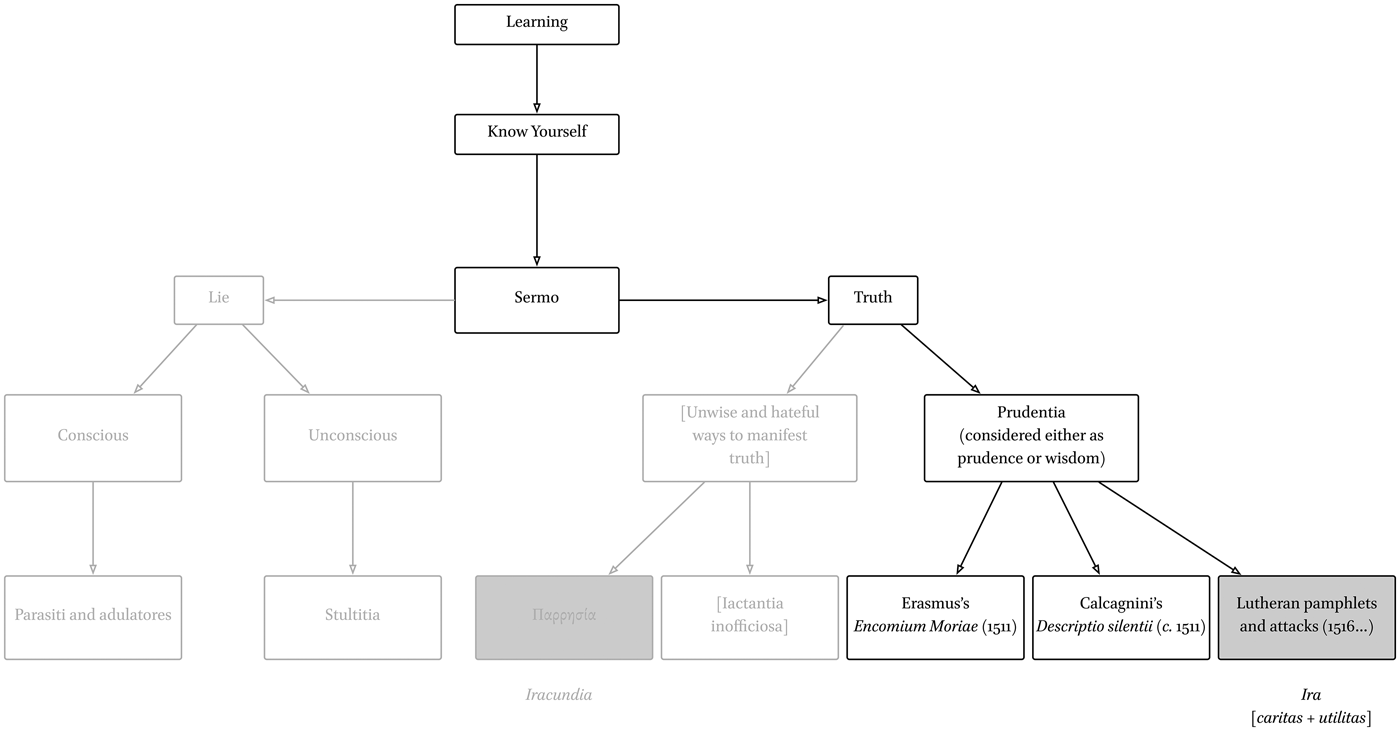
Thus, the finest example of the use of iactantia officiosa and ironia officiosa appeared in print no later than five years after the impression of the first edition of Maffei's Commentaries: Erasmus's Praise of Folly (Paris, 1511). However, there is no straightforward link of Erasmus's work to the tradition of the paradoxical encomium, and what has been traditionally attributed to Erasmus's character sheds dubious light on the matter. In any case, Maffei's framework of paradox is worth considering in this connection. As is well known, Erasmus received around 1514 a letter from a student of theology from the University of Louvain and a former famulus, Maarten van Dorp, in which he is questioned about the rationale for writing a work like the Praise of Folly.Footnote 109 Erasmus, in his extensive response to the letter, sent in May 1515, proposes the following explanation:
Nor was the end I had in view in my Folly different in any way from the purpose of my other works, though the means differed. In the Enchiridion I laid down quite simply the pattern of a Christian life. In my book on the education of a prince I openly expound the subjects in which a prince should be brought up. In my Panegyricus, though under cover of praising a prince, I pursue indirectly the same subject that I pursued openly in the earlier work. And the Folly is concerned in a playful spirit with the same subject as the Enchiridion. My purpose was guidance and not satire; to help, not to hurt; to show men how to become better and not to stand in their way.Footnote 110
In sum, Erasmus links two pairs of his works according to how they express their content, implicitly or explicitly. If the Institutio principis Christiani (1516), dedicated to young Charles V, is a treatise that lays the foundations necessary to become a virtuous king, the Panegyricus ad Philippum Austriae ducem (1504), under the pretext of a praise of Philip I of Castile, is in reality a rhetorical desideratum that in its adulation does not portray Philip himself, but rather the image of what Philip could be in the hope that the rhetorical formula exert traction on the object of praise. With regard to the second two, the Enchiridion (1501) and the Moria (1509–11) (the former is an exhortation to an anonymous person), Erasmus himself will mention in his letters that the first work had been written on behalf of a Christian wife worried by her husband, a quarrelsome, womanizing, heavy-drinking soldier, an exhortation to embrace the Christian faith from the interior to the exterior –– in short, a catechism –– while the latter is a fictive lecture delivered by a goddess in a classroom in the Sorbonne in front of a large group of students and professors of theology, where the topic is exactly the same although presented from the opposite perspective. A bit further in Erasmus's response to Dorp, we read the following:
And they [the theologians] act their absurd parts, more farcical than the original Atellanes, without a mask. I was at least more modest, for when I wanted to show how ill-judged I could be, I wore the mask of Folly, and, like Socrates in Plato, who covers his face before reciting an encomium on love, I myself acted my part in disguise.Footnote 111
So we must concur — whether we follow Maffei or not — that we are in front of a paradox. Confronted with the contrast of “true” doctrine with the mask that corresponds to Maffei's ironia officiosa, we are pointed directly at the intention of the author, that is, who is hidden and what aim is concealed behind the persona in the fable. In other words, we perceive that a lie is in play, whether under the veil of rhetorical formulas that embody the panegyric, or under the cloak of fiction, which in certain contexts (apparently) could not be true, and yet, nonetheless, is the only way to manifest truth, that is, honestas.
But Erasmus is going well beyond this paradox in the Praise of Folly. If we come back to Maffei [figs. 5 and 6], it is evident that not only does he protect himself, but he also protects his own mask. For this reason, he creates a paradox inside the paradox. What Folly (stultitia) says must necessarily be a lie, but an unconscious one, which, as stated by the scholastic theologians who are attacked by Folly herself, is not even a sin.Footnote 112 On the other hand, insofar as Folly (stultitia) is by definition imprudent, she presents herself without a filter (παρρησία), and accordingly her iactantia is skewed or poorly judged, which does not imply that what she says is untrue. Lastly, Erasmus the author has created, in the tradition of Socrates and Plato, a mask employing irony according to the topic he faced; therefore, he has manifested truth prudently, wisely, and honestly. But this position also has important consequences for the understanding of authorial responsibility during the Renaissance. As attacks against the Praise of Folly became more bitter and fierce during the 1520s and the 1530s, Erasmus will progressively abandon in his justifications of the work the argument sub persona, that is, that he is using a mask to present truth, to substitute truth — if I may use the image — with an automaton, so that Folly may oscillate within the bounds of stultitia, spiteful truth, and undue boasting without requiring an author who takes responsibility for her words.
In 1509, the same year that the Praise of Folly was being written, Celio Calcagnini, a good friend of Erasmus,Footnote 113 probably furnished the finest example of the second technique to present truth according to Maffei: the Descriptio silentii.Footnote 114 The opuscule is, even today, poorly known to scholars of the Renaissance, despite its undeniable value as an introduction to the parameters from which the ideas of silence developed in sixteenth-century Europe. Built upon the Tablet of Cebes, Calcagnini transforms his literary model by locating at the center of the ascent to virtue the god Harpocrates, extolling the importance of learning to remain silent after acquiring an education in the liberal arts as the only way to obtain wisdom as the path to happiness. Although at first sight the Descriptio seems to be an apology of silence, which can be easily outlined in accordance with Maffei's De honesto [fig. 5], one fascinating aspect of the work lies in the disposition of the elements in the picture and the selection of key concepts crafted in the ekphrasis, insofar as both allow a much more refined number of readings. For instance, it can be interpreted as a résumé sent to Fusco for Calcagnini to show off his skill as potential secretary of Ippolito I d'Este, that is, his ability to create a text that needs an equally skillful reader to fathom the hidden meanings, allusions, and correspondences embedded in an apparently conventional disguise.Footnote 115 Although for several reasons Calcagnini has been traditionally identified as a “nicodemite,”Footnote 116 and the Descriptio was read accordingly by some of his contemporaries, what the Descriptio shows is that silence can function at very different levels and not only as a tool to hide truth from inquisitive eyes, but also as a means to pile up verities and concentrate them in crafty works of art.
For the third and last example, that of the direct manifestation of truth, Luther predictably comes to mind. His fierce attacks against the Pope and the Catholic Church would be perfect examples of bona contentio, or, in Maffei's terms, of Renaissance parrhesia. Here, it is worth mentioning once more the role of Valla as a model for his attitude towards religion. However, it would also be à propos to adduce Maffei himself, who authored one of the first attacks on Luther in Italy. In his Nasi Romani in Martinum Luterium Apologeticus (1518–19), Maffei cannot identify Luther's attitude as parrhesiastic, insofar as it would imply that he is expressing truth. Rather, he addresses Luther in the following way. First and foremost, he refuses to associate Luther either with the medieval culture of disputation (contentio) or with the Renaissance tradition of arguing on both sides of the question (in utramque partem). Nonetheless, he recognizes Luther's position as directly inherited from Augustinian voluntarism.Footnote 117 Maffei's degree of appreciation here is quite important, in that his efforts to deny early Lutheranism the status of partaking in the Renaissance culture of communication as presented in these pages do not challenge my argument for continuity in an essential way, but rather confirm that the long evolution from contentio to parrhesia provides a crucial yet densely complicated background to the communication ethics of the Reformation. Many Renaissance intellectuals and contemporary scholars will concur with the fact that both Catholics and Reformers considered that the Encomium Moriae of Erasmus paved the way for Luther. Actually, it is possible that the tensions between Erasmus and Luther in the years from 1519 to 1524, beyond their differing approaches to dogma and institutions, can be read as a whole as a polemical exchange on two ways to express truth and the basis for reform, which is intrinsically linked to the history of the evolution of contentio. But this, I am afraid, would be another story.
Conclusion
Few scholars would deny that the legacy of the late medieval period weighs heavily on the shoulders of the humanists and reformers of the new epoch. Although today we enjoy the fruits of centuries of scholarly research into the immensely complicated background of the Reformation, there is still much work to be done on the evolving theory (or theories) of communication that opened the way for the new ethical and philosophical horizons of truth and anger that shaped the Reformation and other currents of European intellectual life. As I have argued in this contribution, the evolution and contours of contentio as a sin of the tongue, its transformation in the hands of Lorenzo Valla, and the systematic treatment of parrhesia at the beginning of sixteenth century provide crucial yet neglected features in the cultural terrain of the Renaissance, pointing the way to a reevaluation of the theory of communication as an essential aspect of these intellectual developments. The perennial interplay of argument and literary artistry would never be the same.