INTRODUCTION
Several species of cetaceans are known to host sessile barnacles (Cirripedia) and several instances of association between cetaceans and cirripeds have been reported. The degree to which barnacles have adapted to living on cetaceans varies. The stalked barnacles of the genera Conchoderma and Lepas (family Lepadidae) can be considered generalists because they occur on both living organisms (turtles, cetaceans, etc.) and inanimate objects (ship hulls and floating items) (Aznar et al., Reference Aznar, Balbuena and Raga1994). In contrast, other species such as those of the genera Coronula, Cryptolepas, Tubicinella, and Xenobalanus (family Coronulidae) are highly specialized to live on cetaceans (Clarke, Reference Clarke1966; Aznar et al., Reference Aznar, Balbuena and Raga1994; Seilacher, Reference Seilacher2005) and it has been suggested that its hermaphroditic reproduction may be synchronized with that of its host (Dollfus, Reference Dollfus1968).
In general, these crustaceans are found as epizoic attached on the body of the mammals. Although some barnacles are not true ectoparasites as they do not feed on cetacean skin or body fluids, they could become abundant enough to increase drag and affect hydrodynamics, reducing the mobility and physiology of their hosts (Aznar et al., Reference Aznar, Balbuena and Raga1994; Felix et al., Reference Felix, Bearson and Falconi2006).
The monotypic barnacle Xenobalanus globicipitis is specialized for living as a commensal on dolphins and whales (Darwin, Reference Darwin1854), being reported on about 34 species of cetaceans of both temperate and tropical waters (Rajaguru & Shantha, Reference Rajaguru and Shantha1992; Kane et al., Reference Kane, Olson, Gerrodete and Fiedler2008). In Brazil, Siciliano et al. (Reference Siciliano, Capistrano and Lodi1988) and Di Beneditto & Ramos (Reference Di Beneditto and Ramos2000) found X. globicipitis on the coast of Rio de Janeiro attached on the Risso's dolphin Grampus griseus and on three species of small cetaceans (Sotalia fluviatilis, Pontoporia blainvillei and Tursiops truncatus), respectively. Young (Reference Young1991) reported X. globicipitis found attached on Sotalia guianensis on the coast of São Paulo and Engel (Reference Engel1994) observed the presence of this barnacle in a sperm whale Physeter macrocephalus on the coast of Bahia.
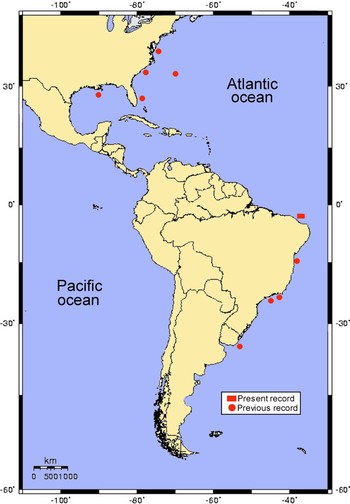
Besides on the Brazilian coast, only seven previous records of X. globicipitis in the western Atlantic are known to date: in Florida on the short-finned pilot whale as a host (Spivey, Reference Spivey1977), on the central Atlantic Coast, USA and in North Carolina on the bottlenose dolphin Tursiops truncatus (True, Reference True1891; Mead & Potter, Reference Mead, Potter, Leatherwood and Reeves1990), in North Carolina, on the goosebeaked whale Ziphius cavirostris (Bane & Zullo, Reference Bane and Zullo1980), in New Jersey, on T. truncatus (Gittings et al., Reference Gittings, Dennis and Harry1986; Toth-Brown & Hohn, Reference Toth-Brown and Hohn2007), in the Gulf of Mexico, on the clymene dolphin Stenella clymene (Jefferson et al., Reference Jefferson, Odell and Prunier1995), and on the coast of Uruguay, on the franciscana dolphin Pontoporia blainvillei (Brownell, Reference Brownell1975). This contribution aims to report for the first time the presence of X. globicipitis on the striped dolphin S. coeruleoalba in the oligotrophic waters of north-eastern Brazil.
MATERIALS AND METHODS
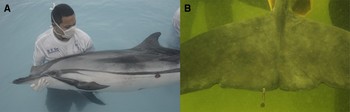
An adult female striped dolphin Stenella coeruleoalba, measuring 2.17 m (Figure 1), was found stranded alive on Manibu Beach, Icapuí (S04°48′06.6″ W37°16′00.8″), Ceará State, north-eastern Brazil (Figure 2). The dolphin was examined for external parasites and one specimen of Xenobalanus globicipitis was found attached on caudal fluke. The barnacle was collected and preserved in ethanol (70%) for further analysis. The identification was done following Darwin (Reference Darwin1854) and Pilsbry (Reference Pilsbry1916) and the material was deposited in the carcinological collection of the Instituto de Ciências do Mar (LABOMAR), Universidade Federal do Ceará (LABOMAR#707), Fortaleza, Ceará, Brazil. Measurements of total length (TL), width of the body (WB), width of basal plate (WBP), and width of hood (WH) were done using a Vernier caliper (±0.01 accuracy). The classification adopted in the present contribution follows Martin & Davis' (Reference Martin and Davis2001) proposed scheme to family level.
(A) Striped dolphin Stenella coeruleoalba (Meyen, 1833) (Cetacea: Delphinidae); (B) Xenobalanus globicipitis Steenstrup, Reference Steenstrup1852 (Cirripedia: Coronulidae) attached on caudal fluke.

Presently known range of the sessile barnacle Xenobalanus globicipitis Steenstrup, Reference Steenstrup1852 (Cirripedia: Coronulidae) in the western Atlantic Ocean.

RESULTS
Classification
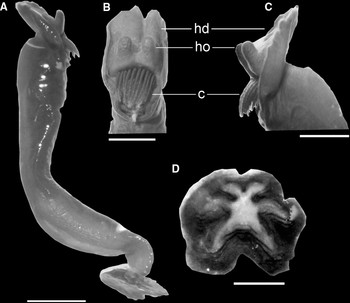
Xenobalanus globicipitis specimen from north-eastern Brazil, collected on the striped dolphin Stenella coeruleoalba. (A) Lateral view of the specimen; (B, C) detail of hood (hd), horn (ho) and cirri (c); (D) shell. Scale bars: A = 0.5 mm; B–D = 0.25 mm.

Xenobalanus globicipitis Steenstrup (Reference Steenstrup1851): 62; (1852); Darwin (Reference Darwin1854): 440, pl. 17, figures 4a, c.; Cornwall (Reference Cornwall1927): 510; Stubbings (Reference Stubbings1965): 902; Young (Reference Young1991): 194, figures 1d,e; 1998:
Siphonicella (sine descript.) Darwin (Reference Darwin1852): 156
MATERIAL EXAMINED
One specimen, Brazil, Ceará State, Manibu Beach, Icapuí on Stenella coeruleoalba, coll. Katherine Fiedler Choi, 12 February 2007. TL = 26 mm; WH = 4.6 mm; WB = 3.4 mm; WBP = 4.9 mm.
DIAGNOSIS
Shell thin, small, white, irregularly star-shaped, in an almost rudimentary condition, containing only the basal parts of the animal. Connected to this thin, star-shaped shell is a cylindrical, smooth, flexible, peduncle-like body. It is narrow in the region coming out of the central cavity of the animal. At the distal end of this greatly elongated pseudopeduncle is a reflexed hood, which bears two stumpy outpushings or ‘horns,’ and hence is broader, and this has the appearance of forming a capitulum, but terga and scuta are absent. Cirri, mouth, a probosciform penis, and associated organs project from the reflexed hood. The wall plates of this barnacle are embedded in the skin of the dolphin, with feeding appendages (cirri) and associated organs suspended by the long fleshy stalk.
REMARKS
Although belonging to the sessile group Cirripedia, this barnacle closely resembles stalked barnacles, especially Conchoderma auritum which is also found on cetaceans, though in general, never attached directly to the skin of its host. On the other hand, Xenobalanus globicipitis is always attached directly to the skin of its host (Pilsbry, Reference Pilsbry1916; Barnard, Reference Barnard1924). The genera Coronula, Platylepas, and Tubicinella are morphologically closely related to Xenobalanus (Darwin, Reference Darwin1854; Pope, Reference Pope1958).
DISCUSSION
Xenobalanus globicipitis and a host, the striped dolphin Stenella coeruleoalba, have been previously recorded from the Mediterranean Sea by Raga et al. (Reference Raga, Carbonell and Raduan1982; Reference Raga, Raduan, Blanco and Carbonell1983), South Africa by Ross (Reference Ross1984) and in the eastern tropical Pacific by Kane et al. (Reference Kane, Olson, Gerrodete and Fiedler2008). This specimen seems to be the most abundant and persistent epizoic living on striped dolphin (Aznar et al., Reference Aznar, Balbuena and Raga1994).
Rajaguru & Shantha (Reference Rajaguru and Shantha1992) considered mature barnacle specimens with 30–39 mm of total length, while Aznar et al. (Reference Aznar, Balbuena and Raga1994) estimated the age based on shell diameter and found a large young population (shell diameter < 4 mm) on striped dolphin in the Spanish Mediterranean. We found a subadult specimen (TL = 26 mm; WBP = 4.9 mm) on a living, pregnant and sick animal, suggesting that the cetacean was infected soon before its death.
In general, X. goblicipitis apparently prefers to attach on sick animals once they present slow movements and immunity (Brody, Reference Brody1989; Aguilar & Raga, Reference Aguilar and Raga1993; Aznar et al., Reference Aznar, Perdiguero, Perez del Olmo, Repulle, Agusti and Raga2005). The animal in this study was pregnant and had an abortion in rehabilitation facilities. During the necropsy signs of septicaemia were observed. Considering the gestation and disease, it is possible to affirm that the dolphin was severely immunosuppressed. Aznar et al. (Reference Aznar, Balbuena and Raga1994) found a high concentration of X. globicipitis on diseased striped dolphins. Thus, the cetacean swimming speed is an important factor in X. globicipitis settlements, as suggested by Orams & Schuetze, (Reference Orams and Schuetze1998). However, Kane et al. (Reference Kane, Olson, Gerrodete and Fiedler2008) pointed out that the swimming speed of the cetacean could not be a primary factor in host species selection, once they found a great intensity of X. globicipitis on the blue whale, a species that sustains cruising speeds up to 33 km/hour.
The striped dolphins are usually found outside the continental shelf, often associated with convergence zones and upwelling waters (Ross, Reference Ross1984; Archer & Perrin, Reference Archer and Perrin1999). This behaviour typically favours the filter-feeding barnacle and reports of high infestation have been made associated with upwelling areas (van Waerebeek et al., Reference Van Waerebeek, Reyes and Alfaro1993; Orams & Schuetze, Reference Orams and Schuetze1998; Kane et al., Reference Kane, Olson, Gerrodete and Fiedler2008). The previous records of X. goblicipitis along the Brazilian coast were collected in areas of high primary production, on the coast of São Paulo, Rio de Janeiro and Bahia States (Siciliano et al., Reference Siciliano, Capistrano and Lodi1988; Young, Reference Young1991; Di Beneditto & Ramos, Reference Di Beneditto and Ramos2000); however, the waters of the north-eastern Brazilian coast are oligotrophic (Boltovskoy, Reference Boltovskoy1981) and the occurrence of this cetacean species in the region could be accidental, due to the health conditions of the animal. In fact, Kane et al. (Reference Kane, Olson, Gerrodete and Fiedler2008) did not find X. globicipitis on the deep-diving species Physeter macrocephalus (sperm whale) and Mesoplodon spp. (beaked whales) in the eastern tropical Pacific, suggesting that the dive depth of the host may limit the settlement of the barnacle, probably due to the presence of oligotrophic waters in high depth.
In the present contribution, the X. globicipitis was found on an adult striped dolphin with age estimated as 22 years, based on counting of dentine layer groups. Striped dolphins are estimated to live for as long as 58 years (Jefferson et al., Reference Jefferson, Webber and Pitman2008). Orams & Schuetze (Reference Orams and Schuetze1998) found a statistically significant difference between subadult and adult number of barnacles attached on the bottlenose dolphin Tursiops truncatus, being more prevalent on the young (smaller) specimens. In the same way, Rajaguru & Shantha (Reference Rajaguru and Shantha1992) reported the presence of X. globicipitis only in small bottlenose dolphins. Probably, the barnacle prefers young animals because they may have skin features which allow an easier attachment of the X. globicipitis larvae such as low immunity and movement (Orams & Schuetze, Reference Orams and Schuetze1998). On the other hand, Aznar et al. (Reference Aznar, Balbuena and Raga1994) found no significant difference between prevalence and intensity of infection and dolphin age/size in striped dolphins, showing that the dolphin size has no influence on the prevalence and rate of colonization by this epizoic (Aznar et al., Reference Aznar, Perdiguero, Perez del Olmo, Repulle, Agusti and Raga2005).
Xenobalanus globicipitis has been reported on 34 cetacean species worldwide and has a prevalence ranging from 0.5% to 55% of individuals in each sighting (Aznar et al., Reference Aznar, Perdiguero, Perez del Olmo, Repulle, Agusti and Raga2005). We found only one specimen attached on the dolphin. However, intensity is highly variable, and there are some reports greater than 100 barnacles on a single host (Kane et al., Reference Kane, Olson, Gerrodete and Fiedler2008). Aznar et al. (Reference Aznar, Perdiguero, Perez del Olmo, Repulle, Agusti and Raga2005) reported two striped dolphins with more than 100 barnacles attached, while the greatest intensity observed by Kane et al. (Reference Kane, Olson, Gerrodete and Fiedler2008) was only seven, on killer whale (Orcinus orca); although the last authors pointed out that their results could be underestimated due to the photographic method used.
According to Kane et al. (Reference Kane, Olson, Gerrodete and Fiedler2008), the fact that X. globicipitis has been reported on 34 cetacean species in both coastal and offshore waters, from the Arctic to Antarctic, could indicate that the barnacle is extremely cosmopolitan (Newman & Ross, Reference Newman and Ross1976; Spivey, Reference Spivey1981), or may suggest that more than one species of the genus Xenobalanus is involved. Moreover, this fact suggests an apparent lack of specialization, which may indicate, according to Kane et al. (Reference Kane, Olson, Gerrodete and Fiedler2008), that its evolution and relationship with cetaceans may be more recent than that of other cetacean commensals, and also that its specialization to host species has not yet occurred. This is the first record of the X. globicipitis as an epizoic of Stenella coeruleoalba in the oligotrophic waters from north-eastern Brazil, filling a gap of distribution between Texas, the Gulf of Mexico and Bahia, Brazil.
ACKNOWLEDGEMENTS
The authors are very grateful to Professor Dr Alexandre Oliveira de Almeida (DCB/UESC) for his usual support, comments and criticism, to PhD student Gustavo Arruda Bezerra (Karl-Frazens University of Graz) for revision of English written language and three anonymous referees for their valuable criticisms and suggestions, which improved the manuscript.