





School feeding programmes have been implemented in Brazil since 1955. The current National School Feeding Program (PNAE), one of the largest school feeding initiatives worldwide, represents the consolidation of these longstanding public policies and provides free, government-subsidised meals to around 40 million students daily. As a universal public policy, it serves all students enrolled in public basic education, regardless of socioeconomic status(1). In addition to its broad coverage, the PNAE is internationally recognised for advancing food and nutrition security and promoting healthier eating habits among schoolchildren(Reference Watkins, Fiala and Haag2). By ensuring access to nutritious meals in public schools, it supports children’s growth and cognitive development while reducing social inequalities and strengthening social protection systems(3,Reference Sidaner, Balaban and Burlandy4) .
The current regulatory framework, defined by the Law No. 11,947 (2009) and Resolutions no.6 (2020) and no.3 (2025) issued by the National Fund for the Development of Education(1), sets standards for school menus. Although the PNAE indirectly promotes sustainability by requiring that at least 30 % of funds come from family farming, regulations neither establish explicit criteria for environmentally preferable foods nor address the climate impacts of procurement choices. The absence of environmental criteria in PNAE procurement means that a programme of this scale may unintentionally reinforce high-emission food supply chains, despite its strong social and nutritional mandate. This gap is critical, as Brazil is among the world’s largest greenhouse gas (GHG) emitters(5), with food systems accounting for nearly three-quarters of national emissions, 78 % from the beef supply chain(Reference Alencar, Zimbres and Souza6). Cattle production is the main driver of deforestation in Brazil, with 29–70 % of beef emissions stemming from the expansion of pasture in the Brazilian Amazon and Cerrado biomes(Reference Alencar, Zimbres and Souza6,Reference Poore and Nemecek7) .
Recent global evidence shows that between 1990 and 2018, children’s and adolescents’ consumption of animal-source foods increased markedly, particularly in Latin America and Asia, with Brazil among the countries exhibiting the steepest rises in red meat intake(Reference Miller, Webb and Cudhea8). This trend reinforces the urgency of aligning school feeding programmes with sustainability principles to promote healthier and lower-emission diets from an early age. Given the PNAE’s scale, integrating sustainability into school feeding policies represents a unique opportunity to reduce the environmental footprint of public procurement and foster climate-conscious eating habits among future generations. Given Brazil’s strong cultural tradition of meat consumption(Reference Hase-Ueta, Tanaka and Marchioni9), and the lack of quantitative dietary recommendations for animal-source foods(Reference Rios-Leyvraz and Montez10), strategies based on reducing or replacing animal-source foods may face important practical and political challenges. For this reason, understanding the mitigation potential of substitutions among different animal-source foods may provide a more feasible pathway for reducing emissions within school feeding programmes.
International calls have urged public food procurement to promote sustainable food systems(Reference Parsons and Barling11,Reference Swensson and Tartanac12) , particularly through menu reforms and reduced consumption of animal-source foods for climate mitigation(Reference Watkins, Fiala and Haag2,Reference Willett, Rockström and Loken13) . The environmental implications of PNAE, however, remain largely unexplored. Previous research on PNAE has focused on food security(Reference Sidaner, Balaban and Burlandy4), family farming(Reference Moreira, Freitas and Alves Júnior14), nutritional adequacy(Reference Silva, Oliveira and Ribeiro15) and programme evaluation(Reference Bicalho, Santos and Slater16), mostly within local or regional contexts. To date, no national-level studies have systematically assessed the environmental impacts of PNAE procurement or how changes in food purchases could reduce GHG emissions. In parallel, sustainable sourcing strategies may also contribute to mitigation. In the Amazon and Cerrado biomes, major slaughterhouses have adopted zero-deforestation commitments that have demonstrated potential to substantially reduce cattle-related emissions(Reference Levy, Cammelli and Munger17,Reference zu Ermgassen, Garcia and Ribeiro18) , although such environmental criteria are not currently incorporated into PNAE procurement practices.
Therefore, this study aims to quantify the GHG emissions associated with animal-source foods purchases in the PNAE between 2013 and 2022, to evaluate regional differences, and to explore mitigation scenarios based on alternative procurement strategies. Specifically, we estimate the potential emission reductions associated with partial substitution of beef by lower-emission animal-source foods and with the adoption of deforestation-free sourcing practices.
Methods
Study design and data sources
This retrospective longitudinal study analysed public procurement invoices financed by the Brazilian federal government for the National School Feeding Program (PNAE). Data encompassed all executing entities (5570 municipalities, the Federal District and 26 State Secretariats) from 2013 to 2022. Invoice records were obtained from the publicly available Accountability Management System (Sistema de Gestão de Prestação de Contas – SiGPC; https://www.fnde.gov.br/sigpcadm/sistema.pu?operation=localizar). Because the platform provides data separately for each executing entity and year, procurement records were collected through automated extraction of all available municipality- and state-level files using scripts developed in Python. The extracted files were subsequently consolidated into a single analytical database for data cleaning and analysis, and the overall spending per municipality was validated against data from the National Fund for Education Development (who administers PNAE disbursements: https://www.gov.br/fnde/pt-br/acesso-a-informacao/acoes-e-programas/programas/pnae/consultas/pnae-dados-da-agricultura-familiar). The dataset included only purchases funded by federal transfers, totalling about 5 billion BRL (≈850 million USD) annually. In addition to federal funds, executing entities could also complement these resources with local funds(1).
Data extraction, cleaning and classification
After extraction, data were cleaned and standardised by verifying record integrity, removing duplicates, correcting errors and excluding missing values. A total of 55 782 municipality-year files were scraped, of which 919 (1·6 %) were excluded due to missing or invalid invoice data (Supplementary Table 1). The final dataset comprised 54 863 files containing 10 487 904 invoices. The distribution of excluded files by state and year indicated good overall coverage, with an average of 3 % missing data per state and 10 % per year. Amapá state showed the highest proportion of missing files (23·1 %), and 2020 the largest (14·9 %) (Supplementary Table 1). Both 2020 and 2021 had the lowest numbers of invoices and items per invoice, likely reflecting the effects of the COVID-19 pandemic on school feeding operations (Supplementary Figures 1 and 2).
A total of 35 760 881 individual items were extracted from invoices, with their temporal distribution shown in Supplementary Figure 2. A list of 450 848 unique food item descriptions was generated from all procurement records. Animal-source foods (meats and eggs) were identified through manual review of these unique descriptions, resulting in 69 729 items selected for classification. Food groups were assigned according to a standardised classification scheme adapted from the Brazilian Household Budget Survey and tailored to the objectives of the study. To improve classification reliability, all manual identification and classification procedures were independently conducted by two researchers, and discrepancies were resolved through consensus.
Although milk and dairy products are environmentally relevant components of school meals, this study focused on meats and eggs because they represent a more comparable group of animal-source foods and the primary targets of the substitution scenarios evaluated. Dairy products are consumed in a wide variety of forms, including beverages and composite preparations, making the estimation of milk-equivalent quantities dependent on additional assumptions. Moreover, they play a distinct role in school menus, being more frequently consumed in breakfasts, snacks and culinary preparations rather than as substitutes for protein foods served in main meals.
Purchases were classified into ten categories (Supplementary Table 2): beef, poultry, fish, pork, eggs, processed meats (sausages, deli meat and preserved), processed meat-based preparations (meatballs, hamburgers and nuggets), dried/salted meat, offal and other meats (e.g. lamb, goat). Based on this categorisation, 7 325 334 food items were included in the analyses.
Estimation of greenhouse gas emissions
GHG emissions were estimated in CO2-equivalent (CO2e) using emission factors from Poore and Nemecek’s global meta-analysis of food’s environmental impacts.7 For each food group, factors corresponded to the mean of Brazil-specific observations; when unavailable (e.g. eggs), global averages were used. Mapping rules were defined as follows: sausages and deli meats used the pork factor; offal and dried/salted meats the beef factor and meatballs, hamburgers and nuggets a composite of two-thirds beef and one-third poultry. Emission factors are detailed in Supplementary Table 2. Although Brazil-specific observations were used whenever available, these factors represent average estimates and do not capture the full heterogeneity of production systems across regions, management practices, feed sources, productivity levels, and land-use histories. Therefore, the resulting estimates should be interpreted as population-average emissions associated with food groups rather than as precise values for specific suppliers or production chains. Emissions were calculated by multiplying procured mass (kg) by the respective factor (kg CO₂e), expressed in million tonnes (MtCO₂e). To capture uncertainty, a Monte Carlo simulation (1000 iterations) randomly sampled the empirical distribution of emission factors for each group, generating 95 % uncertainty intervals. Although average emission factors were used to estimate procurement-related emissions, this approach allows part of the variability reported across production systems in the source database to be incorporated into the final estimates.
Total and relative quantities of meats and eggs, as well as their associated GHG emissions, were assessed nationally across the study period to identify temporal patterns and trends. Given Brazil’s continental scale and regional diversity, additional analyses were performed using four geographical food system clusters. The clusters were based on the Brazilian Multidimensional Index for Sustainable Food Systems - Revised, which comprises 46 indicators distributed across four dimensions of food system sustainability (eleven social, ten nutritional, twelve environmental and twelve economic indicators). States were grouped using hierarchical cluster analysis with Ward’s linkage method, as previously described(Reference Norde, Porciuncula and Garrido19). Cluster A comprises the states of Acre, Rondônia, Tocantins (North), Mato Grosso, Mato Grosso do Sul and Goiás (Midwest), representing central states bordering the Amazon. Cluster B includes the Southern (Rio Grande do Sul, Santa Catarina, Paraná) and Southeastern states (São Paulo, Rio de Janeiro, Minas Gerais, Espírito Santo). Cluster C comprises the Northeastern states (Maranhão, Piauí, Ceará, Rio Grande do Norte, Paraíba, Pernambuco, Bahia, Sergipe, Alagoas). Cluster D includes Pará, Amazonas, Roraima and Amapá (North), states largely covered by the Amazon Forest (map in Supplementary Figure 3).
Scenario analysis
Emissions from food consumption can be reduced either by substituting high-emission products with lower-emission alternatives (‘substitution scenarios’) or by improving production practices of high-emission products (‘sustainable sourcing scenarios’). Within this framework, we performed a deterministic simulation to estimate the potential impact of alternative PNAE procurement strategies. The baseline scenario represented the average annual quantity (tonnes) of each meat and egg group procured between 2013 and 2022, excluding 2020 and 2021 because school closures and emergency adaptations to the PNAE during the COVID-19 pandemic resulted in atypical procurement patterns that were not considered representative of routine programme operation. For each scenario, quantities were converted to GHG emissions (MtCO₂e) using group-specific emission factors(Reference Poore and Nemecek7).
As 77·6 % of Brazil’s food-system emissions stem from beef production(Reference Alencar, Zimbres and Souza6), five substitution scenarios were modelled. In scenarios 1A–1D, reductions in beef procurement were offset by proportional increases in poultry, pork, fish and eggs. Scenario 1A simulated a 20 % reduction in beef, replaced by 5 % of each substitute; 1B, a 30 % beef reduction with 7·5 % increases of each; 1C, a 40 % reduction with 10 % of each; 1D, a 50 % reduction with 12·5 % of each. These levels followed current environmental and policy benchmarks. The 20 % cut reflects evidence that such a reduction in global beef consumption could lower methane emissions by 11 % and halve deforestation by 2050(Reference Guglielmi20). The 30 % scenario aligns with Brazil’s Global Methane Pledge commitment to reduce livestock methane by 2030(21). The 40 % scenario is supported by modelling studies showing substantial mitigation potential(Reference zu Ermgassen, Godar and Lathuillière23), and the 50 % cut reflects the EAT-Lancet planetary health diet recommendation to reduce red meat consumption by more than half to meet both health and sustainability targets(Reference da Costa, Debone and Miraglia22).
Our sustainable sourcing scenarios considered supply chain policies in the cattle sector. Slaughterhouses handling ∼70 % of slaughter in the Amazon(Reference zu Ermgassen, Godar and Lathuillière23), and ∼35 % of slaughter in the Cerrado(Reference zu Ermgassen, Garcia and Ribeiro18), have adopted supply chain monitoring to exclude purchases from deforested properties. In the Amazon, commitments adopted since 2009 reduced deforestation by 15 %, with potential for a 50 % emission reduction if fully implemented across all slaughterhouses(Reference Levy, Cammelli and Munger17). Remaining emissions, even under full adoption, stem from loopholes in monitoring protocols, particularly the exclusion of indirect suppliers. In the Cerrado, commitments are more recent (launched in April 2024) and their impact remains undetermined. To estimate how such policies could mitigate procurement-related emissions, we modelled three levels of land-use change emission reduction for beef purchases under PNAE: 15 %, 50 % and 100 %, representing (A) nationwide adoption of the observed reduction associated with current Amazon monitoring commitments(Reference Levy, Cammelli and Munger17); (B) the estimated mitigation potential of full national adoption of monitoring systems covering direct suppliers only and (C) a theoretical upper-bound scenario of comprehensive implementation eliminating all cattle-driven deforestation, including from indirect suppliers. These adjustments were applied exclusively to the land-use change share of beef-related emissions, averaging 34·5 % of total beef-related emissions across the twenty-two Brazil-based studies in the global meta-analysis(Reference Poore and Nemecek7).
Finally, combined scenarios were simulated by integrating substitution strategies with sustainable sourcing adjustments.
The proportional redistribution approach was adopted as a simplified framework to compare mitigation scenarios under standardised assumptions. Therefore, the scenarios should be interpreted as exploratory estimates rather than predictions of actual procurement decisions, which may vary according to regional food availability, costs, logistics, infrastructure, cultural preferences and menu-planning requirements. In addition, the scenarios do not account for broader market-mediated responses or supply-chain adjustments that could arise from large-scale shifts in food demand. Because the substitution scenarios were restricted to animal-source foods, excluding plant-based alternatives that generally have substantially lower emissions(Reference Xu, Sharma and Shu24), the estimated mitigation potential should be interpreted as conservative.
Results
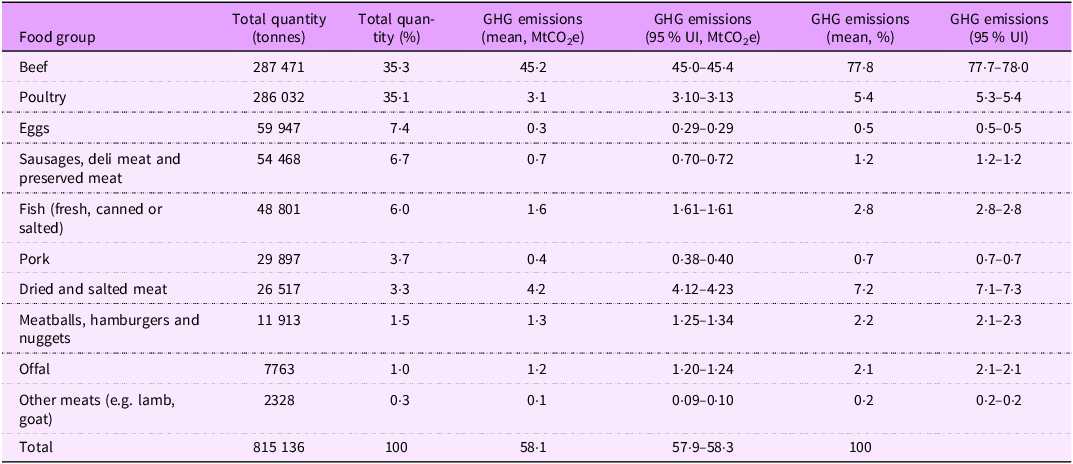
From 2013 to 2022, federal PNAE purchases totalled 815 136 tonnes of animal-source foods (Table 1). Beef accounted for the largest volume (287 471 tonnes), followed by poultry (286 032 tonnes) and eggs (59 947 tonnes). Beef also generated the largest share of GHG emissions during the period, contributing 77·8 % (95 %UL:77·7-78·0 %) of the total. Including dried/salted meats and offal, assigned the same emission factor as beef, this share rose to 85 %. Despite substantial purchase volumes, poultry, pork and fish contributed far smaller shares of emissions. Overall, animal-source food purchases produced approximately 58·1 MtCO₂e (95 %UL:57·9-58·3 MtCO2e) over the decade (Table 1).
Total quantity procured and cumulative greenhouse gas emissions associated with animal–source foods in the Brazilian National School Feeding Program, 2013–2022

Table 1. Long description
A table with 10 rows and 6 columns comparing the total quantity and greenhouse gas emissions of various animal-source foods. The columns are Food group, Total quantity (tonnes), Total quantity (percent), GHG emissions (mean, MtCO2e), GHG emissions (95 percent UI, MtCO2e), GHG emissions (mean, percent), and GHG emissions (95 percent UI, percent). Row 1: Beef, 287471, 35.3, 45.2, 45.0-45.4, 77.8, 77.7-78.0. Row 2: Poultry, 286032, 35.1, 3.1, 3.10-3.13, 5.4, 5.3-5.4. Row 3: Eggs, 59947, 7.4, 0.3, 0.29-0.29, 0.5, 0.5-0.5. Row 4: Sausages, deli meat and preserved meat, 54468, 6.7, 0.7, 0.70-0.72, 1.2, 1.2-1.2. Row 5: Fish (fresh, canned or salted), 48801, 6.0, 1.6, 1.61-1.61, 2.8, 2.8-2.8. Row 6: Pork, 29897, 3.7, 0.4, 0.38-0.40, 0.7, 0.7-0.7. Row 7: Dried and salted meat, 26517, 3.3, 4.2, 4.12-4.23, 7.2, 7.1-7.3. Row 8: Meatballs, hamburgers and nuggets, 11913, 1.5, 1.3, 1.25-1.34, 2.2, 2.1-2.3. Row 9: Offal, 7763, 1.0, 1.2, 1.20-1.24, 2.1, 2.1-2.1. Row 10: Other meats (e.g. lamb, goat), 2328, 0.3, 0.1, 0.09-0.10, 0.2, 0.2-0.2. Row 11: Total, 815136, 100, 58.1, 57.9-58.3, 100, 100.
GHG = greenhouse gases; MtCO₂e = million tonnes of carbon dioxide equivalent; UI = uncertainty interval. Note: 95 % UI = 2.5th–97.5th percentiles from 1000 Monte Carlo iterations.
Figure 1 shows that beef and poultry were consistently the most procured animal-source foods, with annual volumes above 30 000 tonnes until 2019. Procurement dropped sharply in 2020 across all groups, with beef and poultry reaching their lowest levels. From 2021, volumes began to recover, especially beef, which reached nearly 26 000 tonnes in 2022. Eggs and fish remained moderate and stable, while pork increased, particularly in recent years. In contrast, sausages/deli/preserved meat and dried/salted meat declined over time. When analysing procurement trends by food system cluster, beef and poultry dominated purchases in all regions. Absolute quantities were highest in Cluster B, totalling nearly 270 000 tonnes (beef and poultry combined), followed by Cluster C with more than 180 000 tonnes. Cluster D had the lowest overall procurement volumes. Detailed yearly quantities are in Supplementary Table 3.
Annual quantity of animal–source foods procured in the Brazilian National School Feeding Program, by food group for Brazil and food system clusters, 2013–2022 (in tonnes). Meatballs = meatballs, hamburgers, and nuggets; Sausages = sausages, deli meat and preserved meat. Inset map of Brazil (top right) showing the clusters A, B, C and D.

Assessing the relative contribution of each group highlighted temporal and regional variations (Figure 2, Supplementary Table 4). Beef and poultry consistently dominated across all contexts. Poultry’s mean share was slightly higher in Clusters A, C and D, whereas Cluster B had more beef (37·6 % v. 29·7 % for poultry). Nationally, the largest relative increases from 2013 to 2022 were pork (+5·8 %), poultry (+3·3 %) and beef (+2·0 %). In contrast, sausages/deli/preserved meats (–6·4 %), dried/salted meats (–3·2 %) and meatballs/hamburgers/nuggets (–1·5 %) declined. By cluster, beef’s share fell most in Cluster A (–7·8 %) but rose in all others, with Cluster D showing the largest increase (+6·4 %). Dried/salted meats fell sharply in Cluster D (–14·2 %) and C (–5·8 %). All clusters showed declines in meatballs/hamburgers/nuggets and sausages/deli/preserved meats.
Annual relative quantity of animal–source foods procured in the Brazilian National School Feeding Program, by food group for Brazil and food system clusters, 2013–2022 (in percentage). Meatballs = meatballs, hamburgers and nuggets; Sausages= sausages, deli meat, and preserved meat.

The largest GHG emissions from total animal-source foods procurement were recorded in 2014 (7·16 MtCO2e; 95 %UL:7·10–7·21), followed by 2013 (7·13 MtCO2e; 95 %UL:7·06–7·20) and 2019 (7·09 MtCO2e; 95 %UL:7·01–7·19) (Supplementary Tables 5 and 6). Beef was the dominant contributor across all years and regions, with its relative share rising by 8·1 (95 %UL:7·6–8·6) percentage points from 2013 to 2022 despite a decline in absolute emissions (Supplementary Tables 7 and 8). The greatest relative increase in beef emissions occurred in Cluster D, alongside a corresponding decline from dried/salted meats (Figure 3, Supplementary Figure 4).
Annual greenhouse gas emissions associated with animal–source foods procured in the Brazilian National School Feeding Program, by food group for Brazil and food system clusters, 2013–2022 (million tonnes of CO2e). Meatballs = meatballs, hamburgers, and nuggets; Sausages = sausages, deli meat and preserved meat. Inset map of Brazil (top right) showing the clusters A, B, C and D.

Figure 4 shows estimated reductions in total GHG emissions under beef substitution, sustainable sourcing and combined scenarios. Compared with baseline, scenario 1A (–20 % beef) reduced emissions by 16·2 % (95 %UL:11·0–18·7 %), with progressively larger cuts reaching 40·5 % (95 %UL:27·4–46·8 %) in scenario 1D (–50 % beef), equivalent to 2·3 MtCO₂e (95 %UL:0·66–6·80 MtCO₂e) per year. Sustainable sourcing, meaning progressive exclusion of deforestation-linked suppliers, offered smaller but relevant gains: 4·6 % (95 %UL:3·8–5·0 %), 15·5 % (95 %UL:12·7–16·7 %) and 31 % (95 %UL:25·4–33·5 %) reductions under scenarios 2A–2C. Notably, full exclusion of deforestation-linked suppliers (2C) achieved savings comparable to a 40 % beef reduction (1C). The largest reductions occurred, of course, when strategies were combined. Substituting 50 % of beef purchases while adopting deforestation-free sourcing cut emissions by 56 % (95 %UL:40·1–63·5 %). Detailed CO2e values for all scenarios are in Supplementary Table 9.
Projected greenhouse gas emissions under beef substitution, sustainable sourcing, and combined scenarios in the Brazilian National School Feeding Program. The dashed line represents baseline emissions. Percentages above bars indicate reductions relative to the baseline scenario. Scenarios 1A–1D represent reductions in beef procurement offset by proportional increases in poultry, pork, fish and eggs. Scenarios 2A–2C represent reductions in land–use change (LUC) emissions associated with beef production.

Discussion
From 2013 to 2022, Brazil’s National School Feeding Program procured large volumes of animal-source foods, mainly beef and poultry. Beef alone accounted for nearly four-fifths of the programme’s 58·1 MtCO₂e, underscoring its disproportionate impact. Procurement and emissions declined in 2020 and only partially recovered, while beef’s share rose by 8·6 percentage points over the decade. Strong heterogeneity emerged among clusters, with Cluster B (southern coastal) concentrating the largest volumes and emissions. These differences likely reflect a combination of regional food production systems, supply-chain characteristics, procurement practices and local implementation contexts, although these determinants could not be directly assessed with the available data. Scenario analyses revealed substantial mitigation potential through procurement reforms. Substituting part of beef with other animal-source foods could cut emissions by up to 40·5 %, while sustainable sourcing targeting land-use-change could add another 31 %. Combined, these strategies could halve emissions, showing meaningful climate gains are achievable without removing animal proteins from school menus. These findings align with global modelling showing meal composition as the main determinant of school-meal environmental footprints and that healthy menus can reduce impacts by 35–57 %, especially when coupled with waste reduction(Reference Springmann, Hansoge and Schultz25). For policymakers, this means that achievable adjustments within existing procurement structures could yield substantial climate benefits without compromising nutritional provision.
While beef remained central, changes in other meat categories also shaped the programme’s environmental profile. Purchases of sausages, deli, preserved and dried/salted meats declined steadily over the study period. This trend coincided with the Brazilian Dietary Guidelines in 2014(26), which discouraged processed meats, and the 2020 National Fund for Education Development resolution that formally restricted them(1). Yet, reductions in these categories occurred alongside increases in other meat categories. In cluster D, for instance, the largest decline in dried/salted meat procurement (–14·2 %) coincided with a 6·4 % increase in beef procurement. Although causal relationships cannot be inferred from the present analysis, these findings suggest that future evaluations of procurement policies should consider potential shifts among food categories and their implications for environmental outcomes.
Translating these mitigation potentials into practice requires consideration of social, cultural and economic trade-offs(Reference Loken, Dhar and Rapando27). Reducing beef in school menus may face resistance given its cultural centrality, as Brazil is among the world’s largest consumers, averaging 34·6kg per capita in 2022(28). Notably, between 1990 and 2018, red meat intake among Brazilian children and adolescents increased by approximately 2·4 servings per week, one of the largest rises globally(Reference Miller, Webb and Cudhea8). In addition, beef provides high-quality protein and essential micronutrients such as iron, zinc and vitamin B12, but excessive intake is associated with higher risk of non-communicable diseases(Reference Willett, Rockström and Loken13). Ensuring nutritional balance and dietary diversity is therefore crucial in procurement reforms. Because alternative animal-source foods differ in their nutritional composition, substitution strategies should be carefully designed to maintain the nutritional quality of school meals. Accordingly, our study examined substitutions among animal-source foods rather than legumes or plant-based proteins, though future research could expand the scope. For example, a school-based intervention in four cities in Bahia introducing fully plant-based menus twice weekly for over 32 000 students reduced GHG emissions by up to 17 %, while yielding both positive and negative changes in nutritional composition compared with conventional menus(Reference Kluczkovski, Menezes and Silva29).
Infrastructure constraints may also hinder diversification, as many schools lack adequate facilities and resources to prepare varied meals, limiting the substitution of beef with other proteins. Similar challenges occur in other low- and middle-income countries, where limited cooking infrastructure restricts sustainable school meals, and innovations such as electric cooking have been proposed as solutions(Reference Khalifa, Leach and Sieff30). Cost is another major concern, as beef is among the largest contributors to dietary expenses in Brazil, while poultry, pork and legumes can help reduce costs(Reference Caldeira, Vandevijvere and Swinburn31). Conversely, fish and eggs may remain relatively expensive and vary widely across regions(32). Although expanding provision entails additional food costs, part can be offset by lower climate-damage and illness costs, making healthy-sustainable school meals comparatively less expensive than average diets(Reference Springmann, Hansoge and Schultz25). These findings indicate that procurement reforms must be accompanied by investments in school kitchen infrastructure and by adequate per-meal funding, so that diversification efforts are operationally feasible, financially sustainable and equitably implemented across regions.
Beyond cost and infrastructure, regional adaptations are also essential. In our scenarios, reduced beef was equally redistributed among poultry, pork, fish and eggs to illustrate potential gains in diversity. However, poultry is already widely consumed, while less common foods such as fish could be encouraged if aligned with local culture and supply capacity. For instance, pork procurement has risen in Cluster B in recent years, whereas its share in Clusters C and D remains minimal, underscoring regional variation. Any reform must therefore balance climate goals with nutritional adequacy, affordability, cultural acceptability and operational feasibility. Addressing these regional differences also creates an opportunity to reduce social inequities, as more vulnerable regions could benefit most from diversified and sustainable school menus.
Current research highlights the potential of school feeding and other public procurement programmes to promote sustainable diets and support climate mitigation(Reference Parsons and Barling11,Reference Swensson and Tartanac12,Reference Pastorino, Backlund and Bellanca33) . While much of this literature emphasises regulatory frameworks, menu reform and the potential of school meals to leverage food-system change, fewer studies have quantified emissions using actual nationwide procurement records. In Brazil, studies on the PNAE have focused mainly on nutritional, social and economic outcomes, with little attention on environmental aspects. Existing evidence is limited to local evaluation, such as in Piauí(Reference Bezerra, Carvalho and Barbosa34) and Paraíba(Reference Farias, Lacouth and Rodrigues35), which also found that beef had the greatest impact and suggested restricting its inclusion in school menus. To our knowledge, this is the first study to systematically quantify GHG emissions from PNAE procurement at the national level, filling a critical gap and providing evidence at the scale required to guide the integration of sustainability into school feeding policies and inform federal-level procurement reforms. In addition, the use of uncertainty analyses based on Monte Carlo simulations allowed the variability reported in the underlying emission-factor database to be incorporated into the estimates, increasing the robustness of the results despite the heterogeneity inherent to food production systems.
The predominance of beef in PNAE-related emissions reflects how procurement patterns intersect with Brazil’s cultural valorisation of beef in dietary habits(Reference Hase-Ueta, Tanaka and Marchioni9). However, given its scale and institutional reach, the PNAE offers a unique opportunity to use public procurement as a driver of sustainable food systems. This policy not only influences the diets of approximately 40 million students daily but also shapes local markets, supply chains and production practices. Importantly, the PNAE already operates under a robust legislative framework that promotes healthy eating, restricts ultra-processed foods and supports procurement from family farming(1). Building on these existing principles, the incorporation of environmental sustainability criteria into procurement guidelines may represent an incremental extension of the programme’s objectives rather than a fundamental policy shift. In practice, such criteria could include limits on the frequency of high-emission foods, deforestation-free sourcing requirements for beef products and the inclusion of sustainability indicators in menu planning and procurement processes. Notably, the sustainable cattle sourcing commitments in the Amazon biome (known as the Termos de Ajuste de Conduta) are coordinated by the Federal Public Prosecutor’s Office; including the Termos de Ajuste de Conduta into PNAE procurement criteria would therefore represent a harmonisation of action across government entities. Incorporating environmental sustainability into procurement guidelines could generate co-benefits, from reducing GHG emissions and conserving natural resources to fostering healthier and more diversified diets. However, translating these opportunities into practice will require addressing the economic, infrastructural, logistical and cultural challenges discussed above. Beyond the national context, these findings align with international efforts toward achieving the Sustainable Development Goals(Reference Watkins, Fiala and Haag2,Reference Springmann, Hansoge and Schultz25,Reference Pastorino, Backlund and Bellanca33) , which emphasise the role of school feeding in advancing health, equity and sustainability. Recent global analyses suggest that healthy and sustainable school meals could substantially reduce environmental impacts worldwide(Reference Springmann, Hansoge and Schultz25). While such studies have primarily relied on modelled dietary scenarios, our findings provide complementary evidence based on a decade of actual procurement records from one of the world’s largest school feeding programmes. By quantifying the PNAE’s climate footprint and modelling mitigation scenarios, this study provides large-scale evidence to guide national reforms and contribute to global debates on the role of school meals in promoting planetary health.
This study has some limitations that may affect the interpretation of both the emission estimates and mitigation scenarios. First, we assessed procurement data only up to 2022, as access to more recent information was restricted due to changes in the official accounting system. Second, the system records only purchases made with federal funds transferred by National Fund for Education Development to executing entities (i.e. municipal and state government departments), excluding the additional resources these entities often invest to complement federal transfers. While, in 2022, 25 % of municipalities reported being fully reliant on federal funding for school meals, 75 % of municipalities topped-up federal funding with other sources (Supplementary Figure 5)(1), meaning that our results capture only a portion of consumed school meal food purchases. Consequently, the estimates presented here should be interpreted as a lower-bound approximation of emissions associated with animal-source food procurement in the PNAE. Another limitation relates to the emission factors used in the analysis. Although Poore and Nemecek’s database represents one of the most comprehensive and internationally comparable sources available for food-related environmental impacts, the use of average emission factors does not fully capture the substantial variability observed among production systems, regions and producers. For example, emissions associated with beef production can vary considerably according to feeding practices, productivity, land-use change and supply-chain characteristics. We used Monte Carlo resampling to capture variation in emission estimates per food group reported within the Poore and Nemecek dataset, though our estimates should be interpreted as national approximations of procurement-related emissions rather than precise estimates of emissions associated with specific suppliers or production systems participating in the PNAE. Despite these limitations, the adopted approach provides a useful approximation of the relative contribution of different animal-source foods to PNAE-related emissions and allows exploration of plausible mitigation pathways at the national level. Our results show that the adoption of sustainable supply chain commitments could make a material contribution to reducing the environmental impact of Brazil’s school meal programme. Again, these estimates are conservative, because our environmental impact data(Reference Poore and Nemecek7) attribute a smaller share of beef emissions to deforestation (29 % v. 70 % in The Greenhouse Gas Emissions and Removals Estimating System)(Reference Alencar, Zimbres and Souza6), compared with Brazil’s GHG accounts. Similarly, by focusing on reforms within the category of animal-source foods rather than on their reduction, our analysis provides a culturally sensitive yet conservative estimate of the mitigation potential of procurement changes.
Future research should incorporate more recent data as they become available and account for complementary funding from states and municipalities to capture the full scope of school food provision. Additional studies could further examine the determinants of temporal changes in procurement patterns, including the influence of policy reforms, procurement decisions across food groups and regional implementation characteristics on the environmental performance of the PNAE. Expanding assessments beyond GHG emissions to include water use, biodiversity and soil health would also provide a more comprehensive understanding of sustainability trade-offs. Future work should additionally evaluate the cost implications, operational feasibility and acceptability of different procurement scenarios, including plant-based alternatives, to inform the practical implementation of sustainable changes in school feeding. Finally, studies could investigate differences in environmental impacts according to supplier characteristics, including procurement from family farming, which plays a central role in the PNAE and may influence food supply chains and sustainability outcomes.
In conclusion, the PNAE’s procurement of animal-source foods, particularly beef, generates substantial GHG emissions and represents an important source of the programme’s climate footprint. The mitigation scenarios evaluated in this study indicate that reducing reliance on beef procurement and adopting deforestation-free sourcing strategies could substantially decrease emissions associated with animal-source food purchases. Although the implementation of such strategies would depend on contextual factors such as food availability, infrastructure, supply-chain conditions and cultural preferences, the estimated reductions highlight the potential contribution of procurement decisions to climate mitigation. By quantifying these opportunities at the national level, this study provides evidence to inform discussions on the environmental implications of public food procurement within school feeding programmes.
Supplementary material
For supplementary material accompanying this paper visit https://doi.org/10.1017/S1368980026103449
Acknowledgements
None.
Financial support
This work was supported by ICs - Instituto Clima e Sociedade (D-24-01752); INCT de Combate à Fome, funded by CNPq (406774/2022-6); NICFI - Norway’s International Climate and Forest Initiative (BRA-22/0017) and the European Union (ERC, DOMESTIC Grant agreement No. 101162844).
Competing interests
None.
Author contributions
Conceptualisation: J.L.P., A.M.C.; Data curation: J.L.P., D.M.T.R., G.R., B.P.G., J.S.S.F.; Formal analysis: J.L.P.; Methodology: J.L.P., A.M.C., D.M.L.M., E.E., S.M.A.D.; Funding acquisition: A.M.C.; Investigation: J.L.P., D.M.T.R., G.R., B.P.G., J.S.S.F.; Project administration: A.M.C Supervision: A.M.C., D.M.L.M., E.E., S.M.A.D.; Validation: J.L.P., A.M.C.; Writing – original draft: J.L.P.; Writing – review and editing: J.L.P., D.M.T.R., G.R., B.P.G., J.S.S.F., D.M.L.M., E.E., S.M.A.D., A.M.C. All authors critically reviewed the manuscript and accepted the final version.
Ethical standards
This study used exclusively publicly available, de-identified secondary data obtained from a government transparency platform. As no individual-level or sensitive information was accessed, ethical approval was not required under Brazilian regulations or international research ethics guidelines.


 Open access

