Introduction
It is well known that eating problems occur in association with cognitive dysfunction, psychiatric problems, and decline of daily activity in individuals with dementia (Frissoni et al., Reference Frissoni, Volicer and Hurley1998; Holm and Soderhamn, Reference Holm and Soderhamn2003). It is also known that eating/swallowing problems are associated with extrapyramidal signs (EPS) in Parkinson's disease (PD), almost half of all patients having some kind of eating problem (Liberman et al., Reference Liberman1980). Dementia with Lewy bodies (DLB) is a dementing disorder clinically characterized by marked fluctuations in cognition, visual hallucinations, EPS, and sensitivity to typical neuroleptics (McKeith et al., Reference McKeith1996; Reference McKeith2006). As DLB is clinically and pathologically related to PD, eating/swallowing problems have been considered common in DLB patients because of their EPS, autonomic dysfunction, fluctuations in cognition, and psychiatric problems. In a recent report from the DLB Consortium, “eating and swallowing difficulties” are described as a part of autonomic dysfunction in supportive diagnostic features (McKeith et al., Reference McKeith2005). For DLB patients and their caregivers, it is important to evaluate the clinical background to eating / swallowing problems.
DLB is the second most common form of dementia after Alzheimer's disease (AD), accounting for 15–20% of dementia cases in pathological studies (McKeith et al., Reference McKeith1996). However, to our knowledge, only a few systematic studies have investigated eating/swallowing problems in DLB patients (McKeith et al., Reference McKeith2006). The aim of the present study was to clarify the frequency and characteristics of eating/swallowing problems in DLB patients, and their relationship to other symptoms.
Methods
Subjects
The study participants comprised 29 consecutive outpatients attending the Higher Brain Function Clinic of the Department of Neuropsychiatry, Ehime University Hospital, Japan, with a diagnosis of probable DLB according to the international working group criteria (McKeith et al., Reference McKeith1996), between June 2005 and September 2005. Thirty-three patients with AD were also selected, matched for age and Mini-mental State Examination (MMSE) score (Folstein et al., Reference Folstein, Folstein and McHugh1975), clinical dementia rating (CDR) score (Hughes et al., Reference Hughes1982), and education. Patients with AD satisfied the criteria for probable AD developed by the National Institute of Neurological and Communicative Disorders and Stroke and the Alzheimer's Disease and Related Disorders Association (McKhann et al., Reference McKhann1984). All subjects with DLB and AD underwent magnetic resonance imaging (MRI) and HMPAO-SPECT. All subjects were evaluated by senior neuropsychiatrists and underwent both physical and neurological examinations, as well as standard psychiatric evaluation, to exclude major functional psychiatric disorders such as schizophrenia or mood disorders. We also employed the usual battery of screening blood tests including vitamin B12 and thyroid function assessment to exclude treatable causes of dementia. All of the subjects were living with reliable caregivers. After a complete description of the study was presented to all patients or their caregivers, written informed consent was obtained.
Patients were assessed using a comprehensive battery of neuropsychological and neuropsychiatric tests, including MMSE, digit span test, verbal fluency test, Raven's Coloured Progressive Matrices (Raven et al., Reference Raven, Court and Raven1990), CDR, and neuropsychiatric inventory (NPI; Cummings et al. Reference Cummings1994). We used the Unified Parkinson Disease Rating Scale (UPDRS) Part 3 score (motor score) to evaluate the severity of extrapyramidal signs (Fahn et al., Reference Fahn and Elton1987). Caregivers were also asked whether the patients had fluctuations in cognitive functioning, or used neuroleptic or antiparkinsonian drugs. Patients' present weights were also measured.
Assessment of eating problems
In order to assess the characteristics of eating/swallowing problems in DLB patients, we used a comprehensive questionnaire that had originally been designed to assess eating/swallowing problems in patients with frontotemporal dementia/AD (Ikeda et al., Reference Ikeda2002), and had been revised for DLB patients. The questionnaire comprised 40 items investigating the following five domains: swallowing problems, appetite change, food preferences, eating habits, and other oral behaviors. Revision of the eating/swallowing questionnaire was conducted by adding four new questions relating to DLB and deleting seven questions relating to frontotemporal dementia. For example, “Episodes of spontaneous vomiting” and “Episodes of self-induced vomiting” were unified into a single item, and items such as “Fluctuation in swallowing ability” were added. We confirmed the validity of the revised questionnaire items by piloting this version of the prototype with DLB and AD patients. Information was gathered from caregivers familiar with the patients' eating problems. It was emphasized that a “symptom” should reflect a substantive change from the patient's premorbid state and was not a longstanding eating habit. If caregivers endorsed a particular item, they were asked to rate the frequency (0 = never; 1 = occasionally, less than once per week; 2 = often, about once per week; 3 = frequently, several times per week but less than every day; 4 = very frequently, once or more per day or continuously); and severity (1 = mild, easily controlled; 2 = moderate, not easily controlled; 3 = marked, embarrassing or otherwise disturbing to the family). For each eating problem item, we derived a product score of frequency × severity analogous to the method applied in the NPI (Cummings et al. Reference Cummings1994). We compared the product scores (frequency × severity) for each item between the DLB and AD groups. The rater who administered the questionnaire was blind to the patients' diagnosis.
Statistical analyses
Data analyses were carried out using the SPSS-PC software package. The significance of differences in age and education between the two groups was analyzed using the t-test. The Mann-Whitney U test was used for the comparison of MMSE score, CDR score, UPDRS score, NPI, and product score for each item between the two groups.
After comparing the product score for each item between the two groups, multiple regression analysis was conducted in order to investigate factors that most affected each eating problem item. In the stepwise multiple regression analysis, we assumed each item score to be a dependent variable and assumed that age, sex, MMSE score, CDR score, NPI score, UPDRS score, fluctuation, and usage of neuroleptic drugs were independent variables.
Results
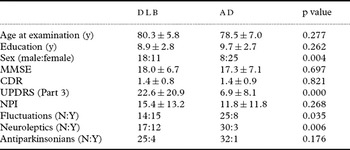
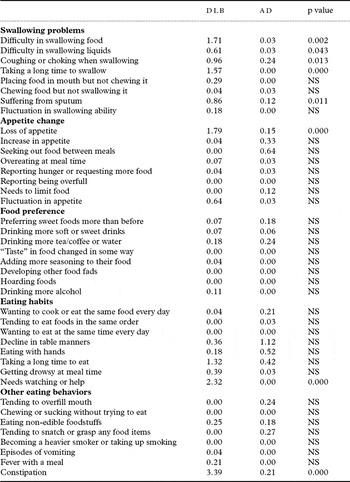
Demographic variables of the two patient groups are summarized in Table 1. There were significant differences in the sex ratio, UPDRS score, presence of fluctuations in cognitive functioning, and use of neuroleptic drugs between the two groups. All the neuroleptic drugs used in both groups were atypical neuroleptics such as quetiapine. There was no significant difference in present body weight between the two groups. The scores (frequency × severity) for each symptom items between the two groups are summarized in Table 2. DLB patients scored significantly higher in items for “difficulty in swallowing foods,” “difficulty in swallowing liquids,” “coughing or choking when swallowing,” “taking a long time to swallow,” “suffering from sputum,” “loss of appetite,” “needs watching or help,” and “constipation.” There were no items for which AD patients scored significantly higher than DLB patients.
Demographic variables of the two patient groups

Mean ± SD or N; MMSE = Mini-mental State Examination; CDR = clinical dementia rating; UPDRS = Unified Parkinson disease Rating Scale; NPI = neuropsychiatric inventory.
The scores (frequency × severity) for each symptom domain in the two groups

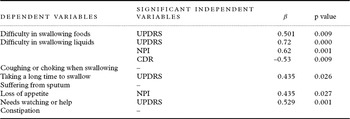
Multiple regression analysis was conducted for each of the items in which DLB patients scored significantly higher than AD patients. The results of the stepwise multiple regression analysis are summarized in Table 3. The UPDRS score significantly affected the “difficulty in swallowing foods” score; the UPDRS score, NPI score and CDR score significantly affected the “difficulty in swallowing liquids” score; no significant independent variable affected the “coughing or choking when swallowing” score; and the UPDRS score significantly affected the “taking a long time to swallow” score. No significant independent variables affected the “suffering from sputum” scor; the NPI score significantly affected the “loss of appetite” score; the UPDRS score significantly affected the “needs watching or help” score; and no significant independent variable affected “constipation” score.
Factors affecting each eating questionnaire item

CDR = clinical dementia rating; UPDRS = Unified Parkinson disease Rating Scale; NPI = neuropsychiatric inventory.
Discussion
Our results indicated that DLB patients showed a higher incidence of eating/swallowing problems than AD patients, when matched for age, MMSE score, CDR score and education. As expected, most of the problems were involved in the swallowing domain: “difficulty in swallowing foods,” “difficulty in swallowing liquids,” “coughing or choking when swallowing,” “taking a long time to swallow,” “suffering from sputum,” along with some problems in other domains such as “loss of appetite,” “needs watching or help,” and “constipation.” Except for “needs watching or help”, no problems in the eating habits domain and food preference domain were noted.
“Difficulty in swallowing foods” was affected only by UPDRS score, whereas “difficulty in swallowing liquids” was affected by UPDRS score, NPI score, and CDR score. This difference between swallowing foods (solid) and swallowing liquids (fluid) may reflect the difference in the underlying mechanism. Liquid has a shorter oral stage than solids, and the speed of flow into the pharynx is fastter (Logemann, Reference Logemann1988). Initiation of the deglutition reflex is likely to be delayed when swallowing liquids. It is difficult to swallow if the flow speed is faster than the swallowing movement. Difficulty in swallowing liquids is likely to occur in neuromuscular disease and pharyngeal disease (Feinberg and Ekberg, Reference Feinberg and Ekberg1994). Our results for the relationship between NPI/CDR score and difficulty in swallowing liquids may suggest problems at the anticipatory stage in DLB patients. This idea is supported by the view that patients with attention disturbances have problems at the anticipatory stage and tend to develop swallowing difficulties (Feinberg et al., Reference Feinberg1992). The “difficulty in swallowing foods” item scored higher than the “difficulty in swallowing liquids” item indicating that problems in swallowing foods are more common than problems in swallowing liquids. However, swallowing liquids may require more accurate control of muscles and nerves than swallowing solids. Clinicians should be aware of this difference in the mechanism, and should ask caregivers which problems are dominant when managing DLB patients.
It was noteworthy that only the NPI score affected “appetite loss.” Visual hallucinations, which are the most common psychiatric symptom in DLB, may lessen a patient's appetite. It has been pointed out that visual hallucinations disturb patients' concentration while eating food (Kindell, Reference Kindell2002), which may explain why the NPI score affected “appetite loss.” However, future assessment of the mechanism whereby psychiatric symptoms according to the NPI affect patients' appetite is required.
Multiple regression analysis demonstrated no significant independent variables affecting the “coughing or choking when swallowing” and “suffering from sputum” scores. EPS, psychiatric symptoms and severity of dementia did not affect these scores, and they may reflect some other mechanism such as autonomic dysfunction. No significant independent variables affected the “constipation” score, because constipation may be the direct result of autonomic dysfunction (Thaisetthawatkul et al., Reference Thaisetthawatkul2004). A previous study noted that 83% of patients with pathologically confirmed DLB showed constipation (Horimoto et al. Reference Horimoto2003), and our results also support this high frequency of constipation in DLB patients.
There are a few methodological issues that should be taken into consideration when interpreting our results. First, although we compared DLB and AD patients, we did not compare DLB and patients with Parkinson's disease without dementia. Therefore, it is still unclear whether our results are DLB-specific problems or problems common to both PD and DLB. Secondly, significantly more neuroleptic drugs were used in DLB patients. As DLB patients are very sensitive to such drugs, which may produce EPS and other adverse reactions (McKeith et al., Reference McKeith1996; Ballard et al., Reference Ballard1998), this use of neuroleptic drugs may result in a high frequency of swallowing and eating problems in DLB patients. However, use of neuroleptic drugs did not affect any items in the multiple regression analysis, and did not provoke severe neuroleptic sensitivity reactions under close supervision. For accuracy, we need to conduct further research comparing DLB and AD patients who do not use any drugs and their swallowing and eating problems, although it would be very difficult in a clinical and hospital-based setting. Thirdly, longitudinal changes in patients' weight were not recorded, and therefore we cannot discuss the difference in weight loss between the two groups in this study.
In conclusion, eating and swallowing problems were more frequent in patients with DLB than in patients with AD. Eating problems were relatively few in AD patients, at least at the mild stage, and this result is consistent with previous studies (Bozeat et al., Reference Bozeat2000; Ikeda et al., Reference Ikeda2002). Although DLB patients show many eating problems, the causes of each problem vary, and are not solely dependent on the severity of dementia or parkinsonism. It is necessary to be cautious about swallowing and eating problems in order to prevent accidents when managing DLB patients. For caregivers, it may be more difficult to understand eating/swallowing problems in neurodegenerative disorders than those related to vascular disease. Education of family caregivers and care staff about eating/swallowing problems in DLB patients is also important for clinicians.
Conflict of interest
None.
Description of authors' roles
S. Shinagawa collected the data, carried out the statistical analysis, and wrote the manuscript. H. Adachi, Y. Toyota and T. Mori collected the data. I. Matsumoto and R. Fukuhara provided critical comments on an earlier draft of the paper. M. Ikeda designed the study and provided critical comments for an earlier draft of the paper.
Acknowledgments
We would like to thank the late Professor H.Tanabe for his encouragement and helpful suggestions on our research.