Introduction
Copepod species of the genus Caligus are fish parasites and are commonly known as sea lice. Caligus spp. feed on mucus, skin and blood of the host fish. These parasitic copepods also have a great capacity to invade new environments, through displacement of water from infested environments to different regions. Therefore, infestations are frequent both in farmed and wild fish populations (Okawachi et al., Reference Okawachi, Ohtsuka, Binti, Venmathi Maram and Ogowa2012; González et al., Reference González, Valerio, Muñoz and Vargas-Chacoff2016; Jensen et al., Reference Jensen, Zydlewski, Barker and Pietrak2016). Sea lice affect survival or reproduction of their host and are responsible for most disease outbreaks in aquaculture, having caused high levels of mortality with catastrophic economic losses (Johnson et al., Reference Johnson, Treasurer, Bravo, Nagasawa and Kabata2004).
Parasitic copepods may be the hosts of several groups of epibionts or parasites, such as protozoans, monogeneans and isopods (Walkusz & Rolbiecki, Reference Walkusz and Rolbiecki2005). In the case of monogeneans, many papers have reported the presence of the monogenean Udonella living on Caligus species (Carvajal et al., Reference Carvajal, Ruiz and Sepúlveda2001; Fuentes et al., Reference Fuentes, Sprock, Mago and Chincilla2009; Okawachi et al., Reference Okawachi, Ohtsuka, Binti, Venmathi Maram and Ogowa2012). However, the nature and dynamics of the Udonella–Caligus association are still uncertain. Some authors have labelled this association as a parasitism (Fuentes et al., Reference Fuentes, Sprock, Mago and Chincilla2009; Okawachi et al., Reference Okawachi, Ohtsuka, Binti, Venmathi Maram and Ogowa2012), without examining the dynamics of cost and benefit on survival and reproduction for both monogenean and copepod. Nevertheless, other authors, such as Carvajal et al. (Reference Carvajal, Ruiz and Sepúlveda2001) and Marin et al. (Reference Marín, Carvajal and George-Nascimento2002), have found that the fecundity and egg hatching of the host are not affected, and the egg capsules or genital complex of the host are not damaged. Therefore, these authors have concluded that this association may be labelled as commensalism.
Therefore, knowledge about the ecology of associations involving aquatic helminths is still poor and in Neotropical regions, particularly, it is almost completely unknown (Aguirre-Macedo et al., Reference Aguirre-Macedo, May-Tec, Martínez-Aquino, Cremonte and Martonelli2016). Here, we analyse an association between a monogenean (Udonella cf. caligorum Johnston 1835) and a parasitic copepod species (Caligus sp.) living on a wild population of Arius herzbergii Bloch, 1794, a Neotropical catfish species from Venezuela. This work was carried out to characterize infestation and to analyse its effects on fecundity, hatching success and damage to egg capsules and the genital complex of the host.
Materials and methods
Specimens of the fish (A. herzbergii) for study were collected in July and December 2008 in the tropical coastal lagoon ‘Las Marites’, located on the south-eastern coast of Margarita Island of north-eastern Venezuela, in the Caribbean Sea (10°53′50″–10°55′N, 63°53′54″–63°57′20″W). More information on this location is given in Palazón et al. (Reference Palazón, Hernández, Hernández and Penoth1996). Fish were transported alive to the laboratory, where fish were anaesthetized with benzocaine. For each fish, the body surface (integument) was checked in detail for the presence of parasitic copepods.
Parasitic copepods were removed by skin scraping with a slide, from the opercular base to the caudal peduncle of the fish, using tweezers. All the samples (scrapings) were placed separately in Petri dishes with filtered seawater and observed under a stereoscopic microscope.
Epibionts on copepods were observed in vivo. These were fixed with 70% ethanol and photographed to measure the body size (total length). Their sex was identified and stages of development were separated.
The effect of Udonella on fecundity (number of eggs per female) was determined by comparing the fecundity of 30 infested ovigerous females with that of 30 non-infested ovigerous females.
The hatching success of eggs from both infested ovigerous females and those non-infested with Udonella was measured by counting the eggs carried for each female. Observations of these, maintained in 0.2 mm of culture medium (UV-sterilized filtrated seawater) at a temperature of 30°C and photoperiod 12:12, were carried on until egg hatching occurred (Carvajal et al., Reference Carvajal, Ruiz and Sepúlveda2001).
In the copepod host, histological tissues of egg capsules and the genital complexes of females, with and without monogeneans (30 females of each one), were prepared and stained according to Luna (Reference Luna1968) and observed for damage or lesions.
Relationships between measured variables were analysed using Pearson correlations at a significant level of P = 0.05. Comparisons were made using Student's t-test or χ2 at a significant level of P = 0.05. All analyses were made using the statistical software SPSS 24.0 (SPSS Inc., Chicago, Illinois, USA).
Results
Characteristics of infestation of the monogenean on the copepod host
We analysed a total of 218 Caligus specimens. These included 94 males, 110 females (of these, 30 were ovigerous) and 14 immature stages, in which a total of 1017 monogeneans were found. These included 311 mature stages and 706 egg capsules. Monogenean stages were found attached to the cephalothorax, abdomen, genital complex and egg capsules of the copepods.
The prevalence of infestation was 45.47% and the intensity of infection was between 1 and 57 monogeneans/copepod, with a mean value of 4.67 monogeneans/copepod. Although the prevalence of monogeneans was higher on females than male copepods, statistical analysis of the relationship between the host sex and the prevalence showed that there was no significant association between the two variables (χ2 = 1.04; P = 0.308).
Similarly, analysis of the correlation between body size and intensity of infestation, both in females and males analysed separately, was not significant (r = 0.036, P = 0.709 for females; r = 0.105, P = 0.312 for males).
Comparison of fecundity of infested and non-infested ovigerous females
Body size showed a mean value of 3.9 mm in infested ovigerous females and 4.2 mm in those not infested. However, differences in body size were not significant when infested and non-infested ovigerous females were compared (t = 1.579, P = 0.119).
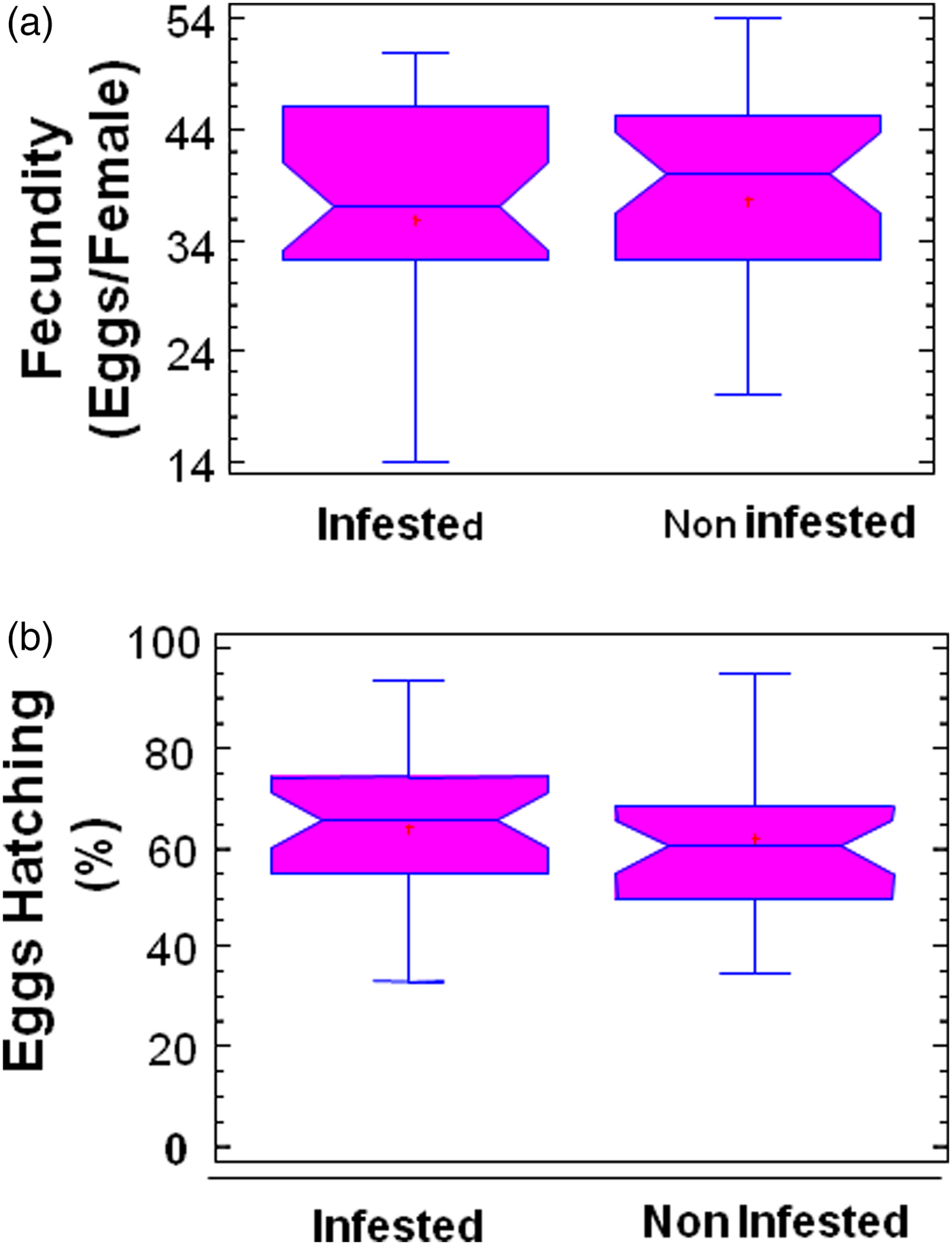
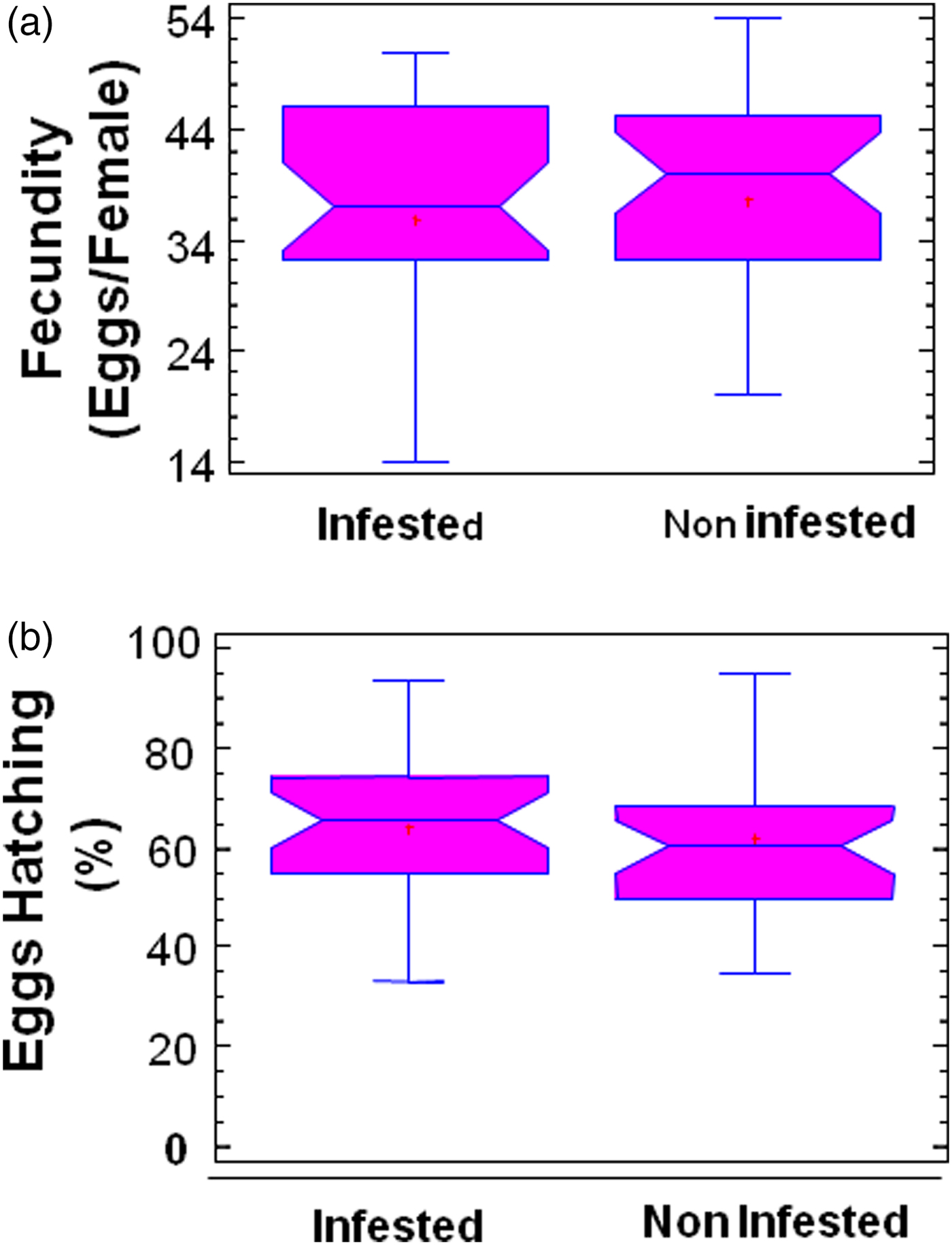
The mean values of fecundity were 38 eggs/female for infested ovigerous females and 36 eggs/female for non-infested ovigerous females (fig. 1a). Differences were not significant (t = −0.645, P = 0.521).
Reproductive parameters of infested and non-infested copepod hosts: (a) fecundity; (b) percentage of eggs hatching.
Success of egg hatching in infested and non-infested ovigerous females
The percentage of eggs hatching from non-infested ovigerous females was between 38.29 and 93.75% (mean = 64.30 ± 6.52%), and between 34.15 and 95.12% (mean = 61.76 ± 6.00%) in those from infested ovigerous females (fig. 1b). No significant differences were found (t = 0.585, P = 0.561).
Histological analysis of egg capsules and genital complexes
In infested ovigerous females, eggs of U. caligorum were found attached to the terminal section of the genital complex, while mature stages of this monogenean were found on both the cephalothorax and egg capsules.
Histological analysis of sections of the structures involved in the adhesion of monogeneans to egg capsules of Caligus sp., stained with haematoxylin–eosin, showed an absence of mechanical lesions (tissue discontinuity). Likewise, sections obtained from the genital complex of infested females did not show signs of morphological or histological alterations.
Discussion
Udonella spp. may have adverse effects on the host, because of mechanical action on the body surface and genital structures. According to Messick et al. (Reference Messick, Vanderploeg, Cavaletto and Tyler2004), necrotic tissues derived from injury or trauma, and formation of tumour masses, in copepods are consistent with death or irreversible cell damage. This damage can be detected in the cytoplasm as hypereosinophilia and loss of normal structure; and in the nucleus as pyknosis, diffusion or enlargement. Our histological analysis of the sections of tissue obtained from genital areas and egg capsules of the host did not show apparent damage or lesions. Similar results were reported by Carvajal et al. (Reference Carvajal, Ruiz and Sepúlveda2001) in another association of Caligus and Udonella. The explanation for these results is that udonellids have an attenuated haptor composed of a cup-shaped suction cup, devoid of hooks or septa, by which it attaches to the host, Caligus sp., by suction (Marin et al., Reference Marín, Carvajal and George-Nascimento2002; Fuentes et al., Reference Fuentes, Sprock, Mago and Chincilla2009), instead of a haptor armed with anchors and marginal hooks, and/or staples supported by sclerites (Bruno et al., Reference Bruno, Nowak and Elliot2006). Soft structures do not seem to produce mechanical damage (cell atrophy, necrosis, erosion, ulceration) at the site of attachment.
Some parasites and epibionts may affect survivorship and reproduction of free copepods (Xu & Burns, Reference Xu and Burns1991; Weissman et al., Reference Weissman, Londsdale and Yen1993), usually by limiting movements (increasing predation vulnerability), competing for food (Visse, Reference Visse2007) or physically interfering in the mating process (Souissi et al., Reference Souissi, Souissi and Hwang2013). In ectoparasitic copepods, movements are limited to the host body (Kabata, Reference Kabata1973) and the host represents a successful refuge from predators. Therefore, negative effects of monogenean infestation on survivorship and reproduction of copepod hosts may be through food competition or interference with mating.
Some authors have suggested that both monogeneans and ectoparasitic copepods seem to feed on the mucus produced by the body of the fish (Kabata, Reference Kabata1973; Carvajal et al., Reference Carvajal, Ruiz and Sepúlveda2001). Therefore, food competition is likely a predictable interaction in this association. However, we also found that monogeneans are frequently located on the genital complex of the host and thus interference with mating is also possible. The strength of food competition and mating interference depends on the intensity (for individuals) and prevalence of infestation (for the population). Therefore, the nature of this association may change in relation to environmental conditions and time scales, in concordance with the idea that interactions between organisms exist along a continuous gradation and are not neatly delineated (Leung & Poulin, Reference Leung and Poulin2008). Our results suggest that this association, at the observed level of prevalence and intensity of the infestation, is closer to commensalism than to any other interaction. Labelling these associations as static processes, based only on the existence or absence of damage or lesions on the host, does not reflect their true nature and the dynamics of this association in nature. Caution is urged when using labels such as parasitism, mutualism or commensalism to describe associations between monogeneans and their hosts. It should be considered that effects are density dependent and the costs to both components of the association should be evaluated.
Acknowledgements
We thank the referees for their comments and observations, which contributed to the improvement of an early version of the manuscript. We appreciate the help of Dr E. Gómez and Dr J. Palazón in lab work and statistical analysis. The infrastructure and laboratory facilities of the Universidad del Zulia and Universidad de Oriente of Venezuela made this research possible. Special thanks go to F. Morales and Professor K. Tambay and the AWT team of Escuela Superior Politécnica del Litoral, Ecuador for English grammar revision.
Financial support
This research received no specific grant from any funding agency, commercial or not-for-profit sectors.
Conflict of interest
None.