Introduction
India is a vast reserve of 37 indigenous goat breeds with a total population of 148.88 million goats (Livestock Census, Reference Census2019; NBAGR, 2022). Goat farming is one of the major enterprises, especially for small and marginal households in India. An increasing demand for goat meat has triggered the interest in farmers to start goat farming and has produced more kids in recent years. Furthermore, the growth and survival of kids have been the most important aspects for goat farmers as they are directly associated with farm income (Kumar et al., Reference Kumar, Singh and Bangar2013; Magotra et al., Reference Magotra, Bangar and Yadav2022). In addition to this, an early growth rate is more cost effective for profitable goat farming (Magotra et al., Reference Magotra, Bangar, Chauhan, Malik and Malik2021a). It has been reported previously that genetic and environmental factors affect initial growth performance up to slaughter age, and ultimately influence farmer income (Boujenane and Hazzab, Reference Boujenane and Hazzab2008; Zhang et al., Reference Zhang, Zhang, Xu, Li, Su and Yang2009; Gowane et al., Reference Gowane, Chopra, Prakash and Arora2011; Lalit et al., Reference Lalit, Malik, Dalal, Dahiya, Magotra and Patil2016; Bangar et al., Reference Bangar, Magotra and Yadav2020; Dige et al., Reference Dige, Rout, Singh, Dass, Kaushik and Gowane2021; Magotra et al., Reference Magotra, Bangar and Yadav2021b; Bangar et al., Reference Bangar, Magotra and Yadav2022b).
In addition to growth performance, litter size in goats is also an important parameter in goat production systems that directly contributes to higher economic returns for goat farmers (Song et al., Reference Song, Jo and Sol2006; Bangar et al., Reference Bangar, Magotra, Yadav and Chauhan2022a). Genetics, along with breeding and feeding practices, may contribute to larger litter sizes in goats and, furthermore, selection based on molecular markers and stringent breeding plan could achieve the desired genetic progress in flocks (Rashidi et al., Reference Rashidi, Bishop and Matika2011; Kebede et al., Reference Kebede, Haile, Dadi and Alemu2012; Mohammadi et al., Reference Mohammadi, Moradi Shahrebabak and Moradi Shahrebabak2012; Selvan et al., Reference Selvan, Gupta, Verma, Chaudhari and Magotra2016; Mokhtari et al., Reference Mokhtari, Asadi Fozi, Gutierrez and Notter2019; Jeet et al., Reference Jeet, Magotra, Bangar, Kumar, Garg, Yadav and Bahurupi2022). However, published literature suggests that litter size in goats is a low-heritable trait and, therefore, it is less favourable for selection for flock improvement (Mellado et al., Reference Mellado, Mellado, García and López2005; Bangar et al., Reference Bangar, Magotra, Yadav and Chauhan2022a). This indicated the importance of management practices for rearing by goat farmers and for improving litter size, and also simultaneously litter weight and survival (Song et al., Reference Song, Jo and Sol2006; Lopez-Sebastián et al., Reference Lopez-Sebastián, Coloma, Toledano and Santiago-Moreno2014). The identification of litter size among pregnant does in advance may give an advantage to goat farmers in optimizing farm practices to increase farm profits (Mellado et al., Reference Mellado, Mellado, García and López2005). The required attention through nutritional and health aspects to pregnant does with twins or more litter size could provide better returns to farmers through higher birth weights, and better survival of kids as well as dams (Pan et al., Reference Pan, Biswas, Majumdar, SenGupta, Patra, Ghosh and Haldar2015).
The detection of litter size using ultrasonography is the safest and most reliable technique; however the cost of instrumentation and availability at the farmer’s door is not suitable for goat farmers in developing countries such as India. Other techniques, such as abdominal palpation, are less reliable and have a high risk of damaging or aborting the fetus. The use of linear body measurements could be an alternative method for detecting litter size in goats (Mellado et al. Reference Mellado, Garcia, Ledezma and Mellado2004). However, there is scarce literature available on the use of physiological and morphological parameters for the prediction of litter size in goats.
Therefore, the aims of the present study were to determine the important physiological and morphological parameters for pregnant does bearing single fetuses for twins at advanced gestation, along with non-pregnant does (as a control) and to develop discriminant functions based on these parameters for classifying the pregnant does into different litter sizes in advance. The results of the present study would indicate the possibility of implementing strategies for improving the growth and survival of kids in farm flocks.
Materials and methods
Animal resource
An experimental study was conducted using two indigenous breeds (22 Beetal and 11 Jakhrana) maintained at a goat breeding farm, at the Department of Animal Genetics and Breeding, LUVAS, Hisar (India). Using ultrasonography, these 33 does were categorized into three categories: (1) does bearing twin fetus (n = 12); (2) does bearing a single fetus (n = 12); and (3) non-pregnant does (n = 9). In the initial statistical analysis, we did not find any significant (P > 0.05) differences between the two breeds for various parameters. Therefore, we pooled these two breeds into a combined category to give a sufficient sample size in each litter size category.
Traits targeted
In the present study, age at service and weight of service were obtained from the service register maintained at a goat breeding farm. Two physiological parameters, i.e. rectal temperature oF (RT) and respiration rate (RR), and two morphological parameters, i.e. abdominal girth in cm (AG) and udder circumference in cm (UC), were recorded at different times of gestation, i.e. 118, 125, 132, and 140 days.
Statistical analysis
All the data from the 33 does were compiled using Microsoft Excel and processed for further statistical analysis. Descriptive statistics and one-way ANOVA were used to determine any significant difference between the three groups of does for age at service (years), weight at service and kidding (kg) and litter weight (kg). To compare these three groups of does, along with gestation times, a two-way ANOVA with repeated measures was used to obtain a significant difference between the three groups of does and the four gestation time intervals (within groups). Pairwise comparisons were made using Duncan’s test between groups and Bonferroni test within groups.
To predict in advance whether pregnant does would have single or twin litter size, a linear discriminant analysis (LDA) was used in this study. Considering two categories of does, i.e. single and twin litter size as a dependent variable and six variables, and i.e. age at service, weight at service, RT, RR, AG and UC as predictors, four discriminant functions were developed separately for each gestation time. The strength of the estimated discriminant function was checked using Wilk’s lambda, which is the proportion of unexplained variability out of total variability; smaller values indicate the better ability of the function to classify the individuals into the correct category of litter size. The significance of Wilk’s lambda was determined using the chi-squared test. The homogeneity of covariances under each LDA was confirmed using Box’s M statistic. Furthermore, a classification table of observed and predicted categories of does bearing single and twins was used to estimate the accuracy, sensitivity, and specificity of the estimated discriminant function at each gestation time. For all analyses, the significance was considered for a P-value < 0.05. All statistical analyses were performed using SPSS 20.0 version software; graphical representations were produced using GraphPad Prism 9.0 version software.
Results
Descriptive analysis
A detailed data structure and descriptive statistics for three groups of does that were sampled initially for the current study are given in Table 1. The overall body weight gain in kg was 1.50 and 2.50 kg for does bearing twin and single kids respectively. The average litter weight for the respective groups was 2.59 and 2.91 kg, respectively. The does with twins were a statistically similar (P > 0.05) age at service, but had significantly (P < 0.05) different weights at service compared with does with a single fetus. However, non-pregnant does had a significantly (P < 0.05) lower age and weight at service than did both pregnant groups, i.e. single and twin fetuses. Although weight at kidding was higher in does with twins compared with does with a single fetus, the litter weight in both groups was statistically (P > 0.05) on par.
Data structure and descriptive statistics for different litter size of does

#One kidding gave triplets that was included under twin type of litter size.
Different superscripts (a, b) in the same column indicates that values differ significantly (P < 0.05).
Physiological and morphological parameters
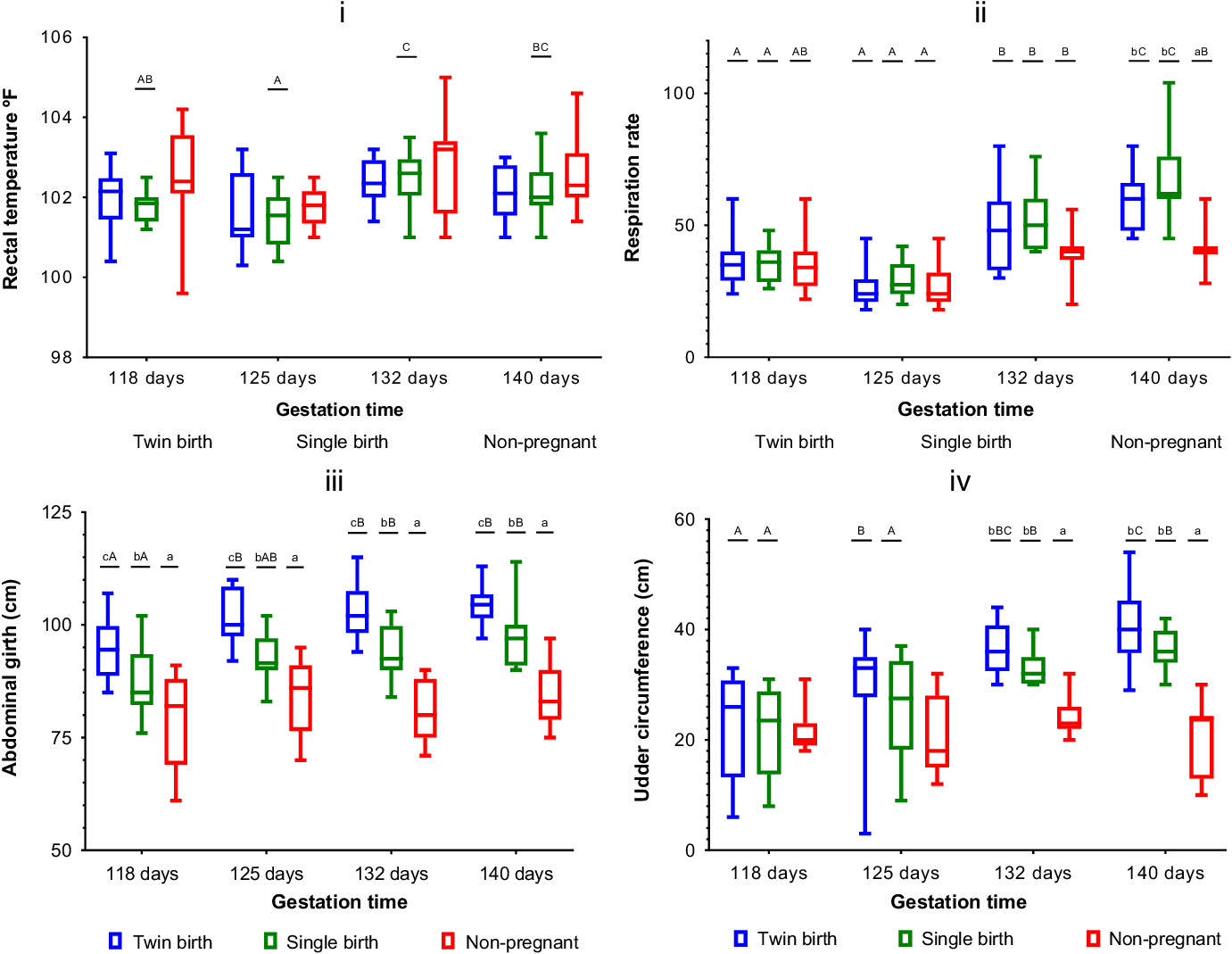
The association of three groups of does with physiological (RT and RR) and morphological (AG and UC) parameters at different times of gestation, i.e. 118, 125, 132 and 140 days, was obtained and the results are depicted in Figure 1. It was observed that there was no significant (P > 0.05) difference for both physiological parameters between the three groups at different gestation times, except at 140 days of gestation. RR was found to be significantly (P < 0.05) different among the three groups at 140 days and was higher in does bearing a single fetus, followed by twins compared with non-pregnant does. Between different times of gestation, it was observed that RT was significantly (P < 0.05) increased, especially after 125 days of gestation in does bearing a single fetus. However, does bearing twins and non-pregnant does did not (P > 0.05) show this difference in RT over time. For RR, all three groups had significantly (P < 0.05) higher values for advanced gestation times, i.e. 132 and 140 days compared with 118 and 125 days.
Physiological and morphological parameters with respect to litter size categories in goats. Different superscripts (a–c) differ significantly (P < 0.05) between groups among time. Different superscripts (A, B) differ significantly (P < 0.05) between times among groups. (i) Rectal temperature °F, (ii) respiration rate, (iii) abdominal girth (cm), and (iv) udder circumference (cm).

For morphological parameters, AG (cm) was significantly (P < 0.05) increased at advanced gestation time (from 118 to 140 days) and ranged from 94.92 to 104.50 cm for does bearing twins, 87.54–97.58 cm for does bearing a single fetus, and 78.44–84.43 cm for non-pregnant does. It was also revealed that significant (P < 0.05) differences were observed between the three groups at all gestation times and that a wider AG was found among does bearing twins, followed by a single fetus and non-pregnant does.
Similarly, UC (cm) showed a significantly increasing (∼40%) trend from 118 to 140 days among the pregnant does and ranged from 22.50 to 40.70 cm in does bearing twins and 21.67–36.15 cm in does bearing a single fetus. Although UC was non-significantly different between the three groups up to 125 days, it was significantly (P < 0.05) different among pregnant does compared with non-pregnant does at 132 and 140 days. However, it was not statistically significant (P > 0.05) between does bearing single/twin fetuses at advanced gestation. Furthermore, there was a non-significant (P > 0.05) difference in gestation time among the non-pregnant does.
Discriminant function
A stepwise LDA was performed to check if all predictors contributed to function. It was revealed that all six predictors, i.e. age, weight at service, RR, RT, AG and UC, were important for developing the discriminant function. The estimated unstandardized coefficients under discriminant analysis are presented in Table 2. The associated values of Wilks’ lambda that measured the discriminating power of each function for separating animals into two groups were low and ranged from 0.46 to 0.64. As a proportion of the total variance in the discriminant scores was not explained by differences among the groups, smaller values of Wilks’ lambda in this study indicated the greater discriminatory power of the estimated functions. The significance of Wilk’s lambda was tested using chi-square statistical tests and it was revealed that respective functions had significantly better power for separating the two groups, i.e. single and twin litter sizes at 125 days onwards.
Discriminant function for prediction of litter size in goats

Age: age at service (years); AG: Abdominal girth (cm); RR: Respiration rate; RT: rectal temperature °F; UC: Udder circumference (cm); WTS: weight at service (kg).
* Significant chi-squared distribution at the 5% level.
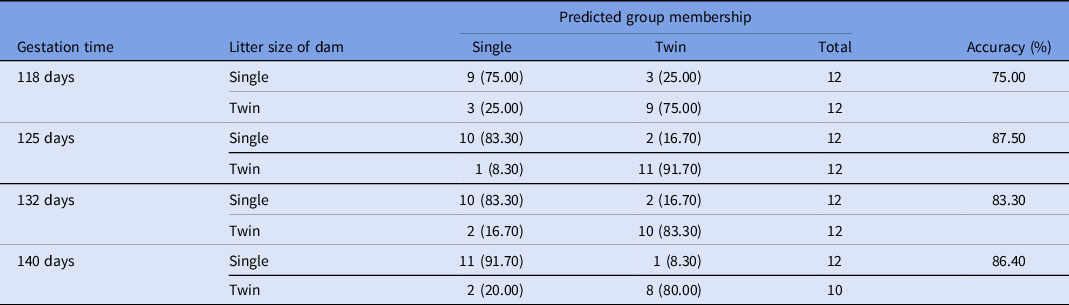
Table 3 shows the classification for does bearing single and twin fetuses using estimated discriminant functions based on six predictors at each gestation time. The accuracy (%) of classifying does into the correct category at days 118, 125, 132, and 140 days was obtained as 75.00, 87.50, 83.30 and 86.40%, respectively. The sensitivity (%) and specificity (%) for respective gestation times were 75.00 and 75.00%, 83.30 and 91.70%, 83.30 and 83.30% and 91.70 and 80.00%, respectively.
Classification of pregnant does into two groups of litter size

Discussion
The present study focused on studying various morphological and physiological parameters with the possibility for early prediction of prenatal litter size in goats. The results suggested that physiological parameters such as RT and RR were statistically similar among pregnant and non-pregnant does up to 132 days of gestation. However, there was a significant difference between does bearing single and twin litter size for RR at 140 days of gestation. Also, RR was found to be increasing in all three groups of does as gestation advanced. Contrary to the present findings, Atmoko et al. (Reference Atmoko, Maharani, Bintara and Budisatria2020) reported that RR and RT remained non-significant between the early and late pregnancies of Etawah Grade does. From the findings of the present study, it was concluded that those physiological parameters increased in advanced pregnancy might be due to physiological and gestation stress, and might not be useful for differentiating between single or twin litter size among pregnant goats.
Conversely, morphological parameters showed significant changes over gestation duration, as well as between does bearing different litter sizes. Similar to the current findings, Mellado et al. (Reference Mellado, Garcia, Ledezma and Mellado2004) reported 9.3 and 10.6 cm increases in abdominal circumference for single and twin-bearing does, respectively. It is also worth mentioning here that does with twins showed a higher AG than does with a single fetus, which might be due to the larger volume covered by twins in the uterus. Therefore, AG was considered to be a potential indicator for deciding litter sizes among the pregnant does under the current study, and was in accordance with reports by Mellado et al. (Reference Mellado, Garcia, Ledezma and Mellado2004) who conducted a study for the prediction of goat litter size using body measurements.
The present results also showed an increase in UC during late gestation and also provided significance for differentiating between pregnant and non-pregnant does at 132 and 140 days. (Linzell, Reference Linzell1966; Fleet et al., Reference Fleet, Goode, Hamon, Laurie, Linzell and Peaker1975; Zahraddeen et al., Reference Zahraddeen, Butswat and Mbap2008; James and Osinowo, Reference James and Osinowo2021). Davis (Reference Davis2017) also reported that larger litter size in goats led to a 20–25% increase in mammary development at the end of gestation. These findings indicated that UC alone could be useful for detecting advanced gestation, especially near to kidding, and also may not be useful for differentiating twin litter size.
LDA was performed to find out the potential for morphological and physiological parameters, along with age and weight at service, to discriminate pregnant does bearing single and twin fetuses at different gestation times. The present results indicated the greater accuracy for the prediction of prenatal litter size based on various parameters. The sensitivity and specificity for developed discriminant function were also at satisfactory levels in the present study.
Mellado et al. (Reference Mellado, Garcia, Ledezma and Mellado2004) performed discriminant analysis to predict litter size based on linear measurements, such as live weight, abdominal circumference and vulva–cervix distance, and reported an ∼60% accuracy for predicting twin-bearing goats correctly based on abdominal circumference or its combination with other traits. Our study suggested a greater accuracy for predicting litter size among pregnant does based on morphological and physiological parameters compared with reports by Mellado et al. (Reference Mellado, Garcia, Ledezma and Mellado2004). Pan et al. (Reference Pan, Biswas, Majumdar, SenGupta, Patra, Ghosh and Haldar2015) used a discriminant function for deciding litter size in Black Bengal goats and suggested that heart girth, punch girth, BW, and distance between the trochanter major and pelvic triangle area could be the predictive indices for larger litter size.
The use of a discriminant function for classifying the genetic resources of goats into distinct categories based on morphology characteristics has been reported by Yakubu et al. (Reference Yakubu, Salako, Imumorin, Ige and Akinyemi2011), Rodero et al. (Reference Rodero, González, Dorado-Moreno, Luque and Hervás2015), Hilal et al. (Reference Hilal, El Otmani, Chentouf and Boujenane2016) and Melesse et al. (Reference Melesse, Yemane, Tade, Dea, Kayamo, Abera, Mekasha, Betsha and Taye2022). However, the use of morphological and physiological parameters for predicting the litter size in goats is very rare. However, it has been suggested that validation of the present findings needs to be done using a greater number of morphological and physiological parameters in increased sample sizes of pregnant goats in order to predict litter size in advance.
In conclusion, the present study focused on the evaluation of important physiological and morphological parameters between pregnant and non-pregnant does to set some criteria for deciding prenatal litter size. Although physiological parameters were not influenced by doe categories, morphological parameters such as abdominal girth and udder circumference were significantly higher in does bearing twins followed by does bearing a single fetus and non-pregnant does. The results of a discriminant function indicated that future pregnant does may be identified in advance for single or twin litter size with greater accuracy.
Data availability statement
Data are available on request due to privacy/ethical restrictions.
Acknowledgements
We duly acknowledge the facilities provided by the Director of Research, LUVAS, Hisar, India and used to conduct this research. We also acknowledge funding obtained from the HSCSIT, Science and Technology Department (HSCSIT/R&D/2021/538), Haryana, India.
Animal welfare statement
The authors confirm that the ethical policies of the journal, as noted on the journal’s author guidelines page, have been adhered to. No ethical approval was required as original research data were collected from the Goat Breeding Farm, Department of Animal Genetics and Breeding, LUVAS, Hisar (India).
Funding
Funding was received from the HSCSIT, Science and Technology Department, Haryana, India with grant no. HSCSIT/R&D/2021/538.
Conflicts of interest
The authors declare that there is no conflict of interest regarding the publication of this paper.
Consent for publication
The authors give their consent for publication.