1. INTRODUCTION
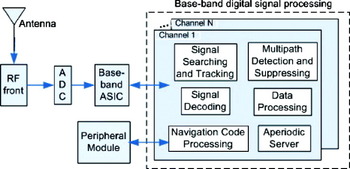
In the navigation and communication types of receivers, tasks such as carrier navigation, signal measurement and data communication need to be processed in real time. Taking a navigation receiver as an example, it is required to receive, process and decode satellite-based navigation signals so that it provides services like round-the-clock real-time navigation and distance/velocity telemetering for a variety of users. The navigation receiver plays a very important role in military/civil navigation and communication domains, such as in high dynamic applications (vehicle-based, ship-based, aero-based, missile-based, etc.), weak signal detection, anti-jamming etc (Kai, Reference Kai, Dennis, Nicolaj, Peter and Jensen2006; Elliott, Reference Elliott and Christopher2007). In a navigation receiver, a satellite signal is received by its antenna first, then passes through its RF (Radio Frequency) module, after the IF (Intermediate Frequency) sampling of ADC (Analog-Digital Converter) and frequency down-conversion, the baseband signal is obtained. In the baseband processing, some important tasks such as multi-frequency multi-channel satellite signal (P and C code) searching and tracking, signal decoding, navigation code processing, multipath detection and suppressing (Jovancevic, Reference Jovancevic, Brown, Ganguly, Kirchner, Zigic, Scott and Ward2001; Jovancevic, Reference Jovancevic, Brown, Ganguly, Goda, Kirchner and Zigic2003) need to be performed. The typical architecture of a navigation receiver is shown in Figure 1.
Typical architectural block of navigation receiver.

Nowadays, with the improvement of the Integrated Circuit and Digital Signal Processing technologies, microprocessor chips of receivers are being developed to feature smaller size, higher speed and lower power consumption. The receivers also begin to be able to combine multipath suppressing, digital beam control, self-adaptive algorithm in both space-time and space-frequency domains, and real-time high dynamic telemetering and positioning algorithms (Gold, Reference Gold and Brown2003; SPIRIT Company, 2008). However, the increase of the new task modules makes the processing more time consuming and needs more complicated calculations. Thus, sometimes it is not easy to meet the system's real-time processing requirement. Consequently, the task scheduling of a receiver becomes one of the main bottlenecks for quick response to changing task situations.
The period and deadline of the receiver task are determined by the system requirements and so they can be treated as fixed/constant parameters. Using priority assignment algorithms such as LNPA and APG (Xing, Reference Xing, Wang, Liu, Zeng and Nasro2007), an optimal priority assignment scheme can be obtained. In addition, using the baseband digital signal processing optimizing method (Wu, Reference Wu, Liu, Li and Wang2005), the task's execution time can be decreased. According to these characteristics of the receiver tasks, in this paper, a novel dichotomy optimization method based on the equilibrium rule is proposed for handling the situation of task changing. This method can search for the maximum allowed execution time of receiver tasks, and complete the receiver scheduling scheme off-line.
In Section 2, receiver tasks are analysed, a receiver-scheduling model is established, and schedulable condition for the receiver tasks is given. In Section 3.1, the maximum allowed execution time dichotomy optimization method is presented and analysed. Furthermore, the maximum allowed execution time optimization for multi-task situations using the equilibrium rule is illustrated in Section 3.2. In Section 4, simulations and experiment results are presented for the validation of the proposed method.
2. SCHEDULING MODEL OF RECEIVER TASKS
In this section, commonly used navigation tasks are analysed and the commonly used scheduling model for the tasks is explained.
2.1. Analysis of Navigation Tasks
The receipt and processing of navigation signals are achieved by the following tasks (NB: those tasks that are triggered by hardware/software interrupts and the execution time required by hardware/software interrupts are counted in these tasks):
• Signal Searching and Tracking (SST). After the frequency down-conversion is performed, multi-frequency multi-channel related data are transferred to the receiver's microprocessor at the rate of a few kHz, and the searching and tracking of the satellite signal are carried through. This task is the foundation of all of the other tasks and it consumes a great amount of the processor time, and it also executes more frequently than any other tasks.
• Signal Decoding (SD). When a satellite signal is captured, the related data need to be used for decoding and the determination of its sign. This task realizes bit and frame synchronizations and completes the decoding process of the navigation data. Its execution frequency is the second highest among all tasks – second only to the SST task.
• Data Processing (DP). Data processing rates of 50 pps DP and 1 pps DP, i.e., performing data processing at refresh rates of 50 Hz and 1 Hz respectively. This signal processing task includes many subtasks such as updating carrier wave phases, estimating carrier noise ratios, assisting navigation, calculating positions, outputting navigation information etc.
• Navigation Code Processing (NCP). This task implements the processing and format conversion of navigation code information.
• Peripheral Module Processing (PMP). For security and safety of communications, navigation receivers usually need to schedule data frames into the peripheral module so that they can perform tasks such as P code reception, encryption and decryption processing etc.
• Aperiodic Server (AS). This task processes aperiodic tasks, such as user query events, aperiodic event processing etc.
Apart from these listed tasks, navigation receivers that have some special auxiliary features may need more modules such as:
• Multipath Detection and Suppressing (MDS). This task cumulates related data in a relatively long time, separates the direct signal from multipath signals for estimating and mitigating the pseudo-range error inducted by multipath effects. The higher the precision of the multipath estimation, the more the number of iterations needed by the calculation of the task, and the longer the execution time takes.
2.2. Scheduling Model
If the scheduling of N periodic tasks uses static priorities and the task set is T={τ1, τ2, …, τN}, then each task τi in the task set can be modelled using the four elements (Xing, Reference Xing, Wang, Liu, Zeng and Nasro2007; Wu, Reference Wu, Ni and Liu2009):

where p i denotes the priority of τ i; Ci denotes the worst-case execution time of τ i; Ti denotes the period of τ i and D i denotes the relative deadline of τ i with D i⩽T i.
The processor utilization of task τ i is defined as:

The task with higher priority can pre-empt the task with lower priority. Those tasks with the same priority follow the FIFO (First In First Out) queue, i.e., the earlier the task comes to the FIFO queue, the earlier the task will be executed. In order to schedule receiver tasks in the right way, task parameters p i, Ci, Ti and D i need to be rationally designed. If all of the tasks can be completed before the deadline, then the task set is schedulable.
2.3. Schedulability Condition
In the task scheduling with static priorities, the classical ‘level-i busy period’ method gives a schedulability condition for the arbitrary deadline circumstance (Tindell, Reference Tindell, Burns and Wellings1994). Reference (Wu, Reference Wu, Ni and Liu2009) proposes a schedulability condition suitable for the FIFO queue. In the scheduling scheme of receiver tasks, usually, all tasks are required to complete in time, i.e., the relative deadline is not longer than its period (D i⩽T i). In this case, the schedulability condition of task τi is (Katcher, Reference Katcher, Sathaye and Strosnider1995):
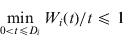
where:

where hp(τ i) denotes the set of tasks that have priorities higher than that of τ i and ip(τ i) denotes the set of tasks that have the priority the same as that of τ i.
3. MAXIMUM ALLOWED EXECUTION TIME DICHOTOMY SEARCH
As mentioned in Section 1, the period and deadline of receiver tasks are determined by the requirements, so T i and D i can be treated as fixed/constant parameters. p i can be obtained with an optimal priority assignment algorithm (Tindell, Reference Tindell, Burns and Wellings1994). Therefore, the focus of this section is on the optimal design of execution time C i.
When task execution time C i is longer than a given value, the task set will become unschedulable, according to the constraint for the schedulability condition in Section 2.3. The maximum valid value of C i is defined as the maximum allowed execution time C imax. If and only if C i⩽C imax, the task set is schedulable. According to formula (4), the response time W i(t) is a monotonic increasing function of parameter C i. The dichotomy search method is a commonly used quick search method for single-parameter monotonic function optimization. Hence in this research the dichotomy search method is used to find the optimal C imax.
3.1. Dichotomy Search for Single-task Cimax
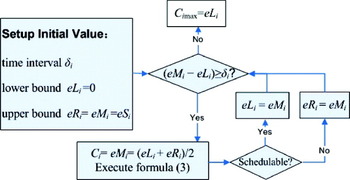
Searching for the maximum allowed execution time C imax of task τi is the key to a scheduling scheme. If C i>C imax, τi is unschedulable, otherwise it is schedulable. The minimum value of C imax is 0, and the maximum value of C imax corresponds to the circumstance where the total utilization of the processor is 100%. Taking  , then the searching scope of C imax is in [0, eS i].
For the single task τ i, both parameters of all other tasks and parameters of p i, Ti, Di of task τ i are fixed, then the flowchart of the dichotomy search for the maximum allowed execution time C imax is shown in Figure 2. The performance of this algorithm mainly depends on the total number of executions of the schedulability condition. ∀i=1,2, …, N, this algorithm executes at most log2(eS i/δ i) times of the schedulability condition.
Dichotomy search flowchart for single-task Cimax.

3.2. Dichotomy Search for Multi-task Cimax Using Equilibrium Rule
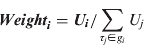
When the single-task search method cannot meet the application requirements, or, the cost of the single-task optimization is great, a simultaneous optimization of multi-task should be considered. In general, considering the simultaneous optimization of n tasks, the total number of searching is C Nn. ∀i=1,2, …, C Nn, where C imax is the vector of the maximum allowed execution time of the n tasks. Its minimum value is the zero vector, i.e., 0, and its maximum value corresponds to the circumstance where the total utilisation of the processor is 100%. Let  , where g i denotes the task group of the n tasks, Weight i denotes the normalized equilibrium weight vector.
Based on the relative equilibrium rule, the task's execution time decreases proportionally with the utilization of the processor:
Based on the absolute equilibrium rule, the task execution time decreases proportionally with execution time:
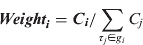
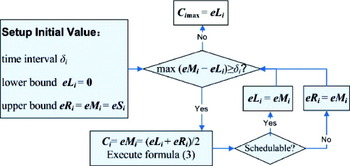
The searching scope of Cimax is [0, eSi], and its dichotomy searching flowchart is shown in Figure 3. ∀i=1,2, …, C Nn, This algorithm executes at most log2(max(eS i)/δ i) times of the schedulability condition. The calculation amount in the search is predictable.
Dichotomy search flowchart for multi-task Cimax.

4. SIMULATIONS AND APPLICATIONS
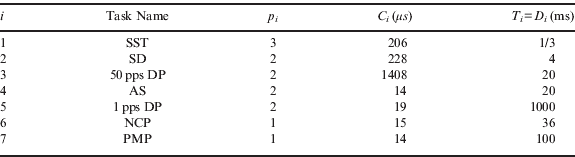
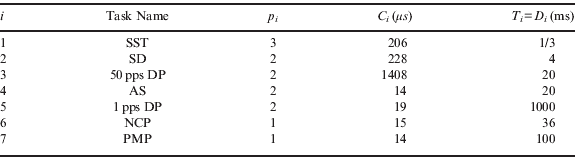
The parameters of the task set of a type of navigation receiver are listed in Table 1. According to the schedulability condition in Section 2.3, this task set is schedulable.
Task set parameters of a type of navigation receiver.
4.1. Dichotomy Search for Single Task
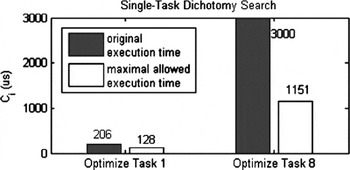
In addition to those parameters in Table 1, the MDS task τ 8={2, 3000 μs, 100 ms, 100 ms} was also added to the task set. Using the schedulability condition in Section 2.3, the new task set becomes unschedulable. In this case, the execution time optimization is needed. The dichotomy search method described in Section 3.1 for single-task C imax was used here. The total number of searching is eight, and only two of which are schedulable as shown in Figure 4. According to Figure 4, in one solution, it needs to optimize C 1 from the original values of 206 μs to 128 μs, and in the other solution, it needs to optimize C 8 from the original values 3000 μs to 1151 μs. However, the SST task τ 1 is the most important task, which consumes a great amount of the processor timing. It is difficult to compress a huge amount of the execution time of the SST task. On the other hand, optimizing the MDS task τ 8 decreases the execution time by about 65%, which is a significant amount.
Maximum allowed execution time dichotomy search for single task.

4.2. Dichotomy Search for Dual-task Using Equilibrium Rule
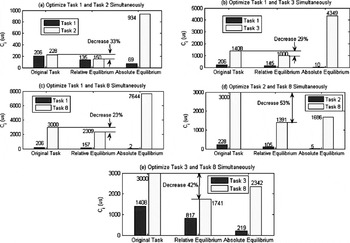
Here, simultaneous optimizing of dual-task seems more favourable. Similarly, in addition to those parameters in Table 1, the MDS task τ 8={2, 3000 μs, 100 ms, 100 ms} is added; and the dichotomy search method described in Section 3.2 for multi-task C imax was used and based on both relative and absolute equilibrium rules respectively here. For the dual-task search, the total number of searching is C 82=28, and only five of which are schedulable as shown in Figure 5.
Maximum allowed execution time dichotomy search for dual-task with relative and absolute equilibrium rules.

According to Figure 5, in the five solutions, the simultaneous optimizing of tasks τ 1 and τ 8 decreases execution times by about 23%, whereas the simultaneous optimizing of tasks τ 2 and τ 8 decreases execution times by about 53%. These results show that simultaneous optimizing of both tasks τ 1 and τ 8 with the relative equilibrium rule can obtain the minimum decrease of the execute time, which provides a valuable reference scheme for receiver task scheduling. On the other hand, the simultaneous optimizing of dual-task with the absolute equilibrium rule needs to compress a great amount of the execution time of the SST task or the SD task, which is difficult to implement for navigation receivers.
5. CONCLUSION
Signal processing tasks such as the carrier navigation, signal measurement and data communication need to be performed by navigation and communication receivers in real-time. Changing the requirements of a receiver may lead to the increase of task modules and also task complexities. The maximum allowed execution time of the receiver task is very important in the receiver task scheduling. In this paper, a novel dichotomy optimization method based on the execution time is proposed, and the equilibrium rule is also proposed to assist simultaneous optimizing multiple-task dichotomy searching. Simulation results show that the proposed method is convenient and can quickly calculate the upper bound of the task execution time that meets the timing requirement of the receiver. Designers can adjust the task's execution time according to these results. Besides, the relative equilibrium rule is more favourable than the absolute equilibrium rule in the applications of receiver task scheduling. The proposed method also provides quick scheduling approach for the top level task design of navigation receivers, and remarkably improves the development efficiency of receiver embedded software.