Introduction
Throughout urban history, towns and cities have depended on grain to feed the population, and a secure supply is a prerequisite for the very existence of stable urban settlements. The procurement of grain has historically been a source of both concord and confrontation, in which the issue was nothing less than survival. The creation of an efficient grain supply system encouraged the development of towns, especially in pre-industrial times when cereals were a key commodity, and the disruption or decay of these arrangements undermined the continuity of urban society. Thus, the intrinsic value of grain in the urban order and the need to secure supplies of this basic good have often profoundly influenced public policy.
In this context, it is unfortunate that research into public policy governing the grain supply in medieval and early modern Europe has stagnated in recent historiography. After the pioneering work of North American economic historians in the early decades of the twentieth century, these studies attracted considerable attention from European academics between the 1950s and the 1980s under the influence of the French Annales School. Since then, historians dealing with the early modern period have largely ignored this matter, preferring to concentrate on political, social and cultural issues. From a practical standpoint, this field was abandoned because it required costly local studies, the general value of which is debatable given the scarcity of precise primary sources, and the lack of any methodology capable of confirming or discarding hypotheses and providing a basis for the development of a sound synthesis at the regional and national levels. Meanwhile, the disjointed treatment of the topic over the last twenty years has made it impossible to fill in the gaps, broaden perspectives and undertake any more extensive analysis.
As a result, significant issues in public wheat policy in early modern European countries have not been clearly sketched out. While it is broadly accepted that securing the wheat supply in towns and cities was a key objective of public policy, other policy goals pursued by the authorities have been largely ignored. Studies have focused mainly on centuries of economic growth, neglecting periods of decline, and this lack of continuity has obscured understanding of wheat policy in the long run. Historians have thus frequently given a static account of municipal intervention in the early modern wheat market, disregarding the political, economic and social transformations taking place.
Furthermore, scant attention has been paid to the methods used to frame and implement new supply policies or to provide social support, given the limitations inherent in public control in this period. Finally, there has been little effort to understand the evolution of the relationship between private and public wheat supply initiatives, or to clarify their complex boundaries. Also, large cities, especially capitals, have received preferential treatment given their political and administrative importance,Footnote 1 but few studies have considered the nature of the wheat supply policies applied in rural small- and medium-sized towns, which were strongly influenced by local political, economic and social factors.
Given this historiographical context, this article reconsiders the evolution of wheat policy in European towns and cities during the ancien régime through a regional case-study of the municipal wheat supply in the Kingdom of Aragon in the sixteenth and seventeenth centuries. Located in the north-east of Spain, the kingdom was part of the Crown of Aragon, a federation of realms that coalesced in the late medieval period and also included Catalonia, Valencia, the Balearic Islands, Sardinia, Sicily and Naples. The kingdom experienced clear demographic and urban expansion in the sixteenth century.Footnote 2 Despite the lack of survey data, local studies suggest that urban growth was fastest in the second half of the century, coinciding with the crest of the economic wave. Having reached the height of its growth at the end of the sixteenth century, Aragon underwent a clear demographic decline in the seventeenth century, precipitated in 1610 when Philip III ordered the expulsion of the moriscos (formerly Muslim inhabitants of Moorish origin, who had already been forced to adopt Christianity in 1526) from Aragon. This decision affected around 14,000 families or 18.85 per cent of the population.Footnote 3 Even so, if a general survey of the kingdom in 1495 indicated 51,540 hearths or tax units, a similar survey carried out between 1646 and 1650 showed an increase to 70,729 hearths.Footnote 4 However, the bubonic plague ravaged the kingdom in 1648–54, causing an enormous death toll in the towns and cities. The Diputación, which acted as a standing committee of the Aragonese parliament, thus estimated in 1670 that just 60,000 hearths existed. Recovery only began in the last two decades of the seventeenth century, so that Aragon had 76,613 hearths by 1711.Footnote 5
This demographic decline put considerable stress on the scarce urban population living in Aragon in the medieval and early modern period. According to the general survey performed between 1646 and 1650, 16.27 per cent of the Aragonese population (11,510 out of 70,729 hearths) lived in towns, most of which were royal boroughs.Footnote 6 If we estimate 4.5 inhabitants on average for each hearth, with around 25,000 inhabitants, only Saragossa was a real city as the capital of the kingdom. Next in importance, Huesca had 5,400 and Calatayud 4,725 inhabitants. Seven medium-sized towns ranged between 2,250 and 3,950 inhabitants and 28 smaller towns and villages between 900 and 2,250. The rest of the population lived in over 1,500 villages with fewer than 900 inhabitants. Thus, the urban character of Aragon's towns owed less to their demographic size than to their political, economic and cultural functions, providing cohesion for the surrounding territory. As the decline of the major fairs and industrial output indicates,Footnote 7 economic downturn in the seventeenth century dramatically reduced the commercial and productive activities that the expansion of the sixteenth century had generated in towns and cities.
Meanwhile, political rights were reserved in Aragonese towns for the vecinos or townsfolk, who were the true lay members of the local community, as against the habitantes, mere residents. As the most relevant and powerful vecinos, the municipal elites governing towns and cities in Aragon in the sixteenth century consisted of ciudadanos honrados or ‘honoured citizens’ (basically leading merchants and knights) engaged in trade and the liberal professions, and landowners and rentiers.Footnote 8 Their political control was confirmed in the middle of the fifteenth century, when the monarchy introduced the system of insaculación in the Spanish territories of the Crown of Aragon, under which candidates for high municipal office were chosen annually by lot from a list of candidates that was periodically approved by the council magistrates and revised by a royal delegate, usually a jurist.Footnote 9 Power was further concentrated in the hands of these ‘honoured citizens’ in the late medieval period as council magistrates took on the main municipal responsibilities and the role of the ‘general council’ diminished. This council was a kind of open assembly where decisions considered to be of general concern were submitted to the vecinos for approval. Except for the city of Saragossa, where the nobility did not form part of the municipal elite, these wealthy citizens shared local political power in the town councils with a stratum of minor nobles, who had consolidated their economic and social status in the fifteenth century by engaging in commerce and the law.Footnote 10 In small towns, knights and squires along with landowners and craftsmen made up the guiding minority. In these cases, the main municipal offices were usually shared out more or less equally.Footnote 11 In towns and villages under secular or ecclesiastical lordship, the composition of the ruling elite was influenced by the right of the nobility to appoint certain officials, often from a list of candidates proposed by the council.
Given the composition of local elites, craftsmen and farmers had little decision-making power in the towns and cities of Aragon. Anybody who had previously carried on any manual trade was debarred from high municipal office, and stringent property qualifications existed. Despite this political exclusion, representatives of the guilds and farmers were annually elected through the system of insaculación to hold other municipal offices in many rural towns and villages in the sixteenth century, which allowed them to share with the local elites the control of the public market, the upkeep of communal property and farming municipal taxes.Footnote 12 As representatives of the parishes, they could participate in annual audits of the conduct of municipal affairs by senior officials, and they could demand changes in the town council's economic decisions where these affected communal rights and practices. These minor positions were very significant locally in protecting communal rights and the economic interests of the humbler townsfolk.
Local elites adopted new strategies to preserve their status and power in the seventeenth century. Wealthy citizens and lesser nobles drew in their horns, shying away from trade and focusing on more conservative activities, such as the acquisition of land, and the purchase and lease of property.Footnote 13 They also became increasingly keen to integrate with the central administration of the Spanish state, in the expectation of gaining titles and other benefits.Footnote 14 Meanwhile, many urban commoners petitioned the king or purchased titles to join the ranks of the petty nobility and share their privileges.Footnote 15 At the same time, the municipal elites sought to restrict political control to the richest strata of society by raising the property qualification required to hold any relevant office on town councils.Footnote 16 If the monarchy gained influence over the designation of municipal officers, however, it was only at critical moments that the sovereign actually intervened to change the composition of local elites and increase royal power in Aragon.Footnote 17 This occurred between 1626 and 1652, after the Spanish monarchy had launched a last ditch effort to preserve its political and military hegemony in Europe in 1621 under Philip IV.Footnote 18 Normally, however, the royal officials who drew up the lists of candidates for municipal office or recommended the inclusion of certain individuals in town councils were anxious to co-operate with the local elites, as this was the best way to ensure their co-operation with the monarchy.Footnote 19 Nevertheless, as jurists, these royal delegates would often amend local legislation to reserve the most influential municipal offices for the wealthy elite. As a result, well-to-do craftsmen and farmers lost their earlier political influence over the municipal administration, as the legal representatives of a significant part of the community. The supervisory rights of parish representatives were also suppressed.
In this political context, the municipal authorities’ control over the public grain market became ever more direct in the sixteenth and seventeenth centuries, in contrast to the lax intervention of the state. In a country where commercial networks were less tightly interwoven than in north-west Europe,Footnote 20 this public policy not only addressed consumer demand but also producers’ needs within municipalities. While it took account of the importance of the public grain supplies in the major Mediterranean cities in the early modern period, smaller towns and villages were also significant scenarios for the application of this policy. Meanwhile, Aragon's peculiar institutional framework allowed a social consensus to grow up around the grain policy in the common interest. However, the change in the interests of the urban elites and rising municipal indebtedness in the seventeenth century led to rising taxes on grain, a favourite target for the revenues levied by councils in Mediterranean Europe and the reorientation of public supply in an effort to preserve the social order.Footnote 21 This reform fostered private initiative in the urban market but at the same time intensified economic and social inequality, as it worked to the detriment of the poorer social groups in the towns and cities.
The sixteenth century: the creation and management of communal granaries
As in other parts of Mediterranean Europe, the local conception of public grain supply policy differed widely between coastal areas and the hinterland in the Spanish territories belonging to the Crown of Aragon. Thus, the municipal authorities generally exercised only indirect control over the grain markets in the port cities of Barcelona, Valencia and Alicante, which were able to benefit from maritime trade in the Mediterranean, an active grain market since classical antiquity.Footnote 22 Wheat imports were favoured with tax exemptions, interest-free loans and other incentives for local and foreign merchants, who were already attracted by strong demand for grain among the urban population.Footnote 23 As a cereals exporting region, however, public grain supply policies in the Kingdom of Aragon were more akin to those applied in the Castilian hinterland. The transportation of grain was much more difficult and costly outside the Ebro Valley, Aragon's main communications artery, and bad harvests caused prices to rise faster and higher than along the coast. This encouraged more direct public control over the grain market, culminating in the creation of communal granaries in the sixteenth century.
Local public intervention in the wheat market was strongly marked in Aragon from medieval times. As more and more territories were reconquered from their Moorish overlords, towns and villages taken or founded by the Christian kings were granted important economic privileges and broad political and administrative autonomy in order to encourage settlement and fix the population. This royal strategy allowed municipal authorities to establish and shape a system of market regulation capable of assuring the wheat supply in the medieval and early modern periods. Meanwhile, the role of the king and other Aragonese institutions in this area was very limited. Royal intervention mainly occurred in lean years to help town councils import wheat from other territories under the authority or influence of the Crown. The political union of the Crowns of Castile and Aragon under the Catholic monarchs, Ferdinand and Isabella, made this royal support more effective from the late fifteenth century onwards. As the capital of the kingdom, the city of Saragossa thus obtained from Kings Charles V and Philip II permission to buy grain in Castile and Navarre to supply the city in 1530, 1578 and 1584.Footnote 24 Meanwhile, the Aragonese parliament approved various laws in the late medieval period, designed to keep back locally produced wheat for domestic consumption in lean years. The Diputación applied these laws in the fifteenth, sixteenth and seventeenth centuries by banning the export of wheat when prices rose above a fixed limit in the public grain market or Almudí of Saragossa.Footnote 25
Despite the importance of the grain supply, the method employed by the towns to regulate the market in the late medieval period was still confined basically to regulating trade, weights and measures, milling and the production and sale of bread. The direct sale of municipal grain in the market was, however, reserved for times of scarcity, and the quantities supplied were limited, except in Saragossa, given the difficulties and costs involved. Having supplied grain at or below cost in times of dearth, any remaining surplus would be sold off below the market price. Aware of their inability to provide enough grain, the towns also applied other measures to secure supplies, banning the removal of wheat from the district, requisitioning stocks in private hands, setting market prices and fining traffickers. The effect of such provisions was very limited, however, as hoarding and speculation became widespread.Footnote 26
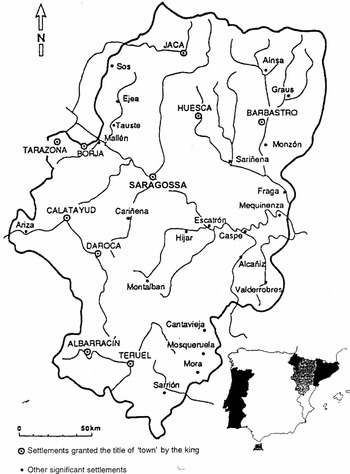
The kingdom of Aragon during the sixteenth and seventeenth centuries

Despite these constraints, municipal control over the grain market gradually increased in sixteenth-century Aragon. In this period, towns invested in numerous projects to foster economic growth and improve living conditions, for example by creating new irrigation and drinking water systems,Footnote 27 or to symbolize municipal power by erecting civic buildings.Footnote 28 Among such projects, councils were particularly keen to create communal granaries in order to ensure a regular wheat supply for the townsfolk.Footnote 29 The first such granaries were founded in the early sixteenth century, and by the mid-sixteenth century they had spread to the principal towns and cities, where demand for wheat from the population was rising. Smaller towns and villages followed this example in the second half of the century.
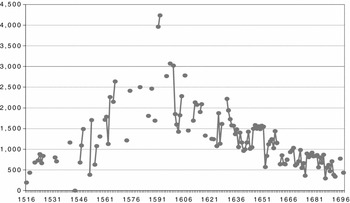
Meanwhile, these granaries were gradually oriented to providing a regular supply of wheat all year round, allowing town councils tighter control of the market. This meant holding permanent grain stocks (see Figure 1). Wheat bought at harvest time, when prices were lower, could be stored until the following spring thanks to Aragon's cold, dry winters, but the progressive increase in these stocks exposed the granaries to price fluctuations, a problem that had affected the temporary measures taken to alleviate shortages in the medieval period to a much lesser degree. Thus, where the market price fell below the purchase price, the granaries found it difficult to sell their stocks.Footnote 30 In view of the need to renew the grain stored, the towns began to require bakers to purchase wheat from the communal granary in the mid-sixteenth century. This measure was possible because bakeries were municipal property, although other institutions and individual townspeople could own ovens and bake bread for private buyers and their own consumption.Footnote 31 The cities only supplied wheat to bakers, but in smaller towns the granaries also sold grain to individual townspeople to be ground into flour and then baked in such private ovens.Footnote 32 Commonly in villages, the communal granaries could only sell wheat to locals for this purpose and they usually showed some preference for the neediest families.
Wheat stocks in the granary of Daroca (1516–1706) (in cahíces)
Source: Mateos, Auge, 487–9.

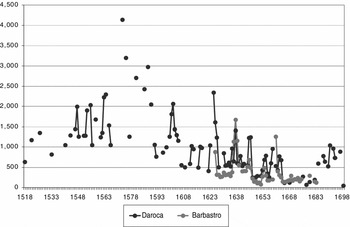
By securing an outlet for surpluses through their control over bakeries, the granaries were able to expand their sales to meet the increasing demand for grain from a growing population. Though wheat could in principle be sold to any town dweller, vecinos enjoyed preferential rights to buy grain at the granary, and even in the marketplace, in lean years. As shown in Figure 2, sales peaked towards the end of the 1570s. Despite some moderation in the following decades of the sixteenth century, these sales remained significant in the main towns and cities. A comparison of granary sales with the total wheat milled shows that the granary accounted for 27 per cent of average annual consumption in the town of Daroca between 1565 and 1595, 31 per cent in Saragossa in 1588 and 24.2 per cent in Calatayud in 1600.Footnote 33
Wheat sales by the granaries of Barbastro and Daroca (1518–1707) (in cahíces)
Sources: Salas, La población, 348; Mateos, Auge, 487–9.

As their sales rose, the granaries took advantage of expanding wheat production in Aragon to increase purchases over the course of the sixteenth century.Footnote 34 Wealthy producers were among their main suppliers, but the rise in municipal wheat procurements also left room for other social groups like smallholders, artisans, carriers and so forth, who were less closely bound up with the local elites, to supply wheat.Footnote 35 Meanwhile, the major increase in procurements that took place in the second half of the sixteenth century offered the large merchants of Saragossa a golden opportunity. As the holders of the tax farming rights for ecclesiastical tithes and seigniorial tributes, they controlled all of the major grain transactions in the kingdom, earning vast sums.Footnote 36 Faced with this speculation, the city council of Saragossa threatened in the dearth years of 1576–77, 1592–93, 1595, 1606, 1614, 1630 and 1651 to haul the merchants before special courts if they did not hand over the wheat they had in store. Even so, they were always able, as members of the city oligarchy, to reach a negotiated solution that favoured their interests.Footnote 37
Despite the increasing volume of wheat supplies, the granaries continued to earn only meagre profits, because the sale price of the wheat was close to cost.Footnote 38 This moderation greatly benefited consumers, particularly when the towns began to link the price of bread to the granary instead of the public market price of wheat from the mid-sixteenth century onwards. In lean years, the granaries relinquished any claim to a profit or even accepted moderate losses on sales of wheat in order to entice privately held stocks into the public market. Also, they often supplied grain to the poorest townsfolk at reduced prices.Footnote 39 When the king visited Saragossa with the court in 1578 and 1585, and again in the severe dearth years of 1614 and 1630, the city even bought large quantities of grain from the Mediterranean islands of Sardinia, Sicily and Majorca with royal support. These stocks were brought by sea to Tortosa, Tarragona and Vinaroz and then up the River Ebro to Saragossa.Footnote 40 The complexity and enormous expense of these operations, especially in 1614 and 1630, when the grain was sold at cost, reveal the interest of the city authorities in stopping speculation and holding down prices in years of scarcity.
As their modus operandi generated only minimal profits, the financial viability of the communal granaries from 1550 onwards became increasingly bound up with fluctuations in grain prices as their stocks rose progressively. If the stability of prices until 1550 indicates a balance between wheat production and demand as a result of slow urban growth, the very real demographic expansion of towns and cities in the second half of the sixteenth century put a special strain on the system of wheat production and distribution. Dearth years were relatively few and far between in the two decades from 1550 to 1570, which favoured the expansion of granary supplies, helped by the stable price progression in the grain market (see Figure 3). However, serious shortages occurred in 1570–72, 1576–80, 1584–85 and 1591–94, probably as a result of unrelenting cropping and declining yields, causing abrupt price fluctuations in the market. Having paid a high price for grain in the period of scarcity, the communal granaries had to sell considerable stocks of grain at much lower prices when the harvest was brought in, otherwise bakers and townsfolk would not take its wheat, preferring to buy it more cheaply in the market.Footnote 41 Facing punitive losses, town councils were forced to borrow to maintain the wheat supply. This model was too costly to sustain, and it became necessary to replace it with a more profitable administration in the seventeenth century.
Evolution of the wheat price in Saragossa, Daroca, Barbastro and Fraga (1500–1707) (in sueldos per cahíz)
Note: The cahíz in Aragon equals 140 kilos or 179.36 litres. The sueldo was a unit of account used in Aragon in the sixteenth and seventeenth centuries. After the change to Castilian standards of weight and fineness in all silver issues from 1519 onwards, one sueldo equalled half a real, the basic silver coin minted in Aragon in both centuries.
Source: J.A. Mateos, ‘Hacienda municipal, control público y mercado agrario en el reino de Aragon durante los siglos XVI y XVII’, Hispania, 66 (2006), 578–80.

Municipal politics, social agreement and public control of the market
The considerable expansion of the public granaries in the sixteenth century was made possible only by the creation of a consensus around key issues affecting the common weal between the social groups represented on town councils. Favoured by the Aragonese legal and institutional framework, these policies were similar to the agreements reached to provide a drinking water supply in towns and villages,Footnote 42 involving even members of the privileged estates (nobility and clergy), who did not enjoy local political representation. Though political and social tensions did exist in Aragon,Footnote 43 the economic expansion that the kingdom enjoyed in the sixteenth century encouraged the elites and other social groups to reach an understanding, as each enjoyed benefits in the long run.Footnote 44 Both projects were helped in the second half of the century because the local elites offered abundant credit in the mid-sixteenth century, assuring themselves fixed incomes from the annual interest received in exchange. The arrangement of municipal loans reduced fiscal pressure on the poorest social groups, who also benefited from a decline in the real tax burden in this period, and this encouraged acceptance of the policy.Footnote 45 This consensus was a key factor in inducing townsfolk to buy wheat at the communal granary in years with good harvests, especially in rural towns and villages. Therefore, it became increasingly important as the granaries increased purchases and sales of wheat from the mid-sixteenth century onwards.
The confluence of interests between social groups around the formation of communal granaries even determined the social background of their managers in the second half of the sixteenth century, as was also commonly the case in the administrations responsible for supplying water to towns and villages.Footnote 46 In the main royal towns and cities (Saragossa, Huesca, Calatayud and Barbastro), the administrator was usually a merchant, who was elected by lot from a shortlist of candidates connected to the ruling elite of citizens and lesser nobles.Footnote 47 The appointment of such officials in more rural towns, where communal sentiment was stronger, clearly included representatives from all the social groups involved in the wheat supply policy, however.Footnote 48 In the medium-sized town of Alcañiz, under the lordship of the Military Order of Calatrava, the purchase of grain was entrusted to an administrator elected by lot from among reliable artisans and farmers, and finances were managed by an administrator and several councillors appointed from among the municipal elite. Though it was possible in towns under feudal control such as Alcañiz, the involvement of different social groups in the administration of the granary was, if anything, more common and better structured in the royal boroughs. In the small town of Albarracín, the Ordinances of 1567 and 1580 stipulated that the sale price of wheat in the granary should be fixed by the four town councillors and the twelve local deputies, half of whom were to be elected by the citizens and half by the townsfolk. In Daroca, an artisan or farmer served as administrator of the granary along with four deputies, two of whom were elected by lot from among the members of the local oligarchy and two (one artisan and one farmer) from candidates drawn from the two strata of commoners represented on the town council. The administrator's conduct of affairs was examined annually by two municipal accountants and seven delegates, one for each of the town's parishes. In the face of mounting difficulties in the late sixteenth century, the municipal elite resolved, in accordance with the agreed division of responsibilities, that management should be entrusted either to an artisan or to a farmer in 1578 and 1595.
The existence of these social agreements raises the question of the underlying reasons for the creation of granaries. Unquestionably, this was partly a response to the Christian expectation that the needier members of the local community should be supported in times of scarcity, which is also evident in the charitable activities of town councils.Footnote 49 Likewise, it reflects a municipal policy aimed at the protection of consumers, which may already be observed in various European countries in the late medieval period,Footnote 50 influenced by a clear concern about possible disorder caused by grain shortages.Footnote 51 In particular, various granaries were created in the early sixteenth century after Aragon had suffered a series of severe famines, which had triggered subsistence riots.Footnote 52 However, the sharp rise in the granaries’ purchases and sales of wheat in the mid-sixteenth century, a period when grain harvests were in general good and dearth years were rare, indicates that these institutions no longer saw the alleviation of scarcity and the prevention of spring grain price rises before the harvest in summer as their sole purpose. In accordance with the social compact described, the aim of municipal policy was to set a ‘just price’Footnote 53 for grain in the market to balance the needs of both consumers and producers at a time of strong price inflation.
Thus, as granaries increased the volume and regularity of local sales in the sixteenth century (see Figure 2), they also tried to steer private transactions into the public market, cutting out the middleman and dampening speculation as a means of defending consumers’ interests. As well as ensuring the grain supply, this expansion of sales in the public market sought to hold down wheat prices in Aragon, which rose considerably from the middle decades of the century onwards (see Figure 3). In exchange for the moderation of market prices for grain, the increased regularity of local demand from a growing population offered farmers an incentive to plant more wheat. Thus, the local elites and farmers represented on town councils, who were the main producers and distributors of grain, supported the creation of granaries as an outlet for their surpluses. Many communal granaries were therefore created in rural towns and villages in the grain growing areas of Aragon, which obviously had less need to ensure a regular supply of wheat than large cities like Saragossa.Footnote 54 Though widespread, the consolidation of the granaries sometimes ran into economic problems, especially when municipal finances were weak. Furthermore, the consensus surrounding the operation of the system was sometimes affected by social and political conflict, such as the revolts against feudal lords and factional power struggles that occurred in some areas of Aragon in the latter decades of the sixteenth century.Footnote 55 Thus, the prevailing level of municipal and social support shaped the management of the granaries and conditioned public intervention in the grain market.
The seventeenth century: the reform of the granary administration
In the seventeenth century, administration of communal granaries in town and cities became increasingly conditioned by municipal economic difficulties.Footnote 56 The problems experienced by towns in raising the revenues required to absorb the growth in their expenditure in the second half of the sixteenth century worsened in the following century until even the perpetual recourse to borrowing was not enough. From the end of the sixteenth century onwards, many town councils arranged with their creditors to defer repayments or reduce interest charges as a way of dealing with the debt burden. As these arrangements were revised in the seventeenth century, the management of municipal treasuries passed into the hands of boards of creditors, in exchange for guarantees that the councils would maintain their existing communal political administration and jurisdiction.
Thus, councils were forced to raise taxes in order to contain their indebtedness and head off bankruptcy. Despite the imposition of some duties on manufactured goods and raw materials, the main burden of taxation fell on farm products.Footnote 57 The definition of the new taxes was a constant bone of contention between the elites and the commons. One option was direct taxes, which might consist either of annual harvest dues or payments in cash or in kind. In both cases, the exemption of the nobility and clergy as ‘privileged estates’ and the difficulty of calculating the tax base led to conflict and delayed collection. Another alternative was indirect taxes, in the form of sisas, a sort of consumption tax levied in kind on basic foodstuffs such as wheat, meat and wine. The easiest to collect, these duties were traditionally linked to the payment of services to the king and works of common interest. However, their adoption without prior approval from the Aragonese parliament was forbidden by the law De prohibitione sisarum passed in 1398, and temporary permission from the king or the pope was required. Despite these difficulties, duties took root in towns and cities where their indirect nature attracted the interest of the local oligarchies, but opposition from the nobility and clergy.Footnote 58 The common people were likewise hostile to such taxes because of their impact on basic foodstuffs.
The swelling burden of municipal debt affected the management of communal granaries. First, increasing royal taxation in Aragon between 1628 and 1652 forced municipalities to pay tributes in kind, especially by offering wheat and other cereals from the communal granaries to feed the Castilian army, which required a constant supply of grain during the Catalan War of Secession (1640–52).Footnote 59 As some Castilian troops were stationed permanently in neighbouring Catalonia after their victory, this expedient was frequently used to pay donations and contributions to the king in the second half of the seventeenth century.Footnote 60 Meanwhile, the administration of the communal granary by municipal officials allowed the council oligarchy to raise taxation on wheat without the need to negotiate with their superiors, creditors or other social groups. Thus, communal granaries were used to increase fiscal pressure and siphon cash into municipal treasuries in order to ease their permanent deficit, except in times of severe grain shortages (1605–06, 1614–15, 1630–31, 1651–52), which obliged towns to increase the wheat supply and forego any gain.Footnote 61
Such transfers could not, of course, save town councils from bankruptcy, but they did oblige them to abandon the wheat supply policy that had been practised in the sixteenth century. Granaries cut their stocks during the seventeenth century, above all from the 1650s onwards as demand fell in the Kingdom of Aragon in response to demographic and economic decline (see Figures 1 and 3). As a result, sales of wheat by communal granaries to both townspeople and bakers were significantly lower than in the sixteenth century (see Figure 2).Footnote 62 This contraction was clearly slower in Saragossa, where demand was greater than in rural towns, and the communal granary still accounted for 26 per cent, 33 per cent and 34 per cent of the city's annual consumption in 1633, 1640 and 1651.Footnote 63 Meanwhile, the sale price at the communal granary was more often than not higher than the market price, although the fiscal burden would be lowered in the lean years, which were anyway fairly spread out in the second half of the seventeenth century (see Figure 3). Fiscally inspired price rises especially affected bakers’ purchases of grain at the communal granaries in the main towns, where the gap between granaries’ purchase and sale prices widened some 4,000 per cent, or 40 times, in the second half of the seventeenth century, compared to the small margins that had been applied in the middle of the sixteenth century.Footnote 64 As a result, the sale price of municipal grain for bakers could no longer function as a benchmark for the retail price of bread, which was once again fixed by reference to the price of grain in the public market from the mid-seventeenth century onwards. Meanwhile, lower sales and rising taxation in turn persuaded the granaries to examine new methods to manage their grain stocks, and it became common for them to lend stocks or sell wheat on credit to solvent vecinos, who could repay the debt in cash or in kind after the harvest.Footnote 65 This was intended, among other objectives, to ensure that supplies reached the population in lean years, to provide farmers with seed stock and to renew the granaries’ stocks of grain and prevent spoiling.
Unable to control the market, town councils ceded the supply-side initiative to individuals under partial supervision. Thus, they allowed bakers more freedom to buy wheat in the market, either from dealers, who acquired the grain in surrounding areas, or from merchants and carriers.Footnote 66 In the last quarter of the seventeenth century, the Saragossa city council granted permission to the city's inhabitants to sell wheat from their homes and barns somewhat below the price prevailing in the public grain market. Meanwhile, the granaries’ retrenchment awakened municipal interest in the regulation or taxation of private transactions in this market, particularly from the middle of the seventeenth century.Footnote 67 The leeway granted to private initiative and the declining purchasing power of the population led to a more competitive and fluid wheat market in Aragon, but this did not save the population from the worst economic and social effects of serious shortages, when they arose, or of the general deterioration of the public wheat supply system.Footnote 68
Municipal politics, social conflict and private control of the market
This reform of food policy sorely hurt the agreements between social groups that the creation of communal granaries had entailed in Aragon in the sixteenth century, as the managers and deputies of these granaries built stronger links with the ruling elite in order to maximize benefits for the municipal treasury. Accordingly, the social background of officials underwent a radical change in rural towns and villages, as the example of Daroca clearly shows.Footnote 69 First, the parish representatives who had supervised the management of the granary on an annual basis were replaced in 1618 by municipal accountants. Second, the council created a new office of inspector or confidente of the granary at the end of the sixteenth century, which was reserved for citizens and the minor nobility. Third, the confidente’s powers over the wheat supply were steadily increased until he was eventually given complete control of the municipal granary in 1640, when the council suppressed the former position of administrator and the committee of four councillors traditionally elected from among the local elites, artisans and farmers. These decisions broke the social consensus concerning the market forged in the sixteenth century, but they affected local elites, producers and consumers in different ways.
As producers and distributors of grain, wealthy citizens and lesser nobles could to some extent offset the decline in domestic demand in the seventeenth century by exporting more grain to the neighbouring regions of Valencia and Catalonia, where local production could not meet existing demand from the population.Footnote 70 As prices for Aragonese wheat were competitive in these markets, this trend gathered strength in the second half of the century. Bowing to the interests of the municipal elites, the Aragonese parliament and the Diputación became increasingly favourable to the export of grain and applied their traditional policy of holding back domestically produced wheat in dearth years less strictly.Footnote 71 However, smaller producers suffered when economic and demographic decline brought down grain prices in Aragon in the second half of the seventeenth century (see Figure 3). Staggering under their debts and lacking the means of production themselves, many wealthy landowners, merchants and money lenders opted to deprive the peasants of their surpluses and land as a straightforward way to generate income.Footnote 72 Small producers thus found themselves squeezed out of the market, while their economic and social subordination to local elites in towns and villages only increased.
Reacting to the indebtedness of the peasantry, ecclesiastical institutions, clergy and laymen, religious brotherhoods and associations of vecinos and farmers created the agricultural credit entities known as Montes de Piedad, and other bodies, to provide farmers with seeds for a modest charge.Footnote 73 There were various reasons for the foundation of these institutions, which were especially important in rural towns and villages. Sometimes they reflected the emergence of communal feeling, including responses to feudal power on seigniorial lands. For example, all of the vecinos of the small village of Letux created a granary along these lines in 1692, so that they would not have to rely on the annual distribution of seeds to the poorest farmers by the local overlord. In other cases, foundations arose out of parochial or professional solidarity. Thus, the town of Ejea had twelve brotherhoods that lent grain to their members in 1656. Meanwhile, the dependence of the Montes de Piedad on lay and ecclesiastical donations of money, lands and other properties, which generated annual revenues in cash or wheat, shows that these institutions often had pious and charitable aims, which were closely linked to the Catholic sentiment of the Counter-Reformation. Town councils modestly encouraged these private initiatives with donations and also created similar institutions with municipal funds. The authorities also permitted communal granaries to lend wheat to vecinos to be returned, either in cash or in kind, after the harvest.Footnote 74 Like the private foundations, however, the Montes de Piedad and communal granaries would lend only moderate amounts of grain to the more solvent farmers. This strategy was intended to head off any accumulation of debt like that suffered by the Monte de Piedad in the town of Huesca, which saw defaults on cereal loans soar by 252 per cent between 1652 and 1684. The towns only increased their loans in times of famine to prevent serious social disorder and starvation.Footnote 75 Though widespread in Aragon, the management of the Montes de Piedad was constrained by the scant support they received from the wider community, which was a consequence of their increasing social and political inequality, especially where the interests of their administrators and beneficiaries diverged. Lacking firm public support, many private agricultural credit institutions saw their revenues shrink and their debts increase until they became insolvent. By the mid-eighteenth century, they had all but disappeared from northern Aragon.Footnote 76 Though they managed rather better, the Montes de Piedad and communal granaries were likewise unable to halt the impoverishment of the neediest peasants, as they restricted credit to the better-off farmers.
Reform of the wheat supply policy faced stiff opposition from the majority of consumers. On the one hand, commoners were largely shut out of municipal government and more exposed to intense fiscal pressure. They therefore felt it was legitimate to defraud the council and conduct wheat transactions outside the communal granary and the public market.Footnote 77 Eventually, their uncooperativeness obliged the municipal authorities to reduce the stocks held in granaries to the amount of wheat necessary to contain shortages and preserve the social order.Footnote 78 On the other hand, the failure to repeal the late fourteenth-century law De prohibitione sisarum was used by the ‘privileged estates’ to combat tax rises especially in the towns and cities, which generated significant revenues.Footnote 79 After accusing the council of breaching common law by introducing concealed taxes on the price of wheat without licence, the nobility and clergy demanded exemption from any such impost. As they did not hold this extraordinary taxation to be in the common interest, the councils found themselves unable to offer any concession to gain their support. The opposition of the clergy was especially important given their economic power, social influence and privileged condition, and churches and convents of the religious orders became hotspots of smuggling and fraud. Both the position of the commons and that of the privileged estates thus led to the decay of public control over markets and the growth of private initiatives, often in the illegal form of black markets.
Growing private influence in the grain market in the seventeenth century and opposition to municipal taxation are clearly revealed in the efforts made by wealthy magnates and the ecclesiastical institutions to obtain or strengthen royal privileges allowing them to conduct transactions outside the bounds of public control. Wealthy citizens, the petty nobility and the convents were granted ownership of new ovens and bakeries, in particular during the reign of Philip IV (1621–65).Footnote 80 As the granaries’ capacity to keep up supplies declined, ovens and bakeries began not only to bake bread using private wheat and flour supplies, but also to buy and sell wheat in the market. These operations limited municipal control over the grain and bread markets. The very numerous private ovens and bakeries established in Saragossa caused such disorder that the city council eventually found itself obliged to try to restrict or abolish the rights of their owners.Footnote 81 The city thus found itself embroiled in litigation with the cathedral chapter in 1595, 1627, 1636, 1640 and 1652, and in 1631 and 1691 it made arrangements with the Inquisition to bring its ovens within the sphere of public regulations governing the price and quality of bread. It also became necessary to petition the king to refrain from any further concessions after Philip IV had granted ownership of numerous bakeries to various private parties and convents between 1626 and 1648. Upon obtaining satisfaction, the council went on to agree the transfer of ownership of these assets to the city in exchange for an annual rent payable in cash.
Conclusion
The creation of communal granaries in the sixteenth century profoundly changed public wheat policy in the towns and cities of Aragon. Where state intervention focused on helping town councils import wheat from other territories in lean years, municipal control over the urban grain market increased greatly. Communal granaries not only alleviated grain shortages in years of scarcity, but also provided extensive, regular supplies to the urban population after 1550. Meanwhile, the granaries’ rising sales not only strengthened the public market in towns and cities but increased the power of town councils to intervene and cool endemic price inflation. By linking the price of bread to the price of wheat held in the communal granary, the towns sought to establish a market price that would balance the needs of both consumers and producers, boosting demand and local production. Given the Aragonese institutional framework, the expectation of common benefits around the urban market made it possible to forge a consensus among all of the social groups represented on town councils. This consensus was essential if the urban population was to accept the new municipal grain supply policy, especially in rural towns where self-sufficiency was often possible, as shown by the important role reserved for the representatives of local artisans and farmers in the administration of the granaries. While communal granaries spread to all the medium-sized and even many small Aragonese towns, social and municipal support varied from place to place depending on the cohesion of local society and the state of the municipal finances. To begin with, the granaries had to make moderate profits to gain the trust of the urban population, but this made management more difficult, and just as their sales had become really significant for the urban population in the last decades of the sixteenth century, sharp fluctuations in grain prices caused serious losses. Though loans were arranged to maintain the grain supply, runaway costs made reform imperative in the seventeenth century.
The shape of this restructuring was conditioned by the financial weakness of town councils in the seventeenth century. In addition to cutting both stocks and sales, the urban elites increased the fiscal pressure on granary wheat in towns and cities without negotiating with the other social groups concerned, though this was in breach of the common law. Some stocks were still held to keep the lid on speculation in times of scarcity and prevent social tensions from boiling over, and these were renewed by selling or lending wheat to solvent vecinos and farmers. In the second half of the century, this policy intensified as domestic demand for wheat fell and dearth years were few. However, the urban oligarchies profited greatly from the export of grain to Catalonia and Valencia with the support of the kingdom's main public institutions, and as they came to see the co-operation of artisans and farmers as unnecessary, they decided to cut these local groups out of any political control over the management of the granaries. These measures broke the consensus around the urban market and aroused fierce opposition both among the nobility and clergy, and among the common people, who soon resorted to smuggling and black marketeering. As they lost their grip over the market, the urban elites opted to suppress certain privileges which they considered detrimental to the wheat and bread supply, although they had little choice but to accept private initiative under council supervision. The efficiency gains provided by private activity in the urban market were not sufficient, however, to reverse the harm caused to consumers by the decay of the public supply system. To defend producers’ interests, many rural town councils made donations to encourage the foundation of private agricultural credit institutions, the Montes de Piedad, which lent seeds to farmers, and municipal funds were used to create other similar entities. However, their financial weakness and the scant social support they engendered severely limited the scope of their operations. Finally, the retreat of public intervention from the urban grain markets of Aragon affected both producers and consumers, enhancing the power of the wealthy over the poorer sections of urban society.