


Introduction
In recent years, white identity has become an increasingly salient force in American politics, shaping support for Donald Trump (Long Reference Long2023), Republican vote choice (Knuckey and Kim Reference Knuckey and Kim2020), Christian nationalism (Armaly et al. Reference Armaly2022; Perry and Grubbs Reference Perry and Grubbs2025), political violence (Armaly and Enders Reference Armaly and Enders2024), support for immigration restrictions (Pérez et al. Reference Pérez2024), and racialized attitudes about welfare and social security (Jardina Reference Jardina2019). Yet, at the same time, scholars have documented a broader liberalization in white racial attitudes: whites have become less racially resentful (Hopkins and Washington Reference Hopkins and Washington2020; Jardina and Ollerenshaw Reference Jardina and Ollerenshaw2022), which appears to reflect a genuine change in attitudes (Engelhardt Reference Engelhardt2023). Some whites have become more supportive of Black political candidates (Mikkelborg Reference Mikkelborg2025), increasingly sympathetic to the structural disadvantages encountered by Black Americans (Chudy Reference Chudy2021), and sometimes guilty about their own racial privilege (Chudy et al. Reference Chudy2019). These trends are particularly pronounced among white Democrats (Engelhardt et al. Reference Engelhardt2019), though often characterized more by sympathy than solidarity (Clemons Reference Clemons2022) and amounting to limited engagement with antiracist action (Christiani and Britt Reference Christiani and Britt2024; Chudy Reference Chudy2023). This apparent contradiction raises a central question: is white identity an inherently racially conservative attitude or is it simply measured that way?
This article argues the latter—that the stark contrast between ideologically conservative white identity and liberalizing white racial attitudes reflects a deeper problem of measurement and conceptualization. The most common existing measures of white identity and consciousness embed conservative ideological assumptions—such as pride, grievance, or perceived disadvantage—into their design. This approach conflates white ingroup identification with a specific form of politicized group consciousness that overlooks how the subjectivity and relational nature of identity may lead whites to interpret and embrace their identity in prosocial or reflexive ways. That is, the measurement of white identity and consciousness as politicized with a set of specific ideological commitments to a defensive or disadvantaged form of ingroup solidarity constitutes a conceptual contamination. The results of this contamination have significant implications for trends in social science research: racially liberal whites may appear to lack ingroup identity while expressing strong prosocial outgroup attitudes, whereas racially conservative whites appear highly identified and politically mobilized around grievance. This measurement contamination obscures important variations in how white identity shapes and is reshaped by American politics.
How do white Americans identify with and understand their white identity? This question is a key precursor to accurate survey measurements, and I address it first through a series of in-depth interviews with white Americans. These interviews reveal variations in both the extent to which respondents identify as white and also how they interpret their politicized group consciousness as an advantage or a disadvantage from their lived experiences. Drawing on this qualitative research, I propose and evaluate adapted survey constructs. The first captures simple white identification without explicit ideological content, and the second measures white consciousness, allowing for variations in the ideological interpretation of group interests and position. While the existing literature often treats identity and consciousness as a single additive dimension, these new measures treat them as separate dimensions. I assess the new constructs via an original survey and find that these new constructs are empirically distinct from one another and from other relevant attitudinal measures. I then assess who identifies as white using both existing and adapted measures of identity and consciousness to demonstrate how these dimensions are related to existing constructs, demonstrating that new measures are better at capturing variation across the ideological spectrum.
Next, I compare the old and new measures, evaluating the predictive power of white identity for a self-reported vote for Trump in 2020 and support for affirmative action policies in schools. When white identity is measured separately from consciousness, it is not predictive of support for Trump, which is contrary to scholarly consensus (Blankenship and Stewart Reference Blankenship and Stewart2019; Jardina Reference Jardina2019; Kaufmann Reference Kaufmann2019; Long Reference Long2023). Furthermore, higher white identification is associated with modestly higher support for affirmative action depending on how whites interpret their group position, which is consistent with existing literature (Jardina Reference Jardina2019; Lowery et al. Reference Lowery2006; Swim and Miller Reference Swim and Miller1999). Thus, I argue that broadening our understanding of how whites subjectively form ideological attachments to their racial group can yield more precise estimates of the influence of white identity and consciousness in American politics. This article thus emphasizes the importance of variations in how individuals interpret their subjective identification with the white racial group for measuring and analyzing the role of white identity in American politics.
Identity and Consciousness
Group identity refers to “an individual’s awareness of belonging to a certain group and having a psychological attachment to that group based on a perception of shared beliefs, feelings, interests, and ideas with other group members,” and is considered a necessary precursor to the development of a politicized group consciousness (McClain et al. Reference McClain2009, 474).Footnote 1 Put differently, group identity encompasses an individual’s understanding of their own position within the status hierarchy, their relationship to others who share that group position (Gurin et al. Reference Gurin1980), and feelings of closeness to a perceived prototypical example of a group member (Huddy Reference Huddy2001). Identity is also fundamentally relational, defined simultaneously by internal and external processes, and influenced by context and expressed through narrative (Hayward Reference Hayward2013; Lamont and Molnár Reference Lamont and Molnár2002; Somers Reference Somers1994).
McClain et al. (Reference McClain2009) explain that “group membership is the foundation for notions of group identity, from which, in turn, group consciousness can arise.” This implicitly suggests that group membership is a necessary but not sufficient condition for the formation of group identityFootnote 2 and the emergence of group consciousness (481). Identity grows into consciousness when individuals both understand their position in the status hierarchy and interpret that group position in an intense or political manner (Jackman and Jackman Reference Jackman and Jackman1973). This interpretation involves a politicized set of “beliefs and action orientations arising out of this awareness of similarity” with the group (Gurin et al. Reference Gurin1980, 30). Consciousness emerges as a shift from an individualistic to a collectivist orientation regarding social and political issues (Miller et al. Reference Miller1981). Due to these characteristics, scholars have concluded that group consciousness is associated with sympathy toward the ingroup and pro-ingroup issue preferences (Conover and Feldman Reference Conover and Feldman1981).
White Identity and White Consciousness
Group identity and group consciousness have long been foundational in the study of the political behavior of minority groups, particularly among Black Americans. This is consistent with theoretical expectations regarding group consciousness: Gurin et al. (Reference Gurin1980) argue that it should be more pronounced among lower-status groups, as these groups are more likely to attribute their personal struggles to their group position rather than to individual failings. Indeed, this connection between the individual and the group is often referred to as “linked fate,” which is the belief that individual life chances are tied to the successes and failures of the racial group as a whole (Dawson Reference Dawson1994). Linked fate and group consciousness have proven to be powerful predictors of Black political behavior (Shingles Reference Shingles1981; Tate Reference Tate1991) and, to a lesser extent, the political behavior of other racial minority groups (Junn and Masuoka Reference Junn and Masuoka2008; Sanchez and Masuoka Reference Sanchez and Masuoka2010).
Research on white political behavior has long emphasized prejudice and outgroup animus as key drivers of white attitudes and policy preferences. Racial resentment, defined as anti-Black attitudes combined with moral traditionalism, serves as a dominant explanation for white opposition to welfare policies, Black candidates, and more (Cepuran and Berry Reference Cepuran and Berry2022; Kinder et al. Reference Kinder1996; Tuch and Hughes Reference Tuch and Hughes2011).Footnote 3 Recently, scholars have argued that racial resentment is rooted in beliefs about justice, deservingness, and the desire to maintain the status quo (Davis and Wilson Reference Davis and Wilson2021). This perspective aligns with the growing body of literature on white identity, which is conceptualized as a grievance-based ingroup attitude where individuals with a stronger sense of white identity feel threatened by the changing racial landscape. While white identity was not found to be significant in earlier studies (Wong and Cho Reference Wong and Cho2005), factors such as status threat from the changing racial composition of the country, increasing immigration, and the election of Obama heightened the salience of whiteness as an ingroup identity (Hutchings et al. Reference Hutchings2011; Jardina Reference Jardina2019). According to this literature, white identity is activated by these dynamics, consistent with theories suggesting that “identity can be asserted when dominant group interests are threatened by challenges from subordinate groups” (Doane Reference Doane1997, 378).
Jardina’s pathbreaking work revealed that identity has become increasingly important for white Americans’ political attitudes and behavior, distinguishing this attitude from outgroup animus such as symbolic racism or racial resentment (Jardina Reference Jardina2021). This research has spurred further investigation into white identity and consciousness, demonstrating that individuals with a stronger sense of white identity are more likely to endorse policies and political projects aimed at consolidating and maintaining white group dominance. This includes support for Christian nationalism (Armaly et al. Reference Armaly2022; Perry and Grubbs Reference Perry and Grubbs2025) and political violence, such as the January 6th insurrection (Armaly and Enders Reference Armaly and Enders2024), as well as opposition to perceived limitations on liberty and the white status quo during the COVID-19 pandemic (Utych et al. Reference Utych2022). Politicized white identity is also associated with support for extremism and alt-right sentiment (Long Reference Long2023) and opposition to diversity training (Kaufmann Reference Kaufmann2022). Higher levels of white identity are consistently associated with opposition to immigration and support for immigration restrictions across the political spectrum (Jardina Reference Jardina2019; Pérez et al. Reference Pérez2024; Thompson Reference Thompson2022).
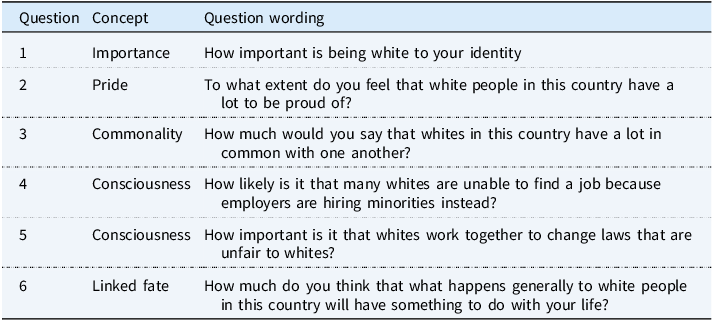
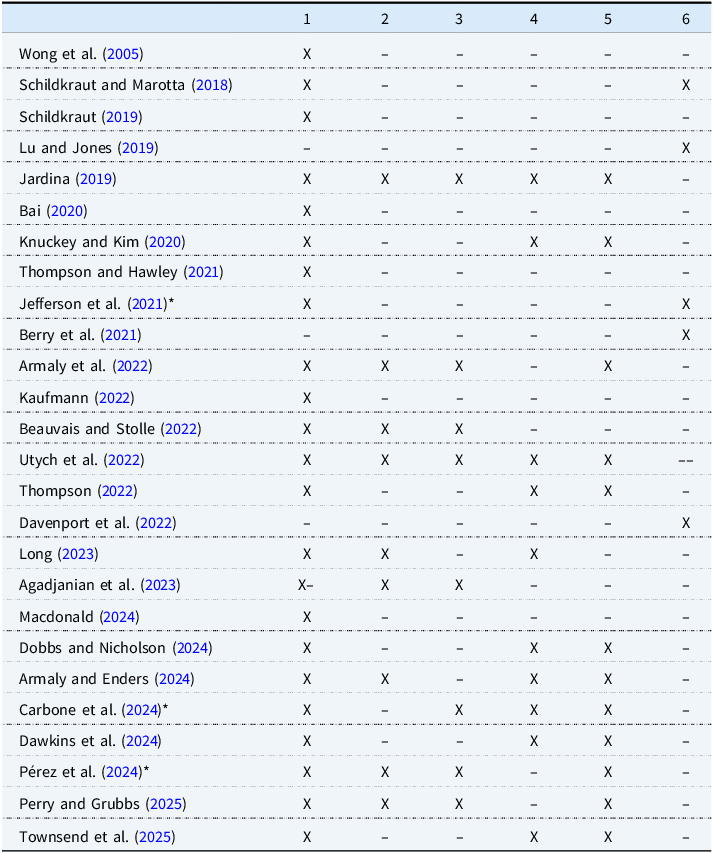
The majority of these studies use some or all of a measurement of white identity and consciousness popularized by Jardina (Reference Jardina2014) and collected in the American National Elections Study.Footnote 4 This measurement consists of items 1 through 5 outlined in Table 1. Research on the political effects of white identity, outlined in Table 2,Footnote 5 uses various combinations of these items to study the effects of white identity in American politics. However, there are reasons to believe that this existing measurement strategy for white identity and consciousness conflates two distinct, albeit related, constructs in a way that predetermines a relationship between white identity and more racially conservative preferences.
White identity and consciousness survey items

Table 1. Long description
A table with six rows and three columns. The columns are labeled Question, Concept, and Question wording. The rows list survey questions related to white identity and consciousness. Row 1: Question 1, Concept Importance, Question wording How important is being white to your identity. Row 2: Question 2, Concept Pride, Question wording To what extent do you feel that white people in this country have a lot to be proud of. Row 3: Question 3, Concept Commonality, Question wording How much would you say that whites in this country have a lot in common with one another. Row 4: Question 4, Concept Consciousness, Question wording How likely is it that many whites are unable to find a job because employers are hiring minorities instead. Row 5: Question 5, Concept Consciousness, Question wording How important is it that whites work together to change laws that are unfair to whites. Row 6: Question 6, Concept Linked fate, Question wording How much do you think that what happens generally to white people in this country will have something to do with your life.
White identity measurement in the discipline

Table 2. Long description
The table has 6 columns and 21 rows, including a header row. The columns are labeled 1 through 6. The rows list various studies with their corresponding years and the presence of certain measurements indicated by ‘X’. The studies span from 2005 to 2025. Each row represents a different study, with the columns indicating the presence of specific items related to white identity measurement. Notable studies include those by Jardina (2019), Knuckey and Kim (2020), and Thompson (2022), among others. The table shows a variety of combinations of items used to study the effects of white identity in American politics.
The core item used across many studies of white identity is a question regarding the importance of racial identity (1), which asks, “How important is being white to your identity?” This question has been consistently included in the ANES since 2010 and has been used in numerous studies as a single-item estimator for white identity.Footnote 6 While this item has been the subject of valid criticisms regarding its measurement properties (Huddy Reference Huddy2001; Kinder and Kam Reference Kinder and Kam2010; Krysan and Couper Reference Krysan and Couper2003; Mendelberg Reference Mendelberg2001), its continued use as both a standalone measure and in conjunction with other survey questions makes it relevant for inclusion in ongoing analyses.
The existing white identity measurement scale includes an item assessing pride (2), which asks, “To what extent do you feel that white people in this country have a lot to be proud of?” This item invokes a specific racial narrative of pride that positions white group identification as superior despite the historical context of white pride being intertwined with racial hierarchy, oppression, and domination in the United States (Dobratz and Shanks-Meile Reference Dobratz and Shanks-Meile2000; McDermott and Samson Reference McDermott and Samson2005). This question also implies a greater level of politicization than the theoretical conceptualization of white identity suggests (Conover and Feldman Reference Conover and Feldman1981; Huddy Reference Huddy2001; McClain et al. Reference McClain2009). Indeed, the question wording of this item reflects the measurement goal of “pars[ing] out the white identifiers who view their group positively from those who do not” (Jardina Reference Jardina2019, 58). However, identity is conceptualized as an understanding of self within a stratum (Gurin et al. Reference Gurin1980) and distinct from group affect (Conover and Feldman Reference Conover and Feldman1981). Thus, this survey design choice excludes individuals who may strongly identify as white but do not feel pride regarding their group identity from the analysis.
The existing measure for white identity also includes a survey item about commonality (3), which asks, “How much would you say that whites in this country have a lot in common with one another?” This survey item is theoretically sound, establishing the extent to which individuals feel a sense of cohesion with the broader racial group or see themselves as part of a coherent stratum and is indicative of an “awareness of similarity” among group members (Gurin et al. Reference Gurin1980, 30).
A more politicized attachment to the white group, referred to as white consciousness, is commonly estimated using two additional survey questions. These questions are more ideological than questions 1 through 3 but invoke an explicitly conservative ideology. This includes a question asking (4) “How likely is it that many whites are unable to find a job because employers are hiring minorities instead?” This question echoes themes of the Great Replacement Theory, suggesting that white Americans are engaged in a zero-sum economic competition with racial others. Furthermore, it explicitly invokes racial outgroups within a measurement that is purportedly focused on ingroup solidarity.
A final survey item (5) asks, “How important is it that whites work together to change laws that are unfair to whites?” This question estimates a collective political orientation based on the assumption that laws are biased against whites. While it explicitly addresses the politically mobilizing nature of group consciousness, it does so in a way that primarily captures political mobilization aimed at maintaining or even improving white racial group status, implying that white status is under threat. This framing may not be problematic, as consciousness is conceptualized as being associated with pro-group issue preferences and sympathy toward the ingroup (Conover and Feldman Reference Conover and Feldman1981).
Some work incorporates the concept of white-linked fate (6) when examining white consciousness, which follows Dawson (Reference Dawson1994) by first asking, “Do you think that what happens generally to white people in this country will have something to do with what happens in your life?” and then branching to “How much do you think it will affect you?” There are some concerns about using linked fate for whites given the historical and contemporary dominant social position of the white racial group (Gay et al. Reference Gay2016; Sanchez and Vargas Reference Sanchez and Vargas2016). Evidence regarding the existence of linked fate among white Americans is mixed: while self-reported linked fate is associated with a desire for descriptive representation among whites (Schildkraut Reference Schildkraut2017), it shows a weaker connection to political participation compared to linked fate among Black Americans. This may be driven by anxiety about loss of status (Marsh and Ramírez Reference Marsh and Ramírez2019) or may serve as a proxy for economic self-interest (Melcher Reference Melcher2021).
While Jardina (Reference Jardina2019) uses items one through three to measure white identity and items four and five to measure consciousness, other research employs a subset of these measures, typically Items 1, 4, and 5.Footnote 7 More than half of the works cited in Table 2 use a subset of Jardina’s measures, but the variation in usage, along with additional items not tracked here, suggests that scholars remain skeptical about the conceptualization and measurement of white identity.
But identity is both subjective (Bilgrami Reference Bilgrami2006) and relational (Lamont and Molnár Reference Lamont and Molnár2002). If we follow Gurin et al. (Reference Gurin1980) in considering social groups as strata with different attributes, the subjectivity of identity implies that individuals may have different perceptions of the attributes associated with their social stratum. Indeed, identity is shaped through both internal definition and external interaction that includes the “cultural repertoires, traditions, and narratives that individuals have access to” (Lamont and Molnár Reference Lamont and Molnár2002, 171). With different sociocultural contexts, individuals may develop different interpretations of identity even within the same racial group. Conover (Reference Conover1988) suggests that identifying with a group leads to the merging of a self-schema and group schema and that consciousness includes “a well-developed ingroup schema containing information about the group’s status” (Conover and Feldman Reference Conover and Feldman1981, 62). Conover argues that this consciousness fosters stronger pro-group preferences, but these schemas are influenced by the subjectivity of identity, which may lead to variations in what individuals perceive as pro-group. Items 4 and 5 outlined above measure a group consciousness that links the white ingroup to a distinct set of attributes and a specific status: one in which whites perceive themselves as losing status and power to minorities and feel compelled to unite against this perceived unfairness. Prominent research indicates that “most of the whites who possess high levels of white identity […] are not racially conscious in a way that is intended to promote greater racial equality” and that “most white identifiers embrace their privileged status” (Jardina Reference Jardina2019, 48, 134). However, since these questions invoke a specific schema, or set of attributes and characteristics, these findings may not accurately capture variations in how whites interpret their group identity. Indeed, Chong and Rogers (Reference Chong and Rogers2005) remind us that “the influence of group consciousness may depend critically on how consciousness is conceptualized and measured.” If political scientists conceptualize white identity and consciousness as a unidimensional racially conservative phenomenon, the empirical influence of group consciousness will continue to confirm this narrative, which I argue misses a crucial part of the story.
How White Americans Interpret Their Racial Group Membership
Existing methods of measuring white identity and evaluating its political implications indicate that white identity has grown politically consequential for contemporary politics and that it is associated with racially conservative political preferences. But existing research relies almost entirely on survey-based measurements for estimating the content and effects of white identity. It is worth asking how white Americans actually understand and interpret their racial group membership in their own words in order to gain a deeper understanding of the political role of identity (Cramer Reference Cramer2024).
I conduct interviews with white Americans which allow me to learn, in their own words, how they understand their racial group identification and how it shapes their understanding of the broader political world. I conducted interviews in the Minneapolis-St. Paul metropolitan area where my positionality as a white Minnesotan also aided in the development of a rapport with respondents as a perceived “insider” to both whiteness and the culture of the Twin Cities, which increased chances of having candid political conversations with respondents. This is especially important because whites are not often pressed to think about, let alone talk about, their race when not specifically confronted with it (Bayeck Reference Bayeck2022; Soss Reference Soss2015). Furthermore, the culture of race and politics in Minnesota makes it a particularly suitable location for this research: the overwhelmingly white population,Footnote 8 the history of stark racial disparities, and the reputation for progressive politics, which is often coupled with an assumption of racial progressivism (Crowell and Fossett Reference Crowell and Fossett2020; Elazar et al. Reference Elazar1999; Gilman Reference Gilman2000; Myers Jr Reference Myers2000).
Centering a qualitative approach to understanding how individuals interpret their white identity, I recruited a purposive sample of 40 white residents of the Twin Cities and conducted interviews in February and March 2020.Footnote 9 Notably, these interviews occurred prior to the onset of the COVID-19 pandemic and the uprising in the summer of 2020 in response to the murder of George Floyd and provide a foundation for the measurement distinctions developed in the following section. These interviews covered a variety of topics, including how individuals understand and interpret their white racial identity and wider-ranging discussions of other relevant political topics. I conducted all of the interviews myself with a semi-structured approach that allowed me to have more personal connections with my interlocutors and to delve deeper into interesting topics as they came up, allowing me to probe responses for key themes and insights. I found that while indeed many white Americans do claim to identify with the white racial group, there are key variations in how they express and interpret this identity that are not consistent with the existing ways of measuring white identity in surveys. This approach follows recent calls to use qualitative approaches to study American political behavior (Berg and Ternullo Reference Berg and Ternullo2025; Cramer Reference Cramer2022).
Across interviews there was variation in level of identification with the white racial group, consistent with expectations from the literature. Some interlocutors have low levels of identification, such as SophiaFootnote 10 who said that her whiteness is not an important part of her identity because “It’s never been something that – to me, I just look at people as people.” Others, like Andrew, said, “I guess it’s who I am, but I don’t really look at it like that.” Many respondents expressed higher identification with the white racial group, like Rachel, who said, “It kind of has changed the way that the world interacts with me and the way I interact with the world. I also think that because it’s seen as the default, I’ve kind of been unaware of it for a long time.” This is consistent with arguments that white identity is politically activated by the increased salience of race in American politics (Cole Reference Cole2026; Hutchings et al. Reference Hutchings2011; Jardina Reference Jardina2019; Wong and Cho Reference Wong and Cho2005).
Importantly, analysis of the interviews revealed that there are also variations in how individuals interpret their identity—namely, variations in the political ideology of white consciousness rooted in relational identity formation from social and political interactions. Some see their white group membership as a negative attribute that makes their lives more difficult. Others perceive their white group membership as something that has positively impacted their lived experiences by making their lives easier. Consistent with other studies of white identity, several respondents expressed a more negative, or disadvantaged, interpretation of their white group membership. For example, Tim expressed a grievance-based interpretation of white consciousness explicitly, saying, “When white people are discriminated against, there’s no way for them to speak up in defense of their own race because claiming white power or trying to rally and organize around whiteness is worse than Satanism.” These responses are consistent with variations in level of white identity with an ideological interpretation of white consciousness that is consistent with findings from the existing literature outlined in the previous section. Philip’s interpretation of his identity was more subtle. He said, “I mean, to me race really doesn’t play a big part in that. I am aware that there are different perceptions of treatment and things like that…the fact that I’m a white person, I don’t feel great pride or anything like that. I’m a human being.” Philip distances himself from white identity by denying any sense of pride and using colorblind language. Another respondent, Richard, said, “When you ask me a question like that, frankly, my natural reaction, what a stupid question. What’s my white have to do with that? I don’t know.” Richard is hostile to the question about how being white has impacted his life. These responses suggest reluctant awareness of whiteness but purposeful distancing from racial identification using colorblind language.
Dan more explicitly distanced from his racial identification, explaining that because his “fourth grade was maybe 98% minority…I actually always grew up on the fringes of the majority.” This illustrates how social interactions can shape racial identity, particularly when individual experiences do not comport with narratives of white dominance and privilege. In contrast to Dan’s identity construction at school, Jessica described her understanding of whiteness, saying, “It never occurred to me until probably high school because all of my friends, a lot of them were people of color.“ Where Dan felt that being in the racial minority at school precluded him from receiving the advantages of whiteness, Jessica’s experiences taught her about her privilege. It is through these kinds of interactions that Dan and Jessica come to interpret their identity differently.
Several respondents interpreted their white racial identity differently, perceiving benefits gained from their racial group status. One such respondent, Karen, said that she has been “very privileged by being white” and “I’ve felt very comfortable most of the time. I haven’t been outstanding by being the different color from the people around me.” Thomas similarly explained that “as someone that has white skin, I feel like people aren’t going to grill me, that I’m able to go into a lot of different spaces.” Thomas and Karen both gesture more generally at the relational processes through which they come to understand what whiteness means for their lived experiences. This includes social interactions but extends to interactions with the state: Lizzie explained that her whiteness means that “if I get stopped by the police, I don’t have to be afraid that I’m going to get shot.” Another respondent, Jasmine, admitted that “the idea that there’s a thing called whiteness is something that’s relatively new for me in the last five years or something,” consistent with scholarship documenting the growing salience of white identity in contemporary politics. However, instead of motivating a sense of grievance or disadvantage, Jasmine explained that “[whiteness] is very much where my head is at most of the time in my life right now, professionally and personally,” as she told me about serving on the board for a local racial justice organization. Both Jasmine’s personal life and workplace are sites of identity development through relational interactions. These respondents demonstrate a different interpretation of their white group membership, one that recognizes a privileged group position that provides benefits and can even motivate behavior in political and personal contexts.
These interviews reveal variation in both the extent to which white Americans identify with their racial group and how they interpret what that group membership means. While some interlocutors expressed a more defensive or disadvantaged interpretation of their racial position, others clearly interpret their whiteness as an advantage that can be just as mobilizing as grievance. Existing survey measures that conflate identity strength and a specific grievance-based interpretation of whiteness systematically misclassify white Americans like Jessica, Karen, Thomas, Lizzie, and Jasmine who identify strongly as white but view this membership through a lens of privilege rather than threat. Furthermore, discussing race with white Americans reveals how identity is relational and developed through lived experiences and interactions that shape how individuals understand white group membership. These interviews motivate the adapted measurement strategy developed in the following section, which distinguishes between the extent of white group identification and the ideological interpretation of that group position.
Measuring White Identity and Consciousness
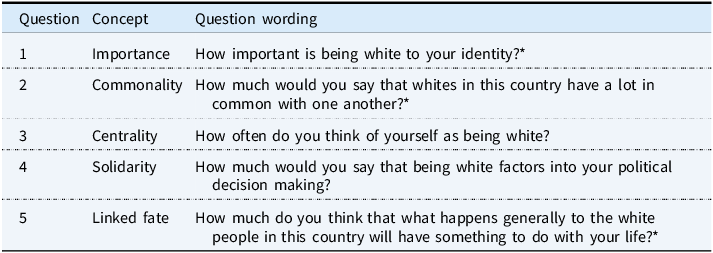
Based on the interviews outlined in the prior section, I propose adapted measures for white identity and white consciousness that treat identity and consciousness as distinct dimensions, allowing for variation in how individuals interpret their group membership.Footnote 11 For this measure, I draw on several existing survey questions as well as new survey items, which are outlined in Tables 3 and 4. These survey items draw on core aspects of identity, including importance, commonality, centrality, solidarity, and a sense of linked fate without an ideological interpretation of group position. The core item used in the existing literatureFootnote 12 asks respondents, “How important is being white to your identity?” and this item is retained in the revised measurement of white identity. I retain the item “How much would you say that whites in this country have a lot in common with one another?” as it invokes white racial group cohesion without imposing ideological interpretations on the group.
White identity survey items

Table 3. Long description
A table with five rows and three columns. The columns are labeled Question, Concept, and Question wording. The rows are as follows: Row 1: Question 1, Importance, How important is being white to your identity? Row 2: Question 2, Commonality, How much would you say that whites in this country have a lot in common with one another? Row 3: Question 3, Centrality, How often do you think of yourself as being white? Row 4: Question 4, Solidarity, How much would you say that being white factors into your political decision making? Row 5: Question 5, Linked fate, How much do you think that what happens generally to the white people in this country will have something to do with your life?
White consciousness survey items

Table 4. Long description
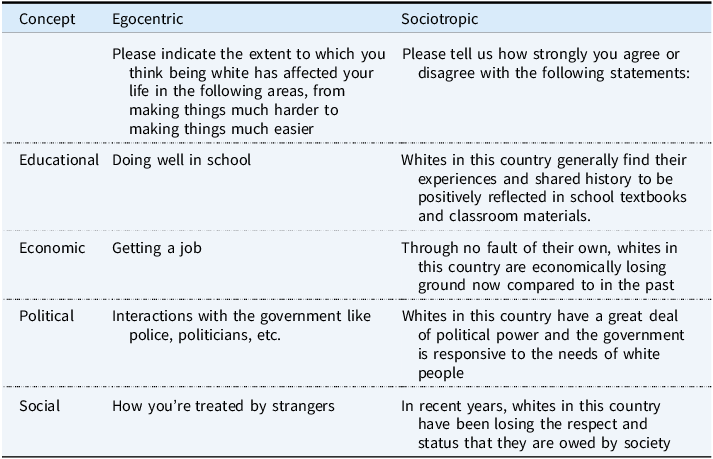
A table with two main columns: Egocentric and Sociotropic, and four rows labeled Educational, Economic, Political, and Social. The Egocentric column asks individuals to indicate how being white has affected their life in areas such as doing well in school, getting a job, interactions with the government, and treatment by strangers. The Sociotropic column asks individuals to agree or disagree with statements about whites in the country, such as their experiences in school textbooks, economic status, political power, and social respect. Each row provides specific survey items related to the concept.
I include the item “How often do you think of yourself as being white?” which estimates the cognitive centralityFootnote 13 of whiteness more directly and an item that asks, “How much would you say that being white factors into your political decision-making?” This question similarly prompts respondents to assess the cognitive salience of their whiteness in relation to their political behavior without directly invoking outgroups as a motivation for white political solidarity. Finally, I include a standard measure for estimating white-linked fate, which asks, “How much do you think that what happens generally to white people in this country will have something to do with your life?”Footnote 14 This measurement should be more politically neutral than the measure of white identity consisting of Items 1 through 3 in Table 1, and it should also be more empirically precise than measures of identity that rely solely on Item 1. Taken together, these items should provide an estimation of white identity that captures a more politically neutral form of ingroup attachment than the current widely used measures of white identity.Footnote 15
To estimate how white consciousness is politicized in potentially divergent ideological ways, I inquired about individuals’ interpretations of whiteness in educational, economic, political, and social contexts. I choose these four issue areas because they emerged as important topics in the interviews discussed in Section 3, where respondents consistently referenced these contexts when discussing how their whiteness shaped their experiences and opportunities. Following a relational understanding of group identity (Emirbayer Reference Emirbayer1997; Lamont and Molnár Reference Lamont and Molnár2002; Somers Reference Somers1994), these survey questions address the narratives that individuals use to understand their own identity within a larger group (see also Hayward (Reference Hayward2013)). Importantly, respondents varied in whether they understood whiteness as an advantage or disadvantage across each domain with that understanding shaped by repeated interactions in and around the institutions of public life. Measuring white consciousness this way is a departure from the existing literature, but this strategy is better able to capture the relational nature of identity formation and the subjective assessments of group position without imposing ideological assumptions. This new measurement draws on areas of social and political life where identity is formed through relational interactions based on the interviews in the previous section, but these domains have precedent as sites of racialized political conflict.
Education is an increasingly racialized political issue, with conflicts surrounding educational materials, critical race theory, and perceptions of disadvantage due to affirmative action (Carbone et al. Reference Carbone2024; Kaufmann Reference Kaufmann2022; Taylor et al. Reference Taylor2023). The economy is similarly a growing battleground for racial politics. For example, President Trump relied heavily on the narrative that the economy is deteriorating for white Americans, particularly due to jobs and opportunities being taken away by other groups (Abramowitz and McCoy Reference Abramowitz and McCoy2019; Morgan and Lee Reference Morgan and Lee2018). While this narrative resonates with some working-class whites, not all interpret their whiteness in the same manner (Knowles and Tropp Reference Knowles and Tropp2018; Walley Reference Walley2017). How whites perceive their economic status can also have far-reaching effects: social science suggests that individual behavior is more accurately predicted by their perceptions of the economy’s overall performance rather than their personal financial evaluations (Kinder and Kiewiet Reference Kinder and Kiewiet1981). I ask respondents about their interactions with the government because I expect that interpretations of white political power will vary among white identifiers. Some may feel that whites are losing influence as demographic changes lead to an increasing number of minorities serving in government and expressing their preferences through the ballot box (Danbold and Huo Reference Danbold and Huo2015). In contrast, others may perceive whites as facing fewer barriers to participation in political life compared to other groups (Emig et al. Reference Emig1996).
To measure consciousness, I employ the items outlined in Table 4. In the left column, I designed questions to elicit an egocentric evaluation of how whiteness shapes individual experiences, while the right column contains questions aimed at capturing a sociotropic evaluation of how individuals interpret the significance of whiteness for the group across these contexts. The use of both egocentric and sociotropic questions should capture what Conover and Feldman (Reference Conover and Feldman1981) describe as a self-schema that links the individual to the group schema (62), accounting for the diverse subjective interpretations that the group schema may encompass. These items are coded so that more grievance-based or disadvantaged ideological interpretations of group consciousness receive higher values, ensuring consistency and comparability with existing measures. The adapted instrument for white identity should capture ingroup attachment, while the instrument for consciousness should capture the ideological interpretation of racial group membership. Taken together, these measures should capture previously undetected variation in white identifiers and provide a more nuanced understanding of the impact of white identity and consciousness in American political life.
Data
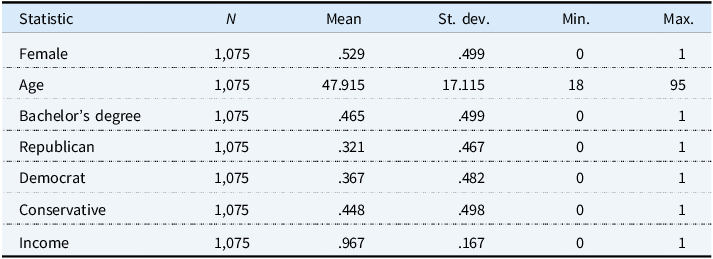
To evaluate these updated measures of white identity, I use an original survey collected via Lucid Theorem between July 28 and August 8, 2022.Footnote 16 This sample comprises 1,075 non-Hispanic white Americans who completed the survey, passed the attention checks,Footnote 17 and had high response integrity.Footnote 18 Summary characteristics for the sample can be found in Table 5. While there may be concerns about the quality of Lucid data, prominent research has established it as a reliable source for measuring political attitudes (Coppock and McClellan Reference Coppock and McClellan2019), and this data was collected prior to widespread concerns about AI survey takers (Westwood Reference Westwood2025). I further corroborate the subsequent analysis using data collected by YouGov in the 2023 CES in Appendix A.5 for a subset of the new items.Footnote 19
Summary characteristics

Table 5. Long description
A table summarizing characteristics of a survey sample of 1,075 non-Hispanic white Americans. The table has 8 rows and 6 columns. Column headers are Statistic, N, Mean, St. dev., Min., and Max. Row labels include Female, Age, Bachelor’s degree, Republican, Democrat, Conservative, and Income. Each row provides values for the respective statistic. For example, the row for Female shows N as 1,075, Mean as 0.529, St. dev. as 0.499, Min. as 0, and Max. as 1. The table provides a detailed breakdown of the sample’s demographic and political characteristics.
As discussed in Section 4, I use a composite 5-item survey scale to measure white identity that contains 2 items from the existing measure for white identity as well as a linked fate question. The wording of the survey questions is presented in Table 3. To measure white consciousness, I use a composite 6-item survey scale outlined in Section 4 with wording in Table 4.Footnote 20 These variables are coded so that a more grievance-based ideological interpretation of white consciousness corresponds to higher values for comparability with the existing measures for white consciousness. To verify that the adapted measures capture two distinct dimensions, I conduct factor analysis on all proposed and existing items, with full results in Appendix A.3. I find that the proposed adapted measures for white identity and white consciousness are negatively correlated (r = −.35, p < .001), which confirms that they are empirically distinct. Furthermore, this finding challenges the existing literature by suggesting that higher white identity is negatively correlated with the kind of aggrieved consciousness measured before and further affirms that these empirically distinct dimensions should not be collapsed into a single additive scale.
Correlations
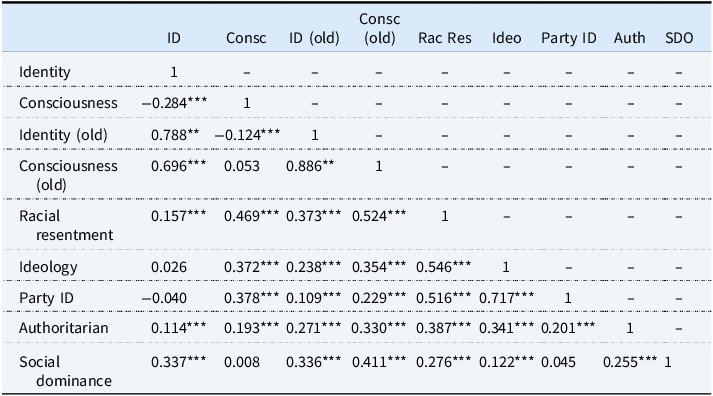
Table 6 examines the correlations between the new composite scale measures and existing measures of white identity and consciousness, racial resentment, ideology, partisanship, authoritarianism, and social dominance orientation, demonstrating that the new measures are empirically distinct from one another and from existing constructs.
Correlations with relevant attitudes

Table 6. Long description
The table presents correlation coefficients between different measures. It has 8 rows and 9 columns. The columns are labeled as ID, Consc, ID (old), Consc (old), Racial resentment, Ideology, Party ID, Authoritarian, and Social dominance orientation. The rows are labeled as Identity, Consciousness, Identity (old), Consciousness (old), Racial resentment, Ideology, Party ID, Authoritarian, and Social dominance orientation. Each cell contains a correlation coefficient value. Notable values include strong positive correlations between Identity (old) and Identity (0.788), Consciousness (old) and Consciousness (0.696), and Racial resentment and Ideology (0.546). There are also significant negative correlations such as between Consciousness and Identity (-0.284).
Note: ***p < 0.001; **p < 0.01; *p < 0.05.
The existing measures of white identity and consciousness correlated at .886, behaving as nearly identical constructs despite ostensibly measuring different concepts.Footnote 21 However, the new measurements for identity and consciousness show a correlation of −.284, consistent with the findings from the factor analysis in Appendix A.3. This confirms that identity and consciousness are both distinct and divergent attitudinal dimensions, as whites who report strongly identifying with the racial group also report a more advantaged interpretation of that group position, challenging existing assumptions that higher white identification implies grievance. Similarly, the relationship between consciousness and the existing measures is very low; for the 3-item measure, the correlation is −.124, and for the 5-item measure, the correlation is .053, which is not statistically significant. This further corroborates the unidimensional nature of existing measures and the new dimension introduced by the updated construct.
The updated measure of white identity shows a small but significant positive relationship with racial resentment (.157), notably lower than the existing identity measure (.373) or existing consciousness measure (.524). The new consciousness measure retains a strong relationship with racial resentment (.469), consistent with the ideological interpretation of group position captured by consciousness. This finding supports the critique of prior measures, demonstrating that when the ideological questions are removed from the measurement for white identity, the relationship with racially conservative attitudes diminishes.
The new measure of consciousness has a positive and statistically significant relationship with both ideology (.372) and partisanship (.378), consistent with patterns observed for the existing measures. By contrast, the new identity measure shows no statistical relationship with partisanship or ideology, further supporting its validity as a measure of white ingroup identity distinct from the ideological interpretations of consciousness.
The new measures also show lower correlations with authoritarianism than the existing measures for identity (.114 vs. .271) and consciousness (.193 vs .330), suggesting that the new measurement strategy captures white identifiers who are less authoritarian. Social dominance orientation correlates with the adapted white identity measure (.337) and the original identity (.336) and consciousness (.411) measures. However, there is no statistical relationship between social dominance orientation and the adapted measure for consciousness (.008), suggesting that socially dominant attitudes are associated with ingroup identification and not the ideological variations in consciousness. These findings consistently demonstrate that consciousness, not identity, correlates with political orientations and racial conservatism, confirming that separating these two constructs reveals a form of white ingroup attachment that is distinct from the ideological commitments that define white identity in existing literature and is sensitive to the variations in how identity is influenced by relational interactions.
Applying the Measures
To assess the utility of the new measures of identity and consciousness for analyzing political phenomena, I evaluate these composite measures as predictors of self-reported voting for Trump in 2020 and support for Affirmative Action in schools.Footnote 22 Support for Trump offers a useful test of the adapted measurement strategy given the associations that Trump has with racially conservative political positions. White identity has been found to motivate support for Trump (Jardina Reference Jardina2019; Knowles and Tropp Reference Knowles and Tropp2018; Long Reference Long2023) and his key policy positions in prior research (Armaly and Enders Reference Armaly and Enders2024; Kaufmann Reference Kaufmann2022; Pérez et al. Reference Pérez2024), making it an important case for evaluating the new measures. Support for affirmative action provides a contrasting case that is less explicitly partisan due to broad disapproval (Gilens et al. Reference Gilens1998; Petts Reference Petts2022). Prior research finds that white opposition stems from perceptions of ingroup disadvantage (Lowery et al. Reference Lowery2006; Mangum and Block Jr Reference Mangum and Block2022), whereas awareness of white privilege predicts support (DeSante and Smith Reference DeSante and Smith2020), suggesting that the distinction between white identity and the more ideological understanding of white consciousness could produce meaningfully different predictions based on relational understandings of group position.
Based on this literature, I expect the adapted measures of white identity and consciousness to behave differently across these outcomes. Support for President Trump, often framed through narratives of white grievance, should be positively associated with white consciousness interpreted as a disadvantage and exhibit a negligible relationship with the more ideologically neutral white identity. Support for affirmative action, which is sometimes interpreted as reverse discrimination, should have a negative relationship with white consciousness and a negligible association with white identity. By contrast, existing measures should show a stronger positive relationship with Trump support and a weaker or null relationship with support for affirmative action, consistent with the argument that these measures contain ideological contamination. Regarding the new measures, I test the following hypotheses:
H1A: White identity, measured as psychological attachment to the racial group without ideological content, will have no significant relationship with self-reported Trump vote in 2020.
H1B: White consciousness, measured as a grievance-based ideological interpretation of white group position, will have a positive and significant relationship with self-reported Trump votes in 2020.
H2A: White identity will have no significant relationship with support for affirmative action in schools.
H2B: White consciousness will have a negative and significant relationship with support for affirmative action in schools.
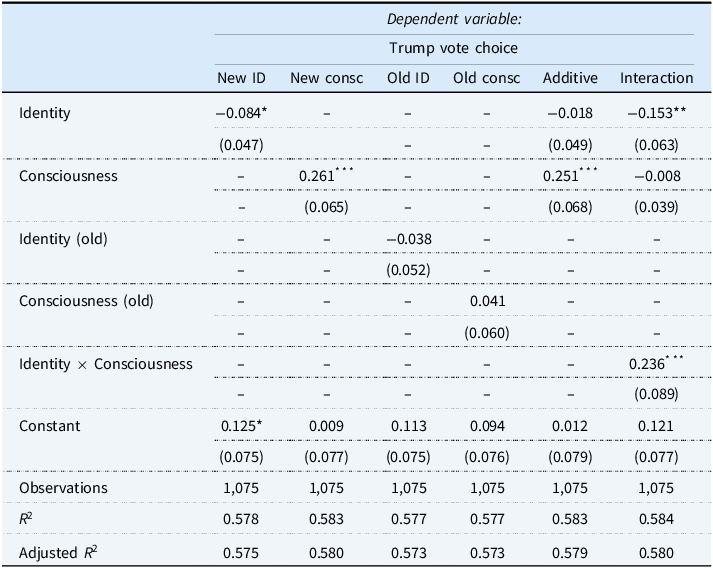
In Table 7, I use ordinary least squares regression with Huber-White robust standard errors and control for partisanship, ideology, racial resentment, age, income, education, and gender. When white identity is isolated from the ideological interpretation of white group membership, there is no statistical or substantive relationship with voting for Trump. Consciousness, which is coded so that lower values indicate an advantaged interpretation of white group membership and higher values indicate a disadvantaged interpretation, is strongly associated with voting for Trump, as is the old measure for consciousness. The old measure for white identity is not statistically significant, and the relationship between the new measure for white identity and voting for Trump is actually negative. This suggests that support for Trump is driven by white consciousness and how individuals interpret their racial group position, rather than simple psychological attachment to the group. Model 5 includes both new measures together and demonstrates that the ideological interpretation of group membership drives support for Trump: when both constructs are included simultaneously, the effect of white identity alone on Trump support attenuates.Footnote 23 The interaction of identity and consciousness in Model 6 adds to this narrative. At lower levels of consciousness (advantaged interpretation), higher white identity is associated with a lower likelihood of voting for Trump. At higher levels of consciousness (disadvantaged interpretation), higher white identity is associated with a higher likelihood of voting for Trump. This suggests that the variations in how whites interpret their racial group position are meaningful for politics.
Voted for Trump in 2020

Table 7. Long description
A table titled AQ15 showing the relationship between different measures of identity and consciousness and the vote choice for Trump. The table has six columns: New ID, New consc, Old ID, Old consc, Additive, and Interaction, each representing different models. The rows include Identity, Consciousness, Identity (old), Consciousness (old), Identity × Consciousness, and Constant, with corresponding values and standard errors in parentheses. The table also lists the number of observations, R-squared, and adjusted R-squared values for each model. Notable trends include the negative relationship between New ID and Trump vote choice, the positive relationship between Consciousness and Trump vote choice, and the interaction effect between Identity and Consciousness.
Note:*p<0.1; **p<0.05; * * * p< 0.01.
OLS with Huber–White robust standard errors (HC1).
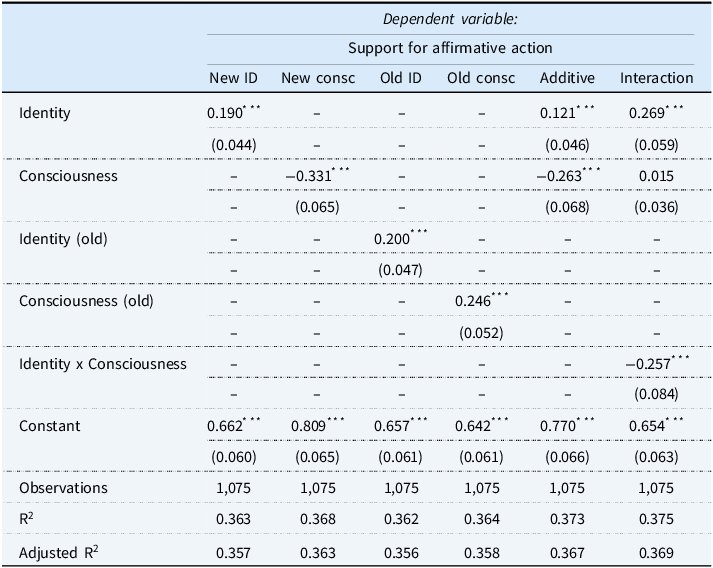
In Table 8, I use ordinary least squares regression with Huber-White robust standard errors and controls to assess the relationship between white identity and consciousness and support for affirmative action in schools. Model 1 suggests that with the new measure, higher levels of white identity are modestly associated with greater support for affirmative action. In model 2, the new measure for consciousness has a strong and significant negative relationship with support for affirmative action, suggesting that those who interpret white group membership as a disadvantage are less supportive of these policies. The existing measures for identity and consciousness in models 3 and 4 have positive and statistically significant relationships with support for affirmative action, which is inconsistent with expectations from existing literature. However, this is likely due to the included control for racial resentment, as the same models without racial resentment in Appendix Table 21 show no statistical relationship between either old measure and support for affirmative action. Model 5 includes the new measure of white identity, which is positive and significant, and the new measure of white consciousness, which is negative and significant, confirming that ingroup attachment and ideological interpretation of group position exert opposite influence for this outcome. In model 6, the interaction between white identity and consciousness again suggests that these dimensions are interactive. Individuals with an advantaged interpretation of white group membership have modest support for affirmative action, while those with a disadvantaged interpretation of whiteness have a strong opposition to affirmative action, and these effects are strongest among those with higher levels of identity.
Support for affirmative action in schools

Table 8. Long description
The table presents data from ordinary least squares regression with Huber-White robust standard errors, assessing the relationship between white identity, consciousness, and support for affirmative action in schools. It includes six models with different measures of identity and consciousness. Each row lists the coefficients and standard errors for the variables in each model. The table has six columns: New ID, New consc, Old ID, Old conc, Additive, and Interaction. Each model includes a constant term and observations count. The R-squared and adjusted R-squared values are provided at the bottom.
Note: * p<0.1; ** p<0.05; * * * p< 0.01.
OLS with Huber–White robust standard errors (HC1).
The above analysis demonstrates that white identity alone is not predictive across domains: it has a modest negative relationship with support for Trump and a positive association with support for affirmative action. H1A and H2A predicted null relationships for white identity, which is largely supported by the additive models in Tables 7 and 8. When both identity and consciousness are included simultaneously, identity is not a significant predictor of Trump support, and consciousness dominates. However, when identity is modeled alone, it shows a modest negative relationship with Trump support and a positive relationship with affirmative action support, suggesting that ingroup attachment absent grievance-based consciousness may have a modest progressive directional pull. Taken together, these results suggest that white identity is not inherently racially conservative as some previous research may suggest. Instead, consciousness appears to be the key driver of directional attitudes across domains. When whites interpret their racial group position as disadvantaged, they are more supportive of Trump and less supportive of affirmative action. But when whites have an advantaged interpretation of group position, they are more open to egalitarian policies like affirmative action and less supportive of Trump. The interactive analysis also suggests that higher levels of white identity amplify the effect of consciousness, reinforcing the theory that identity and consciousness are separate but related dimensions.
Discussion & Conclusion
This study demonstrates that existing measures of white identity and consciousness, while foundational to the literature, embed conservative ideological assumptions that limit their ability to capture the full range of white racial group attachments. Drawing on original survey data, I show that white identity and white consciousness are distinct constructs and that the political consequences of white identity depend on how individuals ideologically interpret their group position. Importantly, the subjective nature of identity implies that there is ideological variation in the politicized attachments to the racial group that emerge as part of white group consciousness. Put simply, some whites are racially conscious with the intent of protecting and maintaining dominant group status, while others are conscious in a more racially progressive way.
This distinction is particularly important given the widespread usage of the existing measures in research about white identity as outlined in Table 2. While this study does not dispute these findings, it does render them less surprising. Given the racial conservatism baked into the existing measures of white identity, finding that white identifiers support more racially conservative policies risks tautology. For example, Townsend et al. (Reference Townsend2025) find that white-identifying Democrats have more conservative preferences on issues such as immigration policy while including question 4 from Table 1 in the measurement for white identity. In other words, this study finds that whites who believe they are losing jobs to minorities are more conservative on immigration policy. Other studies also find that individuals with higher levels of white identification are more supportive of outcomes that strongly resemble items in the measurement of identity itself. For example, Armaly et al. (Reference Armaly2022) find that whites with higher levels of identity—measured with questions about white pride and the importance of whites working together to combat unfairness—are more supportive of the political violence displayed on January 6, 2021, an event widely understood as an expression of white grievance (DiMaggio et al. Reference DiMaggio2024). This is not to say that these studies are invalid; on the contrary, they are highly informative about the political attitudes and behavior of a subset of white Americans who interpret their white consciousness through a lens of threat and disadvantage. And indeed, this problem of ideological contamination on a racial attitude measure is not new (see, for example, Sniderman and Carmines (Reference Sniderman and Carmines1997)), but it has gone largely unaddressed in the white identity literature until now. While the hypotheses about the relationship between new measures of identity and consciousness and attitudes like support for Trump and affirmative action are only partially supported in this analysis, there is ample room for future research across different domains. In particular, support for immigrants and immigration enforcement based on existing literature would expect a negative relationship with white identity. But this new conceptualization suggests that white consciousness and the directionality of how whites interpret their identity should drive these attitudes.
This ideological variation aligns with broader divisions in American racial politics. As Smith and King (Reference Smith and King2024) argue, two competing coalitions, one focused on “protecting” the privileges associated with whiteness and the other on “repairing” persistent racial inequalities, shape how individuals understand their place in the racial hierarchy. These coalitions offer divergent ideological interpretations of white group positions, shaping individuals’ understanding of their place within the status hierarchy. The protect coalition remains a strong and imposing force in American politics, as evidenced by the re-election of President Trump, increasingly restrictive immigration policy and ICE raids, and backlash against diversity, equity, and inclusion practices. However, the repair coalition is emerging as a significant political entity, with lower levels of racial resentment (Hopkins and Washington Reference Hopkins and Washington2020), increasing support for Black political candidates among some racially liberal whites (Mikkelborg Reference Mikkelborg2025), and growing concerns over racial inequality among others (Chudy Reference Chudy2024). Tensions between these two coalitions are intensifying in President Trump’s second term, as his supporters and deputies, representatives of the “protect” coalition, clash with the “repair” coalition made up of minorities, immigrants, and white Americans who interpret their racial group membership through a lens of repair rather than protection.
After Trump was first elected in 2016, scholars found a decrease in white identity among those trying to distance themselves from the image threat of association with Trump (Dai et al. Reference Dai2021) or social disgust towards the President (Jardina et al. Reference Jardina2021). Others responded by actively denying white privilege (Dobbs and Nicholson Reference Dobbs and Nicholson2024) or embracing colorblind ideology—a tendency found across the ideological spectrum (Burke Reference Burke2017; Collins and Walsh Reference Collins and Walsh2024). While the literature shows that some whites disavow their white identity precisely because of its relationship to the “protect” coalition, this study suggests that some whites may instead be embracing white consciousness in ways that are ideologically distinct and aligned with the “repair” coalition. These findings point to a broader trend: some white Americans may be less attached to their ingroup identity when it becomes politically stigmatized or loses perceived value, but others may reinterpret that identity through a more reflexive or progressive lens Cole (Reference Cole2018).
This study challenges the prevailing consensus regarding the politically conservative nature of white identity politics, demonstrating instead that its political meaning is contingent on how it is measured and interpreted. By separating white ingroup attachment from the ideological interpretation of group position, this study reveals a white electorate that is more ideologically varied and politically complex than existing measures suggest. The white Americans who mobilize around racial grievance and interpret their whiteness as a disadvantage are not simply those who identify most strongly with the racial group, and indeed whites with a more advantaged or repair-oriented interpretation of group membership can similarly be mobilized on the basis of their identity (Cole Reference Cole2026). This distinction is essential for understanding both the nature of white identity politics and its trajectory, including the conditions under which white racial consciousness might support rather than undermine interracial solidarity.
Supplementary material
The supplementary material for this article can be found at https://doi.org/10.1017/rep.2026.10106.
Data availability statement
Replication data and code for this article are available at Harvard Dataverse: https://doi.org/10.7910/DVN/0YPHZS.
Acknowledgements
I would like to thank Genevieve Bates, Andres Uribe, Mackenzie Israel-Trummel, Avi Ahuja, and anonymous reviewers for their helpful comments and suggestions.
Funding statement
This research was supported by the Center for the Study of Race, Politics & Culture and the University of Chicago.
Competing interests
The author declares no competing interests.


 Open access

