Introduction
Two recent systematic reviews of nearly 100 published studies on the prevalence of pain in cancer patients and the adequacy of analgesic treatment in such patients have indicated that cancer pain is still a major problem, despite recent advances in analgesic treatments.Reference van den Beuken-van Everdingen, de Rijke, Kessels, Schouten, van Kleef and Patijn1, Reference Deandrea, Montanari, Moja and Apolone2 Van den Beuken-van Everdingen et al. reported an overall pain prevalence of greater than 50 per cent in patients with all cancer types; the highest cancer subtype was head and neck cancer, with a pain prevalence of 70 per cent.Reference van den Beuken-van Everdingen, de Rijke, Kessels, Schouten, van Kleef and Patijn1 Deandrea et al. found that nearly one in two patients with cancer pain did not have adequate analgesia.Reference Deandrea, Montanari, Moja and Apolone2 These figures demonstrate a major deficiency in the management of patients with cancer, particularly those with head and neck cancer.
The purpose of this study was to define the problem of pain in head and neck cancer patients in our hospital, and to identify any patients particularly vulnerable to the development of pain. Additionally, we wanted to better understand the problem of pain in cancer survivors, the recognition of breakthrough and neuropathic pain, and the phenomenon of non-malignant pain in cancer patients.
Results from this study are expected to be used to more effectively focus resources on improving pain management and quality of life in this group of patients, and to identify barriers to pain control.
Materials and methods
Study setting
The study was approved by the ethics committee of the Royal Marsden Hospital, London.
Patients were recruited from head and neck oncology out-patient clinics at the Royal Marsden Hospital, a large, tertiary referral cancer hospital in the UK. Some of the clinics focused on medical treatments (i.e. radiotherapy and chemotherapy) and others on surgical treatment, while some were mixed.
Patient characteristics
The inclusion criteria for this study were: age greater than 18 years; diagnosis of head and/or neck cancer; able to respond to an assessment written in English; and able to provide informed consent to participate in the study. Study subjects included patients who had received anticancer treatment (surgery, radiotherapy and chemotherapy), patients currently receiving anticancer therapy, and patients characterised as having advanced, metastatic and/or terminal disease.
The only exclusion criterion was the risk that the patient's health would be compromised by participation in the study.
Study characteristics and data collection
Consecutive patients attending any of the six regular head and neck oncology out-patient clinics were eligible for inclusion. A week before their out-patient clinic appointment, all eligible patients were contacted by post or telephone and informed of the study. On the clinic date, eligible patients were approached by the research team and, if they agreed to inclusion, informed consent was obtained. The screening questionnaire was then filled out by the patient with the assistance of a member of the research team, who was independent from the medical staff.
Screening tools
Demographic information
This was obtained from the patients' electronic records, and comprised age, gender, tumour site and histopathological type, and treatment history.
Pain aetiology
All patients were asked by the research team if they had pain or not, and what analgesic medication was being taken. Patients who scored positive for pain then underwent an assessment of their pain by the research team member to determine the possible aetiology of the pain (i.e. neuropathic, nocioceptive or mixed; due to cancer or anticancer treatment; or non-cancer-related pain).
Pain assessment
Patients with pain were asked to fill out two well validated and reliable self-assessment pain research tools: the Brief Pain Inventory (a collection of visual analogue scales (VASs) assessing pain severity and impact on function), and the self-assessment version of the Leeds Assessment of Neuropathic Symptoms and Signs Pain Scale (which uses multiple questions to assess the presence of neuropathic pain).Reference Cleeland and Ryan3, Reference Bennett4
Adequacy of pain management
This was assessed using the Pain Management Index. This is a widely used research tool which determines whether the patient is receiving adequate analgesia for cancer-related pain.Reference Cleeland, Gonin, Hatfield, Edmonson, Blum, Stewart and Pandya5 It compares the patient's worst pain score on the Brief Pain Inventory to the potency of the prescribed analgesia, according to the World Health Organization analgesic ladder.6 Negative scores indicate inadequate analgesia.
Risk factors
We aimed to determine whether certain subpopulations were associated with severe pain. The risk factors examined were: (1) gender (was the likelihood of pain associated with being male or female?); (2) surgery; (3) chemotherapy; (4) radiotherapy (was the presence of pain associated with previous surgery, chemotherapy or radiotherapy?); (5) tumour site (was the presence of pain associated with tumours at a particular anatomical site, e.g. tongue or mouth?); and (6) histopathology (was the presence of pain associated with certain histopathological types, e.g. adenocarcinoma?).
Post-study tracking
Since a brief pain assessment was performed as part of the screening, it was sometimes felt that the patient would need advice on their pain management. With ethics committee approval and the agreement of the clinicians responsible for the patient, the research team member would in such circumstances institute some form of post-study tracking. This could consist of either (1) giving advice and contact details, (2) prescribing appropriate analgesia, and/or (3) booking the patient into their local pain management clinic. A note was made on the patient's questionnaire regarding whether or not such tracking had occurred.
Results and analysis
Patients
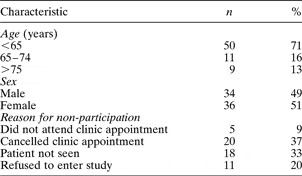
Of the 124 eligible patients, 70 consented to the study. Fifty-four patients did not participate in the study for various reasons, listed in Table I. Reasons for patient refusal included poor English, not receiving the information leaflet, being too ill and having just received bad news. Patients' ages ranged from 19 to 90 years, with a mean age of 57 years. Patients were recruited from a total of 12 out-patient clinics: three medical oncology, three surgical, two plastics, two mixed medical and surgical, and two thyroid.
Description of patients

Pain
Prevalence
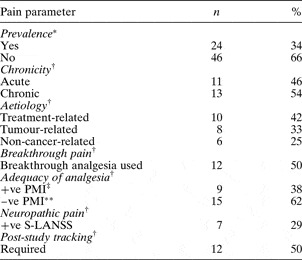
Twenty-four patients (34 per cent; 95 per cent confidence interval (CI) 23–47 per cent) reported pain due to any cause in the previous 24 hours (Table II). The patients' Brief Pain Inventory VAS scores ranged from 3 to 10. Nine patients (38 per cent) described their pain as moderate (i.e. VAS score 4–6), while 14 patients (58 per cent) reported severe pain (i.e. VAS score 7–10). The prevalence of severe pain was 20 per cent.
Patients' pain: prevalence and other characteristics

*When asked ‘any pain in previous 24 hours from any cause?’. †For 24 patients reporting pain. ‡Adequate treatment; **inadequate treatment. +ve = positive; –ve = negative; PMI = Pain Management Index; S-LANSS = Leeds Self-Assessment of Neuropathic Symptoms and Signs Pain Scale
Chronicity
In patients reporting pain, 54 per cent had chronic pain (i.e. pain present for more than three months), while the remaining 46 per cent had pain of less than three months' duration.
Aetiology
Pain secondary to anticancer treatment was present in 42 per cent of patients with pain. Tumour-related pain was present in 33 per cent. Pain due to non-cancer causes was present in 25 per cent (six patients). One patient described residual pain from a stroke, while the remaining five complained of lower back pain. Two patients felt their pain was moderate, while four described it as severe. Three of the five patients with chronic back pain had their analgesia reviewed by the hospital pain team, while one patient was booked into the pain clinic.
Breakthrough pain
Twelve of the 24 patients with pain felt that they required breakthrough analgesia. Most of these patients (nine of 12) had chronic pain, and the remaining three had acute pain. Thirty-three per cent of these patients described their pain as moderate, while the remainder described their pain as severe. Seven out of these 12 patients received some form of post-study tracking: three received advice and the contact details of the pain control team, and four were booked into the pain clinic.
Adequacy of analgesia
Fifteen of the 24 patients reporting pain (62 per cent) had a negative score on the Pain Management Index, indicating undertreatment with analgesia.
Neuropathic pain
Three patients were assessed by the researchers as having neuropathic pain. However, seven patients scored high enough on the Leeds Self-assessment of Neuropathic Symptoms and Signs Pain Scale (score >12/20) to strongly suggest a neuropathic element to their pain. Of the seven patients who screened positive for neuropathic pain, one described their pain as mild, one as moderate and five as severe. Only one patient was receiving adequate analgesia according to the Pain Management Index, while the rest were undertreated (i.e. they had negative Pain Management Index scores). However, two of these patients were already taking anticonvulsants, and so were receiving appropriate treatment that was not measured by the Pain Management Index. Three of the seven patients were given pain clinic appointments. Of the four who received no post-study tracking, one was already taking an antineuropathic pain agent, and one had a Pain Management Index score indicating adequate analgesia.
Post-study tracking
Twelve patients received some form of post-study surveillance. Four were given advice and contact details, three were prescribed analgesia only, two patients were asked to liaise with their existing pain service, and three were given appointments for the pain management clinic.
Risk factors
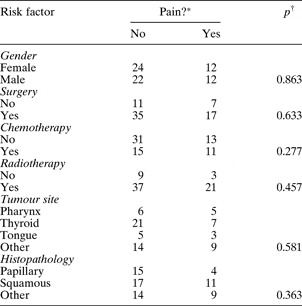
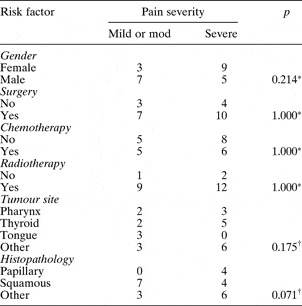
Binary logistic regression was used to identify any predictors or risk factors associated with self-reported pain. The following variables were tested: gender, surgery, chemotherapy, radiotherapy, tumour site and histopathology. These variables were tested against patients reporting ‘any pain in the previous 24 hours’ (Table III) and against patients' severity of pain (i.e. comparison of patients with mild or moderate pain versus patients with severe pain) (Table IV). There were no statistically significant associations between the risk factors tested and patients' reporting of any pain, or patient's severity of pain.
Association of patient risk factors with prevalence of any pain in previous 24 hours

Data represent patient numbers unless otherwise indicated. *When asked ‘any pain in the last 24 hours?’. †Chi-square test.
Association of patient risk factors with pain severity

Data represent patient numbers unless otherwise indicated. *Fisher's exact test (due to low sample number); †chi-square test. Mod = moderate
Discussion
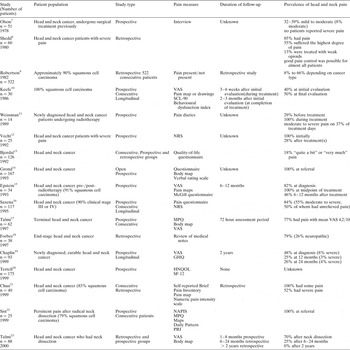
Various statistics have been reported for the prevalence of pain in head and neck cancer patients, depending on the clinical setting surveyed (e.g. oncology clinic or palliative setting) and the type of cancer and its treatment. Our 70 patients had a pain prevalence of 34 per cent (95 per cent CI 23–47 per cent). This is considerably less than the result of a synthesis of three studies containing 95 patients, which found a prevalence of 70 per cent (95 per cent CI 51–88 per cent).Reference van den Beuken-van Everdingen, de Rijke, Kessels, Schouten, van Kleef and Patijn1 Our own review of prevalence figures from published studies revealed rates of 40–94 per cent in 17 studies from a variety of clinical settings, including developing countries (Table V). Therefore, it would appear that our pain prevalence rate is slightly lower than those reported elsewhere, but that pain is still a significant problem in this group of patients, with more than one in three patients reporting pain.
Previous studies investigating pain in head and neck cancer patients

Mod = moderate; pts = patients; H&N = head and neck; Ca = cancer; VAS = visual analogue scale; SCL-90 = Symptom Checklist 90-R; wk = weeks; mth = months; NRS = Numerical Rating Scale; QoL = quality of life; MPQ = McGill Pain Questionnaire; hr = hours; GHQ = general health questionnaire; HNQOL = University of Michigan Head and Neck Quality of Life instrument; SF-12 = Medical Outcomes Study SF-12 General Health Survey; NAPIS = Numerically Anchored Pain Intensity Scales; PRI = Pain Rating Index
Whilst we found a slightly lower prevalence figure than that reported in the systematic review, our assessment of the adequacy of pain treatment revealed that 62 per cent of patients were receiving inadequate pain treatment. This compares with a weighted mean value of 43 per cent from a review of 26 studies of cancer pain patients, and to a rate of 51 per cent for cancer in-patients with pain.Reference Deandrea, Montanari, Moja and Apolone2, Reference Larue, Colleau, Brasseur and Cleeland24 Clearly, more needs to be done to improve the recognition and treatment of pain in patients with head and neck cancer.
In an attempt to identify specific ‘at risk’ patients, we assessed a number of variables which we thought may influence pain prevalence. Other studies have reported an increased incidence of chronic pain in women, radiotherapy, post-surgery, with certain tumour types, and in patients whose acute pain was poorly controlled.Reference Keefe, Manuel, Brantley and Crisson10, Reference Epstein and Stewart15, Reference Chaplin and Morton19, Reference Salomon, Tcherny-Lessenot, Collin, Coutaux, Levy-Soussan, Legeron, Bourgeois, Cesselin, Desfosses and Rosenheim25, Reference Kehlet, Jensen and Woolf26 However, we found no positive no associations, either between the presence of any pain and the investigated risk factors, or between the severity of pain and the same risk factors. This could be due to the aforementioned heterogeneity of our patient population, or to an insufficient sample size. However, these findings draw attention to the importance of recognising severe, chronic pain in any patient. Conceivably, pain prevalence may be related to other variables which were not assessed. Further, on-going studies are already underway to explore this.Reference Apolone, Mangano, Compagnoni, Negri, Mosconi, Mannino, Villa and Zuccaro27
It is particularly important to recognise neuropathic pain, as this type of pain is common (occurring in 34 per cent of our patients) and difficult to treat, requiring specialist drugs such as antidepressants and anticonvulsants in the first instance.Reference Vecht, Hoff, Kansen, de Boer and Bosch12, Reference Sist, Miner and Lema22
Interestingly, 25 per cent of the patients with pain had non-cancer-related pain. This compares well with a recent study which reported a similar finding in a general oncology out-patient population, and emphasises the fact that this type of pain must be considered and appropriate treatment pathways established.Reference Valeberg, Rust¢en, Bjordal, Hanestad, Paul and Miaskowski28
Similarly, the presence of breakthrough pain needs to be established. Breakthrough pain analgesia was needed by 50 per cent of our patients with pain. Such pain has a reported prevalence of 65 per cent in other, large scale studies, and is a indicator of poor prognosis.Reference Bruera and Scholler29, Reference Caraceni and Portenoy30 Inadequate management of breakthrough pain has been known to result in reduced function, higher incidence of depression, and the need for hospital admission.Reference Portenoy, Payne and Jacobsen31, Reference Fortner, Okon and Portenoy32
• Recent systematic reviews of pain in cancer out-patients indicate that as many as 50 per cent may have significant pain; the prevalence amongst head and neck cancer patients may be even higher
• Identification of specific pain risk factors may enable resources to be targeted at certain ‘at risk’ patient groups
• This study assessed the impact of gender, surgery, radiotherapy, chemotherapy, tumour site and pathology on the prevalence of pain in head and neck cancer out-patients, but found no statistically significant associations
• A high prevalence of neuropathic pain, breakthrough pain and pain of non-malignant origin was found in these patients
• Further studies will examine the impact of routine screening and treatment protocols in such patients
Overall, this study has highlighted the significant problem of pain and its control in head and neck cancer patients. Whilst no specific risk factors for developing pain were identified, our results highlight the importance of systematically enquiring about pain (particularly neuropathic and breakthrough pain) in such patients, and of implementing an immediate treatment plan.
Further studies are needed in this area as pain prevalence rates, and undertreatment rates, are high. Future research has commenced into the effectiveness and cost effectiveness of a new systematic screening and treatment algorithm for head and neck cancer out-patients, which is sponsored by the National Institute of Health Research.
Acknowledgement
We are pleased to acknowledge funding from Royal Marsden Hospital charitable funds for the conduct of this study.