“What's in a name? that which we call a rose
By any other name would smell as sweet”.
William Shakespeare's Romeo and Juliet; 1600
Our heading is taken from a romantic and philosophic rant, rendered in iambic pentameter, in which the bard of Avon cast doubt on the significance of nomenclature. He went on to say, “So Romeo would, were he not Romeo call'd, Retain that dear perfection which he owes without that title”. Shakespeare, however, could not have told the tragic story of the young star-crossed lovers, who were Montagues and Capulets, without referring to them by name. Confusion and chaos would surely have been the results of such an effort. Although his plays have been performed in countless theatres, and translated into dozens of languages, it is the names of the lovers, Romeo and Juliet, which are unmistakenly recognised around the world and in every generation (Fig 1).
The frontispiece to one edition of “Romeo and Juliet”, by William Shakespeare.

To attempt to advance the care, and improve the quality of life, of patients with congenital cardiac malformations without resorting to the use of specific, widely accepted, and intuitively appealing nomenclature would be akin to trying to construct and ascend a Tower of Babel. Investigators would not be understood, and would likely fail in their mission. It is now more than a decade since the start of the International Congenital Heart Surgery Nomenclature and Database Project.Reference Gaynor, Jacobs and Jacobs 1 The goal was to begin the standardisation of nomenclature, in the hope of eventually establishing an international database for congenital cardiac surgery. Collaboration with like-minded individuals in the Association for European Paediatric Cardiology, who had developed the European Paediatric Cardiac Code,Reference Franklin and Franklin 2 led to the formation of the The International Society for Nomenclature of Congenital and Paediatric Heart Disease, and eventually to the creation of their important work product, the International Paediatric and Congenital Cardiac Code. 3
The International Society created the Nomenclature Working Group, which strives “to standardise and maintain an international nomenclature system that could enhance global communication and facilitate patient care, teaching and research into paediatric and congenital heart disease across disciplines”.Reference Franklin, Jacobs and Krogmann 4 Unofficially speaking, it is fair to say that a major objective of this group was to cross-map existing lists of names and terms. The success of such a process is dependent upon the accuracy and internal consistency of existing systems of nomenclature, as well as ensuring the compatibility of terms within different systems, in other words the accuracy and precision with which terms can be identified as being synonyms. The success of the aforementioned organisations, and their tremendous efforts, has been very substantial, as evidenced by the use of standardised nomenclature to code diagnoses and procedures in surgical databases in North America, Europe, and Asia, coupled with the fact that either the same system of nomenclature, or one that has been completely cross-mapped to the surgical nomenclature, is now used by cardiologists, anesthesiologists, intensivists, and others on several continents. There are, however, rare but important instances in which historically established, well-respected, and sometimes iconic systems of nomenclature or classification for congenital structural anomalies of the heart are plagued by either internal paradoxes, incompatibility between systems due to the lack of potential for identification of synonyms, or irreconcilable inconsistencies with our current knowledge of cardiac development and morphology.
Initial categorisation of single outlet from the heart
Hearts having a common arterial trunk belong to a family of congenital cardiac malformations for which traditional systems of classification and nomenclature are plagued by all three of the problems enumerated above. The history of descriptive nomenclature for this family of cardiac malformations stretches back at least to the end of the 19th century, when Hermann Vierordt, working at the University of Tubingen, published Die Angeborenen Herzkrankheiten, a book that included a systematic review of embryology that included congenital cardiac anomalies.Reference Vierordt 5 One of the sections was entitled, as translated by us, “Incomplete Division and Unilateral Transformation of a Primary Truncus: Persistence of the Truncus Arteriosus – Presence of Only One Single Major Arterial Vessel”. In his description of hearts with only one single major vessel, he included those in which the single vessel had “the character of an aorta with more or less typical branching of the same, lacking a pulmonary artery as such, and the pulmonary vessels arise from the main arterial vessel”. These hearts, today, would be recognised as instances of pulmonary atresia, almost certainly with deficient ventricular septation, and with pulmonary arterial supply derived from major aortopulmonary collateral vessels. He also described those in which the single vessel had the character of a pulmonary trunk, leaving uncertainty as to whether he was describing aortic atresia. He then accounted for those in which there was “partial persistence of an embryonic truncus arteriosus: one major vessel from which arises an aorta and pulmonary artery”. It seems curious that this last type, which we can recognise today as common arterial trunk, was then afforded the state, and described in terms, of “partial persistence”. The concept of persistence is an interesting one. It suggests the inference that the anomaly does not represent an abnormal process of development, but rather a stage of arrested development. In this respect, Vierordt made his suggestion at a time when knowledge of cardiac development was limited, and markedly different from what is known today.
Subsequent categorisations for common arterial trunk
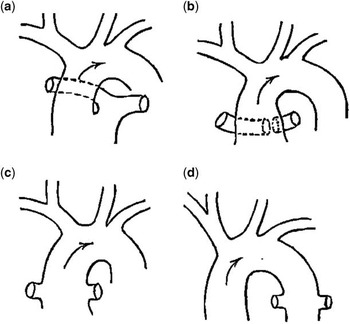
The system of classification for hearts with common arterial trunk that is most widely used today is the one proposed in 1949 by Collett and Edwards.Reference Collett and Edwards 6 In their report, published in the Surgical Clinics of North America, they explained the reasoning for their investigation as follows: “There has always been considerable confusion concerning the pathologic criteria for the diagnosis of persistent truncus arteriosus. In order to clarify the pathologic diagnosis of persistent truncus arteriosus and to arrive at an applicable classification of this congenital anomaly, an analysis was made of reports of 116 cases of a congenitally defective heart characterized by a single functional arterial trunk”.Reference Collett and Edwards 6 Collett and Edwards accepted the statement made earlier by by Lev and Saphir,Reference Lev and Saphir 7 namely, the criterion necessary for diagnosis of persistent truncus was “the presence of one large trunk emanating from the heart and giving off the coronary arteries, the pulmonary arteries, and the systemic arteries”. It is also implicit in this definition that the trunk exits the ventricular mass through a common arterial valve. Collett and EdwardsReference Collett and Edwards 6 logically added the criterion that, in addition to one main arterial trunk leaving the base of the heart, there must be no remnant of an atretic pulmonary artery or aorta. Following a brief introduction, they presented a scholarly dissertation on embryologic considerations as they pertained to this family of anomalies. They summarised, and relied substantially, on the work of Kramer,Reference Kramer 8 who had published a description of the partitioning of the ventricular outflow tract in the embryonic human heart. In this work, KramerReference Kramer 8 introduced the terms “truncus arteriosus” and “conus arteriosus” to account for the distal and proximal parts of the developing outflow tract, and included a review of the closure of the embryonic interventricular communication. The principle hypothesis of Collett and EdwardsReference Collett and Edwards 6 was that, when classifying the different types of lesions unified because of presence of a common arterial trunk exiting from the base of the heart, the trunk representing the undivided outflow tract differed depending on the embryonic stages in the development of the pulmonary arteries from the sixth aortic arches. Their four major classes of cases were held to represent the various stages of arrested development (Fig 2).
Adapted from Figure 463 of Collett and Edwards’ 1949 description of their proposed system for classification of persistent truncus arteriosus.Reference Collett and Edwards 6

Each of their four major classes was further sub-divided on the basis of additional characteristics. These included, among others, the sidedness of the aortic arch, the presence of associated anomalies such as patent arterial duct and/or aortic arch interruption or coarctation, and the presence of “one or both sixth arches”, taken to be one or both of the pulmonary arteries, arising from the common trunk. Despite the presentation and illustration of no fewer than 21 subtypes, of which six represent what today we would recognise as aortopulmonary window or tetralogy of Fallot with pulmonary atresia and major aortopulmonary collateral arteries, no emphasis was given to the notion that the emerging fourth and sixth arterial arches varied inversely in their development. As such, therefore, although attention had been directed towards problems involving the aortic circulation, there was no major category proposed in which to segregate hearts with aortic hypoplasia and either interruption of the aortic arch or coarctation.
The thoroughness of their review,Reference Collett and Edwards 6 and their evaluation of previously published material describing cases of defective hearts with a single major arterial trunk, is quite amazing. At the same time, it is perhaps more amazing that the important system of classification, which is still today the most frequently cited when analysing and stratifying cases of common arterial trunk, was based not on their own examination and comparison of preserved specimens in multiple registries, but rather on the review of published series and case reports, and the photographs or drawings contained therein.
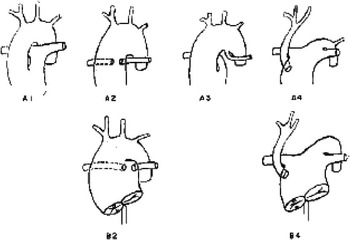
Their approach was in direct contrast to that taken by Van Praagh and Van Praagh.Reference Van Praagh and Van Praagh 9 The latter investigators carried out a direct review of 57 necropsied cases drawn from two centres, specifically in Chicago and Toronto. They made several assertions with regard to the earlier classification of Collett and Edwards.Reference Collett and Edwards 6 They argued that the type 4 described by Collett and Edwards, with absence of the pulmonary arteries, and with the lungs supplied by bronchial arteries, recognised today as major aortopulmonary collateral arteries, should not be considered as a common aorticopulmonary trunk, which was their preferred term for the overall condition. Rather, they considered type 4 of Collett and Edwards to be a solitary aorta, with absence of the pulmonary trunk and its branches. They further suggested that type 2 of Collett and Edwards, in which both pulmonary arteries arose from the left posterior aspect of the common aortopulmonary trunk, and type 3, in which each pulmonary artery arose laterally from the right and left sides of the trunk, should be combined into one type, as in their opinion there was no significant difference between them. They suggested that “absence of one pulmonary artery”, now recognised as most often representing the circumstance of ductal or collateral origin of one pulmonary artery, should be considered as a separate type. They then suggested that there was need for a fourth fundamental grouping to include those hearts with hypoplasia, coarctation, atresia, or absence of the aortic isthmus, the descending systemic circulation supplied through a large persistently patent arterial duct. They emphasisedReference Van Praagh and Van Praagh 9 that this variety was depicted by Collett and EdwardsReference Collett and Edwards 6 in 3 of their 21 subtypes, but that the latter investigators had considered this issue to be of less importance for categorisation than the patterns of origin of the pulmonary arteries. In contrast, Van Praagh and Van PraaghReference Van Praagh and Van Praagh 9 argued that this type, which they identified as their type 4, appeared to have the worst prognosis of all, although in retrospect it remains unclear how that determination can be inferred with certainty from an autopsy series. They did emphasise that their findings supported the inference that, in the setting of a common aorticopulmonary trunk, arterial arches four and six varied inversely in their embryonic development. Their system of classification (Fig 3) also addressed the issue of presence or absence of an interventricular communication. Although they acknowledged that it was very rare for a common aorticopulmonary trunk to be found with an intact ventricular septum, no such cases were found in their autopsy series. It is possible for the ventricular septum to be intact in the presence of a common arterial trunk, but only when the trunk arises exclusively from the morphologically right ventricle, and there has been closure of a pre-existing interventricular communication.
Reproduced from Van Praagh and Van Praagh's 1965 review article in which they proposed a new system for classification of common arterial trunk including two basic types: those with a ventricular septal defect (type A) and those without (type B).Reference Van Praagh and Van Praagh 9

Subsequent to this initial investigation, Calder then carried out a further investigation in association with Van Praagh and Van Praagh and other colleagues, publishing an ambitious review of clinical, angiographic, and pathologic findings from 100 patients having a common aorticopulmonary trunk.Reference Calder, Van Praagh and Van Praagh 10 Although the proposed thesis was largely a reiteration and defense of the initially proposed system for nomenclature,Reference Van Praagh and Van Praagh 9 the later investigators drew special attention to the angiographic characteristics of the cases with aortic hypoplasia. They described these cases, accounting for their type A4, as follows: “the relatively small ascending aorta arises from the right lateral aspect or from the right anterolateral aspect of a markedly enlarged pulmonary trunk”. They referred to the appearance of the ascending aorta as resembling “a stocking cap attached to the side of a huge main pulmonary artery”.Reference Calder, Van Praagh and Van Praagh 10 As in the earlier report,Reference Van Praagh and Van Praagh 9 they suggested, on the basis of age at death, that this type of lesion had the worst natural history, and also acknowledged the required differences in its surgical management.
Subsequent evolution of thinking
For several decades, various authors and groups of clinicians adhered to the use of one of the two predominant systems of nomenclature and classification, in other words that of Collett and EdwardsReference Collett and Edwards 6 or the system favoured by Van Praagh and Van PraaghReference Van Praagh and Van Praagh 9 and Calder et al.Reference Calder, Van Praagh and Van Praagh 10 It became evident to one of us (M.L.J.), while studying these systems in the course of developing a consensus-based system of nomenclature under the auspices of the Congenital Heart Surgery Nomenclature and Database Project,Reference Jacobs 11 along with the reasoning underscoring their production, and their subsequent patterns of usage, that there were fundamental problems with each system, and that the achievement of consensus would not be a simple matter of identifying synonyms. At the time, it seemed intuitive that any system of classification should distinguish the large aortic type from the large pulmonary arterial type. This reasoning was based on the appreciation that the aortic type was characterised by adjacent or nearly adjacent origins of the right and left branch pulmonary arteries from the posterolateral aspect of the common arterial trunk, whereas the pulmonary type included interruption of the aortic arch or coarctation, with the distal systemic circulation depending on patency of the arterial duct. Van Praagh, in an editorial, had already pointed to the importance of this distinction.Reference Van Praagh 12 The suggested terms, of “large aorta type” and “large pulmonary artery type”, were less than enthusiastically received. The terms had been proposed for use in surgical databases because “…the anatomic features that more than any others determine the necessary surgical approach are those related to the virtually ever-present inverse developmental relationship between the derivatives of primitive arterial arches 4 and 6 (aortic isthmus and ductus arteriosus, respectively)”.Reference Jacobs 11 It seems to us that this statement remains entirely valid.
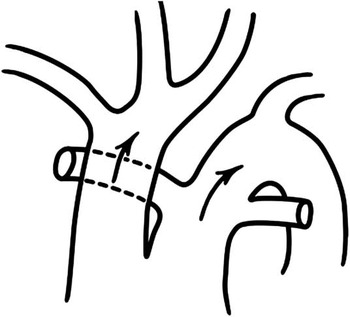
The need for such a new approach became more evident when, in 2006, the Congenital Heart Surgeons Society published a multi-institutional cohort analysis of 50 patients with “Truncus Arteriosus Associated with Interrupted Aortic Arch”.Reference Konstantinov, Karamlou and Blackstone 13 They chose to base their description of cases using the classification of Collett and Edwards,Reference Collett and Edwards 6 while acknowledging that all of their cases represented “one or another variation of (Van Praagh's) type A4”. They described almost half of their patients as having the ascending aorta arising from the common arterial trunk, but with origin of the right and left pulmonary arteries from a confluent pulmonary component, in other words type 1 of Collett and Edwards.Reference Collett and Edwards 6 The remaining patients were said to be fit within types 2 and 3 of Collett and Edwards, presumably based on the sites of origin of the right and left pulmonary arteries. This phenomenon, of course, is inconsistent with the detailed description of the pathognomonic features of the type A4, as outlined in the correlations provided by Calder et alReference Calder, Van Praagh and Van Praagh 10 of the angiographic features with the pathologic findings. In our own subsequent consideration of this conundrum,Reference Russell, Jacobs and Anderson 14 we stated that “Further analysis of the Congenital Heart Surgeons Society study revealed a potential problem with the use of either of the two existing popular systems for categorization”. As had been shown by the studies of Van Praagh and Van Praagh,Reference Van Praagh and Van Praagh 9 and Calder et al,Reference Calder, Van Praagh and Van Praagh 10 the essence of the problem in hearts that have interruption of the aortic arch is that the main component of the common arterial trunk is continued via the arterial duct to the descending aorta, with the pulmonary arteries arising from either side of the main pathway for the pulmonary circulation. Such patients, therefore, not only qualify for categorisation within the first subset of the system proposed by Collett and Edwards,Reference Collett and Edwards 6 because they show evidence of extensive formation of distinct intrapericardial pulmonary and aortic pathways, but they also qualify for categorisation within the third subtype on the basis of the mode of origin of the right and left pulmonary arteries.Reference Russell, Jacobs and Anderson 14 Although all cases with interrupted aortic arches studied by Van Praagh and Van Praagh,Reference Van Praagh and Van Praagh 9 and Calder et al,Reference Calder, Van Praagh and Van Praagh 10 were described as having a discrete intrapericardial pulmonary arterial segment, only half of the patients collected in the Congenital Heart Surgeons Society collaborative studyReference Konstantinov, Karamlou and Blackstone 13 were categorised as having such type 1 anatomy, and only a small proportion were considered to have type 3 morphology. In Figure 4, we illustrate the paradox wherein patients with common arterial trunk and interrupted aortic arch fit into both type 1 of Collett and Edwards,Reference Collett and Edwards 6 on the basis of distinct intrapericardial aortic and pulmonary arterial pathways, and type 3 of Collett and Edwards,Reference Collett and Edwards 6 on the basis of the mode of origin of the right and left pulmonary arteries.
Artist's illustration of the paradox wherein patients with common arterial trunk and interrupted aortic arch fit into both type 1 of Collett and Edwards – on the basis of distinct intrapericardial aortic and pulmonary artery pathways – and type 3 of Collett and Edwards – on the basis of the mode of origin of the branch pulmonary arteries.Reference Russell, Jacobs and Anderson 14

Resolving the differences in categorisation
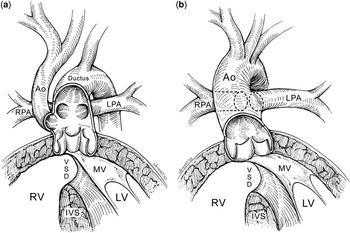
In an effort to resolve the aforementioned paradox, in association with our surgical colleagues at Children's Memorial Hospital in Chicago, we studied 28 autopsied hearts with common arterial trunks, drawn from their archive and the archives of the University of Florida and Medical University of South Carolina.Reference Russell, Jacobs and Anderson 14 Analysis of the detailed observations established some fundamental principles. First, all of the hearts could be assigned to one of two groups based on the mutually exclusive presence of either aortic or pulmonary dominance of the common trunk. Second, pulmonary dominance was found only when the aortic component of the trunk was hypoplastic, and an arterial duct supplied the majority of flow to the descending aorta. Third, only in the setting of pulmonary dominance did we observe pulmonary arteries arising from the sides of the major pathway. Fourth, only in this setting was the aortic component of the common trunk discrete from the pulmonary component. On the basis of these observations, we reiteratedReference Russell, Jacobs and Anderson 14 our preference for a system of classification that divides patients with common arterial trunk into those with either aortic or pulmonary dominance (Fig 5). This simple system addresses the fact that the classification proposed by Collett and Edwards,Reference Collett and Edwards 6 and that put forward by Van Praagh and Van Praagh,Reference Van Praagh and Van Praagh 9 and endorsed by Calder et al,Reference Calder, Van Praagh and Van Praagh 10 cannot be rationalised by pairing of terms that are synonymous, or even nearly synonymous. It also resolves the paradox whereby patients with common arterial trunk and hypoplasia of the aortic component may be assigned, illogically, to both type 1 and type 3 of Collett and Edwards.Reference Collett and Edwards 6 In addition, the simplified categorisation for common arterial trunk based on the existence of either aortic or pulmonary dominance emphasises the anatomic feature that is the single greatest risk factor for adverse outcomes following surgical repair. The simplified system, furthermore, is no longer dependent upon historical concepts of embryologic development, which now appear to be incomplete at best, and in some respects erroneous.
Artist's drawing illustrating the essential features of pulmonary versus aortic dominance in hearts with common arterial trunk. Panel ( a ) illustrates common arterial trunk with pulmonary dominance and ( b ) illustrates common arterial trunk with aortic dominance.Reference Russell, Jacobs and Anderson 14

Developmental considerations
In a thoughtful review, Carr et al,Reference Carr, Bharati, Kusnoor and Lev 15 when describing a heart alleged to have an intact ventricular septum, but in which the truncal valvar leaflets closed during ventricular diastole on the crest of the ventricular septum, pointed to the problems existing in the then existing embryologic classifications. The essential feature of hearts with common arterial trunk as defined by Collett and Edwards,Reference Collett and Edwards 6 following the precedent of Lev and Saphir,Reference Lev and Saphir 7 was not the commonality of the arterial pathways, but rather the presence of a common ventriculo-arterial junction, even though Collett and Edwards had included some cases with separate arterial valves in their overall review. The essential difference between hearts having a common arterial trunk and those with aortopulmonary window is found in the arrangement of the arterial valves, rather than the commonality of the intrapericardial arterial pathways. It remained difficult, nonetheless, to correlate the commonality of the ventriculo-arterial junction with the embryologic theories, as there was no agreement as to whether developmental investigators considered that the “truncus” gave rise to the intrapericardial arterial pathways, or additionally produced the arterial roots. Kramer,Reference Kramer 8 in fact, had shown that the arterial roots were derived from the middle component of the developing outflow tract. He showed, for the first time, that some leaflets of the developing arterial valves were derived from intercalated cushions, a term he introduced. A review of his work shows that only with appearance of the intercalated cushions does it become possible to recognise an intermediate component of the developing outflow tract. Kramer, however, did not state whether this intermediate component should be considered as being derived from his truncus, or from the conus. Indeed, since then there has been no agreed resolution of this problem. In our opinion, resolution is best provided by recognising that the outflow tract exhibits distal, intermediate, and proximal parts during its development. It is failure of division of the intermediate component that leads to persistence of a common arterial trunk, which exits the heart through a common arterial valve.Reference Anderson, Chaudhry and Mohun 16 It is changes occurring within the distal intrapericardial pathways during their development that then determine the dominance of either the pulmonary or aortic circulations. When assessed in this manner, the developmental findings support totally the notion that common arterial trunk is best considered in terms of aortic as opposed to pulmonary dominance.
Clinical considerations
Recent development of empirically based tools to group types of operative procedures performed on patients with congenital cardiovascular anomalies into categories that are based on estimates of relative risk of in-hospital mortality and morbidity now provide confirmation of the clinical relevance of the proposed system for classification of hearts with common arterial trunk. Of the STS-EACTS Congenital Heart Surgery Mortality Categories (1–5 indicating lowest to highest risk of in-hospital mortality), “Truncus arteriosus repair” – aortic dominant type – is in Mortality Category 4, with a Bayesian model-based estimate of risk of mortality of 14.1% (95% Bayesian credible interval 11.4–16.8%), while “Truncus + Interrupted Arch Repair” – pulmonary dominant type – is in Mortality Category 5, with a Bayesian model-based estimate that is the highest of all 148 procedures in the analysis at 29.8% (95% Bayesian credible interval 17.7–44.3%).Reference O'Brien, Clarke and Jacobs 17 More recently, a separate empirically based tool for analysing morbidity associated with operations for congenital heart disease has likewise been developed. The Society of Thoracic Surgeons Congenital Heart Surgery Morbidity Categories use a composite metric, which includes both post-operative length of stay and the prevalence of occurrence of one or more major complications.Reference Jacobs, O'Brien and Jacobs 18 In this metric, procedures are grouped into five categories according to modelled estimates of the relative risk of morbidity. “Truncus arteriosus repair” – aortic dominant type – is in Morbidity Category 4. “Truncus + Interrupted Arch Repair” – pulmonary dominant type – is in Morbidity Category 5, with the highest composite morbidity score of any of the 140 procedure types that were included in the analysis of more than 62,000 operations performed between 2002 and 2008.
Conclusion
Nomenclature and classification of hearts with common arterial trunk can now be rationalised by the use of a simplified categorisation that classifies these hearts on the basis of pulmonary or aortic dominance. This approach reconciles the existing disparate categorisations of patients having common arterial trunks, is in keeping with recent findings concerning cardiac development, and emphasises the principal morphologic determinant of surgical outcome.