Introduction
We live in neo-liberal times in which creativity is commodified (Florida Reference Florida2002). In reference to population ageing, this implies that older people are encouraged to engage in arts activities to increase their wellbeing and cope with physical and cognitive changes that come with age (Katz and Campbell Reference Katz, Campbell and Katz2005). In this discourse, creativity is understood as ‘little-c’ creativity (Boden Reference Boden2004), a skill accessible to all, and presented as an answer to today's demographic and economic challenges. A case in point is the Long Live Arts programme of the Dutch Cultural Participation Fund (2013), that financially supports the development of participatory arts tailored to older people.
Simultaneously, ‘Big-C’ creativity (Boden Reference Boden2004) in reference to a professional career in the arts is pushed further to the margins of Dutch society following the budget cuts implemented in 2013. A recently published report (Donker Reference Donker2016) on the impact of the budget cuts on the labour market for the creative and cultural sector showed that the income of arts professionals is decreasing. Also, they have reduced access to health insurance and pensions. In this second creativity discourse, the romantic struggle for existence in the lives of arts professionals is still implied and potentially affects older artists more.
Against the backdrop of these contemporary and competing examples of creativity discourses and their repercussions on older people's lives, the present article seeks to comprehend the meanings of (‘Big-C’) creativity for older professional writers in The Netherlands. How do writers over 65 experience and understand the relation between ageing and creativity? The article presents the findings of a study in which professional Dutch poets were interviewed and, through their responses, offered insights into this research area.
Literature review
The relation between ageing and creativity has mainly been studied from the perspectives of psychology, arts and gerontology. Generally, psychological approaches to late-life creativity examine correlations between biographical statistics (e.g. chronological age) and longitudinal changes in creative achievements, with a focus on peaks and declines in artistic careers (Lehman Reference Lehman1953; Simonton Reference Simonton1988 b, Reference Simonton1994, Reference Simonton1997). Art approaches focus on late style in artworks by canonical artists (e.g. Michelangelo and Verdi). They analyse case studies comparatively (Cohen-Shalev Reference Cohen-Shalev2002; Saïd Reference Saïd2006) to identify thematic (e.g. self-reflexivity) and formal (e.g. compositional looseness) art features. These are then paired with psychological characteristics of artists approaching death (e.g. rage). Within art sociological approaches, there has been little attention paid to the question of how age influences an author's position in the field of cultural production. This lack of consideration for research questions related to the experience and situation of older artists is perhaps not surprising, given that the study of authorship became unfashionable when Barthes (Reference Barthes and Heath1977) proclaimed the ‘death of the author’.
In recent years, cultural gerontologists and ageing studies scholars have developed interdisciplinary qualitative frameworks to study creativity in later life. Some apply a discourse-analytical approach to identify the taken-for-granted generalising conceptualisations of both ageing and creativity that many studies of late-life creativity uncritically reproduce (Amigoni and McMullan Reference Amigoni, McMullan, Twigg and Martin2015; Hutcheon and Hutcheon Reference Hutcheon and Hutcheon2012; Katz and Campbell Reference Katz, Campbell and Katz2005). Such conceptualisations of creativity include the description of artistic careers in terms of rise and fall and the identification of a style as avant-garde or passé. In a similar vein, ageing is often stereotypically conceptualised by means of the opposing discourses of physical and mental decline versus wisdom and transcendence. Another strand within gerontological research is the study of the relation between participation in the arts and wellbeing (Cohen Reference Cohen2005; Cohen et al. Reference Cohen, Perlstein, Chapeline, Kelly, Firth and Simmens2007; George and Houser Reference George and Houser2014; O'Shea and Ní Léime Reference O'Shea and Ní Léime2012). In contrast to the other approaches, this type of research focuses on ‘little-c’ creativity that signifies psychological health.
In addition to the literature above, my study asks how professional writers experience and understand creativity. Twenty-five years ago, Kastenbaum (Reference Kastenbaum, Cole, Van Tassel and Kastenbaum1992: 286) perceived that the question of what creativity means to persons in the context of later life (including older artists) is rarely addressed in research on creativity and ageing. This holds even today despite the increasing popularity of phenomenological approaches to studies of ageing (Montgomery, Barber and McKee Reference Montgomery, Barber and McKee2002; Powell and Gilbert Reference Powell, Gilbert, Powell and Gilbert2009). What follows is an overview and assessment of the few sources that have affinity, both thematic and methodological, with my study and are relevant for the discussion of my findings.
In his monograph Aging, Creativity, and Art (Lindauer Reference Lindauer2003; see also Lindauer, Orwoll and Kelley Reference Lindauer, Orwoll and Kelley1997), experimental psychologist Lindauer asks if and how the quality (defined as originality) and quantity (described as productivity) of creative work changes in later life, as well as if and how the creative process (i.e. sources of ideas) and style (the approach taken to one's work) have augmented with age. Addressing these questions, 160 graphic artists in their sixties, seventies and eighties completed open-ended questionnaires and rating scales. The participants reported that all four aspects of creativity improved with growing older and the reasons provided for each aspect intersected. Fifteen reasons for changes in creativity were outlined, here presented in descending order of importance: increased knowledge (including more experience and training), self-acceptance/confidence, adjustments compensating for losses due to physical changes, available time, new circumstances (e.g. finding new opportunities and an increase in resources and facilities), better motivation and drive, improved understandings of themselves and others (e.g. a greater sensitivity for others' concerns), changing priorities, trying new techniques, maturity, stronger commitment to excellence, willingness to be more experimental (i.e. trying new things), shifts to more abstract or realist works, reduced family responsibilities and exploring different kinds of subject matters. Together, Lindauer noted, these rather mundane reasons relate to self, work and external circumstances. Differences between age groups were insignificant in the sense that even if artists admitted that quality and quantity slightly declined after 60, these aspects were still perceived as higher than in the earlier years of their careers, including the artists' thirties and forties.
Further to Katz and Campbell's (Reference Katz, Campbell and Katz2005) assertions, Lindauer's study falls under one of two opposing grand narratives through which creativity in later life is usually addressed. This narrative presents creativity as a continuous process of growth and renewal across the lifespan, and has been described as ‘the eugeros mission: the attempt to counter ageism by selecting and emphasizing information that supports a favourable image of the older person’ (Kastenbaum Reference Kastenbaum, Cole, Van Tassel and Kastenbaum1992: 286). Katz and Campbell (Reference Katz, Campbell and Katz2005: 107) called it ‘the promotional and gerontologizing mandate of positive aging’. The opposing narrative is a peak-and-decline model of aesthetic expression suggesting that, after midlife, ‘creativity either declines into unimaginative aesthetic expressions or hardens into stylistic conventions' (Reference Katz, Campbell and Katz2005: 101). However, both narratives supersede individual differences, artistic traditions and historical contexts. Also, they largely fail to acknowledge the intersection of age and other identity markers such as gender in the development of an artistic career (cf. Wyatt-Brown Reference Wyatt-Brown, Wyatt-Brown and Rossen1993; Gullette Reference Gullette, Wyatt-Brown and Rossen1993). There is, though, a more productive middle way of approaching late-life creativity, free from normative claims, as the following two resources demonstrate.
In the Handbook of the Humanities and Aging, Kastenbaum (Reference Kastenbaum, Cole, Kastenbaum and Ray2000) brings his earlier work on late-life creativity based on case studies such as Wagner and Picasso together in a few preliminary suggestions regarding the lived, attested experiences of artists. The first concerns the freedom that older artists experience to follow their own personal motivation, which might manifest itself in a liberated approach to artistic matters. According to Kastenbaum (Reference Kastenbaum, Cole, Kastenbaum and Ray2000: 394), older artists have few worries ‘about precedent and propriety’. This sense of freedom may be accompanied by a declining concern for recognition by colleagues, art critics and society at large. A second element is openness to new experiences: artists continue to start new projects and experiment with new ideas even after the completion of what now is considered to be their final work. Lastly, Kastenbaum (Reference Kastenbaum, Cole, Kastenbaum and Ray2000: 395) posited that older artists develop protective strategies: ‘they protect their time, working space, and products, but also their artistic integrity. Tactfully or boorishly, they try to fend off distractions, interruptions and other impositions'. In his opinion, it is this sense of endurance that is required to thrive as a creative artist throughout the lifecourse.
While Matarasso's Winter Fires (Reference Matarasso2012) is not an academic publication in the strictest sense of the word, it is of importance to the present study because it engages with the question of how the ability to make art changes the experience of ageing. Matarasso interviewed 33 amateur and professional artists in their sixties, seventies and eighties and active in the fine arts, performance art, music, dance or writing. The text constructs generalisations rooted in the individual experiences of the interviewees, but does not explain how these generalisations were arrived at. Nonetheless, the themes on which, especially, the second part of the publication is structured resonate with some of the other findings in this literature review. Winter Fires shows that artists have the ability to turn retirement from a negative into a positive experience through their artistic practice. Also, older artists are not only faced with general prejudices about old age, but also, correspondingly, professional prejudices. Matarasso (Reference Matarasso2012: 36) found that: ‘[Older artists] are easily typecast by commissioners and critics who believe they know what that artist does (or should do). Past success can become a trap that defines future opportunities.’
Creativity across one's lifespan in itself counters notions of old age as a time of disengagement and passivity. Thus, Matarasso (Reference Matarasso2012) advanced, artists are capable of celebrating ageing's distinctive qualities through their art. In addition, for those who grew up in the 1930s, 1940s and 1950s, when personal choices were limited, retirement may imply the beginning of a new life and personal transformation. From the interviews it followed that older artists experience a sense of fulfilment, the source of which is more to be found in the creation of art than in recognition by peers and purchasers. Professional artists in particular expressed ‘a common detachment from markets' (Matarasso Reference Matarasso2012: 48). Furthermore, in contrast to amateur artists, professional artists draw on memory in implicit ways in their artistic production; that is, in terms of the knowledge and expertise acquired throughout their lifecourse. Matarasso wrote that the prospect of no longer being able to do what one loves most because of functional losses weighs heavily on artists. Yet, art enables people to perform the intellectual and emotional work required to handle the loss of beloved ones. Also, making art can be a social activity. A few other themes are mentioned in the final part of the publication, including freedom from family obligations, the need to earn money and external expectations, acceptance of one's capacities and a more relativising stance towards critics, and one's craft becoming ‘so known and embodied that the creative mind can range free’ (Matarasso Reference Matarasso2012: 61). Winter Fires concludes by asserting that, through artistic creation, we can act in the world and resist the threats to our agency in later life.
Although these few sources provide valuable results, the absence of a rigorous methodological framework, the under-development of the hermeneutical component (cf. the uncritical reproduction of the positive ageing discourse as interpretative framework) and/or the conflation of professional with amateur artists as well as of different art media, inspired me to contribute to the existing scholarship by focusing on experiences and understandings of late-life creativity by Dutch professional writers following the approach of interpretative phenomenological analysis (IPA).
Method
Interpretative phenomenological analysis
IPA has increasingly been implemented in gerontological research (e.g. Hautz Reference Hautz, Swinnen and Schweda2015; Sadkowska, Wild and Fischer Reference Sadkowska, Wild and Fischer2015; Reynolds, Vivat and Prior Reference Reynolds, Vivat and Prior2011) because it is tailored to examine how certain people experience and make sense of different aspects of life, such as creativity in the context of ageing. Smith, Flowers and Larkin (Reference Smith, Flowers and Larkin2009) distinguished between three theoretical foundations of this qualitative approach. First, IPA is underpinned by phenomenology, as it explores lived experiences. Secondly, IPA is supported by hermeneutics, because it is dedicated to reiterative inductive processes of interpretation in which meaning-making manifests itself as a practice of knowledge co-construction between researcher and participants. Thirdly, IPA subscribes to idiography by virtue of its commitment to the particular, which operates on two levels: the sense of detail in the data analysis and the use of small samples that provide insight into the perspectives of a particular group of people, from which careful generalisations can be drawn. As such, IPA is a method that avoids the danger of drawing generalising conclusions ignorant of the differences in ‘individual life circumstances (health, lifestyle, background, economics, public reception), as well as historical and social conditions (and role changes)’ that Hutcheon and Hutcheon (Reference Hutcheon and Hutcheon2012: 6) and Katz and Campbell (Reference Katz, Campbell and Katz2005) warned of in studies of late-life creativity. IPA has affinity with both discourse and narrative analysis in that it accepts that meaning-making always takes place ‘using certain kinds of resources (narrative, discourse, metaphor, etc.) and within certain sorts of contexts' (Smith, Flowers and Larkin Reference Smith, Flowers and Larkin2009: 40). This implies that, in the interpretation of the personal accounts, it is appropriate to ask to what extent the two grand narratives outlined above play a role in the participants' understandings of late-life creativity.
Participants and context
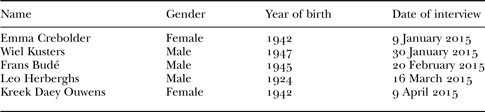
Seven poets over 65 were invited to participate in the study. These poets are located in the periphery of the Dutch literary field (Dorleijn and van Rees Reference Dorleijn and van Rees2006) – namely in the cities of Maastricht, Heerlen and Eindhoven – but receive national recognition for their work. The Literary Centre Limburg helped me with selecting the sample and provided contact details for the poets. Two poets declined the invitation to partake: the first did not give a reason for his refusal; the second expressed his disapproval of being positioned as older and felt that he speaks through his literary work. Five poets, three men and two women, agreed to participate: Emma Crebolder, Wiel Kusters, Frans Budé, Kreek Daey Ouwens and Leo Herberghs (see Table 1).
Participating professional writers

Word-of-mouth recommendations facilitated access to this particular literary community. The participants were between 65 and 92 years old when the interviews took place, with four of them being born in the 1940s. Throughout (periods in) their lives, the poets have combined their authorship with other professional activities to support their living costs. Even though there is an age difference between the oldest poet and the other interviewees, the sample is sufficiently homogenous as the experiences of creativity in later life connects the people within the sample.
Ethics
At the time this research project was developed and executed (spring 2015), the Ethics Review Board of Maastricht University did not consider research applications from humanities scholars for review because of presumed ‘minimal risk’. Nonetheless, ethical guidelines regarding respect for persons, beneficence and justice have been followed conscientiously. The participants were informed about the aim and approach of the study, the voluntary basis of their participation and possibility to withdraw consent at any time. I explained how their participation would benefit the development of a more nuanced approach to ageing and creativity in academia and beyond. What sets this study apart from other studies involving human subjects is that the writers who decided to participate already have public personae that figure in the news media. This explains the agreement to use real names. When issues arose during the interview that the participants verbally characterised as confidential, such as remarks about colleagues or situations in their private life, they were excluded from the data-set.
Interviews
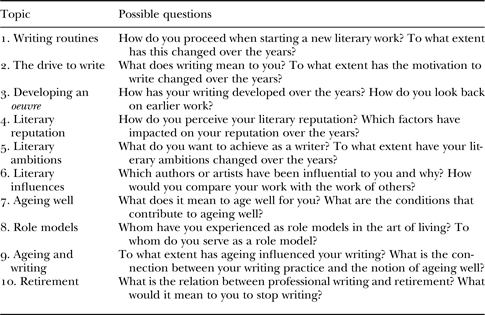
I conducted in-depth semi-structured interviews with the participants. The interviews took place in the writer's residence, my home or a café depending on the preference of the participant and the degree of familiarity already established through previous professional encounters. Each interview lasted between 75 and 150 minutes and was recorded and transcribed verbatim (in Dutch). In the introduction to the interviews, I explained to the participants that IPA requires the interviewer to refrain from adding personal observations during the conversation. In this respect, the interview would be more of a monologue by the writer than a typical writer's interview in which the interviewer and interviewee exchange views on the interpretation of a new literary work and its raison d’être. There were ten open-ended topics for discussion (see Table 2).
Interview topic guide

Data analysis
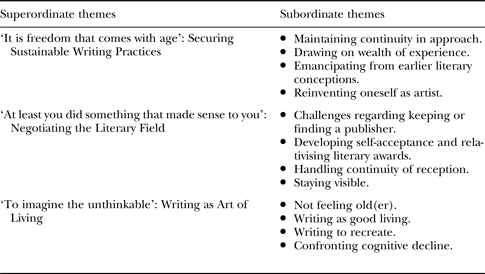
For the analysis of the transcripts, I followed the guidelines of Smith, Flowers and Larkin (Reference Smith, Flowers and Larkin2009). First, I immersed myself in the texts and made initial descriptive, linguistic and conceptual notes. Then, I developed emergent themes and looked for connections between these themes. Finally, I looked for convergences and divergences within the sample. Having repeated these steps several times, I identified three superordinate themes and their respective subordinate themes – 12 in total (see Table 3). Characteristic of IPA is its double hermeneutic. The researcher can only access the experiences of the participants through what they tell about it. The analysis of these accounts is inevitably coloured by the specific stance of the researcher, in this case an ageing studies scholar originally trained as a literary theorist.
Superordinate and subordinate themes in the study

The subordinate themes occurred in at least four out of five interviews. The sections that follow present the findings and provide exemplifying quotes (my translations) from the interviews to let the material ‘speak’. The presentation of the findings is not an exhaustive description, though, as potentially interesting subordinate themes that occurred less frequently in the transcripts fall beyond the scope of this article.
Findings
‘It is freedom that comes with age’: Securing Sustainable Writing Practices
The superordinate theme Securing Sustainable Writing Practices includes all elements related to the question of how these older authors comprehend the way in which they proceed with their writing projects. The first subordinate theme, ‘maintaining continuity in approach’, entails different aspects of writing procedures that turn out to be stable over the years. These aspects can include the place where and the moment when an author prefers to write. Crebolder's ‘writing mood’, for instance, occurs ‘in the evenings, when it is silent in and around the house’ and when she has ample opportunity to withdraw to her writing desk. For other writers, continuity is rather found in the preference for a particular literary form or theme. Daey Ouwens prefers prose poems, and her work originates from the figure of the grandmother. Budé favours serial poetry because it enables him ‘to tell stories in addition to conveying emotions' within the lyrical genre. Looking back at his work, he defines ‘death and journey’ (including life as journey and imaginary journeys) as recurrent themes in his poetry. The interviewees also mention mortality and transience as prominent in their work from its very beginning – an aspect I will return to in the Writing as Art of Living section. Furthermore, the source of inspiration, such as fine art, literary quotes, memories and names, remains the same over the years for some writers. Kusters mentions how a word like the technical film term ‘Sprechhund’ can set his imagination off. Budé enjoys crossovers between poetry and visual arts. For instance, the discovery of a photograph in a Dutch newspaper, accompanying a piece on one of the poorest counties in the United States of America, resulted in his Nebraska series. The image served as the catalyst for him ‘to imagine how the innkeeper in the photograph lives with his wife and children’. He then paired this picture with one of his most painful childhood memories – the moment when a tree cut by a father accidentally killed his little daughter who passed on her bike. Herberghs always takes refuge in nature. Promenades through the South Limburgian landscape form the basis of his poetry. He self-identifies as ‘an outdoor poet’ and ‘a poet of nature, meadows and cows'.
The second subordinate theme denotes ‘drawing on the wealth of experience’ that comes with age. Crebolder describes ageing as ‘something cumulative that brings more and more new perspectives' – she is convinced that her writing may benefit from it. I interviewed Crebolder in January 2015, right after the terrorist attack on Charlie Hebdo in Paris. An article in a Dutch newspaper had drawn Crebolder's attention to the fact that the cartoonists of the French satirical paper were older men. This led her to conclude that they were capable of making such great drawings because they were ‘dyed in the wool’ and ‘understood what life is all about’. In Crebolder's view, it would be ‘an oversight’ not to value older people's accumulation of experiences. Kusters affirms that ‘the life you live determines the poetry you write – and, vice versa, creative writing teaches you how to look at the world in a different way’. That is why, for example, the wooden climbing park on the slagheap of the former mine Wilhelmina in Kerkrade suddenly appeared to him as the mine turned inside out, as ‘a large void propped up with poles'. Likewise, Budé now experiences the shop window of his parents' grocery store as ‘a window to the world’ that initiated him, as a young boy, into its wonders. Yet, the wealth of experience as a writer's toolkit is not to be confused with wisdom. Each interviewee opposed the positioning of wise old (wo)man. Daey Ouwens, for instance, contends, ‘one expects that wisdom comes with age, maybe you could call it wisdom, but I feel far from wise … and I haven't made much headway, I believe’. In a similar vein, Herberghs suggests that a ‘ten-year-old child already may know more than a 20-year-old’. For Daey Ouwens, ageing means that ‘you are mastering the words to express what you intuitively knew as a child’. Instead of wisdom, she says, ‘it is freedom that comes with age’.
This notion of freedom is particularly characteristic of the third subordinate theme, ‘emancipating from earlier literary conceptions', especially in relation to poetic form. Kusters explains that, technically, his earlier work built on ‘his readings of poetry by Gerrit Kouwenaar’, a prominent member of the Dutch poetry group known as De vijftigers (a Dutch term literally referring to the people from the 1950s). From Kouwenaar, Kusters borrowed the idea that ‘poetry should be objectifying and its affect only revealed through the practice of reading’. He describes this poetics with metaphors such as ‘chilled’ and ‘fossil’. In the early 1980s, however, Kusters felt that he, as a creative writer, was approaching a standstill in that ‘cold and coolness', which prompted him to take a new literary direction. Through writing children's poems and rhyming poems with musical rhythms, he was able to free himself from the ideal of ‘scant elliptical poetry’. In Kusters' experience, growing older makes a writer more adventurous. He also increasingly feels the need to establish contact with his readers rather than operating from the philosophy of ‘art for art's sake’. Budé, too, explains that, at the beginning of his career, he believed that poetry should be something ‘exalted, extraordinary, and almost otherworldly, averse of anecdotes'. For this reason, he replaced ‘ordinary speech with more abstract language’. Over the years, though, Budé distanced himself from this earlier literary conception and his work developed more into ‘parlando-like poetry’. Crebolder, meanwhile, describes her early work as ‘a lyrical account of a variety of things'. In her latest poetry volumes, though, she focused on what she really wanted to say. In order to get her message across, she left ‘the lyrical singing, the sing song which sealed her voice’ behind. The idea of having found the freedom and courage to make one's voice heard recurs in the interview with the other female interviewee, Daey Ouwens. Now in her seventies, Daey Ouwens has made peace with the fact that the prose poem is her primary mode of expression. Yet, she does not experience this form as ‘a straitjacket’ anymore because she no longer feels obliged to follow its rules rigidly.
The fourth subordinate theme covers ‘reinventing oneself as artist’. The motivation behind the process of continuous self-reinvention is to prevent the writer from becoming one's own epigone. Although artists' latest work can be their finest, Kusters explains that sometimes the opposite may be the case. Pierre Kemp, a renowned Limburgian writer from the previous generation about whom Kusters wrote a biography, turned into ‘his own imitator’, according to Kusters. Even the great Kouwenaar assessed his own late writings as a ‘poor version of his earlier work’, and, therefore, stopped writing. Daey Ouwens admires authors who quit writing because ‘they have nothing genuine left to say’. The moment creative writing becomes a routine, it loses its eloquence and rationale. Thus, for each new project, Daey Ouwens self-investigates the truthfulness of her motivation and only continues if her writing is ‘justified’. The interviewees talk about endless literary self-development as an internal drive entwined with the notion of risk taking; for instance, by experimenting with literary techniques or genres that they have never tried before. Crebolder hopes she will find ‘new ideas that will result in a new poetry volume or a series of volumes' like her latest trilogy, which she regards her finest. Budé is experimenting with the libretto for an opera on the river Meuse. He has never taken on an assignment like this before, and bursts with inspiration. Daey Ouwens is translating poetry with another Dutch writer, a collaboration that serves as ‘inspiration for new poems'. Kusters aspires to write a biography on a photographer, which will contain ‘more fictional elements than his previous biographies and visual material’. All writers are excited about their new projects and speculate on whether they will be able to bring them to a good end. Still, the urge to reinvent oneself does not coincide with the desire for originality. On the contrary, the authors understand their desire to self-regenerate in terms of achieving one's full potential. As Kusters counsels, ‘If all goes well, originality is the end product of your development rather than the origin of your writing’. Throughout his career, he has commented on the work of aspirant writers seeking his advice on the literary quality of their poems, and found a discrepancy between ‘the quest of poets for originality and their products that often looked alike’. On this subject, Herberghs laconically declares to find the novel in nature; ‘the wind, the paths and the trees are always new’. In his experience as a ‘poet of nature’, walking turns into writing.
‘At least you did something that made sense to you’: Negotiating the Literary Field
The superordinate theme of Negotiating the Literary Field points to the ways in which writers experience and manoeuvre among the mores characteristic of the Dutch literary world in which they operate. The concept of ‘the literary field’ is a familiar contribution of the sociologist Bourdieu (Reference Bourdieu1992) to the field of literary studies, and, therefore, is included as denominator of this superordinate theme. The first subordinate theme within it concerns ‘challenges regarding keeping or finding a publisher’ once you get older. There is unanimity about the fact that it is harder for older writers to stay with a renowned publisher or to find a new established publisher with which to collaborate. Crebolder points at the importance of getting support from ‘a nationally recognised publisher that has the capacity to launch one's work widely’. After ‘a brief but frustrating period in which she did not have a publisher’, she now feels ‘satisfied to have accomplished having published her latest volumes with publishing house Nieuw Amsterdam’. Kusters is proud that, for a long time, he was part of Querido's ‘gallery’, together with famous poets such as Gerrit Achterberg and Kouwenaar. Budé mentions that Kusters now collaborates with a small new publishing house in Amsterdam, called Koppernik – evidence towards Budé’s conviction that older writers ‘struggle to sustain the support of their publishing houses'. Those who have managed to stay with the same publisher throughout their career are very grateful for the publisher's commitment and confidence in their work. Budé, who characterises himself as a ‘copious writer’, feels gratitude for the persistence of Meulenhoff in publishing his ‘heavy volumes of serial poetry’. Daey Ouwens collaborates with Wereldbibliotheek and realises that she is blessed to have a publishing house that feels like taking ‘a warm bath’. As a side note though, the interviewees remark that it is more challenging for poets than prose writers to get their work out today. Herberghs further explains that we ‘live in the age of the novel, especially crime fiction’, and he speculates that ‘there might be more people who write than read poetry’. Budé, though, foresees ‘a careful revival of poetry’. In his opinion, the expected breakthrough of slam poetry did not come. Instead, ‘young women poets who adopt a more classical approach stand out’ to his great satisfaction.
The second subordinate theme encompasses ‘developing self-acceptance and relativising literary awards'. All interviews contain self-relativising moments in which the writers make a sensible effort to put their authorship into perspective. Budé asserts:
Just put the lid on the coffin. At least you did something that made sense to you, and, hopefully, someone else also occasionally felt that it was a great poem or so.
While Daey Ouwens acknowledges:
I like collaborating with others so much more than working alone. As if you and your writings are so important. Yes, that is what you start feeling (silence); you are far from important.
Kusters, Budé and Crebolder disclose that well-meaning supporters feel that they should have received literary awards that have national appeal by now, such as the VSB Poetry Award that Daey Ouwens was nominated for some years ago. In a common perception among literary professionals, other forms of recognition such as being knighted in the Order of Orange Nassau, distinguished as Limburger of merit or having received a regional cultural prize – all examples of distinctions that these authors have received – do not seem to count. Kusters, Budé and Crebolder have come to terms with this. Budé suggests that an important award even might have ‘silenced his poetic voice’. On the other hand, Kusters and Crebolder admit to daydreaming of a particular award but without obsessing over it. Kusters reminisces over Pierre Kemp, who received the Constantijn Huygens prize when he was almost 70 years old; he does not use this memory to compare himself with Kemp, but more as ‘a gentle reminder of the relativity of the mechanics of the literary field’. Similarly, Crebolder acknowledges her ‘cautious desire to win the Anna Bijns award’ (the only national prize exclusively for women writers and, until recently, a lifetime achievement award):
Receiving that award at my age would signify the completion of my work, of a successful oeuvre. Or, no, an award does not make my work successful. It rather would indicate recognition for what I have done. At least, it would be a small party of people noticing what I have accomplished.
Budé and Herberghs have committed themselves to stimulating the recognition of other poets by either establishing a literary prize in their name or by acting in the capacity of adviser when new literary and cultural awards are founded.
The third subordinate theme concerns ‘handling continuity of reception’. While the writers experience that their work is in constant development, literary critics seem to turn a blind eye to these changes, tending instead to stick to labels that they once introduced to interpret and assess poetry. Daey Ouwens, for instance, explains how reviewers always characterise her writings as ‘small’. Even though she understands that the word in itself has a negative connotation, she appreciates this particular label and is determined to stand for the beauty that is to be found in the ‘trivial’. Kusters describes how his academic persona predominates the reception of his work, including his poetry. To his knowledge, the expectation that ‘the perspective of readers can be transformed’ is at odds with the fact that, ‘once you have been placed in a box, you stay in that box’. Four interviewees brought up the characterisation of poetry and/or the positioning of poets as Limburgian, with Budé, Herberghs and Kusters finding the classification indicative of the position of literary critics in the centre rather than the periphery of the Dutch literary field. As such, ‘Limburgian’ says more about literary critics' attitude towards Limburgian language and culture than the nature of their work and authorship. The poets have mixed feelings about the depreciation of linguistic variation and context-related literary themes; they practise standing tall and following their own course. Daey Ouwens (born in Limburg, feeling at home in its literary scene but living outside the province) advises younger Limburgian authors ‘to just write, to continue writing’ instead of ‘indulging in feelings of being discriminated against’ because of their location. Budé takes pride in his transnational identity at the border of The Netherlands, Belgium and Germany, and finds pleasure in observing the responses of passers-by to his poem written in local dialect and painted on the façade of a house on the corner (Achter de Comedie) of one of the most popular squares in Maastricht. Dutch-speaking colleagues believe he ‘corrupted himself by writing in dialect’, while local dialect speakers claim that ‘the spelling of their dialect is incorrect’ (Budé followed the latest spelling rules for the dialect of Maastricht, with which many people are unfamiliar). Budé loves this commotion around his poem, as it proves that it is able to affect people.
The fourth subordinate theme specifies ‘staying visible’ in the public sphere. For writers located in the south of The Netherlands, this implies that they have to travel to the Randstad (a megapolis consisting of the four largest Dutch cities: Amsterdam, Rotterdam, The Hague and Utrecht) to perform their work on larger literary podia. However, many factors, such as taking on teaching jobs or care-giving responsibilities, can prevent writers from doing so at different stages of their lifecourse, as several interviewees reveal. In addition, for older generations, poetry readings might not be a favoured mode of expression. Daey Ouwens is ‘startled by the demands that are placed on younger writers who have to distinguish themselves through their performance’. She criticises the fact that ‘people seem to value the instantaneousness of the live poetry reading over sustained silent reading’. One of the negative consequences of the trend for poetry on stage is, she observes, that ‘poetry is well attended but poorly sold’. Although Daey Ouwens ‘hates’ reading her work out loud, she did present her latest volume with younger women writers on the podium of De Nieuwe Liefde in Amsterdam. Yet, she avoids attending large literary events like the Boekenbal (book ball) because she experiences them as ‘such a terror’. Meanwhile, Crebolder admits to making a conscious effort to maintain her visibility in the Dutch literary scene even when this is ‘at the expense of the surplus energy required to write in later life’. She explains that it is comfortable to indulge in the idea of being free not to take on certain self-promotional activities anymore – yet, she makes an effort to present herself to the audience because ‘no one else will safeguard your public visibility’. Through having organised the poetry festival in Landgraaf as well as running the Literary Café in Venlo for years, Crebolder managed to stay in close contact with the centre of the Dutch literary field from Limburg. By contrast, Herberghs has always tried to avoid literary events and remains faithful to his more romantic view of the secluded poet.
‘To imagine the unthinkable’: Writing as Art of Living
The superordinate theme of Writing as Art of Living refers to how the interviewees understand the connection between creative writing and how one lives and ages. The first subordinate theme of it concerns ‘not feeling old(er)’. Herberghs, already in his nineties, talks about old age as if it does not affect him. He describes ageing as ‘a lengthy issue’, something one does year in, year out from birth onwards. The poet envisions that ‘people all grow older together and therefore no one is left behind’. Kusters does not recognise himself in the portrayal of an older writer by a younger colleague in the press, steering towards a public generational conflict. Daey Ouwens discloses that old age ‘was always something for later’ and, even though ‘it is later now’, she still ‘does not feel like it’. To her, growing older ‘doesn't mean anything in itself … Age is an abstract number that one does not live by’. Also, physically, it has no implications. Instead, it is the notion of finitude when family members or friends get age-related diseases and pass away that disrupts the experience of not feeling older. Budé affirms that ‘saying final goodbyes to friends puts a great strain on me’. He chooses not to burden his children with his grievances, as this consequence of growing older is ‘unimaginable’ to the young. Kusters explains that the word ‘old’ is still primarily connected with the concepts of decline and loss. He elaborates on the Western anti-ageing ideology that ‘promotes agelessness' as a state of being to which humankind can aspire. In his opinion, this ideology still builds on ‘the archaic layer of “older” as synonymous with “weak”, “sick” and “queasy”’. One learns the negative connotations of growing older from birth onwards, and that is why one does not identify with it in later life. With embarrassment, Daey Ouwens recalls how she ‘simultaneously felt love and disgust’ for her grandmother, disgust for ‘such an old old face, such smell an old smell’. Crebolder explains how she ‘got over the idea that getting older is really awful’, and argues that it is a writer's privilege to reinvent the ageing process itself:
Growing older doesn't mean anything if you say the words out loud. But maybe you have the influence or talent or possibility to make ageing new, to describe it in a way that has never been done before. And that it, growing older, continues as you have envisioned it. It is an honour to be able to write.
From this quote it follows that Crebolder credits the figure of the writer with a unique creative agency to reinvent discourses of ageing, which may have immediate positive material effects. Also on a more positive note, Daey Ouwens emphasises that, in her experience, ‘personhood beats age when making friends'. She was 46 years old when she met Herberghs, who then was in his sixties. The age difference did not prevent them from recognising each other as kindred souls. She experiences a similar affinity with the poet Eva Cox, who, in terms of their respective ages, could be her daughter.
The second subordinate theme, ‘writing as good living’, indicates that writing is associated with living well throughout one's lifecourse. Herberghs describes his existence as ‘a life in words, written words’. To quit writing is unimaginable because it would imply the end of a good and meaningful life. Likewise, Budé admits that ‘he is not himself’ when he is ill and incapable of writing. He understands writing as ‘continuous reflection, continuous exploration, continuous memory browsing, continuous observation, continuous storing of ideas’ that safeguard ‘the suppleness of one's mind’. Daey Ouwens remembers, from her childhood, how writing her first essays at school filled her with joy. She finds it difficult to imagine where she might find ‘such fulfilment and intensity’ if she had to fill her days with ‘all kinds of clubs, philosophy clubs, cultural clubs, museum clubs, etc.’ as many older people do. Crebolder, too, understands writing as ‘the only gratifying way of being’ and situates its origin in her childhood, even before she could write. Lying alone in her parents' bed as a two-and-a-half-year-old girl, she witnessed the bees humming around the pear tree, which prompted her to make a short rhyming verse in her head. She ran downstairs to recite it to her mother, who loved it. Over the years, the driving force behind Crebolder's poetry has ‘only grown stronger’. Now that she is in her seventies, she feels ‘an urgency to speak the unspoken words'. Otherwise, she argues, ‘it might take years again before one of the younger poets arrives at the point where they have learned through experiences and found the courage to put them forward unscrupulously’. One of Crebolder's self-termed ‘unspoken’ topics is the parallel between her grandmother, who died in childbirth, and her own difficult experience of giving birth:
Giving birth I have always experienced as being on the verge of dying. Pushing a baby out is a life-threatening situation. A child is born and will eventually die … you give birth to death as well as life. You present dying a new face, as it were. That is how I always experienced it, but no one wants to hear it, huh? No one at your bedside wants to hear it, certainly not your partner or husband … But these are my lived experiences that I now finally can express through my poetry.
Crebolder explains that, now that she is older, she takes inspiration from her lived experiences to the fullest in her creative writing without much anticipation of reader responses. Kusters also recognises the ‘sense of urgency’ in everything that he is currently undertaking as a writer.
The third subordinate theme is ‘writing to recreate’. As mentioned in the section discussing Securing Sustainable Writing Practices, mortality and transiency have been major sources of inspiration throughout these writers' careers. They have resorted to creative writing not as a means to archive and restore people, things or events, but to provide them with new meanings and, in doing so, bring them to the present. Kusters' first poetry volume Een oor aan de grond (An Ear to the Ground) was prompted by the illness and death of his father and set against the disappearance of the oldest mining town in The Netherlands. Creative writing helped the poet ‘to approach the changing world around me with wonder and acceptance’. In his latest volume, Hohner (a brand of mouth organ), Kusters discovered that, while writing about his brother who had recently passed away, suddenly another brother, his parents' first child, who died a few months after his birth, appeared through Kusters' poetic voice. In his understanding, ‘poetry does not serve to document the past but to rework it’. The figure of a deceased sibling also featured in the interview with Budé. As a young boy, he discovered a photograph of his older sister who only lived for a day. This was one of the tragic events that Budé witnessed shaping his parents' lives. The poet says that he ‘increasingly investigates what lies beyond death’ through his poetry. For example, he ‘contemplates the afterlife’ in a poem about the Dutch artist Bas Jan Ader who disappeared when he tried to cross the Atlantic Ocean in a small sailing boat in 1976. Budé imagines him ‘walking over the bottom of the sea, guided by the light of the sun’. Writing serves as a way ‘to imagine the unthinkable’. Hence, his latest collection of poetry is titled Achter het verdwijnpunt (Behind the Vanishing Point). Daey Ouwens continues to write ‘to do justice’ to her late grandmother, who was brought from a small rural village in the south of Limburg to Brussels by her godmother where she got a formal education and worked as a governess. When Daey Ouwens was a young girl, the grandmother lived with her and was the person to whom she ‘could turn to find empathy and affection’. The poet experiences a strong sense of continuity between herself and the grandmother ‘who had nowhere to go with her talents'. Her writing is a permanent tribute to this woman of the past: ‘I want to say: “I have understood and seen you.”’ Indeed, her grandmother has become ‘a metaphor for women in general, a window through which to reflect on the meaning of life’. In the volume De achterkant (The Reverse), Daey Ouwens' late husband joins the figure of the grandmother because ‘he too was misunderstood by his environment’ – a situation Daey Ouwens aspires to rectify through her poems. Correspondingly, Crebolder recalls that one of her first poems at primary school attempted to ‘give voice to the lamentation following the death of the mother of a neighbour’. Even Herberghs, as a witness of nature, recreates ‘the landscape of death, the secret of the valley’ in his poetry.
The final subordinate theme considers ‘confronting cognitive decline’. Budé does not wish upon the people surrounding him to be diagnosed with Alzheimer's. Crebolder declares that she would take ‘a very tasty drink’ in order ‘to avoid becoming a burden on my family’. While she acknowledges that some people experience that dementia brings ‘many good things’, she does not want to go through the first stage of the disease when one knows what is happening but with no prospect of improvement. In her opinion, there would be ‘too much weight on society’ if we all were diagnosed with dementia. Alternatively, Kusters has ‘become less fearful’ of this diagnosis since he witnessed the resilience of the person behind the disease first-hand. When his mother stayed in nursing home Klevarie in Maastricht, he visited the psychogeriatric ward often and made contact with her co-residents, and consequently could ‘never make radical statements about the so-called “unworthy” lives of people with dementia’ and feels ‘uncomfortable with the direction the debate on euthanasia and dementia is currently taking in The Netherlands'. Daey Ouwens suggests that ‘you may continue writing if your mind fails’, and that it could result in ‘very beautiful poetry – like Dada stuff’. Similarly, Herberghs does not pit dementia against creative writing, and even wonders if the disease might be ‘a prerequisite for excellent writing’. ‘There must be many poets with dementia’, he ponders. It is Herberghs' wife Cis who introduces the issue of his memory loss during the interview, while the poet drops the ‘d’ word without identifying with it. Experiencing memory loss has certainly not prevented Herberghs from writing and publishing: his latest poetry collection came out in 2014 and, while he confessed to considering finalising his oeuvre, he simultaneously pointed to a heap of poems on the table on which he is currently working. When Herberghs talks about personal experiences of illness and disability that have deeply impacted his life, he does not mention his current condition of increasing frailty, but refers back to the seven years he spent at a sanatorium in young adulthood.
Discussion
Some of the findings in this study are compatible with themes that came to the fore in the literature review. Lindauer (Reference Lindauer2003) analysed the reasons his participants mentioned to explain the augmentation of creativity in later life in three categories: work, external circumstances and self. The three superordinate themes in my findings – Securing Sustainable Writing Practices, Negotiating the Literary Field and Writing as Art of Living – relate unmistakably to these categories. The subordinate theme of ‘drawing on wealth of experience’ corresponds with Lindauer's detection of the increased knowledge that artists can build on in the creative process. Furthermore, the subordinate theme ‘emancipating from earlier literary conceptions’ occurred in Lindauer (Reference Lindauer2003) and Kastenbaum (Reference Kastenbaum, Cole, Kastenbaum and Ray2000), who described it as a liberated approach to artistic matters that include trying new techniques. ‘Developing self-acceptance’, another subordinate theme in my findings, confirms results by Lindauer (Reference Lindauer2003) and Matarasso (Reference Matarasso2012). The latter also mentioned the persistence of professional prejudices (i.e. being typecast), which is in line with the subordinate theme ‘handling continuity of reception’. My participants also find that reviewers seem to be blind to the developments the writers underwent and keep returning to their earliest assessments. The advantage of IPA is that we can obtain a better insight into how the different themes are experienced and understood individually. For instance, with Daey Ouwens, her declining concern for recognition and growing acceptance of her capacities do not correspond with an increase in professional self-esteem – she is especially concerned that what she has to say is still worth putting into poetic form.
Age-related physical changes that played a part in the findings of Lindauer (Reference Lindauer2003) and Matarasso (Reference Matarasso2012) were hardly mentioned in my data. However, each participant talked about dementia without the interviewer prompting it. There might be two reasons for the prominence of the subordinate theme ‘confronting cognitive decline’ in my findings. First, my interviewees are poets, and writing is primarily a cognitive affair that requires less physical strength than, for instance, sculpture or dancing. Second, the concern for cognitive decline may reflect a trend in the Dutch public discourse on ageing. By and large, the general public perceives dementia as a debilitating and degrading disease in The Netherlands, where the law provides a legal possibility for euthanasia in people with advanced dementia (Kouwenhoven et al. Reference Kouwenhoven, Raijmakers, van Delden, Rietgens, van Tol, van de Vathorst, de Graeff, Weyers, van der Heide and van Thiel2015). Since such a case was first reported in 2011, the news media have regularly featured stories related to dementia care and end-of-life decisions. Meanwhile, Dutch scholars such as Anne-Mei The (Reference The2005) and artists like Adelheid Roosen, who made the controversial documentary Mum (Swinnen Reference Swinnen2012), attempt to counter all too negative stereotypes of ageing into cognitive decline by advocating a social model of dementia. The present study's interviewees represent both positions in the public debate and, while it may be that the oldest participant is experiencing memory loss, this does not set his understandings of late-life creativity apart from the other interviewees.
The participants do not define late-life creativity in terms of peak and decline. Simonton's (Reference Simonton and Sternberg1988 a) assertion that lyrical poets peak in their early thirties does not hold for this group. Budé and Daey Ouwens made their debut ‘late’, in their late thirties and early forties, respectively. Both wonder, though, if they would be better poets if they had started earlier and, thereby, acknowledge the hegemonic discourse that an early start corresponds with higher quality. The writers do not divide their work into different periods but do distinguish between earlier and later work. While acknowledging formal changes over time, they still appreciate their early work to a certain extent. The interviewees do not elaborate on psychological changes that they experience approaching death. The findings illustrate that death and transiency have always been a source of inspiration for these poets and appealed to their empathetic ability. These results seemingly negate the idea that worries about ageing and death in later life prompt stylistic variation (cf. Cohen-Shalev Reference Cohen-Shalev2002; Saïd Reference Saïd2006; Woodward Reference Woodward1980, Reference Woodward1991). In terms of age identity, the declining health of loved ones disrupts the poets' psychological experience of being younger than their chronological age. Kusters acknowledges cultural age by referring to the imperative to stay as young as possible in old age. Crebolder is the only poet who explicitly addresses the possibility to reinvent ageing through writing. A third of the subordinate themes concern the literary field. In the experiences of the writers, contextual and social influences trump personality traits when accounting for creative behaviour in later life. Therefore, a relational or interactionist model of creativity (Hendricks Reference Hendricks1999; Woodman and Schoenfeldt Reference Woodman and Schoenfeldt1990) from which to approach ageing and creativity seems far more suitable than models based on generalising psychological characteristics of older artists.
Smith, Flowers and Larkin (Reference Smith, Flowers and Larkin2009: 180–3) refer to Yardley's four principles to assess qualitative research: sensitivity to context, commitment and rigour, transparency and coherence, and impact and importance. I followed the IPA method carefully to safeguard these principles. Yet, in my study, the specificities of the participants' accounts of their experiences risk getting lost in the translation from Dutch to English. I tried to minimise this risk by rewriting and polishing the presentation of my findings. I believe that the findings are too significant to make them accessible only to people who read Dutch. Further comparative phenomenological research could examine similarities and differences between professional poets in different national contexts or between poets and other professional artists. A particularly interesting avenue for future research could be the intersection of gender and age in relation to creativity which, unlike the intersection of creativity and cognitive disability in later life, did not appear as one of the subordinate themes in the findings (it only occurred in three out of five interviews). Rodeheaver, Emmons and Powers (Reference Rodeheaver, Emmons, Powers and Adams-Price1998: 229–30) argued that elements accounting for disparities in creative expression between men and women are:
…differences in training and education as they relate to a chosen field; the demands of childrearing and homemaking; and the standards imposed by a culture that often denies women access to creative fields and then denies the creativity of their work.
As access to art education has improved and gender roles are changing, the question of to what extent gender impacts on the way professional writers experience creativity in later life would be exciting to pursue further.
Conclusion
In A Guide to Humanistic Studies in Aging, Cohen (Reference Cohen, Cole, Ray and Kastenbaum2010: 187–8) distinguishes between four patterns of creativity in the second half of life: continuing, changing or commencing creativity, and creativity connected with loss. The poets in my study experience and understand creativity in later life along the lines of the three superordinate themes Securing Sustainable Writing Practices, Negotiating the Literary Field and Writing as Art of Living. The subordinate themes that offer more detailed insights into what the superordinate themes exactly entail illustrate that the notions of continuity and change figure prominently in the findings. Yet, they do not need to be contradictory. The poets find continuity in their creative approach and investment in artistic self-development. However, continuity also refers to the reception of literary work by reviewers who seem out of sync with the writers' self-perceptions of creative growth. Change, meanwhile, is understood as increased knowledge and experience, as well as an aptitude to take on new artistic challenges. Yet, it also refers to the changing conditions of the literary field, which are experienced as challenges concerning being published and staying visible. Overall, writing is considered a practice of good living and a way of keeping negative stereotypes of ageing at bay.
Acknowledgements
Previous drafts of this article were presented at the Forum Aging: Bridges Between Research and Professional Practice (Graz, 22–24 October 2015), the Inaugural Conference of the North American Network in Aging Studies, entitled Aging and Age Studies: Foundations and Formations (Oxford, Ohio, 19–22 May 2015) and the Long Live Arts conference (The Hague, 21–22 May 2015). I thank the audiences as well as the anonymous reviewers for their valuable suggestions.