1. Introduction
In many applications, like spot welding or multi-position welding in a large workspace, it is necessary that a robotic manipulator find a collision-free path to move from an earlier working point to the new working point [Reference Shahabi and Ghariblu1–Reference Shahabi, Ghariblu, Beschi and Pedrocchi3]. The goal of motion planning in these cases is to find a collision-free path. On the other hand, these robotic applications have large workspaces, and the robot base must be movable, which causes motion planning to be more complex with respect to traditional robotic manipulators due to kinematic redundancy. Various methods have been introduced to plan robot paths between two points in the presence of obstacles such as Artificial Potential Field (APF) Method [Reference Khatib4, Reference Mingxin, Sun’an, Canyang and Kunpeng5], Search-based planning algorithms (SBP) [Reference Likhachev6], optimization methods and genetic algorithms (GA) [Reference irzaei Teshnizi, Kosari, Goliaei and Shakhesi7–Reference Nearchou and Aspragathos12]. They have some disadvantages, for example, getting stuck in local minima, no passage between closely spaced obstacles, oscillations in certain conditions for APF [Reference Koren and Borenstein13–Reference Keselman16], deployment difficulty for SBP [Reference Likhachev and Ferguson17–Reference Pivtoraiko, Knepper and Kelly20] and need a reduced robot model to decrease high computational cost for GA [Reference irzaei Teshnizi, Kosari, Goliaei and Shakhesi7–Reference Nearchou and Aspragathos12]. In comparison, other motion planning methods, called sample-based planning algorithms, are fast, easy for implementation and very powerful tool not only for planning in high-dimensional spaces, but also for system with complex dynamics.
A sampling-based motion planning can be stated as “the task of finding a collision free path in the state space of the robot from a distinct start state to a specific goal state, utilizing a path composed of configurations connected by collision free paths”. As it will be discussed in detail in Section 2, Roadmap-based and Tree-based are two general concepts of sample-based motion planners. Researchers use different approach for sample-based motion planners and try to develop the algorithms. They do not necessarily have disadvantages, and the most of these algorithms are currently used in different research works.In this study, we will compare state-of-the-art sampling-based motion planning methods for the general case of point-to-point motion planning of robotic manipulators with static obstacles in their work space and their performances are compared with each other. Collision checking is a very important part of sampling-based planning [Reference Kang, Yong, Young, Hyun, Won and Hyouk21]. Tsianos et al. [Reference Tsianos, Sucan and Kavraki22] discussed the progress made in sampling-based algorithms in path planning. These algorithms guarantee the likelihood of finding an answer. Kaltsoukalas et al. [Reference Kaltsoukalas, Makris and Chryssolouris23] proposed an intelligent search algorithm to define the industrial robot path. Larsen et al. [Reference Larsen, Kim, Kupke and Schuster24] presented a system that can plan paths for industrial robots and compared sampling-based methods with GAs. Kwon et al. [Reference Kwon, Zhou, Liu and Zhang25] used sampling-based motion planning in a robotic system for autonomous grasping and manipulation. Alatortsev et al. [Reference Alatartsev, Stellmacher and Ortmeier26] have shown sampling-based motion planning role in the approaches for optimization of the robotic task sequence.
In several robotic operations, it is needed for a robot to operate in different positions [Reference Zhu, Tang, Chen, Peng, Yan, Zhou, Li and Wu27], for example, welding of different joints to the main pipe in the petrochemical and power plant industries or spot welding, assembling of different parts on the body of the vehicle industry. In these cases, after completing a task in one position, the robotic manipulator moves to the next position in order to do its new programmed task. In these applications due to the large workspace, the robot base is movable, and the robot has kinematic redundancy or excess degrees of freedom. Ghariblu and Javanmard find the maximum allowable load for two redundant robotic manipulators with kinematic redundancy in their common base [Reference Javanmard and Ghariblu28]. Ghariblu and Shahabi [Reference Ghariblu and Shahabi29] introduced a path planning algorithm for robotic systems with excess degrees of freedom for welding intersecting pipes. Beschi et al. [Reference Beschi, Mutti, Nicola, Faroni, Magnoni, Villagrossi and Pedrocchi30] introduced an algorithm to generate optimal trajectories for redundant industrial robots in machining and additive manufacturing applications. Once motion planning algorithm finds the path, it gives its information to the control module. Our scope in this study is introducing motion planning algorithms that must be followed by sophisticated control methods to send appropriate commands to the actuators to follow the desired path [Reference Deng, Yao, Wang, Yang and Chen31, Reference Deng and Yao32].
When a robot works at different points, two different kinds of movement for the robot are needed. First kind, which is called effective path, is the path of the end effector through a predefined trajectory to perform its operation in a place. The second kind, which is called supportive path, is the path of the robot between two task positions. The supportive path is not planned in a predefined path and should be planned between task points with motion planning algorithms, taking into account some path. Our main goal is finding an efficient supportive path between two task positions by comparing recently developed sample-based motion planning algorithms. The comparison between different motion planning algorithms is realized by different criteria, like shortest path, minimum time or consumed energy, maximum distance from peripheral obstacles, etc.
This work introduces a computational framework to analyze the efficiency of the most recent sampling-based methods for point-to-point motion planning for redundant robotic manipulators in large workspaces. Therefore, at first the state-of-the-art sampling-based motion planning methods for the general case of point-to-point motion planning are introduced. Then, these methods are implemented for a special case of displacing a welding torch from its initial position to the other task point in the neighborhood in the presence of static obstacles in the robot work space. In addition, an algorithm is proposed to choose the most appropriate method for manipulator motion in the neighborhood of the end points. The rest of the article is organized as follows. In Section 2, different sample-based path planning algorithms are introduced. The benchmarking is done in Section 3 to compare the performance of the various motion planning algorithms. Section 4 evaluates the results of motion planning algorithms to select a smaller set of suitable algorithms based on the defined criteria. Constrained collision-free path planning in the neighborhood of the end points is discussed in Section 5. Finally, Section 6 addresses conclusions and results obtained from this study.
2. Sample-based Path Planning Algorithms
As outlined in Introduction section, the sample-based path planning algorithms among the motion planning algorithms are easy to use, quick and powerful in redundant robotic systems because in a complex or high-dimensional system, it may not be easy to explicitly represent the free state space, but in sampling-based methods it is not necessary to create this space. Collision checking is used not only in the local planner when attempting to find collision-free paths between samples, but also during the sampling process itself. It is the job of the collision checker to accept a configuration of the robot and quickly determine whether this state is in collision. In the following sections, the supportive path planning algorithms and their corresponding efficiency are demonstrated.
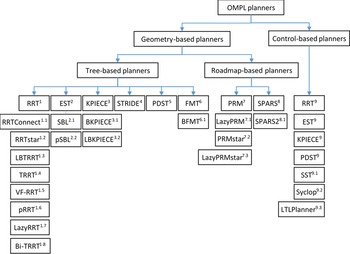
Many sampling-based motion planners are collected in Open Motion Planning Library (OMPL) that is open source and can be accessed directly or via other software. Currently, it is available in the Moveit Software, which is state-of-the-art software for industrial robots based on the robot operating system (ROS) platform. The OMPL is a powerful collection of state-of-the-art sampling-based motion planning algorithms. Figure 1 shows the motion planners that exist in OMPL.
Motion planners included in OMPL.

Based on whether workspace includes dynamic or differential constraints, geometry-based or control-based planners are used. A geometry-based planner just takes into account the geometry and kinematic constraints of the workspace and provide the output containing a series of point expressing the geometric configuration, that is, the coordinates in the joint space, while a control-based needs additional parameters, control space and state propagator, to apply control vector in order to control the propagation of the state.
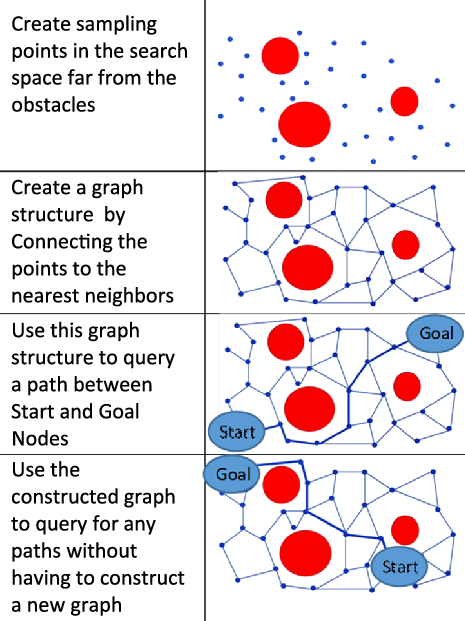
Roadmap-based and Tree-based are two general concepts of geometry-based sample-based motion planners. As Fig. 2 shows, in Roadmap-based concept, the planner utilizes random sampling of the workspace to build a roadmap of the free workspace. Once the desired numbers of sampling points have been created, the roadmap itself can be constructed by connecting the random samples to form edges. Once the roadmap is complete, it can be used to answer motion planning queries by connecting the start and goal points to the roadmap using the local planner, and performing a graph search to find the shortest path in the roadmap. The probabilistic roadmap (PRM) is the most famous Roadmap-based motion planners [Reference Kavraki, Svestka and Overmars33].
PRM algorithm.

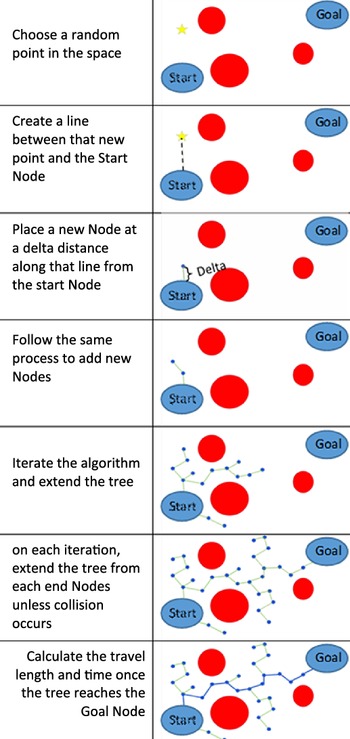
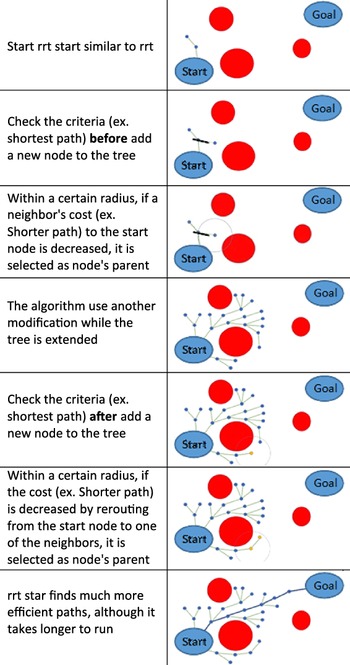
In Tree-based concept as shown in Fig 3, the planner begins by rooting a tree at the starting configuration of the robot. The planner employs an expansion heuristic from which the sample is connected to the tree along a collision-free path. The Rapidly exploring Random Tree known as RRT [Reference LaValle34] is the basic Tree-based motion planner. As it is shown in Fig (4), RRTstar [Reference Karaman and Frazzoli35], is one of the most famous variant of RRT, that uses optimization steps to add nodes to the tree. Two main optimization objectives are minimizing the Path Length and maximizing the clearance to obstacles. More optimization objective has been created by combination of these two objective such as Balanced Optimization, which optimizes a trade-off between path length and maximum clearance via weighting factor, and Maximize minimum clearance, that is the cost of a given path is the only function of the closest distance between the path and an obstacle.
RRT algorithm.

RRTstar algorithm.

In this study, a problem with static constraints is considered, so geometry-based planners are used. Before describing the problem, a brief description of the used planners is reviewed.
-
1- RRT (Rapidly-exploring Random Tree) [Reference Deng and Yao32]: as described in Fig. 3 it is the basic tree-based technique. There are some variants of RRT, since these variant are repeated for other planners we explain them as follows:
-
1.1- RRTConnect[Reference Kuffner and LaValle36]: The bi-directional version of the RRT, where two trees are grown simultaneously from start and goal nodes until they meet each other.
-
1.2- RRTstar [Reference Karaman and Frazzoli35]: The RRT planner with an optimizing step, where a new sample node is connected to the tree so that the state space is more locally refined.
-
1.3- LBTRRT (Lower Bound Tree-RRT) [Reference Salzman and Halperin37]: It is an asymptotically near-optimal version of RRT that uses an auxiliary graph called lower bound graph.
-
1.4- TRRT (Transition-based RRT) [Reference Jaillet, Cortés and Siméon38]: The proposed method combines the exploratory strength of RRTs, with the efficiency of stochastic optimization methods. It tries to find short, low-cost paths by performing transition tests to add new states to the tree.
-
1.5- VF-RRT (Vector Field RRT) [Reference Ko, Kim and Park39]: tries to minimize the so-called upstream cost of a path. The upstream cost is defined by an integral over a user-defined vector field.
-
1.6- pRRT (Parallel RRT) [Reference Bialkowski, Karaman and Frazzoli40]: Many different parallelization schemes have been proposed so that several threads simultaneously add states to the same tree. Once a solution is found, all threads terminate.
-
1.7- LazyRRT (Lazy RRT): It checks the validity of a state “lazily” so that accepts invalid configuration states to construct a tree. After the graph search is performed, the invalid parts of the candidate solution are altered to make the path collision-free.
-
1.8- Bi-TRRT [Reference Devaurs, Siméon and Cortés41]: The Optimized bi-directional version of TRRT.
-
-
2- EST (Expansive Space Trees) [Reference Hsu, Latombe and Motwani42]: This planner was published around the same time as RRT.It tries to determine the direction of the tree by checking the density of nodes in the configuration space. The tree will expand towards the less explored space. Like RRT, there are bi-directional, lazy collision checking, projection-based and parallel variants of EST.
-
2.1- BiEST [Reference Hsu, Latombe and Motwani42]: Bi-directional variant of EST
-
2.2- ProjEST [Reference Hsu, Latombe and Motwani42]: Projection variant of EST
-
2.3- SBL [Reference Sánchez and Latombe43]: It is single-query bi-directional lazy collision checking
-
2.4- Psbl [Reference Sánchez and Latombe43]: It is Parallel Single-query Bi-directional Lazy collision checking variant
-
-
3- KPIECE (Kinodynamic motion Planning by Interior-Exterior Cell Exploration) [Reference Şucan and Kavraki44]: This planner uses layers of discretization to guide the exploration of the (continuous) state space. There are two variants of KPIECE, bi-directional and lazy collision checking.
-
3.1- BKPIECE: Bi-directional variant of KPIECE
-
3.2- LBKPIECE: Lazy Bi-directional variant of KPIECE
-
-
4- STRIDE (Search Tree with Resolution Independent Density Estimation) [Reference Gipson, Moll and Kavraki45]: This planner was inspired by EST. Instead of using a projection, STRIDE uses a Geometric Near-neighbor Access Tree to estimate sampling density directly in the state space. In comparison to the EST, STRIDE is useful for high-dimensional systems where the free space cannot easily be captured with a low-dimensional (linear) projection.
-
5- PDST (Path-Directed Subdivision Tree) [Reference Ladd and Kavraki46]: this planner represents samples as path segments instead of configuration states. It uses non-uniform subdivisions called cell to explore the state space. The density of motions per cell is used to guide expansion of the tree. PDST entirely removes the dependency on a distance measure, which is useful in cases where a good distance metric is hard to define.
-
6- FMT (Fast Marching Tree) [Reference Janson, Schmerling, Clark and Pavone47]: this planner is an asymptotically optimal planner, which marches a tree forward in the cost-to-come space on a specified amount of samples. Unlike all other planners, the numbers of valid samples need to be chosen beforehand.
-
6.1- BFMT (bi-directional Fast Marching Tree) [Reference Starek, Gomez, Schmerling, Janson, Moreno and Pavone48]: The bi-directional variant of FMT.
-
-
7- PRM (Probabilistic Road Map) [Reference Beschi, Mutti, Nicola, Faroni, Magnoni, Villagrossi and Pedrocchi30]: as described in Fig. 2, it is the basic Probabilistic Road Map technique. There are lazy collision checking, star and lazy plus star variants of PRM.
-
7.1- LazyPRM [Reference Bohlin and Kavraki49]: Lazy collision checking variant of PRM
-
7.2- PRMstar [Reference Karaman and Frazzoli35]: star variant of PRM
-
7.3- LazyPRMstar [Reference Karaman and Frazzoli35]: It is PRMstar with lazy collision checking.
-
-
8- SPARS [Reference Dobson and Bekris50]: This planner provides asymptotic near-optimality and includes a meaningful stopping criterion. Its convergence rate tends to be much higher than PRMstar.
-
8.1- SPARS2 [Reference Dobson and Bekris51]: It is a variant of SPARS, that works through similar mechanics, but uses a different approach to identifying interfaces and computing shortest paths.
-
3. Path Segmentation in the Motion Planning
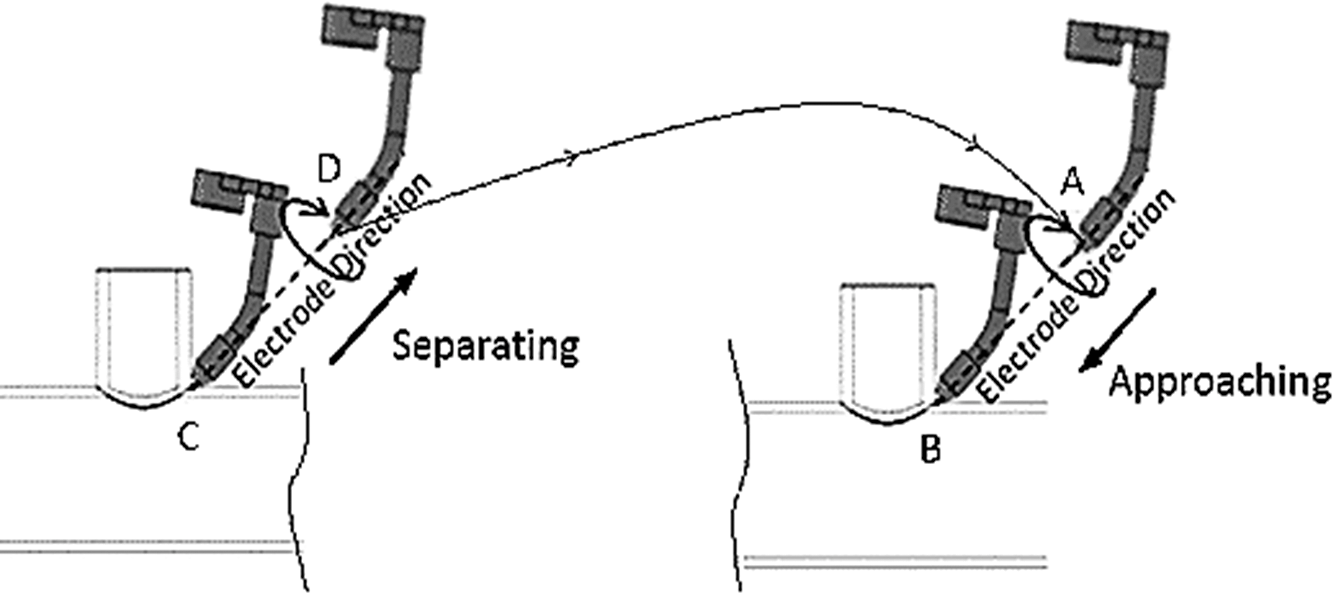
As it is seen in Fig. 5, in the large workspaces motion of an end effector between two task points can be divided into three phases. At the first phase, the end effector moves away from the first task point (C to D in Fig. 5), then in the second phase it moves toward the next task positions (D to A), and finally in the phase 3, it approaches to the next task point (A to B). Therefore, an auxiliary point, marked as A and D in Fig. 5, is defined near the starting/ending point of task points (C and B). In phase 1 and phase 3, the robot moves with path constraint. This path constraint keeps the orientation of the end effector. Robot movements in phase 1 and phase 3 are slow, while the robot moves with maximum speed in the phase 2.
Supportive path between two task position, Phase 1) Separating from first task position,Phase 2) Moving through the path between the two task positions, and Phase 3) Approaching to the second task position.

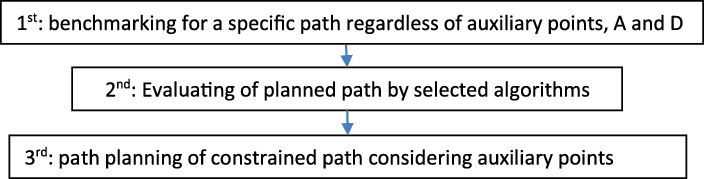
Path planning considering path constraint (C-D and A-B in Fig. 5) has a high computing cost, because for each state (sample) the inverse kinematic has to be solved. Therefore, in this study, the problem is divided into some steps, which are shown in Fig. 6.
The motion planning is divided into some steps.

In the first step, for a specific path from A to D without regarding the auxiliary points, the benchmark between different sample-based motion planning algorithms is done to compare the performance of the various motion planning algorithms. In the second step, the path planned by the selected algorithms of the prospective step is examined to ensure satisfying the kinematic constraints and the smoothness of the path. In the third step, the constrained path planning between the auxiliary points and the starting points (C-D and B-A paths) is demonstrated.
4. Benchmarking
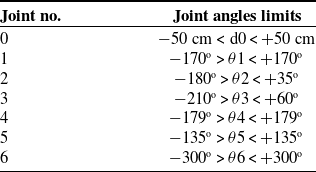
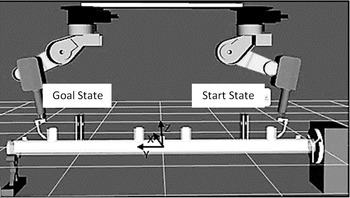
In this section for benchmarking, the same problem is used to compare different motion planning algorithms which are described in Section 2. First, as it is depicted in Fig. 6 and Table I, our problem is defined to move from start state to goal state. After the stop condition of runs is introduced, the number of missing runs is counted up due to this stop condition. Finally, different sample-based algorithms are compared using the results of runs.
Robot joint angles limits of industrial welding robot CLOOS ROMAT 320 [Reference Shahabi and Ghariblu1].

To implement a benchmarking, some parameters have to be defined in Moveit. The main parameters are Planning scene, Group, Start sates, Queries, Workspace (Optional), Goal constraints (Optional), Path constraints (Optional) and Planners which consist of Plugin and Planner-Name.
Where Group determines the group of robot joints participating in motion planning. Queries represent the joints values in the goal state. Start states represent the joints values in the start state. Workspace determines the space that planners search in. plugin support motion planner plugin like OMPL. Planner-Name is the name of planner, in case of OMPL one or some of the planner name of Fig. 1. The Planning scene transforms information such as robot_state, which determines the name, angle (position), velocity and effort of joints, robot_model_name, which includes the geometry of link and joints of robot, fixed_frame_transforms, which determines the reference frame, and allowed_collision_matrix, which determines the pair links that their collisions are ignored.
As it is shown in Fig. 7, the robotic manipulator “Cloos Romat 320" employed in this case study has seven degrees of freedom (DOF), joint number zero belongs to the base of the manipulator linear movement suspended from ceiling, and another six degrees of freedom belongs to the manipulator joints. This robotic manipulator is redundant for various tasks like arc or spot welding and cutting operations, because these operations only need 5 or 6 DOF. For the benchmarking of case study, Fig. 7 shows the start state and goal state, which are indicated by the robot joint angles. Table I shows the robot joint angle limits. To avoid repetition and extension of this paper, the kinematic analysis of this manipulator we refer it to the authors previously published paper [Reference Shahabi and Ghariblu1].
Start state and goal state simulated in Moveit.ROS.

4.1. Case study
For analysis and comparing performance of the different sampling-based motion planning methods between start and goal states, a case study is considered. In this case study, Cloos Romat 320 manipulator moves from start state:
 ${[{{\rm{X}}_{\rm{s}}},{\rm{\;}}{{{\unicode[Times]{x03B8} }}_1},{\rm{\;}}{{{\unicode[Times]{x03B8} }}_2},{{\rm{\unicode[Times]{x03B8} }}_3},{{\rm{\unicode[Times]{x03B8} }}_4},{{\rm{\unicode[Times]{x03B8} }}_5},{{\rm{\unicode[Times]{x03B8} }}_6}]_{{\rm{start}}}} = $
[0.111cm,
 ${0^\circ },{\rm{\;}} {-\!127.2^\circ },{\rm{\;}} {-\!12^\circ },{\rm{\;}}{38.4^\circ },{\rm{\;}}{0^\circ },{\rm{\;}}{140.9^\circ }$
] to the goal state:
 ${[{{\rm{X}}_{\rm{s}}},{\rm{\;}}{{\rm{\unicode[Times]{x03B8} }}_1},{\rm{\;}}{{\rm{\unicode[Times]{x03B8} }}_2},{{\rm{\unicode[Times]{x03B8} }}_3},{{\rm{\unicode[Times]{x03B8} }}_4},{{\rm{\unicode[Times]{x03B8} }}_5},{{\rm{\unicode[Times]{x03B8} }}_6}]_{{\rm{goal}}}} = $
[−0.103cm,
 ${0^\circ },{\rm{\;}}{0.6^\circ },{\rm{\;}} {-\!160.4^\circ },{\rm{\;}} {-\!73.9^\circ },{\rm{\;}}{0^\circ },{\rm{\;}}{73.9^\circ }$
]. The first term Xs indicates the robot base position in centimeter, while other six terms, that is, [1, 2, 3, 4, 5, 6] indicate manipulator joints angles in radians. For goal state, a general default tolerance of 1e-5 length unit in position and 1e-5 radians in orientation is specified in Moveit. These tolerances are sufficient for many robotic applications like welding. There is no path constraint in this case. The request for benchmarking is done using the motion planning request message. This message transfers information such as workspace dimensions, start state, goal constraints and allowed planning time (10 s).
The benchmarking collects various statistics for different types of planners. In this case, 23 planners are used and 50 runs per planner are executed with a 10 s time limit for each run. Memory limit for each run was 100 KB. Totally, 86.25 min spent to collect the data of this benchmarking using an Intel core i7 − 6500 U and 8 GB memory computer.
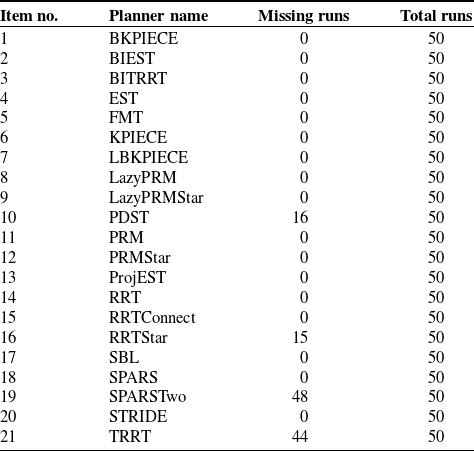
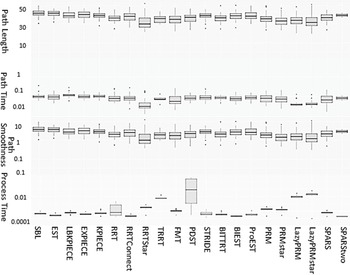
After introducing the stop condition, the missing runs are counted up due to this stop condition and results are shown in Table II. Also Fig. 8 compares the different performance criteria between various sample-based algorithms.
The number of missing runs of different planner in 50 runs.

The benchmarking results of different type of sample-based motion planning algorithms.

If either planner could not find the solution in 10 s or its memory exceeds 100KB, the related run will be missed. Table II shows the number of missing runs. Sparstwo and TRRT have many missed runs. Hence, these two algorithms were omitted for the next runs.
To show the statistical distribution, the box plot is used that is particularly useful for comparing distributions between several groups or sets of data. Figure 8 shows the results of benchmarking.
Path length in centimeter, path time in seconds, path smoothness and process time in seconds are five factors, which demonstrate the state of each planner. The less smoothness value means the smoother movement. The log scale for Y-axis is used to have more visible data. Analyzing the obtained results, the following conclusions are made:
-
Among roadmap-based planners, the path specifications, that is, path time, path length and path smoothness of LazyPRM and LazyPRMstar are better than what was found by PRM, PRMstar and Spars. However, the process time of PRM, PRMstar and Spars are better than LazyPRM and LazyPRMstar.
-
A trade-off between roadmap-based and tree-based planners demonstrates that although the roadmap-based planner, that is, PRM, LazyPRM, PRMstar, LazyPRMstar and Spars found better solutions regarding the path length and path time, their computational cost is much higher than tree-based planners. Therefore, in our application, tree-based planners are preferred to the roadmap-based planners.
-
A trade-off between tree-based planners demonstrates that BiTRRT could find the best solution. Because its path specifications are more and less similar to RRT, RRtstar, PDST, and FMT, but its computational cost is much less than those are. However, The RRTstar could find the best path specifications.
As a conclusion, BiTRRT is selected as the most appropriate planner. BiTRRT is the bi-directional version of TRRT, which uses a stochastic optimization method and tries to add new states to the tree in order to find short, low-cost paths by performing transition tests. However, RRTstar is the better choice if only the shortest path is desired. RRTstar is an RRT planner with an optimizing step, where a new sample node is connected to the tree so that the state space is more locally refined.
5. Evaluation of the Path Planned by the Selected Motion Planning Algorithms
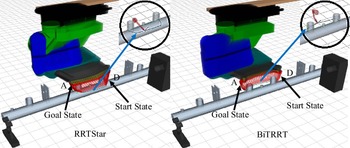
In this section, we will look more closely at the paths planned by selected motion planning algorithms. Each BiTRRT and RRTstar algorithms is executed five times with the same start and goal states. The best execution is chosen and its simulation in the Cartesian space is shown in Fig. 9. As it is shown in a circle in Fig (9), the tool tip paths are different for BiTRRT and RRTstar algorithms in the Cartesian space. Here, the robot is requested to move from the auxiliary point D with the coordinates
 $\left[ {0, - 0.42,\;0.16} \right]$
and Euler angles
 $\left[ {{{45}^\circ },\;{0^\circ },\;{0^\circ }} \right]$
to auxiliary point A of another welding position with the coordinates
 $\left[ {0.16,\;0.42,\;0} \right]$
and the Euler angles
 $\left[ { - {{45}^\circ },\;{0^\circ },\;{0^\circ }} \right]$
.
Simulation of the path planned by the selected path planning algorithms with the same start and goal states in Moveit.ROS.

The number of path samples and length of traveled path planned by the selected motion planning algorithms BiTRRT and RRTstar are stated in Table III. Because there are some obstacle like two branch pipe and also main pipe between start and goal states, the BiTRRT and RRTstar algorithms use different strategy and therefore the number of path samples is significantly different. In this case, RRTStar succeed to reach goal state with fewer path samples. It means that the computational cost is lower and it is faster than BiTRRT. Although the length of traveled path by RRTStar is 5.7 cm (108.3–102.6) longer than BiTRRT, but as Fig. 9 shows it is smoother than BiTRRT’s one.
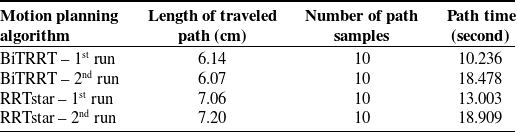
Path specification planned by selected algorithms BiTRRT and RRTstar.

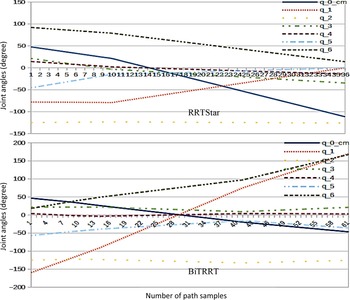
Figure 10 shows the joint angles along the path planned by the selected motion planning algorithms. In this figure, q_0 represents the linear motion of the robot base in cm, q_1 to q_6 are the joint angles of the robot joints. According to Table I, all joint angles are within the range of the production path. Also, as the figure shows, the path planned by both the BiTRRT and the RRTstar algorithms in the joint space are smooth.
Joints angles along the path planned.

6. Constrained Path Planning in the Neighborhood of the Welding Positions
In this section, the end effector keeps its orientation while it separates or approaches towards the task positions. The robot travels the path with a low speed to ensure collision avoidance. In this section, the ability of selected motion planning algorithms, BiTRRT and RRTstar, is examined in order to plan these constrained paths. Like previous section, each motion planning algorithm is executed five times and the best execution is considered.
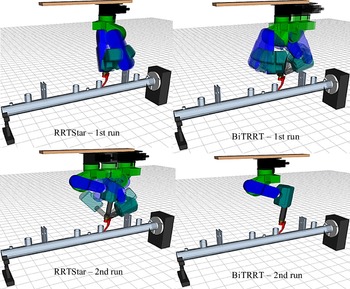
Figure 11 illustrates the simulation of robot motions in the path planned in the Cartesian space twice for each selected motion planning algorithm, BiTRRT and RRTstar. Here, the end effector of robot was requested to travel from the point A with the coordinates
 $\left[ {0,\; - 0.42,\;0.16} \right]$
and Euler angles
 $\left[ {{{45}^\circ },\;{0^\circ },\;{0^\circ }} \right]$
to the starting point of task position B with the coordinates
 $\left[ {0,\; - 0.37,\;0.11} \right]$
and Euler angles
 $\left[ {{{45}^\circ },\;{0^\circ },\;{0^\circ }} \right]$
, while keeps the end effector orientation during path traveling.
Constrain path planned simulation, keeping the end effector orientation during path, twice for BiTRRT and RRTstar.

The number of path samples and length of traveled path planned by the selected motion planning algorithms BiTRRT and RRTstar are stated in Table IV. Because there are no obstacles between start and goal states, the number of path samples does not differ significantly. They use minimum number of samples, assumed 10, to find the path. The Euclidean distance between start state
 $\left[ {0,\; - 0.42,\;0.16} \right]$
and goal state
 $\left[ {0,\; - 0.37,\;0.11} \right]$
in Cartesian space is 0.0707. It is the minimum length of travel. The reported length in BiTRRT is less than this amount. It is probably due to the accumulation of rounding errors of distance between samples calculated by the BiTRRT algorithm. However, the difference in length of traveled path indicates that robot end effector do not move in the straight line. Another point is that the path time is not directly related to the length of travel. The 1st run of BiTRRT is longer but faster than the 2nd run of BiTRRT, because the path time depends on the joint angle movement in the joint space. Less joint angle changes cause less path time.
Path specification planned by selected algorithms BiTRRT and RRTstar.

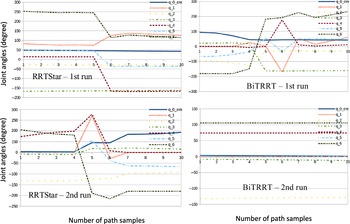
Figure 12 shows the joint angles along the path planned by the selected motion planning algorithms. In this figure, q_0 represents the linear motion of the robot base in cm, q_1 to q_6 are the joint angles of the robot joints. According to Table I, all joint angles are within the range of the production path.
Joints angles along the constriant path.

Among all four planned paths, the BiTRRT_02 has the best results because the joint angles have minimal motion and are smooth. Figure 12 shows the reason for difference between the planned paths, which is the configuration, or joint angles, at the starting points of the path. Therefore, by choosing the right joint angles at the starting points of the constrained path, an acceptable and smooth path can be planned.
7. Conclusion
In this study, different sample-based path planning for point-to-point robotic manipulator motion to travel between two task points was considered. These motion planning methods can be employed for large workspaces that need to use a redundant robotic manipulator with linear movement in its base. In comparison with other related researches, this work has taken in to account most important state-of-the-art sampling-based motion planning methods and compares their performances. Different criteria, like running time, number of successful paths, path time, path length and path smoothness were employed for performance analysis and comparison. Hence, 23 kinds of planners are used and 50 runs per planner are executed with 10 s time limit for each run, and 100 KB memory limit for each run using an Intel core i7 − 6500 U and 8 GB memory computer. The following conclusions for this analysis were obtained.
-
Results demonstrate that roadmap-based planners found better solutions regarding the path specification, that is, path length and path time.
-
On the other hand, computational cost of Tree-based planners are much lower than roadmap-based planners, So they are more appropriate where fast path planning analysis is required.
-
Between Tree-based planners, Bi-directional Transition-based RRT (BiTRRT) and RRTstar have superior performances in comparison with other RRT methods. Therefore, BiTRRT and RRTstar are selected among 23 path planners for obstacle-free path planning.
-
Finally, it is seen that BiTRRT has better results with minimal joint angles, motion and smoothness of path. In addition, it is seen that for the same sample points (nodes), the length of the traveled path of BiTRRT is shorter than RRTstar.