Introduction
The CISD (CISD, Antoine et al., Reference Antoine, Antoine and Nandrino2008) has been developed to assess different dimensions of cognitive distress and to help in the functional analysis of patients with sub-threshold depressive states that are in need of psychological support. Indeed, many studies have pointed out that the older people exhibit maladaptive thoughts related to somatic illness, loneliness, or the future perspective of being physically-ill or dependent (Baltes and Smith, Reference Baltes and Smith1997). Thus, the development of the CISD has taken into account these age-related beliefs considering seven schemas relevant to aging people: (1) abandonment, corresponds to the fear of being abandoned by family and friends and the fear of ending up isolated with no social contacts, (2) the dependency schema corresponds to a perceived need for continuous and extensive assistance in handling everyday affairs and coping with one's own needs, (3) the third schema corresponds to the fear of losing control and involves the tendency to display hostility, whether verbally or physically and to be aggressive when angry, (4) the vulnerability schema entails a generalized fear about various concerns commonly found in the older people, (5) the fifth schema is related to the loss of individuality while aging: feeling trapped, loneliness, and loss of control over one's life, (6) the refusal-of-help schema corresponds to actual refusal of help, or behavioral and emotional reactions generated by the need for help and (7) the disengagement schema refers to the loss of interest in activities.
The first four dimensions–fear of losing control, dependency, vulnerability, and abandonment–were derived from earlier research on schemas (Schmidt and Joiner, Reference Schmidt and Joiner2004), while the remaining three dimensions–disengagement, loss of individuality, and refusal of help–seem to be specific to the older people (Antoine et al., Reference Antoine, Antoine and Poinsot2007). They were deduced from research on distress and sub-threshold depressive states in aging. The CISD construct affords a broader view of distress that is not only quantitative but also qualitative. In a schema-based approach, suffering can be grasped in a more finely-tuned manner and in several different domains, thereby supporting both a functional analysis and a psychopathological analysis of patients. Schema assessment can constitute the first step towards patient care, it can help in determining the best therapy or treatment as well as the best way to apply it. Understanding patients’ distress requires understanding their self-appraisal, thoughts, and beliefs about their life. At a more fundamental level, these results raise the question of the nature of psychological distress in comparison to anxiety and depression, which, from the statistical standpoint, appear to be intricately linked to each other. These two disorders may be subcategories of one and the same disorder (Devanand, Reference Devanand2002). It can be hypothesized that distress factors may be representative of a core cognitive schema of vulnerability, shared by all older people suffering from anxiety, depression, or sub-threshold depressive states. Finally, the CISD tackles the difficulty linked to the feasibility of testing distress measures in the older people given their degree of cognitive deterioration. The scale was validated on participants aged 60 years or older and scoring above 10 on the Mini-Mental State Examination (MMSE). The results indicated a low difficulty rating that was only weakly correlated with the MMSE score, meaning that for the degree of deterioration under consideration here, this criterion is not relevant. Moreover, the internal consistency and temporal reliability of the schema scales were good.
The CISD can be used to evaluate several facets of distress, as a supplement to traditional tools for diagnosing affective disorders. It can serve as a baseline for following a patient over time and in the course of therapy. Thus, in order to better adjust psychological testing to the old and very old population and to provide brief and useful measures to clinicians and researchers, we conducted two studies pertaining to the following objectives: Study 1 was designed to investigate the relevance of a hierarchical structure of the CISD that would lead to the possibility of calculating a general score of distress. Hence, it would be possible to decrease the number of items used and create a screening tool. The shortened form would allow referring back to the original scale for individually significant dimensions. Study 2 was designed to assess the replicability of a shortened version of the CISD and to test its multi-sample structural invariance.
Study 1
Methods
Population
The French version of the CISD was administered to 290 older people (living at home or in retirement centers) between the ages of 63–105 years old (mean age 84.72 ± 7.34 years). The exclusion criteria were: severe dementia (MMSE score below 10) and sensory or mental disorders that prevented testing via a questionnaire. The presence of a mood disorder was not an exclusion criterion. Their MMSE score fell between 11 and 30 (mean 23.2 ± 4.8). All participants signed an informed consent to the study, and all ethical recommendations for human research were followed.
Questionnaires
The CISD (CISD, Antoine et al., Reference Antoine, Antoine and Nandrino2008). The CISD is a 29 five-point items inventory (from no, completely wrong to yes completely right) that describes thoughts representing seven distress schemas scored on a five-Likert scale. Internal consistency for the seven dimensions was satisfying with Cronbach's α ranging from 0.73–0.85 [Abandonment: α = 0.85 (four items), Dependency: α = 0.84 (four items), Disengagement: α = 0.73 (five items), Fear of losing control: α = 0.76 (four items), Loss of individuality: α = 0.79 (four items), Refusal of help: α = 0.73 (four items), Vulnerability: α = 0.79 (four items)].
The MMSE (Folstein et al., Reference Folstein, Folstein and McHugh1975, MMSE). This quick test screens for cognitive deficits evaluating temporal and spatial orientation, immediate memory, recall, attention, language, and praxis.
The Activities of Daily Living Scale (Lawton and Brody, Reference Lawton and Brody1969, IADL). This measure was obtained by questioning a caretaker. The basic activities assessed were bathing, eating, dressing, self-care, walking, and toileting. Scoring of each activity was simplified, with 1 point for full autonomy and 0 if any help was needed.
The geriatric depression scale (Yesavage et al., Reference Yesavage1983, GDS). The GDS used in this study is the 15-item version (Sheikh and Yesavage, Reference Sheikh, Yesavage and Brink1986) which is a “yes–no” self-evaluation scale for the older people that requires little time and effort. This scale does not include the somatic items that are often part of depression measures, because these items can generate a bias in the older people population.
The State-Trait Anxiety Inventory, trait form (Spielberger, Reference Spielberger1983, STAI): Trait anxiety was assessed using the trait form of the STAI. This 20-item self-report questionnaire is scored on a four-point Likert scale. The French version shows good psychometric properties, leading to its intensive use in health research.
Statistical procedures
We conducted CFA using maximum likelihood estimations with AMOS 22 (IBM Inc.) on sample 1 to establish the second-order structure of the CISD and then to shorten the length of the CISD. We refined the 29-item CISD based on low item factor loadings (≤0.50) and high modification indices criteria. Specifically, we iteratively removed the items which showed the lowest explanatory power of their respective dimensions (≤0.50) and/or that cross-loaded on the other latent factors as indicated by the modification indices criteria, suggesting to allow covariance between items of different dimensions. Pearson's correlations were used to assess the convergent and the discriminant validity of the S-CISD. Model fit was assessed using the criteria of Hu and Bentler (Reference Hu and Bentler1999) based on the comparative fit index (CFI: good fit: ≥0.95, acceptable fit: ≥ 0.90), and the Root Mean Square Error of Approximation (RMSEA; good fit: < 0.06, acceptable fit: <0.08) with its 90% confidence interval (CI), and the Standardized Root Mean Square Residual (SRMR; acceptable fit: <0.08).
Results
Hierarchical structure
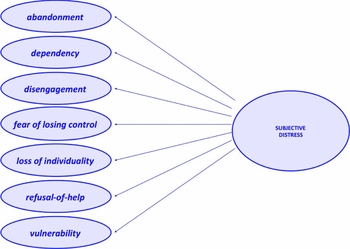
A second-order factorial structure (Figure 1) exhibited a satisfying goodness of fit with χ 2 (370) = 601.56, p ≤ 0.001; CFI = 0.93, RMSEA = 0.047 with a 90% CI of 0.040–0.053, and a SRMR = 0.06. The CISD demonstrated that a general distress factor explained the seven dimensions. The internal consistency was very good with a Cronbach's α of 0.90. Thus, the former gave grounds to proceed to a reduction in length of the CISD as a brief screening tool.
Hierarchical conceptualization of subjective distress.

The reduced form of the CISD: the S-CISD
Based on the high modification indices and cross-loadings, we first retained a 14 item scale with two items per dimension (the minimum observed variables allowed to compute such analyses). Second, as suggested by the previous second-order analysis, we decided to retain the most representative item of each dimension to fit the overall model of cognitive distress. We used the following rules to choose the most interesting item: exhibited the higher loading on its dimension without any covariance with an item of another dimension as suggested by modification indices criteria, else, we retained the other one. This yielded the following goodness of fit indices χ 2 (14) = 15.56, ns; CFI = 0.99, RMSEA = 0.02 with a 90% CI of 0.00–0.062, and a SRMR = 0.04.
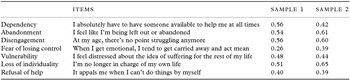
The factor loadings are described in Table 1.
Factor loadings of the S-CISD

Convergent and discriminant validity
As the whole sample did not complete all the measures, 71 participants were retained to evaluate convergent and discriminant validity.
The S-CISD showed a strong correlation with the GDS (r = 0.71, p ≤ 0.001) and the STAI (r = 0.63, p ≤ 0.001) supporting convergent validity. For discriminant validity, the S-CISD was not correlated to the MMSE (r = −0.19, ns) or with age (r = 0.06, ns) but was negatively and significantly associated to IADL (r = −0.34, p ≤ 0.01).
Study 2
The aim of study two was to confirm the psychometric properties of the S-CISD on a large French sample in order to test its factorial replicability and to confirm the satisfactory goodness-of-fit obtained from study 1 (χ 2 (14) = 15.56, ns; CFI = 0.99, RMSEA = 0.02 with a 90% CI of 0.00–0.062, and a SRMR = 0.04). We also analyzed its structural invariance through a multi-sample cross-validation comparison based on gender.
Population
Participants from the second sample (n = 1,429) were community-recruited through a panel of current respondents to an online survey of a national Belgian magazine (Plus Magazine, Roularta). The mean age of this sample was 64.85 ± 6.81 and the gender distribution was 33.5% men and 66.5% women. Out of 100%, 75.3% of the sample was married or cohabiting and 24.6% lived alone.
Statistical procedure
We assessed the replicability of the S-CISD using a maximum likelihood CFA on this second independent sample. Finally, we conducted a cross-validation of the S-CISD in order to evaluate the replicability of its factorial structure by testing the configural invariance, the measurement weight as well as structural weight invariance between the two samples (Bollen, Reference Bollen1989).
Model fit was assessed using the same criteria as in study 1.
Results
Replicability of the factorial structure of the S-CISD
The CFA lead to the following fit: χ 2 (14) = 127.37, p ≤ 0.000; CFI = 0.92, RMSEA = 0.075 with a 90% CI of 0.064–0.088, and a SRMR = 0.04.
As the model fit was just satisfactory, a closer look at modification indices suggested allowing two covariance errors to freely co-vary (between items 39 and 16). This lead to a better fit: χ 2 (13) = 38.77, p ≤ 0.000; CFI = 0.98, RMSEA = 0.037 with a 90% CI of 0.024–0.051, and a SRMR = 0.02. Factor loadings are described in Table 1.
The internal consistency was satisfying with a Cronbach α of 0.70.
Multi-sample cross-validation
Multi-sample analysis was performed to determine if the factorial structure of the S-CISD was invariant across our two samples based on gender.
We first tested gender invariance for the non-corrected model, i.e. without correlated covariance errors. Configural invariance was achieved with χ 2 (28) = 125.55, p ≤ 0.000; CFI = 0.93, RMSEA = 0.049 with a 90% CI of 0.041–0.058, and a SRMR = 0.03. Assuming the configural invariance was correct between the two gender samples, measurement weight did not show any statistical differences (Δχ 2 (6) = 2.06, p = 0.91) as did the structural covariance (Δχ 2 (7) = 4.29, p = 0.74). Furthermore, imposing the equality of measurement weight, the structural covariance remained non-significant (Δχ 2 (1) = 2.22, p = 0.14). The measurement invariance as well as the structural weight invariance confirmed that the S-CISD scores could be used confidently.
When considering the corrected model allowing covariance between two items, the results confirm the S-CISD invariance at configural level with χ 2 (26) = 48.71, p ≤ 0.004; CFI = 0.98, RMSEA = 0.025 with a 90% CI of 0.014–0.035, and a SRMR = 0.03. Assuming the configural invariance was correct between gender group, the measurement weight invariance between gender group was established (χ 2 (6) = 2.17, p = 0.90), as did the structural covariance (χ 2 (7) = 4.73, p = 0.69). Furthermore, imposing the equality of measurement weight, the structural covariance remained non-significant (Δχ 2 (1) = 2.56 p = 0.11).
Discussion
These investigations aimed to develop a screening tool readily usable for clinicians and researchers with old and very old people, institutionalized or not, with mild cognitive impairment or not.
First, we assessed the hierarchical factorial structure of the CISD. Our results support a second-order structure meaning that dimension scores confidently explain a general distress factor confidently allowing the use CISD total score. Further, this second-order structure supports the uni-dimensionality of distress in the older people. Indeed, distress may be viewed as a core construct underlying anxiety and depression, reflecting core self-schemas more or less activated, hence leading to higher CISD scores. As the hierarchical structure was psychometrically sound, we shortened the original scale allowing us to provide a brief screening scale satisfying to usual fit criteria. Further, the concurrent and discriminant validity were supported. Indeed, as expected, the S-CISD was correlated with both the GDS and the STAI and exhibited an inverse relationship with IADL. Further, this brief screening tool did not demonstrate any correlation with supposedly unrelated constructs, such as a brief cognitive examination (MMSE) or age. This screening tool is particularly interesting for the older people because it provides a rapid examination of the general distress even when people show cognitive impairment. Further, a higher score on the S-CISD allows checking the dimension(s) particularly relevant for an individual, allowing clinicians to refer to items pertaining to this dimension on the long version in order to proceed to a more refined analysis.
To overcome limitations of the S-CISD, it would be necessary to engage in studies aimed at defining cut-off for the general distress score as well as evaluate the specificity and sensitivity of this screening tool.
Our first study did not show any significant relationship between the MMSE and the S-CISD but this needs to be replicated to assess the confidence level of the S-CISD scores regarding the cognitive impairment level of older people. Indeed, because the S-CISD is a self-evaluation, it requires one to have preserved abilities to estimate his or her emotional states.
To shorten the CISD, we used the items’ factorial saturations after demonstrating the relevance of a hierarchical factorial model underlied by a common general psychological distress factor. As the S-CISD is defined by a uni-dimensional structure, one alternative would have been to use an item-response model. However, our first sample was too small to use such a model and conceptually speaking, it was necessary that each schema of the original CISD be represented in its short form, making the factorial method more suitable.
In conclusion, the S-CISD is a rapid screening tool that takes approximately 2–3 minutes to complete while being sustained by a complex model of seven dimensions of psychological distress in the older people. The S-CISD is sensitive to the general distress encompassing sub-threshold anxiety and depression dimensions or negative facets of the quality of life both in psychologically disturbed and the general population. This sensibility may allow capturing more general psychological difficulties underpinned by, for example, attachment disorders or self-esteem. Like the original scale (CISD), the short form could be used during psychotherapy in order to define the main orientations but also as a baseline assessment. In line with this idea, the S-CISD should be more sensitive to subtle changes in psychotherapy (Kindynis et al., Reference Kindynis, Burlacu, Louville and Limosin2013) as these changes are not always and immediately captured by a decreasing score on depression or anxiety scales particularly if the therapy aims to reduce the activation of specific schemas. Further, its short length allows its repeated use to assess individual responses to the psychotherapy course.
Conflict of interest
None.
Description of authors’ roles
Mrs. Fantini-Hauwel and Mr. Antoine designed the study, supervised the data collection, carried out the statistical analysis, and wrote the paper. Mrs. Dovi collected the data and assisted with writing the paper.
Acknowledgments
We would like to acknowledge Pr Paulo Bertolucci for his careful reading of the manuscript.
Apendice: French version of the S-CISD
-
1. J’ai le sentiment d’être mis(e) à l’écart ou abandonné(e)
-
2. Il faut absolument que quelqu’un soit toujours disponible pour m’aider
-
3. A mon âge, cela ne sert plus à rien de lutter
-
4. Sous le coup de l’émotion, j’ai tendance à m’emporter et à être méchant(e)
-
5. Je ne suis plus maître de ma vie
-
6. Cela me révolte quand je ne peux pas me débrouiller seul(e)
-
7. Je suis angoissé(e) à l’idée de souffrir durant le reste de ma vie