Introduction
In Australia, residential aged care facilities (RACFs) accommodate adults with a range of physical and psychiatric conditions. Many of these residents display challenging behaviors. For example, up to 90% of people with dementia (PWD) living in RACFs display challenging behaviors (Lyketsos et al., Reference Lyketsos2000), and these are often the precipitant for placement (Gitlin et al., Reference Gitlin, Mark, Stanley, Hansen and Van Haitsman2014). There are a number of theoretical models which seek to understand their etiology. The biology/genetic model states that the behavior results from the neurological changes which occur due to these conditions. The behavior model posits that there is a reciprocal relationship between the person and the environment (Teri, Reference Teri1998). The reduced stress model hypothesizes that the behaviors result from an alteration of the person's ability to experience and interpret environmental stimuli due to the psychiatric condition (Hall and Buckwalter, Reference Hall and Buckwalter1987). The fourth model states that the behaviors originate as an expression of unmet need (Kitwood, Reference Kitwood1997). For example, up to 90% of PWD living in RACFs display challenging behaviors (Lyketsos et al., Reference Lyketsos2000), and these are often the precipitant for placement (Gitlin et al., 2014). Non-pharmacological interventions are recommended first-line strategies to manage challenging behaviors seen in RACFs due to the risk of adverse effects of psychotropic medications (Lyne et al., Reference Lyne2006; O'connor et al., Reference O'connor, Ames, Gardner and King2009; Kales et al., Reference Kales2012).
Non-pharmacological approaches such as music and aromatherapy have been researched to test their effectiveness in managing behaviors associated with dementia have had inconsistent results (O'connor et al., Reference O'connor, Ames, Gardner and King2009). Kitwood (Reference Kitwood1997) highlighted that a person-centered care approach to managing behaviors focuses on the PWD, rather than the disease itself. This approach can also be extrapolated to adults with other psychiatric conditions.
Thus, a crucial element of a non-pharmacological approach is to individualize the strategy according to the person's preferences and needs.
Touchscreen technology (TT) such as iPads has recently been used as a novel approach to support older adults. These have been utilized for various purposes. TT was used as a medium for reminiscence in adults with dementia, and was reported to help maintain social connectedness and reduce anxiety and depression (Upton et al., Reference Upton, Upton, Jones, Jutla and Brooker2011; Mokhtari et al., Reference Mokhtari2012). Leng et al. (Reference Leng, Yeo, George and Barr2014) reported that using apps with iPads in a group setting was effective in engaging and improving the mood in six adults with dementia. Cooking and craft apps were chosen as the participants had enjoyed these activities previously, and a professional staff member specifically trained in dementia care facilitated the group. Similarly, Lim et al. (Reference Lim, Wallace, Luszcz and Reynolds2013) studied the use of apps with iPads to 21 adults with dementia, but in contrast, this study was based in the home, on an individual, rather than group level, with the informal caregiver acting as the facilitator. The authors agreed with Leng et al. (Reference Leng, Yeo, George and Barr2014) in that apps should be individualized according to the adult with dementia, and they also suggested that the apps needed to be appropriately selected according to the cognitive capabilities of the adults.
Most of the published studies on apps and dementia have focused on engaging, and reducing anxiety and depression in adults with dementia. There is less literature available which investigates whether apps could act as a non-pharmacological strategy to reduce other associated behaviors such as aggression or agitation. There is also a scarcity of studies which report on apps being used to improve challenging behaviors in adults with other psychiatric conditions.
It is also important to consider the perceptions of the staff who implement the TT. Upton et al. (Reference Upton, Upton, Jones, Jutla and Brooker2011) reported that while the staff had positive feedback on the effects of TT on their PWD, they lacked confidence in their ability to use the TT, which may in turn have had a negative effect on the PWD.
In consideration of the above, and that a large number of adults living in RACFs display challenging behaviors, this study sought to investigate whether using apps with iPads could be an effective non-pharmacological strategy for managing challenging behaviors in adults with a variety of psychiatric conditions living in RACFs. The primary hypothesis in this pilot study was that the use of apps would reduce challenging behaviors, compared to usual care (no intervention), and a control intervention.
As a secondary outcome, the study also aimed to explore staff acceptability of using apps with these adults who have challenging behaviors living in RACFs.
Methods
This study occurred between October and December 2014. The design was a non-blinded, non-randomized crossover study with measurements made at baseline, i.e. usual care, after three weeks of a control intervention (control), and after three weeks of the apps intervention.
A convenience sample of adults with psychiatric conditions who displayed challenging behaviors was recruited from a RACF in metropolitan Melbourne, Victoria. They had to be medically stable and be able to attend to a task for at least ten minutes. There was no limitation on diagnosis and participants did not have to speak English as their first language. Next-of-kin provided consent for those who were unable to provide informed consent.
All staff who were working at the RACF during the study were able to be involved in administering the control or apps interventions.
Approval for the study was given by the Melbourne Health Human Research Ethics Committee.
The leisure-lifestyle coordinator (LLC) working at the RACF who engaged the residents in activities knew the participants’ preferences and hobbies, and so was responsible for selecting and downloading a range of apps. This was done by entering terms in iTunes which were relevant to the participants’ hobbies. Terms such as “music” and “drawing” were examples. Some of resultant apps included music apps such as “tap drum-pad,” creative apps such as “fingerpaint magic” and “pottery,” and games such as “dot-to-dot” and “jigsaws.” All of the selected apps were free. A previous study of the staff working in this RACF six months ago reported that at least 60% of them were “moderate” or “experienced” users of iPads, and 80% felt comfortable in their ability to use apps and iPads to engage residents. Thus, the LLC provided four one-hour educational training sessions about iPads with a focus on how to engage residents with apps to the RACF staff in the preceding three weeks prior to the study commencing. She provided written general instructions with basic steps in how to engage the participants for the study and a list recommending which apps could be used for the participants.
It was possible that some participants may have difficulty understanding and following verbal instructions. This would include some participants with dementia and participants who did not speak English. Nevertheless, staff were instructed to continue to follow the same procedure of engaging the participant with either the control or apps interventions as for those who did not have difficulties following verbal instructions.
Usual care measures were taken first. The control intervention involved staff engaging participants with a newspaper or magazine, for ten minutes daily, three times a week, for three weeks (90 minutes altogether). This was followed by a week with no interventions when the measures were obtained. The apps intervention followed this break and involved staff engaging participants with iPads and apps for the same frequency and duration as the control intervention. After the completion of three weeks of apps intervention, the measures were repeated. Staff were instructed to record in the participants’ records when and for how long, the control or apps interventions had occurred. Please see Table 1 for the procedure.
Procedure

Ax: assessment; Apps: applications; NPI: Neuropsychiatric Inventory.
Measures
The Neuropsychiatric Inventory, NPI (Cummings et al., Reference Cummings1994), was used to measure the frequency and severity of challenging behaviors. The NPI is a reliable and valid clinician-rated tool which assesses ten behaviors, such as agitation, aggression, and depression. The NPI-Nursing Home version was used. Each behavior is assessed for its frequency (ranging from “rarely” (1) to “very often” (4)), severity (ranging from “mild” (1) to “severe” (3)), and occupational disruptiveness (ranging from “not at all” (0) to “very severely or extremely” (5)). For each behavior, the scores of frequency and severity are multiplied (range 0–12). The individual behavior scores are also cumulative, so that a total frequency times severity score (denoted as “total score”), and a total disruptive score (denoted as “total disrupt”) can be calculated. Higher scores indicate more severe, more frequent, and more disruptive behaviors. One of the authors, a psychiatrist (SL) administered the NPI to the same senior nurse at each time point, i.e. at usual care and at the completion of the control and apps interventions. The senior nurse was chosen as she was not involved with implementing the control or apps interventions.
RACF staff were administered a feedback questionnaire after completion of the study. This consisted of nine statements with a 5-point Likert scale for responses, with 0 being “strongly disagree” and 5 being “strongly agree.” Examples of the statements included “Being involved in this study has helped me learn about apps and iPads,” “Being involved in this study helped my work be more stimulating,” and “Being involved in this study made my work more difficult and stressful.”
Statistical analysis
Descriptive statistics such as age were performed using mean and standard deviations (SD). To compare duration of the control for participants with the duration of apps, a paired t-test was used. To compare NPI total frequency times severity, individual NPI behaviors, and total disruptive scores across the three assessment points, repeated measure ANOVA was used. The significance level was set at p < 0.05. The Statistical Package for Social Sciences (SPSS version 21, IBM Corporation, 2012) was used.
Results
Patient demographics
Fifteen participants were recruited. The mean (SD) age was 78.5 (12.5) years and there were five males and ten females. Eleven participants (73.3%) spoke English as their first language, and there were three Italian-speaking participants, and one Slovenian-speaking participant. Participants had a variety of diagnoses and comorbidities. Seven had dementia, three had an anxiety disorder, five had depression, three had schizophrenia, and two had intellectual disability.
Duration of the control and apps interventions
A review of the participants’ records revealed that there was no significant difference between the duration of total time for the control (mean 80.6 minutes, SD 13) and apps (mean 77.5 minutes, SD 14.1) intervention (t(14) = 0.690, p = 0.502). However, both these durations were less than the initially planned times of ten minutes sessions, three times a week for three weeks.
Neuropsychiatric inventory
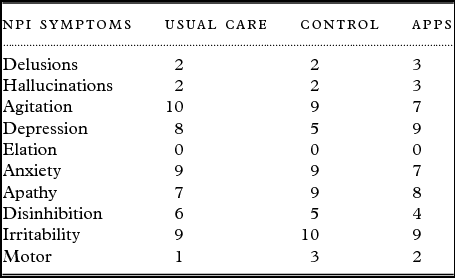
Table 2 lists the NPI symptoms, and the number of participants expressing these symptoms at each assessment. The most frequent symptoms were agitation, anxiety, apathy, and irritability.
Neuropsychiatric Inventory (NPI) symptoms (absolute frequency) expressed by participants at each assessment point

NPI: Neuropsychiatric Inventory; Control: after the control intervention; Apps: after the apps intervention.
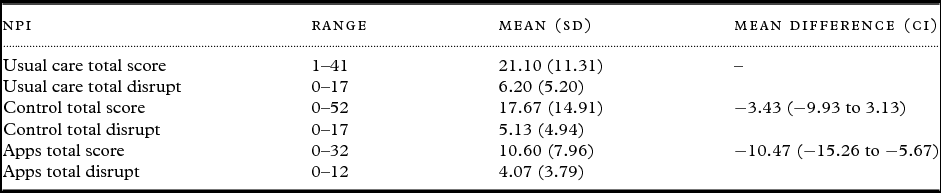
Table 3 shows the NPI scores across the three assessments. There was a significant decrease of the NPI Total score (Wilks lambda = 0.282, F (2,15) = 16.549, p < 0.0001, multivariate paired eta squared (ŋ2) 0.72), and Total Disrupt score for the control and apps intervention, compared to usual care. Post-hoc tests using the Bonferonni correction revealed that the apps intervention elicited a reduction in the NPI total score compared to the control intervention and usual care (p = 0.035 and p < 0.001, respectively). The decrease in Total Disrupt scores was not significant (p = 0.115).
Neuropsychiatric inventory (NPI) total score and total disrupt scores over the three assessment points

NPI: Neuropsychiatric Inventory; Control: assessment 1 (control intervention); Apps: assessment 2 (apps intervention); CI: confidence interval.
Analyzing individual symptom change across each assessment point was only performed using symptoms which had a higher number of participants expressing these symptoms. For example, at usual care, only two participants had delusions and hallucinations, so these symptoms were not analyzed. For agitation, there was a significant decrease of the NPI frequency times severity score at each assessment (usual care score 4.3 (SD 4.6), control intervention score 3.6 (SD 4.1), and apps intervention score 1.7 (SD 2.8)), Greenhouse Geisser correction F (1.42, 19.83) = 5.61, p = 0.019, multivariate paired ŋ2 0.29. Post-hoc tests using the Bonferonni correction revealed that the apps intervention elicited a significant reduction in the agitation score compared to the control intervention (p = 0.043) and with usual care (p = 0.004).
There was also a significant decrease in Anxiety frequency times severity scores from the control intervention to apps intervention (usual care score 3.1 (SD 3.4), control intervention 3.5 (SD 4.4), apps intervention 0.7 (SD 0.98)), Wilks lambda = 0.566, F (2, 13) = 4.986, p = 0.025, multivariate paired ŋ2 0.43. Post-hoc tests using the Bonferonni correction revealed that the apps intervention elicited a significant reduction in the Anxiety score compared to the control intervention (p = 0.043) and with usual care (p = 0.045).
There were no significant changes in any of the NPI individual symptom Disrupt scores.
Staff evaluation
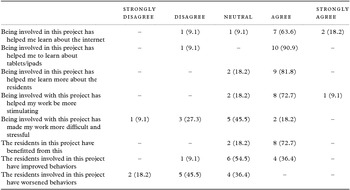
There were 11 female staff who completed the post-questionnaires (please see Table 4 for frequencies). Only half provided their age (mean 49.7 years (SD 8.2)). Ten agreed that the study helped them learn about iPads and apps. Nine (81.8%) agreed that the study helped them to learn more about the participants, and that their work had become more stimulating. In contrast, seven staff reported that work was more stressful. Four staff (36.4%) agreed that residents had improved behaviors overall, one disagreed, and the remainder (54.5%) were “neutral.” The staff also reported barriers, which included lack of confidence using the iPad itself (such as worry about “breaking” it and being unsure how to engage participants with apps). Positive comments included staff being surprised at how well the participants engaged with the iPad and apps but a negative comment from one staff member was that it was difficult to disengage the participant from the iPad and apps.
Results of staff questionnaire

% denotes percentages.
Discussion
This study is the first that we are aware of which investigated apps in managing challenging behaviors displayed by residents in RACFs, and results suggest that this may be a feasible strategy and have some benefits.
The first hypothesis was supported, in that compared to the control intervention and usual care, the apps intervention decreased the NPI total score suggesting that behaviors had reduced. However, because of the small sample size, testing which individual symptom best responded to the apps intervention was unable to be performed, though agitation and anxiety appeared to improve. The secondary outcome was related to staff acceptability of the apps intervention, and results suggested that staff found some benefits from using the iPads and apps (learnt about the internet, iPads, and more about the residents), but it was unclear whether they thought the apps intervention improved the residents’ behaviors.
Of interest, there were no significant decreases to any of the NPI Disrupt scores, which proposes that staff did not think that any of the interventions (control or apps) affected the time spent in managing behaviors. This finding is consistent with the evaluation. Staff indicated using the apps and iPads were beneficial for the participants, but they also found it time-consuming, and even stressful. Staff working in RACFs are often busy and may be “task-focused,” rather than “person-focused,” which may lead to less engagement with residents. Livingston et al. (Reference Livingston2014) hypothesized that changing staff culture may be one effective method in decreasing challenging behaviors.
It can be argued that because the staff were implementing both the control and apps interventions, it is unclear how rigorous the protocol was adhered to, and the mean durations of the control and apps intervention were lower than the 90 minutes which was initially planned, possibly implying that staff were busy with their other tasks and thus spending less time with the project in engaging the participants. Consistent with this, it is likely that staff may not have recorded their usage (frequency) accurately in the participant records.
Other limitations included the small sample size, the heterogeneous group of participants, and lack of randomization. It is also possible that the findings were due to the increased companionship and attention resulting from a research study, rather than the actual apps intervention (Livingston et al., Reference Livingston2014), though a control helped to mitigate this. The lack of blinding also meant that the potential for biased results could not be controlled for. Visitors to the RACF may have engaged participants using apps and iPads, which also meant that the control and apps interventions were not directly comparable with regard to duration and frequency. In addition, the sequence of using the apps after the control intervention may have also promoted greater benefits with the latter.
There have been multiple studies which have researched the effect of non-pharmacological strategies on challenging behaviors seen in people living in RACFs. One systematic review (O'connor et al., Reference O'connor, Ames, Gardner and King2009) reported that of the 25 studies included, aromatherapy, bed baths, and music were effective interventions. Individualizing therapies, such as music, was reported to be important. This study sought to engage people living in RACFs using a strategy which was also individualized and there has been scarce published concerning the use of TT in residents who have dementia and other psychiatric disorders. O'Connor and colleagues stated that many studies in this area are limited by small sample sizes, a range of clinical presentations, and lack of blinding. This study was also plagued by these issues.
Nevertheless, there were a number of strengths to this pilot study. Despite the disadvantages mentioned previously, having staff working in the RACF deliver the interventions was an asset as this was “real life.” Being able to engage residents is an important role of staff, and possibly some staff who were involved in the study may continue to use the iPads and apps to connect with the residents. This may ensure sustainability of the concept. The feedback demonstrated that staff learnt more about the participants and this personal information may lead to further positive interactions and improved relationships between staff and residents. Although there was feedback with regard to staff lack of confidence using the technology, Lim et al. (Reference Lim, Wallace, Luszcz and Reynolds2013) showed that informal caregivers who have minimal formal training using iPads and apps, and in dementia care, they were still able to successfully engage their loved ones.
Despite the shortcomings, results suggest that using apps which are consistent with individualized care, could be a useful and novel non-pharmacological strategy to manage challenging behaviors displayed by adults living in RACFs. Further research would involve more robust trials with larger sample sizes with interventions which are of a longer duration and increased frequency. Investigations using family members or volunteers with training and support might provide an alternative source of personnel to engage residents.
Conflict of interest
None.
Description of authors’ roles
S.M. Loi conceived and designed the project, assisted with data collection, performed the statistical analysis, and wrote the paper. A. Mazur, B. Hoy, and J. Swan implemented the project to participants and assisted with data collection. D. Huppert, B. Hoy, J. Swan, and N. Lautenschlager reviewed the paper and suggested changes. N.T. Lautenschlager supervised S.M. Loi.
Acknowledgments
The authors would like to acknowledge the staff and residents of the residential aged care facility where the study occurred. The project was funded by two sources: The Royal Melbourne Hospital Home Lottery grant and North West Mental Health seed funding.