In developed societies, people in homeless situation are one of the most obvious embodiments of the phenomenon of social exclusion (Vázquez, Panadero, Martín, & Díaz-Pescador, Reference Vázquez, Panadero, Martín and Díaz-Pescador2015). Homeless people not only live in extreme poverty, but also suffer from high levels of family and social disengagement, and have great difficulty in achieving social/employment reintegration, and significant health problems (Vázquez, Panadero & Zúñiga, Reference Vázquez, Panadero and Zúñiga2017a, Reference Vázquez, Panadero and Zúñiga2017b, Reference Vázquez, Panadero and Zúñiga2018). Women living homeless are in a particularly vulnerable subgroup among people in a homeless situation (Arangua, Andersen, & Gelberg, Reference Arangua, Andersen and Gelberg2005; Ryan et al., Reference Ryan, Stern, Hilton, Tucker, Kennedy, Golinelli and Wenzel2009), with characteristics, needs and life trajectories that are different from those of homeless men (Vázquez et al., Reference Vázquez, Panadero and Zúñiga2017a). Given that women living homeless in shelters or in the street account for a relatively small percentage of the population of homeless people in Spain (Muñoz, Vázquez, & Vázquez, Reference Muñoz, Vázquez and Vázquez2004; Panadero & Vázquez, Reference Panadero and Vázquez2016; Vázquez et al., Reference Vázquez, Panadero, Martín and Díaz-Pescador2015), hardly any research with a gender perspective focused specifically on them has been carried out.
Beyond Spain’s borders, various studies have examined the differences between homeless women and men. For example, several studies report that homeless women have a lower average age than homeless men, are more likely to be more accompanied by small children, and rarely sleep in the street (Marsapt, Reference Marsapt2000; North & Smith, Reference North and Smith1993). Various authors (Christensen & Vinther, Reference Christensen and Vinther2005; Marsapt, Reference Marsapt2000; North & Smith, Reference North and Smith1993; Piliavin, Wright, Mare, & Westerfelt, Reference Piliavin, Wright, Mare and Westerfelt1996; Zlotnick, Robertson, & Lahiff, Reference Zlotnick, Robertson and Lahiff1999) have pointed out that periods of homelessness are longer for men than women, while Christensen and Vinther (Reference Christensen and Vinther2005) report that men experience considerably more episodes of homelessness than women. In Madrid, 28% of the homeless people had been homeless between two and five times, and 14% more than five times (Roca, Panadero, Rodríguez, Martín, & Vázquez, Reference Roca, Panadero, Rodríguez, Martín and Vázquez2019). Unfortunately, suffering from multiple episodes of homelessness after having gained access to independent housing (the revolving door to homelessness) is an issue that is rarely addressed in the scientific literature (Ringwalt, Greene, Robertson, & McPheeters, Reference Ringwalt, Greene, Robertson and McPheeters1998), especially as regards homeless women.
Different circumstances that affect homeless people (e.g. poor education, difficult access to the labour market, state of health, excessive consumption of psychoactive substances, poor social support, etc.) may be vulnerability factors that potentially lead to them becoming and remaining homeless, and have different effects according to gender (Roca et al., Reference Roca, Panadero, Rodríguez, Martín and Vázquez2019). In relation to these issues, various studies carried out outside Spain show that compared to homeless men, homeless women have a higher level of education (e.g. North & Smith, Reference North and Smith1993), have had more unstable and lower-quality jobs during their lives (e.g. O’Grady & Gaetz, Reference O’Grady and Gaetz2004, Okamoto, Reference Okamoto2007), have a worse state of health (e.g. Arangua et al., Reference Arangua, Andersen and Gelberg2005; Wenzel, Leake, & Gelberg, Reference Wenzel, Leake and Gelberg2000) and are forced to overcome more barriers in order to access medical care (e.g. Gelberg, Browner, Lejano, & Arangua, Reference Gelberg, Browner, Lejano and Arangua2004; Lewis, Andersen, & Gelberg, Reference Lewis, Andersen and Gelberg2003), although they have fewer problems arising from excessive alcohol consumption (e.g. Christensen & Vinther, Reference Christensen and Vinther2005; Suarez, Berrios, Bonilla, & Vázquez, Reference Suarez, Berrios, Bonilla and Vázquez2018; North & Smith, Reference North and Smith1993; Vázquez, Berrios, Bonilla, & Suarez, Reference Vázquez, Berrios, Bonilla and Suarez2019). Furthermore, several studies have shown that there are no relevant differences among homeless people according to gender in terms of excessive drug use (e.g. Arangua et al., Reference Arangua, Andersen and Gelberg2005; Christensen & Vinther, Reference Christensen and Vinther2005; Robertson, Zlotnick, & Westerfelt, Reference Robertson, Zlotnick and Westerfelt1997) or reporting feelings of loneliness (e.g. Rokach, Reference Rokach2005).
In Madrid (Spain), various studies have found that the educational level of homeless people is lower than that of the general population (e.g. Leonori et al., Reference Leonori, Muñoz, Vázquez, Vázquez, Bravo, Nuche and Horenbek2000; Muñoz, et al., Reference Muñoz, Vázquez and Vázquez2004; Panadero & Vázquez, Reference Panadero and Vázquez2016), and they have extreme difficulty in accessing the labour market (e.g. Muñoz et al., Reference Muñoz, Vázquez and Vázquez2004; Panadero & Vázquez, Reference Panadero and Vázquez2016). The health of homeless people is also considerably worse than that of the general population (e.g. Leonori et al., Reference Leonori, Muñoz, Vázquez, Vázquez, Bravo, Nuche and Horenbek2000; Muñoz et al., Reference Muñoz, Vázquez and Vázquez2004; Panadero & Vázquez, Reference Panadero and Vázquez2016). While homeless people in Madrid tend to present very high levels of alcohol consumption (Panadero, Vázquez, & Martín, Reference Panadero, Vázquez and Martín2017), drug consumption does not appear to be as widespread in this group, despite being higher than the average for the Spanish population (Panadero & Vázquez, Reference Panadero and Vázquez2016). In addition, homeless people in Madrid have also been found to have little social support (e.g. Muñoz et al., Reference Muñoz, Vázquez and Vázquez2004; Panadero, Guillén, & Vázquez, Reference Panadero, Guillén and Vázquez2015; Panadero & Vázquez, Reference Panadero and Vázquez2016).
Although government agencies and service providers tend to consider women living homeless as being particularly vulnerable (Panadero & Vázquez, Reference Panadero and Vázquez2016), the specific scientific literature in Spain on women in a homeless situation is very limited, and no thorough research that specifically addresses the differences between homeless women and men has been published. This study aims to examine the existence of possible vulnerabilities in terms of characteristics, situation and needs, of women living homeless in Madrid (Spain) in regard to the domiciled population and according to gender.
Method
Participants
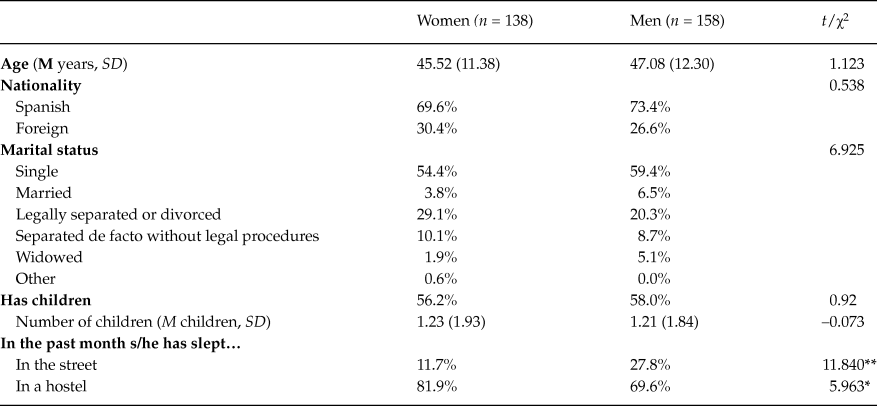
The study was carried out in Madrid (Spain) with a representative sample of homeless men (n = 158) and a sample of homeless women of a similar size (n = 138). Participants were all adults with enough knowledge of Spanish to understand the questions, who had spent the night before the interview in a shelter or other facility for homeless people, on the street or in other places not initially designed for sleeping: abandoned buildings, basements, metro stations, etc. The basic socio-demographic characteristics of the two samples and the usual locations where the interviewees spend the night are shown in Table 1.
Differences in Socio-demographic Characteristics and Places for Overnight Stays by Women and Men Living Homeless in Madrid

Note. *p ≤ .05. **p ≤ .01. ***p ≤ .001.
As shown in Table 1, both the homeless women and the homeless men had an average age of around 46 years, and most of them were Spanish, single or separated/divorced. More than half had children, with an average of 1.2 offspring. No statistically significant differences were observed between women and men in terms of age, marital status, nationality or having children. The interviewees who had been mothers had a mean of 2.18 children (SD = 1.300), and their first child had been born when the mother’s mean age was 21.8 years old (SD = 5.300). Differences in the place where women and men stayed overnight during the month prior to the interview were observed, as a larger percentage of women had slept in a shelter and a smaller percentage had spent the night in the street.
Procedure
The sample size of men in a homeless situation was determined beforehand, based on the available data for the total number of people living homeless in Madrid (Panadero & Vázquez, Reference Panadero and Vázquez2016). We designed a strategy for random sampling in the street and in all housing resources for homeless men in Madrid: The sample selection in the street was carried out randomly and proportionally, based on the number of homeless men sleeping on the streets of Madrid; and we selected a specific number of participants proportionately and randomly in each service, according to their capacity. Given the relatively small number of women living homeless in the street in or in shelters in Madrid, in order to access a sample of a similar size to the sample of homeless men we interviewed all the women who agreed to participate, both in care services for homeless women and on the street. The time period of conducting the interviews was eight months for the homeless men (November 2011 – June 2012) and one year for the homeless women (November 2014 – November 2015).
The participants were asked for their informed consent after receiving an explanation of the purpose of the research and the treatment that the data would receive, and they were assured that their anonymity would be respected. In view of the results obtained in previous studies (Muñoz et al., Reference Muñoz, Vázquez and Vázquez2004; Panadero & Vázquez, Reference Panadero and Vázquez2016), we assumed that a relatively high number of respondents could have a low or very low level of education, and that the number of people living homeless in Madrid of foreign origin - with potential difficulties with understanding the language - would be relatively high. As a result, a structured interview was used to gather information, which enabled us to circumvent the possible problems arising from the interviewees’ difficulties with reading and/or understanding. We used a structured interview with the choice of answers to the questions fixed (close-ended) in advance, though a few open-ended questions was also included which required very short answers. The interviews lasted between 45 and 80 minutes.
The database was developed and processed using the SPSS statistical analysis and data management system. When making comparisons, the Chi square (χ2) statistic was used for nominal variables, and the “Student t” test for independent samples was used for continuous variables.
Results
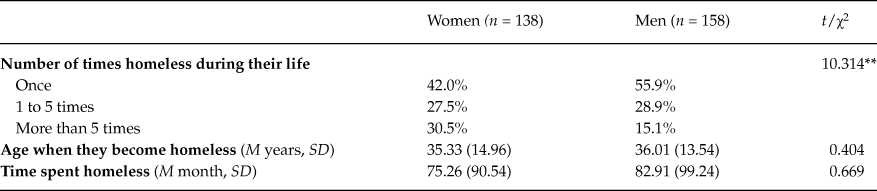
Table 2 shows that there are no statistically significant differences between women and men in terms of the age when they became homeless for the first time - which occurred at an average age of 35–36 years old in both cases, nor in the average time spent homeless, which was in on average more than six years both cases. However, differences were found in the number of episodes of homelessness during the interviewees’ lives, with women drifting in and out of homelessness more frequently: 56% of the homeless men had been homeless once, compared to 42% of the homeless women, while 30% of the homeless women had succumbed to and overcome homelessness more than 5 times, compared to 15% of the homeless men.
Differences in Time Spent Homeless, Number of Episodes of Homelessness and Age at which They Became Homeless for the First Time between Women and Men Living Homeless in Madrid

Note. *p ≤ .05. **p ≤ .01. ***p ≤ .001.
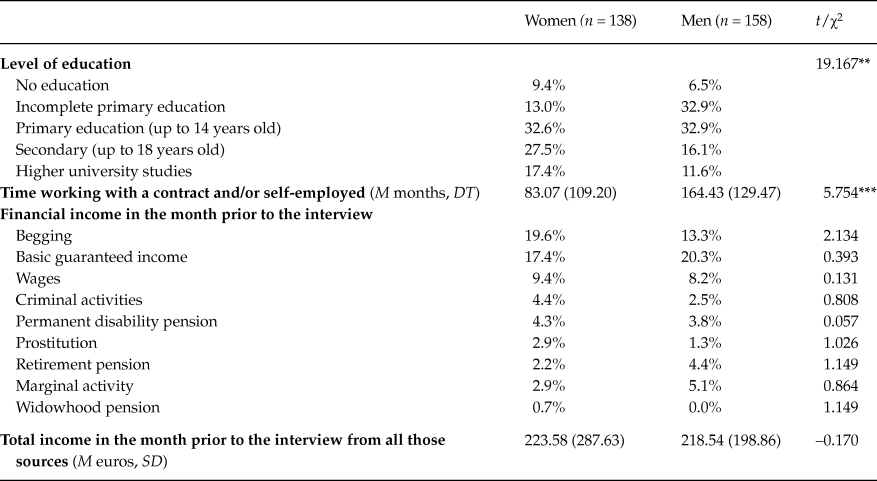
As can be seen from Table 3, there are differences between the women and men in terms of their level of education: Although the percentage of people with no education was similar in both groups, a larger percentage of males had not completed primary education, while more women had completed secondary or university education. However, despite the higher educational level among the women, they had had access to regulated employment for only half the time as the men had - an average of 7 years for the women, and 14 years for the men. No statistically significant differences according to gender were observed in terms of the main sources of income or the amount of money received by the interviewees, which was around 220 Euros per month on average. In both cases, the main sources of income were begging and the basic guaranteed income, while less than 10% earned income from some sort of employment.
Differences in Level of Education, Employment and Income between Women and Men Living Homeless in Madrid

Note. *p ≤ .05. **p ≤ .01. ***p ≤ .001.
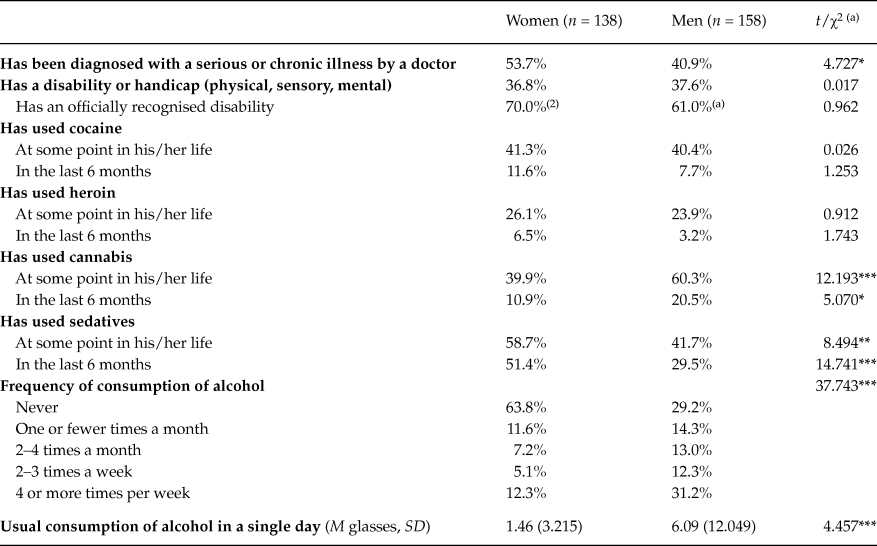
As can be seen in Table 4, more women than men had been diagnosed with a serious or chronic illness, although there were no statistically significant differences according to gender in terms of the perception of having a disability or the official recognition thereof. The most frequently consumed drugs by people living homeless in Madrid were cannabis, cocaine and particularly sedatives, with some differences observed in this respect according to the gender of the interviewees. In specific terms, the women reported a greater consumption of sedatives, both throughout their lives and in the six months prior to the interview, while the men reported a greater consumption of cannabis, both throughout their life and in the previous six months. No statistically significant differences were observed according to gender in terms of use of heroin and cocaine. The women reported a lower frequency of alcohol consumption, which is particularly striking among those that never consume alcohol (64% women vs. 29% men) and those that regularly consume it four or more times per week (12% women vs. 31% men). The women also had a much lower average level of daily alcohol consumption than the men.
Differences in Health and Consumption of Psychoactive Substances between Women and Men Living Homeless in Madrid

Note. (a) % of those with a disability
*p ≤ .05. **p ≤ .01. ***p ≤ .001.
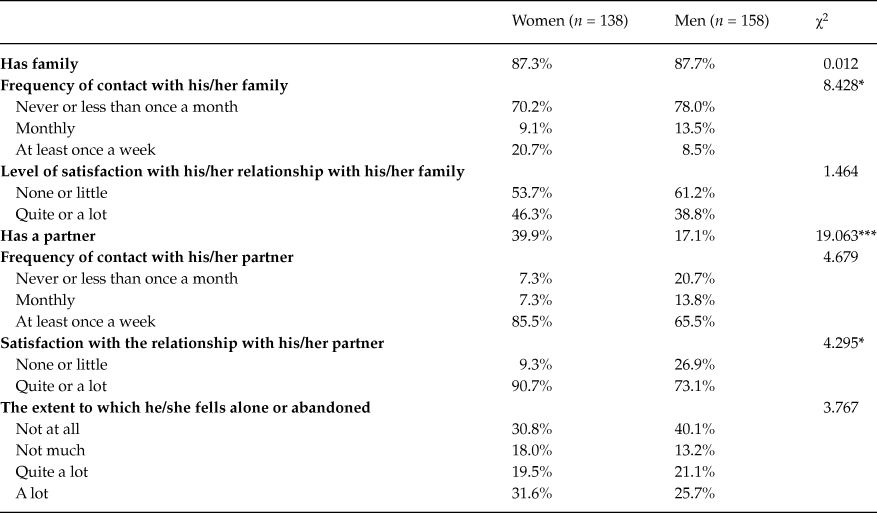
As can be seen in Table 5, no statistically significant differences were observed between women and men in terms of having a family, satisfaction with their family relationship, frequency of contact with their partner or the degree to which they felt alone or abandoned. However, the women said they were in contact with their family more often, and more of them had a partner, and they were more satisfied with their relationship than the men.
Differences in Social Support between Women and Men Living Homeless in Madrid

Note. *p ≤ .05. **p ≤ .01. ***p ≤ .001.
Discussion
The women and men living homeless interviewed in Madrid did not differ significantly in terms of their main socio-demographic characteristics (age, nationality, marital status or number of children), although the women spent the night in shelters more often and slept less in the street often. These data are consistent with those reported by authors including Marsapt (Reference Marsapt2000) and North and Smith (Reference North and Smith1993). This situation tends to be related to greater vulnerability among women (Arangua et al., Reference Arangua, Andersen and Gelberg2005; Ryan et al., Reference Ryan, Stern, Hilton, Tucker, Kennedy, Golinelli and Wenzel2009) and to the greater risk for them involved in spending the night in the street. The perception by the service providers of this greater vulnerability among women (Panadero & Vázquez, Reference Panadero and Vázquez2016) seems to facilitate them being given priority access to care facilities and mechanisms.
Although studies carried out in various cultural contexts have found that men remain homeless for longer periods of time (Christensen & Vinther, Reference Christensen and Vinther2005; Marsapt, Reference Marsapt2000; Piliavin et al., Reference Piliavin, Wright, Mare and Westerfelt1996; Zlotnick et al., Reference Zlotnick, Robertson and Lahiff1999), no significant differences were observed in this study for remaining homeless according to gender. Despite having become homeless for the first time at relatively advanced ages (around 35 years on average), the homeless people in Madrid were chronically homeless to a significant extent regardless of gender, having been homeless for more than six years on average. However, contrary to the observations by other authors (Christensen & Vinther, Reference Christensen and Vinther2005), the phenomenon of the "revolving door to homelessness" seems to affect women to a greater extent in Madrid. Many circumstances may lead individuals to suffer from repeated episodes of homelessness after gaining access to independent housing, although issues related to health, excessive alcohol consumption and experiencing stressful life events appear to be particularly influential (Aubry, Klodawsky, & Coulombe, Reference Aubry, Klodawsky and Coulombe2012; Caton et al., Reference Caton, Dominguez, Schanzer, Hasin, Shrout, Felix and Hsu2005; Dworsky, Napolitano, & Courtney, Reference Dworsky, Napolitano and Courtney2013; Greenberg & Rosenheck, Reference Greenberg and Rosenheck2010; Kim, Kertesz, Horton, Tibbetts, & Samet, Reference Kim, Kertesz, Horton, Tibbetts and Samet2006; Muñoz et al., Reference Muñoz, Vázquez and Vázquez2004; Parker, Reference Parker2010, Roca et al., Reference Roca, Panadero, Rodríguez, Martín and Vázquez2019). There are various explanations for homeless women in Madrid becoming homeless on more occasions than men. According to the model proposed by Roca et al. (Reference Roca, Panadero, Rodríguez, Martín and Vázquez2019), suffering from serious or chronic illness (observed to a greater extent among women) has a negative effect on the "revolving door to homelessness," mediated by a negative perception of one’s own health, which is in turn mediated by suffering from disability. Homeless women with a serious illness and/or a disability may have a limited ability to function, which leads to increased care needs and greater dependence on others (Parker, Reference Parker2010). The low levels of social and family support available to homeless women hinder their access to the care required to deal with illness and disability, which increases their chances of repeatedly becoming homeless. Furthermore, idiosyncratic issues in Spanish culture could lead to women suffering from repeated episodes of homelessness, such as the perception of women as deserving of special help and protection (Panadero & Vázquez, Reference Panadero and Vázquez2016). Accordingly, homeless women sometimes overcome homelessness by going to live with family or friends, establishing a relationship with a new partner, finding employment that provides accommodation, e.g. domestic service, gaining access to temporary income that allows them to pay for temporary accommodation, etc. However, in many cases, problems in their relationships with their relatives or friends, suffering from intimate partner violence or the breakdown of the relationship, the loss of employment or the loss of temporary income can make these women homeless once again.
The educational level of women living homeless is lower than that of the domiciled women, so that 38.9% of Spanish women between 25 and 64 years old had university studies (Instituto Nacional de Estadística [Statistics National Institute] INE, 2018) versus 17.4% of the women living homeless. Although they have a higher level of education than homeless men, homeless women in Madrid face more difficulties in both gaining access to the labour market and keeping their job, to the extent where they have on average worked for half the time worked by the homeless men. It should be noted that more than half of the women living homeless interviewed in Madrid were mothers with an average of 2.2 children, this could have had an impact on the shortest time of work activity observed among women living homeless. This situation does not only seem to affect women living homeless in Spain, since studies carried out in various countries (e.g. USA, England, Japan, Canada) have also found that homeless women tend to have a higher level of education but have worse jobs, which more unstable and of poorer quality than those of homeless men (North & Smith, Reference North and Smith1993; O’Grady & Gaetz, Reference O’Grady and Gaetz2004; Okamoto, Reference Okamoto2007). Among the homeless women, their academic background does not seem to be a factor protecting them from homelessness, and the serious difficulties they encounter in accessing the labour market can be a major handicap with a potential negative impact on becoming or remaining homeless and/or suffering from the revolving door to homelessness. Although differences between homeless women and men have been noted in terms of their academic background and employment history, once they have become homeless there are no differences according to gender in terms of sources of income or money they have access to. Among both homeless women and men in Madrid, the main sources of income were begging and the basic guaranteed income - although 10% obtained income from employment, and they earned a monthly average of around 220 Euros, an insufficient amount to be able to live decently in the city of Madrid.
The percentage of women living homeless with disabilities (36.8%) is four times higher than that of women in the Spanish general population (10.6%) (INE, 2018) and, while 8.5% of women domiciled indicated having a “bad” or “very bad” health status, the women living homeless with serious or chronically illnesses diagnosed accounted for 53.7% (INE, 2018). There are no significant differences according to gender among people living homeless in Madrid as regards disability. However, as observed in other countries (Arangua et al., Reference Arangua, Andersen and Gelberg2005; Wenzel et al., Reference Wenzel, Leake and Gelberg2000), homeless women in Madrid presented a poorer state of health, suffering from serious or chronic illness to a greater extent than homeless men. Authors including Gelberg et al. (Reference Gelberg, Browner, Lejano and Arangua2004) and Lewis et al. (Reference Lewis, Andersen and Gelberg2003) point out that homeless women also face more barriers to access medical care.
The psychoactive substances most commonly consumed by people living homeless in Madrid were cannabis, cocaine and above all, sedatives. It is noted that the consumption of psychoactive substances by women living homeless was much higher than that of Spanish domiciled women. Among the latter group 7.8% of women had used hypnosedatives, 2.5% cannabis and 0.4% cocaine during the year prior to the interview (Observatorio Español de las Drogas y las Adicciones [Spanish Observatory of Drugs and Addictions] OEDA, 2018). However, there are no gender differences among homeless people in Madrid for the use of heroin and cocaine, which is consistent with the reports in other contexts by Arangua et al., (Reference Arangua, Andersen and Gelberg2005), Christensen and Vinther (Reference Christensen and Vinther2005) and Robertson et al. (Reference Robertson, Zlotnick and Westerfelt1997). Meanwhile, cannabis was consumed by a larger percentage of men among people living homeless in Madrid, while sedatives were consumed by women to a much greater extent, and more than half of them consumed these substances on a regular basis. The high consumption of sedatives among homeless women could be related to their poorer state of health, and a strong tendency among health professionals to prescribe this type of drug to homeless women (Panadero & Vázquez, Reference Panadero and Vázquez2016). Finally, it should be noted that as in studies carried out in various cultural contexts (e.g. Christensen & Vinther, Reference Christensen and Vinther2005; Suarez et al., Reference Suarez, Berrios, Bonilla and Vázquez2018; North & Smith, Reference North and Smith1993; Vázquez et al., Reference Vázquez, Berrios, Bonilla and Suarez2019), homeless women in Madrid presented a lower rate of alcohol consumption than homeless men, with a high percentage of non-consumers and a relatively low percentage of habitual consumers of alcohol.
Suffering from chronic illnesses, disability and addiction problems can greatly hinder homeless people’s ability to access the labour market, and prevent them from keeping a job, which has a very negative impact on their homelessness becoming chronic (Vázquez et al., Reference Vázquez, Panadero and Zúñiga2017a, Reference Vázquez, Panadero and Zúñiga2018). Likewise, people in a homeless situation with serious illnesses, disabilities or addiction problems may have a limited general functional capacity, which would lead to an increase in their needs for care and greater dependence on other people (Parker, Reference Parker2010). The low levels of social and family support available to people living homeless (Hwang et al., Reference Hwang, Ueng, Chiu, Kiss, Tolomiczenko, Cowan and Redelmeier2010) prevent them from accessing the care they need, which increases their likelihood of becoming homeless and suffering from the revolving door to homelessness to a greater extent.
A large percentage of people living homeless in Madrid reported feelings of loneliness or abandonment, although as in the results of the study by Rokach (Reference Rokach2005), no differences in loneliness according to the gender of the interviewees were observed. Despite stereotypes to the contrary (Vázquez et al., Reference Vázquez, Panadero and Zúñiga2017b), Bates and Toro (Reference Bates and Toro1999) point out that most homeless people are in regular contact with family. The vast majority of people living homeless in Madrid reported having a family, although they were dissatisfied with their family relationships to a large extent. The homeless women reported having particularly frequent contact with their relatives, which was at least weekly in a high percentage of cases. This regular contact with the family could be a facilitating factor for social inclusion processes, although in the opinion of Bates and Toro (Reference Bates and Toro1999), the homeless person’s contact with their family may not always be positive. Meanwhile, 40% of the homeless women in Madrid said they had a partner. This percentage was that double that of homeless men with a partner. Although partner relationships among homeless women have sometimes been interpreted as a means of obtaining protection in hostile environments (e.g. Panadero & Vázquez, Reference Panadero and Vázquez2016; Ryan et al., Reference Ryan, Stern, Hilton, Tucker, Kennedy, Golinelli and Wenzel2009), most of the women interviewed in Madrid (a much higher percentage than the men) were very satisfied with their relationship.
Tucker et al. (Reference Tucker, Kennedy, Ryan, Wenzel, Golinelli, Zazzali and McCarty2009) point out that most women in a homeless situation reported having relationships that could be characterized as both "low risk" (e.g., involving individuals perceived as not drinking heavily, using drugs, or engaging in risky sex) and "high quality" (e.g., long-term, emotionally close, or supportive), although these relationships tended to be rather tenuous. Nyamathi, Leake, Keenan, and Gelberg (Reference Nyamathi, Leake, Keenan and Gelberg2000) observed that compared with those who have little or no support, homeless women whose support included substance non-users reported better psychosocial profiles and somewhat greater use of health services. Since as Meadows-Oliver (Reference Meadows-Oliver2005) points out, homeless women feel estranged from sources of support, it would be important to strengthen their social networks and support their positive relationships, in order to improve their quality of life and reinforce their processes of inclusion. It would be positive to provide spaces and organise activities that facilitate the creation and development of “low risk” and “high quality” relationships (Tucker et al., Reference Tucker, Kennedy, Ryan, Wenzel, Golinelli, Zazzali and McCarty2009).
One of the main limitations of this study is that although it is based on a representative sample of homeless men in Madrid, it is impossible to guarantee the representativeness of the sample of homeless women. Furthermore, this is a cross-sectional study design, and as such caution must be exercised when trying to establish causal relationships. It should also be noted that we used a structured interview with closed response options and a few open-ended questions which required very short answers, but no qualitative data was collected. Finally, the study is limited to Madrid, Spain, which means that it is difficult to generalise the results to other contexts.
The results obtained show that women living homeless are highly vulnerable compared to the domiciled population and, in some respects (such as a greater “revolving door” to homelessness, lower working life, more serious or chronic illness, greater consumption of sedatives), to homeless men as well. Nevertheless it is observed that women living homeless show, in some aspects, greater strengths than homeless men (women have better academic training, lower consumption of cannabis and alcohol, greater contact with the family, more satisfying couple relationships…). Such strengths could be relevant points of support in their social inclusion processes. The analysis of issues that differentiate women in a homeless situation from their male counterparts could be useful for developing public policies and care resources adapted to the specific characteristics and needs of women living homeless.