
Introduction
During the Middle Iron Age of the early first millennium BC, the Neo-Assyrian Empire pushed into south-eastern Anatolia. This region, which encompasses the upper Euphrates and Tigris River valleys and the Taurus Mountains, was home to Luwian- and Aramaic-speaking groups. Neo-Assyrian kings reduced the rulers of these city-states to vassal status, eventually converting the kingdoms into provinces. Control of the region was, in part, negotiated through material culture and, especially, the use of Assyrian court style as an expression of power. One medium for this style was the carving of monumental rock reliefs, although known Neo-Assyrian examples are rare. A newly discovered rock wall panel, located in a subterranean complex at Başbük near Siverek (Şanlıurfa province) in south-eastern Turkey, is the first known example of a Neo-Assyrian-period rock relief with Aramaic inscriptions, featuring unique, regional iconographic variations and Aramean religious themes. Here, we report on the discovery of this relief and associated inscriptions, providing an interpretation set within the wider cultural milieu of the Neo-Assyrian Empire.
Background
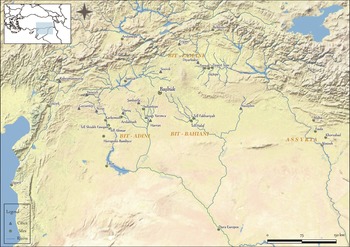
Between c. 900 and 600 BC, the Neo-Assyrian Empire expanded in south-eastern Anatolia, a region occupied by a long-standing cultural fusion of Luwian- and Aramean-speaking populations loyal to regional city-state dynasties (Lawson-Younger, Jr. Reference Lawson-Younger2016; Osborne Reference Osborne2021). This period of the Middle Iron Age is characterised by the arrival of Assyrian- and Urartian-style ceramics and the development of Assyrian-dominated urban centres, such as Ziyaret Tepe, Üçtepe, Pornak and Diyarbakır/Amedi in the Upper Tigris, and Harran and Sultantepe along the Euphrates, accompanied by a network of smaller settlements (Matney Reference Matney, Steadman and McMahon2011: 450–53). King Assurnaṣirpal II (883–859 BC) established Neo-Assyrian rule over the Aramean city-states of Bit-Bahiani (capital Gozan) in the Khabur region, and Bit-Zamani in the Upper Tigris. Their Aramean kings served as vassals under Assurnaṣirpal II and his successor Shalmaneser III (859–824 BC). Assurnaṣirpal II and Shalmaneser III converted the region into the provinces of Guzana (by 866 BC) and Amedi (in 856 BC). Bit Adini in the Upper Euphrates was conquered and converted into a province in 856 BC (Radner Reference Radner2006: 49–51). Melid (also known as Arslantepe), Kummuh (Samsat) and Karkemish survived as vassal states of Assyria until their conversion into provinces during the rule of Sargon II (721–705 BC). The city of Harran was separated into its own province by 685 BC, during the rule of Sennacherib (705–681 BC) (Radner Reference Radner2006: 55). Assyrian control of south-eastern Anatolia continued until 610 BC, when Harran, their last stronghold, fell to the Babylonian-Median coalition (Holloway Reference Holloway2002: 418).
Throughout their rule, the Assyrians controlled vassals and provinces, in part, through the spread and adaptation of a shared elite or court style, a form of cultural negotiation through which social and religious authority was expressed (Gerlach Reference Gerlach and Bunnens2000; Rehm Reference Rehm2014; Wicke Reference Wicke, Rollinger and van Dongen2015: 573–86; Köroğlu Reference Köroğlu, Köroğlu and Adalı2018). Features of this court style were adopted in an Assyrian provincial style by Assyrian representatives and the local elite (Wicke Reference Wicke, Rollinger and van Dongen2015: 563–66). During the ninth and early eighth centuries BC, both the Assyrian officials (known as magnates) and the Aramean vassal kings sought to enhance their own power by combining the Assyrian court style with elements drawn from local, Aramean visual and written traditions. A well-known example of this cultural negotiation between Assyrian Aramean expressions of power is the ninth-century BC statue from Tell Fakhariyah—with a bilingual Aramaic-Akkadian inscription—of an Aramean governor, Hadd-yit‘i, who served Assyria (Osborne Reference Osborne2021: 143–46).
The rock panel at Başbük
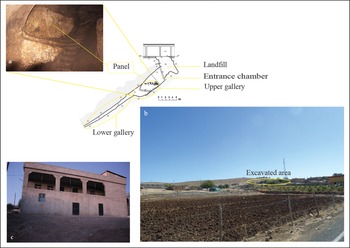
In 2017, a rock-incised panel was discovered in a subterranean complex beneath a two-storey house in the centre of the village of Başbük (Figure 1). Criminal investigations by the authorities discovered an artificial opening, 2.23 × 1.50m, cut by looters through the paved ground floor of the house. A rescue excavation in 2018 accessed the opening, identifying an entrance chamber carved into the limestone bedrock (Uludağ et al. Reference Uludağ, Koyuncu and Ergin2018). This chamber led into the upper gallery via a long, descending staircase. Erosion had filled the subterranean spaces with sediment, some of which was removed, revealing the wall panel (Figure 2). Following two months of excavation in 2018, investigations were halted due to the instability of the site, which is now under the legal protection of Turkey's Ministry of Culture and Tourism. Excavations will resume after the site is made safe.
Map showing the major sites and places mentioned in the text (figure by E. Sökmen using QGIS v.3.18.1, with an Esri physical map).

a) The 2018 vertical ground plan of the subterranean Başbük complex (plan by Cevher Mimarlık, based on laser scanning; photograph by C. Uludağ); b) view of Başbük from the west; c) two-storey house above the excavated area at Başbük (photographs B–C by M. Önal).

The complex consists of a series of spaces carved into the bedrock (Figure 2). Access into the entrance chamber was made through the artificial opening, followed by a 2.55m descent through naturally built-up sediment (‘landfill’ on Figure 2). Future excavations could reveal the original entrance. The current artificial opening leads into the entrance chamber, which is 3.15m wide and 4.30m high. This leads into the upper gallery, which measures 8.50m wide and 5m high. On the west wall of this upper gallery is a 6 × 2.50m rock face that is carved and smoothed into a concave form to a maximum depth of 0.70m. It is on this rock face that the 3.96m-long panel is located. Eleven steps carved into the bedrock inside the upper gallery, each 0.40m wide and 0.30m high, and set at approximately 45◦, descend towards the lower gallery. The lower gallery could only be recorded for a distance of 31.50m due to accumulation of sediment.
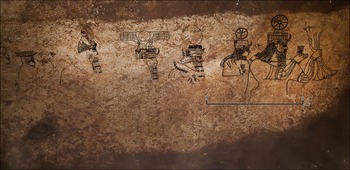
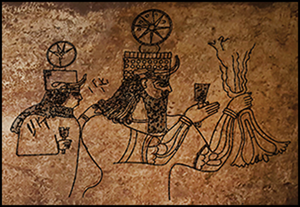
The rock panel in the upper gallery is carved in an Assyrianised style and depicts eight members of the Aramean pantheon in procession. Aramaic inscriptions accompany the three figures on the right-hand side. The outlines of the figures were first incised to a depth of 1mm and then painted in black. During recording, lighting conditions allowed for only limited digital photography and the illustrations accompanying this article are therefore based on the excavators’ first-hand observations (Figures 3 & 4). The human figures are all represented in profile, facing right (north), depicting half-body, bust or head only. The figures’ heads measure approximately 0.60m in height; the largest of the figures—the male deity leading the procession—is 1.10m in height.
The Başbük divine procession panel with superimposed interpretative figure drawings (photograph by M. Önal; interpretative drawings by M. Önal, based on laser scan by Cevher Mimarlık).

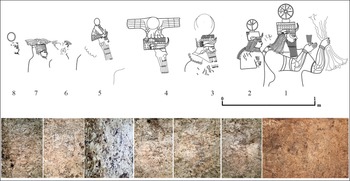
Interpretative drawings of the divine procession scene at Başbük (above) with photographs of the figures (below) (photographs by Y. Koyuncu and M. Önal; interpretative drawings by M. Önal, based on laser scan by Cevher Mimarlık).

The Başbük panel: description and stylistic analysis
From right to left, the Başbük procession scene begins with the leading male deity, Adad (or Hadad) (Figure 4: 1), depicted in the ‘storm-god’ tradition of northern Syrian and south-eastern Anatolian iconography—recognisable from his triple lightning fork and circled star (Börker-Klähn Reference Börker-Klähn1982: 225; Ornan Reference Ornan2005: 100). He is emphasised in the scene by being shown at a larger scale than the other figures. The lightning fork, bracelet and double-horned cylindrical headgear with short vertical lines resemble the depiction of Adad on the Arslantaş Stela of Tiglath-pileser III (Börker-Klähn Reference Börker-Klähn1982: 225 & pl. 250) and the Turlu stela at Nizip/Gaziantep (Köroğlu Reference Köroğlu, Köroğlu and Adalı2018: 172 & fig. 7b). The latter dates to before the seventh century BC, perhaps to the time of Sargon II or earlier (Balcıoğlu & Mayer Reference Balcioğlu and Mayer2006), especially given that the hair is at an angle over the shoulders (Sevin Reference Sevin2010: 109–10; Köroğlu Reference Köroğlu, Köroğlu and Adalı2018: 171–72). The Başbük representation of Adad differs from that on the Turlu stela in that he is shown with long, straight hair, a two-layered beard, and star-crowned headgear instead of a rosette. Assyrian iconography used the star and rosette interchangeably (Ornan Reference Ornan2005: 151). The rosette used for a male deity on the Turlu stela has also been used for female deities (Albenda Reference Albenda2005: 90).
The artist at Başbük provided the storm god with an Ištar-type goddess consort (Figure 4: 2). She wears a double-horned, cylindrical polos (crown), on which a star is set, with three points still visible. The star and polos resemble those worn by Ištar of Arbela at Til Barsip and other depictions of Istar-type goddesses (Börker-Klähn Reference Börker-Klähn1982: 225–26, pls 250 & 252; Sevin Reference Sevin2010: 111 & fig. 133; Ornan Reference Ornan2005: 151–52). Iconography alone cannot provide a specific identification because attributes of the storm god and Ištar-type goddesses were also given to local deities, who were named after the major Assyrio-Babylonian deities, sometimes along with their localities as geographical epithets (Porter Reference Porter and Porter2000: 236; Schwemer Reference Schwemer2008; MacGinnis Reference MacGinnis, Finkel and Simpson2020: 107).
Depicted behind the Başbük Ištar-type goddess is a deity (Figure 4: 3) whose headgear is crowned by a crescent and full moon. The crescent suggests that this is the moon god Sîn of Harran (Börker-Klähn Reference Börker-Klähn1982: 222; Kulakoğlu Reference Kulakoğlu and Erkanal-Öktü2006: 516; Köroğlu Reference Köroğlu, Köroğlu and Adalı2018: 174–77), whose cult was recognised throughout northern Syria and south-eastern Anatolia (Holloway Reference Holloway2002: 388–425). Following the Sîn figure stands the sun-god, Šamaš (Figure 4: 4), identified by his winged sun-disc crown (Ornan Reference Ornan2005: 64).
The remaining four deities cannot be clearly identified. One wears double-horned and conical headgear crowned with a circle (Figure 4: 5), recalling that of the deity Karhuha depicted at Karkemish and Zincirli (Hawkins Reference Hawkins1972: 95; Bonatz Reference Bonatz and Niehr2014: 212), where he is identified by his shield and spear. The deity at Başbük does not carry these accoutrements and remains unidentified. Behind him, the heads of two female figures (Figure 4: 6–7) are visible. On the first, two tresses of hair fall to the front and back of the head. A circular object (the outline of a necklace?) appears on the right shoulder. A second female head is shown along with the outline of her back. Three long tresses fall to the front and back of her headdress, reaching the nape of her neck. The polos is an extension of her garment. The ensemble resembles depictions of the goddess Kubaba and her priestesses on orthostats from Karkemish (Woolley Reference Woolley1921: pl. B19). The tips of tresses resemble the ends of the Başbük storm-god's lightning fork, perhaps suggesting that the goddess had lightning symbolism. The face of a final figure (Figure 4: 8) is mostly preserved, and the polos is crowned with a large, double-lined circle. The line of a garment or necklace hints at a female figure, or, alternatively, if the double-lined circle represents an astral entity, the figure may be a lunar deity. The new moon was associated with Nusku, the son of Sîn (Green Reference Green1992: 70). Since Başbük is in the Harran region, this figure may, perhaps, equate with the Harranean ‘Sarmas’ (another name for Nusku), named alongside his father Sîn, ‘the moon-god of Harran’, according to an eighth-century BC Luwian text from Kululu in central Anatolia (Hawkins Reference Hawkins2000: 486; Holloway Reference Holloway2002: 397).
The curved nose, emphasised eyebrows, prominent and almond-shaped eyes, the shape of the ears (wide above and narrow below), and the flat faces and rounded cheeks of the female deities are features of Assyrian-style figures (Orthmann Reference Orthmann1971: 149). The beards of the male deities, fashioned in a horizontal and sectioned style, recall depictions of the rulers Assurnaṣirpal II and Shalmaneser III, who are portrayed with beards and wavy hair down to their shoulders on the Kurkh stelae (Köroğlu Reference Köroğlu, Köroğlu and Adalı2018: 169, fig. 5b, 171 & fig. 6b) in Üçtepe and the Kenk Boğazı relief (Köroğlu Reference Köroğlu, Köroğlu and Adalı2018: 182 & fig. 15b) near Yavuzeli/Gaziantep, both in Turkey. The shoulder-length, curled hair on the Başbük image differs from that shown parallel to the ground on figures from Faida (Simi Reference Simi2020: fig. 4) and Maltai (Börker-Klähn Reference Börker-Klähn1982: 210 & pl. 207), both in Iraq, in that it more closely resembles the hair depicted in wall paintings at the palace of Til Barsip in Syria (Thureau-Dangin & Dunand Reference Thureau-Dangin, Dunand, Carvo and Dossin1936: pl. XLVII a–c). From the time of the reign of Sargon II and the creation of art at the Dur-Šarrukin Palace (Khorsabad), depictions tend to show hair curling horizontally on the shoulders, replacing the curved, obliquely draped curls with more angular ones (Albenda Reference Albenda1986: pl. 70; Sevin Reference Sevin2010: 145). The near-linear drawing of arm muscles in the Assyrian palace style, as in the Dur-Šarrukin Palace (Sevin Reference Sevin2010: 147), differs from the thin, multiple curved lines representing muscles at Başbük, which more closely resemble the muscles defined with curved lines on figures at the Til Barsip Palace (Sevin Reference Sevin2010: 103 & fig. 121).
The Başbük headgear is in the Syro-Anatolian style and differs from the Neo-Assyrian headgear of deities of the Sargonid period (721–705 BC). The horned headgear depicted at Maltai is cylindrical and taller than the Başbük headdresses. The goddesses’ headdresses at Başbük recall the cylindrical headdresses worn by figures of the goddesses Kubaba and Hebat at Karkemish (Hawkins Reference Hawkins1972: fig. 4: B38–40) and Zincirli (von Luschan Reference von Luschan1902: tabs. 28, 40 & 41, 1911: 325 & fig. 236), which are in the Syro-Anatolian style (Cornelius Reference Cornelius2012: 16). Necklaces worn by the second and seventh figures at Başbük are in the Syro-Anatolian style, as exemplified by the late ninth-/early eighth-century BC Ördekburnu stela, found near Zincirli (von Luschan Reference von Luschan1911: 325 & fig. 236; Lemaire & Sass Reference Lemaire and Sass2013: 73, 126 & fig. 16).
Aramaic inscriptions and the predecessor of the divine couple Hadad and Atargatis
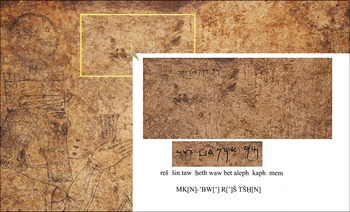
Three short sinistroverse (i.e. read right to left) Aramaic inscriptions referring to the three leading deities in the Başbük procession are found in the space between the storm god and his Ištar-type consort goddess, on the right shoulder of the goddess, and on the right shoulder of the moon god Sîn. A longer Aramaic text, carved on the rock surface to the right of the storm god's headgear (Figure 5), remains largely illegible. The eponym ‘Mukīn-abūa of Tušhan’ (the name in the eponym is transliterated in Akkadian as mMukīn-abu-u-a; Millard Reference Millard1994: 58 & 101) can be tentatively read as MK[N]-’BW[’] R[']Š TŠḤ[N], or ‘Mukīn-abūa the head (re’š) of Tušhan’ (Figure 5), with the omission of the final nun letters and an initial taw letter for Tušhan resembling a rare taw letter form also found in the archive at Ma‘lana (for the taw, see Lipińsky Reference Lipińsky2010: 196). Mukīn-abūa was the Assyrian official in charge of the provincial capital of Tušhan who campaigned against the city of Der in 794 BC. If the Başbük reading is accurate, once renewed access to the site becomes possible and the rest of the inscription is recorded, it may confirm that Mukīn-abūa was granted extensive territory in the province during the rule of Adad-nirari III (811–783 BC), a period when officials exercised power and interacted with Aramean traditions. Mukīn-abūa's influence would be expressed by the mention of his name in association with local Aramean deities at Başbük, and with a local title of ‘head’ (re’š) of Tušhan.
The Aramaic text to the right of the storm god's headgear (based on Figure 3 and prepared by S.F. Adalı).

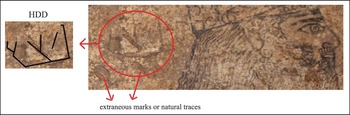
Preliminary readings of the short Aramaic inscriptions accompanying the first three figures in the procession at Başbük help identify them as regional Aramean deities. We use palaeographic letter form comparison with the closest forms known from other Middle Iron Age Aramaic texts in south-western Anatolia. The Aramaic inscription between the storm god and his consort indicates that the name of the leading deity is HDD/Hadad (Figure 6). The he and daleth letter forms compare with those on a clay docket from Marqasi (Kahramanmaraş) and on clay tablets from Tell Shiukh Fawqani (Fales et al. Reference Fales, Radner, Pappi, Attardo and Fales2005: 652, Tablet 45: reverse 2’ and 4’; Fales Reference Fales2019: 54). The tail of the letter he joins the lower part of the letter daleth, followed by another daleth with only a slightly different inclination, giving the deity's name. While the first consonant is not clearly visible, there are no obvious features that would suggest an alternative reading. The iconography also supports the conclusion that this is the storm god Hadad. The name for the deity dominated Aramean Syria and Upper Mesopotamia in the first millennium BC, and was represented in Aramaic writing as HD, D and HDD (Schwemer Reference Schwemer2008: 160).
Short Aramaic text for Hadad (based on Figure 3 and prepared by S.F. Adalı).

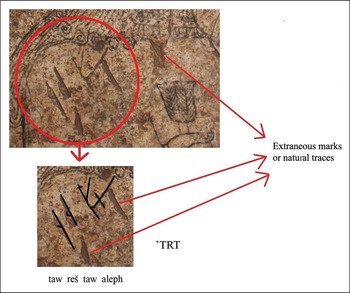
The Aramaic inscription on the shoulder of Hadad's consort reads as ’TRT (Figure 7). The Aramaic letter aleph, with an attached double-edged letter taw (cf. Fales et al. Reference Fales, Radner, Pappi, Attardo and Fales2005: 652, Tablet 45: reverse 2’ and 663, Tablet 53: Face B 2’), is followed by the letter reš, recognised from its curl (for such curls see, for example, Fales et al. Reference Fales, Radner, Pappi, Attardo and Fales2005: 660, Tablet 48: obverse 2’). The taw seen after reš is problematic and could be likened to a reš. A left-edged letter taw, however, is known from Tell Shiukh Fawqani (Fales et al. Reference Fales, Radner, Pappi, Attardo and Fales2005: 653, Tablet 46: obverse 3). The line attached at the bottom right of the initial aleph letter could be part of a letter mem. This would not, however, produce a reading (for example without a letter lamed or a final sin, one cannot read the name ‘Mulissu’). The line resembles other nearby extraneous marks (Figure 6). The reading of ’TRT/’Attar‘ata agrees with the Ištar-type iconography of the figure of Hadad's consort. It appears to be an earlier variant of the name of the goddess known in Syriac as ’Attar‘attē (’TR‘T’) in epigraphic texts from Hatra (first century BC to third century AD; Beyer Reference Beyer1998: 29, 36, 142–43 & 152) and (A)tar‘ata (ܬܪܥܬܐ) in Bardasian of Edessa's (AD 154–222) Book of the laws of the countries, which was distributed from the third century AD onwards (Bakker Reference Bakker2011: 46). The goddess name ‘Athtart/‘Ashtart found in Late Bronze Age texts from Ugarit (Ras Shamra) and Emar (Tell Meskene) (Smith Reference Smith and Sugimoto2014) may provide a precedent for the name inscribed at Başbük, as a Syrian offshoot of the Ištar-goddess tradition.
Short Aramaic text for ’Attar‘ata (based on Figure 3 and prepared by S.F. Adalı).

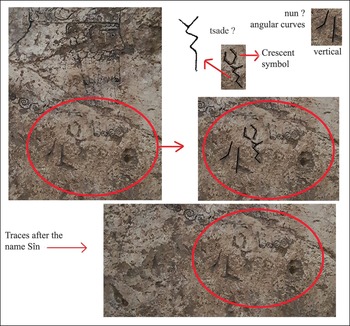
An archaic tsade letter form, crowned with a crescent that commonly represents the god Sîn in Harran (Ornan Reference Ornan2005: 140), appears on the moon god's chest. The archaic tsade letter form is known from the ninth-century BC inscription from Tell Fakhariyah and assumes an emphatic sibilant (ṣ) value inferred from its Akkadian-Aramaic bilingual context (Abou-Assaf et al. Reference Abou-Assaf, Bourdreuil and Millard1982: 94, 123 (line 5) & 124). This allows a reading of Ṣ(YN), Ṣ(’)—an Aramaic variant of Sîn is Se’ (Fales et al Reference Fales, Radner, Pappi, Attardo and Fales2005: 622)—or Ṣ(Y)N if there is a nun letter after the initial letter (Figure 8). Tsade is usually a dental fricative (a consonant pronounced with the tip of the tongue against the teeth) in tenth- to eighth-century BC Aramaic texts (Degen Reference Degen1969: 36), but its exact pronunciation is unclear. One may wonder whether the form resembling an archaic form of the letter tsade is instead an ornament accompanying the crescent that denotes the moon god. Stelae from Aşağı Yarımca (between Harran and Sultantepe) and Sultantepe present the crescent-on-a-pole motif (Köroğlu Reference Köroğlu, Köroğlu and Adalı2018: 175 & figs. 9–10), the symbol of the moon god (Ornan Reference Ornan2005: 163–67), although the pole is straight and unlike the zigzag tsade. The problematic form following tsade could represent the components of the nun letter form, as documented in a docket from Kahramanmaraş (Fales Reference Fales2019: 55), although its angular curves and vertical body are separated at Başbük. The more usual nun forms from Tell Shiukh Fawqani have an oval extension attached to the vertical line (Fales et al. Reference Fales, Radner, Pappi, Attardo and Fales2005: 653). The diagonal form below the vertical line at Başbük is difficult to understand. It could be an ornament, or an extraneous mark, or an error. The faint traces after Sîn's name are illegible. The crescent symbol above the figure identifies it beyond doubt as belonging to the divine figure Sîn.
Short Aramaic text for Sîn (based on Figure 3 and prepared by S.F. Adalı).

The name form ’TRT at Başbük—here read as ’Attar‘ata—is the first explicit Aramaic rendering of this goddess, known in later historical sources as Atargatis. The earliest reference to her dates to c. 300 BC, when her temple in Hierapolis-Bambyce (Manbij) in Syria was rebuilt by Queen Stratonice, wife of Seleucus I (Drijvers Reference Drijvers1980: 76–77; Walton & Spawforth Reference Walton and Spawforth2015). Atargatis was known as the ‘Syrian goddess’ (Συρία θɛά/dea Syria) and mother-goddess of fertility. Her consort, the storm god Hadad and his bull, are attested in a Parthian-period (113 BC–AD 165) relief from Dura-Europos, where the goddess is flanked by lions (Teixidor Reference Teixidor1979: 73). Memory of her Neo-Assyrian-period heritage is evident in Greek and Roman sources, from her association with lions, and from Hadad's association with bulls. This compares with the association of Ištar with lions and the storm god with bulls. Mesopotamian glyptic imagery points to Ištar's role as Adad's consort (Ornan Reference Ornan2005: 32). There is also a Greek tradition associating Atargatis with Semiramis, as mentioned by Diodurus of Sicily (Library of history 2.3.4–2.4.5 & 2.20.1–2; Oldfather Reference Oldfather1989) and Ovid (Metamorphosis 4.44–58; Miller Reference Miller1951). Semiramis is the marker of Assyrian identity and legendary memory in Greek mythic historiography. Hadad and ’Attar‘ata as a couple at Başbük also compare with Hadad and Atargatis from Palmyra (Rostovtzeff Reference Rostovtzeff1933), which are different historical and regional expressions of this divine couple.
Discussion
Comparison with Middle Iron Age reliefs within the region indicate that the Başbük deities and symbols are adapted from the Neo-Assyrian style in a local Syro-Anatolian tradition. From right to left, the scene shows Hadad, ’Attar‘ata, Sîn, Šamaš, Ea(?)/Karhuha(?), a goddess, another goddess(?) and Nusku(?). Aramean deities were rendered in an ‘Assyrianised’ (cf. Wicke Reference Wicke, Rollinger and van Dongen2015: 565), monumental, artistic style. Only the upper bodies or profile heads or busts are preserved at Başbük. The most finely executed figure, Hadad, occupies only half the panel's full height of 2.50m and room is left for the rest of the body. This suggests that the figures were unfinished. The 1mm-deep incisions painted in black may be draft outlines that were never fully carved; the next step would have been to create relief panel carvings, either by preliminary, experimental outlines prior to painting (as at Til-Barsip), or black ink drawings before carving (as seen on a pair of colossi in Khorsabad) (Reade Reference Reade1979: 29). The black colouring at Başbük may have ensured that the figures were visible by lamplight. No other colour was added, presumably because carving did not proceed to the relief-making stage. Possible scenarios explaining why the authorities who initiated the local Assyrianised-style depictions at Başbük did not complete them include regional unrest, a transition in power, or another reason affecting the work schedule.
The predominance of the ear-of-corn imagery in the Başbük divine procession may provide a clue to its local use. Corn decorates the headdresses of Sîn and Šamaš, and perhaps also Karhuha(?) and the female figures. Even Hadad, along with ’Attar‘ata, holds an ear of corn. This emphasis on fecundity is compatible with Sîn's association with fertility in Harran, the moon god's monthly disappearance and return from the netherworld being linked with cycles of renewed fertility (Green Reference Green1992: 25 & 29). Hadad was associated with both storms and fertility through his control of the waters of the sky and the Earth (Ferg Reference Ferg2020: 56, 58 & 69). South of Başbük lies a fertile, flat land with soils suitable for cultivation; springs would also have been more accessible. The art at Başbük may therefore have been related to an enduring tradition of cultivation. Sites away from densely populated areas (e.g. the Bırkleyn cave, with its carved inscriptions and depictions of Neo-Assyrian kings) could have been centres of site-specific ritual activities, where Neo-Assyrian art may have been used to support the performance of authority (Kreppner Reference Kreppner2002: 373; Harmanşah Reference Harmanşah and Harmanşah2014: 150). Başbük may have been part of a local cult that drew on regional Aramean traditions to consolidate the political legitimacy and authority of (Assyrian-backed?) Aramean rulers or Assyrian officials.
Conclusion
Assyrian anthropomorphic depictions of deities were rare before the time of Sennacherib at the start of the seventh century BC, and were probably influenced by a northern Syrian Aramean tradition (Ornan Reference Ornan2005: 76). It is this Syrian Aramean milieu—also confirmed by Aramaic inscriptions naming leading Aramean deities—that seems the most likely context for the subterranean rock wall panel at Başbük depicting a divine procession led by the Aramean god Hadad, his consort ’Attar‘ata and Sîn of Harran. The stylistic analysis presented here indicates elements that may point to earlier periods of Neo-Assyrian influence in Harran, and south-eastern Anatolia more generally. This is also supported by the archaic tsade letter form in Sîn's inscribed name (Figure 8). The reading of Mukīn-abūa (see above), the Assyrian ruler of Tušhan who campaigned against the city of Der in 794 BC, on the inscription next to Hadad, remains tentative. If confirmed, it would imply that he carried out local Aramean rituals at Başbük, which was within territory connected with his province during the reign of Assyrian King Adad-nirari III (811–783 BC); at that time, officials exercised significant power on the king's behalf. If Mukīn-abūa later lost his position, this could also explain why the panel was unfinished. The only known textual reference to Mukīn-abūa is in the eponym list mentioning his campaign in 794 BC against Der on behalf of Adad-nirari III (Millard Reference Millard1994: 58 & 101; Siddall Reference Siddall2013: 19). In any case, elements present in Neo-Assyrian art are not sufficiently defined to date them to specific reigns unless they are explicitly dated by inscriptions (Larsen Reference Larsen, Finkel and Simpson2020: 119–21). The underground Başbük complex, with its divine procession led by Hadad and artistic features perhaps pointing to a pre-Sargonid, Neo-Assyrian influence in style, expresses a local Aramean cultic context in (the earlier part of?) the Neo-Assyrian period. The processional panel, which would have greeted visitors in the upper gallery, has yet to yield all its secrets. Başbük's rock wall panel is among the few such reliefs found since the mid-nineteenth century and future excavations may uncover more (for other more recent finds, see Assyrian reliefs excavated in northern Iraq n.d.; Weiss Reference Weiss2020). By illustrating a local cohabitation and symbiosis of the Assyrians and the Arameans in a region and period under firm Assyrian imperial control, the Başbük panel gives scholars studying the imperial peripheries a striking example of regional values in the exercise of imperial power expressed through monumental art.
Acknowledgements
The 2018 rescue excavation was led by Celal Uludağ, Director of the Şanlıurfa Museum, and carried out by archaeologists Yusuf Koyuncu and Aziz Ergin and six workers under the scientific supervision of Mehmet Önal. The site is listed as the ‘Başbük Second Degree Archaeological Site Area’ by the Şanlıurfa Council for Conservation of Cultural Properties of the Ministry of Culture and Tourism of the Republic of Turkey. The panel was cleaned by Museum conservator Ayşenur Çömlekçi. The laser scan of the site was conducted by the company Cevher Mimarlık. The Aramaic inscriptions were read by Selim Ferruh Adalı from excavation photographs. We thank Julian Reade and Andrew Daniel for recommendations; Mark Weeden for reading an earlier version of this article; Kemalettin Köroğlu for sharing his line-drawings; Berlin State Museums for providing drawings of the Zincirli relief; Emine Sökmen for producing the map; and Taha Yurttaş and Tayfun Bilgin for bibliographical support.
Funding statement
This research received funding from Turkey's Ministry of Culture and Tourism.